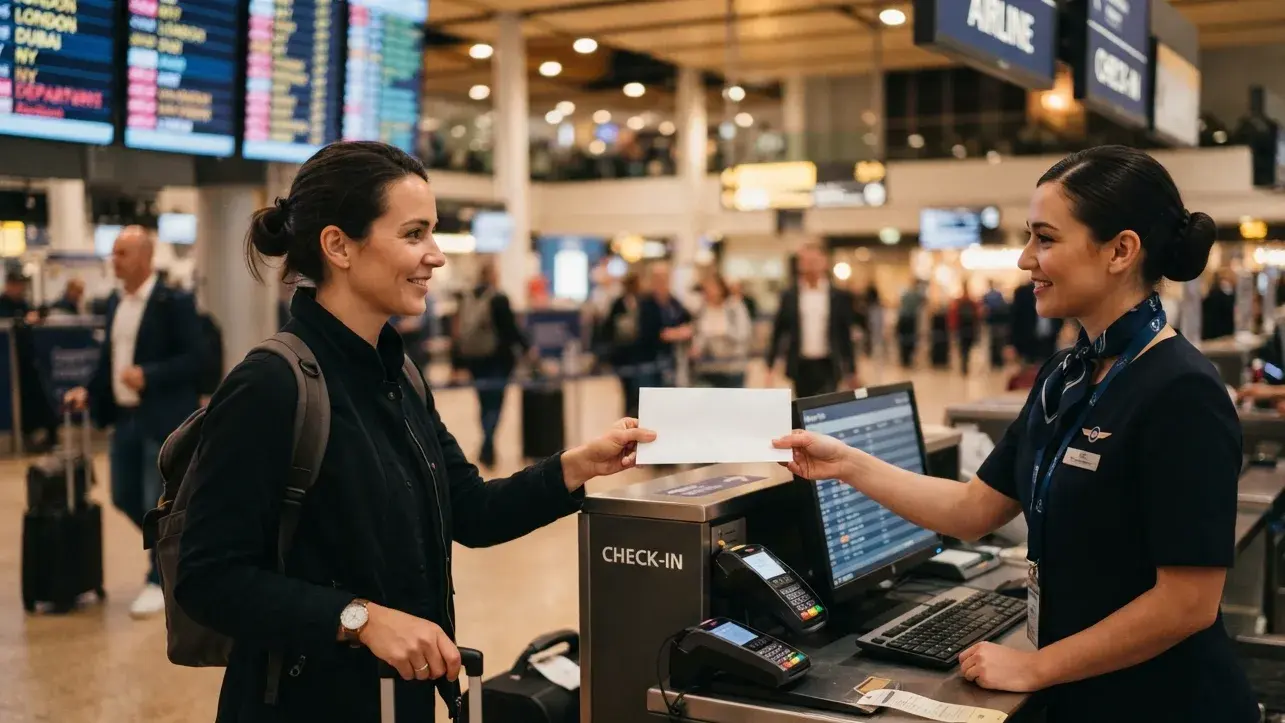

Short answer: If a travel agent holds your return booking, confirm the passenger name, route, dates, ticket or reservation status and booking reference yourself before departure. Ask the agent for a document the carrier or border authority can actually check, and keep a printed and offline copy. A current onward ticket reservation can support a travel-proof request when permitted, but it is not a boarding pass, paid ticket, visa, transit authorization or guarantee of entry.
Booking a trip through a travel agent usually makes life easier. But when your return flight sits inside an agent's system instead of your own inbox, proving onward travel at check-in or border control gets complicated fast. This guide walks through exactly what happens when your onward ticket is one step removed from you, and what to do about it.
You don't need a lecture on what an onward ticket is. You need to know how immigration officers and airline staff treat a booking they can't independently confirm, and how to close that gap before you're standing at a counter with a nervous look on your face.
When your agent's booking falls through, a fast dummy ticket booking can cover the gap before departure.
Key facts
- The agent’s name is less important than whether the booking is current, complete and searchable.
- Airline check-in and border control can apply different checks.
- A polished PDF or email cannot repair an expired, canceled or unverified reservation.
- Destination, nationality, visa type and route determine what onward evidence may be requested.
Need a temporary onward reservation while an agent confirms the return? Use the passenger name, route and dates you can truthfully support, then verify the reference before printing.
Prepare your dummy ticketIn This Guide
- Why Immigration Officers Care More About the Booking Than Who Made It
- When Your Travel Agent's Booking Reference Isn't Enough at the Airport Counter
- The Communication Gap: Getting a Verifiable Itinerary From an Agent on Short Notice
- Airline Check-In Desks vs Border Control: Two Different Onward Ticket Checks
- What Happens If Your Agent-Booked Return Flight Doesn't Show in the Airline's System
- Southeast Asia, the Schengen Area, and Other Regions With Stricter Onward Checks
- Building a Backup Plan: Alternatives When You Can't Reach Your Travel Agent in Time
- Digital Nomads and Long-Term Travelers: Handling Onward Proof Across Multiple Countries
- Costa Rica, the UK, and Other Case Studies in Onward Ticket Enforcement
- Flying Confident When Someone Else Holds Your Return
Official-source check
- IATA Travel Centre explains that passport, visa and health requirements vary by nationality and route and support airline document checks.
- GOV.UK transit guidance shows why transit permission and onward evidence depend on the route and permission held.
- UK carrier-status guidance illustrates that carriers may verify status before travel.
Use these as examples of the distinction between carrier checks and a border or visa decision; confirm the current official rule for the exact itinerary.
Reviewed for: agent-held booking verification, PNR and ticket-status language, airline-versus-border checks, destination-rule caveats and consistency between onward proof and the stated journey.
Why Immigration Officers Care More About the Booking Than Who Made It
For a practical overview of the supporting-document role, see our what a dummy ticket is guide; it is not a substitute for the destination's official entry rules.

Immigration officials don't care who typed your reservation into the system. They care whether the booking proves you plan to leave.
The Booking Detail That Actually Gets Checked
Border officers rarely ask who arranged your travel plans. They look for a specific booking reference tied to a real flight number, a route, and a departure date that makes sense against your permitted stay.
This is a subtle but important shift in thinking for anyone used to trusting a travel agent to handle the logistics. The agent's job ends once the trip is arranged.
Your job, as the traveler standing at the counter, is to be able to speak to and produce that arrangement on demand, in a form the person checking it can trust immediately.
If your travel agent holds the return leg and you only have a vague confirmation email, that's the first weak point. Immigration authority staff want something they can verify in minutes, not a promise that your agent will sort it out later.
This matters because proof of onward travel shows intent to leave a country. It's not about who booked the flight. It's about whether the booking itself stands up to scrutiny.
Consider a traveler named Sarah flying from Chicago to Bangkok on a ticket her agent arranged as part of a multi-city package. Her agent's confirmation email looked polished, complete with a logo and a reference number.
But when an officer asked her to pull up the actual return date, she realized she'd never confirmed it herself. The booking existed, but she couldn't speak to it with any confidence.
That kind of gap is common with agent-arranged travel plans, and it's rarely intentional. Agents often assume the traveler will simply trust the paperwork. Immigration officers don't extend the same trust automatically, especially when a printout looks unfamiliar, or the traveler can't answer basic questions about their own onward journey.
Passenger Name Records and Why They Matter More Than the Agent's Name
A Passenger Name Record, or PNR, is the actual data string airlines and border systems use to confirm a reservation exists. It links your name, your route details, and your travel dates in one verifiable record.
When a travel agent books your flight, the PNR usually sits under the agency's account rather than your personal one. That's normal. What matters is whether you can produce it on request.
-
Ask your agent for the PNR code directly, not just a summary
-
Confirm the PNR works when checked against the airline's own lookup tool
-
Keep a screenshot or printout in case your phone battery dies at the worst moment
Immigration officers don't need to know your agent's name. They need a PNR that resolves to a real, current reservation.
It also helps to understand what a PNR actually contains. Beyond your name and flight number, it typically holds ticketing status, fare rules, and contact details tied to the booking. An officer glancing at a printed PNR can often tell within seconds whether it represents a paid, ticketed seat or an unpaid hold that could fall through.
If your agent gives you a reference that only works inside their own internal booking platform, rather than the airline's system, that's worth flagging immediately. A PNR that only resolves through a third-party portal isn't the same as one the destination country's immigration authority can check directly against the airline's records.
A useful rule of thumb: if you can search your booking on the actual airline's website using your last name and the reference number, it's a proper PNR.
If that search fails and the reference only works on your agent's own portal, ask for the airline-issued PNR specifically before you travel, since that's the version any officer will actually be able to verify.
What Border Officers Are Trained to Look For
Border officers are trained to spot mismatches, not to interrogate your booking history. A one-way ticket with no onward proof is the most obvious red flag, but a mismatched return date or an unfamiliar agency name on a printout can also trigger extra questions.
Officers typically check three things in sequence:
-
Does the name on the ticket match the passport
-
Does the return or onward date fall within the visa type or visa-free window
-
Does the booking look active rather than expired or speculative
Requirements for onward tickets vary by destination, nationality, visa type, and airline, which means what satisfies one immigration officer may not satisfy another at a different border post. A traveler flying into one country on a tourist visa might face a completely different level of scrutiny than someone arriving visa-free for a short stay.
This inconsistency is exactly why relying entirely on an agent-held booking can be risky. If the officer can't verify it on the spot, the conversation gets longer, and your travel plans get shakier.
Immigration officials generally aren't trying to catch you out. They're trying to close a checklist item quickly, and a booking they can confirm in seconds does that better than one they have to chase down through a third party.
There's also a practical timing element most travelers overlook. Officers process dozens of arrivals an hour, and a booking that takes an extra five minutes to verify can create a bottleneck that draws more attention, not less.
A traveler with a clean, instantly verifiable onward ticket usually moves through faster than one whose agent-held reservation needs a phone call to confirm.
None of this means agent bookings are inherently unreliable. It means the traveler carrying one needs to do a bit more homework before relying on it as their sole proof of onward travel.
This homework matters most for travelers submitting visa applications where onward proof is a listed requirement rather than an informal check. A travel visa application that references a specific booking needs that booking to remain valid and unchanged through your actual travel dates, not just at the moment you submitted your paperwork.
If your agent later adjusts the return leg without telling you, the document your visa was approved against may no longer match what shows up at passport control.
It's worth building this verification into your pre-departure routine the same way you'd check your passport's expiry date or confirm your visa's validity window. A booking that was accurate when submitted with an application can drift over weeks or months if an agent makes changes on the back end without flagging them to you directly.
Once you understand what officers are actually screening for, the next question becomes obvious: what happens when the airline counter, not the border, is the first place your agent's booking gets tested.
When Your Travel Agent's Booking Reference Isn't Enough at the Airport Counter
Airline staff at check-in operate under different pressure than immigration officers, and that changes what they ask for.
Recognizing this early, before you're standing at the desk, helps you prepare the right documents instead of scrambling once a question catches you off guard.
The Difference Between a Reservation and a Confirmed Ticket
A reservation is a placeholder. A confirmed ticket is a paid, issued document tied to a specific flight number and fare class. Travel agents sometimes hold bookings in a reservation state longer than travelers expect, especially with package deals or group fares.
This distinction sounds minor until you're standing at a counter with a boarding time closing in. A reservation can look complete on paper, with your name, dates, and route all filled in correctly, while still lacking the one thing that actually satisfies an airline: a ticketed, paid, issued status the system can confirm instantly.
If your return flight is still technically unticketed, airline staff at check-in may not see it the same way a fully issued booking confirmation would appear. This is where confusion starts. You believe you have a return ticket. The system shows something closer to a temporary hold.
-
A confirmed ticket carries an e-ticket number, not just a reservation code
-
Airlines can view e-ticket status instantly; unticketed holds sometimes require manual lookup
-
Group or agent fares occasionally ticket closer to the travel date than individual bookings
Knowing the difference before you reach the airport saves you from an uncomfortable surprise at the desk.
Take a traveler named Marcus, booked through an agent for a trip from Toronto to Delhi with a return leg two months later. His agent's package included the return flight in the total price, but the actual ticket wasn't issued until closer to the outbound date, standard practice for some group fares.
Marcus assumed "booked and paid for" meant "ticketed." At check-in, the agent pulled up a reservation with no e-ticket number attached, which meant an extra ten minutes of phone calls before he could board.
This kind of delay isn't rare. Package deals, especially ones bundling flights with hotels or tours, sometimes hold ticketing until closer to departure to manage inventory or pricing. If you're flying on one of these arrangements, ask specifically when your ticket will be issued, not just when your booking was confirmed.
It's also worth asking whether your fare is part of a bulk allocation the agent purchased from the airline in advance. These allocations sometimes get released and ticketed in batches rather than individually, which can mean your specific seat isn't finalized until a batch deadline passes, even though your payment went through weeks earlier.
Why Airline Staff Ask for More Than a Reference Number
Airlines enforce onward ticket checks to avoid liability. If a passenger is denied entry at the destination, the airline is often responsible for flying that passenger back at its own expense. That single fact explains almost every strict question you'll get at check-in.
Budget airlines often check for onward tickets at check-in more aggressively than full-service carriers, since thinner margins make the cost of a denied boarding or a forced return flight harder to absorb. Airline staff isn't being difficult for its own sake. They're protecting the airline from a liability that becomes their problem the moment you board.
Denied boarding isn't just an inconvenience for the airline. It usually means rebooking costs, missed connections, and sometimes overnight delays for the passenger too, which is another reason check-in staff would rather resolve doubts before the gate than after the flight lands.
Some airlines maintain internal watchlists of routes with historically high rates of onward ticket disputes, applying extra scrutiny specifically on those flights regardless of how relaxed their general policy might be.
A route into a country known for stricter enforcement can trigger this closer look even when your booking is entirely legitimate, simply because the airline has been burned on that specific route before.
This is why a reference number alone rarely satisfies a check-in agent. They want to see:
-
A ticketed flight number for your onward or return leg
-
Dates that align with the visa or entry requirements of your destination
-
Confirmation that the booking is active, not cancelled or pending payment
Getting Your Agent to Send the Right Documents Before You Fly
The fix here is almost entirely preventative. Before you leave for the airport, ask your travel agent for documentation that airline staff can actually use.
Booking details from travel agents should include a verifiable Passenger Name Record at minimum, and ideally a full e-ticket confirmation. A booking confirmation with only a hold reference and no ticket number leaves you exposed.
Request the following at least 48 hours before departure:
-
The e-ticket number for every flight in your itinerary
-
A PDF or printable version of the full travel itinerary
-
Written confirmation that all sectors are ticketed, not just reserved
Save every version your agent sends you, even if it's just a minor update. Agents occasionally issue a corrected itinerary after catching an error in the original, and having the most current version on hand, rather than an outdated draft, is what actually matters at the counter.
If your agent can't produce a ticketed confirmation in time, that's a signal to arrange a separate, verifiable onward reservation rather than gambling on a check-in desk accepting an unfinished booking.
It's also worth asking your agent directly whether your fare type allows changes. Some of the cheapest agent-booked fares come with restrictions that make last-minute fixes harder, and knowing this ahead of time changes how much buffer you should build into your pre-departure checklist.
A fare that can't be adjusted without a penalty is worth confirming days in advance, not hours before your flight.
It's also worth remembering that not every air ticket issued by an agent arrives the same way. Some carriers issue tickets instantly once payment clears, while others batch-process agent bookings overnight or even weekly.
Asking your agent which category your booking falls into tells you how much buffer to build in before you can expect a fully ticketed confirmation in hand.
The next challenge, though, isn't just what to ask for. It's how to actually get your agent to respond fast enough when your flight is already close.
The Communication Gap: Getting a Verifiable Itinerary From an Agent on Short Notice
If the reservation is being prepared for a visa file, compare the route and dates with this flight reservation for visa guide. It is a cross-platform reference, not a guarantee of approval or boarding.

Travel agents juggle multiple clients, and your request can sit in a queue while your departure date creeps closer.
What to Ask For When Your Agent Is Slow to Respond
If you're within a few days of travel and haven't received a usable itinerary, be specific rather than polite-and-vague. General requests like "can you send my booking" often get a general reply. Specific requests get specific documents.
Ask directly for:
-
The exact dates and flight numbers for every leg of your onward journey
-
A PDF itinerary you can print or save offline
-
Confirmation in writing that the return or onward flight is ticketed, not just held
If your agent works through a call center or a shared inbox, put the request in writing so there's a paper trail. This also gives you something to show an airline agent if a dispute comes up over whether the booking exists.
A traveler named Emily, booked through an agent in Mumbai for a trip onward to Kuala Lumpur, found that a single follow-up message specifying exactly what she needed, rather than a general "please confirm my booking," cut the response time from two days to under three hours.
Agents often respond faster to a checklist than to an open-ended question, simply because it takes less back-and-forth to answer.
If you're still not hearing back within 24 hours of your outbound flight, it's reasonable to escalate to a supervisor or a different contact at the agency. Waiting silently rarely improves the odds of getting what you need in time.
It also helps to know which day of the week you're dealing with. Agencies often run with skeleton staff over weekends, so a request sent on a Friday evening may not get real attention until Monday morning.
If your departure falls early in the week, push for confirmation the week before rather than assuming a quick weekday turnaround will save you.
Some travelers find it useful to set a firm internal deadline, separate from their actual flight date, by which they'll stop waiting on the agent and arrange their own backup. Three to four days before departure is a reasonable cutoff for most routes, giving enough buffer to sort out a temporary reservation without any last-minute panic.
Email Confirmations vs Official Booking References
Not all confirmation emails carry the same weight. A generic "your trip is booked" email with no PNR or flight number is close to useless if an airline or border officer asks for proof.
What actually holds up:
-
An email containing the PNR and airline-issued booking reference
-
A document showing route details, exact dates, and passenger names exactly as they appear on the passport
-
A confirmation that can be independently verified through the airline's own booking lookup tool
A real booking, even one arranged by a third party, should always be traceable back to the airline directly. If your agent's email can't be verified that way, treat it as incomplete rather than final.
One quick test worth running: take the PNR from your agent's email and enter it directly on the airline's own website, using your last name as the second field.
If the booking pulls up with matching flight numbers and dates, you're in good shape. If it returns an error or a mismatch, that's your signal to follow up before you're anywhere near a boarding gate.
This small check takes less than a minute and resolves most doubts immediately, either confirming your onward journey is solid or giving you enough runway to fix it while you still have options.
If the verification fails and your departure is close, arranging a separate onward ticket reservation directly, outside your agent's system, is often faster than waiting for a fix on their end. It gives you something concrete to show at check-in while the original booking issue gets resolved on a separate track.
Keep a simple log of every verification you run, including the date and the result. If a dispute ever comes up later about whether a booking existed at a given point in time, having your own record of checking it independently strengthens your position considerably.
When It Makes Sense to Arrange Your Own Temporary Reservation
Sometimes the timeline simply doesn't work. Your agent is unreachable, your flight is in two days, and you still don't have a usable confirmation for your return leg.
This is where temporary reservations can serve as proof of onward travel without requiring you to purchase a full-price return ticket you may never use. Temporary flight reservations typically remain active for 24 to 72 hours, which is usually enough time to satisfy a check-in agent or border officer while your actual travel plans get sorted out separately.
-
A temporary reservation gives you a real, checkable flight number and PNR
-
It buys time without locking you into an expensive return you don't need yet
-
It works as a bridge while your agent finalizes the actual ticketed booking
Onward ticket rental services provide legitimate, verifiable flight reservations for exactly this situation, and they're built around short timelines rather than full itinerary planning.
This approach works especially well for travelers on a tight schedule who don't want to commit to a specific return date before they've settled their actual travel plans. A temporary reservation covers the immediate check, while the real booking gets finalized separately, without forcing a rushed decision on dates you're not ready to lock in.
It's a fundamentally different tool from a real booking, and worth understanding that way rather than as a workaround. A temporary reservation exists specifically to prove intent to leave for a short window, not to replace your actual travel plans, which is exactly why it pairs well with an agent-arranged itinerary that's still being finalized.
Once you have something verifiable in hand, the next question is where that verification actually gets tested first: the check-in desk or the border itself.
Airline Check-In Desks vs Border Control: Two Different Onward Ticket Checks
These two checkpoints are often treated as one obstacle, but they run on different rules and different incentives.
Understanding the distinction upfront makes the rest of your trip planning much clearer, since preparing for one check doesn't automatically mean you're prepared for the other.
What the Check-In Desk Is Actually Screening For
The check-in desk is the airline protecting itself. Airline staff isn't enforcing immigration law directly. They're avoiding a scenario where they fly you somewhere, you get refused entry, and they're stuck arranging your return flight at their own cost.
Because of that, check-in agents tend to focus on:
-
Whether you hold a confirmed exit ticket out of the destination country
-
Whether the exit ticket, plane ticket, or onward reservation matches the entry requirements of where you're landing
-
Whether the booking is active rather than expired, cancelled, or unticketed
A confirmed ticket resolves this quickly. An agent-held reservation without a ticket number often does not, which is why airline counters can be stricter in practice than the border itself.
This is also where fare class matters more than travelers expect. A ticket in a heavily restricted fare bucket can sometimes show as pending in the airline's system even after payment clears, simply due to processing timelines on the carrier's end.
Check-in staff working from that same system see the same ambiguity you do, which is why they default to asking for more proof rather than assuming everything is fine.
It's a different picture once you're through the gate and standing at passport control on arrival. By that point, the airline's liability concern is essentially settled, since you've already boarded. The officer in front of you is working from the destination country's own entry rules, which may weigh your documentation differently than the check-in desk did just hours earlier.
Travelers sometimes assume that because the check-in desk is stricter in practice, the border check on arrival must be a formality. That assumption doesn't always hold. Some destinations apply lighter airline-side scrutiny, but much closer border checks, which reverses the pattern travelers may be used to from other routes entirely.
What Border Officers Look at Once You Land
Border control operates under a different mandate. Border officers and border patrol staff are enforcing entry requirements set by the destination country's immigration authority, not protecting an airline's liability.
At this checkpoint, officers typically look at:
-
Whether your onward or return date fits inside your permitted stay
-
Whether your ticket type, visa type, and stated purpose of visit line up
-
Whether you can produce proof on request, whether digital or printed
A refundable ticket can be canceled after booking, which means some travelers purchase one specifically to pass this check and cancel it shortly after arrival. This is a widely used, legitimate approach precisely because purchasing a real refundable ticket allows for a full refund after passing immigration, unlike a low-cost non-refundable fare that locks in a real cost either way.
A traveler named David used exactly this strategy on a trip from Delhi to Lisbon, buying a refundable return specifically to satisfy entry requirements, then cancelling it two days after arrival once his actual travel plans firmed up.
The upfront cost was higher than a basic fare, but the full refund made it a net-zero expense once the border check was behind him.
The tradeoff is timing. Refunds on these fares can take anywhere from a few days to a few weeks to process, so this approach works best when you're not relying on that money for near-term expenses.
It's also worth reading the fine print on what counts as a valid cancellation window. Some refundable fares only guarantee a full refund if cancelled before a specific cutoff, often 24 to 48 hours after purchase or a set number of days before departure.
Missing that window can turn a refundable ticket into a much smaller partial refund, so mark the cutoff date somewhere you won't forget it.
Why Passing One Check Doesn't Guarantee the Other
Here's the part travelers frequently misunderstand. Clearing the check-in desk does not guarantee a smooth border crossing, and clearing the border on arrival does not mean you're fully covered for the rest of your trip.
A traveler flying one way with a vague agent-held return reservation might get past a rushed check-in agent, only to face harder questions from border officers on arrival who ask for something more concrete.
The reverse also happens: a border officer might wave someone through with minimal questions, while a stricter airline at the next leg of a multi-country trip refuses boarding without a clear onward plan to the next country.
-
Check-in liability concerns and border entry requirements are enforced by different parties with different priorities.
-
A confirmed onward ticket satisfies both more reliably than a reservation that only one side can verify.
-
Multi-leg trips mean this check can repeat at every departure point, not just once
Understanding that these are two separate hurdles, not one, changes how you prepare. Preparing for one and assuming the other will follow automatically is where most agent-booked travelers run into trouble.
A booking that satisfies a relaxed check-in desk might still draw questions from a stricter border officer on landing, and a smooth arrival doesn't guarantee an equally smooth departure at your next stop if that leg is also unticketed.
Treating each checkpoint as its own independent test, rather than assuming one clears the other, is the safer mindset for any multi-leg itinerary.
It also raises a practical question: what do you actually do if the booking your agent made simply isn't showing up when it's checked?
This scenario deserves its own close look, since it's one of the more stressful moments a traveler can face and one of the most common with agent-arranged bookings specifically.
What Happens If Your Agent-Booked Return Flight Doesn't Show in the Airline's System
This is one of the most stressful situations a traveler can face, and it's more common with agent bookings than direct ones.
Common Reasons a Booking Fails to Sync
Agent bookings sometimes route through consolidator fares, group blocks, or third-party ticketing platforms that don't sync instantly with the airline's main system. A flight ticket can exist on the agent's end while showing as unconfirmed or missing on the airline's side.
This kind of mismatch is one of the more unsettling experiences a traveler can have, precisely because it feels like the booking has simply vanished. In most cases, it hasn't. It's sitting in a queue somewhere between the agent's platform and the airline's own records, waiting on a step that hasn't finished processing yet.
Typical causes include:
-
Payment processed by the agent but not yet settled with the airline
-
A hold placed under a group booking that hasn't been individually ticketed
-
A system delay between the agent's platform and the airline's reservation system
None of these mean your trip is cancelled. They mean the paperwork hasn't caught up with reality yet, and that gap can be a real problem at a check-in desk or border post.
A traveler named Rachel booked a multi-city trip through an agent, with her final return leg part of a group block negotiated for a tour.
Her individual name didn't get attached to a specific seat until the group manifest was finalized, roughly a week before departure. Until then, searching for her booking under her own name returned nothing, even though the trip itself was entirely real and paid for.
Situations like Rachel's are more common with tour packages and group fares than with individually booked tickets, simply because the airline processes the whole block together rather than each traveler separately.
Knowing this in advance means you won't panic if your name doesn't show up immediately after booking, as long as your agent can confirm the expected timeline for individual ticketing.
How to Verify Your Reservation Before You Reach the Airport
Don't wait until you're at the counter to find out there's a sync issue. Verify independently, using channels the agent doesn't control.
-
Use the airline's own website or app to look up your booking using the PNR
-
Call the airline's reservations line directly and ask them to confirm ticketed status
-
Cross-check the flight number and departure date against the airline's schedule
If the airline can't find your booking using the reference your agent gave you, escalate with the agent immediately rather than assuming it will resolve itself by departure day.
Set a personal deadline for this check, ideally five to seven days before departure rather than the night before. That window gives your agent enough time to fix a sync issue through normal channels, instead of scrambling through an emergency ticketing desk at the last minute, which can involve extra fees or limited availability.
If your agent asks for patience because "the system just needs time to update," it's reasonable to ask for a specific date by which the booking should resolve, and to verify again on that date rather than letting the issue drift without a clear checkpoint.
Fixing a Missing Booking Without Losing Your Travel Plans
If your agent-booked return doesn't show up in time, you have a few practical paths, and none of them require abandoning your original plans.
-
Ask the agent for immediate re-ticketing and a new confirmation you can verify directly.
-
Consider a bus ticket or train ticket for a nearby exit route if your onward proof only needs to show departure from the country, not a flight specifically.
-
Arrange a separate verifiable reservation as a placeholder while the agent resolves the sync issue.
Many airlines accept a valid Passenger Name Record as proof of onward travel, so a working PNR from a backup booking, even a modest one, can be enough to get you through.
This also matters for anyone whose exit plan doesn't strictly require a flight. An onward ticket can be a flight, bus, or train reservation, and cross-border bus or train tickets can serve as valid proof of onward travel in regions with strong overland connections.
Bank statement records, or travel insurance documents, sometimes get requested as supporting evidence too, though they rarely replace an actual onward booking on their own. Carriers like Air Canada or Virgin Atlantic, along with regional operators, generally follow the same core rule: they want a ticketed, verifiable exit plan before they'll board you toward a destination with entry restrictions.
If your agent's fix will take longer than your departure allows, don't treat that as a dead end. A short-term backup reservation can close the gap for the specific check you're facing, while the agent continues resolving the underlying issue on a slightly longer timeline. The two paths don't have to compete with each other.
A missing booking is a fixable problem, but only if you catch it early enough, before it turns into a bigger issue at the border of an unfamiliar third country.
It's worth building a simple habit around this entire process. Every time you receive an updated confirmation from your agent, whether it's a minor date change or a full re-ticketing, verify it independently within 24 hours rather than filing it away and assuming it's final.
Agents managing dozens of bookings can make small errors, and catching one early is far easier than catching it at the airport.
Travelers who've dealt with a sync issue once tend to build this verification step into every future booking, agent-arranged or not. It costs a few minutes and removes one of the more stressful unknowns from an otherwise smooth trip.
Southeast Asia, the Schengen Area, and Other Regions With Stricter Onward Checks
Not every region treats onward ticket checks the same way, and agent-booked travelers should know where scrutiny tends to be highest.
The gap between "technically required" and "actually enforced" is wider in some regions than others, and knowing where your route falls on that spectrum changes how much verification your agent-booked itinerary really needs before you travel.
Why Southeast Asian Countries Screen So Closely
Southeast Asia has strict onward ticket checks, and this reputation isn't exaggerated. Airlines flying into popular hubs like Kuala Lumpur routinely ask for proof of onward or return travel before allowing boarding, regardless of whether the destination country enforces it heavily at the border itself.
This pattern exists partly because airlines flying these routes have been burned before by denied boarding costs, so they've made onward checks a standard part of check-in for this region.
Travelers island-hopping or crossing multiple Southeast Asian borders on a single trip often find that the check repeats at nearly every departure point, not just their first entry into the region. An agent-arranged multi-country itinerary needs every leg individually verifiable, since a single unticketed segment partway through the trip can hold up an otherwise smooth journey.
If your travel agent's booking for the next leg of a Southeast Asia trip is still unticketed, this is exactly where it becomes a problem before you even leave your origin airport.
Travelers connecting through hubs before a Southeast Asia leg sometimes assume the check will happen only once, at their final destination. In practice, an unticketed onward leg can get flagged at the connecting airport just as easily, since the connecting airline has its own liability to protect regardless of where your journey ultimately ends.
This is one more reason to confirm ticketing status for every segment of an agent-arranged Southeast Asia itinerary individually, rather than assuming that one confirmed leg means the rest are equally solid.
Schengen Area Countries and the Shared Entry Standard
Schengen Area countries operate under a shared visa framework, which means a rejection or a heavy questioning experience in one member country's system can echo across the whole zone for future travel plans.
Officers here tend to focus on:
-
Whether your stay fits inside the permitted number of days
-
Whether your onward travel proof shows a clear exit from the zone, not just from one country within it
-
Whether your tourist visa or visa-free entry matches your stated purpose
Because the Schengen Area functions as one connected space for entry purposes, an onward ticket needs to show departure from the zone as a whole, not just a hop between member countries.
A traveler flying from Rome to Paris on an internal Schengen hop hasn't left the zone at all, even though the flight crosses a national border. Agent-arranged itineraries that bounce between member countries before eventually exiting can confuse this picture if the final exit leg isn't clearly documented alongside the earlier, internal ones.
Keeping the exit booking separate and clearly labeled, rather than buried inside a longer multi-city agent itinerary, makes it easier for an officer to confirm at a glance that your stay has a real endpoint.
This matters even more for agent-arranged trips covering several Schengen Area countries in sequence, since the exit proof needs to reflect the final departure from the zone, not an intermediate hop that only looks like an exit at first glance.
Double-checking with your agent exactly which leg represents the true exit from the zone, rather than assuming the last flight on your itinerary automatically qualifies, avoids a confusing conversation at the final checkpoint.
Regions Where Enforcement Is Inconsistent
Not every region enforces this rule with the same consistency. Countries may require proof of onward travel for visa-free entry on paper, while in practice the check happens rarely at the border itself and more often at the airline counter before departure.
Many countries require proof of onward travel for entry, but the strictness of enforcement can depend on:
-
How busy the airport or border post is that day
-
Whether you're arriving on a tourist visa or through a visa-free arrangement
-
Whether the airline itself has a strict internal policy regardless of the destination's actual enforcement level
This inconsistency is exactly why relying on assumptions from a previous trip can backfire. A destination country that waved you through last year without checking anything may enforce the rule strictly this time, especially if regional policy has shifted.
The safest approach is treating every trip as if the check will happen, which brings up a practical question: what do you actually do when your agent simply can't deliver in time?
It's also worth noting that enforcement can tighten with little warning, often in response to a spike in overstays or a policy review that doesn't get widely publicized in advance.
A route that felt relaxed on your last trip is worth re-checking before you assume the same experience this time, especially if you're relying on an agent's booking rather than something you've personally verified.
Visa requirements and onward ticket rules don't always update in sync, either. A country might loosen its visa requirements for a certain nationality while keeping onward proof mandatory, or the reverse. Anyone doing regular international travel through an agent should treat each trip as its own check rather than assuming last year's experience still applies.
A practical habit worth building is checking the destination country's official immigration or tourism website directly before each trip, rather than relying on general travel forums or an agent's assurance that "it's usually fine." Official sources update faster than word of mouth, and they're the closest thing to a reliable answer when policy has shifted recently.
This is especially true for routes with a history of tightening enforcement without much advance notice. A quick five-minute check before booking can save hours of uncertainty at the airport later.
Building a Backup Plan: Alternatives When You Can't Reach Your Travel Agent in Time
Sometimes the cleanest solution is accepting that the agent-held booking won't be ready, and building a backup instead of waiting.
Waiting on a single point of failure, whether that's an unresponsive agent or a slow-moving ticketing queue, puts your entire departure at risk over something that's genuinely fixable with a little advance planning.
Low-Cost Booking Options That Work as a Bridge
A cheap proof of onward travel doesn't need to be expensive or permanent. It needs to be real, checkable, and dated correctly.
Reasonable bridge options include:
-
A low-cost budget flight booked directly, used purely to satisfy the check and cancelled or ignored later if plans change
-
A bus ticket or train ticket for regions with strong overland routes across a border
-
A short-term reservation specifically designed for this purpose rather than a full paid ticket
Weigh each option against how much flexibility you actually need. A budget flight works well if you're fairly confident about your onward plans. A short-term reservation designed specifically for onward proof works better when your plans are still genuinely unsettled, and you don't want to commit to a real flight at all.
Booking a low-cost budget flight can serve as a cheap throwaway ticket in situations where a full-price return isn't practical, though this only works cleanly with fare rules that allow changes or aren't a significant financial loss if unused.
Before booking any bridge option, check the cancellation window. Some budget carriers allow a full refund within 24 hours of booking, which effectively makes the flight free to hold as proof, provided you cancel before that window closes and don't need it after all.
Why a One-Way Fabricated Document Isn't the Answer
It might be tempting to consider a fabricated document or a fake ticket when time is short, but this creates far more risk than it solves. A fabricated booking reference won't resolve when an airline or immigration officer looks it up, and getting caught with one can lead to consequences well beyond a single denied boarding.
One-way tickets do not indicate future travel plans on their own, and a one-way ticket does not satisfy onward travel requirements in most jurisdictions with proof-of-exit rules. Trying to disguise a one-way flight as something it isn't only adds a layer of risk that a real, verifiable reservation avoids entirely.
-
A fabricated document fails the moment anyone actually checks it
-
Airlines and border systems can verify real bookings in seconds
-
The consequences of a fake reservation outweigh the inconvenience of arranging a real one
The math here rarely favors the shortcut. A verifiable, legitimate reservation typically costs less than the potential rebooking fees, delays, or entry complications that follow from a document that doesn't hold up under scrutiny. It's simply not worth the gamble when a real alternative is this accessible.
What a Legitimate Onward Ticket Service Actually Provides
This is where a proper onward ticket service earns its keep, especially when your agent's booking is delayed, incomplete, or simply too slow to arrive. A refundable or temporary evidence may sometimes support a check when the destination permits it, but so can a short-term reservation built specifically for this purpose.
A reservation provider may offer a searchable reference, a PDF itinerary, stated pricing and a change policy; confirm the current terms and verify the record yourself before relying on it.
That kind of flexibility matters most when you're waiting on someone else's timeline. It's great advice for anyone booking through an agent to keep this option in reserve rather than finding out too late that the agent's confirmation isn't ready.
The appeal of a service built specifically for this purpose is that it doesn't require guessing whether a fare will pass scrutiny. A reservation designed to be checked by airlines and immigration officials looks and functions like any other confirmed booking, without the cost or commitment of a full ticket you may never use.
This becomes even more relevant for travelers who don't have a simple round trip to fall back on in the first place, or whose agent is handling multiple bookings across a longer, more complicated route where any single leg could fall behind schedule.
Digital Nomads and Long-Term Travelers: Handling Onward Proof Across Multiple Countries
Travelers without a fixed return date face a version of this problem that agent bookings often make worse, not better.
Why Long-Term Itineraries Confuse Border Officers
Digital nomads and long-term travelers frequently book accommodation, transport, and stays in stages rather than committing to a single fixed itinerary months in advance. That flexibility is the whole point of the lifestyle, but it clashes with entry requirements built around a clear onward journey.
An agent handling a complex, multi-country itinerary might have your first few legs ticketed and later legs still tentative. Border officers reviewing your travel plans don't see "flexible schedule." They see a gap in your onward travel ticket, and that gap gets flagged.
A traveler named James, working remotely while moving through several countries over a few months, ran into exactly this problem when his agent had only booked and ticketed the first two legs of a five-country plan.
The remaining legs existed only as tentative holds, which meant James had no verifiable proof beyond his second stop, even though his overall trip was well planned and fully intended.
This is a common pattern with agents who specialize in shorter trips rather than extended, multi-stop travel. They're used to ticketing a full itinerary upfront because most of their clients travel that way.
A long-term traveler's needs look different, and it's worth telling your agent directly that you need each leg ticketed as you go, rather than assuming they'll structure the booking the way a long-term traveler actually needs it structured.
Being upfront about this at the very start of the booking process saves a lot of back-and-forth later, especially if your plans are likely to shift slightly as the trip unfolds.
Proving Onward Travel When You Don't Have a Return Date
If you're moving from one country to the next over several months rather than flying home on a fixed date, the proof you need looks different from a standard tourist's return ticket.
A return ticket brings you back to your origin country, which is exactly why it doesn't fit the reality of someone moving continuously from one destination to the next without a home-bound leg anywhere in the plan.
What tends to work:
-
A confirmed booking for your immediate next destination, even if it's not your final one
-
A pattern of onward travel proof across your full itinerary, not just the current leg
-
A hotel booking or accommodation confirmation for the next country when a flight isn't the most relevant document
Officers generally care about proof you're moving onward, not proof you're going home. A verified flight, bus, or onward travel ticket to your next country usually satisfies this, even without a return to your country of origin anywhere in sight.
This is also where booking one leg at a time, rather than trying to lock in an entire multi-month route upfront, tends to work better for long-term travelers. It keeps every proof of onward travel current and verifiable, rather than relying on tentative plans several countries ahead that haven't been ticketed yet.
A useful middle ground is booking two legs ahead rather than just one, so you always have a verified next step plus a backup in progress, without over-committing to a schedule that's likely to shift as your trip unfolds.
Keeping Documents Ready for Multiple Entry Points
Long-term travel means repeating this check at every border, not just once. That makes organization the real skill here, more than any single booking.
-
Keep a running folder, digital and printed, of every current onward reservation.
-
Update it each time your agent or booking platform issues a new confirmation.
-
Cross-check IATA's Travel Centre resources for current onward ticket requirements before entering a new country, since rules shift by nationality and destination
IATA's Travel Centre helps verify current travel documentation requirements, which is especially useful for nomads moving through several countries with different visa types in a short span. A little preparation before each leg avoids the same conversation with a different border officer every few weeks.
It also helps to keep a simple habit: whenever an agent or booking platform issues a new confirmation, save it in the same place immediately, rather than trusting it will stay accessible through an app or inbox you might not have reliable access to later.
A single folder with every current reservation, updated as you go, removes most of the friction long-term travel otherwise creates at each new border.
Travelers moving through more countries on a single extended trip tend to run into this friction more often, simply because there are more checkpoints where an outdated or unticketed leg can cause a delay. Comparing notes with others who've traveled similar routes through other countries in the region can also help you anticipate which borders tend to check more closely.
Cloud storage works well for this, provided you also keep a downloaded copy available offline. Border crossings in remote areas don't always offer reliable data access, and an officer asking to see your onward proof won't wait for a slow connection to load a document you could have saved in advance.
With the general pattern for long-term travel covered, it helps to look at how two very different destinations, the UK and Costa Rica, actually apply these rules in practice.
Costa Rica, the UK, and Other Case Studies in Onward Ticket Enforcement
Specific examples make this whole topic easier to plan around than abstract rules ever do.
Reading about onward ticket rules in the abstract only goes so far. Seeing how two genuinely different destinations apply the concept in practice makes it much easier to judge how seriously to take the requirement for wherever you're actually headed next.
The UK Approach: Return-Proof Rules Depend on Route and Permission
UK visitor and transit rules do not create one universal return-ticket rule for every traveller, nationality or route. Check the current official guidance for the permission you hold. Immigration officers may still ask about your travel plans and intended length of stay, but that does not prevent an airline from applying its own document or carrier-liability checks before boarding.
That said, airlines flying into the UK may still apply their own onward ticket checks at check-in, separate from what the UK itself legally requires. So even without a border-level mandate, your agent-booked return can still matter at the departure airport before you ever reach UK immigration.
This distinction trips up a lot of travelers. They read that a destination doesn't legally require a return ticket and assume that means no check will happen anywhere in the journey. In practice, the airline enforcing its own liability policy can still ask for the exact same proof, regardless of what the destination country's law technically demands.
Travelers flying into the UK on a one-way flight, planning to travel onward overland or by ferry rather than flying back, sometimes find this exact gap catches them off guard.
The UK border itself may not press hard on a return ticket, but the departure airline on the outbound leg might still ask for evidence of onward movement before allowing boarding in the first place.
Costa Rica's Onward Ticket Rule for Tourists
Costa Rica illustrates why destination-specific checking matters: official and carrier instructions may call for onward or return evidence, and the point of checking can vary between the airline and arrival authorities.
For travelers whose return is booked through an agent, this means confirming that Costa Rica-bound bookings are fully ticketed well before departure, not left as a pending reservation. A missing or unverifiable booking here isn't just a check-in inconvenience. It can affect entry itself.
Travelers arriving in Costa Rica through an agent-booked package sometimes discover that their return leg, while genuinely booked, hasn't been separately confirmed as ticketed by the time they land.
Since Costa Rican entry checks can happen at the immigration desk itself rather than only at the departure airport, this is a destination where verifying your booking status in advance is worth the extra effort.
The safest approach for a Costa Rica trip booked through an agent is confirming ticketed status for the return leg at least a week before departure, then keeping a printed copy of the confirmation alongside your passport for the arrival check.
A phone screenshot may not be sufficient when a carrier or officer asks for a readable document, so a printed backup avoids battery and connectivity problems.
What These Examples Teach You About Reading Entry Requirements Carefully
The UK and Costa Rica sit at opposite ends of the same spectrum, and that gap is the real lesson. Entry requirements aren't uniform, and assuming one country's rules apply everywhere is how travelers get caught off guard.
-
Always check the specific entry requirements for your destination country, not a general assumption from past trips.
-
Remember that airline policy and border policy can differ even within the same country.
-
Treat agent-booked itineraries as needing extra verification precisely because rules vary so much by destination.
Italian customs and immigration staff, similarly, may apply checks differently depending on whether you're arriving from within the Schengen Area or from a third country outside it, which is another reminder that context always matters more than a blanket rule.
Reading the specific requirements for your actual route, rather than relying on general habit, is the single most useful thing you can do before relying on an agent-held booking to get you through.
Before any trip involving an agent-arranged itinerary, spend ten minutes checking the specific entry requirements for your destination directly, rather than relying on secondhand advice from a previous traveler or an outdated forum post. Rules change, and the extra effort costs far less than sorting out a problem after you've already landed.
This habit becomes even more valuable when your booking runs through a third party. An agent handling dozens of clients across different routes can't always keep track of every destination's latest policy shift, so treating their booking as one input rather than the final word protects you from relying on information that may be a step behind current practice.
Ultimately, the UK and Costa Rica examples aren't meant to be memorized as rules to apply everywhere. They're meant to illustrate how differently two respected, well-traveled destinations can approach the same underlying question, which is reason enough to check rather than assume for wherever you're actually headed.
Flying Confident When Someone Else Holds Your Return
For a wider DummyFlights planning reference, use the complete dummy-ticket-for-visa guide alongside the current carrier and destination requirements.
An agent-booked return doesn't have to be a liability. It becomes one only when it stays unverified until the moment someone asks to see it. Ask early, confirm the PNR yourself, and keep a backup plan ready for the gap between booking and boarding.
Once you know what airline staff and border officers are actually checking, the rest is just preparation. If your agent's confirmation is running late, a quick dummy ticket booking can carry you through check-in without derailing your trip.
Every trip runs smoother when the paperwork matches the plan. Verify early, ask direct questions, and treat your agent's booking as a starting point, not the final word, and you'll walk through any check with confidence.
Need a current onward proof document before departure? Keep the name, dates and route aligned with the itinerary you can explain, then check the reference before you travel.
Create your dummy ticketFAQ
What should I ask a travel agent to send me?
Ask for the passenger name, route, dates, flight numbers, booking reference or PNR, ticket or reservation status and any deadline that could cancel the booking. Confirm the details yourself before travel.
Is an agent’s confirmation email enough for onward travel proof?
Not always. An email can be useful evidence, but the carrier or border authority may need a current record it can search. A document that cannot be verified may not satisfy the request.
Can a dummy ticket replace an agent-booked return ticket?
It can sometimes support a temporary travel-proof request when the destination and carrier permit it, but it cannot replace a required paid ticket, visa, transit authorization or confirmed boarding document.
Why can check-in and immigration ask different questions?
The airline checks whether it can carry you under its document and carrier-liability rules. Border officers decide entry under the destination’s rules. Passing one check does not guarantee the other.
What if the agent changes my return date?
Request the updated record, compare it with your passport and permitted stay, and update any visa-file evidence that no longer matches. Do not present an old version as current.
What if the booking cannot be verified at the airport?
Ask the agent or carrier what current proof is required, preserve the original details and obtain a truthful replacement or paid ticket if necessary. Never rely on a fabricated reference.
Friendly reminder: DummyFlights provides temporary travel-proof documents for planning and application support. Requirements vary by destination, airline, route and applicant situation. A dummy ticket can support a file, but it does not guarantee approval, boarding or entry.