
Your visa or entry permission may get you to the airport, but it does not always end the travel-proof question. At airline check-in or border control, the practical concern is often simple: does this traveler have a believable plan to leave or continue onward before the permitted stay becomes a problem?
That is why onward ticket proof matters. A one-way traveler can be completely legitimate and still face questions if the exit plan is vague. A clean onward ticket helps turn that vague exit into a visible route, date and next step. The trick is making the onward ticket fit the whole travel story instead of using it as a random throwaway document.
Think of the onward ticket as the bridge between flexibility and credibility. Flexible travelers do not always want to buy final airfare before the route is certain, but border and airline checks still reward a clear exit plan. The best onward ticket gives that clarity without forcing you to lock every part of the trip too early.
- A one-way ticket does not automatically mean refusal, but it can trigger onward-travel questions.
- Airline check-in and immigration may ask different questions for different reasons.
- Your onward ticket should match your permitted stay, accommodation and spoken travel plan.
- A verifiable onward ticket is stronger than a random PDF with weak route logic.
- Long-stay visa holders may need different exit logic than short-stay tourists.
Create an onward ticket with route, date and passenger details aligned to your travel plan.
Create Your Onward Ticket- Official-source check
- What officers check with one-way travelers
- Visa-on-arrival and visa-exempt routes
- Airline agents vs immigration officers
- Red flags an onward ticket must answer
- What happens if proof is questioned
- Build an entry story that holds up
- Multi-country onward ticket sequencing
- Long-stay visa categories
- FAQ
The Moment of Truth: What Officers Check When You Land With a One-Way Ticket
Most one-way travelers are not refused automatically. Digital nomads, backpackers, students, workers, family visitors and long-stay travelers often travel without a simple round-trip ticket. The issue is not the one-way ticket itself. The issue is whether the traveler can explain what happens after arrival.
Why a one-way ticket rarely triggers automatic refusal by itself
A one-way ticket is a signal, not a verdict. It tells the airline or officer that the exit plan may need clarification. If the traveler has a long-stay visa, work permit, study permit, residence document, onward ticket, funds, hotel proof or clear itinerary, the one-way route may be perfectly reasonable.
The problem begins when the one-way ticket is paired with vague answers, no accommodation, weak funds, unclear next destination or an onward ticket that does not match the story.
This is the exact point where many travelers lose control of the conversation. They assume the officer is judging the ticket alone, but the officer is really judging whether the person, route and document all tell the same story. A well-prepared onward ticket reduces that gap because it gives the officer a concrete next step to compare against the rest of the file.
The three questions behind “How long are you staying?”
When an officer asks how long you are staying, they may really be asking three things: do you understand your permitted stay, do you have a plan to leave or continue, and can your documents support the answer? An onward ticket helps because it turns the answer into a date and route.
If you say “about two weeks” but your onward ticket leaves after 58 days, the document weakens you. If you say “30 days” and the onward ticket leaves on day 28 with hotel dates that match, the story is easier to trust.
The answer does not need to be complicated. It needs to be aligned. A simple sentence such as “I will stay in Thailand for 24 days, then continue to Malaysia on this onward ticket” is stronger than a long explanation with uncertain dates. The more predictable your answer is, the easier it is for the onward ticket to support it.
System checks vs physical document checks
Sometimes the check is digital. Sometimes the officer or airline agent reviews the PDF in your hand. Sometimes they compare both. The onward ticket should survive basic logic in either situation: passenger name, route, date, airline details, booking reference when available and consistency with your trip.
A clean onward ticket is not only about being searchable. It is about being believable when read by a human in a hurry.
That human factor matters. Check-in counters and border desks are fast, pressured environments. A confusing route, unclear name format, mismatched date or strange onward destination can slow the conversation down. A clean onward ticket should let someone understand the route in seconds.
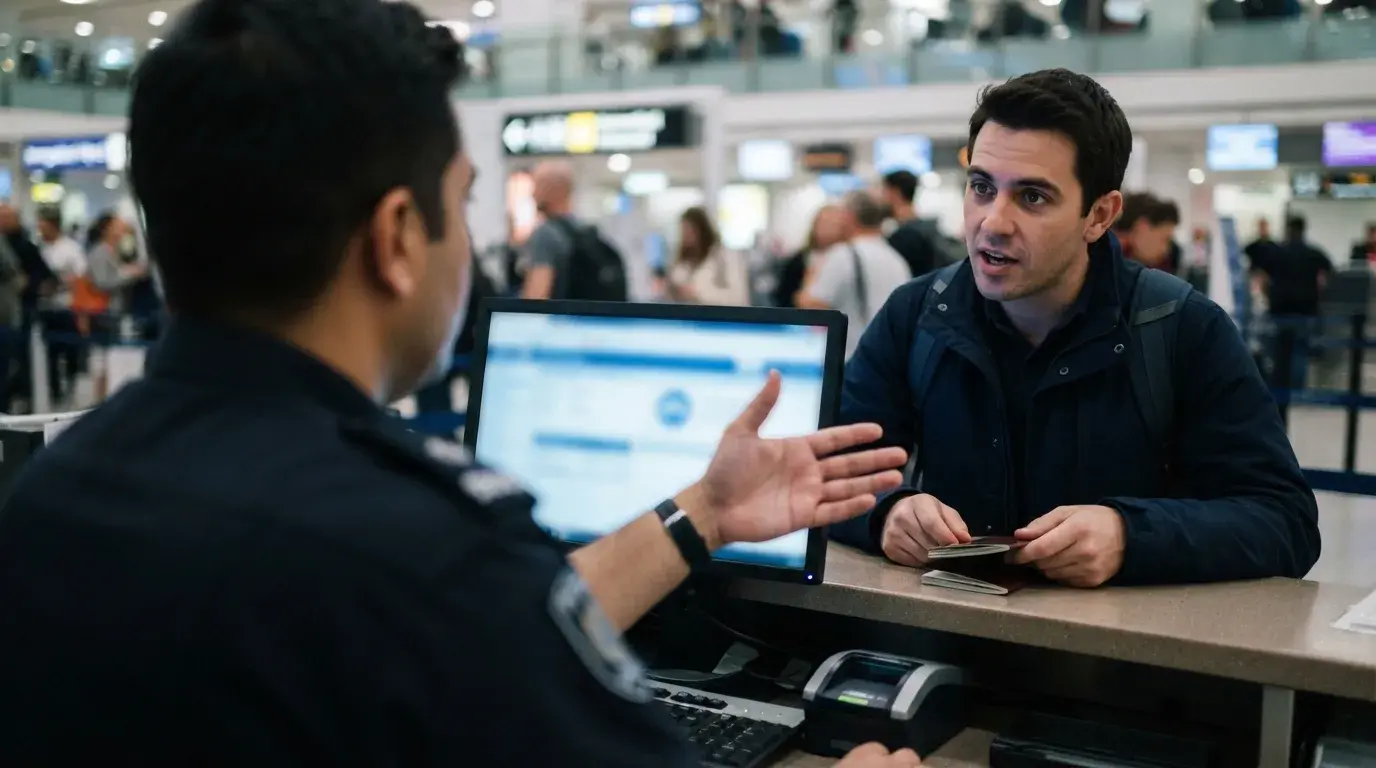
Visa-on-Arrival and Visa-Exempt Countries: Where the Border Is the Main Checkpoint
Some travelers submit a full visa file before departure. Others rely on visa-exempt entry, visa on arrival or electronic authorization. In those cases, the airport and border checkpoint can become the place where onward ticket proof matters most.
Why some routes put scrutiny at the gate instead of the consulate
If there is no full pre-travel visa review, the airline and border officer may carry more of the screening burden. They may check passport validity, funds, accommodation, permitted stay, return or onward travel, and whether the traveler appears admissible for the route.
This is why onward ticket proof is especially important for travelers who do not have a traditional visa sticker or full consular approval before flying.
For these travelers, the onward ticket is often part of the first serious document check. The airline may be the first gatekeeper. Immigration may be the second. If the proof is weak at check-in, the traveler may never reach the border desk where the rule could have been interpreted more flexibly.
The two-ticket trap
The airline may ask for one thing and immigration may care about another. An airline agent may need proof that carrying you will not create an inadmissible-passenger problem. A border officer may focus on whether your stay, funds and exit plan are credible after arrival.
A weak onward ticket can satisfy neither. A strong onward ticket should help at both points by showing a believable exit route inside the permitted stay.
The trap is assuming “I found a cheap onward route” means “I solved the onward ticket requirement.” The route still needs to make sense. If the airline wants onward proof and the border officer later asks why you chose that destination, your answer should be natural, not improvised.
Fast-processing routes vs manual interview routes
Fast entry routes require you to be prepared at the airport because there may be little time to correct weak proof. Manual interview routes give more room for explanation, but also more room for contradiction if your answer does not match your documents.
In either case, the onward ticket should be easy to explain in one sentence: “I am staying for 18 days, then flying onward to Singapore on this date.”
Manual interview routes can also expose small inconsistencies. If your hotel booking ends on one date, your onward ticket leaves much later, and your funds barely cover the gap, the officer may keep asking questions. A tighter onward-ticket plan reduces those openings.
Airline Check-In Agents vs Immigration Officers: Two Gatekeepers, Two Standards
The airline and immigration officer are not performing the same job. Confusing them is one reason travelers prepare the wrong proof.

Why the airline cares about liability
Airlines can face costs when a passenger is refused admission or cannot continue travel. That is why an airline agent may be stricter than expected before departure. They are not approving your visa. They are deciding whether the airline can carry you without document risk.
This explains why travelers sometimes feel the airline is “stricter than immigration.” The airline is protecting itself before the flight departs. The border officer is deciding admission after arrival. The same onward ticket can be viewed through two different lenses, so it should be clean enough for both.
The reservation that satisfies one gatekeeper but not the other
An airline may accept a simple onward ticket because it shows planned exit. Immigration may ask additional questions about funds, accommodation or purpose. The reverse can also happen: immigration rules may be flexible, but the airline agent wants visible onward proof before boarding.
Prepare for both. Your onward ticket should align with your answers, and your answers should align with the rest of your documents.
If you only prepare for the airline, you may create a document that gets you boarded but leaves awkward questions at immigration. If you only prepare for immigration, you may forget that the check-in agent may need quick visible proof before printing the boarding pass. The top-ceiling approach prepares the onward ticket for both moments.
What to do when the airline agent is stricter than the country
Do not argue from memory. Show documents clearly: passport, visa or entry permission, onward ticket, hotel proof and any official entry guidance if useful. If the agent still requires clearer proof, solve the problem calmly. A clean onward ticket is often faster than debating policy at the counter.
The practical move is to keep the proof accessible, not buried in email screenshots or multiple apps. Save the PDF, know the route, know the date, and know why that next destination makes sense. Confidence at the counter usually comes from preparation, not pressure.
Red Flags That Onward Ticket Proof Must Answer
An onward ticket is strongest when it removes doubt. It becomes weak when it introduces new questions.
Mismatched trip length
If your onward ticket leaves after the permitted stay, or far later than the answer you give, it raises a simple question: which timeline is real? Keep the onward date inside the stay you can explain.
For visitor-style entries, a conservative onward date often performs better than a stretched one. If the permitted stay is 30 days, an onward ticket around day 21 to day 29 is usually easier to explain than one that pushes the last possible day without a clear reason.
Suspiciously cheap or unfamiliar routing
A strange onward route can look like a throwaway ticket. The onward destination should be believable. If you are in Bangkok and your onward ticket goes to a random city with no connection to your plan, the document may create more doubt than confidence.
A believable route does not have to be expensive or final. It simply needs logic. Neighboring countries, major hubs, home-country routes and known continuation points usually make more sense than obscure detours chosen only because they are cheap.
No matching accommodation or local contact
If you say you will stay 14 days, hotel proof or local contact details should support that. An onward ticket alone cannot carry a weak file. The travel story should work across accommodation, funds, purpose and exit plan.
Accommodation alignment is especially important when the onward date is far away. If you cannot show where you will stay for most of the visit, the onward ticket may not answer the officer’s deeper concern. The document should support the file, not distract from gaps inside it.
A PNR that cannot be verified when needed
If the onward ticket includes a PNR, it should not be expired or mistyped when it may be checked. If the document is only planning proof, it should not pretend to be a fully paid ticket. The wording and booking details should match reality.
This is where aggressive wording becomes risky if it overpromises. A verifiable onward ticket can be powerful, but only when the details are real enough for the intended use. Fake paid-ticket language, impossible fare data or a dead booking reference can damage trust fast.
| Red flag | What a strong onward ticket should do | Weak version |
|---|---|---|
| One-way arrival | Show exit or continuation inside the permitted stay. | No onward proof or vague verbal answer. |
| Long stay | Match visa type, funds and accommodation. | Onward date conflicts with stated duration. |
| Unusual route | Use a believable next destination. | Random throwaway route with no travel logic. |
| Airport check | Keep PDF, route and booking reference consistent. | Expired PNR or fake paid-ticket language. |
What Happens If an Officer Does Not Believe Your Onward Ticket
Being questioned does not always mean refusal. It often means the officer or agent needs the travel story clarified. The best response is calm, specific and consistent.
The follow-up interview
Once skeptical, an officer may ask where you are staying, why you chose that onward destination, how long you can remain, how much money you have, whether you know anyone locally, and what you will do if plans change. Your onward ticket should help you answer, not force you to invent.
The safest answers are specific but not overbuilt. “I’m staying near Sukhumvit, leaving on this date, then continuing to Kuala Lumpur for three nights” is easier to believe than a dramatic story with too many moving pieces. Your onward ticket should support a normal travel explanation.
Being asked for proof beyond the screen
Proof can mean the onward ticket PDF, booking reference, hotel proof, funds, visa for the next country if required, or supporting explanation. Do not rely on one document alone. Carry a small, organized evidence set.
For one-way travelers, the strongest set usually includes the onward ticket, accommodation for the first part of the stay, enough funds, and a clear reason for the trip. If the next destination requires a visa, make sure you are eligible to go there. An onward ticket to a country you cannot enter is not strong proof.
Secondary inspection
Secondary inspection usually means more questions and more time, not automatic refusal. Officers may compare documents, ask for details, or request additional evidence. A clear onward ticket and consistent answers can reduce confusion.
Do not change your story just because the questioning becomes more formal. If your route is legitimate, keep the same dates, same destination and same purpose. Secondary inspection often punishes inconsistency more than uncertainty.
Delay vs denial
Most onward ticket doubts begin as delay, not denial. The traveler who can show a credible exit plan, funds and accommodation has more room to recover than the traveler who has only a random PDF and no explanation.
This is why the onward ticket should be prepared before stress begins. When the document is clean, the route is logical and the answer is rehearsed naturally, a question becomes a checkpoint instead of a crisis.
Build an Entry Story That Holds Up
The onward ticket should be part of a complete entry story: why you are entering, where you will stay, how long you will remain, how you fund the stay, and where you go next.
Why officers cross-reference everything
Officers do not read the onward ticket in isolation. They compare it with passport history, hotel proof, funds, local contacts, visa type, return-to-work story and your spoken answers. If those pieces line up, the onward ticket becomes stronger.
This cross-reference habit is normal. If a traveler has several recent long stays, limited funds and a vague onward destination, the officer may look more closely. If the same traveler has a clear route, realistic stay length and onward ticket inside the allowed period, the document carries more weight.
The purpose-duration mismatch
A five-day business meeting with a 60-day onward ticket may require explanation. A 30-day backpacking route with onward travel on day 28 is easier to understand. Keep the duration proportional to the purpose.
Purpose-duration alignment is one of the cleanest ways to make onward ticket proof feel natural. Short business trips usually need short routes. Tourism can justify more days when accommodation, funds and activities support it. Long-stay categories need their own logic instead of forced tourist-style proof.
Match the onward destination to a believable next step
Your next destination should make sense. It can be home, a neighboring country, a transit hub, a conference city, a family destination or the next stop in a larger trip. Random onward tickets are easier to challenge.
If you are traveling regionally, the next destination should fit the region. If you are attending an event, the onward date should fit the event schedule. If you are visiting family, the onward plan should not contradict the invitation or accommodation dates. This is how the onward ticket becomes part of a coherent file.
Rehearse without sounding rehearsed
You should know your answer, but not sound robotic. A strong answer is short and factual: where you stay, how long, and where you go next. The onward ticket should match that answer exactly.
Overexplaining can make a clean file feel suspicious. The best preparation is not a script; it is clarity. Know the route well enough that your answer sounds ordinary.
Multi-Leg and Multi-Country Trips: Sequence Onward Tickets Carefully
For multi-country travel, each border may care about a different part of your route. The onward ticket shown at the first checkpoint may not answer the question asked at the second.
Why leg two cares about leg one
If you enter country A and then country B, the officer in country B may ask where you go after B. Showing only the ticket from A to B may not be enough. Each checkpoint wants proof that fits that country’s entry question.
For example, a traveler entering Thailand from India and then continuing to Vietnam may need onward proof from Thailand. Later, when entering Vietnam, the relevant question may become where the traveler goes after Vietnam. Multi-country travelers should prepare proof checkpoint by checkpoint.
The chain-of-custody problem
Your travel proof should maintain a chain: arrival, stay, exit, next destination. If the chain breaks, the route becomes harder to understand. This matters for backpackers, digital nomads and long multi-country journeys.
The chain does not need to lock every future country months in advance. It needs to answer the immediate admissibility question at each border. A clean onward ticket for the next meaningful leg is usually stronger than a messy document trying to prove the entire year.
Transit countries have their own rules
A layover country may have transit rules, visa requirements or document checks. Do not choose an onward ticket route that creates a new transit problem. Simple is often stronger.
Transit risk is easy to miss because the traveler focuses on the destination, not the airport in between. If the onward ticket uses a connection that requires separate immigration clearance, baggage recheck or transit eligibility, it can create a new problem while trying to solve the first one.
Timing changes during the trip
If your plans change mid-trip, update the onward ticket before the next checkpoint when needed. Do not keep relying on proof that no longer matches your route.
This is especially important for digital nomads and long backpacking trips. Flexible travel is fine, but stale proof is weak proof. If the route changes, the onward ticket should change with it before the next check.
Student Visas, Work Permits and Long-Stay Categories
Long-stay travelers are different from short-stay tourists. A return flight may not always make sense, but officers may still ask how the stay is funded, authorized and eventually concluded.
Why a return flight does not always apply
Students, workers and residents may not know the final return date. Their strongest proof may be the visa, permit, school documents, employment documents and funds rather than a simple round-trip ticket.
For these travelers, the onward ticket should not contradict the long-stay permission. A student with a one-year program should not present a short tourist-style exit plan unless there is a clear reason, such as semester travel, transit proof or a separate onward requirement.
The student visa nuance
A student may have a program start date, school address, funds and accommodation. The onward ticket may matter less than the study permission, but an onward or future travel plan can still help explain temporary intent when relevant.
The key is category logic. A student file should sound like a student file. The onward ticket should support that file only where it fits, not replace school documents, enrollment proof or financial evidence.
Work permit holders
Work permit travelers should not force a tourist-style return ticket if their permission explains a longer stay. The proof should match the category. If an onward ticket is used, it should not contradict the work authorization.
For work categories, the better question is usually whether the traveler has permission to work, a credible employer or contract, and a route that matches the start date. Onward proof can help with airline or transit checks, but it should not make the stay look shorter or different than the permission allows.
When short-term onward proof still helps
Some long-stay travelers use onward proof for airline or transit reasons before the long-stay permission is fully understood by the carrier. In that case, the onward ticket should be used carefully and consistently with the permit.
If there is any tension between the onward ticket and the long-stay document, the traveler should be ready to explain it plainly. For example, the onward ticket may be a flexible planning document, while the visa or permit explains the actual right to remain longer.
Clearing Immigration With Confidence, Not Luck
An onward ticket is not magic. It is a credibility tool. Used well, it answers the exit question before it becomes stressful. Used badly, it creates a route, date or PNR problem at the worst possible moment.
The best onward ticket is simple, believable and aligned. It matches your stay length, destination rules, accommodation, funds and spoken answer. That is the kind of travel proof that helps one-way travelers move with confidence instead of hoping nobody asks.
That is the real mastery: not buying the most dramatic document, not stuffing the file with claims, and not pretending an onward ticket guarantees admission. The win is a clean onward ticket that answers the right question at the right checkpoint with the least possible friction.
Use DummyFlights to prepare an onward ticket, dummy ticket or ticket onward document that supports your route, dates and next destination.
Create Your Onward TicketFrequently Asked Questions
What is an onward ticket?
An onward ticket is proof that you plan to leave or continue from a destination, often used by one-way travelers, visa-exempt visitors, visa-on-arrival travelers and people entering countries that ask for onward travel evidence.
Do immigration officers check onward tickets?
They can. Some officers review the PDF, some compare it with your answers and documents, and some may ask follow-up questions. The exact check depends on country, route, traveler profile and current rules.
Can an airline ask for onward ticket proof before boarding?
Yes. Airlines may ask because they can face costs if a passenger is refused admission for inadequate documents. Airline checks can be stricter than travelers expect.
Is an onward ticket the same as a return ticket?
No. A return ticket usually goes back to the origin country. An onward ticket can show travel to another destination after your stay, as long as the route is believable and allowed.
Can I use a dummy ticket as onward ticket proof?
Yes, travelers commonly use a dummy ticket or temporary reservation as onward ticket proof when final travel is not yet fixed. It should match the route, dates, stay length and next destination.
What makes onward ticket proof weak?
Weak proof includes mismatched dates, expired PNR, random destination, unclear route, fake paid-ticket wording, or an onward date that conflicts with your permitted stay or spoken answer.
Do long-stay visa holders need onward tickets?
Not always. Students, workers and long-stay travelers may have different proof because their permission explains a longer stay. But onward proof can still help in some airline, transit or border situations.
Does an onward ticket guarantee entry?
No. An onward ticket can support your entry story, but border decisions depend on the full situation, including passport, visa or eligibility, funds, accommodation, purpose and current rules.
Friendly reminder: DummyFlights provides temporary travel-proof documents for planning and application support. Requirements vary by destination, airline, route and applicant situation. An onward ticket can support a file, but it does not promise approval, boarding or entry.