

An onward ticket is required at border control when the officer, airline or entry rule needs proof that you will leave within your allowed stay. It is most likely to be requested when you arrive on a one-way ticket, enter visa-free or on a short-stay visa, transit through a strict hub, have flexible plans, or show dates that do not clearly match your travel story.
You land on a one-way ticket, step up to immigration, and the officer asks, “When are you leaving?” In some airports, that question is routine. In others, it appears only when your route, visa type, stay length or explanation triggers an onward-travel check.
This guide helps you decide when onward proof is truly required, when it is simply likely to be requested, and why airlines can be stricter than border control even though both may ask for the same document. We will map the patterns that cause last-minute check-in trouble, show how to match onward dates to permitted stay, and explain what to present if an officer pushes for proof without turning the conversation into a problem.
Key facts before entering without visible exit proof:
- Border officers ask for onward proof when they need a clear answer to one question: when do you leave?
- Airlines may enforce onward proof before departure because they carry risk if a passenger is refused on arrival.
- One-way arrivals, visa-free stays, transit entries, limited-exit destinations and flexible travel plans trigger the most checks.
- Your onward date should sit inside the allowed stay and match your accommodation, purpose and spoken explanation.
- A clean PDF with name, route, date and booking reference is easier to assess than a vague screenshot or verbal plan.
- The safest answer is short, calm and document-backed: “I leave on this date, and here is the proof.”
Entering on a one-way ticket or flexible route? Create a clean onward ticket with DummyFlights before airline check-in or border control asks for exit proof.
In This Guide
- Official-source check
- When border control asks for onward proof
- Trips most likely to get an onward ticket check
- Airline check-in vs border control
- Choosing the right onward ticket option
- Presenting onward proof at the counter
- Tricky situations: overland, open-jaw and long-stay entries
- When you may not need an onward ticket
- Walk up with a clear exit plan
- FAQ
Official-source check: onward-proof expectations vary by destination, entry category and traveler profile. Singapore ICA tells short-term travellers to have sufficient cash and proof of onward travel where applicable. UK Visitor Rules require visitors to show they can pay for return or onward travel. European Commission Schengen guidance says applicants may need evidence of journey purpose, accommodation, financial means and intention to return. Sources: Singapore ICA entry requirements, UK Visitor Rules Appendix V and European Commission Schengen visa guidance.
Reviewed for: border-control onward-proof wording, airline check-in practicality, stay-window date logic, transit and self-transfer risk, overland-exit clarity, dummy ticket claim safety, official-source alignment and contextual-link rotation.
When Border Control Actually Asks for Onward Travel Proof
Most onward-ticket stress does not start at the border. It starts when a traveler realizes the question can appear with no warning. You may have a valid passport, enough funds, a hotel address and a genuine plan, yet still be asked to show how you will leave.
Border control works fast. Officers test whether the entry story makes sense inside the permission being requested. A return or onward ticket gives them a visible answer. A one-way arrival turns the same issue into a conversation.
The one-way arrival pattern
A one-way arrival is the fastest way to trigger an onward-proof request because it leaves a simple gap. You are asking to enter, but your main ticket does not show how you will leave. That does not mean the trip is suspicious by itself. It means the officer has to check exit certainty another way.
This pattern appears often when:
- You booked one-way to keep travel plans flexible.
- You are waiting for school dates, leave approval, event schedules or project timing.
- You plan to exit overland, by ferry or from another city.
- Your onward segment is on a separate booking that is not visible in the main ticket.
- You are entering on a short-stay permission where the system expects a clear end date.
None of these situations is automatically wrong. The issue is how they look in a short counter interaction. “Flexible” can read as “open-ended” when the officer has no document to check. A clean exit plan keeps the interaction short.
A strong approach is to align the onward date with the allowed stay. If your entry permission allows 30 days, an onward date comfortably inside that window usually looks normal. If the onward date sits after the maximum stay, it invites more questions even if you plan to adjust the route later.
Routing matters too. A one-way ticket into Country A and an onward flight leaving from Country B can be legitimate, but it forces the officer to ask how you will reach Country B. If you want the shortest conversation, make the onward proof match the country you are entering unless your overland or multi-country route is clearly supported by other documents.
The key is not to make a flexible plan look rigid. The key is to make the current entry look controlled. You may still adjust hotels, change the next city, or update a future booking later when rules allow it. But at the desk, the officer is judging the entry in front of them. If the only visible fact is “one-way arrival,” the conversation starts with uncertainty. If the visible fact is “one-way arrival plus clear onward exit inside the stay window,” the file feels more complete.
This is especially important when your trip starts from a country that is not your home country. If you fly from Dubai to Bangkok with a passport from another country, the officer may not immediately know whether you are returning home, moving regionally, or starting an open-ended route. The onward ticket gives the file a next step.
Visa type changes the assumption
Border control does not read your visa as a traveler reads it. Officers read it as a permission category with its own risk and timeline. Tourist, transit, long-stay and residence-style entries all create different assumptions.
Tourist and short-stay visitor entries usually produce the most direct onward questions. The permission is short, the purpose is temporary, and the system expects a defined end date. If your ticket does not show the end date, the officer may ask for proof.
Transit entries can be stricter, but for a different reason. Transit is time-boxed. If your transit window is 24, 48 or 72 hours, the onward segment is not a nice extra. It is the reason you are being allowed through that checkpoint. If the onward segment looks unclear, the officer may treat the situation as an entry problem rather than a transit problem.
Transit checks depend on:
- Your nationality and transit privileges.
- Whether you remain airside or pass immigration.
- Whether your onward flight leaves from the same airport or terminal.
- Whether you have separate tickets that require baggage collection and re-check.
- Whether you already hold entry permission for the final destination.
Long-stay visas and residence-type entries change the tone, but they do not always remove onward questions. A long-stay visa signals permission to remain longer, yet an officer may still ask about the plan after a program, work contract or appointment period ends. This is especially true when the visa is new, the entry is early, or the supporting documents look incomplete.
For long-stay entries, the mistake is assuming the visa alone answers every practical travel question. It often answers why you can enter, but it may not answer why your first arrival date is so early, how your first route connects to the program, or what happens after the approved period. If the officer asks about departure, answer through the structure of the stay: course dates, work contract, family sponsorship, residence appointment, or eventual exit plan.
Stay-length math: when dates do not match the story
Onward checks often happen because of simple date math. Officers compare three things: the maximum stay you are allowed, the stay length you describe, and the onward date you show. If those three do not align, the questions start.
Common mismatches include:
- You say “two weeks,” but the onward flight is seven weeks later.
- Your visa allows 30 days, but your onward ticket leaves in 45 days.
- The onward date is inside the allowed stay, but hotel or event dates imply a longer visit.
- You say you are attending a short event, but the exit date looks unusually rushed or unusually late.
- Your travel insurance ends before the onward date.
Small inconsistencies can turn into extra scrutiny because the officer has to decide whether you understand your own permission. If you look unsure about dates, it can read as uncertainty about intent. The easiest fix is one clear story supported by every document.
A clean example looks boring: you enter with a short-stay permission, plan a stay comfortably inside the maximum, show an onward flight inside that window, and give a reason for travel that matches the duration. You do not need to use every day you are allowed. Staying exactly to the maximum can sometimes invite more questions than leaving a little earlier.
Date math also matters when your journey crosses midnight. A late-night departure can arrive the next day, and a long-haul connection can make the stay appear one day longer or shorter if the document is not clear. If you are counting a 30-day or 90-day stay, confirm whether your arrival day counts under the destination’s rules and make sure your onward date does not sit on the wrong side of the limit. When unsure, build a small buffer instead of pushing the last possible day.
Profile and context triggers without stereotypes
Onward proof requests are not only about tickets. Officers also watch for signs that the traveler does not have a realistic exit plan. This is not about stereotypes; it is about coherence.
Common context triggers include:
- You cannot explain the itinerary in one sentence.
- Your stated purpose does not match the documents in your file.
- Your funds and trip length feel disconnected.
- Your accommodation plan looks vague or ends far before your exit date.
- You cannot open the proof quickly when asked.
- Your answers change between airline check-in and arrival.
You do not need to overcompensate. You need to be ready. Keep onward proof saved offline, know the exact exit date, and use the same date logic across your hotel, insurance, cover letter and spoken explanation.
Secondary inspection triggers you can avoid
Most travelers do not get into trouble because they lack a perfect document. Problems usually happen when the interaction escalates. Secondary inspection can be triggered by avoidable behavior, contradictions or overexplaining.
Oversharing is common. If an officer asks when you are leaving and you answer with five possible plans, you create uncertainty. The officer now has a reason to check deeper. A better approach is to present the current entry plan clearly. Flexible future options can exist, but they do not need to dominate the border conversation.
Arguing the rule can also escalate the moment. Even if you believe you are exempt, the counter is not the place for a policy debate. Keep the answer neutral: “My exit is planned within the permitted stay, and I have the confirmation here.”
Before travel, run one consistency check:
- Does the exit date fit inside the allowed stay?
- Does the reason for travel fit the visa category?
- Does the route make sense without extra explanation?
- Can you show onward proof in under 20 seconds?
- Would the same answer work at airline check-in and border control?
If you want one standard, aim for boring. A boring trip story is easy to approve. A complicated trip story is easy to question.
“Boring” does not mean weak. It means the file has no surprises. The officer sees the passport, understands the entry type, asks the exit question, and receives a document that matches the answer. There is no need to interpret five alternate plans, decode a route map, or reconcile conflicting dates. That is the quiet strength of good onward proof.
The Trips Most Likely to Get an Onward Ticket Check
Some trips glide through with no questions. Others trigger an onward check so often that you should prepare for it the same way you prepare for baggage limits, passport validity and visa documents.
Visa-free, eVisa and visa-on-arrival entries
Visa-free, eVisa and visa-on-arrival entries can feel simple because the paperwork is lighter. They can also bring stricter exit-certainty expectations because the permission is short and fast to grant.
You are more likely to be asked when:
- You arrive on a one-way ticket.
- You carry little evidence of a short visit.
- You plan to stay close to the maximum allowed period.
- You arrive during peak seasons when overstays or refusals may receive more attention.
- Your itinerary suggests work, relocation or long-term living even though the entry is visitor-style.
The question may not sound legalistic. Officers often ask, “How long are you staying?” or “When are you leaving?” They want an answer that can be checked at a glance. A simple onward ticket inside the stay window gives that answer.
If you use onward proof for these trips, make the date logic clean. The onward date should be inside the allowed stay, the onward route should be feasible from your arrival city, and the timing should match your stated plan instead of looking like a random placeholder.
Peak season can make this stricter. When airports are busy, officers and airline staff have less patience for unclear files. A traveler arriving during a festival, holiday period, major conference week or high-volume tourist season should expect faster document triage. That does not always mean rules changed overnight. It means unclear proof has less room to survive a rushed scan.
Transit is not always just transit
Transit checks cause confusion because travelers think in airline terms while border officials think in legal terms. A “transit” label can mean very different things depending on what you must do between flights.
Onward proof becomes more important when:
- You must pass immigration to catch the next flight.
- You need to collect bags and re-check them on a separate ticket.
- Your onward flight is on another booking.
- The connection is tight enough to look unrealistic.
- The airport or country applies strict transit rules for your nationality.
Transit proof should look immediate. The onward date and time should be visible without scrolling, the onward segment should match the airport reality, and the connection story should be simple enough to explain in one sentence. If the transit includes an overnight stay, treat it like a short entry rather than a casual layover.
Separate tickets deserve extra care. If your first airline cannot see the second airline’s booking, the PDF or app view becomes the bridge between the two records. Show the onward flight number, departure airport, departure date and destination clearly. If you must collect baggage, the timeline should still look possible. A missed onward segment can turn legal transit into an unplanned stay, which is exactly what staff are trying to prevent.
Island or limited-exit destinations
Limited-exit destinations ask for onward proof more consistently because exit logistics matter. When there are fewer ways to leave, authorities and airlines want to see that you have arranged a realistic exit path.
This is more common with:
- Island nations with limited flight frequency.
- Remote territories where flights can sell out.
- Regions where weather disrupts routes.
- Places where ferries are seasonal or capacity-limited.
- Destinations where long one-way stays are closely watched.
From the desk’s point of view, “flexible” can mean “no exit plan.” In limited-exit locations, that is exactly the uncertainty they want to avoid. Keep your onward proof aligned with a normal exit path: a realistic carrier, reasonable timing, and a route that leaves the place you entered.
If ferries, seasonal flights or small-airport routes are part of the real plan, keep backup evidence. A ferry schedule, hotel checkout, onward flight from the nearest major airport, or short route note can make the exit logic easier to understand. The proof should not require the officer to know local transport patterns from memory.
Flexible travel plans that look unclear
Flexibility is a travel style. At the counter, it can look like uncertainty. Certain phrases reliably trigger follow-up questions:
- “We will see how it goes.”
- “We might extend.”
- “We have not decided where we go next.”
- “We will book when we feel like leaving.”
- “The onward ticket is only there in case they ask.”
Those lines may be honest, but they make the officer’s decision harder. Keep flexibility structured by anchoring three points: the maximum stay you plan to follow, the exit date you can show, and the onward destination that fits your route.
A clean answer sounds like this: “We are staying for 10 days, then flying onward to our next stop.” That is enough. Border control is deciding today’s entry, not approving every possible future change.
This is where digital nomads, backpackers and long-trip travelers need discipline. You can be genuinely flexible and still present a structured current plan. The officer does not need to hear that you might extend, apply for something later, or decide based on weather. They need to see that this entry has a lawful shape.
Airline Check-In vs Border Control: Same Document, Different Rules
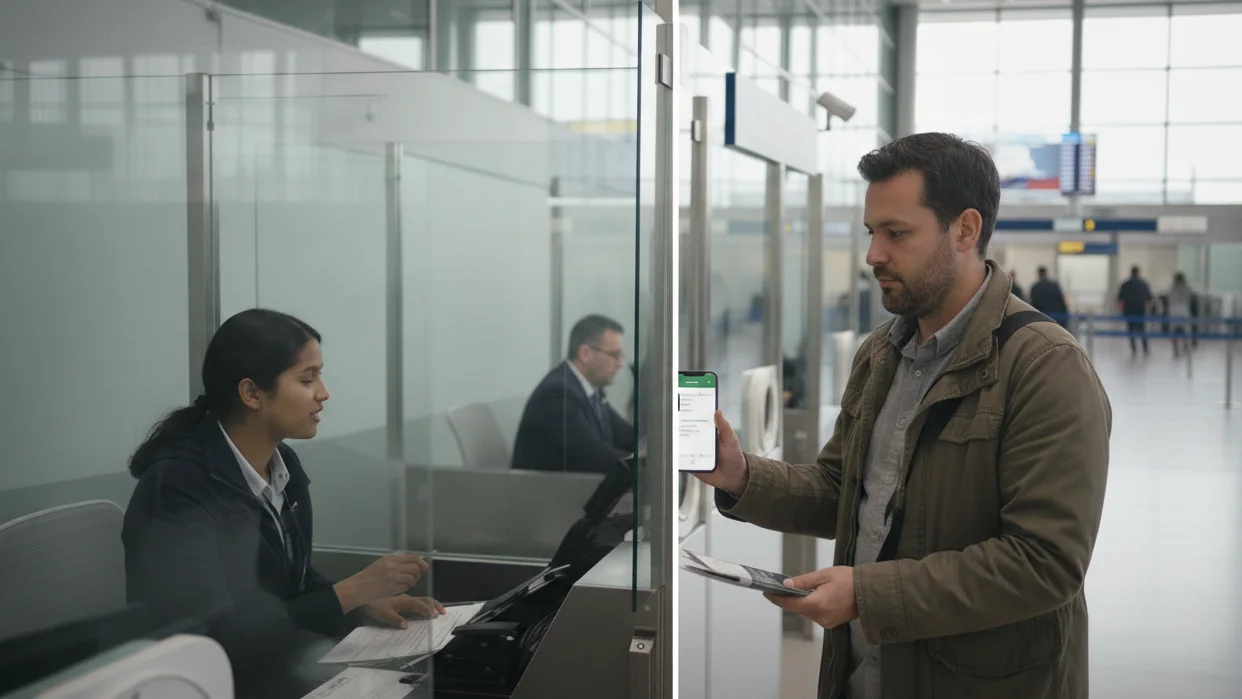
An onward ticket can be accepted at the border and still create trouble at the airport. That feels unfair, but it happens because airlines and border officers use the same document to solve different problems.
Why airlines often enforce harder than the border
Airlines have a financial reason to be strict. If you are refused entry on arrival, the carrier may be responsible for transporting you back and may face penalties or administrative consequences. That is why check-in staff often treat onward proof as a binary requirement.
Border officers can ask questions, assess credibility and apply discretion. An airline agent usually cannot run a full immigration interview at the counter. If the system says onward proof may be needed, the agent wants a document they can tick off quickly before issuing the boarding pass.
So the practical reality is this:
- Border control may ask for onward proof but may also accept a clear explanation.
- Airlines often need a document before you board.
- A document that works for check-in must be easy to read and verify quickly.
- A document that works for border control must also match your story.
The strictest checkpoint is often the first one you meet. If the airline refuses boarding, you may never reach the officer who might have accepted your explanation. That is why experienced travelers solve the airline version of the problem first: clear document, clear date, clear route, no long speech.
The rule-database problem
Many check-in decisions are driven by entry-requirement tools used by airline staff. The language can be short, strict and written like an operational rule. Staff are trained to follow the prompt rather than interpret your personal context.
This creates a familiar airport problem. The staff member says, “The system says you need onward proof,” while you believe your visa or entry category should not require it. Arguing rarely helps. The faster solution is to ask what the issue is and solve that specific trigger.
Useful questions include:
- “Is this requirement for the destination or the transit point?”
- “Is it because my booking is one-way?”
- “If I show a confirmed onward booking within the permitted stay, will that clear the check?”
- “Can a supervisor confirm the requirement for this passport and route?”
Those questions keep the conversation operational. They help you find whether the problem is destination, transit, ticket type or document format.
What gets accepted at check-in
Check-in staff want proof that is easy to verify at a glance. They are not looking for the cheapest proof or the fanciest design. They want clarity, name match, date visibility and a route that makes sense.
Onward proof usually works smoothly when it shows:
- Full name matching the passport.
- Departure date near the top or in a clear itinerary row.
- Route leaving the destination country or travel zone.
- Carrier or transport provider.
- Booking reference, PNR or confirmation details when applicable.
- A PDF or app view that is legible on a phone and printable if needed.
Debates usually begin when the proof is confusing: a route departs from a different country with no connecting plan, the date sits outside the permission window, the file loads slowly, or the onward segment is buried inside an email thread. The busy-agent test is simple: can they understand your exit plan in five seconds?
This is also why screenshots fail more often than travelers expect. A screenshot may crop the passenger name, hide the date, miss the booking reference or look like it was copied from another message. A normal PDF is less dramatic and more useful. It gives the staff member something they can read, print, forward to a supervisor or compare against your passport without guessing.
What border officers care about that airlines do not
Border officers usually care less about the format and more about the story the proof supports. They are watching for coherence: does your plan fit the permission you are requesting?
At the border, onward proof gets evaluated beside:
- Your stated length of stay.
- Your reason for travel.
- Your accommodation plan.
- Your funds and ability to support the visit.
- Your visa, eVisa, invitation letter or program documents.
- Your ability to answer basic route questions calmly.
This is why travelers sometimes pass check-in with a neat document but face a longer conversation on arrival. The airline got what it needed. The border now wants to understand intent and compliance.
For border control, the best onward proof is not isolated. It connects with the rest of the file. A family visitor should have an exit plan that fits the family stay. A conference traveler should not show an exit before the event starts or long after it ends without explanation. A digital nomad should show a next destination that sounds like a real regional move, not a random cheap route selected only because it was available.
When airline demands and entry rules seem to conflict
Sometimes you believe onward proof is not required for your specific entry, but the airline insists on it before boarding. Your goal is not to win a policy debate. Your goal is to board without creating a record of conflict or delay.
Start by confirming what the airline thinks you need. If the issue is a one-way booking, a clean onward ticket may solve it. If the issue is transit, you may need proof of the next segment. If the issue is visa category, a supervisor may be able to interpret the rule screen more carefully.
If the airline still requires proof, provide the simplest acceptable document. Keep the answer short. Do not say the document is fake, disposable or “only for the airline.” Present it as your onward travel plan for this trip.
If you are solving the issue at the airport, avoid panic choices. Do not buy a non-refundable ticket just to escape the counter unless you genuinely accept the cost. Do not invent a route that contradicts your hotel, visa or stated purpose. A fast fix still needs to look like it belongs to the trip.
Choosing the Right Onward Ticket Option Without Creating Red Flags
The right onward proof does not need to be perfect. It needs to look normal for your route, date window and entry category. Plausibility beats decoration.
The looks-normal rule
A clean onward ticket should fit the trip so naturally that the officer does not need to ask why it exists. The route should leave the country or zone you are entering. The date should sit comfortably inside your allowed stay. The passenger name should match the passport. The document should not look manually edited.
If you are unsure whether a document type is appropriate, the what is a dummy ticket guide explains the difference between temporary travel proof, a reservation and a fully paid ticket. For border-control checks, the key is not the label alone. It is whether the proof is credible, current and consistent.
Date strategy: how far out should the onward ticket be?
The safest onward date depends on the stay permission and travel story. If the permission is 30 days, choose an onward date inside that period, not after it. If your accommodation is for seven nights, an onward date on day eight may look cleaner than an exit three weeks later with no housing explanation.
Use this practical date logic:
- Short city break: exit date close to hotel checkout or event end.
- Tourist trip: exit date inside allowed stay and consistent with accommodation.
- Regional travel: onward destination that fits the next country or route.
- Transit entry: onward departure inside the transit window.
- Long-stay entry: return or onward plan tied to program, contract or residence timeline when needed.
Do not create an exit date just to maximize the allowed stay unless that is truly your plan and your file supports it. Officers often find a shorter, realistic stay easier to process than a maximum-stay plan with thin support.
A useful middle ground is the “believable buffer.” If your hotel ends on day seven, an onward date on day eight, nine or ten often feels easier to explain than day twenty-nine with no plan for the missing nights. If your event ends on Friday, leaving that weekend feels natural. If you are visiting family, a date that matches the invitation window is usually cleaner than a date chosen only to fill the visa allowance.
Route strategy: why random routes backfire
Random onward routes create questions. If you arrive in Bangkok but show an onward flight from Singapore, the officer may ask how you plan to reach Singapore. If you enter France but show exit from Portugal, the route can work, but the Schengen itinerary should explain the movement. If you enter an island destination and show exit from a different island with no transfer, the proof looks weak.
Strong route proof follows three rules:
- It leaves the country or zone that matters for the entry check.
- It departs from a place you can reasonably reach.
- It matches the trip style you are explaining.
For a broader visa-file route strategy, a flight reservation for visa framework belongs on BookForVisa. Here, the DummyFlights angle is more specific: your onward ticket should answer the border or airline exit question without making the route look invented.
The route should also match traveler behavior. Backpackers can move regionally, but the next stop should still make sense. Business travelers usually need cleaner city logic because their route is tied to meetings. Students and workers may need a return or onward plan that does not contradict start dates, employer letters or enrollment timing. The more formal the travel purpose, the less random the exit proof should look.
Proof format checklist
Your onward proof should show the essential details without making staff hunt for them. If the document is too busy, cropped or vague, it creates friction.
Before you rely on onward proof, confirm:
- Your full name matches your passport.
- The destination and exit route are easy to understand.
- The onward date fits the allowed stay and your stated plan.
- The booking reference or PNR is readable if included.
- The PDF opens offline on your phone.
- The proof can be printed if manual checks are likely.
- No field looks edited, patched or contradictory.
A dummy ticket for visa can support this travel-proof layer when the route and date logic are honest and aligned. It should never force you into a story you cannot explain.
Presenting Onward Proof at the Counter
How you present the document matters almost as much as the document itself. The goal is not to overwhelm the officer with paperwork. The goal is to answer the exact question quickly.
The 20-second presentation
Keep the proof ready before you reach the counter. If asked, open the file immediately and point to the exit date and route. Do not scroll through every booking email. Do not show five versions. Do not make the officer wait while the phone searches for airport Wi-Fi.
Your 20-second setup should include:
- Offline PDF saved in a clearly named folder.
- Backup screenshot of the main itinerary details.
- Printed copy if the destination or airline is known for strict checks.
- Passport, visa and onward proof grouped together.
- A one-sentence explanation of the route.
The easier you make the check, the faster the officer can move on.
What not to volunteer
Some statements make onward proof sound weaker than it is. Avoid saying:
- “It is only for formality.”
- “I might cancel it.”
- “The real plan is different.”
- “I bought the cheapest proof I could find.”
- “I heard they never check.”
Those phrases shift the focus from the document to your intention after arrival. If the proof is clean, let it speak. If the plan changes later, that is a separate travel decision. At the counter, answer the entry question in front of you.
Border control script: short answers that reduce follow-ups
Short, factual answers work best:
- “I am staying for 12 days.”
- “I leave on this date.”
- “Here is my onward ticket.”
- “I am visiting these cities, then flying to my next destination.”
- “The exit date is before my allowed stay ends.”
If the officer asks why the main ticket is one-way, keep the answer practical: “My return is on a separate booking,” or “My onward travel is from this route.” Do not explain every possible future plan. The officer needs today’s entry story.
If they challenge the proof
If an officer or airline agent challenges the proof, do not become defensive. Ask what they need verified. The issue may be the date, destination, route, name, document status or booking reference.
A calm response sounds like this:
- “Which detail would you like me to show?”
- “The booking reference is here.”
- “The exit date is inside the permitted stay.”
- “The onward destination is my next stop.”
- “I can show the PDF version if this screenshot is unclear.”
Do not edit the document at the airport. Do not switch to another story. Do not produce multiple conflicting PDFs. If the proof has a genuine problem, solve the specific issue with a cleaner version.
Device and connectivity reality
Airport Wi-Fi fails at the worst time. Phones lose battery. Apps log out. Email search breaks under pressure. A strong onward-ticket strategy includes basic device preparation.
Before leaving for the airport:
- Save the PDF offline.
- Take one clean screenshot of the key details.
- Email the proof to yourself and a travel companion.
- Print a copy for strict routes or manual counters.
- Keep the file name obvious.
- Charge the phone and carry a power bank when possible.
Good documents still fail if you cannot show them. Preparation is part of proof.
Tricky Situations: Overland Exits, Open-Jaw Trips and Long-Stay Visas
Not every traveler leaves by a simple return flight. Some leave by bus, ferry, train or another country. Some enter for a long-stay program and do not know the final return date. These situations can work, but the proof must be clearer.
Overland exits
Overland exits can be credible when the geography and documents support them. If you enter one country and plan to leave by bus, train or ferry to a neighboring country, your route should make practical sense. The officer should be able to understand how you leave without a long lecture.
Overland proof is stronger when:
- The exit point is realistic from your final city.
- The date fits the allowed stay.
- The transport provider and route are clearly shown.
- You have accommodation or itinerary details leading toward that exit.
- You hold any needed permission for the next country.
Overland proof is weaker when it looks disconnected from the trip. If you enter a capital city and show a bus departure from a distant border town with no plan to get there, the officer may ask more questions.
Open-jaw itineraries
An open-jaw itinerary means you arrive in one city or country and leave from another. This is normal for multi-city travel, but it needs route support. The onward proof should not look like a random exit from a place you never planned to visit.
Open-jaw proof works better when:
- The cover letter or itinerary explains movement between cities.
- Hotel stays follow the same route order.
- The exit city appears naturally at the end of the trip.
- The travel zone rules support the route, especially in Schengen-style trips.
- The dates do not leave unexplained gaps.
If the route is complex, simplify the spoken explanation. “I arrive in Paris, travel to Rome, then fly onward from Rome” is better than a full travel diary.
Long-stay visas and residence paths
Long-stay visas, student visas, work visas and residence paths do not always require immediate onward proof. But officers may still ask about the plan after the course, job, assignment or residence stage. They may also ask if the entry is unusually early or the documents look incomplete.
For long-stay entries, the proof can be broader than a simple return flight:
- School enrollment or course dates.
- Employment contract or assignment dates.
- Residence permit appointment or approval letter.
- Family sponsorship or host documentation.
- Financial evidence showing capacity to leave later.
If you do use a dummy ticket for visa complete guide style approach for a long-stay file, keep the wording honest. The document supports a travel-proof layer; it does not replace the visa category, sponsor, institution or immigration permission.
“I am extending in-country” plans
Plans to extend in-country can be legitimate, but they create risk at the border when presented too casually. If you arrive as a visitor and immediately say you plan to extend, the officer may wonder whether the original entry permission fits the real plan.
Use careful language. Do not make the extension sound like the main plan unless the visa category allows it and your documents support it. For the current entry, show that you can leave within the permission granted. If future extension becomes relevant, handle it through the proper in-country process later.
When You May Not Need an Onward Ticket
Not every traveler needs an onward ticket. Some entry categories, citizenship rights, residence permits or long-stay permissions reduce the need for immediate exit proof. But “not required” does not always mean “never asked.” It means the answer can be supported differently.
Exemptions that usually work in practice
You may have a stronger position without onward proof when:
- You are a citizen or permanent resident of the destination.
- You hold a residence permit or long-stay permission that clearly explains your stay.
- Your visa category is tied to employment, study or family residence.
- Your return plan is not expected at the initial entry stage.
- You have a documented reason why a fixed return date is not yet available.
Even then, carry documents that explain the stay. If you do not show an onward ticket, the file should still answer why you are allowed to remain and what makes the stay temporary, lawful or structured.
Alternatives that may satisfy the exit-plan question
When an onward ticket is not required or not practical, other documents can help explain the exit plan or lawful stay:
- Residence permit card or approval letter.
- Work contract, assignment letter or school enrollment.
- Return-to-work or leave approval documents.
- Proof of funds sufficient for the stay and later departure.
- Invitation letter with dates and host details.
- Travel itinerary showing planned exit by land, sea or another route.
These alternatives do not always replace onward proof at airline check-in. An airline may still ask for a document it can tick off. That is why the risk ladder matters.
The risk ladder if you skip onward proof
If you skip onward proof on a route where it is commonly checked, the risk increases in stages:
- Online check-in blocks boarding pass issuance.
- Counter staff asks for onward proof before printing the pass.
- A supervisor reviews your passport, route and visa category.
- You must buy or create onward proof at the airport under time pressure.
- You miss the flight if the document cannot be produced fast enough.
- Arrival border control asks for the same proof again.
The worst case is not always refusal. Sometimes it is expensive stress: rushed purchases, missed flights, long counter arguments and avoidable scrutiny. A clean onward ticket is cheap insurance against a predictable question.
Last-minute decision flow before you fly
Use this quick self-check before leaving for the airport:
- Are you flying one-way?
- Are you entering as a tourist, visitor, visa-free traveler or transit passenger?
- Does your allowed stay have a clear end date?
- Does your hotel or host plan cover the same period as your exit plan?
- Will your onward route be obvious to a busy airline agent?
- Can you show the document offline in under 20 seconds?
If several answers create uncertainty, prepare onward proof. If the route is simple, the stay is clearly documented and your permission category explains the timeline, you may not need it — but keep backup documents ready.
The calm backup plan
A calm backup plan is not a pile of random documents. It is a small set of proof that answers the actual concern. For most travelers, that means passport, visa or entry permission, accommodation, funds, and onward or return proof when relevant.
Keep the explanation simple: “I am entering for this purpose, staying until this date, and leaving on this route.” If the document supports that sentence, you are in a stronger position than a traveler who has a perfect story but no visible proof.
Walk Up to the Counter With a Clear Exit Plan
An onward ticket is not required for every traveler, every route or every visa category. But when it is required — or when an airline decides it needs to see it before boarding — the best proof is clean, current and easy to understand.
The strongest setup is simple. Your onward date fits inside the allowed stay. Your route leaves the country or zone that matters. Your name matches the passport. Your PDF opens offline. Your explanation is short. You do not argue, overshare or present five possible future plans.
Border control wants to understand whether your entry is temporary, lawful and coherent. Airlines want to avoid carrying someone who may be refused on arrival. A clean ticket onward document gives both sides a visible answer without forcing you into a premature final airfare purchase.
Need a clear exit plan before airline or border checks? Create a DummyFlights onward ticket with readable route, date, passenger details and booking reference before the question appears.
FAQ
When is an onward ticket required at border control?
An onward ticket may be required when destination rules, visa-free entry conditions, short-stay permissions, transit rules or officer discretion require proof that you will leave within the allowed stay.
Do airlines ask for onward tickets more than border officers?
Often, yes. Airlines may enforce onward proof before boarding because they carry risk if a passenger is refused entry on arrival. Border officers can use more discretion, but airlines usually need a document they can check quickly.
Is a return ticket the same as an onward ticket?
No. A return ticket usually shows travel back to your home or residence country. An onward ticket shows travel from the destination to another country. Both can answer the exit-plan question when the route and date are credible.
Can I enter with a one-way ticket?
Sometimes, but one-way arrivals are more likely to trigger questions. If your permission is short-stay, visa-free or tourist-style, carry onward proof or strong alternative documents that explain when and how you will leave.
What should an onward ticket show?
It should show your passport-matching name, onward route, departure date, carrier or transport details, and a readable booking reference or PNR when applicable. The date should fit your allowed stay and travel story.
Can my onward proof be from a different country?
It can, but the route must make sense. If you enter one country and leave from another, your itinerary should explain how you move between them through hotels, transport, cover letter or a clear multi-country plan.
What if I plan to exit by bus, train or ferry?
Overland or ferry exits can work when the route is realistic and documented. The proof should show a clear exit from the country or zone, fit the allowed stay, and connect logically to your final city or itinerary.
Should I tell border control my plans are flexible?
Keep the answer focused on your current entry plan. You can have flexible future options, but at the counter you should be able to state where you are staying, when you leave, and which proof supports that exit date.
Can a dummy ticket help with onward proof?
Yes, a clean dummy ticket can help when you need temporary travel proof before buying final airfare. It should be verifiable, readable, logically dated and consistent with your passport, route and permitted stay.
Friendly reminder: DummyFlights provides temporary travel-proof documents for planning and application support. Requirements vary by destination, airline, route and applicant situation. A dummy ticket can support a file, but it does not guarantee approval, boarding or entry.