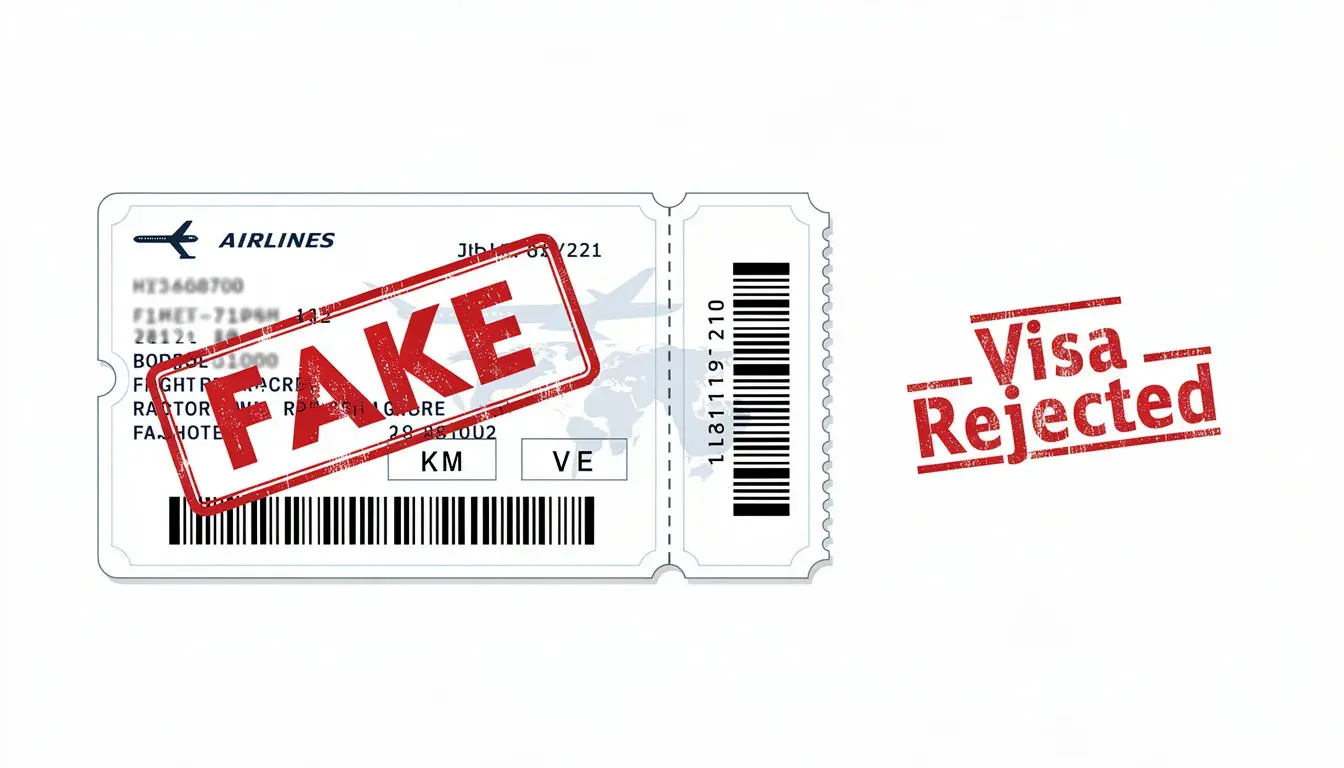
Short answer: If airline staff ask for printed onward proof, carry a current, complete document that shows the passenger name, route, date, flight details and booking reference or PNR in a form the carrier can check. A printed dummy ticket can support a travel-proof request, but it is not a boarding pass or a substitute for a paid ticket, visa, transit authorization or entry permission. Keep a paper copy and an offline digital backup, then make sure the dates still match your visa file and actual journey.
A check-in agent glances at your passport, then asks for a printed onward ticket before releasing your boarding pass. Your visa is approved, and your bags are packed, but the airline works from a different checklist than the embassy ever used. Printed proof, not a screenshot buried in your inbox, is what gets you past the counter.
Knowing what a printed dummy ticket needs to show, and when a digital copy simply will not do, changes how you prepare before departure day. This guide covers exactly what airline staff check, how it differs from what the visa office wanted, and how to keep both sides satisfied. Keep a dummy ticket booking aligned with the route before you head to the airport.
Key facts
- Airlines and routes can apply different document checks, so a printed request is not universal.
- The printout should match the passport name, route, dates and the reservation record that can actually be checked.
- A printed page does not repair an expired, canceled or unverifiable PNR.
- A reservation supports planning or an application file; a paid, confirmed ticket is what supports boarding.
Need a print-ready onward reservation before check-in? Prepare a temporary document that matches the passenger name, route and dates you can truthfully support, then check the reference before printing.
Prepare your dummy ticketIn This Guide
- Why Airline Check-In Counters Ask For Printed Onward Travel Proof
- What Counts As Valid Printed Proof At The Check-In Desk
- How A Dummy Ticket Differs From A Boarding-Ready Airline Ticket
- Getting Your Dummy Ticket Print-Ready Before You Reach The Airport
- What Happens When Airline Staff Verify Your PNR On The Spot
- Handling Pushback From Staff Who Are Unsure About Temporary Reservations
- Matching Your Printed Dummy Ticket To Your Visa File And Travel Dates
- Common Situations Where Printed Proof Gets Requested Beyond Check-In
- Building A Travel Folder That Keeps Airline Staff And Visa Officers Satisfied
- Printed Proof That Holds Up At Every Checkpoint
Official-source check
- IATA Travel Centre explains that passport, visa and health requirements are route- and nationality-specific and are used to support airline travel-document checks.
- GOV.UK transit guidance shows why transit permission and onward-travel evidence depend on the route and the permission held.
- UK carrier-status guidance illustrates that carriers may verify a traveller’s status before travel.
These sources support the distinction between airline document checks and an embassy’s visa decision; always confirm the current official rule for your own itinerary.
Reviewed for: printed-proof fields, PNR-check language, the difference between a reservation and a boarding ticket, visa-file/date consistency, and alignment with current official travel-document guidance.
Why Airline Check-In Counters Ask For Printed Onward Travel Proof

Airline staff is not checking your paperwork out of curiosity. They are protecting the airline from a very specific financial risk: carrying a passenger into a country that later refuses entry, then being on the hook for flying that person back.
The Rule Airlines Follow, Not The One Visa Offices Follow
Immigration authorities can fine an airline for landing a passenger who cannot prove onward travel or a valid reason to leave within their permitted stay. This rule has nothing to do with your visa file. It applies at check-in, sometimes hours before you ever reach the destination country's border.
Because of this, a gate agent or check-in clerk may ask questions a visa officer never raised. They are not reviewing your travel itinerary for tourism intent. They are confirming you have a documented exit date that keeps the airline compliant with the destination country's carrier liability rules.
Why This Catches Travelers Off Guard
Most visa applicants spend weeks preparing a visa file: cover letter, hotel bookings, bank statements, a dummy flight ticket for the visa application. Once the visa is stamped, many assume the hard part is done.
Then, at check-in, an agent asks for a return ticket or onward ticket printed and ready to show. Travelers who used a temporary flight reservation only for the visa application, and never expected to need it again, are suddenly searching their email on airport WiFi.
-
Some airlines check this manually at busy counters during peak travel season.
-
Others flag it automatically when the destination country has strict entry conditions.
-
A few only ask when your ticket type or route looks unusual for the stated purpose of the business trip or holiday.
Which Routes Trigger This More Often
Certain routes see this question far more than others. Flights into countries with a documented history of overstays get closer scrutiny from ground staff, especially on one-way bookings. If your final ticket is a one-way flight paired with a tourist visa, expect the question almost every time.
Connecting flights add another layer. If your first leg is with one carrier and your onward flight is with another, the first airline may ask for proof of the second booking before allowing you to check in for the first leg at all. This is common on itineraries that pass through hub airports with tight visa-on-arrival rules for onward passengers.
How This Question Fits Into The Airline's Own Risk Model
Airlines track denied-boarding incidents and carrier fines by route, and this data feeds directly into how strictly staff are trained to check onward proof on any given itinerary. A route with a recent spike in refused entries will usually see tighter enforcement for months afterward, even if your own travel plans have nothing to do with those earlier incidents.
This is why the same route can feel completely different depending on the season or even the specific week you are flying. A colleague who flew the identical route two months earlier without being asked for onward proof is not a reliable guide to what will happen on your own departure day.
The Difference Between A Suggestion And A Requirement
Not every question at check-in is a hard requirement. Some agents ask about onward travel as a routine courtesy check, expecting a verbal answer rather than a printed document. Others treat it as a strict boarding condition and will not issue a boarding pass without seeing paperwork.
You generally cannot tell in advance which type of check you will face, which is exactly why arriving with printed proof is worth the small amount of preparation it takes.
Treating the question as optional, based on past experience with a different agent or a different day, is one of the more avoidable ways travelers end up delayed at the counter.
How A Business Trip Itinerary Can Draw More Questions Than A Holiday
Travelers flying for a business trip sometimes assume a corporate purpose automatically satisfies onward-travel expectations. In practice, staff may look just as closely, or occasionally more closely, at a business itinerary that includes an open-ended return or a schedule that shifts based on meetings still being confirmed.
A clear flight itinerary showing a defined exit date, even for a work trip, answers the same question a tourist itinerary would need to answer. The purpose of travel does not exempt anyone from the airline's own carrier liability obligations at the destination country's border.
What This Means For Your Preparation
The practical takeaway is simple: your visa approval and your airline check-in are two separate checkpoints with two separate sets of expectations. A dummy ticket that worked perfectly for the visa office may need to be reissued, reprinted, or replaced with updated travel dates before you fly, especially if weeks or months have passed between visa approval and departure.
How Seasonal Travel Volume Changes The Odds Of Being Asked
Peak travel periods change how thoroughly any single passenger gets checked. During high-volume seasons, some counters move faster and ask fewer follow-up questions simply due to time pressure on staff. During quieter periods, agents often have more time per passenger, which can mean more thorough document checks rather than fewer.
Neither pattern is guaranteed, and assuming a quiet counter means a lighter check, or a busy one means no check at all, is a bet not worth making. Preparing the same way regardless of season keeps you covered either way.
Travelers who treat these as one continuous process, rather than two distinct steps, tend to arrive at the airport with outdated printouts, expired reservations, or nothing printed at all. The next discussion breaks down exactly what a valid printout needs to contain so the counter interaction goes smoothly the first time.
What Counts As Valid Printed Proof At The Check-In Desk
Not every printout satisfies a check-in agent. A boarding pass stub from a previous trip, a hotel confirmation email, or a screenshot with cropped details will usually raise more questions than it answers. Staff are trained to look for specific fields, and missing even one can slow you down at the counter.
The Fields Airline Staff Actually Scan
When an agent asks for onward travel proof, they are typically scanning for:
-
Passenger name that matches the passport exactly, including middle names and spelling.
-
A booking reference or e-ticket number that can be searched in the airline's own system.
-
Flight details, including departure and arrival cities, dates, and flight numbers.
-
An exit date that falls within the permitted stay for the visa category or visa-free entry rule.
If any of these fields are blank, cropped out of a screenshot, or inconsistent with your passport, the agent may ask follow-up questions or escalate to a supervisor. This is where a proper dummy ticket booking, formatted the way a real airline confirmation looks, becomes far more useful than a hand-typed itinerary summary.
Why A Screenshot Rarely Works As Well As A Printed PDF
Phone screens are small, WiFi at airports is unreliable, and battery life is not guaranteed. A printed page removes all three problems in one step. It also lets the agent hold the document, compare it against your passport, and move on quickly without asking you to unlock your phone or refresh a page.
A well-organized reservation PDF is easier to hand over than a screenshot. It should present the passenger, route, dates and reference in a clear format, while making no claim that it is a paid ticket or boarding pass.
Formatting Details That Matter More Than People Expect
Small formatting choices affect how quickly staff process your document.
-
Print clearly, in color when practical, so dates, flight numbers and status fields are easy to read.
-
Keep the booking reference visible and unobstructed by staples or folds.
-
Bring two copies if your itinerary includes a connecting flight on a separate airline.
-
Avoid printing a document that shows a past travel date from an earlier trip mixed into the same file.
How Staff Compare Your Printout Against Your Boarding Pass
A detail travelers often overlook is that the printed proof is not reviewed alone. It is compared, at least visually, against your boarding pass and your passport at the same moment.
If the destination city on your onward proof does not match the country listed on your visa, or if your passport number was never captured on the document at all, the agent has three separate items to reconcile instead of one consistent story.
A well-built dummy ticket keeps this comparison simple. Consistent spelling, matching dates, and a route that logically follows your stated travel plans mean the agent's visual check confirms what they expect to see, rather than raising a question they now have to resolve manually.
Why Some Airlines Accept A Verbal Explanation And Others Do Not
Policy on this varies more than most travelers expect. Some carriers train staff to accept a clear verbal explanation alongside a digital confirmation, especially on routes with looser enforcement. Others require a printed document without exception, regardless of how confidently a traveler explains their plans.
Because you cannot know in advance which policy your specific counter will follow, the safest approach treats every airline as though it requires the stricter standard: a printed, complete, and verifiable document ready to hand over the moment it is requested.
Why Bringing Two Copies Solves More Problems Than It Seems To
Carrying a single printed page feels sufficient until it gets damaged, misplaced in a bag, or needed at two counters within the same hour, such as a first check-in desk and a separate transfer desk during a connection. A second copy, folded into a different bag or jacket pocket, removes this risk almost entirely.
This habit matters even more on itineraries involving a business trip with tight connections, where there may not be time to reprint anything if the first copy goes missing between flights.
What Happens If Your Printed Copy Looks Incomplete
An incomplete printout does not automatically mean denied boarding. In most cases, the agent will ask you to pull up the booking on your phone, call the reservation provider listed on the document, or confirm details verbally. This takes time you may not have if you are already running close to your check-in cutoff.
Why Some Travelers Bring A Cover Letter Alongside Their Printed Ticket
A short cover letter, the same type sometimes prepared for a visa office submission, can help at check-in too, particularly on itineraries that look unusual at a glance, such as a short trip paired with an expensive route or an itinerary with several stops.
It briefly explains the purpose of travel and points to the attached onward proof, giving staff context in seconds rather than requiring several follow-up questions.
This is optional in most situations, but it costs nothing to include and occasionally saves a few minutes of back-and-forth at a busy counter.
The safer approach is arriving with a document that answers every question before it is asked.
Why Printed Proof Should Never Be An Afterthought Packed Last
It is tempting to treat printed documents as one more small task on a long pre-departure checklist, handled quickly the night before alongside packing. Given how directly this single page affects whether check-in goes smoothly, it deserves a slightly higher priority than a last-minute printout squeezed in between other errands.
Setting aside ten focused minutes to verify, print, and file this document properly, separate from general packing, tends to catch mismatches or outdated dates before they become a problem at the counter.
That means matching the printed dummy ticket to the same travel dates, spelling, and route already on file with your visa application, a topic covered in more depth later in this guide. First, it helps to understand exactly how a dummy ticket differs from the ticket you would use to actually board the aircraft.
How A Dummy Ticket Differs From A Boarding-Ready Airline Ticket

Confusion at the check-in counter often comes from travelers not knowing which category their document falls into. A dummy ticket and a boarding-ready airline ticket look similar on paper, but they serve different purposes and behave differently once you are standing at the counter.
What A Dummy Ticket Is Built To Do
For a plain-language definition before you compare documents, see our what a dummy ticket is guide.
A dummy ticket is a temporary flight reservation created to show travel intent and a verifiable PNR, without the cost of a final ticket purchase. It typically holds the same fields as a real reservation, including passenger details, flight numbers, and an exit date, but it is not tied to a fully paid seat on the aircraft.
Embassies request this kind of document because it satisfies the requirement for onward travel proof without asking applicants to risk a non-refundable ticket before a visa decision is made. This is precisely why dummy tickets exist as a category separate from real tickets in the first place.
What A Real, Boarding-Ready Ticket Requires
A real ticket, sometimes called a final airline ticket, is fully paid and confirmed for boarding. Airlines require this level of confirmation before allowing a passenger through the gate. A dummy ticket, by design, cannot be used to board an active flight, because it was never intended to replace a final ticket purchase.
This distinction matters at two very different moments in your travel plans:
-
During visa preparation, when a temporary reservation is appropriate and expected.
-
On travel day, when the airline needs a confirmed, paid booking to issue a boarding pass.
Why Travelers Get This Mixed Up
Many applicants assume that once a dummy ticket satisfies the visa office, it will also work at the airport on departure day. This misunderstanding usually comes from the fact that both documents look nearly identical: same layout, same fields, same airline branding style.
The difference only becomes obvious when a traveler tries to check in using a dummy ticket instead of their actual paid ticket. At that point, staff will ask for the confirmed booking used for the flight you are actually taking, not the one used months earlier to satisfy a visa checklist.
Where This Gets More Complicated: Onward Proof After Arrival
Here is where dummy tickets remain genuinely useful even after your flight is booked and paid for. Many countries do not require your entire journey to be on a single paid ticket. They require proof of onward travel or intended exit, which can be a separate, temporary reservation showing your planned departure from the destination country.
Why Embassy Ready Flight Reservation Formatting Still Matters After Approval
An embassy-ready flight reservation is built to satisfy a specific checklist item during the visa process, with clean formatting that visa officers recognize quickly. That same formatting standard turns out to be useful again after approval, since airline staff are scanning for the same fields, just for a different reason.
Keeping this formatting intact from visa submission through to travel day, rather than switching to a different template or provider partway through, keeps every checkpoint looking at a document they can process quickly.
In this scenario, your real ticket gets you on the plane, while a fresh dummy ticket, dated appropriately, satisfies the destination country's entry requirement for a documented exit date. This is common for travelers whose return flight has not been finalized yet, or who plan to extend their stay and book a final ticket later.
Why Refundable and Non-Refundable Tickets Fit Into This Picture Differently
Some travelers try to solve the onward-proof problem by booking a fully refundable ticket instead of a dummy ticket, planning to cancel it after their visa or entry is confirmed. Refundable tickets can work for this purpose, but they usually cost significantly more upfront than a temporary reservation, and refunds are not always processed as quickly as travelers expect.
A non-refundable ticket booked purely for visa purposes creates the opposite problem: if your visa is delayed or denied, you have committed money to a booking you may never use. This is precisely the financial risk a dummy ticket is designed to remove from the process entirely, since no full ticket purchase happens until your plans are actually confirmed.
How This Distinction Plays Out With Multi-City Dummy Ticket Itineraries
Travelers with more complex routes, such as a multi-city dummy ticket covering several cities across a single business trip, face this distinction even more clearly. Booking a real, paid ticket for every leg of a tentative multi-city plan before a visa decision is both expensive and impractical if any single leg later needs to change.
A dummy ticket built to reflect the full multi-city itinerary gives visa officers and, later, airline staff the same structured view of your travel plans, without locking you into paid segments you might otherwise need to rebook.
Why Dummy Tickets Are Legal, But Misusing One Gets Costly Fast
Questions about whether dummy tickets' legal status holds up in a specific country come up often, and the short answer stays consistent across most jurisdictions: yes, precisely because they exist to solve a real problem.
Applicants searching for a dummy ticket for visa purposes should not need to buy a costly ticket before knowing whether their visa will be approved. Used correctly, a dummy ticket is simply a documented, verifiable step in a longer travel plan.
Where things go wrong is misuse, not the format itself. Trying to use a dummy ticket to board an actual flight, presenting one as a real ticket at check-in, or holding onto an expired copy and hoping nobody checks the dates are all ways a genuinely legal document turns into a problem.
Using a dummy ticket incorrectly can result in missed flights and additional costs, since a rejected boarding attempt often means rebooking a real, valid ticket at short notice and at a much higher price than planning ahead would have cost.
The distinction is simple to hold onto: a valid ticket for boarding is always your confirmed, paid booking. A dummy ticket is always a supporting document, never a substitute for that final purchase.
Keeping The Two Documents Clearly Separated
A practical habit that prevents confusion at the airport: label your files clearly. Keep your confirmed, paid boarding ticket in one folder and any dummy tickets used for visa or entry proof in another. Mixing them together, especially when printed, increases the chance of handing an agent the wrong document under pressure.
The next discussion walks through how to prepare a fresh, print-ready dummy ticket before departure day, so you are never scrambling to generate one at the airport with a spotty WiFi connection.
Getting Your Dummy Ticket Print-Ready Before You Reach The Airport
Waiting until you are already at the airport to sort out a printed dummy ticket is one of the more common mistakes travelers make. The process itself is short, but doing it under time pressure, with limited connectivity, adds unnecessary stress to travel day.
Confirm What The Destination Country Actually Requires
Before generating anything, check whether your destination requires proof of onward travel at entry, and whether your airline separately requires it at check-in. These two requirements sometimes overlap and sometimes do not. A quick look at the destination country's official immigration guidance, or your airline's carrier information page, clarifies which fields matter most.
Fill In Passenger Details And Travel Dates Accurately
Once you know what is required, fill in passenger details like name and travel dates exactly as they appear on your passport. Small spelling mismatches, an extra initial, or a different date format can create confusion at the counter even when the underlying booking is genuine.
Your travel dates should sit within the same travel window as your actual trip. A dummy ticket dated for a period unrelated to your real travel plans looks inconsistent the moment anyone compares it to your boarding pass or visa stamp.
Complete Payment And Receive Your Reservation Quickly
Complete payment securely to finalize the reservation, then expect to receive your dummy ticket within 10 minutes via email in most cases. This turnaround matters when you realize late in your planning, sometimes the night before a flight, that you need a fresh printout with updated dates.
A reservation provider worth using should offer:
-
Instantly verifiable reservations, so staff can confirm details without delay.
-
A PNR with a matching PDF, formatted the way airline confirmations normally look.
-
Unlimited date changes, useful when your travel plans shift before departure.
-
Transparent pricing, without hidden fees added after you have already entered your details.
Check the provider's current price and terms before ordering; pricing, availability and change policies can vary over time.
Verify The PNR Before You Print
Once your dummy ticket arrives, a valid PNR is essential for verification of the ticket, and it can typically be checked on the airline's own website using the booking reference and passenger name. Doing this check yourself, before you ever reach the airport, confirms the reservation is live and searchable in the airline's booking system.
This single step separates a genuine dummy ticket from a fabricated one. A genuine dummy ticket must not be fabricated or altered, and a legitimate copy will always return a match when checked through the correct airline channel.
What Separates A Genuine Dummy Ticket Service From A Risky One
Not every dummy ticket service online operates the same way. Some generate documents that look convincing but cannot actually be verified against any airline's booking system, which defeats the entire purpose of carrying printed proof in the first place.
Before relying on any provider, confirm that reservations are searchable using the airline website directly, not just presented as a static PDF with no live backing.
A reliable dummy ticket online service will also be transparent about validity windows, refund policy on the small booking fee, and how quickly a replacement or updated reservation can be issued if your travel dates change. Providers that avoid answering these questions clearly are usually not worth the small amount of money saved.
Why A Best Dummy Ticket Choice Depends On Your Specific Trip
There is no single best dummy ticket option that fits every traveler, since requirements shift depending on your destination, your visa category, and whether you need a one-way, round-trip ticket, or multi-city structure.
A short-stay Schengen visa applicant generally needs a straightforward round trip ticket, while someone managing a longer business trip with several cities needs a structure that reflects each leg accurately.
Matching the reservation type to your actual travel plans, rather than defaulting to whatever format a provider offers first, is what actually determines whether the document holds up when it is checked.
How Dummy Ticket Pricing Compares Across The Market
Pricing for a dummy flight ticket online varies more than most first-time applicants expect. Dummy tickets start at $5 or ₹699 per passenger with some providers, and a few services advertise pricing uniformly at ₹699 for all ticket types, regardless of route or itinerary complexity.
Dummy ticket prices are lower than actual flight tickets by design, since no full fare or taxes are being paid on a seat that will not actually be boarded.
A lower-priced dummy ticket is not automatically unsuitable, but price alone should not be the deciding factor. A dummy air ticket that costs less but cannot be verified through the airline website offers little real protection at the check-in counter.
It helps to weigh cost against turnaround time, verification support, and how easily the reservation can be updated if your travel dates change before your final purchase of a real ticket.
Print Multiple Copies And Store Them Properly
Print at least two copies: one for your carry-on documents folder and one as a backup in checked luggage or a separate bag. Keep a digital copy accessible offline as well, saved directly to your phone rather than relying on an email app that needs a live connection.
Genuine dummy reservations expire after a short period, typically 24 to 72 hours in some booking systems, though many reservation providers issue tickets that remain valid through your travel window.
Confirm the exact validity period with your provider, and keep a note of when your dummy ticket validity window closes, so your printed copy does not go stale before you actually reach the counter.
Why Some Applicants Book Their Dummy Ticket Earlier Than Necessary
There is no strict rule requiring you to wait until the last moment to prepare this document, and some travelers prefer generating their dummy ticket booking as soon as travel dates are reasonably firm, well before the visa process even concludes. This gives more breathing room to fix errors, request date changes, or simply double-check details without time pressure.
The trade-off is remembering to refresh it again closer to departure if anything changes, which is a small task compared to the alternative of discovering a problem the day of your flight.
With a verified, print-ready dummy ticket in hand, the next question is what actually happens when an airline agent checks that PNR against their own system, and what a smooth verification looks like from the other side of the counter.
What Happens When Airline Staff Verify Your PNR On The Spot
Airline staff verify tickets against live operational systems, not against the printed page itself. The paper you hand over is simply a starting point. What happens next depends on how the reservation was created and whether it holds up under a quick database search.
The Verification Process, Step By Step
When an agent takes your printed proof, they typically search the booking reference or e-ticket number directly in their system, sometimes cross-checked against a shared industry database. This search returns basic details: passenger name, route, and current status of the reservation.
-
If the reference returns a valid, active reservation, the process ends quickly.
-
If the reference returns nothing, or shows a different name, the agent will ask clarifying questions.
-
If the system flags the reservation as canceled or expired, you may need to explain or replace it on the spot.
This is why a valid PNR can be verified on airline websites matters so much before you ever reach the counter. If you can confirm it yourself in advance, you already know how the agent's search will turn out.
Why Fake Tickets Fail This Test Almost Immediately
Fake tickets often have invalid PNRs and mismatched details, which means they fail the very first search an agent performs. A fabricated booking reference either returns no result at all or returns a reservation under someone else's name, both of which immediately raise concerns.
Presenting a fake ticket can lead to document fraud accusations, a risk that is entirely avoidable by using a genuine, verifiable service instead of attempting to alter a real document or generate one without an actual reservation behind it.
This is one of the clearest reasons dummy tickets exist as a legitimate, structured product rather than something travelers should attempt to fabricate themselves.
What A Smooth Verification Looks Like
Most travelers who prepare properly never notice this process happening at all. The agent scans or types the reference, sees a valid confirmed dummy ticket sitting in the system, and moves on to the next step in check-in.
A few habits make this outcome more likely:
-
Double-check that the name on the dummy ticket matches your passport exactly, including diacritics or hyphenation.
-
Confirm the reservation status shows as active, not canceled, before you print your final copy.
-
Avoid printing a reservation earlier than necessary, since some systems refresh status closer to the travel date.
Why Booking Systems Sometimes Show Slightly Different Statuses
Airline booking systems are not all built on identical technology, and how a temporary reservation appears can vary between carriers. One booking system might display a dummy ticket as a standard "hold" status, while another shows it under a category more commonly used for group bookings or travel agency holds.
Neither status means the reservation is invalid, but it can prompt a curious agent to ask what they are looking at.
Knowing that this variation exists helps you respond calmly rather than assuming something has gone wrong with your booking. The underlying PNR is either valid and searchable, or it is not, regardless of which internal label the airline's system happens to display.
What A Verifiable Flight Reservation Actually Confirms
It is worth being precise about what verification proves and what it does not. A verifiable flight reservation confirms that a real booking exists in the airline's system under your name, with the stated route and dates. It does not confirm that a seat has been paid for, and it is not meant to.
Airline staff who understand this distinction move through the check quickly, since they are not expecting a dummy ticket to behave like a final ticket purchase.
How This Search Differs From What Embassies Check Earlier In The Process
It helps to remember that visa officers check the PNR for authenticity during visa applications using a very similar process to what airline staff does later, just at an earlier stage and through a different system. Both checks rely on the same underlying idea: a searchable, verifiable flight reservation tells them more than any printed page alone ever could.
Because both checkpoints rely on the same verification logic, a dummy ticket built to satisfy one will generally satisfy the other too, as long as the dates and passenger details have not drifted out of sync between the two moments.
When Staff Ask Additional Questions
Occasionally, an agent will ask why your ticket shows as a temporary reservation rather than a final ticket purchase. This is a normal question, not an accusation, and it usually comes from newer staff or unfamiliarity with how dummy tickets are used for onward proof rather than boarding.
A calm, direct explanation works best: the reservation is being used to satisfy an onward travel or visa requirement, and your actual travel is confirmed separately if applicable. Airlines process this scenario regularly, even if any individual agent has not personally encountered it that day.
Understanding what the system sees on their end helps you anticipate these questions before they are even asked. The next discussion covers how to handle situations where staff are visibly unfamiliar with temporary reservations and push back harder than the situation actually calls for.
Handling Pushback From Staff Who Are Unsure About Temporary Reservations
Not every airline employee encounters temporary flight reservations often enough to recognize them instantly. Occasionally, this unfamiliarity turns into pushback, where an agent insists on a final airline ticket even though your documentation is entirely valid for your situation.
Recognizing The Difference Between A Valid Question And A Misunderstanding
A valid question sounds like a request for clarification: asking why the ticket shows as unpaid, or asking to confirm your actual return flight. A misunderstanding sounds more absolute, such as an agent stating outright that dummy tickets are not accepted by any airline, without checking the reservation first.
Staying calm here matters more than being right immediately. Most misunderstandings resolve once a supervisor or a more experienced colleague reviews the same booking reference.
What To Have Ready In These Moments
-
A clear, one-line explanation of why the document exists: proof of onward travel or a visa requirement, not a boarding ticket.
-
Your actual confirmed ticket, if your dummy ticket is separate from the flight you are boarding that day.
-
The booking reference easily accessible, so staff can search it again without delay.
-
Contact information for your dummy ticket service, in case verification questions go beyond what the counter agent can resolve alone.
Why Escalating Politely Often Works Better Than Arguing
Requesting a supervisor is not confrontational; it is a normal part of airport procedure when front-line staff is uncertain. Supervisors typically have more experience with country-specific entry rules and are more likely to recognize dummy tickets accepted as standard practice for onward travel proof.
Framing the request calmly, such as asking whether a colleague with more experience in this specific route could take a quick look, tends to defuse tension far better than insisting the original agent is wrong.
Common Scenarios Where This Comes Up
A newer agent at a smaller regional airport. Smaller stations handle fewer international routes, so staff may see temporary reservations less frequently than agents at major hub airports.
A connecting flight where the second airline's rules differ from the first. Some carriers are stricter about onward proof than others, even on the same overall itinerary.
A route recently added to a country's list of stricter entry requirements. Airlines sometimes update internal guidance faster than front-line staff receive full training on the change.
A Few Phrases That Tend To Help During These Conversations
The exact wording you use in a tense moment at the counter can shape how quickly it resolves. A few approaches that tend to work well:
-
"This reservation is for onward travel proof, and here is my confirmed ticket for today's flight." This immediately separates the two documents in the agent's mind.
-
"Would it help to search the booking reference directly? I can confirm it's active." This signals confidence without sounding confrontational.
-
"I understand this might look unfamiliar; is there someone who handles this route regularly?" This opens the door to escalation without implying the original agent made a mistake.
Why Staying Documented Matters More Than Staying Persuasive
In a disagreement at the counter, the strongest position is not the most persuasive explanation; it is the most complete paperwork. An agent who is uncertain will almost always default to whatever the system shows, and whatever printed evidence is directly in front of them.
Arguing a point verbally, without paperwork to back it up, rarely changes an outcome the way a clear, verifiable document does.
This is also why keeping your visa file, cover letter, and dummy ticket physically together, rather than scattered across email and cloud storage, pays off specifically in these harder conversations.
What Rarely Happens, But Is Worth Knowing
In rare cases, an agent may decline to accept a temporary reservation entirely and ask for a real ticket before allowing check-in. If your travel timeline allows it, this is where having a provider offering a stated change policy and a turnaround that fits your timeline becomes genuinely useful, since you can adjust or supplement your documentation without starting the entire booking process over.
This kind of situation is uncommon, but preparing for it removes most of the stress if it does happen.
Why Staying Polite Protects You Even When You Are Frustrated
It is genuinely frustrating to be questioned over a document you know is valid, especially after weeks of visa preparation already went into your travel plans. Even so, staying calm and cooperative works in your favor far more often than frustration does.
Airline staff make judgment calls throughout a shift, and a traveler who seems agitated is statistically more likely to be treated with added caution, not less.
A brief, polite acknowledgment that the situation is new to the agent, paired with your organized documentation, tends to move things along faster than insisting the rules are on your side. You are usually right about the rules. Staying easy to work with is simply the faster route to the same outcome.
The next discussion shifts focus slightly, looking at how your printed dummy ticket needs to align with your original visa file, since mismatches between the two create their own set of problems.
Matching Your Printed Dummy Ticket To Your Visa File And Travel Dates
When the same route must support an application file as well as an airport conversation, compare the dates and sectors with this visa flight itinerary requirements guide. It is a cross-platform reference, not a substitute for the destination's current checklist.
A dummy ticket does not exist in isolation. It sits alongside a visa file that already contains a cover letter, travel itinerary, and specific travel dates submitted to a visa office weeks or months earlier. Any printed copy you carry on departure day should still line up with that original submission.
Why Visa Officers Care About These Details In The First Place
A dummy ticket must match the travel dates in the visa application, because visa officers use this document, alongside your travel itinerary, to assess whether your stated purpose and timeline are consistent. For a Schengen visa, a round-trip dummy ticket is generally preferred for short-stay applications, since it clearly shows both entry and exit within the permitted window.
Most Schengen visa applications require a dummy flight reservation as one part of a broader visa checklist, alongside proof of accommodation and financial documents. The same logic extends to other regions: tourist visas for the UK, USA, and Canada often carry similar onward proof expectations, even when the exact wording of official guidance differs slightly between countries.
What Happens When Dates Drift Between Visa Approval And Departure
It is common for actual departure dates to shift after visa approval, sometimes by days, sometimes by weeks. Submitting an expired dummy ticket, or one with outdated travel dates, can lead to application issues if you are asked to show it again during entry, even though your visa itself remains valid.
This is particularly relevant if:
-
Your visa allows entry within a broad window, but your dummy ticket showed a narrower, specific date range.
-
You changed your booked real ticket after the visa was issued, creating a gap between visa file and actual travel plans.
-
Immigration staff at your destination separately ask to see the same documents originally submitted with your visa application.
Refreshing Your Dummy Ticket Before You Travel
If your travel dates have shifted since your visa was approved, generating a fresh dummy ticket with updated dates, printed closer to your actual departure, keeps your documentation internally consistent. This is far simpler than trying to explain a date discrepancy to an immigration officer at the border.
A provider with a stated change policy can make this update more straightforward, since you are adjusting an existing booking rather than starting from scratch. Keep the same passenger details and route, and only the travel dates need to change to reflect your updated plans.
How Visa Categories Change What Onward Proof Should Look Like
Your visa category affects how strictly dates need to align. A short-stay tourist visa with a fixed entry window generally needs a dummy ticket that mirrors that window closely, since any significant gap looks inconsistent with the stated purpose of the trip.
A multiple-entry business visa, by contrast, often allows more flexibility, since the applicant may reasonably travel in and out several times during the visa's validity.
Reviewing your specific visa category before finalizing your dummy ticket's dates avoids the common mistake of applying tourist-visa logic to a business visa file, or the reverse, when the underlying expectations are genuinely different.
A Quick Look At UK Visitor Guidance As An Example
UK visitor and transit guidance illustrates why the exact requirement must be checked for the route and permission you hold; evidence of onward travel may be relevant, but the current official checklist controls.
This means a UK-bound traveler may have slightly more flexibility in how precisely their dummy ticket dates need to match their original application, though consistency still matters for the overall credibility of the travel plans presented.
Every destination country sets its own version of this expectation, which is why checking country-specific guidance directly, rather than assuming one region's rules apply everywhere, remains an important part of visa preparation.
Regional Notes Worth Knowing Before You Submit Your Visa Form
Applicants filling out a Schengen visa India application, for example, often submit a dummy ticket as one line item within a broader visa form, alongside proof of accommodation and financial documents. The expectation there is a clean, embassy-ready flight reservation that clearly states entry and exit dates within the requested Schengen visa window.
Other regions phrase the same expectation differently. Some ask for a general flight itinerary as itinerary proof without specifying an exact document type, which gives applicants more flexibility in exactly how they present it.
Regardless of the specific wording, keeping your flight proof and any accommodation documents, including hotel dates that align with your flight dates, consistent across the whole application remains the underlying goal every version of this requirement is trying to achieve.
Building A Simple Cross-Check Before You Pack
Before departure day, lay out your visa approval, your original visa file documents, and your current dummy ticket side by side. Confirm that names, passport numbers, and travel dates all tell the same consistent story. This five-minute check catches the majority of mismatches before they ever become a problem at an airport counter or border desk.
-
Passenger name spelled identically across every document.
-
Travel dates falling within your approved visa category and permitted stay.
-
Route matching what was described in your original cover letter or travel itinerary.
Why It Helps To Revisit Your Original Visa Checklist One More Time
Most applicants build a visa checklist early in the process and rarely look at it again once the visa is approved. Pulling that checklist back out shortly before departure and matching each item against your current documents is a fast way to confirm nothing has quietly gone out of date between approval and travel day.
This single habit closes the loop between visa preparation and actual travel day, keeping the entire visa process consistent from the first submitted document to the last one checked at a counter.
Printed proof is not only requested at the check-in counter. The next discussion looks at other moments during your trip where the same kind of documentation might be requested again, often when travelers least expect it.
Common Situations Where Printed Proof Gets Requested Beyond Check-In
Check-in counters are the most predictable place to be asked for printed proof, but they are not the only one. Several other moments during a trip can bring the same question back, sometimes with less warning and less time to react.
At The Immigration Desk On Arrival
Border officers in many countries ask arriving travelers directly about their onward travel plans, particularly for visa categories tied to a specific visa category or permitted length of stay. A printed onward ticket, in addition to whatever documents were used for the visa itself, reassures the officer that your exit plan is already documented rather than open-ended.
This is especially relevant for one-way arrivals or itineraries where the final ticket for departure has not yet been purchased. A dummy ticket used here plays a slightly different role than it did at the visa office: it is now supporting entry rather than a visa approval decision.
At Connecting Airports With Their Own Transit Rules
Some transit hubs require onward travel proof independently of your destination country's own requirements, particularly if you are passing through immigration during a layover rather than staying airside. A missing printout at this stage can complicate an already tight connection window.
Travelers on complex itineraries, including a multi-city dummy ticket that reflects several legs of a longer business trip, should carry printed proof for each relevant leg, not just the final destination.
When Hotels Ask For Onward Travel Details At Check-In
Occasionally, accommodation providers in countries with strict visitor tracking ask guests for proof of onward travel alongside hotel proof of booking, particularly for longer stays. While this is less common than airline or immigration checks, it does happen in a handful of destinations, and having your documents ready avoids an awkward conversation at the front desk.
This is one of the few moments where a dummy hotel booking and a dummy flight ticket might both be requested together, even though the original visa application may have only emphasized one of the two more heavily.
During Random Spot Checks By Airline Ground Staff
Airline check-in staff sometimes conduct additional spot checks beyond the standard process, particularly during periods of heightened scrutiny on specific routes. These checks are not usually announced in advance and can happen even to travelers who passed through the same route without issue on a previous trip.
Keeping your travel folder organized, rather than assuming the initial check-in process was the only checkpoint, prevents these spot checks from catching you unprepared.
When A Host Or Local Contact Gets Asked About Your Plans
In a smaller number of cases, particularly for visits involving a private host rather than a hotel, immigration officers or even the host themselves may be asked to confirm your intended length of stay. Host proof, combined with your own printed onward travel documents, gives a consistent picture that supports whatever your visa file already established.
Travelers staying with friends or family sometimes assume that hotel bookings are the only accommodation-related document that matters, but a letter or confirmation from a host can carry similar weight when paired with a clear exit date on your dummy ticket.
Why Return Journeys Get Checked Too, Not Just Arrivals
It is easy to assume that onward proof only matters on the way into a country, but return journeys can trigger the same questions, particularly for travelers who extended their stay or changed their original return ticket.
An airline checking you in for your return ticket may still ask about your entry date and permitted stay, especially if your visa's validity window is close to expiring.
Keeping proof of your intended travel dates accessible for the entire trip, not just the outbound leg, avoids being caught without an answer on the journey home.
Why Some Travelers Carry Proof For Both Legs Of A Round Trip
A round trip ticket does not automatically remove the need for supporting documents. Some travelers assume a return ticket alone answers every question they might face, but a return ticket that was booked with a dummy reservation, rather than a fully paid one, still needs the same verification process described earlier in this guide.
Carrying proof for both the outbound and return legs, especially when either segment relies on a temporary reservation rather than a final ticket, keeps you prepared regardless of which direction a question comes from.
What Ties All Of These Scenarios Together
Every situation above shares one common thread: someone in the travel process wants quick, verifiable confirmation that you have a documented plan to leave when you are supposed to. None of these checks require a real ticket purchased months in advance. They require a genuine, verifiable dummy ticket that matches your actual travel plans at that specific moment.
The final practical step is pulling all of this together into a single, organized travel folder that holds up no matter which checkpoint asks for proof first.
Building A Travel Folder That Keeps Airline Staff And Visa Officers Satisfied
After understanding what each checkpoint actually wants, the last piece is organization. A well-structured travel folder means you are never digging through emails or explaining a missing document under time pressure, whether you are standing at check-in, a border desk, or a hotel front desk.
What Belongs In The Folder
-
Your visa approval and visa file documents, including the cover letter and any supporting paperwork originally submitted.
-
Your confirmed, paid ticket, clearly separated from any dummy tickets used earlier in the process.
-
A current dummy ticket, refreshed with accurate travel dates if your plans shifted after visa approval.
-
Hotel bookings or dummy hotel booking confirmations, printed alongside your flight documents rather than stored separately.
-
A printed copy of your visa checklist, useful if you need to quickly confirm which document answers which requirement.
Organizing By Checkpoint, Not By Document Type
Rather than grouping documents by category alone, consider organizing by the moment each document is likely to be requested. Put check-in documents at the front of the folder, since that checkpoint typically comes first. Immigration and entry documents can follow, with anything related to your return or onward travel proof placed where it is easy to reach quickly.
This small reordering saves time exactly when it matters most, since you are not flipping past unrelated paperwork while an agent or officer waits.
Keeping Both Digital And Printed Versions
Even with printed copies ready, keep digital backups saved directly to your phone, not just accessible through an email app that needs a live connection. Airports with unreliable WiFi make this distinction more important than it initially seems.
A simple system that works well:
-
One physical folder with printed documents, organized by checkpoint order.
-
One offline folder on your phone with the same documents saved as PDFs.
-
One shared copy with a travel companion or family member, in case your primary copies are misplaced.
A Short Checklist To Run Through The Night Before You Fly
Before your travel day begins, a short review catches most problems while there is still time to fix them:
-
Are all printed documents in the folder, not still sitting as browser tabs or email attachments?
-
Do travel dates on the dummy ticket match your visa file and your actual booked itinerary?
-
Has the PNR been checked on the airline website within the last day or two?
-
Are hotel bookings, host proof, or accommodation confirmations printed alongside your flight documents?
-
Is there a digital backup saved directly to your phone, accessible without WiFi?
Running through this list takes a few minutes and closes most of the gaps that otherwise surface under pressure at a counter or border desk.
Why This Preparation Pays Off Beyond A Single Trip
Travelers who build this habit once tend to reuse the same folder structure for future trips, adjusting only the specific documents rather than starting from scratch each time.
Visa preparation and travel documentation become noticeably less stressful once the process is familiar, and the same organizational logic applies whether the destination is a short weekend trip or a longer international visa process.
A Few Questions Travelers Ask Once Everything Is Organized
Does a printed dummy ticket expire the same way a digital one does? Yes. The validity window is tied to the reservation itself, not the format it is printed in, so refresh your printout whenever you generate an updated booking.
Should the travel folder include documents for connecting flights on separate airlines? Yes, particularly when the first carrier requires proof of your onward segment before allowing check-in for its own flight.
Is it worth keeping old dummy tickets after a trip is complete? Generally no, since outdated documents mixed in with current ones increase the risk of handing over the wrong printout by mistake. Clear the folder out after each trip and rebuild it fresh for the next one.
Why This Folder Approach Works Regardless Of Visa Category
Whether your trip involves a tourist visa, a business visa, or a shorter visa-free entry with its own onward-proof expectations, the same folder structure applies without needing a different system for each visa category. Only the specific documents inside change, while the underlying order, checkpoint by checkpoint, stays the same trip after trip.
This consistency is what eventually makes the entire process feel routine rather than stressful, since you are applying one familiar system to a new destination rather than rebuilding your approach from scratch every time you travel.
A Final Word On Staying Consistent
Every document in your folder should tell the same story: the same name, the same travel window, and a route that matches what was described throughout your visa preparation. Consistency, more than any single document, is what convinces staff at every checkpoint that your travel plans are genuine and well organized.
Preparing this way turns a potentially stressful moment at any counter into a quick, routine confirmation, exactly what airline staff, immigration officers, and hotel front desks are actually looking for when they ask for printed proof.
Printed Proof That Holds Up At Every Checkpoint
If you need a broader planning reference, the complete dummy-ticket-for-visa guide covers the supporting-document role without treating a reservation as a paid boarding ticket.
Getting through a visa application is only part of the process. The moments that follow, from the check-in counter to the immigration desk, each carry their own expectations for printed proof of onward travel.
Understanding what changes between these checkpoints, and keeping your dummy ticket current and consistent with your visa file, removes most of the uncertainty travelers face on departure day.
A little organization goes a long way here. Verified reservations, accurate travel dates, and a folder built around each checkpoint mean you spend less time explaining documents and more time actually getting to your gate. When you need a fresh, print-ready reservation before your next trip, a dummy ticket built for exactly this moment is ready in minutes.
Need a temporary printed reservation for your route? Use the passenger name, dates and sectors your supporting documents can substantiate, then verify the reference before you travel.
Create your dummy ticketFAQ
What should a printed dummy ticket show?
It should show the passenger name as on the passport, the route or onward sector, travel dates, flight details and a booking reference or PNR that matches the underlying reservation. Check the record before printing.
Is a printed dummy ticket the same as a boarding pass?
No. A dummy ticket is supporting travel-proof documentation. A boarding pass is issued for a confirmed journey after the carrier accepts the booking and check-in conditions.
Will a screenshot work if airline staff ask for printed proof?
A screenshot may be difficult to read or verify and may not show the full itinerary. Carry a clear, current PDF or paper copy and keep an offline digital backup, but follow the carrier’s actual request.
Can staff verify the PNR at check-in?
They may search the booking reference in the carrier or reservation system. If the record is expired, canceled, incomplete or not searchable, the printout cannot make it valid.
Should the printout match the original visa-file dates?
Yes, where the trip has not changed. If dates, route or purpose changed, update the supporting evidence and follow the destination’s instructions rather than presenting conflicting versions.
What if the printed reservation has expired or cannot be verified?
Do not describe it as active. Ask what current proof is required, preserve what was submitted, and obtain a current reservation or paid ticket only if it truthfully reflects your permitted travel and the carrier’s rules.
Friendly reminder: DummyFlights provides temporary travel-proof documents for planning and application support. Requirements vary by destination, airline, route and applicant situation. A dummy ticket can support a file, but it does not guarantee approval, boarding or entry.