

Can an Onward Ticket Reduce Thailand Visa Rejection Risk?
Thailand applications often fail quietly before they fail officially. The route may look open-ended. The hotel stay may end before the return flight. The bank statement may not support the declared travel length. The applicant may submit a ticket screenshot that cannot be retrieved, or use a one-way plan without explaining where they go next. In those cases, the issue is not only the ticket. It is the story around the ticket.
This guide focuses on the practical question behind the keyword: whether onward proof can lower the chance of Thailand visa rejection. The answer is yes in the narrow sense that exit proof answers one important doubt. But the safer strategy is to build a coherent file where onward travel, accommodation, money, employment or study ties, and Thailand stay length support each other.
If you need the broader foundation before applying this to Thailand, use the complete dummy ticket for visa guide to understand how a temporary reservation fits into a full visa file. This Thailand page owns the rejection-risk angle: how exit proof lowers one risk signal without pretending to solve every refusal reason.
In This Guide
Why Onward Proof Helps, But Is Not a Golden Ticket
An onward ticket helps because it answers a concrete question: how will this visitor leave Thailand within the declared stay? For a tourist file, that question matters. A reviewer or border officer does not need a complicated travel essay. They need a simple pattern: arrive on this date, stay at these places, spend within this budget, leave by this route.
The mistake is treating the onward ticket as a magic document. It is not. A return or onward reservation supports the file only when the rest of the evidence does not fight it. If the ticket says Bangkok to Delhi on July 20, but the hotel booking runs to July 23, the ticket creates a question. If the visa form says ten days but the itinerary shows twenty-one days, the ticket creates another question. If the bank balance looks thin for the declared stay, the exit proof cannot fix the funding concern by itself.
What Thai officers and airline staff actually worry about
In practical terms, Thailand-related screening often centers on four worries. First, whether the traveler has a real tourist purpose. Second, whether the traveler can support the stay. Third, whether the traveler can legally leave Thailand and enter the next place. Fourth, whether the documents are consistent enough to trust without extra questioning.
- Overstay risk: A one-way or vague exit plan can make the stay look open-ended.
- Funding risk: A long trip with weak financial evidence can look unsupported.
- Route risk: A ticket to a third country only works if entry into that country is realistic.
- Document risk: Different dates across flights, hotels, forms and letters create avoidable doubt.
That is why a dummy ticket should be understood as a temporary travel reservation, not a forged ticket and not a shortcut around normal travel-document checks. Used properly, it supports intent. Used carelessly, it can expose contradictions.
Where your exit plan gets checked
Your exit plan can be reviewed before travel, at airline check-in, during a visa or e-Visa process, and at arrival. The level of checking is not identical every time. Some files receive only a consistency scan. Some travelers are asked to show onward travel at the counter. Some entry checks focus more on funds and accommodation. Because you cannot predict which point will matter, the safer approach is to make the same exit logic visible everywhere.
A good Thailand exit plan usually has these features: the passenger name matches the passport, the exit date fits the declared stay, the destination is legally reachable, the reservation can be retrieved while active, and the document does not imply a different story from the one written in the application.
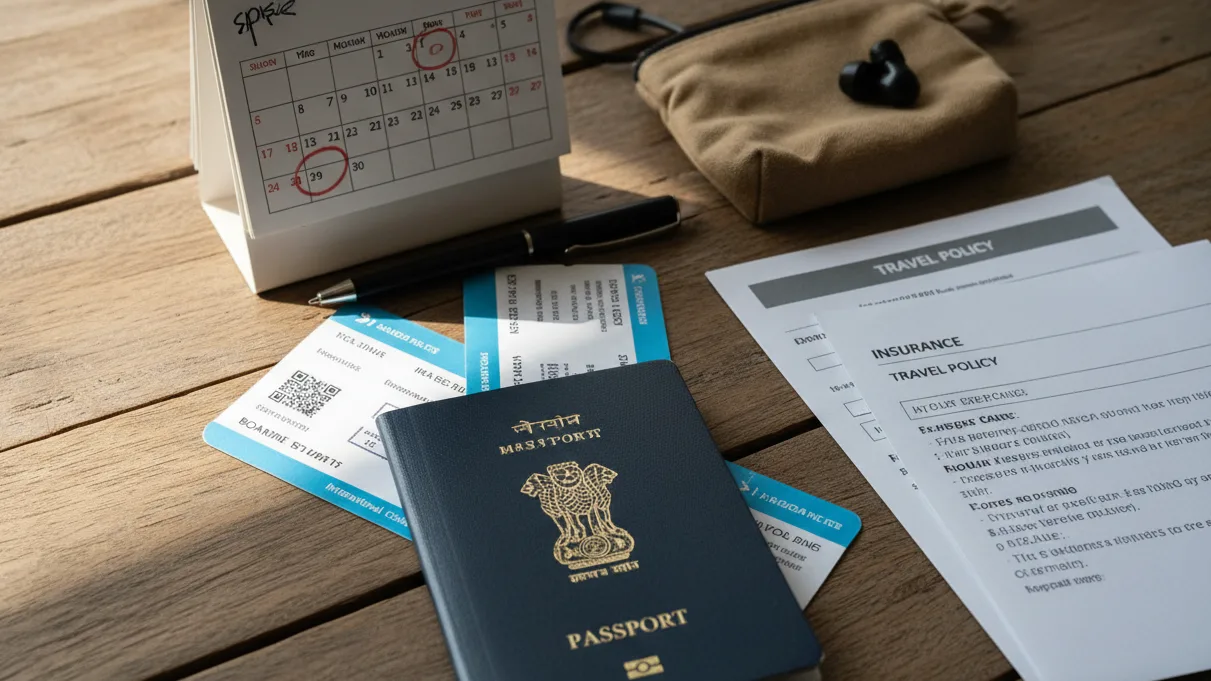
Spot the Real Tripwires and Use Your Exit Flight to Disarm Them
Most Thailand visa rejection anxiety gets pinned on the flight ticket, but the deeper issue is usually coherence. An onward ticket is strongest when it disarms a specific tripwire. It shows the trip is time-bound. It supports the hotel calendar. It explains the last travel day. It proves the applicant has thought beyond arrival.
Bank balance concerns: show stability, not surprises
Thailand guidance can involve evidence of adequate funds, and recent official messaging has reminded visitors to keep proof of sufficient funds ready for entry screening. Do not respond to this by making the trip look artificially expensive or by moving money at the last second without explanation. The cleaner pattern is a trip length that matches normal spending capacity.
- A five-to-seven-day Bangkok or Phuket stay is easier to support than an unexplained month-long trip.
- Hotel costs, internal travel and return travel should fit the balance shown.
- Recent large deposits may need a normal explanation if the file otherwise looks thin.
- A return ticket helps, but it does not replace credible funds.
Date mismatches: align every line on every page
Date mismatches are one of the easiest rejection risks to prevent. Reviewers do not need to prove fraud when documents contradict each other. They can simply treat the file as unclear. The practical fix is boring but powerful: build one calendar and force every document to match it.
| Document | What it should match | Common Thailand risk |
|---|---|---|
| Onward or return ticket | Visa form, hotel dates and declared stay length | Exit date later than hotel checkout or beyond plausible funds |
| Hotel booking | Arrival date, city order and departure date | Missing first night after a late Bangkok arrival |
| Bank statement | Trip duration and spending level | Long holiday with weak balance or unexplained deposits |
| Employment or leave letter | Travel period and return obligation | Leave ends before the return flight |
| Invitation, event or tour proof | Route and dates | Event date after the claimed departure from Thailand |
Employment proof that actually proves something
For Indian travelers and other applicants with workplace ties, employment proof should not merely say the applicant has a job. It should help explain why the traveler returns. A leave letter covering the exact travel dates is stronger than a generic employment certificate. If the exit ticket matches the approved leave, the file reads cleaner.
Students can use a similar logic with school schedules, enrollment letters or semester timing. Business owners can use registration evidence and ongoing business obligations. The key is not to over-explain. It is to make the return date feel normal.
First international trip: keep it short and sensible
A first-time international traveler can still make a strong Thailand file. The route just needs to be modest. A short Bangkok, Phuket, Krabi or Chiang Mai trip usually reads more clearly than a long multi-country loop with land borders and unclear accommodation. If travel history is thin, let simplicity do the work.
- Choose a normal arrival airport for the stated destination.
- Avoid a complex exit through a country where you do not clearly meet entry rules.
- Keep the stay length aligned with funds and leave.
- Use accommodation proof that covers each night.
Prior overstays or refusals: control what you can control
If there is a past overstay, refusal or immigration issue, the onward ticket becomes more important but not sufficient. You need a calmer file: shorter dates, stronger ties, clearer funding, and no route tricks. Do not hide facts that an application asks for. Do not submit multiple versions of the itinerary. Keep the travel plan consistent and defensible.

Make Your Exit Plan Verifiable and Low-Risk
A low-risk Thailand exit plan is not about choosing the fanciest route. It is about choosing the route that creates the fewest questions. For many tourists, that means a straightforward return to the home country. For backpackers or regional travelers, it may mean an onward flight to Malaysia, Singapore, Vietnam or Indonesia, but only if the next entry requirement is realistic.
Check your PNR the way reviewers do
If the reservation includes a booking reference, check whether the name and route can be retrieved through the relevant airline or booking channel while the reservation is active. Not every temporary reservation behaves the same way, and some airline systems display limited details. What matters is that the document you submit is not a static-looking PDF that fails basic consistency checks.
- Passenger name should mirror the passport spelling.
- Route should match the declared Thailand stay.
- Exit date should match accommodation and leave evidence.
- Booking reference should not be manually edited into a document.
- Flight time should leave enough room for hotel checkout and airport travel.
Time the hold so it is active when it counts
Timing matters. If a reservation expires before the reviewer or airline counter checks it, the document loses strength. Generate or refresh the reservation close enough to submission or travel that it remains useful, but do not change dates casually after the rest of the file is already built. If a date change is necessary, update the entire file rather than patching only the flight.
This is where a purpose-built dummy ticket for visa workflow can help, because the goal is not only a PDF. The goal is a clean, retrievable, date-consistent proof of travel intent that fits the application story.
Route smartly and avoid transit surprises
For Thailand, onward proof can be a return ticket or travel to a third country. But a third-country ticket should be realistic. If you show Bangkok to Singapore, make sure your passport, visa status or entry eligibility supports that next step. If you show Thailand to Vietnam, make sure the Vietnam entry plan is not missing. A reviewer may not check every onward country in depth, but a strange onward destination can still create doubt.
| Exit proof style | Best use | Risk to avoid |
|---|---|---|
| Round-trip ticket to home country | Short tourist trip with fixed dates | Return date beyond leave or hotel proof |
| Onward ticket to a third country | Regional Southeast Asia itinerary | No legal or practical plan for the next country |
| Flexible temporary reservation | Visa dates still being finalized | Expired record at review or check-in |
| Fully paid refundable ticket | Traveler comfortable with real funds and refund rules | Cash-flow pressure or refund delay |
Keep documents clean, readable and consistent
Do not manually edit flight PDFs. Do not crop screenshots until key details disappear. Do not submit one itinerary in the visa file and another at check-in. Thailand travel-document checks reward clarity. Your booking reference, surname, route, flight dates and destination should be readable without zooming or guessing.
Use DummyFlights to create a verifiable dummy ticket that supports your visa or entry file without buying a non-refundable ticket too early.
India-to-Thailand Playbook: Itineraries, Document Matrix and Edge Cases
For Indian travelers, Thailand is often a short leisure destination, but the document logic still matters. Recent Thai consular guidance has referenced visa exemption for Indian ordinary passport holders for tourism and short-term business engagement until further announcement, while also reminding travelers to carry genuine accommodation, TDAC completion and a confirmed return flight ticket. The practical lesson is clear: even when a visa is not required for a specific traveler category, return or onward proof can still matter at travel-document checks.

Three sample itineraries that make sense
Simple Bangkok return: Delhi to Bangkok for five nights, hotel in Bangkok for all nights, return Bangkok to Delhi. This is the cleanest file for a short first trip because the route, hotel, funds and exit are easy to compare.
Thailand beach trip: Mumbai to Phuket, stay in Phuket and Krabi, return from Phuket. This works when hotel bookings cover every night and the internal movement does not create a missing accommodation gap.
Regional onward trip: Bengaluru to Bangkok, five days in Thailand, onward flight to Kuala Lumpur, then return to India later. This can work when Malaysia entry eligibility, accommodation and onward movement are also coherent. It is weaker if Kuala Lumpur appears only because the traveler did not want to show a return ticket.
Your documents matrix: make the dates click
- Passport: valid for the required period and matching all name fields.
- Flight proof: arrival and exit dates match the declared stay.
- Accommodation: covers every night in Thailand or explains host stay clearly.
- Funds: support the length, city choice and travel style.
- Employment or study proof: supports the return date if included.
- TDAC or entry form: completed when required before travel.
Edge cases: how to de-risk them
One-way ticket: Add onward proof or a clear continuation plan. A one-way arrival with no exit story is one of the easiest ways to invite questions.
Staying with friends: Use a host letter or address details where required, and keep the flight dates aligned with the host stay. Do not pair a host stay with hotel dates that tell another story.
Multiple Thailand entries: If the itinerary leaves and re-enters Thailand, each entry and exit should have a purpose. Avoid a route that looks like border-hopping without a tourism reason.
Last-minute trip: Keep the file simpler, not more complex. Shorter stay, direct route, clear hotel proof and a realistic return ticket are stronger than a rushed multi-city plan.
Pre-Submission and Pre-Departure Checks
Before you submit a Thailand visa or travel file, run a ten-minute coherence test. This is more useful than adding extra documents. Extra documents can help only when they clarify the story. If they introduce a new date, address or route, they can make the file weaker.
Final pre-submission checklist
- Does the exit flight match the travel period on the form?
- Do hotel dates cover every night until departure?
- Can the booking reference and surname retrieve the itinerary while active?
- Does the next destination make sense legally and practically?
- Do funds support the planned stay without looking forced?
- Does your employment, study or business proof support returning on time?
- Are all names spelled according to the passport?
- Are screenshots avoided unless official PDF proof is unavailable?
- Have you removed duplicate or conflicting itinerary versions?
Pre-departure checks for smooth boarding
Airline counters care about whether the passenger appears admissible for the destination and has the documents required for travel. They may ask for a return ticket, onward ticket, visa, accommodation, entry form or funds depending on the route and traveler profile. Keep the same documents accessible on your phone and printed if practical.
The safest Thailand file is not dramatic. It is boring in the best way: a normal route, a clear exit, reasonable funds, covered accommodation and one consistent set of dates. That is how onward proof lowers rejection risk. It does not overpower the rest of the file. It makes the rest of the file easier to believe.
FAQ
Can an onward ticket reduce Thailand visa rejection risk?
Yes, it can reduce one risk signal by showing a clear plan to leave Thailand, but it does not decide the application by itself. The ticket should match the form, hotel dates, funds and travel purpose.
Is a return ticket required for a Thailand tourist visa?
Thailand tourist-visa guidance lists evidence showing that the applicant will leave Thailand, such as a round-trip ticket or a ticket to a third country. Exact document handling can vary by visa type, nationality and consular process.
Can Indian travelers be asked for a confirmed return ticket for Thailand?
Yes. Thai consular travel guidance for Indian ordinary passport holders has referenced carrying a confirmed return flight ticket along with accommodation proof and TDAC completion, so Indian travelers should keep exit proof ready.
Can I use an onward ticket to a third country instead of returning home?
Often yes, if the next country is realistic for your passport and route. The onward destination should not create a new question about whether you can legally enter the next place.
What makes an onward ticket weak for Thailand?
Weak signs include expired reservations, mismatched dates, manually edited PDFs, unclear passenger names, unrealistic routes, missing accommodation coverage or an onward country with no entry plan.
Should my Thailand hotel dates match my onward ticket?
Yes. Hotel dates should cover the stay until departure or clearly explain a host stay, overnight transit or city transfer. Missing nights make the itinerary harder to trust.
Does proof of funds matter if I already have an onward ticket?
Yes. Thailand guidance can involve sufficient funds, and official visitor reminders note that proof of funds may be checked. An onward ticket does not replace financial evidence.
When should I create a dummy ticket for a Thailand visa file?
Create or refresh it close enough to submission or travel that the reservation remains active during likely review or check-in. Avoid changing only the flight without updating the rest of the file.
Can a one-way ticket increase Thailand entry questions?
It can, especially when there is no onward travel, return plan or clear reason for the route. A one-way ticket is easier to defend when a realistic onward journey is documented.
Is a dummy ticket the same as a fake ticket?
No. A proper dummy ticket is a temporary reservation used to show travel intent. A fake ticket is a fabricated or edited document that cannot be verified and can create serious problems.