An onward ticket for a two-passport traveler should usually match the passport you will present at the first checkpoint that asks for proof of onward travel. If a visa, entry stamp, e-visa, airline document check or transit desk is tied to one passport, build the reservation around that passport’s exact name, passport number, nationality and date of birth instead of mixing details from both documents.
Two passports solve a lot of travel problems. They can open visa-free corridors, simplify returns to a home country, and let dual citizens choose the document that best fits a specific route. The confusion starts when you need travel proof and neither passport clearly tells you which one the onward reservation should match.
Visa officers may compare the ticket against the passport number on the application. Airline counters may compare it against the passport in your hand. Transit staff may care about the passport used for that checkpoint, while final-destination officers may care about another. This guide settles that question before it becomes a problem at the counter.
Key facts before creating onward proof with two passports:
- Choose the passport that governs the first checkpoint where onward proof will be checked.
- Match the reservation to the exact passport name, number, nationality and date of birth.
- Do not blend one passport’s visa advantage with another passport’s booking details.
- If different legs require different passports, separate bookings may be cleaner than one mixed reservation.
- Carry both passports, but present the document that matches the ticket unless an officer asks for the other.
Traveling with two passports and need clean onward proof? Create your DummyFlights onward ticket after you decide which passport controls the trip, so the reservation matches the document you will actually present.
Create Your Onward TicketIn This Guide
Official-source check: The U.S. Department of State says dual nationals may have obligations to both countries and that U.S. dual nationals must use a U.S. passport to enter and leave the United States. CBP also describes APIS as a system carriers use to transmit passenger data. That supports the practical rule here: always check country-specific passport rules, then make the onward ticket match the travel document being used for that checkpoint. Sources: U.S. Department of State dual nationality guidance and CBP eAPIS carrier data guidance.
Reviewed for: dual-passport routing, passport-number consistency, APIS/check-in wording, name-mismatch risk, transit-document logic, onward-proof positioning and factual claim control.
Which Passport Number Goes On Your Onward Ticket When You're Holding Two?

Holding two passports gives you options at the border, but it gives your onward ticket exactly one identity to match. Before you book anything, decide which passport this trip actually runs on. That decision shapes every detail on the reservation that follows.
The Passport Used For Your Visa Application Must Match The One On The Ticket
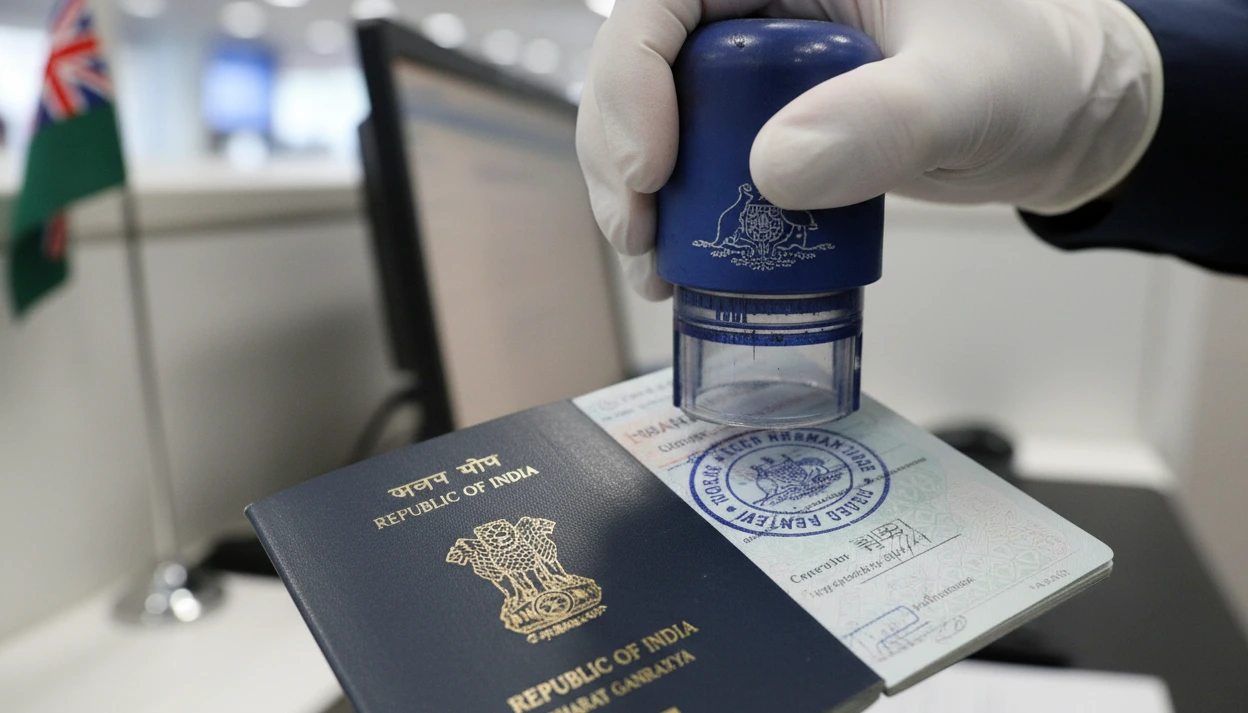
Visa officers do not reconcile your travel plans against “a passport.” They reconcile them against the specific passport number tied to your application. If you submitted a visa application using your Canadian passport, every document connected to that application, including the onward ticket, should point back to that same document unless the destination gives a different instruction.
It does not matter that you also hold a British passport that might get you into the same country visa-free. Once a visa is stamped, approved or digitally issued against one document, that document becomes the reference point for the rest of your file.
This matters more than it seems on paper. Many e-visa systems generate approval PDFs that display the passport number directly on the confirmation page. A mismatch between your visa approval and your onward ticket is no longer buried in separate paperwork. It can sit on a single screen, side by side, for any officer or airline desk to notice quickly.
Take a practical example. Suppose you are a dual U.S.-Italian citizen applying for a Vietnam visa using your U.S. passport. Your onward flight reservation should list the U.S. passport number, the name exactly as it appears on that passport, and matching personal details. If you accidentally generate the reservation using the Italian passport because it was the one in your hand that day, the reservation may be real, but it does not match the visa file it is meant to support.
The fix is simple. Confirm which passport carries the visa before you touch the booking. Everything downstream follows from that single decision.
What Happens When You Plan To Enter On One Passport And Exit On Another
Some dual citizens face a different version of the problem. They enter a country visa-free using one passport, but the return or onward ticket gets created before they settle which document they will actually use at departure.
Here is the practical rule: the ticket should reflect the passport being used at the checkpoint that needs the proof. If immigration is checking your entry document first, that is the passport the reservation should match. If an airline document desk is checking eligibility for the next country, the reservation should match the passport you present for that desk.
This connects to a broader travel habit that matters well beyond dual passport holders. Always verify entry and exit requirements for each national passport you carry. Some countries expect citizens or dual nationals to enter and leave using that country’s passport. Others may apply exit controls based on the passport used at entry. If you enter a country on one passport and try to leave on another without understanding the rule, the onward ticket may not be the only document questioned.
This is also where the difference between a visa-application problem and a boarding problem becomes important. If your actual trip involves flying out on a different passport than the one you entered with, that needs to be managed clearly at the airport and sometimes with separate bookings. Trying to build one reservation that represents two passport identities across entry and exit can create more confusion than it solves.
Travelers with dual citizenship should carry both passports on the trip, but only present the one that matches the checkpoint they are at. Keep the other passport available, but do not introduce it into the conversation unless an officer or airline agent specifically asks about it.
Dual Citizens Flying Through Visa-Free Corridors On A Second Passport
There is a third pattern worth planning for separately: using a second passport because it unlocks visa-free entry, while your primary passport remains tied to a longer-term visa, residence permit, work authorization or family status elsewhere.
In this setup, the onward ticket exists mainly to satisfy the immigration checkpoint tied to the visa-free passport, not a visa office. That shifts the matching priority. Instead of lining up the reservation against a visa number, you are lining it up against the exact name and passport number that will be scanned at check-in and arrival.
This is especially relevant for travelers who switch passports after crossing a land border and later fly out from a nearby airport. If you drive into one country on Passport A but plan to fly onward from that country using Passport B, ask which document will be relevant at the airport document check before creating the ticket.
Airlines are not trying to understand your full citizenship history. They are trying to confirm that the document in front of them satisfies the entry conditions for the next place you are going. That is why a correct, realistic, readable onward ticket matters most when your travel plan involves visa-free entry, one-way movement, flexible dates or an onward route that is not obvious from the first passport alone.
If you need a broader definition of how temporary travel proof works, the what is a dummy ticket guide explains the document logic behind reservations, PNRs, route proof and temporary booking evidence without mixing it with dual-passport specifics.
How Immigration And Check-In Staff Cross-Check Your Onward Reservation Against Your Travel Document
Getting the passport decision right on paper is only half the job. The other half happens at the check-in counter, transit desk and immigration desk, where staff run their own independent check against whichever document you hand over.
Why A Name Mismatch Between Passports Can Get Your Onward Ticket Flagged
Check-in agents do not always read your name the way a person would in casual life. Airline systems often rely on the machine-readable zone at the bottom of the passport, then compare that identity against the booking and travel document fields attached to the reservation.
For dual passport holders, this creates a specific risk. Your British passport might list you as “Sarah Jane Whitfield,” while your Australian passport reads “Sarah J Whitfield.” Both documents may be valid. Both may belong to you. But they are not the same string to a system checking travel documents quickly.
If the onward ticket was created using the name from one passport while you check in with the other, the system may not treat that as a minor variation. It may treat it as a mismatch, which can trigger manual review at the worst possible moment.
The fix is procedural, not complicated:
- Confirm which exact passport you will present before generating the reservation.
- Copy the name from that passport, not from a driver’s license, visa sticker, old ticket profile or the other passport.
- Double-check middle names, hyphens, suffixes and spacing.
- Use the same date of birth and nationality code attached to that passport.
- Recheck the PDF before leaving for the airport.
A traveler flying from Chicago to Frankfurt, for example, should treat the machine-readable identity on the departure passport as the single source of truth for every field on the onward reservation, not just the first and last name.
The Airline's System Doesn't Know You Have Two Passports
Airline reservation systems are built around a simple assumption: one traveler, one document identity per booking. A standard booking does not give the agent a neat field that says “secondary nationality available if needed.”
That matters because the system has no way to understand your context unless a human agent manually reviews it. If the passport number, date of birth, nationality or name attached to the reservation does not match the document being scanned, the result may look like a document error rather than a dual-citizenship nuance.
Consider a traveler with both Mexican and Spanish passports flying from Mexico City to Madrid. If the reservation was built using the Spanish passport but the traveler checks in with the Mexican passport because it was easier to reach in the bag, the airline system sees a mismatch. It does not automatically know that the Spanish passport exists.
This is why the passport decision needs to happen before the airport, not in the check-in line. Confirm these points in advance:
- Which passport will physically be in your hand at departure?
- Does the reservation reference that same passport identity?
- Does the destination require one of your national passports specifically?
- Does your onward country require proof of exit, onward travel or sufficient funds?
- Does your airline ask for travel-document details before online check-in?
Sorting this out the night before departure takes minutes. Sorting it out at a counter with a queue behind you can turn a simple document check into a stressful delay.
Transit Countries That Ask Which Passport You Entered On
Layovers add another layer, especially in transit hubs with visa-on-arrival rules, transit visas, manual document desks or security screening that asks which passport you used to enter the transit area.
Some checkpoints expect a simple, consistent story: the passport you present, the booking in front of them, and the next-leg proof should all make sense together. If you transit using one passport but your onward reservation appears to belong to a different nationality, staff may ask why the documents do not line up.
Take a traveler flying from Toronto to Doha, then onward to Nairobi. If the traveler uses a Canadian passport for the Doha transit process but intends to enter Kenya on a Kenyan passport, the airline and transit desk may still care which document is controlling the immediate movement through Doha. The final-destination passport matters, but so does the document being checked at the current desk.
The practical takeaway carries through every multi-leg itinerary: build the ticket around the checkpoint directly in front of you, not just the country at the end of the route. A reservation that works perfectly for final immigration but confuses the transit desk has solved the wrong problem at the wrong moment.
For visa-file routes where the issue is not dual citizenship but itinerary proof itself, BookForVisa’s visa flight itinerary requirements guide is the cleaner cross-reference, because that topic belongs to flight-itinerary documentation rather than onward-ticket service intent.
Booking Scenarios Unique To Two-Passport Travelers

Real trips rarely match a textbook example. Dual passport holders tend to run into a handful of recurring situations, each with its own logic for how the onward ticket should be built.
One Passport Has The Visa, The Other Has Better Visa-Free Access
Start with a simple test: book against whichever passport clears the first checkpoint that actually inspects it, not the passport that looks stronger on paper.
Picture a traveler holding both a U.S. passport and an EU passport. The EU document offers visa-free access to a destination that would otherwise require U.S. citizens to apply through a consulate first. It is tempting to build the onward ticket around the EU passport because it skips the visa process entirely.
But if the actual entry plan involves presenting the U.S. passport because a residence permit, previous approval or long-term status is tied to that document, the reservation needs to reflect the U.S. passport instead. Border officials at passport control do not give credit for holding a stronger passport that is not the one in your hand.
A useful way to think about it: the passenger details on your ticket support one specific document, not your strongest option. If a consulate stamped or issued a visa against Passport A, the onward ticket supporting that visa file should carry Passport A’s details.
There is also a practical reason to avoid the “book under the visa-free option just in case” instinct. If a visa officer, immigration officer or airline agent asks for the onward ticket tied to your visa, a reservation built around a different passport can raise more questions than it saves.
Connecting Flights Where You Switch Passports Mid-Itinerary
Some itineraries genuinely involve two countries and two identities across one trip. This is where one continuous reservation may stop being clean enough.
Take a traveler departing a home country on that country’s passport, flying through a hub, and then entering the next destination on a second passport that grants residence rights or faster processing. This is common among dual citizens who split time between countries for work, study or family.
In situations like this, it may be more reliable to treat the journey as two clean booking records:
- The first booking matches the passport used for departure and the connecting leg.
- The second booking matches the passport used for final entry.
- Each ticket should have its own coherent passenger details.
- Each checkpoint should see the passport and reservation that belong together.
This also affects timing. Passport control or manual document review at a connecting airport may take longer when staff need to understand a passport switch. Build extra buffer into the layover rather than assuming the fastest possible transfer.
Airlines care primarily about whether your documents satisfy entry requirements for boarding. They usually do not object to a traveler holding two valid passports. What matters is that each specific ticket matches the exact document being used for that leg’s entry requirements.
Married Name, Maiden Name, And Passports That Do Not Match
This scenario catches more travelers off guard than almost any other, mainly because it has nothing to do with citizenship and everything to do with paperwork timing.
A passport issued under a maiden name and a second passport issued later under a married name can both be valid documents. The problem is not legality. The problem is that they represent two different name strings, and a ticket can only match one of them at a time.
The rule is straightforward: match the ticket to whichever passport applies to that trip or visa application, not the name you currently use socially, the name saved in an airline profile, or the name on a local ID card. If the visa was granted under a married-name passport, the corresponding onward ticket should carry that married name exactly, including spacing and middle-name logic.
Problems surface when travelers mix the two without noticing. Someone applies for a visa using a married-name passport, then later creates a ticket while logged into an account still saved under a maiden name. The booking technically belongs to a real person and may even match another valid passport, but it does not match the document tied to this trip.
A small habit prevents most of this. Before creating travel proof, keep a private note that says which passport controls the trip, which name appears on that passport, and which document number should appear on the booking. This is not an official document. It is simply a personal guardrail so you do not let an old browser profile or saved passenger field decide for you.
Passport control agents are not evaluating your marital history. They are comparing the name field in front of them against the travel document in your hand. Any mismatch, however innocent, becomes a manual check rather than a routine one.
When One Passport Has A Different Transliteration
Some travelers hold passports issued in countries that transliterate names differently. A surname with accents, apostrophes, hyphens or non-Latin characters may appear one way on Passport A and another way on Passport B. Both spellings can be officially correct, but they are not interchangeable for a booking.
Use the version printed on the passport you will present. If the airline profile auto-fills another version, do not accept it blindly. A tiny spelling difference can be enough to force an agent to pause, especially when the ticket is being used as onward proof rather than a final paid itinerary.
If your passport has a machine-readable zone, use that zone as the cleanest source of truth. It removes accents and formatting in the way airline systems are most likely to process. When the visible name and machine-readable name differ slightly, keep the booking as close as possible to the airline’s accepted passenger-name format.
Building An Onward Ticket That Survives Scrutiny From Both Sides
Everything covered so far comes down to one final step: turning the right passport decision into a reservation that holds up when someone checks it. This is where the details get put into practice.
Match The PNR Details To The Exact Passport You Will Present
The governing rule across this topic is simple to state and easy to skip under pressure: decide the passport first, then build the reservation around it, never the other way around.
Before creating a ticket, confirm which country’s passport you will hold at check-in and at border control for this specific trip. Once that is settled, four fields need to match that document exactly:
- Full legal name, spelled as the travel document expects it.
- Passport number attached to the trip.
- Date of birth.
- Nationality code or issuing country used for that journey.
Skipping this step is how travelers end up delayed over something as small as a missing middle name, a hyphen, a saved profile error or a transliteration difference between two valid passports. A carrier’s system does not know your backstory. It only knows whether the fields in front of it match.
This matters even for short regional trips. A traveler holding two passports and planning to re-enter a second home country later that year still needs the onward reservation for the current trip to match whichever single passport is active for that journey, not a blend of both.
Why Booking Confirmation Alone Is Not Enough If Passport Details Are Wrong
A clean, professional-looking confirmation PDF can create a false sense of security. The document layout is not the only thing that may be checked. Airlines and immigration systems may compare reservations against data tied to the passport details on file, not just the paper you are holding.
This is worth understanding clearly: a reservation with the wrong passport number can look legitimate on the surface and still fail the moment someone compares it to the document being presented. For two-passport travelers, the risk is not that the booking is fake. The risk is that it belongs to the wrong identity for this checkpoint.
If you realize partway through planning that you used the wrong passport, correct the reservation before you travel. Do not wait to explain the mismatch at the counter unless there is no other option.
A properly prepared dummy ticket for visa or onward-proof document should support the file quietly: real passenger details, clear route, readable dates, and one passport identity per booking. That is the part reviewers and airline desks need to understand quickly.
A Quick Pre-Departure Checklist For Dual Passport Holders
Before finalizing anything, run through a short, practical checklist instead of relying on memory.
Before traveling with two passports, confirm:
- The first checkpoint that will inspect your onward proof.
- The passport you will present at that checkpoint.
- The name on the ticket matches that passport, not the other one.
- The passport number and nationality are correct if collected.
- The onward route fits the entry permission, visa-free stay or transit rule.
- The PNR or booking reference is readable on the PDF.
- You are carrying both passports, but not mixing them unnecessarily.
- You have enough time to correct the document before departure.
None of these steps are complicated on their own. What makes them effective is doing them in order, before the booking exists, rather than trying to explain a mismatch after you are already standing at the counter.
When A Fresh Onward Ticket Is Cleaner Than Explaining The Old One
If the reservation was created under the wrong passport, a fresh document is often cleaner than a long explanation. This is especially true when the mismatch affects more than one field: name, passport number, nationality, date of birth or destination eligibility.
Explaining one small difference can be reasonable. Explaining a chain of differences can make the file look improvised even when the traveler is legitimate. If you still have time before submission, check-in or departure, reissue the onward ticket around the correct passport identity.
This is where flexible temporary travel proof is useful. You are not trying to create a fake travel story. You are correcting the document so it reflects the real passport, real traveler and real route being presented at the relevant checkpoint.
One Passport, One Ticket, No Guesswork
Traveling with two passports gives you flexibility, but your onward ticket only represents one identity at a time. The moment you decide which passport governs the trip, everything else becomes easier: visa file, check-in desk, transit review and arrival control.
Make that call early. Match every field to the selected passport. Carry the second passport as support, not as a mixed identity inside the same booking. This single habit prevents most of the friction dual passport holders run into at borders and airline desks.
If you ever need to adjust a reservation after realizing the details do not match the right passport, fix it before the document is checked. A clean onward ticket should make the route easier to understand, not force the traveler to explain two identities under pressure.
Need onward proof that matches the right passport? Use DummyFlights to create a clean onward ticket with passenger, route and date details aligned before check-in or visa review.
Create Your Onward TicketFrequently Asked Questions
Which passport should my onward ticket match if I have two passports?
Your onward ticket should usually match the passport you will present at the checkpoint where proof of onward travel is checked. If a visa or e-visa is tied to one passport, use that passport for the supporting ticket.
Can I enter on one passport and show an onward ticket under another?
It can create confusion. Some travelers legally use different passports for different parts of a trip, but the ticket shown at a specific checkpoint should match the document being reviewed there.
What if one passport has my visa and the other has visa-free access?
Use the passport that actually controls the trip. If the visa was issued to one passport, the onward ticket supporting that visa file should match that passport, even if the other passport has stronger visa-free access.
Do airlines know I have two passports?
Not automatically. Airline systems usually process one passenger identity per booking. If the reservation details do not match the passport being scanned, the system may treat it as a mismatch.
Should I carry both passports when traveling?
Yes, dual passport travelers commonly carry both passports. Present the passport that matches the ticket or checkpoint, and show the second passport only if an officer or airline agent asks for it.
What if my two passports show different names?
Create the ticket under the passport name that applies to the trip. Do not mix a married name, maiden name, middle initial or old airline profile with a different passport identity.
Can a dummy booking be corrected if I used the wrong passport?
Yes, if the provider allows revisions. The cleaner option is usually to correct the passenger and passport details before submission or travel instead of explaining the mismatch later.
Does an onward ticket need my passport number?
Some reservations and document checks collect passport details, while others focus on name, route and dates. If passport details are used, they should match the document you will present.
Is one booking enough if I switch passports mid-trip?
Sometimes, but not always. If different legs clearly depend on different passports, separate bookings can be cleaner because each reservation can match the document used for that leg.
Does a correct onward ticket guarantee boarding or entry?
No. A clean onward ticket supports your file, but airlines and officers still review visa status, passport validity, route logic, entry rules and traveler eligibility.
Friendly reminder: DummyFlights provides temporary travel-proof documents for planning and application support. Requirements vary by destination, airline, route and applicant situation. A dummy ticket can support a file, but it does not guarantee approval, boarding or entry.