Short answer: If the name order on a dummy flight ticket differs from your passport, use the passport’s spelling and order as your controlling reference and check whether the airline’s system is simply displaying surname-first formatting. A dummy ticket for visa support should show the same passenger identity, route and dates as the rest of your file, but a reservation cannot replace a passport, visa, transit authorization or paid boarding ticket.
Your passport lists your name one way. Your flight reservation sometimes shows it another way, and that single inconsistency is enough to make a visa officer stop and look twice. A dummy ticket booking is meant to support your passport and visa form, not contradict it, yet name order problems slip into travel documents more often than most applicants realize.
A reversed surname, a missing middle name, or an extra initial can turn a routine flight itinerary into a document that looks out of step with the rest of your visa file. It’s necessary for the booking name to match the travel document to avoid complications. Even a well-prepared visa application can lose momentum over a detail this small.
This guide walks through why the mismatch happens, how consular officers actually read it, and what to do the moment you spot one on your dummy ticket. Book a dummy ticket that mirrors your passport name exactly and skip the reformatting headache altogether.
Key facts
- Airline systems may display surname-first names or remove punctuation without changing the underlying record.
- Missing, shortened or invented names are different from harmless spacing or slash conventions.
- Compare the ticket with the passport and application form before submitting it.
- A current, searchable reservation supports a file only where the destination checklist permits it.
Need a temporary reservation that reflects your passport name? Enter the identity details exactly as shown on the travel document, then review the first PDF before using it in an application.
Prepare your dummy ticketIn This Guide
- How Global Distribution Systems Reorder Your Name Without You Noticing
- What Visa Officers See When They Compare Your Ticket To Your Passport
- Fixing A Name Order Mismatch Before You Submit Your Visa File
- Booking A Dummy Ticket That Mirrors Your Passport From The Start
- Getting Your Name Right Before Your Visa Appointment
Official-source check
- IATA Travel Centre shows why passport and visa requirements are route- and nationality-specific and why carrier checks matter.
- GOV.UK transit guidance illustrates that document requirements depend on the route and permission held.
- Use the destination authority’s current checklist for the exact name, itinerary and supporting-document format it requests.
These sources support document consistency but do not create a universal name-display rule for every airline or visa office.
Reviewed for: passport-name order, surname-first airline displays, middle names and initials, PNR and document consistency, and safe distinction between a reservation and a paid ticket.
How Global Distribution Systems Reorder Your Name Without You Noticing

Most travelers never think about how their name gets processed once they submit it during checkout. It disappears into a booking system, gets reformatted, and comes back out on a flight itinerary that can look nothing like the input you typed.
The Surname-First Format Airlines Use Behind The Scenes
Airline global distribution systems may format names as SURNAME/GIVEN NAME. This isn't a mistake on the airline's part. It's simply how many airline systems have handled passenger records for decades, long before online visa applications became routine, and it applies just as much to domestic flights as it does to international travel.
The problem shows up when this internal format spills onto a printed itinerary or PDF ticket without proper punctuation or spacing. A missing space between the surname and given name, or a missing slash where one should sit, can make a two-part name look like one long word. If the surname sits first with no separator at all, a visa officer reading it quickly might interpret it as your first name, especially when your passport lists things in the opposite order.
Some booking systems display the passenger name exactly as entered, keeping the given name and family name in the same order as your passport and visa form. Others auto-convert it into their internal one-line ticket name format the moment you hit confirm. You often won't know which one you're dealing with until the confirmation document lands in your inbox, complete with an e-ticket number and a booking reference you'll need later for check-in.
When A Missing Middle Name Changes How Your Ticket Reads
Middle names are not mandatory for most flights. Plenty of passengers leave them off their dummy ticket booking without a second thought, and for most domestic flights this omission never comes up again. On international flights tied to a visa application, though, a missing middle name can create a visible gap between your passport name and your ticket name.
Here's where it gets nuanced. If your passport itself doesn't carry a middle name, leaving it off your reservation causes no issue at all. But if your machine-readable zone includes a middle name and your ticket drops it, an officer scanning both documents side by side may pause on the difference, even though nothing about the ticket is fraudulent. A missing middle name reads very differently from a missing family name.
A missing surname can lead to boarding denial. Airline counter staff will not check in a passenger whose government-issued travel document doesn't match the passenger name on file, and this rule applies whether you're flying with a major international carrier or a regional operator handling short domestic flights. A missing middle name is far less severe, but it's still worth correcting before an embassy sees it, and it's a different problem entirely from a missing surname.
Why A Shortened Name Looks Different From Your Passport
Nicknames and shortened versions of a legal name are common in everyday conversation, but they have no place on a travel document meant to support visa documents. If your passport lists "Alexander" and your dummy ticket says "Alex," that's a shortened name issue, not a simple spelling error, and it reads very differently to a visa officer trained to catch inconsistencies. The exact name on your passport is the only version that belongs on a ticket meant for a visa file.
The same applies to initials. Booking with just an initial for a first or middle name might feel like a shortcut. Initials can trigger questions during visa reviews. This happens particularly when the rest of your visa file spells the name out in full. A consular officer isn't trying to trip you up. They're simply checking whether every travel document tells the same, consistent story about who is traveling, right down to the correct name format on each page.
This is exactly why matching the passport's name order and spelling as closely as possible matters more on a flight reservation used for visa purposes than on one used purely for personal travel. Use the passport spelling and order as the controlling reference; airline systems may display punctuation or spacing differently. That rule applies wherever your name shows up in an official capacity.
A dummy ticket is a temporary flight reservation. Even so, it still needs to hold up to the same scrutiny as a paid ticket once it enters your application file. Minor formatting changes like uppercase text or extra spaces are generally less important. That distinction is worth remembering before you assume every small variation is a serious problem.
A practical way to catch this early is to compare your reservation against your passport the same day you receive it, rather than filing it away until your appointment. Read the name field slowly, character by character, instead of skimming it the way you might skim a hotel booking confirmation. Small formatting habits differ across booking platforms too.
Some systems insert a middle name automatically if one was ever saved to your traveler profile, even when you didn't type it into the current booking. Others strip it out entirely to keep a printed itinerary short. Neither behavior means the system made an error. It just means the responsibility for checking the final version sits with you, not with the airline or the reservation provider generating it.
Once you understand how these formatting quirks originate, the next question becomes how much they actually matter once they reach an embassy desk.
What Visa Officers See When They Compare Your Ticket To Your Passport
For the broader role of a reservation in an application file, see this flight reservation for visa complete guide; it is a cross-platform reference, not a substitute for the destination's checklist.
A visa application file rarely gets approved or denied on a single document. It gets approved based on whether every page in that file tells a consistent, believable story, and your flight itinerary is one of the first pages an officer opens, right alongside your cover letter and supporting documents.
Cross-Referencing Every Document In Your Visa File
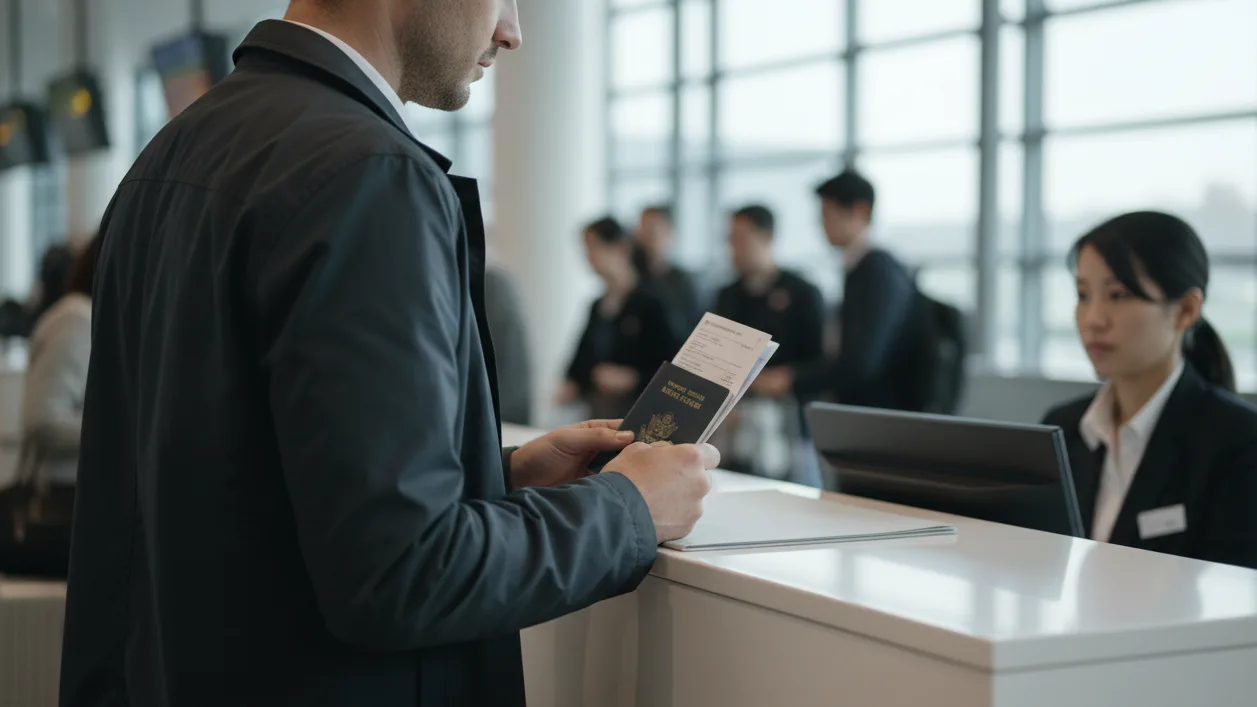
Visa officers cross-reference every submitted document with official passports. This includes your visa application, cover letter, supporting documents, and flight reservation, all checked against the same identity. Consular officers compare your flight itinerary directly with your passport. This happens line by line, well before they look at anything else tied to your travel plans.
This is not a casual glance. Officers processing hundreds of applications a week develop a habit of scanning for document consistency first, then reading content second. Visa officers look for document consistency when processing applications. That means a passenger name that appears correctly on your passport but incorrectly on your itinerary stands out immediately, even if every other page in your file is flawless. No single document can guarantee visa approval on its own, but a mismatched name can still work against your visa approval odds before an officer has read a single other page.
Airlines and verification portals rely on Passenger Name Records for compliance checks. These same records often get cross-checked informally by consular staff who know how to read a booking reference, and if your PNR pulls up a name that doesn't match your passport exactly, that discrepancy is visible the moment someone verifies it. The safest approach is to match the passport's name order and spelling as closely as possible. Keep that rule in mind on every flight reservation you submit.
The Difference Between A Formatting Quirk And A Real Mismatch
Not every inconsistency carries the same weight. An all-caps name, an extra space, or a difference in punctuation is generally treated as cosmetic, since these are recognizable artifacts of how airline systems print names, not signs of tampering. An officer who reviews dummy ticket bookings regularly can usually tell the difference between a system quirk and an actual identity concern, and same spelling with different capitalization rarely raises a flag on its own.
Airlines may allow minor corrections like one-letter spelling errors. These usually don't require a full name change, because they fall under fare rules that distinguish between typos and genuine mismatches. A swapped name order, however, sits in a different category entirely. It doesn't read as a typo. It reads as two different naming conventions applied inconsistently across your visa documents, and it's a far bigger flag than a single dropped letter.
Not every mismatch is treated the same way, and understanding this distinction helps you decide how urgently a correction is needed versus when a booking is genuinely fine as is.
A useful way to gauge severity is to ask whether a stranger glancing at both documents would still recognize them as belonging to the same person. A hyphenated surname split across two fields, or a comma sitting in an unusual spot, usually still reads as one identifiable traveler. A fully reversed name order often doesn't, especially when the applicant's background doesn't traditionally place the family name first.
Officers reviewing files from regions with different naming conventions are generally aware of this variation, but that awareness doesn't remove the need for your ticket to match your own passport's specific order, not a generic convention for your nationality.
How A Swapped Name Order Raises Doubt About The Ticket Holder
A swapped name order can make a reservation look fake or deceptive. This is especially true to an officer who has seen genuinely fraudulent bookings before. A name order mismatch can lead to doubts over the identity of the ticket holder. The officer simply cannot immediately confirm that the person named on the ticket and the person named on the passport are the same person.
If the name order is inverted, it may compromise the application file's trustworthiness. That holds true as a whole, even if every other document is accurate. Document alignment issues can lead to visa rejection or increased scrutiny. That increased scrutiny often means longer processing times, follow-up requests, or an in-person interview that could otherwise have been avoided. Name mismatches can delay visa applications and travel plans. This can happen in ways that have nothing to do with your actual eligibility to travel.
This is the core reason travel advisors keep repeating the same message: keep your passport name and ticket name identical wherever that name appears in an official capacity. It isn't bureaucratic caution for its own sake. It's a direct response to how visa reviews actually work behind the counter.
Knowing why officers care about this detail naturally leads to the more useful question: what do you actually do once you've spotted the mismatch on your own ticket?
Fixing A Name Order Mismatch Before You Submit Your Visa File
Before you reissue anything, review our what a dummy ticket is guide so the temporary-document role stays clear.

Spotting a name order problem before you submit your visa application is far better than discovering it during an interview. Handling a name order mismatch on a flight itinerary depends on the reservation status. The earlier you act, the more options you have.
Contacting Your Reservation Provider The Moment You Spot An Error
Contact the provider immediately if the name order on a dummy flight ticket does not match your passport. Attend to name order mismatches before submitting them to an embassy. Fixing a name order mismatch early prevents friction with consular officers. This matters later in the process too, not just at the visa counter.
Most reputable providers can reissue a temporary reservation with corrected passenger details within a short turnaround, often the same day. A genuine dummy ticket comes with a live PNR, which means a correction usually just requires the provider to update the booking reference and resend the document, rather than starting the entire reservation from scratch.
If you booked through DummyFlights.com, unlimited date changes are included, and the same responsiveness applies to name order corrections, since a reservation that doesn't match your passport isn't useful to you or the embassy reviewing it.
Most corrections move faster over email or a live chat window than over the phone, since a written request gives the provider your exact passport spelling to copy rather than relying on a verbal spelling-out that can introduce a fresh error.
Attach a photo of your passport's information page if the provider allows it, so there's no ambiguity about which order your name follows or which characters appear in it. A same-day turnaround is common for a straightforward reissue, though weekend requests may take a little longer depending on the provider's support hours.
What Major Airlines Will And Won't Change
International flights require exact name matches with passports. Airlines enforce this differently depending on their own fare rules. Reliable dummy ticket providers book you with major airlines like Air India, Air Canada, or Singapore Airlines, and each of these airline systems has its own tolerance for post-booking corrections.
A minor spelling error is usually correctable through the airline directly or the airline website without cancelling the reservation. A full name order change, however, often falls outside what a paid ticket allows without a rebooking. Airlines often reject tickets with mismatched names entirely.
This can happen even once a boarding pass has already been issued, and airport entry procedures are underway. Even a low-cost airline like AirAsia may charge a cancellation fee for a non-refundable ticket if the correction is treated as a name change rather than a typo fix, and the same caution applies with United Airlines or Air France on international flights.
This is one advantage of a temporary flight reservation over a fully paid ticket. Since no actual seat or fare is locked in the way it would be with a confirmed departure city and set travel dates, correcting the passenger name on a dummy ticket booking is typically far simpler than requesting the same fix on airline tickets tied to real payment details.
Business travel and group bookings sometimes complicate this further, since a travel agent managing multiple passenger details may need to update several files at once. For a single applicant preparing one visa file, though, the fix is usually a quick message to your provider rather than a multi-step airline process.
Building One Canonical Name Across Every Travel Document
Use a single canonical name across all documents. This includes your passport, visa form, cover letter, and flight reservation. If you've had a family name change, such as through a marriage certificate, decide which name format you'll use across every travel document going forward and apply it consistently, rather than mixing an old family name on one document and a new one on another.
A name correction at this stage is far easier than one requested after you've already submitted your visa file. Consistency across visa documents, supporting documents, and your flight itinerary is what allows an officer to move through your application without pausing to question the same person's identity twice. Travel insurance paperwork and hotel booking confirmations benefit from the same consistency, even though they usually draw less scrutiny than the flight reservation itself.
Getting this right before you book protects you from having to fix it under time pressure, which is exactly what a careful reservation process is designed to prevent from the start.
Booking A Dummy Ticket That Mirrors Your Passport From The Start
For a route-focused checklist, use the complete dummy-ticket-for-visa guide alongside your passport and application instructions.
The easiest way to avoid a name order mismatch is to prevent it before the booking is even confirmed, rather than correcting it afterward.
Checking The PDF Preview Before You Download Your Reservation
Check PDF previews for name order and spelling. Do this before finalizing any dummy ticket booking. Booking a dummy ticket online is a simple process. Even so, the speed of it can tempt travelers to skip this one verification step. A few extra seconds reviewing the passenger name field against your passport details, along with the flight details for your route, can save you a much longer correction process later.
Look specifically at how the given name and family name appear together, whether a middle name is included or dropped, and whether the format matches passport conventions rather than a casual version of your name. Ensure the name on the dummy ticket matches your passport. Do this before it becomes part of your visa file. Dummy tickets should match the passport name exactly. That standard is what lets a reservation hold up under review, and this one check is far less effort than requesting a name correction later, whether that's on a flight reservation or on a companion dummy hotel booking submitted alongside it.
Why Getting The Name Right The First Time Saves You From Reissuing
A valid dummy ticket includes a live PNR for verification. If a provider supplies a reservation, check that its reference is current and searchable before relying on it. This holds at every stage when an embassy or airline checks it. Getting the passenger name correct from the start means that the verification step confirms your identity cleanly, without an officer needing to reconcile two different spellings or orders.
Some visa checklists request a flight reservation or travel itinerary; follow the current checklist for your destination. A temporary reservation may reduce the risk of committing to a non-refundable fare before a decision, but it does not guarantee acceptance. No full fare is paid upfront the way it would be for a confirmed international flight. A temporary reservation can support a travel-proof requirement without committing to a full fare, where the checklist permits it. A temporary reservation can be used only where the destination checklist permits it and the details are truthful. That confidence grows even further once the name on the document mirrors your passport exactly, and the advantage only holds if the reservation itself is accurate from the moment you download it.
It also helps to keep a saved copy of your corrected reservation in the same folder as your passport scan and other visa documents, rather than relying on an email thread you might lose track of later. If you're applying with family members traveling together, check each traveler's name individually rather than assuming a shared booking automatically formatted every name correctly. Group reservations sometimes copy formatting quirks across every passenger record at once, so an error in one name can quietly repeat itself across the whole party's tickets.
With your reservation matching your passport cleanly, the last step is simply making sure the rest of your visa file, including any accompanying hotel booking or proof of accommodation, reflects that same consistency.
Getting Your Name Right Before Your Visa Appointment
A name order mismatch is fixable, and catching it early is what keeps your visa file consistent from the first page to the last. Treat your flight reservation the same way you'd treat any other travel document tied to your identity, and check it against your passport before it goes anywhere near an embassy desk.
A quick review at booking time, or a fast correction request if something looks off, is usually all it takes to move forward without hesitation. If you order a temporary document, enter the passport name carefully and review the first download before adding it to your file.
Ready to check your reservation before the appointment? Compare the passenger identity, route and dates against your passport and supporting file, then verify the reference before you submit.
Create your dummy ticketFAQ
Does the name on a dummy ticket have to match the passport exactly?
Use the passport as the controlling reference. Airline systems may reverse the order or remove punctuation, but the underlying given name and family name should remain identifiable and consistent.
Is surname-first formatting automatically a mistake?
No. Many booking systems display family name first or use a slash. Check the airline’s convention and make sure the full identity is still clear.
Should I include my middle name?
Follow the carrier and destination checklist. If the passport or machine-readable zone contains a middle name, including it consistently can reduce questions, but do not invent or shorten names.
Can a shortened first name be used on a visa reservation?
Avoid nicknames or shortened forms when the document supports a visa file. Use the passport spelling unless the airline or authority gives a specific alternative.
What if the PDF has the right name but the order looks different?
Compare the underlying given and family names, then check the PNR or carrier record. A display convention can be harmless; a missing surname or changed identity is not.
Can I submit a name-mismatched dummy ticket and explain later?
It is safer to correct the document before submission. Keep one consistent version across the application, reservation and any hotel or insurance evidence.
Friendly reminder: DummyFlights provides temporary travel-proof documents for planning and application support. Requirements vary by destination, airline, route and applicant situation. A dummy ticket can support a file, but it does not guarantee approval, boarding or entry.