
You reach the check-in desk with a valid passport, a visa decision, and a flight booking, yet the airline still pauses your file. That moment usually has less to do with missing papers and more to do with doubt. When your visa dates, transit plans, onward proof, or name details do not line up cleanly, airline staff stop thinking like customer service and start thinking like risk control.
That is the problem we need to solve before airport day. We need to understand what makes an itinerary look uncertain, why agents escalate some cases, and which documents actually remove real doubt fast. Once you see how airlines read your trip, you can prepare a cleaner file, answer questions better, and avoid a preventable boarding delay. If check-in questions your exit plan, keep a clear dummy ticket booking ready to support your route.
This guide owns the airport-document-uncertainty intent for DummyFlights: what causes airline pauses, what agents normally check, how onward proof is judged at the desk, and how to prepare a file that is easier to clear without overloading staff with unrelated paperwork.
If you need the broader visa-file framework before building onward proof, start with the complete dummy ticket for visa guide. It explains how flight reservations fit into forms, cover letters, accommodation dates and travel insurance so the file reads as one coherent travel plan.
For the practical visa-submission angle, use the dummy ticket for visa guide. It helps separate what a visa office normally wants to see from what an airline agent may ask at check-in when onward or return proof becomes relevant.
If the term itself still feels confusing, the foundation page on what a dummy ticket is explains the difference between a reservation, a paid ticket, a hold and a manually edited document, which matters when an airline asks for readable proof.
In This Guide
Why A Valid Trip Can Still Look Risky To An Airline Agent
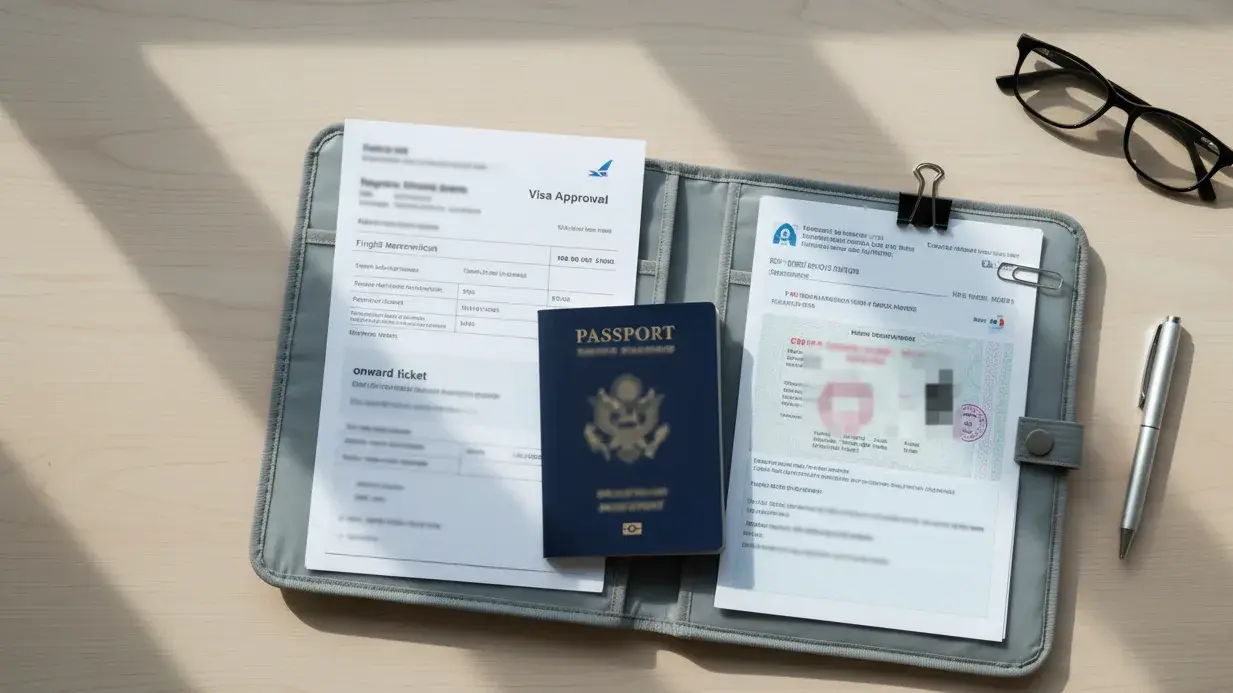
You can have the right visa, the right route, and a genuine travel plan, yet still get stopped at check-in. That usually happens when your documents are valid on paper but unclear when read together under airline pressure.
| Unclear signal | Why airline staff pause | Best document to show first |
|---|---|---|
| One-way or open-ended route | The exit or onward plan is not visible from the main booking. | Readable onward or return reservation with the same passenger name. |
| Transit rule depends on status | The agent must confirm whether the stop is airside, landside or status-based. | Transit support plus visa, residence permit or final-destination proof. |
| Name/date mismatch | The file may belong to the wrong person or wrong travel window. | Passport, visa page and corrected booking shown side by side. |
| Separate tickets | One booking does not automatically explain the next sector. | A simple route summary and both reservation PDFs. |
How Uncertainty Usually Starts Before The Boarding Pass Is Printed
The first warning sign often appears before you even reach the counter. You try to check in online, and the system tells you to see an agent. That message usually means your trip needs a human review, not that your booking is broken.
Airlines flag cases that do not fit a clean pattern. A one-way booking, a long transit, a separate onward flight, or a visa that starts close to arrival can all trigger that pause. The issue is not always legality. It is whether your file looks easy to clear quickly.
This is where small inconsistencies start to matter:
- Your passport name and booking name are formatted differently
- Your visa decision is in one document, but your onward proof is buried in another
- Your first flight is confirmed, but the rest of the journey looks disconnected
- Your arrival date and visa validity need a closer read
To you, the trip may still make complete sense. To the airline system, it looks incomplete until someone pieces it together.
Why Airline Staff Are Trained To Read The Trip, Not Just The Visa Page
At the desk, the agent is rarely judging one document alone. They are reading the whole travel story in front of them. That means your passport, visa, route, stay length, transit stops, and onward plan all get read as one file.
A valid visa page does not automatically solve everything. If your itinerary suggests a longer stay than your paperwork supports, or your transit point raises separate entry questions, the agent has to pause. We need to remember that airline staff are trained to ask one practical question: Does this passenger clearly meet the conditions to board this route today?
That question becomes harder when the documents point in slightly different directions. A few common examples make this clear:
- Your destination visa is valid, but your transit stop may require separate clearance
- Your onward booking exists, but it departs from another airport or on another ticket
- Your stay appears short in one document and open-ended in another
- Your visa allows entry, but your document set does not explain the trip sequence cleanly
This is why passengers sometimes feel unfairly challenged. They are looking at isolated documents. The airline is looking at whether the entire journey can be defended if something goes wrong after departure.
Denied Boarding: Pattern Identification in Reservation & Other Documents That Trigger Manual Review
Most check-in delays in the world come from patterns, not random suspicion. Once you know those patterns, you can see why a valid trip still gets held.
One common issue is timing confusion. Your visa may become valid after departure but before landing. That can be lawful, but the agent still needs to read the dates carefully and decide whether the route works as booked.
Another issue is status-based travel proof. Some passengers rely on a residence permit, long-stay visa, or re-entry document to support transit or return eligibility. If that document is not immediately clear, the airline may slow the process down.
Then there is a document mismatch, which causes more trouble than many applicants expect. Examples include:
- a missing middle name on one record
- surname order differences across documents
- hotel dates that do not align with flight dates
- onward proof that shows a different passenger format from the main booking
Even formatting matters. A clear PDF reservation is easier to assess than scattered screenshots. If a document is hard to read, cut off, or poorly organized, it creates doubt even when the underlying plan is legitimate.
Why “I Have All My Papers” Is Not Always Enough In Practice
At the airport, speed matters. The agent has a queue, a departure clock, and a responsibility to avoid putting the airline in a bad position. So the real standard is not just whether you have the documents. It is whether your documents explain the trip quickly.
That is why a thick folder does not always help. Ten supporting files can create more confusion than three clear ones. We need to think in terms of readability, not volume.
What usually helps most is a file that does the following immediately:
- matches names across every travel document
- shows the visa is valid for the arrival date
- makes the transit path easy to follow
- presents onward travel in a way that the agent can quickly verify
- avoids forcing the agent to guess how separate bookings fit together
What Airlines Usually Do When Your Travel Documents Do Not Look Straightforward

Once your file moves out of the routine lane, the check-in process changes quickly. The airline is no longer just processing a passenger. It is now checking whether your route, visa timing, and flight proof can be cleared with enough confidence to let you board.
What Happens At The Counter When The First Agent Is Not Fully Sure
The first agent usually starts with the basics, then slows down when something does not fit cleanly. That pause can happen after scanning your passport, reading your visa dates, or looking at your onward booking.
You may notice a few signs right away:
- The agent stops typing and rereads the screen
- Your documents are checked twice instead of once
- They ask where you are going after arrival
- They do not print the boarding pass immediately
- They set your passport aside while they review the route again
At that point, the case is still open. You are not denied yet. You are simply no longer being handled as a standard departure.
The agent will usually compare the travel dates against the visa validity and the route structure. If your entry permission starts close to arrival, if your trip includes a transit point with its own rules, or if your onward proof sits on a separate booking, they may need more than a quick glance.
This is why your answers matter. If you explain the trip in a clear, direct way, you help the agent connect the documents faster. If your explanation jumps between different dates, screenshots, and separate airlines, the review tends to slow down.
When Your Case Gets Escalated Beyond The Front-Desk Conversation
Some cases stay with the first agent. Others move up very fast. Escalation usually happens when the issue is not obvious enough for a front-desk decision.
That can mean:
- A supervisor is called over
- The agent checks an internal document support channel
- Your case is reviewed against airline reference systems
- More proof is requested from your email or phone
This step often surprises travelers because they assume the agent should decide on the spot. In reality, many borderline cases are passed on because the airline wants a second level of confidence before allowing boarding.
Escalation is common when the route has more moving parts than usual. A simple round trip with a clearly valid visa rarely creates this problem. A trip with separate tickets, close visa start dates, long transit timing, or status-based transit eligibility often does.
Once the case is escalated, speed depends on how easy your documents are to interpret. A clean PDF itinerary is more useful than a gallery full of cropped screenshots. A visible onward sector with the same traveler name is better than a booking reference sent in a chat thread. Airlines do not want to build your file for you under pressure to depart. They want to verify a file that already makes sense.
The Extra Questions Airlines Ask When They Are Trying To Decide Whether To Clear You
When the airline starts asking more detailed questions, each one has a purpose. The goal is not small talk. The goal is to test whether your paperwork and your travel story match.
You may be asked:
- What is your final destination?This checks whether the route on screen matches the trip you describe.
- Are you entering the country or only transiting?This matters because entry rules and transit rules often differ.
- Do you have confirmed onward travel?The airline wants to see whether you meet exit or onward expectations where relevant.
- Are these bookings linked or separate?Separate tickets create more uncertainty because one booking does not automatically explain the other.
- When does your visa become valid?This is critical when the departure date and arrival date sit close to the visa start date.
- What allows you to take this transit route without extra clearance?Some passengers rely on residence permits, long-stay visas, or nationality-based exceptions. If that basis is not clear, the airline will press further.
Clear answers help only when they line up with visible documents. If you say the onward flight is confirmed but cannot show a readable reservation, the answer does not close the gap. If you say you are only transiting but your file looks like an overnight entry, the airline will keep digging.
Why Some Passengers Are Asked To Wait Even After Showing The Right Document
A delay after document review often comes down to verification, not contradiction. You may have shown the correct visa or flight proof, but the airline still needs someone else to confirm that the case fits the route exactly as booked.
This waiting period happens for several reasons:
- The document is valid, but unusual for that route
- The transit rule depends on nationality plus residence status
- The timing is lawful, but close enough to require a second review
- The onward booking is usable, but not immediately easy to interpret
- The airline wants internal confirmation before releasing the boarding pass
This is where many travelers get frustrated. From your side, the case feels solved because the document exists. From the airline’s side, the question is different. They need to know whether that document is enough for this passenger, on this route, on this date.
That is why two passengers with similar-looking files can be treated differently. One file is simple to verify. The other takes interpretation. Airlines tend to slow down the second case because the cost of getting it wrong is not minor.
Why Airlines Often Become More Conservative Than Travelers Expect

Once your file leaves the routine lane, the airline starts protecting itself as much as it checks your trip. That is why a passenger who feels fully prepared can still face a stricter reading at the desk.
Why The Airline Carries More Risk Than The Passenger Realizes
If a border authority decides you do not meet the visa requirements for that route, the problem does not stop with you. The carrier may have to deal with denied boarding before departure, or denied entry after arrival, and both outcomes create cost, delay, and internal review.
From the airline’s side, this is not abstract. A bad call can lead to rebooking pressure, extra airport handling, staff reports, and questions about who was responsible for clearing the file. In some cases, the airline may also face direct charges from the destination country or practical disruption tied to return travel arrangements.
That is why check-in staff do not think like passengers. You are focused on whether your paperwork should work. They are focused on whether the airline can defend the decision if immigration officers challenge it later.
Their standard is therefore narrower than yours. A trip can look plausible to you and still look risky to them. That difference explains why airlines often decline borderline cases that a passenger, a friend, or even travel agents might describe as manageable.
Why “Technically Usable” Is Often Weaker Than “Easy To Defend At Check-In”
A document can be legally fine and still be weak at the counter. The problem is not always the rule itself. The problem is whether the rule can be checked fast, read clearly, and matched to your booking without doubt.
Think about how many cases turn on presentation. A visa decision shown as a cropped image, a transit exemption buried inside other documents, or onward proof that appears in a hard-to-read form may all be real, but none helps much if the agent cannot verify them quickly.
Airline staff need something more than technical validity. They need something that feels accurate, immediate, and easy to explain to a supervisor. That is especially true close to departure, when the desk has less time to interpret edge-case documentation.
In most cases, the stronger file is the one that can be understood in seconds:
- The passenger's name matches exactly
- The route explains why you can proceed
- The visa timing fits the arrival plan
- The onward sector is visible and readable
- The supporting status or permit is easy to trace
That is also why passengers sometimes lose ground by talking too much. If your answer becomes a long story about exceptions, prior trips, or what someone said on a forum, the case starts sounding less settled. The airline does not want a persuasive speech. It wants a clear travel file it can stand behind.
Why Separate Bookings, Open-Ended Plans, And Document Mismatch Feel Riskier To Carriers
Airlines are more comfortable when one booking tells one clean story. The moment your file depends on separate tickets, split records, or timing that only makes sense after explanation, the risk goes up from their perspective.
A few patterns trigger that reaction fast:
- You fly on one booking but show onward proof on another
- You arrive in one city and leave from another without a clear bridge between them
- Your return plan is flexible, but nothing in the file shows how it fits the stay
- Your route depends on transit treatment that changes across other countries
- Your passport name and reservation name differ just enough to invite a second look
None of this means the trip is wrong. It means the airline sees more room for a mistake.
That matters because the airline is not trying to decide what is fair. It is trying to reduce uncertainty before the door closes. Even a paid reservation can raise questions if its dates, passenger details, or sequence do not line up cleanly. The same applies when a traveler says they will sort out the latter sector after they land. That may suit a flexible holiday or business schedule, but it does not give the check-in desk much to work with.
Some passengers also rely too heavily on context that is invisible at the counter. You may know your parents live in the city you are visiting, or that your course starts a few days later, or that you plan to contact a host after landing. None of that helps much unless the file in front of the airline already supports the route you want to carry through check-in.
Why Your Tone At The Desk Can Influence The Outcome Of A Borderline Review
When your case is closed, your tone becomes part of the review. Staff is listening for whether you understand your own route, whether your answers match the file, and whether you can produce the right page without confusion.
That does not mean you need to sound formal. It means you need to sound settled. A calm person who can explain when they will arrive, where the onward segment sits, and why the route meets the relevant regulations makes the case easier to clear.
What usually helps:
- Answer the question asked, not three questions around it
- Open the exact reservation or visa page, not a gallery of screenshots
- Keep your wording simple, especially if the language at the desk is not your strongest
- Avoid arguing about what the government website seemed to suggest in general
- Do not assume a passport stamp from an older trip proves this one will work the same way
This is also where the airline’s contract of carriage sits quietly in the background. The staff member does not need to win the argument. They need enough confidence to let you board without creating a bigger problem later.
How Visa Applicants Can Build A Travel File That Resolves Doubt Fast
Once you understand how airlines read risk, preparation becomes much more practical. The goal is not to collect more papers. The goal is to build a flight file that answers the airline’s real questions before check-in becomes a slow review.
How To Prepare A Document Stack That Answers The Airline’s Real Concerns
Your documents should work like one connected record, not a pile of separate proofs. The airline wants to see identity, route, timing, and exit logic in one clean flow.
A strong travel file usually starts in this order:
- passport
- visa or entry decision
- primary flight reservation
- onward or return proof, if your route needs it
- transit support, if a stopover creates extra checks
- residence permit or other status document, if that affects your eligibility
That order matters because it mirrors the way airline staff think. First, they confirm who you are. Then they check whether you can enter. Then they look at whether your flight pattern matches that permission.
You should also make sure the file reads consistently. That means:
- Names match across all records
- Dates line up without guesswork
- Airports and routing make sense together
- Any separate sector is easy to connect to the main trip
This is where many applicants lose clarity. They focus on whether each document exists, but not whether the set works together. Good preparation is really about integration. The airline should not have to interpret your plan in advance. It should be visible from the first few pages.
If a document needs an explanation, keep it short and factual. A brief note in your own folder-naming convention can help you find the right file quickly, but the visible proof itself should still do most of the work.
How To Make Your Onward Or Return Proof Look Usable At The Counter
Onward proof helps only when it can be read quickly. A valid booking hidden inside email chains, screenshots, or mixed itinerary versions creates friction even when the route itself is fine.
The most useful proof has a few clear features:
- full passenger name
- booking reference or PNR
- departure city and destination
- exact travel date
- airline or operating flight details
- readable layout in PDF form
The agent should be able to open the file and understand it in seconds. If the reservation looks partial, cropped, or disconnected from your main route, it becomes harder to use.
You should avoid assembling your plan from fragments. For example, a screenshot showing the date, another showing the route, and a third showing the name are far weaker than a single clean reservation page. The same applies when you carry three alternative bookings because you have not decided which one matches your final interests. More options do not create more confidence. They usually create more doubt.
Keep the onward or return proof aligned with the rest of your trip. If you land in one city and plan to leave from another, the broader itinerary should still make sense at a glance. If the route depends on a short surface transfer or a separate domestic hop, be ready to show that part clearly as well. The best document is not the one you understand after ten minutes. It is the one that the airline understands immediately.
When It Helps To Use A Clean, Verifiable Reservation Instead Of A Messy Placeholder
Sometimes the problem is not your route. It is the format of the proof you are carrying. A clean, verifiable reservation is often easier to present than a rough placeholder pulled from scattered emails or temporary holds that do not display well at the desk.
When a visa applicant needs proof of flight that is easy to present and easy for staff to understand, a clean reservation can reduce unnecessary check-in friction. DummyFlights.com offers instantly verifiable reservations with PNR and PDF, unlimited date changes, transparent pricing at $15 (~₹1,300), accepts credit cards, and is used by travelers worldwide for visa use.
The practical point is simple. Whatever service you use, the reservation should look stable, readable, and easy to match to your visa timing. That matters more than trying to impress the desk with extra paperwork that adds no real value.
What To Do In The Final 24 Hours Before Departure If Your Case Is Even Slightly Unusual
The last day before departure is when you tighten the file, not when you hope the airline will sort it out for you. If your route has a transit complication, a separate onward booking, or visa dates that sit close to arrival, do a final review with fresh eyes.
Check these items carefully:
- Passport name matches the booking exactly
- Visa validity covers your arrival date, not just your departure day
- Onward proof is downloaded as a PDF
- Every file is accessible offline
- The main reservation and the onward reservation tell one clear story
- Any transit support is saved in the same folder
You should also prepare a short spoken explanation of the trip. Not a long defense. Just a simple version, the desk can follow. For example: “We arrive in Madrid on the 14th, enter on a valid Schengen visa, and leave for Casablanca on a confirmed onward booking on the 18th.” That kind of wording helps because it is precise and easy to verify.
Arrive earlier if your case is even slightly unusual. Extra time is not just for long lines. It gives the airline room to review your file without turning the moment into a rushed dispute. That matters because once the desk feels pressed, it becomes less willing to stretch toward a favorable reading.
You should also keep your expectations practical. If the airline pauses your file, that does not create a right to compensation. The better approach is to prevent the pause by making every critical document fast to read and easy to defend. When your travel file does that well, the final part of the article becomes much clearer: most airport document problems begin long before you reach the counter.
Need onward proof that is easy to read at check-in?
Use DummyFlights to create a clear, verifiable reservation PDF when your airline or route needs visible onward or return proof.
Make Your File Easy For The Airline To Clear
When your travel documents look unclear, the airline is not judging your trip the way you do. It is deciding whether your visa timing, flight sequence, transit route, and onward proof are clear enough to support boarding on that exact journey. That is why small mismatches, messy reservations, or hard-to-read files can turn a valid trip into a slow airport review.
The smarter move is to prepare for the airline’s questions before check-in starts. When your passport, visa, flight reservation, and onward plan read as one clean story, you give the desk fewer reasons to pause your file and more reasons to clear you with confidence.
Airline Travel Document Checks FAQs
What do airlines do when passenger travel documents are unclear?
They usually pause check-in, review the route, compare passport and visa details, check onward or return proof, and may escalate the case to a supervisor or document-support channel before issuing the boarding pass.
Can an airline deny boarding even if I have a visa?
Yes. A visa helps, but the airline may still stop boarding if the visa timing, transit route, passport details, onward proof or final-destination documents do not clearly support the exact journey booked.
Why do airlines ask for onward or return proof?
Airlines ask when the destination, transit point or route creates a need to show how the passenger will leave, continue travel or meet entry conditions. The proof must be readable and consistent with the rest of the file.
What documents should I show first at check-in?
Show your passport, visa or entry approval, main flight booking, onward or return reservation, transit support if needed, and any residence permit or status document that affects the route.
Is a screenshot enough for airline document checks?
A screenshot may help, but a complete PDF is usually clearer because it can show the passenger name, PNR or booking reference, route, date and airline details in one place.
Why does online check-in tell me to see an agent?
It often means the airline needs human review of travel documents, visa timing, transit rules or onward proof. It does not automatically mean the booking is wrong.
What makes a travel document file look risky to airlines?
Common risk signals include mismatched names, close visa start dates, separate bookings, unclear transit status, cropped screenshots, open-ended plans and onward proof that does not match the main itinerary.
Can a dummy ticket help when airline staff ask for onward proof?
A dummy ticket can help when it is a real, readable reservation with matching passenger details and route logic. It should support a genuine travel plan, not replace required visas or official entry documents.
Should I bring multiple alternative bookings to check-in?
Usually no. Multiple competing bookings can create confusion. Bring the single itinerary that matches your actual route, visa dates and onward or return plan.
What should I do if my case is escalated at the counter?
Stay calm, answer only the question asked, open the exact document requested, and explain the route in one short sentence. Avoid arguing from general forum advice or showing unrelated files.
Can transit documents cause airline delays?
Yes. Transit rules can depend on nationality, airport, terminal change, baggage collection, final destination and residence status. If the basis is not obvious, staff may need a second review.
How can I reduce airport document-check problems before departure?
Download every key file offline, match names and dates across documents, prepare a short route explanation, keep onward proof readable, and arrive earlier if the route has any unusual transit or visa timing issue.