
- SWISS offers a paid 48-hour reservation-with-price-guarantee option on eligible Lufthansa Group-operated flights.
- The hold surcharge is separate from the final ticket price and is not treated like a deposit.
- During the SWISS hold period, changes are limited; if the route changes, you usually need a new reservation.
- For visa use, the document must match your passport, hotel dates, insurance dates, cover letter and intended route.
- A dummy ticket is strongest when it supports a real plan, not when it hides uncertainty or replaces official visa evidence.
Create Your Dummy Ticket
You know your itinerary is not just dates and airports. It is a visa strategy, a budget decision and a timing puzzle. With SWISS, the official fare-hold feature can help when you only need a short window to confirm documents, compare options or speak with a travel companion. But a hold is not always the same thing travelers mean when they search for a Swiss Air dummy ticket.
This guide explains where the SWISS hold works, where it breaks down, and when a separate dummy ticket booking is the cleaner option. The focus is practical: India payment friction, Schengen documentation, PNR wording, airline counter checks, 48-hour timing, multi-city issues, and how to keep the travel story believable from the visa file to the airport.
In This Guide
Official-source check: SWISS describes its reservation with price guarantee as a way to reserve eligible flights for 48 hours after paying a surcharge. SWISS says the final price is shown during booking, the surcharge is separate from the ticket price, the reservation automatically expires after the 48-hour window if unused, and extensions are not possible. SWISS FAQ wording also notes availability limits, the 24-hour-before-departure cutoff, LX flight-number relevance, and that seats are normally selected after confirmation. For Schengen visa context, EU sources describe supporting documents for purpose, accommodation, means and intention to return, and the Visa Code includes reservation or return/round ticket examples. Sources: SWISS reservation with price guarantee, SWISS hold-the-booking FAQ, European Commission Schengen visa guidance and EU Visa Code consolidated text.
Reviewed for: SWISS fare-hold wording, LX route practicality, India payment and OTP friction, Schengen travel-proof alignment, PNR terminology, dummy-ticket claim safety, airline-check realism and route-date consistency.
How the SWISS Hold Works
SWISS gives travelers a short official decision window through its reservation-with-price-guarantee feature. In simple words, you select eligible flights, pay a surcharge, receive a confirmation email, and then decide within the hold period whether to complete the booking at the guaranteed price. For many routes, the practical window is 48 hours.
That makes the feature useful when your decision is almost ready. Maybe your manager needs one more approval. Maybe your visa appointment is tomorrow. Maybe your family needs to confirm one date. In those cases, a SWISS hold can protect a fare without making you buy the full ticket immediately.
Where the hold option appears
The hold option normally appears late in the booking path after you select flights and move toward checkout. Travelers often look for wording such as reservation with price guarantee, fare hold, hold the booking, or a similar phrase. If the button does not appear, it does not always mean the feature is unavailable forever. It can depend on route, fare family, sales country, flight number, payment method and how close the flight is to departure.
- Search your route and dates on the SWISS website.
- Prefer flights with an LX flight number where possible.
- Proceed toward traveler details and payment.
- Look for the price-guarantee or hold option before final payment.
- Read the exact fee, expiry time and conditions shown in your own session.
If the option is missing, try a cleaner route, a different fare family, a fresh browser session, or a nearby date. Codeshares, mixed cabins, promotional fares, tight departure windows and complex multi-city patterns can reduce availability.
What the fee covers
The fee buys time. It does not normally become a credit toward the full fare. It does not mean the booking is fully ticketed. It also does not unlock every extra service you would expect after ticketing. Think of it as a short-term price-protection tool, not as a visa product by itself.
- The surcharge is charged separately.
- The final amount is shown during the booking flow.
- The hold is time-limited, commonly 48 hours.
- Changing the held reservation is usually not the clean path.
- Seats, baggage and some extras generally come after ticketing.
The clean habit is to set your own deadline several hours before the official expiry. Confirm the ticket, cancel if the system allows, or let it lapse according to the rules shown. Do not wait until the last few minutes when payment gateways, OTP prompts or bank-risk filters can ruin a good plan.
SWISS Hold vs Dummy Ticket: Which One Fits Your Situation?
A SWISS hold and a dummy ticket solve related but different problems. A SWISS hold is an airline checkout feature designed to protect a fare for a short period. A dummy ticket is a temporary travel-proof document used when you need a believable itinerary before committing to final airfare. The right choice depends on timing, route complexity and what the document needs to prove.
If you are new to the concept, start with the what is a dummy ticket guide so the wording is clear before you submit anything. The key point is simple: the document should be honest about the travel plan it supports and should not be edited to look like something it is not.
Use the SWISS hold when the decision is inside 48 hours
The SWISS hold shines when your uncertainty is short and specific. You know the route, passenger names, date range and budget. You only need a little time to confirm one missing piece.
- Your VFS or embassy appointment is tomorrow or the next working day.
- Your manager or family member will confirm within two days.
- You want to protect a fare while checking hotel or meeting dates.
- Your route is simple and mostly SWISS/LX-operated.
- You are comfortable completing or dropping the booking before expiry.
This is the cleanest airline-native path. It is official, time-limited and easy to understand. The weakness is the clock. If your appointment moves, your sponsor delays a letter, or your document pack needs a week, the hold may expire too early.
Use a dummy ticket when the visa timeline is longer
A dedicated dummy ticket is more useful when your file needs travel proof but the final airfare purchase is premature. Many travelers are not trying to trick anyone. They are trying to avoid locking money into a non-refundable ticket before the visa path is clear.
- Your embassy appointment is several days away.
- Your visa processing timeline is uncertain.
- Your hotel, insurance and cover letter already need aligned dates.
- Your route may change after approval.
- You need a clean PDF with passenger, route, date and reference details.
For broader visa use, compare this article with the dummy ticket for visa pillar. That page covers the full visa-file logic, while this article focuses on SWISS-specific timing, holds and Swiss Air dummy ticket decisions.
Do not confuse a hold with a fully paid ticket
This is where many articles overpromise. A hold is not always a ticketed booking. A reservation can have a booking reference without an e-ticket number. A fully issued ticket usually carries ticketing details that are different from a temporary reservation. If a consulate or airline asks for a paid ticket specifically, read the wording carefully before assuming a hold or dummy ticket is enough.
If the requirement says “flight reservation for visa,” that broader reservation wording belongs naturally on BookForVisa; you can use the flight reservation for visa guide for that intent. DummyFlights should stay focused on dummy ticket, dummy flight ticket, onward ticket and temporary travel-proof use cases.
India Payment and Timing Reality
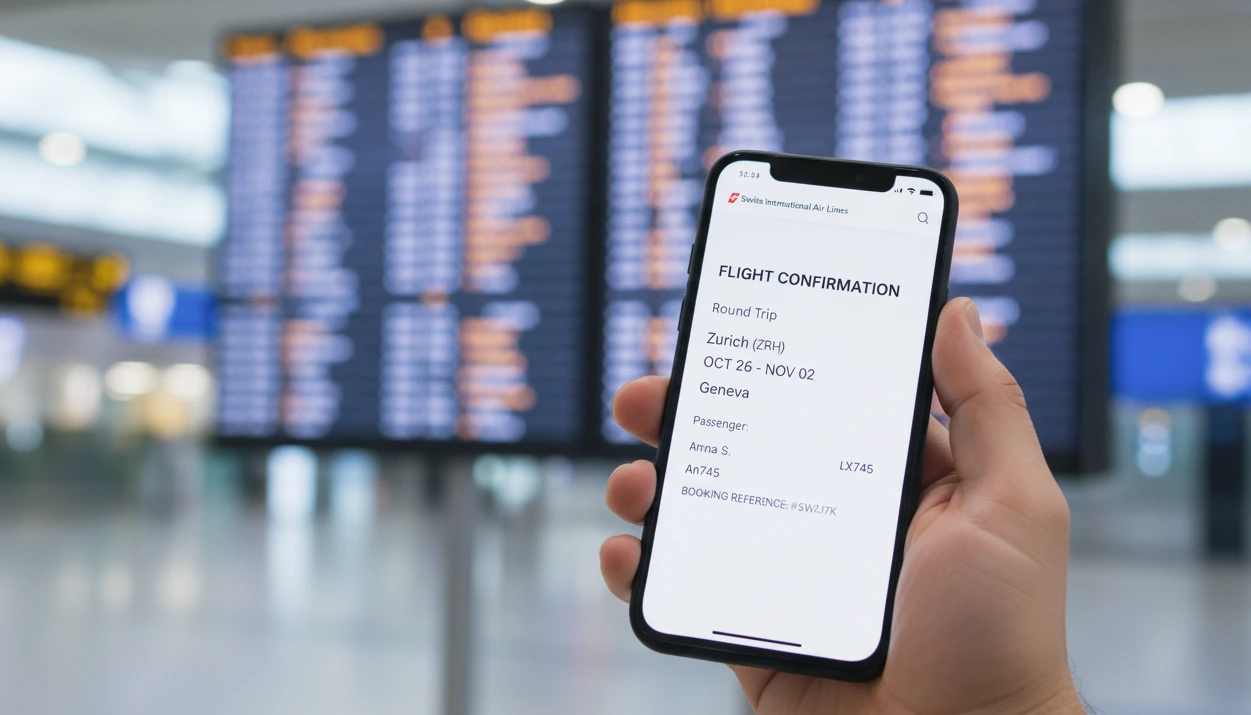
Indian travelers often lose time not because the plan is bad, but because payment friction appears at the worst moment. International card settings, OTP prompts, foreign-currency conversion, bank risk checks and mobile checkout bugs can all turn a simple fare hold into a stressful hour.
Card and currency checks before you start
Before using the SWISS hold, prepare the payment side. The fee may appear in a foreign currency, and your bank may apply its own exchange rate and markup. For one passenger, the difference is small. For a family or group, small fees can stack.
- Enable international card usage before checkout.
- Confirm your bank’s OTP or 3D Secure flow.
- Use a stable desktop session when possible.
- Do not double-click during payment authorization.
- Keep a second payment card ready for genuine gateway failure.
If the payment fails after the hold appears, do not panic-click. Start a clean browser session, check your bank settings, and retry carefully. If a booking code was issued, use that reference when contacting SWISS support.
Why the 48-hour clock feels shorter from India
Time zones matter. SWISS FAQ wording says the consideration period is based on local time at the departure airport. For India-origin travelers, that means you should not think of the hold as two relaxed calendar days. Treat it as one controlled decision window.
- Place the hold during Indian business hours if you need bank or office support.
- Send the itinerary to your manager, family or travel desk immediately.
- Set a reminder 12 hours before expiry.
- Make your decision before the final evening, not in the final hour.
- If the visa appointment is not close, avoid spending money on short holds repeatedly.
For India-based visa applicants, the real enemy is not the SWISS hold itself. It is stacking a short airline clock against a longer embassy, HR, school, client or VFS clock. When the timelines do not match, the smarter move is a clean temporary travel-proof document and a final ticket later.
When phone support helps
A phone call can help when technology blocks an otherwise eligible booking. It should not be treated as a secret rulebook. Agents can sometimes help with payment, booking retrieval, name-format clarification or a confirmation email issue. They generally cannot make an ineligible route eligible just because you ask.
- Call if the payment page fails after the hold option appears.
- Call if your passport name format is difficult to enter online.
- Call if you received a confirmation but cannot retrieve the record.
- Do not rely on phone support for a guaranteed longer hold period.
- Do not expect a refund of the hold surcharge unless the displayed terms allow it.
Website, phone and agency holds are not always the same
A big source of confusion is that travelers use the word “hold” for several different things. One person may be talking about the SWISS website price-guarantee feature. Another may be talking about an airline agent helping with a payment issue. A third may be talking about a travel agency creating an unticketed reservation through its own workflow. These can look similar to the traveler, but they do not carry the same rules.
The website option is the cleanest when it appears because the terms are displayed in your own session. You know the clock, the surcharge and the payment path. Phone support can help execute the same general booking logic when a browser or card problem gets in the way. Agency-created holds can be useful in some circumstances, but they add a middle layer; if the fare expires, the record purges or the agency wording is unclear, the traveler may not understand what they actually hold.
- Use the SWISS website when the route is simple and the hold button appears.
- Use phone support for payment, confirmation or name-format issues.
- Use agency help only when you understand whether the record is ticketed, held or merely proposed.
- Ask for the booking status, expiry time and whether an e-ticket number exists.
- Do not present an agency promise as an airline-issued paid ticket.
Why travelers still talk about 72-hour holds
You may see old forum posts or agency pages discussing 72-hour holds. Some were accurate for a specific market, route, tool or earlier period. Some refer to agency workflows rather than the official SWISS retail feature. The safe planning move is to trust the terms visible in your own booking session, not a memory from another traveler’s route.
For visa planning, this matters because a wrong assumption about the clock can break the file. If you plan around 72 hours but your actual SWISS hold expires after 48 hours, your proof may be stale by the time you attend biometrics. If you plan around the stricter 48-hour baseline, you can still benefit from a longer window if one appears, but you are not dependent on it.
Pro tips to stretch the useful window without paying twice
You cannot extend the SWISS hold itself, but you can use the window intelligently. The goal is not to game the system. The goal is to avoid wasting the 48 hours on avoidable admin.
- Prepare passport details, card settings and travel dates before starting checkout.
- Place the hold only after the main decision-makers are ready to review.
- Send the held itinerary immediately to HR, family, school or client contacts.
- Set a personal decision deadline well before the official expiry.
- Avoid creating duplicate holds on the same route unless there is a clear reason.
If you need to rework the itinerary, let the old decision close cleanly and rebuild with the new route. Duplicate holds can create confusion, extra fees and mixed versions of the same trip. For visa documents, version control matters. The PDF you submit should match the story you tell everywhere else.
Price Clarity: Hold Fee, Flexible Fare or Dummy Ticket?
The smartest option depends on what risk you are paying to remove. A SWISS hold removes short-term fare risk. A flexible fare removes change risk. A dummy ticket removes the risk of buying final airfare before the visa plan is stable. None of these is automatically best for every traveler.
When the hold fee is the smartest spend
The hold fee makes sense when the answer will arrive quickly. You are not uncertain about the trip itself; you are waiting for one small confirmation. In that case, paying a small surcharge to protect the fare can be better than watching the price jump while you wait.
- You will know within one or two days whether to travel.
- The fare is attractive and may rise.
- Your route is simple enough for the hold option to appear.
- You are ready to pay the full fare if the decision is yes.
- You will not need several rounds of date changes.
A common example is a traveler from India waiting for final leave approval. The route is Delhi–Zurich–Delhi, the passport details are ready, and the manager will confirm tomorrow. A short SWISS hold gives the traveler enough breathing room without committing the full ticket amount today.
When a flexible fare is better
Flexible fares look expensive until dates start moving. If your appointment can shift by a week, your client can move a meeting, or your family schedule is not fixed, a higher fare with change flexibility may be cheaper than repeated holds, rebooked reservations and last-minute fare jumps.
- Your travel date may move by more than a few days.
- You need baggage, seats or special services locked after ticketing.
- Your employer or client expects changes.
- You cannot afford a long refund delay if you buy the wrong ticket.
- You prefer one clean paid booking over several temporary decisions.
For families, the calculation changes fast. A small hold fee multiplied by four people and repeated twice can become noticeable. A flexible fare for one uncertain traveler and standard tickets for the stable travelers may be more efficient than forcing everyone into the same risk bucket.
When a dummy ticket wins
A dummy ticket wins when the document is needed for proof, but final airfare is not sensible yet. This happens when the embassy date is far away, the final route depends on visa approval, or the traveler needs to show a travel plan without turning uncertainty into a non-refundable purchase.
- Your visa appointment is outside the 48-hour SWISS hold window.
- You need a readable travel-proof PDF with consistent fields.
- You expect route or date changes after approval.
- Your hotel, insurance and cover letter need a matching travel plan now.
- You want to avoid buying a final ticket too early.
This is where DummyFlights fits naturally. The value is not magic language. The value is a clean, consistent travel-proof layer that supports the real application. A strong dummy flight ticket should reduce questions, not create new ones.
Simple India-origin scenarios
Use these examples to choose quickly.
Scenario one: approval tomorrow. You found a SWISS fare from Mumbai to Zurich, your manager will approve tomorrow morning, and the hold option appears. Use the SWISS hold, set a reminder, and ticket once the approval lands.
Scenario two: visa appointment next week. Your Schengen appointment is six days away, and your hotel and insurance are ready. A 48-hour hold may expire too early. A dummy ticket is cleaner because it can support the appointment timing without forcing final airfare today.
Scenario three: route likely to change. You may enter Switzerland but return from another Schengen country after the visa decision. A paid ticket may be premature. Build a believable temporary plan first, then buy the final routing after approval.
Scenario four: urgent business travel. Your meeting invite is confirmed, the VFS slot is tomorrow, and you can ticket right after submission. A SWISS hold can work well if the itinerary qualifies and the clock covers the appointment.
Scenario five: family with mixed certainty. Three travelers are confirmed, one may delay. Do not force the whole family into repeated holds. Split the uncertain traveler or use a more flexible fare where needed.
Visa-Ready Itinerary Alignment
For visa use, the strongest itinerary is not the fanciest itinerary. It is the one that agrees with every other document in the file. A Swiss Air dummy ticket can support the story only when the travel dates, hotel nights, insurance coverage, cover letter and financial logic all point in the same direction.
What visa staff usually read first
Visa officers and document-intake teams do not need to admire a PDF. They need to understand it quickly. The booking should answer basic questions without a long explanation.
- Who is traveling?
- Where are they entering?
- When are they leaving?
- Does the route match the stated purpose?
- Do the dates match hotel, insurance and invitation evidence?
- Is there a readable booking reference or PNR when available?
If those answers are clear, the document has done its job. If the route looks random, the stay length contradicts the cover letter, or the hotel dates end before the flight plan makes sense, even a polished document can invite questions.
Schengen and Switzerland route logic
For Switzerland or wider Schengen travel, the travel proof should make the main destination and exit plan easy to understand. If Zurich is the entry point but most hotel nights are in Italy or France, explain the route. If Switzerland is the main destination, keep the hotel and travel dates aligned with that story.
- Use realistic arrival and departure dates.
- Keep enough time between arrival, hotel check-in and first activity.
- Avoid impossible same-day city jumps unless the transport plan supports it.
- Match insurance coverage to the full travel window.
- Make the return or onward plan visible before visa expiry.
For complete route, PNR and timing strategy, use the complete dummy ticket for visa guide before finalizing your file. It gives the wider framework; this article applies that framework to SWISS and Swiss Air dummy ticket use.
When a SWISS hold is enough for visa proof
A SWISS hold can be enough when the embassy or intake point accepts a temporary reservation and your appointment is inside the hold window. It is especially useful for short-notice business trips, quick Schengen appointments, or situations where your final decision will happen almost immediately.
- The appointment happens before the hold expires.
- The route is simple and easy to verify.
- The passenger name exactly matches the passport.
- Your cover letter explains that final ticketing follows approval if needed.
- You can convert to a full ticket quickly if the plan becomes final.
If any of those conditions are missing, the hold may create more stress than confidence. You do not want to submit a reservation that expires before the file is reviewed unless the purpose of that document is already complete.
When a dummy ticket is the safer planning bridge
A dummy ticket is often cleaner when the appointment is not immediate, the route may change, or the traveler needs proof without paying full airfare too early. This is common for Schengen tourist files, student files, family trips, business itineraries with movable meeting dates and travelers waiting for employer approval.
The document should still look real because the trip should be real. Names should match. Dates should match. The route should be logical. Hotel proof should support the same calendar. If you also need accommodation proof, the dummy hotel dates should not contradict the flight plan.
Clean paper trail checklist
Before uploading or printing your Swiss Air dummy ticket, check the details that usually create avoidable friction. Most weak files do not fail because the itinerary is temporary. They fail because the travel story is messy.
- Passenger name exactly follows the passport.
- Arrival city, departure city and visa destination make sense together.
- Travel dates sit inside the intended visa validity period.
- Hotel dates cover the same stay period or the missing nights are explained.
- Travel insurance starts no later than arrival and ends no earlier than departure.
- The cover letter does not claim a different route.
- The booking reference or PNR is readable when present.
- The PDF is clean enough to scan on mobile and print clearly.
What not to say in the file
A document can be clean while the explanation makes it look weak. Avoid language that suggests the route is random, disposable or disconnected from the trip. You do not need to overexplain a normal travel-proof document.
- Do not say the ticket is “only for show.”
- Do not say the route was chosen randomly because it was cheap.
- Do not claim a temporary reservation is a fully paid ticket unless it is actually ticketed.
- Do not describe a plan you already know is impossible.
- Do not submit one route and explain a different one in the cover letter.
Better wording is calm and practical: you are presenting a travel plan that matches the intended visit, and final ticketing can follow the visa decision if that is appropriate for the checklist. That position is easier to defend than fake certainty.
Students, business travelers and families
Different traveler types need different levels of support. Students should align travel dates with orientation, course start date and housing. Business travelers should align the itinerary with meeting invitations, conference dates and employer letters. Families should make sure children’s documents, school breaks and hotel nights all match the same route.
- Students: connect arrival date to course or orientation timing.
- Business travelers: connect route dates to meeting or event dates.
- Families: keep every passenger on the same story unless one person has a separate reason.
- Tourists: make hotel and city order match the route.
- Repeat travelers: avoid recycling old dates or stale PDFs.
The better the surrounding file, the less pressure sits on the ticket. A Swiss Air dummy ticket is one piece of evidence, not the whole application.

Complex Routes, Codeshares and Group Bookings
The source article is right about one thing: complex itineraries are where airline holds become messy. Multi-city plans, codeshare legs, group records, mixed cabins, last-minute departures and separate domestic feeder flights can all change what you see at checkout. The solution is not to force the same booking pattern. The solution is to simplify the proof layer.
Keep the LX spine clean
If you want the SWISS hold to appear, start with the simplest SWISS-heavy route. The more partner-operated segments you add, the more likely the hold option disappears. When the document is for visa proof, a clean long-haul route is often better than an overbuilt itinerary that looks clever but fails in checkout.
- Search LX-marketed flights first.
- Avoid mixing too many partner legs into the same hold attempt.
- Keep the main entry and exit route visible.
- Add smaller regional movement later when visa and ticketing are clearer.
- Do not rebuild the same hold repeatedly just to chase a different connection.
Multi-city and open-jaw trips
A traveler may enter Zurich, attend meetings in Basel, visit family in Milan and depart from Paris. That can be a real trip. But it needs explanation. The flight proof should not force every internal detail into one fragile airline record if the visa file only needs a believable entry and exit plan.
- Anchor the long-haul arrival and departure clearly.
- Use hotel dates to explain city order.
- Keep the cover letter short but specific.
- Do not attach random intra-Europe hops that break the booking.
- Make the exit from Schengen clear before the visa ends.
For a Swiss Air dummy ticket, credibility comes from the route story. A simple reservation that matches the file is stronger than a complex booking that contradicts the file.
Families and groups from India
Group bookings multiply small mistakes. One misspelled surname, one passport renewal, one child with a different school schedule, or one parent with delayed leave approval can make a shared booking awkward. Build the record around the stable travelers first, and split special cases when necessary.
- Collect passport names before creating the booking.
- Keep all family members on the same route only when dates truly match.
- Check child passport validity and consent documents early.
- Avoid mixed cabins during the reservation stage unless necessary.
- Use one coordinator to avoid duplicate bookings and mixed instructions.
Last-minute travel
Last-minute departures are not the best environment for a hold. SWISS FAQ wording indicates the option is available only until 24 hours before departure. Even before that, inventory and fares can move quickly. If travel is urgent, choose the cleanest document path that matches the actual requirement.
- If you need a paid ticket, buy the correct ticket and understand refund/change rules.
- If you need temporary travel proof, create a clean dummy flight ticket quickly.
- If a hold is visible, confirm or release it before the final hours.
- If payment fails, contact the airline instead of creating repeated duplicate records.
Red-eye connections and time-zone mistakes
Red-eye flights make dates look strange. A traveler may depart India late at night, land in Zurich the next morning, then check into a hotel several hours later. If the hotel begins on the wrong date or insurance starts one day late, the itinerary feels careless even when the route is normal.
- Check departure date and arrival date separately.
- Use the local date of hotel check-in, not only the India departure date.
- Make sure the insurance calendar covers the actual arrival day.
- Leave enough time for Zurich transit and onward movement.
- Explain overnight or next-day arrivals in the cover letter if needed.
Name formats, middle names and passport details
Name formatting is boring until it becomes expensive. A dummy ticket or SWISS hold should follow the passport closely. If the passenger has a compound surname, no surname, a long middle name or spacing that does not fit neatly into the form, slow down before creating the record.
- Use the passport spelling, not a nickname.
- Do not add initials that do not appear on the passport.
- Keep surname and given-name order consistent with the booking form.
- Check every child’s passport separately in family bookings.
- If a system rejects punctuation, use the accepted airline-style format consistently.
A clean name field helps at every stage: visa desk, airline counter, online manage-booking screen and final ticket purchase. It is one of the easiest quality wins in the whole document.
When dummy hotel proof joins the file
Some visa files need hotel proof as well as flight proof. If you create a Swiss Air dummy ticket and dummy hotel proof, the dates must tell one story. A hotel stay that starts after the flight arrives or ends long before the departure can invite questions unless there is a clear explanation.
- Match the first hotel night to the arrival pattern.
- Account for overnight flights and late arrivals.
- Keep city order consistent with the flight route.
- Do not create accommodation proof in isolation.
- Update hotel proof if the flight dates change.
The point is not to create more paperwork. The point is to create fewer contradictions. Good travel proof feels boring because every field lines up.
Schedule changes and rework
Airline schedules can shift. Flight numbers, departure times and terminals may change after ticketing or while you are still planning. For visa use, small changes do not automatically ruin the file, but you should keep the submitted version consistent with the rest of your documents.
- If the flight time changes but the date stays the same, update only if the document is still being prepared.
- If the date changes, update hotel, insurance and cover-letter references.
- If the airline changes a flight number, keep the latest confirmation for travel day.
- If the visa file is already submitted, do not edit old documents unless the embassy asks for an update.
Version discipline matters. One clean updated file is better than three PDFs with slightly different dates.
Decision Framework Before You Book
Use this framework before spending money. It keeps the decision tied to risk instead of panic.
Choose a SWISS hold if
- Your decision will be made inside 48 hours.
- The hold option appears clearly in your SWISS checkout flow.
- The route is simple and mostly SWISS/LX.
- You can complete ticketing before expiry if the plan is confirmed.
- You only need a short bridge for approval, payment or coordination.
Choose a dummy ticket if
- Your appointment or review window is longer than the SWISS hold period.
- You need a visa-ready itinerary before buying final airfare.
- Your destination, hotel or meeting dates may still shift.
- You want a clean PDF that matches the rest of the file.
- You do not want to risk non-refundable airfare before approval.
Choose a fully paid ticket if
- The official requirement specifically asks for a paid or confirmed ticket.
- Your visa is approved and you are ready to travel.
- The fare is flexible enough for your risk level.
- You need baggage, seat selection or special services locked now.
Do not choose based on competitor slogans. Choose based on the requirement, timing and document consistency. A good Swiss Air dummy ticket strategy keeps your money safe, your file clean and your travel story easy to read.
Fast troubleshooting before you spend again
Most Swiss Air dummy ticket problems are not dramatic. They are timing, browser, payment or document-version problems. Fix the simple things before creating a second record or paying another fee.
- If the hold button disappeared, rebuild the same route in a private browser window.
- If payment failed, check international card permissions before trying again.
- If the route became more expensive, compare whether the fare moved or whether the original fare family sold out.
- If your itinerary has codeshares, test a cleaner LX routing to see whether the option returns.
- If the visa appointment moved, do not keep submitting the old dates; update the whole travel-proof set.
- If a PNR expires before your appointment, replace it with a current document instead of hoping nobody notices.
When the issue is payment, SWISS support may help. When the issue is visa timing, a fresh dummy ticket may be cleaner. When the issue is the route itself, simplify the travel story before creating more documents.
Final pre-submission checklist
Before using the article’s advice, run this final check. It is intentionally practical because real travelers usually make mistakes under deadline pressure.
- The passenger name matches the passport exactly.
- The route matches the visa destination and travel purpose.
- The arrival and departure dates match the cover letter.
- Hotel and insurance dates support the same calendar.
- The booking reference is readable and not hidden in a cropped screenshot.
- The PDF opens on your phone and prints clearly.
- The document does not claim to be paid if it is only a reservation.
- The plan still makes sense if a human asks why you chose that route.
That final question is the real test. If you can explain the route in one calm sentence, the proof is probably aligned. If you need a long story to explain why the dates do not match, fix the documents before submission.
Swiss Air dummy ticket strategy in one clean workflow
Start with the visa requirement, not the airline page. If the checklist wants a travel itinerary or reservation, decide how long the proof must stay useful. If you need only a two-day decision bridge, test the SWISS hold. If you need a longer visa-document bridge, use a clean dummy ticket. If the checklist requires a paid ticket or your visa is already approved, buy the correct fare and understand the refund or change terms.
Then make the documents agree. Your ticket, hotel, insurance, invitation, employer letter and cover letter should support the same trip. The Swiss Air dummy ticket should feel like one clean travel-proof layer inside a believable file, not a shortcut, screenshot or fake paid ticket.
Create Your Dummy Ticket
Frequently Asked Questions
Is a Swiss Air dummy ticket the same as a SWISS hold?
No. A SWISS hold is an official airline price-guarantee reservation for eligible flights, usually for 48 hours. A Swiss Air dummy ticket usually means temporary travel proof used for planning or visa-file support before buying final airfare.
Does SWISS hold a fare for 48 hours?
SWISS describes its reservation-with-price-guarantee option as a 48-hour reservation window for eligible flights after a surcharge is paid. Always follow the exact terms shown in your own checkout session.
Is the SWISS hold fee refundable?
SWISS says the surcharge is separate from the ticket price and is not added toward the final fare. Treat it as the cost of holding the price, not as a deposit.
Can I change a SWISS held booking?
SWISS says changes to a reservation with price guarantee are not possible during the 48-hour validity period. If your route or dates change, you may need to create a new reservation.
Can I use a Swiss Air dummy ticket for a Schengen visa?
It can support a Schengen file when the requirement allows a reservation or itinerary and the document matches the rest of the application. It should not be used to claim a paid ticket where a paid ticket is specifically required.
What details should a dummy flight ticket include?
It should include the passenger name, route, travel dates, airline-style details, booking reference or PNR when available, and a clean layout that matches the visa form, hotel proof, insurance dates and cover letter.
Why does the SWISS hold button disappear?
It may disappear because of route eligibility, codeshares, fare family, promotional-code use, miles payment, mixed cabins, limited time before departure or availability changes. Try a cleaner LX route before assuming the feature is impossible.
Should Indian travelers use a SWISS hold or a dummy ticket?
Use a SWISS hold when your decision happens inside the hold window. Use a dummy ticket when your visa appointment, embassy review or approval timeline is longer and you need temporary travel proof before buying final airfare.
Does a dummy ticket guarantee visa approval?
No. A dummy ticket can support the travel-proof part of a file, but approval depends on the full application, eligibility, funds, purpose, accommodation, ties, immigration history and official review.
When should I create the dummy ticket?
Create it after your route, passenger details, hotel dates, insurance dates and visa timeline are stable enough to match. Creating it too early can lead to expiry, date conflicts or unnecessary rework.
Friendly reminder: DummyFlights provides temporary travel-proof documents for planning and application support. Airline rules, visa requirements, fees and hold availability can change, so always confirm the live airline checkout terms and the official checklist for your case. A dummy ticket can support a file, but it does not guarantee approval, boarding or entry.