
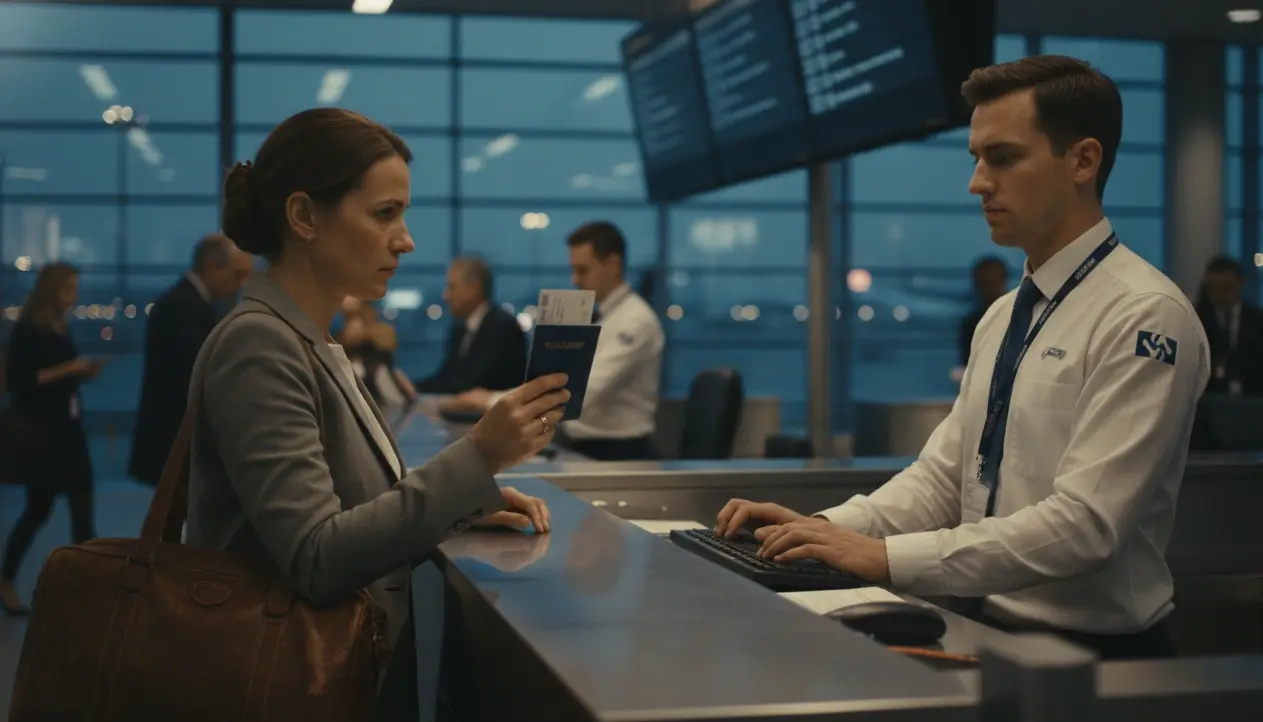
Short answer: If you refuse to buy a return ticket at the airport, the airline may pause check-in, ask for other proof of onward travel, rebook you or deny boarding if the carrier still cannot establish that the route is permitted. A dummy ticket for visa or reservation can help only when it is truthful, current and checkable. Do not argue about a visa alone; ask what document or route evidence the operating carrier requires before the cutoff.
Key facts
- Airline boarding decisions and immigration decisions are separate.
- A carrier may require onward or return proof even when a visa does not list it explicitly.
- Refusing a last-minute fare does not oblige the airline to board you.
- Ask for the exact deficiency and permitted alternatives before the check-in cutoff.
- Keep any reservation truthful, retrievable and consistent with the route.
Need onward proof before airport day? Prepare a truthful reservation that matches your passport name, route, dates and permitted exit plan before you reach the counter.
Create your dummy ticketIn This Guide
- When “No, I’m Not Buying a Return Ticket” Turns Into An Airport Problem
- What The Airline Staff Are Actually Deciding About You
- What Usually Happens Next If You Hold Your Ground
- When Refusing Is Reasonable, And When It Is Just a Bad Strategy
- How Visa Applicants Should Think About This Before Airport Day
- If You Are Already At The Airport, Here Is The Smarter Way To Handle The Standoff
- The Consequences That Matter After The Airport Incident
- Walk Into The Airport Ready To Board
Official-source check: Confirm current onward, transit and entry requirements with the airline and destination authority before departure. For route-facing passport, visa and transit checks, consult the IATA Travel Centre; the operating carrier controls the final boarding decision.
Reviewed for: airport document checks, onward-proof refusals, operating-carrier discretion, check-in cutoffs, route consistency and official-source alignment.
You reach the check-in counter with a valid passport, a visa, and a one-way plan that makes sense to you. For terminology and document scope, review the what a dummy ticket means guide before deciding what to show. Then the airline agent stops the process and tells you to buy a return ticket before boarding. That is the moment this stops being a travel preference and becomes a boarding risk in mere seconds.
What matters next is not pride, and not a long argument about your rights. What matters is whether refusing that purchase will get you waved through, pushed aside, denied boarding, or forced into an expensive last-minute decision. We need to look at how airlines assess risk, when refusal can still be managed, and when holding your ground is the fastest way to lose the flight and complicate your visa story. At the counter, a verified dummy ticket for visa can solve the onward-proof issue without forcing the wrong return fare.
When “No, I’m Not Buying a Return Ticket” Turns Into An Airport Problem

This problem usually feels sudden, but it rarely starts out of nowhere. It starts when your one-way plan meets an airline desk that needs a clean, low-risk answer before it lets you board.
The Moment The Issue Usually Starts Is Not Immigration — It Is Airline Check-In
Most travelers picture the real test happening at the arrival immigration. In practice, the first serious challenge often happens much earlier, at the departure airport.
That is especially true when you are flying on a visit visa, a short-stay visa, or a route that looks incomplete without an onward segment. A counter agent checking you in for Karachi to Istanbul, Manila to Dubai, or Nairobi to Amsterdam is not just printing a boarding pass. They are looking at whether your documents line up with the trip you are about to take.
That review can move fast. Your passport is valid. Your visa looks fine. Your destination allows entry under the visa you hold. Then the missing piece appears. You have no return ticket, no onward booking, and nothing ready to show for how you plan to leave.
At that point, the issue is no longer abstract. It becomes operational. The agent may pause your check-in, ask follow-up questions, or call a supervisor before your bag tag is even printed.
This is why so many travelers get caught off guard. They prepared for the border officer in Paris, Toronto, or Singapore. They did not prepare for the airline desk in the departure hall, where a missing onward plan can stop the trip before it starts.
Why The Airline Sees Your Refusal As Its Problem, Not Your Personal Travel Preference
When you refuse to buy a return ticket at the airport, you may see it as a personal budgeting decision or a reasonable stand against an overpriced same-day fare. The airline does not see it that way.
From the airline’s side, the question is simple: if the destination or transit chain expects onward proof, and you do not have it, who carries the risk when something goes wrong? In many cases, the airline does.
That is why an agent may sound firm even when your explanation sounds logical. You may say you plan to leave Spain by train after your Schengen visit, or exit Thailand on a regional budget carrier you have not booked yet, or decide your return date after a family event in Canada. Those plans may all be genuine. But if nothing verifiable supports them at check-in, the airline hears uncertainty.
Your refusal makes that uncertainty sharper. It tells the staff that you are not just missing a document. You are actively declining the easiest way, from their perspective, to close the file and board you.
That is why this moment escalates so quickly. You are discussing flexibility. They are assessing exposure. Those are not the same conversation, and once the airline starts protecting itself, personal logic has much less weight.
How Staff Interpret Refusal Differently From a Simple Lack Of Preparation
There is a big difference between saying, “I have not finalized my onward booking yet,” and saying, “No, I will not buy a return ticket.” The first sounds incomplete. The second can sound oppositional.
At a busy counter, tone matters because the staff makes fast judgment calls. A traveler who seems cooperative but underprepared may get a few extra minutes, a suggestion, or a supervisor review. A traveler who sounds combative may trigger a harder response, even if the facts are similar.
This matters even more on routes where one-way arrivals already attract scrutiny. Think of a visitor entering the UK on a standard visit visa with no return flight booked, or a tourist flying to Mexico with a vague plan to continue overland, or a Schengen visa holder landing in Rome while claiming they will leave from Budapest later, without any proof in hand. These trips can be legitimate. But refusal at the counter can make them look less planned and less controllable.
Staff also read refusal as a signal about what may happen later. If you do not solve the issue now, will you also resist questions at transit? Will you present inconsistent answers on arrival? Will the airline be left sorting out a denied-entry problem?
That is why refusal often changes the mood at the desk. It stops looking like a document gap and starts looking like a reliability issue.
What The First Ten Minutes At The Counter Often Decide
The opening minutes are where most good outcomes are either preserved or lost. Not because the rule changes, but because the staff forms an impression of whether you are workable.
A typical sequence looks like this:
-
The agent checks your passport, visa, and destination.
-
They ask for a return or onward booking.
-
You explain that you do not have one.
-
The agent pauses and asks how you plan to leave.
-
You refuse to buy a ticket at the airport.
-
The desk either gives you a chance to resolve it or moves toward escalation.
What matters here is not a long speech. It is whether you stay precise, calm, and solution-oriented. If your answer turns into a debate about why the airline should trust you, the clock starts working against you. Boarding deadlines do not wait for principle.
This is also when internal notes may start appearing in your booking. If a supervisor is called, the case stops being a casual counter conversation and becomes a documented judgment about whether you can travel today.
Once that happens, flexibility usually narrows. A traveler who steps aside early, arranges acceptable proof, and returns with a clear document often keeps the trip alive. A traveler who spends those minutes arguing often reaches the same checkpoint with less time and less goodwill.
The Hidden Difference Between Refusing The Ticket And Refusing The Process
This is the distinction that can save you. Refusing to buy an overpriced return fare at the airport is not the same as refusing to meet the airline’s document requirements.
That difference needs to be obvious in how you handle the counter interaction. If you say, “I am not buying that fare right now, but I can provide acceptable onward proof,” you are still inside the process. If you say, “I should not have to show anything else,” you are stepping outside it.
That sounds small, but it changes the whole decision frame. Staff are often less interested in the exact product you buy than in whether you can present something they can rely on before check-in closes. The traveler who understands that has options. The traveler who turns the moment into a personal standoff usually runs out of them.
For visa applicants, this point is even more important because your trip is already document-driven. Your visa file, invitation dates, insurance window, leave approval, and stated itinerary all suggest that the journey should be coherent. If the airport becomes the one place where your exit plan suddenly turns verbal and unprovable, confidence drops fast.
What The Airline Staff Are Actually Deciding About You

Once the counter conversation moves past “Do you have a return ticket?”, the staff are no longer checking whether your travel style is flexible. They are deciding whether putting you on that flight creates a problem they may have to absorb later.
They Are Not Judging Whether Your Trip Makes Sense Without Return Flight — They Are Judging Whether You Are Boardable
This is the key shift most travelers miss.
You may have a perfectly sensible plan. You are flying to Spain on a short-stay Schengen visa, then leaving by train to France and departing from Paris. Or you are entering Thailand, then planning to move on to Malaysia once your meetings finish. The trip can be real, lawful, and well thought out.
But airline staff are not deciding whether your plan sounds intelligent. They are deciding whether they can clear you for transport right now.
That decision is usually much narrower than your own view of the trip. They look for answers to questions like these:
-
Can this traveler show a credible way out?
-
Does the exit timing make sense for the visa or entry permission?
-
Will arrival officers see this booking as incomplete?
-
If there is a transit point, will the next carrier accept the same documentation?
-
If the traveler is denied entry, will the airline be blamed for boarding them?
That is why a one-way ticket plus a strong verbal explanation often feels weaker at the counter than you expect. Your explanation may cover intent. The airline wants something that closes the transport risk.
This is also why travelers with tidy paperwork still get stopped. Your bank balance, invitation letter, or conference schedule may help the overall picture. But if the airline sees no reliable exit path attached to the journey, those documents may not answer the specific question in front of them.
At that stage, the staff is not trying to understand your life. They are trying to decide whether your file is safe to move forward.
Why “But My Visa Is Valid” Is Often The Weakest Argument At The Desk
A valid visa helps you, but it does not settle the issue on its own.
That is where many airport arguments go wrong. You show a valid tourist visa for Canada, a valid UK visit visa, or a valid Schengen sticker, and you assume the case should be over. The staff may look at the same visa and still ask, “How are you leaving?”
That question is not always a challenge to your visa. It is often a challenge to the completeness of your travel plan.
A visa permits you to seek entry under certain conditions. It does not always answer the airline’s operational question about onward movement. If your booking shows a one-way arrival into Rome with no onward segment, or a trip into Dubai with no visible exit despite a time-limited visit purpose, the visa alone may not settle staff concerns.
This matters even more when your visa type does not naturally explain an open-ended stay. A temporary visitor, short-stay tourist, or business visitor with no clear exit plan looks different from someone holding a long-term residence authorization, a confirmed work permit, or a migration pathway that makes one-way entry more normal.
At the desk, “my visa is valid” can sound like you are talking past the real issue. It is legally relevant, but not operationally complete.
A stronger response is always one that ties the visa to a boardable route. The staff does not need a lecture on entitlement. They need a travel record that will make sense if someone downstream checks it.
How Route Complexity Makes Your Refusal Look Riskier
The more complicated your trip looks, the less room you usually have to refuse a simple onward-ticket fix.
Complexity does not mean dishonesty. It means your route takes extra explanation. That can happen when you have:
-
An open-jaw trip, such as entering Italy and planning to depart from Germany
-
A multi-country stay inside Schengen with no final flight booked
-
A one-way ticket tied to a flexible family or business schedule
-
A long visit close to the outer limit of your allowed stay
-
A return plan that depends on a separate carrier, bus, train, or later booking
-
A route with mixed airlines that cannot all see the same onward record
Each of those can be valid. But each also increases the amount of judgment the counter staff must use.
If you refuse to buy a return ticket in a simple case, such as a short leisure trip with fixed hotel dates and a clear ten-day window, the desk may still consider other acceptable proof. If you refuse in a more layered case, the same refusal can look like you are asking the airline to trust a chain of assumptions they cannot verify.
Take a traveler flying from Lahore to Milan with a Schengen visa, planning to continue to Zurich by train, then depart later from Paris on a separate low-cost booking not yet purchased. That journey may be reasonable. But from the airline’s side, it has several moving parts:
-
One country of entry
-
Another country of onward travel
-
A land segment
-
A separate departure city
-
No locked return record at check-in
Now add a firm refusal to buy anything that clarifies the exit. The trip immediately feels harder to defend.
That is why route complexity changes the tone so quickly. The more variables your itinerary contains, the more valuable a clean onward record becomes. Refusal of a simple itinerary may create friction. Refusal of a complex itinerary can make the whole booking look unstable.
Why Transit Airports Can Quietly Raise The Stakes
Sometimes, the final destination is not even the biggest issue. The transit structure is.
A traveler may focus on whether Spain, Thailand, or Mexico will ask for onward proof on arrival. But the airline may be looking at Doha, Istanbul, Abu Dhabi, Singapore, or another transit point along the way and asking whether your documents will hold up across the full journey.
This matters for two reasons.
First, different carriers on the same trip may apply document checks differently. If your route includes a code-share or an interline segment, the staff at the origin may take a more cautious line because they do not want the next carrier to reject the handoff.
Second, transit airports can amplify uncertainty even when no formal transit visa issue exists. A one-way booking with a loose exit story may feel manageable on a direct route. It can feel much less comfortable when the journey depends on multiple systems and multiple checkpoints.
Think of these examples:
-
Karachi to Barcelona via Doha
-
Manila to Amsterdam via Istanbul
-
Nairobi to Toronto via London
-
Delhi to Lisbon via Dubai
In each case, the origin desk may think beyond the destination border. If something breaks in transit, your refusal to regularize the onward plan at the start can look far more costly than it first appears.
This is also why travelers sometimes hear inconsistent answers from different staff. One person is thinking about the destination only. Another is thinking about the entire chain of carriage.
So if the desk seems unusually firm for what looks like a simple one-way issue, it may be because your routing is doing more work in the background than you can see from the counter.
The Role Of Supervisor Discretion — And Why It Helps Some Travelers But Not Most
Travelers often ask for a supervisor as if that alone improves the odds. Sometimes it does. Often, it just moves the same concern to someone with more authority to say no.
Supervisor discretion is real, but it is not random. A supervisor usually looks for a few specific things before stepping outside the safest path.
They want to see whether you are:
-
Calm and cooperative
-
Consistent in your explanation
-
Carrying documents that broadly support the trip
-
Presenting a route that makes sense for the visa you hold
-
Offering a workable solution instead of refusing the process
That last point matters most. Supervisors are more likely to help when the traveler is trying to solve the problem without creating new uncertainty. They are less likely to help when the traveler is making the issue personal, accusing staff of ignorance, or repeating that a valid visa should end the discussion.
A supervisor may accept an onward arrangement that the first agent did not feel comfortable approving. But that usually happens because the traveler has produced something clearer, not because the supervisor is more sympathetic to refusal.
What Usually Happens Next If You Hold Your Ground

Once you say no at the counter, the issue stops being theoretical. The next few minutes usually push you into one of several very specific outcomes, and each one carries a different cost.
The Soft-Block Outcome: You Are Told To Resolve It Before Check-In Can Continue
This is the most common airport response when the staff is not ready to deny boarding immediately, but are not willing to complete check-in either.
You stay at the desk for a moment. The agent tells you they cannot issue the boarding pass until you show a return or onward ticket. Sometimes they send you aside. Sometimes they ask you to step away from the line and come back once you have sorted it out. Sometimes they hold your passport details on screen while you try to fix the problem nearby.
This matters because it feels less serious than a refusal, but the pressure becomes very real very quickly.
You are now dealing with:
-
A live departure clock
-
A check-in cutoff that will not move for you
-
Airport Wi-Fi that may be slow or unstable
-
Mobile banking or card verification issues
-
Limited time to compare options calmly
-
Staff who may already be handling other passengers
A soft block often tricks travelers into thinking they still have plenty of room to negotiate. In reality, it is a timed problem. The desk has not said no yet, but it has stopped saying yes.
That is why the soft-block stage is often where good plans survive, and weak plans collapse. If you can arrange acceptable onward proof cleanly, you may still recover the trip. If you spend this window repeating the same argument, you are burning the exact resource that matters most, which is time.
It is also worth noticing the tone of the staff here. If they say, “Come back when you have something we can verify,” they are leaving the door open. If they say, “You must buy a return ticket before we can continue,” the room for interpretation is narrower, but even then, the real issue is often the proof, not necessarily that exact product.
The Hard-Stop Outcome: Denied Boarding Before The Argument Gets Very Far
Some airports, routes, and desk teams move more quickly. If the staff see the onward-ticket issue as non-negotiable, the conversation may end before you get much space to persuade anyone.
That can happen on routes where one-way arrivals are routinely scrutinized, on heavily regulated carrier networks, or simply when the desk follows a strict internal compliance practice. You may hear language like:
-
“We cannot check you in without onward travel.”
-
“You are not eligible to board with this documentation.”
-
“Please return once you have the required ticket.”
At that point, the booking can effectively freeze. No boarding pass. No baggage acceptance. No movement into the security flow. If the desk records an internal note, later staff may see that the case was already reviewed.
This kind of stop feels harsh because it turns a travel plan into a same-day failure in seconds. But from the airline’s side, it can be the cleanest way to contain risk. If your entry profile already looks sensitive, for example, a one-way tourist entry to the Schengen Area with a long stay and no visible exit, or a short business trip into the UK with no return segment and vague departure plans, the staff may decide not to spend time building exceptions.
A hard stop is also more likely when your own position sounds absolute. If you reject the idea of buying anything, refuse alternative suggestions, or insist that the airline has no right to ask, the desk may conclude there is nothing left to process.
This is where many travelers make the mistake of arguing about fairness instead of reading the operational reality. Once the desk has decided you are not flying on the current record, the issue is no longer whether your reasoning sounds strong. The issue is whether you can still create a boardable file before the flight closes or whether the trip is already lost for that departure.
The Expensive Compromise Outcome: You Buy Something You Did Not Want Under Deadline Pressure
This is the airport outcome many travelers were trying to avoid in the first place.
You resist at first. The desk holds firm. The clock moves. Prices change. Then you buy a return ticket or onward fare under pressure, not because it fits your trip, but because it is the fastest way to unlock check-in.
That solution works often enough to keep flights moving, but it creates its own problems.
The first issue is cost. Same-day airport pricing is rarely kind to travelers who are buying from a weak position. You are not comparing routes over coffee at home. You are solving a boring problem while watching the departure time get closer.
The second issue is a mismatch. You may end up buying a return ticket from the wrong city, on the wrong date, or through the wrong carrier simply because it exists and the desk wants to see something immediately. That can produce an itinerary that does not fit the trip you actually intend to take.
The third issue is downstream consistency. If your visa paperwork, employer leave dates, conference registration, or family invitation letter point to one travel window and your panic purchase points to another, you may later need to explain why the travel record changed so sharply. That does not always create a formal problem, but it can make your file messier than it needs to be.
A rushed purchase also limits your options later. Refundability may be poor. Changes may be expensive. And if you bought the ticket only to satisfy the airport desk, you now have to manage an extra booking that was never part of the real plan.
This is why refusal at the counter sometimes ends in the exact outcome you were trying to avoid, only at a higher price and under worse conditions.
The Self-Arranged Proof Outcome: You Step Aside And Solve The Issue Without Buying A Full Return Fare
This is often the most practical middle path when you do not want to buy an expensive same-day return ticket, but you still want to stay cooperative with the airline’s document requirements.
You step away from the desk and arrange onward proof that fits the trip better. The goal is not to win an argument. The goal is to come back with something clear enough that the staff can continue to check in with confidence.
This route works best when you act quickly and keep the proof simple. A usable solution usually needs to show:
-
Your name
-
A realistic exit route
-
A date that fits your visa or stated travel plan
-
A format that the staff can read without effort
-
Enough detail to satisfy the airline’s immediate check
For some travelers, that means booking a real onward flight they were going to need anyway. For others, it means arranging a verifiable flight reservation that supports the travel timeline without forcing a full return purchase on the spot.
When a reservation is the safer alternative to a last-minute fare, choose a provider only after checking how its record is issued, where it can be verified, how long it remains valid and what its current update terms are.
The strength of this outcome is control. Instead of letting airport pricing dictate your whole itinerary, you solve the airline’s document concern in a way that fits the broader trip better.
But it only works if you move fast. This path is still vulnerable to weak internet, payment delays, document confusion, and check-in cutoffs. If you come back with something messy, incomplete, or slow to verify, the airline may still refuse to proceed.
The Worst-Case Chain Reaction: Missed Departure, Visa Timing Stress, And A Damaged Travel Narrative
Once the flight is missed, the onward-ticket issue stops being a counter dispute and becomes a wider travel problem.
You may need to rebook at a much higher fare. Your visa validity window may now feel tighter. Your host, employer, client, or family contact may have planned around a specific arrival date. A hotel check-in may be missed. A regional connection may disappear. A consular timeline that once looked comfortable can suddenly feel narrow.
This is especially serious for travelers whose plans are document-heavy from the start. If your visit letter names fixed dates, your leave approval covers a limited period, or your travel insurance is aligned with a specific departure schedule, a missed flight can disrupt more than your budget.
It can also complicate your travel narrative.
If you later apply for another visa and the record shows a changed route, last-minute rebooking, or a departure sequence that no longer matches your original paperwork, you may need to explain why the travel plan shifted. That does not mean refusal at the airport will automatically damage future applications. But it can create inconsistencies that were never necessary.
When Refusing Is Reasonable, And When It Is Just a Bad Strategy
Not every refusal is foolish. Sometimes the airport is pushing you toward a costly, clumsy fix that does not match your trip at all. The real question is whether your refusal protects your position or simply strips you of leverage.
| Counter situation | Likely concern | Calmer response |
|---|---|---|
| Return proof is accepted | The route and status are easy to check | Keep the reference and present the same details consistently |
| Return proof is challenged | The segment is missing, stale or hard to retrieve | Ask what exact proof is required and address that gap truthfully |
| Passenger refuses without an alternative | The carrier may treat the boarding risk as unresolved | Ask about permitted options before the check-in cutoff |
Refusing Can Be Understandable When The Airport Is Trying To Force A Terrible Solution
There are moments when your resistance makes sense.
An airline desk may tell you to buy a full return ticket for a trip that was never meant to be round-trip from the same city. That can happen on open-jaw plans, multi-country Schengen routes, or business visits where your departure city is still fixed but different from your arrival city. If you are flying into Madrid and leaving later from Amsterdam, a same-airport return to your origin country may be the wrong product from the start.
The same applies when the fare being pushed is clearly poor value. Airport fares can be wildly inflated, especially close to departure. You may be asked to buy a last-minute return on a full-service carrier even though your actual exit plan is a short regional hop, a separate low-cost departure, or a later outbound flight from another city that fits your visa timeline better.
Your refusal is also understandable when the staff presents only one possible answer to a problem that may have several acceptable solutions. You may not need a full return to your origin country at all. You may only need credible onward proof showing how you intend to leave the destination or region in line with your entry conditions.
That distinction matters a lot for travelers entering places like the Schengen Area, Thailand, the UK, or Canada on short-stay visitor plans. The practical requirement is often about leaving, not about mirroring the airline’s preferred booking pattern.
So yes, there are cases where saying no is rational.
But even in those cases, the refusal only helps you if it is paired with a better alternative. If you reject the bad solution and present a cleaner one, you are protecting your trip. If you reject the bad solution and offer nothing usable in its place, you are not standing firm. You are weakening your file at the exact moment it needs to look controlled.
Refusing Is Usually A Bad Strategy When You Have No Alternative Proof Ready
This is where many travelers misread the situation.
They focus on whether the airline’s request feels excessive, and they forget the timing. At the airport, timing is everything. A good argument without a workable document usually loses to a weaker argument backed by something the desk can process immediately.
If you have no onward proof ready, refusal gives away your strongest card, which is cooperation. The staff may have been willing to pause, review options, or accept a different format. Once you turn the moment into a flat refusal, they have less reason to keep working with you.
This gets even riskier when your route already needs extra explanation. A one-way visitor entry into the Schengen Area close to the limit of your approved stay is not the same as a short round-trip city break. A flight into Bangkok with a loose plan to “figure out the next country later” is not the same as a confirmed ten-day itinerary with a clear exit. The less self-explanatory the trip looks, the more dangerous it is to stand there without a ready substitute.
A refusal without backup usually produces one of three bad outcomes:
-
You lose time while the desk waits for a fix you have not prepared
-
You buy something under pressure after all, but on worse terms
-
You miss the flight and turn a documentation issue into a rebooking problem
None of those outcomes improves because your original objection was reasonable.
This is why experienced travelers separate the fairness question from the airport question. The fairness question asks whether the airline is oversimplifying your trip. The airport question asks whether you can still present something that gets you boarded today. Those are not the same thing, and only one of them matters in the departure hall.
One-Way Ticket Is Not Automatically Suspicious, But Unsupported One-Way Travel Often Is
A one-way ticket is not a red flag by itself.
There are many normal reasons to travel one way. You may be entering Italy and leaving later from France. You may be visiting family in the UK and waiting to confirm your return around an event date. You may be flying into Singapore before continuing on a regional itinerary that depends on business scheduling. You may be entering Mexico and planning an onward overland segment before flying out from another point.
None of that is inherently questionable.
The problem starts when the one-way structure is unsupported. Once the counter staff cannot see how the trip exists, your one-way booking stops looking flexible and starts looking incomplete.
That is especially true when the trip combines several uncertainty points at once:
-
A short-stay visa or visitor status
-
A longer visit duration
-
No checked proof of onward travel
-
A vague departure city or departure date
-
An explanation that depends on future booking decisions
-
Transit points that may apply their own screening logic
At that point, the one-way ticket is not the issue on its own. The issue is that the entire exit plan exists only in conversation.
And conversation is fragile at the airport. It depends on wording, mood, desk discretion, and time. A readable onward booking is much stronger because it reduces the amount of interpretation required.
This is why travelers sometimes feel unfairly judged when the real problem is not the one-way ticket at all. It is the absence of a visible structure around it. Once you understand that, the strategy becomes clearer. You do not need to defend one-way travel as a concept. You need to support it as a file.
Travelers With Strong Documents Still Lose This Argument More Often Than They Expect
A lot of well-prepared travelers assume they will be fine because the rest of their paperwork looks strong.
You may have a valid visa, strong bank statements, previous travel history, employer approval, a hotel reservation, and a detailed itinerary. Those things matter. But they do not always rescue you at the counter if the airline sees the onward issue as unresolved.
This surprises people who have traveled widely before. A frequent traveler may think, “My passport shows I always leave on time.” A business visitor may think, “My invitation letter makes the purpose obvious.” A family visitor may think, “My visa was already approved after review.” All of that can be true. It still may not close the specific gap the desk is focused on.
That is because airport decision-making is often narrower than visa decision-making. The consulate may have looked at your full profile. The airline staff is making a transport decision under operational pressure. They are not reopening your application history. They are checking whether this journey, on this date, on this booking, looks safe to carry.
Strong documents can even create false confidence if they make you less flexible at the desk. Some travelers argue harder because they feel they have already “proven themselves.” But the airline is not broadly grading your overall credibility. It is assessing whether the outbound structure attached to the current trip is clear enough to board you.
So even strong travelers lose this argument when they rely on background strength instead of solving the visible gap in front of the staff.
That is why document quality and decision quality are not the same thing. You can be a genuine, well-prepared visitor and still make a poor airport call by insisting that the rest of your paperwork should carry a missing onward plan.
The Right Question Is Not “Can I Refuse?” But “What Outcome Am I Trying To Preserve?”
This is the question that cuts through the emotion of the moment.
If your main goal is to catch the flight, then your decision should be judged by whether it keeps you boardable within the check-in window.
If your main goal is to avoid wasting money on the wrong fare, then you need a replacement that solves the same problem more cleanly.
If your main goal is to keep your itinerary accurate for a visa-sensitive trip, then you should avoid panic purchases that distort your travel timeline.
If your main goal is to protect future consistency, then you should think beyond the desk and ask whether the fix you choose will still make sense when looked at later.
Once you frame the problem this way, the answer gets more practical.
Refusing may be the right move when it helps you avoid a poor booking, and you already know how you will present acceptable onward proof instead.
Refusing is usually the wrong move when it is driven by frustration, surprise, or a broad sense that the airline “should not” be asking for more.
That is the difference between a strategic refusal and a self-defeating one. The first preserves your options. The second burns them.
How Visa Applicants Should Think About This Before Airport Day
The smartest fix for an airport return-ticket dispute usually happens before you leave for the airport. If your trip depends on a one-way entry, a flexible exit, or a multi-country plan, you need to prepare for airline review with the same care you used for the visa file.
Build Your Onward-Proof Strategy Around The Airport, Not Just The Embassy File
A lot of travelers stop planning once the visa is approved. That is where avoidable airport problems begin.
Your visa application may have already included a travel plan, intended dates, and a broad itinerary. But the airport does not see your application the way the consulate did. The airline desk is not reviewing your file as a full story. It is checking whether the journey in front of them looks safe and complete.
That means your onward-proof planning should answer a different question: What can you show in under one minute if an airline agent asks how you are leaving?
That question matters even more when your travel pattern is not a standard round-trip. Think of situations like these:
-
You are entering the Schengen Area through Italy and leaving from France
-
You are flying into Thailand and plan to continue to Malaysia later
-
You are entering the UK for a family visit, but want flexibility on the exact return date
-
You are flying into Canada first and will leave from a different city after internal travel
In each case, the visa or entry permission may be perfectly fine. But if your airport-facing document strategy is weak, the check-in desk may still see a gap.
So build the proof around airport use, not just application logic. Ask yourself:
-
Will the exit route be obvious to someone who has never seen my plan before?
-
Does the departure date fit the stay I am claiming?
-
Is the record easy to show on my phone and easy to download if the signal is poor?
-
Does it look like a real travel arrangement rather than a loose idea?
Visa approval and airport clearance are connected, but they are not the same step. If you plan only for the first one, the second one can still catch you off guard.
Make Sure Your Exit Story Matches Every Other Travel Document You Are Carrying
A strong onward plan is not just about having a flight record. It is about making sure that the record fits the rest of your trip.
This is where consistency matters. If your onward proof says you will leave Spain in ten days, but your hotel stay, leave approval, conference schedule, or invitation letter points to a different timeline, you are creating friction where none was needed.
At the airport, staff do not always examine every page in detail. But when they do start asking questions, mismatches become more visible very quickly. A traveler who says, “We are staying with family for three weeks,” while showing an onward flight five days later, is inviting more scrutiny. So is a traveler entering the Schengen Area for a short business visit while carrying meeting dates that stretch beyond the exit proof they suddenly present.
This becomes even more important on trips with multiple moving parts. If your route includes two Schengen countries, a later train segment, and a final long-haul departure from another city, your documents should still tell one coherent story.
Before airport day, line up these details carefully:
-
Arrival date
-
Intended stay length
-
Onward or return date
-
Exit city
-
Internal trip flow
-
Supporting dates in invitations, bookings, or leave letters
You do not need every document to repeat the same line word for word. But they should not contradict each other in a way that makes the trip look improvised.
This matters for visa applicants because the trip is already evidence-based. Once the airline starts asking questions, inconsistency becomes more damaging than complexity. A complicated plan can still work if all the parts point in the same direction. A simple plan can fail if the dates and locations do not line up.
Plan For The Version Of The Trip Where A Human Asks Follow-Up Questions
Many travelers prepare documents. Fewer prepare answers.
That gap matters because the airport is not a document upload portal. It is a live conversation, often under time pressure, with someone who may ask one or two quick questions before deciding whether your file feels stable.
So, prepare for the spoken version of your trip.
That does not mean memorizing scripts. It means being able to explain the route clearly, in the same shape as your documents already support. If you cannot describe how you are living in one or two clean sentences, the trip may sound less settled than it really is.
Good preparation means you can answer questions like these without hesitation:
-
When are you leaving the destination country?
-
From which city are you departing?
-
Is your return from the same airport where you arrive?
-
If not, how are you getting to the departure city?
-
Why is your current ticket one-way?
-
Have you already arranged the onward segment?
Those questions matter on routes where one-way travel is normal for genuine travelers but still raises boardability concerns. A visitor entering Italy and leaving from Paris should be able to explain that without sounding uncertain. A traveler flying into Bangkok and planning to continue to Singapore should be able to state the likely timing and route clearly. A UK visitor waiting for a family event date should still be able to explain the return window in a way that makes sense.
The key is not detail for its own sake. The key is confidence grounded in the trip you are actually taking.
Weak answers usually sound like this:
-
“We have not thought that far ahead.”
-
“We will decide after we get there.”
-
“We may take a bus somewhere.”
-
“The visa is already approved, so it should be fine.”
Strong answers sound different because they show structure. They tell the staff that your flexibility is still organized, not open-ended.
Treat Verifiability As A Travel Document Feature, Not A Luxury
One of the biggest mistakes visa applicants make is treating verifiability like a nice extra rather than a core requirement.
At home, a vague screenshot may feel good enough. At the airport, it often is not.
An airline desk needs something it can read quickly and trust enough to move your check-in forward. That usually means the onward proof should be easy to identify, easy to access, and easy to match to your name and travel dates. If it takes too long to explain what the document is, it is already weaker than it should be.
This is why format matters more than many travelers expect. A clean PDF, a recognizable reservation layout, and a document that opens properly on your phone can make a real difference when the desk is busy and the line is long.
Before airport day, check these basics:
-
Can you open the file offline if the airport signal is poor?
-
Does your name appear clearly and correctly?
-
Are the dates visible without zooming and scrolling around?
-
Is the route readable at a glance?
-
Can you find it in seconds, not minutes?
-
Do you have a backup copy in email or cloud storage?
This is especially important for multi-leg international travel. If you are checking in at Karachi for a route to Madrid via Doha, or Manila to Amsterdam via Istanbul, you may not get much patience for messy proof. The easier the document is to process, the easier it is for the staff to keep your trip moving.
Verifiability also protects you from the weakest form of airport improvisation, which is trying to build credibility with fragments. A screenshot of a fare search, a half-completed booking page, or a vague email thread about future travel does not work the same way as a clear, presentable reservation record.
When your route, visa type, or trip length already invites questions, the quality of your proof becomes part of the answer.
Decide In Advance What You Will And Will Not Buy At The Airport
This is one of the most practical decisions you can make before travel, and it saves a lot of bad airport choices.
If the desk challenges your onward plan, you should already know your own fallback line. Not the words you will say, but the actual action you are prepared to take.
Without that decision made in advance, the airport pushes you into expensive improvisation. That is when travelers buy the wrong fare, overpay badly, or argue too long because they are trying to decide under stress.
Set your boundary before departure. For example:
-
You will buy a real onward ticket if it fits the trip and the price stays within your limit
-
You will use a verifiable onward reservation if the trip is still flexible
-
You will accept a same-day purchase only if it protects a high-value itinerary
-
You will not buy a full return to your origin country if your trip is open-jaw, and that route makes no sense
-
You will walk away and rebook later if the only available option destroys the budget
That kind of pre-commitment helps because it turns the airport from an emotional situation into a decision tree you already settled in private.
It also keeps your wider trip intact. A traveler going to the Schengen Area for a tightly timed conference may reasonably choose to spend more to protect the arrival date. A traveler on a flexible family visit may decide that a poor airport fare is not worth locking in and may instead rely on a better-prepared onward structure before the next attempt. The right answer depends on the value of the trip, the cost of delay, and how much flexibility your route genuinely needs.
If You Are Already At The Airport, Here Is The Smarter Way To Handle The Standoff
Once the return-ticket issue is live at the counter, your goal changes. You are no longer optimizing the trip on paper. You are trying to keep a flight reservation, a visa-sensitive timeline, and a real departure window from collapsing in front of you.
Stop Arguing About Fairness And Start Solving The Airline’s Immediate Concern
The fastest way to lose control at the counter is to stay stuck on whether the request feels fair.
You may be right that the desk is oversimplifying your trip. You may be right that a full return to your origin country makes no sense for an open-jaw Schengen itinerary or a UK family visit with a flexible departure city. But once the staff pauses check-in, fairness is not the issue they are trying to resolve.
They are asking a narrower question: What can you show right now that makes this booking safe to carry?
That means your language needs to shift immediately. If you keep repeating that your visa is valid, your plans are genuine, or the fare they are suggesting is unreasonable, you stay in conflict mode. If you say you understand the concern and want to provide acceptable onward proof, you move back into problem-solving mode.
That difference matters because the desk is watching how you handle pressure. A traveler who sounds practical and cooperative is easier to keep working with. A traveler who sounds offended or defiant is easier to freeze out of the process.
So change the frame quickly. Instead of saying:
-
“This is ridiculous.”
-
“You cannot force me to buy that.”
-
“My visa already proves I am allowed to travel.”
Move to a language that helps the desk move the file:
-
“We understand the issue. What specific onward proof will clear check-in?”
-
“We are not looking to buy the wrong ticket. We are looking to show an acceptable exit plan.”
-
“If there is a route or format your team can accept, we can sort that now.”
That does not mean giving up your position. It means protecting it in a way that still leaves the flight salvageable.
This is especially important on routes where one-way visitor entries already make desks cautious, such as flights into the Schengen Area, the UK, Thailand, or Canada. If your booking already requires interpretation, your tone becomes part of the evidence.
Ask The Right Operational Question Instead Of Repeating Your Personal View
Once the issue is active, the most useful question is not “Why are you asking me this?” It is “What exactly will satisfy your check?”
That sounds simple, but it changes everything.
A lot of travelers keep making personal arguments when the desk needs an operational answer. You may personally prefer to book later. You may personally dislike buying under pressure. You may personally believe your travel history should be enough. None of those points tells the staff what they need to approve.
A better approach is to get precise. Ask questions that narrow the requirement.
For example:
-
“Do you need a return to the origin country, or is onward travel out of the destination region enough?”
-
“Does it need to be a confirmed flight booking, or will a verifiable reservation be acceptable?”
-
“Is the concern the destination country, the transit point, or both?”
-
“If the exit is from another city, will that still work if the timing fits the visa?”
These questions do two important things.
First, they stop you from buying the wrong thing. If the desk only needs proof that you will leave the Schengen Area, you may not need a round-trip back to your departure airport at all. If the issue is linked to a transit carrier, you may need a clearer onward segment than you first assumed. If the desk is focused on timing, the date may matter more than the exact route.
Second, they force clarity from the staff side. Sometimes the first agent is using broad language like “buy a return ticket” when the real requirement is narrower. The more specific the desk becomes, the easier it is for you to solve the actual problem instead of a guessed one.
This matters a lot when your itinerary is lawful but non-standard. A traveler entering Italy and departing later from Paris should not solve a France exit issue by panic-buying a Rome round-trip that distorts the entire trip. A visitor entering Bangkok who plans to continue to Kuala Lumpur should not assume the only solution is a full homebound return if the desk really wants visible onward movement.
The clearer the operational question becomes, the less likely you are to waste money or time solving the wrong problem.
Buy Time Without Looking Evasive
If you need a few minutes to sort the issue, the way you create that space matters.
You want to look like a traveler fixing a documentation gap, not a traveler trying to dodge scrutiny. That means stepping aside in a way that keeps the desk comfortable with your intent.
The best move is usually direct and calm. Say you are going to arrange acceptable onward proof and ask whether you should return to the same counter or a nearby service point. That tells the staff you are staying engaged and not disappearing into the terminal with a half-processed dispute.
A few practical habits help here:
-
Keep your passport and current travel documents organized
-
Stay physically close enough to return quickly
-
Have internet access ready before you leave the desk area
-
Make sure your payment method is usable for international travel
-
Avoid wandering off without telling the staff what you are doing
This becomes very important when the line is busy or boarding time is tightening. If the agent thinks you are stalling, they may move on, release the held booking flow, or lose patience when you come back.
You also need to manage the clock honestly. Check-in cutoffs do not care that your onward issue started late in the process. If you are on a route like Delhi to Lisbon via Dubai or Manila to Amsterdam via Istanbul, one missed document decision at origin can destroy the full chain.
So when you buy time, buy it with purpose. Know what you are trying to secure, know what format you need, and know how quickly you can present it.
There is also a communication point here that many travelers miss. If you are still working on the document and the deadline is approaching, go back to the counter before disappearing into a long silence. A brief update can preserve cooperation. Staff are more likely to work with a traveler who stays visible and active than one who vanishes until the cutoff is almost over.
Present Alternatives Cleanly, Not As A Pile Of Unrelated Screenshots
When you return to the desk, your job is not to overwhelm the agent with evidence. Your job is to make the onward solution readable in seconds.
That means presentation matters almost as much as the booking itself.
If you hand over a phone full of disconnected screenshots, fare searches, half-loaded emails, and cropped payment pages, the desk has to do too much interpretation. That creates hesitation, and hesitation is dangerous when you are trying to recover a paused check-in.
A clean presentation usually follows a simple order:
-
Show the primary onward or return proof first
-
Make sure your name is visible
-
Make sure the date is visible
-
Make sure the route is visible
-
Then, only if needed, explain how it fits the rest of the trip
For example, if you are entering Spain and leaving the Schengen Area later from Paris, show the onward flight out of Paris first. Do not start with your hotel booking in Barcelona, your conference email, and your internal train idea. Those documents may support the story, but they are not the answer the desk asked for.
If the route is more layered, keep the logic tight. A traveler entering Thailand and continuing later to Malaysia should present the onward booking first, then explain the local stay. A UK visitor leaving from another city should show the exit booking clearly before talking through family plans.
A few practical standards help:
-
Use a downloadable PDF when possible
-
Increase screen brightness before you approach the desk
-
Open the correct file before your turn resumes
-
Keep backup access in email or cloud storage
-
Avoid making the agent scroll through unrelated material
You also want to avoid mixing strong proof with weak filler. One clean onward reservation is better than one clean reservation buried inside six messy screenshots.
The desk is not a grading effort. It is looking for clarity. The easier you make the document to process, the easier it becomes for the staff to say yes and move you forward.
Know When To Walk Away From The Argument And Make The Practical Choice
There comes a point when the counter-dispute stops being a useful contest.
If the staff has stated the requirement clearly, the check-in cutoff is near, and the only missing piece is a document you can still secure, continuing to argue usually makes your position worse. At that stage, you need to decide what you are protecting most.
Ask yourself the hard questions fast:
-
Is this flight important enough to justify a same-day solution?
-
Will missing today’s departure damage a visa-sensitive itinerary?
-
Is the onward proof issue still fixable within the time left?
-
Am I defending principle, or am I avoiding a bad but manageable expense?
-
If I keep pushing, do I actually improve my chances of boarding?
Sometimes the practical choice is to stop debating and resolve the file, even if you still think the airline’s approach is crude. That can mean arranging onward proof immediately, accepting a workable booking that preserves the trip, or stepping out of the emotional argument and focusing only on what gets you through check-in.
Other times, walking away means something different. If the only available fix is wildly expensive, mismatched to your trip, and no longer likely to clear before the cutoff, continuing may only deepen the loss. In that case, a controlled retreat can be smarter than a desperate purchase that damages both the budget and the travel plan.
The Consequences That Matter After The Airport Incident
The airport argument may end in ten minutes, but the effects can stretch much further than the check-in line. Once a return-ticket problem disrupts a visa trip, it can affect timing, costs, records, and how the rest of the journey is judged.
Missing The Flight Can Affect More Than Cancellation Charges
The first loss is usually financial, but the bigger damage often sits behind it.
If the airline marks you as a no-show, your original booking may lose value fast under the applicable fare rules. In some cases, you may need a completely new ticket for the same route, and the price difference can be brutal once departure is close. You may also be charged extra fees, taxes, or change costs that were avoidable a few hours earlier.
That matters even more if you were not traveling on flexible tickets. A rigid fare can leave very little room to recover without fresh expense. Even when a partial refund exists, the amount may be small after cancellation charges and other deductions are applied.
For visa applicants, the real cost often goes beyond what was paid at the desk or online. A missed departure can throw off the whole structure of the trip. If you were flying to Germany for a conference, entering the UK for a family event, or landing in Spain for a fixed invitation window, a delayed arrival can shrink the purpose of the journey itself.
That pressure multiplies when the itinerary already has tight timing. You may be dealing with:
-
Employer leave approved for exact dates
-
Fixed meetings or family commitments
-
Onward segments inside the destination region
-
Insurance dates are tied to the original departure
-
A hotel or internal transport that cannot be moved easily
-
A visa window that looked comfortable until the first flight failed
A couple of hours at the counter can create a much larger chain reaction. One missed departure can ripple across the trip, especially on routes with connections or region-to-region movement inside Europe or Southeast Asia.
This is why the financial hit should not be measured only by the fare difference. The larger issue is whether the disrupted departure now damages the purpose, timing, and credibility of the visit.
A Rushed Fix Can Create Document Inconsistency Later
Sometimes you still board, but only after making a fast booking that never belonged in the original plan. That can solve the immediate airline issue while creating a weaker paper trail later.
This is a common scenario for travelers entering the Schengen Area, the UK, Canada, or Thailand on short-stay visitor plans. At the airport, the goal becomes speed. Later, the problem becomes consistency.
For example, your visa file may support a two-week family visit in the UK, but the hurried onward booking you buy at the airport shows departure in five days because that was the only workable option. Or your Schengen plan may have been built around entry through Italy and departure from France, but the counter-pressure forces a return from Milan that no longer matches the rest of the trip.
That matters because future forms, interviews, and travel records do not always care why you changed something. They often just show that the trip eventually looked different from the original intention.
This can create problems such as:
-
Different exit dates from the ones supported by your invitation or leave approval
-
Route changes that make the trip look less settled
-
Confusion when you review old travel records for a later application
-
Supporting documents that no longer line up neatly with what you actually flew
A fast airport purchase can also complicate later decisions about whether to cancel a segment, use it, or simply let it lapse. If you do not track what happened, you may forget which reservation was your real exit plan and which one was only a same-day fix.
That is why a rushed onward solution should still be chosen with some discipline. Getting boarded matters, but so does leaving behind a record that still makes sense when you look back at the trip months later. Across the visa world, clean consistency usually ages much better than fast improvisation.
Arrival Screening May Still Ask Questions Even After The Airline Lets You Board
Clearing the departure desk does not always end the issue. You may still be asked about your exit plan on arrival.
That is especially true when your trip remains one-way, flexible, or longer than average for the type of visit you are making. Border officers in places like Canada, the UK, the Schengen Area, or Thailand may still ask how long you plan to stay, where you are going afterward, and whether the onward travel you showed at departure still reflects your actual plan.
This is where the structure of your airport fix really matters. If the booking you used to satisfy the airline does not fit the story you tell on arrival, the mismatch becomes visible.
For example:
-
You told the airline you would leave Spain from Paris in nine days, but on arrival, you sound unsure about when you are exiting Schengen.
-
You used onward travel from Bangkok to Kuala Lumpur to board, but at the border, you describe an open-ended stay with no clear timeline.
-
You entered the UK saying you had a short family visit, but your return record now points to a route that does not match the visit length you describe.
That does not mean an airport fix automatically causes trouble at the border. It means the document still needs to fit the wider file.
So stay aware of what you presented at departure. Keep the document ready. Know the date, city, and route it shows. Make sure your explanation still works with it.
The airline and the border officer are not doing the same job, but both are looking for signs that your trip has structure. If your onward proof was only strong enough to pass one desk and not strong enough to survive the next question, the pressure simply shifts from departure to arrival.
How To Document The Incident For Your Own Records
One of the smartest things you can do after an airport return-ticket dispute is record the facts while they are still fresh.
This helps more than many travelers expect. Memory fades quickly after a stressful airport delay, especially if you still manage to travel later that day or the next morning. A short record can protect you if you later need a refund request, an insurance claim, or a clear answer for a future visa form.
Keep notes on the basics:
-
The date, airport, and route
-
What did the desk ask you to show
-
Whether a supervisor got involved
-
What onward proof did you originally have
-
What you arranged at the airport
-
Whether you boarded or had to rebook
-
What extra amounts were charged
You should also save the documents linked to the incident. That includes the original booking, the airport fix, payment receipts, and any email confirmations. If you booked directly, keep the files in the same account you used for the reservation. If a travel agent helped you after the problem started, keep their confirmation as well.
It also helps to save screenshots from the airline website or app if the booking status changed during the disruption. That can be useful later if customer support disputes what happened or if you need to show the timeline behind a missed departure.
This is especially important for travelers from India or other high-volume visa markets where repeated applications often require careful review of past travel dates and routes. Good records reduce guesswork. They also stop a short airport incident from becoming a long paperwork problem later.
A small note saved the same day can save a lot of confusion later.
Turning The Incident Into A Better Future Process
The best long-term value of a return-ticket problem is that it shows you exactly where your process broke.
Maybe the visa paperwork was strong, but the airport-facing onward proof was weak. Maybe the route made sense to you, but not in a form the airline could process quickly. Maybe the real mistake was not refusing the wrong fare, but arriving without a better fallback already ready.
Those lessons matter because the same problem is usually preventable next time.
Use the incident to tighten the next trip. A practical upgrade may include:
-
Keeping a clear onward PDF available offline
-
Checking whether the exit date still fits the rest of the file
-
Knowing the limits of your booking before the airport day
-
Understanding what parts of the fare can change, what parts can be lost, and what benefits come with the ticket type you chose
-
Deciding in advance when a same-day purchase is worth it and when it is not
It also helps to know whether your route is likely to invite extra scrutiny, especially if you are entering on a visit visa with a one-way flight. The goal is not to overreact. The goal is to remove avoidable friction before it grows into a departure-day problem.
You should also be realistic about airline behavior. Major airlines may handle the counter conversation differently from smaller carriers, but none of that changes the core point. If the onward side of the trip looks weak, the desk may still stop the booking.
So build a process that reduces pressure. Keep the proof clean. Keep your route aligned. Keep your records straight. Even a bit more preparation can stop a small airport dispute from becoming a larger one.
For broader onward-proof planning, see the complete dummy-ticket guide.
If the carrier specifically needs a flight reservation rather than a dummy ticket, see BookForVisa's flight reservation for visa guide so the document type stays clear.
Walk Into The Airport Ready To Board
The real decision in this article was never whether you could win an airport argument. It was whether you could protect your flight, your visa timeline, and your travel record with a clear onward plan. A careful user does not rely on a valid visa alone, chase a free seat, or hope a post-check-in debate will fix a weak file.
When your exit story matches your booking, dates, and route, the counter becomes much easier to manage. That is the confidence you want before flying. If your itinerary is still flexible, sort the onward proof before airport day so you can focus on boarding, not bargaining.
Ready before check-in? Carry one retrievable, truthful exit plan and know what the operating carrier may ask for on your route.
Prepare your dummy ticketFrequently Asked Questions
What happens if I refuse to buy a return ticket at the airport?
The airline may pause check-in, ask for another form of onward proof, require a permitted alternative or deny boarding if its concern remains unresolved.
Can a visa force an airline to let me board without return proof?
No. A visa and a carrier's boarding check are separate. The airline may still verify onward travel, transit permission and entry conditions.
Can a dummy ticket solve an airport return-ticket dispute?
It may help only if the airline accepts that type of proof and the record is truthful, current and retrievable. Acceptance is never guaranteed.
What should I ask the airline agent?
Ask what exact document or route detail is missing, whether an onward reservation is acceptable and which operating-carrier rule applies before the cutoff.
What if I miss the flight after refusing the fare?
You may face rebooking costs, a missed connection or a tighter visa timeline. Keep the incident factual and contact the carrier before buying another document.
How can I avoid this problem before airport day?
Check the route and carrier requirements early, prepare permitted onward proof and carry offline copies with retrieval details that match your application.
Friendly reminder: DummyFlights provides temporary travel-proof documents for planning and application support. Requirements vary by destination, airline, route and applicant situation. A dummy ticket can support a file, but it does not guarantee approval, boarding or entry.