

Short answer: An onward ticket at a U.S. preclearance airport may be useful when an airline agent or U.S. Customs and Border Protection officer asks how and when you plan to leave the United States. Preclearance moves the U.S. immigration, customs and agriculture inspection to the foreign departure airport; it does not create a universal rule that every traveler must show a separate onward ticket. Carry proof that reflects your real route, remains usable when checked and agrees with your passport, permission to travel, stated purpose and intended stay.
Your U.S.-bound flight may leave Abu Dhabi, Dublin, Toronto or another airport with preclearance, but part of the arrival process happens before takeoff. That changes the order of the journey. You normally deal with the airline first, complete the airport's required security steps, then present yourself for the U.S. inspection before reaching the departure gate.
The earlier inspection can make an onward-travel question feel more urgent because there may be no long flight between your final document check and the U.S. border conversation. The safest response is not to collect as many PDFs as possible. It is to prepare one coherent travel story and keep the documents that genuinely support it easy to retrieve.
Key facts
- Preclearance changes where and when the U.S. inspection happens, not the underlying admission standard.
- The airline desk and CBP preclearance are separate checkpoints with different responsibilities.
- An onward or return booking can support a temporary-visit explanation, but it does not establish admissibility by itself.
- A reservation should be truthful, current and consistent with the route you can explain.
- Do not rely on an expired hold, edited PDF, price quote or itinerary that cannot be reconciled with the issuing record.
- Airport-specific check-in, security and preclearance times should be confirmed for the actual flight.
Need travel proof prepared before the airport? Create a clear reservation using the passport name, route and dates you have actually reviewed. Check every field before relying on it at check-in or preclearance.
In This Guide
Official-source check: CBP explains that U.S. preclearance inspects travelers before they board at designated foreign locations. For an Abu Dhabi departure, follow the current Zayed International Airport preclearance process, including its airport-arrival recommendation and document sequence. Confirm the airline's instructions for your particular flight because counters, transfer handling and document checks can differ.
Reviewed for: separation of airline and CBP decisions, preclearance sequence, onward-proof limitations, Abu Dhabi airport guidance, route-date consistency and safe reservation language.
What U.S. Preclearance Changes About an Onward-Ticket Check
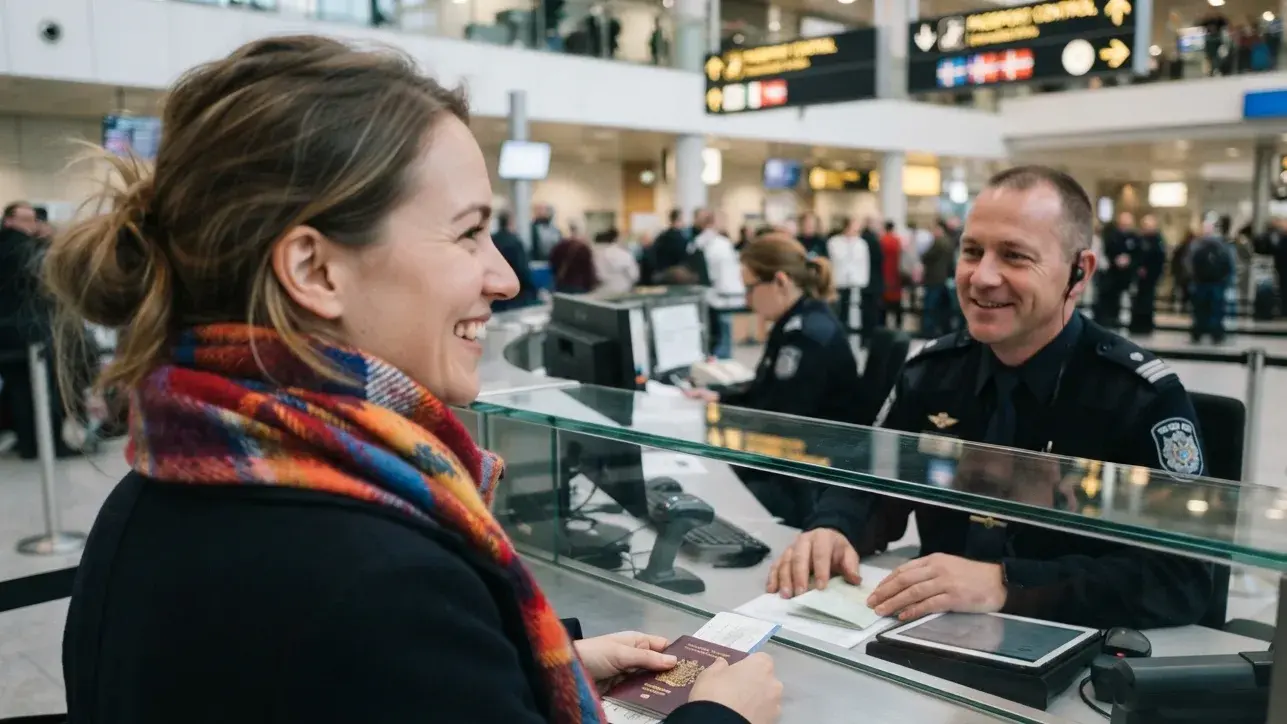
Most international travelers imagine immigration as the first major checkpoint after landing. U.S. preclearance moves that inspection into a designated airport outside the United States. CBP officers conduct the immigration, customs and agriculture review before a passenger boards a precleared U.S.-bound flight. A traveler who completes the process will generally arrive through a domestic-style pathway and can continue to a connection or final destination without repeating the standard arrival inspection.
That does not mean the foreign airport has become U.S. territory, nor does it mean every passenger receives the same questions. It means the relevant U.S. inspection occurs earlier in the journey. The officer can review identity, travel authorization, purpose, declarations and admissibility while the traveler is still abroad. A person may also be referred for additional review, and unusual operational events can affect the arrival process.
The practical change is simple: documents that might have remained in a bag until landing should be organized before airport check-in. If your planned departure from the United States is relevant to your status or explanation, you should be able to state the route and date without contradicting the booking you present.
Preclearance Does Not Create a New Universal Onward-Ticket Rule
It is inaccurate to say that every visitor must show an onward ticket merely because a flight uses preclearance. Documentary requirements depend on nationality, visa or authorization, route, carrier checks and individual circumstances. Some travelers may never be asked for separate onward proof. Others may be asked how long they intend to stay, where they will go next or how their trip is funded, with a reservation serving as one supporting record.
An officer does not have to treat a booking as conclusive. A plausible departure can reinforce an otherwise consistent temporary-visit explanation, but it cannot repair the wrong visa, missing authorization, contradictory answers, insufficient supporting information or another admissibility problem. Treat the itinerary as evidence of a plan, not as a promise of entry.
This distinction matters because travelers sometimes purchase an unnecessary fare after reading a blanket statement online. A better sequence is to identify what your airline and travel status require, decide what proof you can honestly support, and only then select the least risky document.
What an Onward Booking Can and Cannot Show
| It can help show | It cannot prove by itself |
|---|---|
| A planned date and route for leaving the United States | That CBP will admit the traveler |
| How the next segment fits a multi-country itinerary | That the traveler holds every visa or transit document needed |
| A passenger name, carrier, flight and reservation reference | That a temporary reservation will remain active indefinitely |
| Consistency with a stated visit length | That accommodation, funds or travel purpose are satisfactory |
| A concrete answer when an agent asks about the next departure | That the airline must board the passenger |
The useful question is therefore not “Will this ticket guarantee clearance?” It is “Does this record accurately support the part of my travel plan that is being checked?” That framing keeps the document in its proper role and prevents an applicant from overstating what it means.
Why the Earlier Inspection Can Help a Prepared Traveler
Preclearance is not only an additional checkpoint. It can simplify the U.S. arrival after a traveler completes the process. It also places airline staff, airport support and, at some airports, printing or connectivity options near the inspection sequence. If a boarding pass is missing or a leg has changed, the traveler may be able to contact the airline before entering the controlled area.
That opportunity should not become a last-minute strategy. Once a passenger approaches counter closure, security queues and preclearance processing, there may be little time to correct a name, route or date. Airport staff cannot guarantee that a new document will be accepted or that a delayed passenger will be held for the flight. Preparation remains much safer than rescue.
The Airport Sequence Before a Precleared U.S. Flight
Understanding the order of checks prevents a common mistake: assuming that one approval covers every stage. A boarding pass from the airline is not a CBP admission decision. CBP clearance is not a substitute for the airline's boarding and gate controls. Airport security is another separate process.
Step 1: Airline Check-In and Document Review
The airline normally confirms the reservation, passport and documents it needs to transport the passenger. An agent may use a carrier-facing system, consult route-specific guidance or ask about a visa, authorization, transit permission or onward journey. The precise review varies by itinerary and traveler.
If an agent asks for onward travel, answer with the real plan. Show the relevant booking rather than an unrelated collection of reservations. If the next journey is by air, land or sea, say so and present the record that supports it. If the return is on another airline or under a separate booking reference, make that separation clear.
The airline can deny boarding when it concludes that required travel documents are missing or when operational requirements are not met. That commercial boarding decision is distinct from CBP's later inspection. Asking the agent exactly which document is missing is more useful than arguing that a visa or booking should cover everything.
Step 2: Local Airport Security and Route Controls
After check-in, the passenger follows the airport's security and departure procedure. The order can differ between an originating traveler and a person connecting from another flight. Baggage transfer can also depend on whether the journey is issued on one ticket, the airlines have an interline arrangement, and the bag has been tagged through.
Do not assume that an advertised minimum connection is enough for your circumstances. A minimum connection time is an operational threshold, not a personal guarantee. A traveler who needs a new boarding pass, baggage assistance, an additional document check or secondary inspection may require more time. Confirm the applicable transfer process with the operating airline and airport.
Step 3: U.S. CBP Preclearance
At the preclearance facility, the traveler completes the U.S. immigration, customs and agriculture inspection before boarding. The officer may ask about purpose, address, length of stay, declarations and related travel details. Some travelers are sent for secondary inspection; that referral does not, by itself, establish that they have done anything wrong.
If the officer asks how you will leave, give a concise answer that matches the itinerary. A suitable response might identify the departure city, date and destination. Offer the reservation when requested. Avoid reciting a rehearsed speech or volunteering guesses about a segment you have not confirmed.
Step 4: Gate and Boarding Controls
After clearing, the passenger continues to the gate and remains subject to the airline's boarding rules. A schedule change, gate document check or identity confirmation can still occur. Keep the passport, boarding pass and core travel records accessible until you are on the aircraft.
At Abu Dhabi, the airport currently tells U.S.-bound passengers to complete airline check-in, proceed through security, follow the signs to the USCBP facility and then continue to the departure gate. The airport recommends arriving at least four hours before the scheduled departure, but that guidance belongs to that airport and should not be copied to every preclearance location.
Step 5: Arrival in the United States
A properly precleared passenger generally bypasses the standard CBP and TSA arrival inspection and proceeds to a connection or final destination. Still, follow the airline's current baggage and connection instructions. Do not infer from the phrase “domestic passenger” that every bag, terminal transfer or security step will be identical on every itinerary.
Operational changes, diversions or exceptional circumstances can alter the process. Keep documents until the whole journey is complete rather than discarding them after preclearance.
Who May Need Onward Proof at Preclearance
The need for proof is situation-dependent. Instead of assigning every traveler to a rigid rule, assess whether the planned departure is material to the person's permission, airline check or travel explanation.
Short-Term Visitors
A visitor describing a fixed holiday, family visit or short business trip should be able to explain the intended duration and next departure. A return or onward booking may support that explanation when asked. The dates should agree with accommodation, meetings, invitation information and any stated leave from work or study.
A one-week trip paired with a departure several months later is not automatically unlawful, but it invites an obvious question: what explains the remaining time? If the longer stay is genuine, describe it truthfully and carry the appropriate support. Do not manipulate the ticket to imitate a shorter visit.
One-Way and Open-Ended Travelers
A one-way ticket is not automatically invalid. Residents, immigrants and other travelers may have legitimate reasons to fly one way. A temporary visitor with no fixed return may need a clearer explanation of the intended stay, next destination and ability to make that journey. The correct response depends on status, not on the shape of the fare alone.
Open-ended travelers should separate flexibility from vagueness. You can have flexible plans while still identifying a realistic departure window, route and funding. If you choose a temporary reservation, it must describe a route you could use and remain current during the checkpoint where you expect it to matter.
Digital Nomads and Multi-Country Travelers
Travelers moving through several countries often hold separate bookings. Their strongest evidence is a chronological route map supported by individual confirmations, not one artificial round trip that hides the real journey. List the cities, local dates and booking references in travel order.
If a U.S. visit sits between two other countries, make sure the onward segment leads somewhere you can lawfully travel. A ticket to a country for which you lack required entry permission may prompt further questions. The ticket proves a reservation exists; it does not prove the destination will admit you.
Business, Conference and Sponsored Travelers
A business traveler may have a return controlled by an employer or travel desk. Carry the issued itinerary and, if the route is not final, a concise employer or organizer explanation that identifies who will purchase or adjust the ticket. Do not claim a booking is paid when it is only held.
Conference dates, meeting cities and accommodation should fit the flight plan. If an event ends in one city but the return departs from another, preserve the transport link between them. A logical open-jaw route is often easier to explain than an unnecessary backtrack.
Families and Groups
Family members can appear under one or several PNRs. What matters is that each traveler can be identified and the group plan is understandable. Check every passport name, including children, and keep evidence of any separate return segment accessible. Different surnames do not invalidate a family itinerary, but supporting relationship or consent documents may be relevant in some circumstances.
Group leaders should not keep the only copy of every booking. Each adult should be able to access the necessary documents, and a parent should have the records for accompanying children. A separated queue or dead phone should not make the group's plan impossible to explain.
Travelers Connecting Through Abu Dhabi
A person connecting at AUH should first confirm whether the baggage is checked through and whether a boarding pass for the U.S. flight has already been issued. Zayed International Airport directs passengers without an onward boarding pass to its transfer desk after transfer security. U.S.-bound passengers then follow the signs for preclearance.
Do not build a universal rule from one airport. Canadian, Irish, Caribbean and other preclearance locations have their own layouts, carriers and opening arrangements. Use the official airport and airline instructions for the actual departure.
Five Common Itinerary Scenarios
Scenario 1: a fixed holiday with a return flight. The simplest file usually contains the U.S.-bound itinerary, accommodation or host details and a return that matches the stated visit. The traveler should still verify that a schedule change has not moved the return beyond the intended stay. A paid return ticket may be reasonable when the dates are settled, but its existence does not replace the passport, visa or authorization review.
Scenario 2: a visit followed by another country. The onward segment should identify the third-country destination and a realistic travel date. Check whether that country requires a visa or whether the route crosses a transit point with separate rules. If the traveler will spend ten days in the United States and then continue to Canada, the U.S. accommodation and Canadian segment should form a chronological sequence rather than overlapping.
Scenario 3: the employer will buy the final return. A business traveler may have an outbound reservation while an employer waits for meeting dates before issuing the return. Carry any current itinerary and a truthful explanation of the company's process. If temporary proof is prepared, it should follow the best available schedule and should not be described as an employer-paid ticket. A short employer or travel-desk letter can explain who controls the final purchase, but it does not compel an airline or officer to accept an incomplete plan.
Scenario 4: a family returns on different dates. One parent may return earlier while the other remains with the children. Separate bookings are normal when the family can explain them. Each passenger must appear on the appropriate record, and the adults should know which child travels with whom. If consent or custody documentation is relevant to the route, handle that separately rather than expecting the ticket to establish parental authority.
Scenario 5: an open-jaw or nearby-airport departure. A traveler may arrive in New York and leave from Washington, or arrive in one region and depart from another after a road or rail journey. The route can be entirely logical. Keep the internal transport plan, allow enough time and make the intermediate cities consistent with accommodation. An open-jaw ticket is not weaker merely because it is not a round trip; unexplained geography is the real source of friction.
Questions to Answer Before Choosing Any Proof
Run a short decision check before spending money or ordering a reservation. It reduces the risk of buying the wrong route simply because a counter question feels urgent.
- What status or travel authorization am I using, and what documents does the airline need to see?
- Is my visit length fixed, flexible or controlled by another person or organization?
- Will I return to the origin, continue to a third country, or leave by land or sea?
- Can I lawfully enter the destination shown on the onward segment?
- Is the booking protected with the inbound journey or held on a separate ticket?
- Will the record still be current at airline check-in and the preclearance inspection?
- Can every traveler access the document without relying on one device?
If several answers remain unknown, a costly non-refundable ticket may create more risk than clarity. Resolve the immigration and route questions first, then choose evidence that honestly reflects the best available plan. Conversely, if the trip is settled and the fare terms are acceptable, a genuine issued ticket may be more practical than repeatedly renewing a temporary hold.
How to Choose Usable Onward-Travel Evidence
Several documents can describe a future departure, but they do not carry the same financial commitment or operational status. Choose based on the real trip, the point of the check and how certain the dates are.
| Proof type | Useful when | Main limitation to check |
|---|---|---|
| Paid non-refundable ticket | The route and date are final and the fare risk is acceptable | Changes or cancellation can be expensive |
| Refundable ticket | You need an issued ticket but plans may change | Refund rules, fees, payment timing and fare conditions vary |
| Current temporary reservation | A genuine short-term booking record fits the intended journey | It can expire and must not be represented as a paid ticket |
| Separate onward booking | The next leg is on another carrier or booking reference | Self-transfer, baggage, transit and destination permissions remain your responsibility |
| Ground or sea departure | The traveler genuinely plans to leave by train, bus, car or cruise | The record must be credible and relevant to the route; an air ticket may not be necessary |
| Price quote or search screenshot | Useful for planning only | It usually does not establish that a reservation exists |
Paid Ticket Versus Reservation
A paid ticket can provide stronger confirmation of a booked seat, but it can also expose a traveler to unnecessary loss if permission, dates or plans are uncertain. A temporary reservation can document an intended journey without the same upfront commitment, but only for the period in which the issuing system keeps it active.
Neither option is automatically “best.” A fixed family visit with approved leave may justify a flexible paid fare. A traveler waiting for a decision or final employer schedule may prefer a current reservation. Read the provider or airline terms rather than assuming the word “refundable” means cash returned without conditions.
If you are unfamiliar with the distinction between a reservation record and a fabricated file, review what a dummy ticket is before using one. The safe objective is a truthful temporary booking, not an edited ticket image or invented reservation reference.
Return Ticket Versus Onward Ticket
A return ticket takes you back toward the origin; an onward ticket takes you to a different destination. Either can show a planned departure from the United States when it reflects the actual itinerary. Do not purchase a return solely because the term feels safer if the genuine plan is to continue elsewhere.
For a multi-country trip, the onward destination should make geographic and documentary sense. A New York visitor continuing to Mexico City can show that segment, provided it is a real plan and any relevant entry requirements are addressed. The proof should not create a new unexplained problem.
PNR, Ticket Number and Airline Display
A PNR is a reservation record. Its format and public visibility depend on the airline, booking channel and reservation system. A ticket number is associated with ticket issuance; not every held reservation has one. Do not state that every valid booking must have a six-character code or appear in every airline app.
A codeshare or partner-airline itinerary can display different identifiers. The marketing carrier, operating carrier and issuing source may each show part of the journey. Record the operating carrier and use the lookup method provided by the issuer. If a public page displays only one segment, keep the complete confirmation and ask the issuing party how the record should be checked.
Why an Expired Hold Is Not Current Proof
Once a temporary hold expires, it should not be presented as an active reservation. Keeping the old PDF for personal records does not restore the booking. If current proof is required, obtain a new record that matches the present dates and route.
This is one of the most important safety improvements over common online advice. A document can look polished while the underlying record no longer exists. Relying on appearance instead of status increases friction and can damage credibility.
Low-, medium- and high-friction examples
- Lower friction: the name, route and date agree with the passport and stated visit, and the current record is easy to retrieve.
- Medium friction: the trip uses separate PNRs or a partner airline, but the traveler can explain the connection and show both records.
- Higher friction: the booking has expired, the destination is unexplained, the date conflicts with the intended stay, or the PDF has no reliable issuing context.
Build a Coherent Booking Record Before the Airport
A useful onward document is not merely a page with a flight number. It is part of a connected file. Build it from the passport outward so that each element supports the same journey.
1. Start With the Passport Name
Enter the name using the format the airline or booking system requests and the passport data it relies on. Reservation systems can remove spaces, punctuation or special characters, and they may join names. A visual difference is not always an error. The important point is that the booking identifies the same traveler without an unexplained spelling change.
Do not casually add a title to the name field or shorten a given name. For a child or family member, check the individual line rather than assuming the lead passenger's details were copied correctly.
2. Map the Entire Route
Write the route in chronological order: origin, preclearance airport, U.S. arrival, internal stops and departure from the United States. Add local dates beside each segment. This exposes impossible overlaps, missed-night hotel issues and connections that exist only on paper.
If the journey begins in India and connects in Abu Dhabi, distinguish the India-to-UAE segment from the precleared U.S.-bound segment. If the onward journey leaves from a nearby airport rather than the arrival airport, explain how the traveler will reach it. A map, train confirmation or realistic transfer plan can make the route easier to understand.
3. Match the Intended Stay
The departure date should match what you intend to say about the visit. It must also fall within the period you are actually permitted to remain; the visa's validity dates, authorized admission period and planned stay are not interchangeable concepts. Do not calculate a universal stay from the visa label alone.
Avoid arbitrary rules such as always leaving five days early. Build a sensible margin based on the permission, fare flexibility and disruption risk, but do not shorten or extend the documented stay merely to look more acceptable.
4. Check the Destination After the United States
An onward flight only works as a practical plan if the traveler can use it. Confirm the passport, visa, transit and health requirements for the next destination through current official or carrier guidance. A reservation does not transfer entry rights to the traveler.
If the next destination is home, the explanation is straightforward. If it is a third country, be ready to identify why it fits the itinerary. If it is a self-transfer, account for baggage collection, terminal changes and the possibility that the bookings are not protected as one journey.
5. Confirm What the Issuer Provides
Before relying on a temporary reservation, understand its validity window, delivery method and correction process. Check whether the confirmation identifies the passenger, dates, route, carrier and booking reference. Ask how the record should be checked when an operating carrier differs from the issuer.
Do not demand a ticket number from a product that is clearly described as a reservation, and do not describe a hold as fully paid. Accurate terminology is a trust signal.
6. Review the File as One Story
Compare the flight dates with accommodation, invitation, event schedule, insurance and any travel-purpose explanation. Minor differences can be legitimate, but they should be understandable. A hotel beginning one day after an overnight flight may be correct; a hotel ending several days before the stated departure needs an explanation or correction.
For visa-stage planning, a separate flight reservation for visa guide can help distinguish application evidence from the live documents needed on travel day. A consular submission made weeks earlier should not be assumed to remain active at airport preclearance.
Match the Route, Dates and Connection Timing
A booking can be technically valid and still create questions if the route is implausible or the timing contradicts the trip. Review the whole timeline in local time rather than looking at isolated dates.
Use Local Departure and Arrival Dates
International flights cross time zones and date lines. The date printed beside a segment normally follows the local airport. A traveler leaving India at night may reach the Gulf on the next calendar day, then arrive in the United States on what appears to be the same day because of the westbound time change.
Create a simple itinerary table with local date, local time, airport and segment status. This prevents a reservation from appearing to depart before arrival or an accommodation night from starting on the wrong date.
Do Not Use a Generic Connection-Time Rule
A statement such as “three hours is always enough” is unsafe. The needed time depends on airport layout, terminal, baggage, boarding-pass status, security, preclearance queues, secondary review and airline closure times. Follow the operating carrier and airport guidance for the particular itinerary.
At Abu Dhabi, the current airport page recommends arriving at least four hours before a U.S.-bound departure. A connecting traveler should also confirm transfer handling and whether that recommendation changes how the connection should be planned. Another preclearance airport may publish different advice.
Plan for Separate Tickets and Self-Transfers
Separate tickets can create a clean onward plan, but they can also transfer disruption risk to the traveler. If the inbound flight is late, the onward airline may have no obligation to protect the second booking. Baggage may need to be collected and checked again, and local entry permission may be needed to complete the transfer.
Do not hide this structure. Keep both confirmations, know which airline operates each segment and allow a realistic buffer. A truthful self-transfer with a clear plan is stronger than pretending that unrelated bookings form one protected itinerary.
Account for Schedule Changes
Airlines can change times, flight numbers or operating carriers. Compare the latest airline notification with the stored itinerary before leaving for the airport. If the route changed, save the update and make sure accommodation or onward connections still work.
If a schedule change makes the onward plan impossible, contact the issuing party and correct the record. Do not edit the PDF manually. An authentic change notice plus the updated reservation is easier to explain than a document that no longer matches the system.
Keep the Reservation Current Through the Relevant Check
A temporary booking's useful life is determined by the issuing system, not by how long the PDF remains on a phone. If you expect to use the record at airline check-in and preclearance, obtain it close enough to travel that it remains current, while leaving enough time to review and correct every field.
No universal “24-hour” or “48-hour” duration should be assumed. Confirm the actual terms. If the hold may expire during a long multi-segment journey, select a more suitable option rather than hoping the old record will be accepted.
Show Onward Proof Without Fumbling or Overexplaining

A good document can still create friction when the traveler cannot find it, describes it inaccurately or gives an answer that conflicts with it. The goal at the counter or booth is calm retrieval and truthful explanation.
Prepare Digital and Offline Access
Save the confirmation as an offline file, not only as a link that requires airport Wi-Fi. Keep the email and a screenshot of the essential details. A printed copy is a practical backup, particularly during a long route or when several people share one device, but it is not a universal legal requirement.
Charge the phone and carry an allowed power bank in hand luggage. Write down the booking reference and operating carrier. Protect personal data rather than leaving full passport and booking files visible on a public device.
Answer the Question That Was Asked
If asked when you leave, state the date. If asked where you go, name the destination. If asked to show the reservation, retrieve it. A long unsolicited account can introduce inconsistencies that were not part of the original question.
Do not memorize a false script. If you need to check the date, say so and read it from the record. If plans changed, explain the change and show the latest confirmation. Honest uncertainty followed by accurate evidence is safer than a confident wrong answer.
Explain Separate PNRs Clearly
A return or onward segment may be in another app, email or PNR. Say that the bookings are separate and show the second record. Identify the operating airline if the brand displayed on the document differs from the aircraft operator.
A public lookup might not show every partner segment. That does not automatically make the booking false. Keep the complete issuer confirmation and current airline communication. Ask the issuer for the appropriate verification path before travel.
Handle Secondary Inspection Calmly
Secondary inspection can occur for many reasons and does not automatically mean refusal. Keep answers consistent, provide requested documents and follow instructions about phones and belongings. If boarding time becomes a concern, raise it politely, but understand that the inspection takes priority.
Do not treat a temporary reservation as the centre of every answer. The officer may be assessing purpose, status, declarations, funds, address or another issue. Present the ticket only for the question it actually supports.
Keep Family and Companion Records Independent
If a companion's onward proof is on your phone, send them an offline copy before joining the queue. Each traveler should know the core route and visit length. Parents should be able to identify the itinerary for their children.
When family members return on different dates, do not force their reservations into one explanation. Show the individual departures and explain why they differ. Consistency does not require identical travel plans; it requires truthful, compatible ones.
Mistakes That Increase Friction and How to Fix Them
Most correctable problems are ordinary: a date no longer matches, a booking expired, one segment is missing, or the traveler cannot explain a separate reservation. Find these issues before leaving home.
Mistake 1: Treating Preclearance as an Onward-Ticket Mandate
Why it causes trouble: the traveler buys or presents unnecessary proof without understanding the actual status or route requirement.
Fix: confirm what the airline requires and prepare the evidence relevant to your circumstances. Keep the U.S. inspection distinct from airline boarding policy.
Mistake 2: Presenting an Expired Reservation
Why it causes trouble: the PDF may look complete while the underlying record is no longer active.
Fix: check the reservation before travel. If it expired and current proof is needed, create a new truthful record. Do not alter the old document.
Mistake 3: Using a Date That Conflicts With the Travel Story
Why it causes trouble: a departure months after a stated short visit, or before an event ends, makes the file harder to understand.
Fix: reconcile the booking with accommodation, event dates, invitations and the intended stay. If the longer or shorter plan is real, update the explanation rather than hiding it.
Mistake 4: Assuming Every Name Display Must Look Identical
Why it causes trouble: travelers may replace a valid booking because a system removed punctuation or joined names, or they may ignore a real spelling error.
Fix: compare the underlying passenger identity with the passport and the carrier's name-format guidance. Correct genuine spelling or passenger mismatches through the issuer.
Mistake 5: Showing a Search Result Instead of a Booking
Why it causes trouble: a fare page or screenshot shows availability at a moment in time, not a reservation for the traveler.
Fix: when proof is required, use the appropriate confirmed ticket or current reservation. Keep price searches for planning only.
Mistake 6: Ignoring the Next Country's Requirements
Why it causes trouble: an onward flight to a destination the traveler cannot enter may not be a credible exit plan.
Fix: check the next destination and any transit points. Carry required authorizations and be able to explain the route.
Mistake 7: Relying on One Phone or One Person
Why it causes trouble: a dead battery, missing signal or separated queue removes access to the only copy.
Fix: keep offline and printed backups, and share the relevant record with each adult traveler.
Mistake 8: Waiting Until the Counter to Repair the File
Why it causes trouble: check-in closure, security and preclearance leave limited recovery time.
Fix: complete a night-before review and another check before leaving for the airport. If the airline changes the itinerary, address it as soon as the notice arrives.
A Practical Night-Before Checklist
- Confirm the operating flight, departure terminal and airline check-in guidance.
- Review passport, visa or authorization and any transit documents.
- Open the current onward or return record and verify its status.
- Compare passenger name, route, local dates and destination.
- Check accommodation and purpose documents for date conflicts.
- Download offline copies and prepare a readable print backup.
- Confirm baggage and transfer handling for separate tickets.
- Charge devices and place the documents where they can be retrieved quickly.
When a Problem Appears at the Airport
First ask the airline agent or officer what specific issue needs attention. A missing visa, inactive reservation, wrong name and unclear route require different solutions. Do not assume a new onward ticket fixes every refusal.
If the problem is a booking detail and time permits, contact the issuer for a correction or obtain a new current reservation that reflects the real plan. If the airline has changed the flight, ask it for updated confirmation. If legal entry or transit permission is missing, a reservation service cannot solve that issue.
Remain courteous and keep records of changes. If the flight cannot be taken, discuss rebooking with the airline rather than creating a false document under pressure. A delayed trip is preferable to a misleading file.
Walking Into Preclearance With a Clear Travel Story
The most important preparation is coherence. Know the order of checkpoints, understand what your booking represents, and keep the route consistent with the visit you describe. Preclearance makes the conversation earlier; it does not make a temporary reservation more powerful than it is.
Use a paid ticket when the plan is settled and the fare terms fit. Use a current temporary reservation when it truthfully reflects an intended journey and flexibility is necessary. If you need more detail on visa-focused use, read the dummy ticket for visa guidance without assuming that a visa-stage document replaces travel-day checks.
Finally, use the airport and airline instructions for the actual route. Abu Dhabi's published sequence is helpful for AUH; it should not be copied blindly to Dublin, Toronto or another preclearance airport. Good preparation is specific, current and easy to explain.
Prepare before the airline desk and preclearance booth. Build a reservation around the route and dates you can truthfully support, review every passenger field and keep the current record available offline.
Frequently Asked Questions
Do all travelers need an onward ticket at a U.S. preclearance airport?
No. Preclearance does not create a universal onward-ticket requirement for every traveler. The relevant documents depend on nationality, immigration status, route, airline checks and individual circumstances. A temporary visitor may be asked about the planned departure, while another traveler may not need separate onward proof.
Can CBP ask for onward travel before I board the flight?
Yes. At a preclearance location, CBP conducts the U.S. immigration, customs and agriculture inspection before the traveler boards the precleared flight. If onward travel is relevant to the inspection, an officer can ask about it there. The airline may also conduct its own earlier document review.
Is a temporary onward reservation acceptable at preclearance?
A current, truthful reservation may support an intended departure when it fits the route and circumstances, but no document guarantees acceptance, boarding or admission. Do not describe a reservation as a paid ticket, and do not rely on it after the underlying record has expired.
How early should I arrive for U.S. preclearance?
Follow the operating airline and departure airport's current guidance because the required time varies. Zayed International Airport currently recommends arriving at least four hours before a U.S.-bound departure, but that recommendation should not be applied automatically to every preclearance airport or connection.
What if my onward flight is on another airline or PNR?
Keep the separate confirmation and explain that the next journey uses another airline or booking reference. Confirm the operating carrier, baggage plan, transit requirements and destination permission. A separate PNR can support a valid route, but it may leave you responsible for missed connections and re-checking baggage.
Should I carry printed onward-ticket proof?
A readable printout is a useful offline backup, but it is not a universal requirement. Save the current confirmation offline on your phone as well, keep the booking reference accessible and follow any format requested by the airline or authority. The underlying booking status matters more than the appearance of the copy.
Friendly reminder: DummyFlights provides temporary travel-proof documents for planning and application support. Requirements vary by destination, airline, route and applicant situation. A dummy ticket can support a file, but it does not guarantee approval, boarding or entry.