
Short answer: If you need onward ticket proof before an airport transfer, prepare a truthful, checkable record that matches your passport, transfer country, final destination and permitted exit date. Airline staff may review it before boarding, especially on separate bookings or a self-transfer; it cannot replace a required visa, transit authorisation or destination rule.
Key facts
- Onward proof may be checked at the origin counter, a second check-in desk, a transit checkpoint or the destination border.
- Airside and landside transfers are not the same; collecting bags, changing airports or using separate bookings can trigger a new document check.
- The name, route, exit date, visa or authorisation and accommodation story should agree across the file.
- A bus, ferry or train may be relevant, but acceptance depends on the carrier, destination and route.
- A temporary reservation can support planning or an application file when accepted; it does not guarantee boarding or entry.
Need onward proof before a transfer? Build the document around the actual hand-off point, exit date and destination requirements, then keep a copy available offline.
Prepare your onward ticketIn This Guide
- Why Airport Transfers Put Your Onward Ticket Under The Spotlight
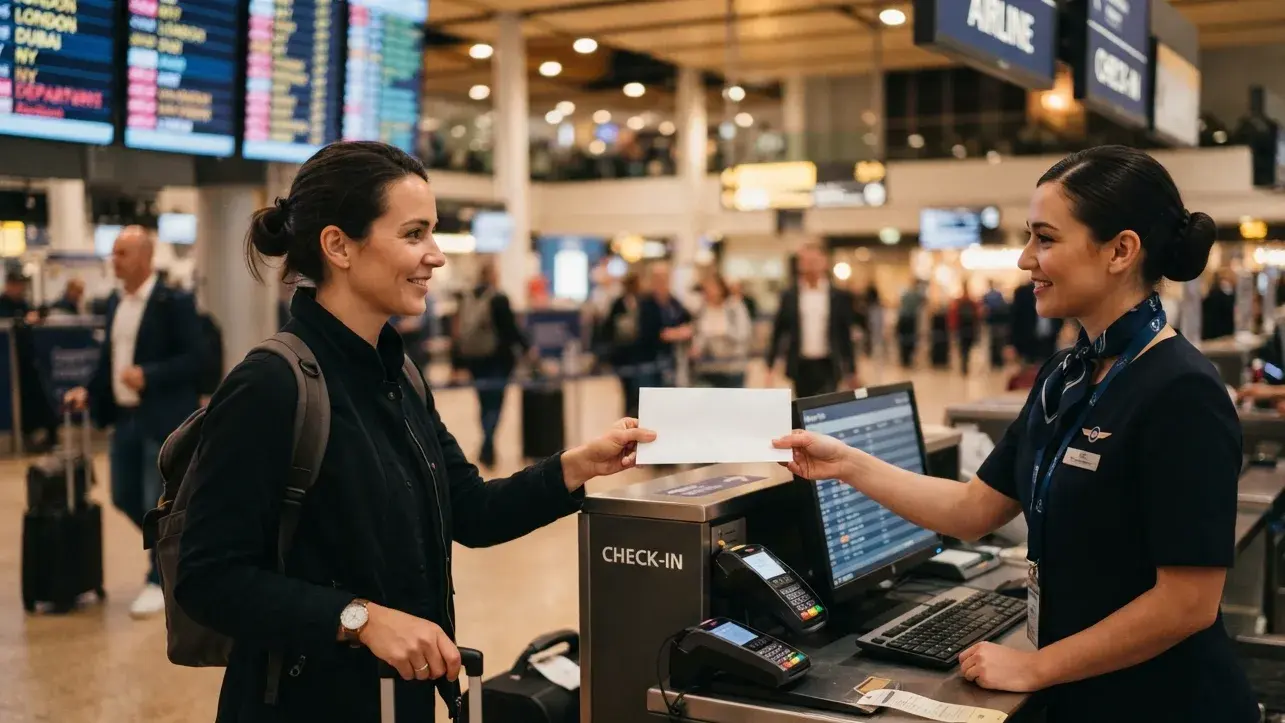
- What Happens At The Check-In Counter Before You Even Reach The Gate
- Which Destinations Ask For Onward Proof Before You Land
- What Actually Counts As Valid Proof When You're Mid-Transfer
- Self-Transfer Vs Airline-Booked Connections: Why The Rules Split
- Building An Onward Ticket That Holds Up At The Transfer Point
- What Happens If You Can't Produce Onward Proof At The Gate
- Regional Patterns Every Transfer Traveler Should Know
- Choosing The Right Onward Ticket Strategy For Your Own Itinerary
- Making Your Next Transfer The One That Goes Smoothly
- FAQ
Official-source check: Passenger-document rules vary by nationality, airline, transit arrangement and destination. Check the IATA Travel Centre for carrier-facing passport, visa and health requirements, then confirm the destination’s current immigration notice. For a concrete transit example, GOV.UK says travellers may be asked to prove that an onward journey is booked or confirmed. These sources do not guarantee boarding or entry for an individual traveler.
Reviewed for: airport-transfer and self-transfer document checks, airline-versus-border responsibility, onward-date consistency, overland exit proof, PNR wording and official-source alignment.
Your connection is tight, your bag is checked through, and the check-in agent is still staring at your screen. That pause usually means one thing: they can't find proof that you're leaving the country you're transferring into. This isn't about your visa application. It's about the exact moment your itinerary gets tested, at the counter, before you ever reach the gate.
Airport transfers create a different kind of pressure than a straightforward visa interview. You might be self-transferring between two separate bookings, connecting through a third country, or landing somewhere that treats your layover as a full entry. Each of these situations calls for a different kind of onward proof, and getting it wrong can mean a missed flight rather than a rejected application.
This guide walks through what actually gets checked at transfer points, why the rules shift depending on how your connection is built, and how to carry proof that holds up whether you're at a check-in counter in Delhi or a transit desk in Bangkok. If the document itself is unfamiliar, start with what is a dummy ticket before choosing a transfer-stage document.
Why Airport Transfers Put Your Onward Ticket Under The Spotlight

A layover feels like a pause between two flights, but immigration systems and airline software rarely see it that way. The moment you step off one flight and into a new check-in queue, you become a fresh case: a traveler with an unfinished itinerary who needs to prove where you're headed next.
The Transit Zone Isn't Neutral Ground
Many travelers assume that once they're inside an airport's transit area, no country's entry rules apply to them. That's only true for a narrow category of same-terminal, airline-managed connections. The rest of the time, you're technically clearing passport control into a country, even if you never plan to leave the terminal.
Requirements for onward tickets vary by destination and visa status, and a transit stamp can carry the same documentation demands as a full tourist entry. Some countries require onward tickets specifically to let travelers clear international transit zones without a separate visa, which means your paperwork does double duty: it satisfies the transit rule and sets up your next leg.
Self-Transfer Itineraries Change What Immigration Officers Ask For
If your two flights are on one ticket, under one airline group, the system usually already knows your full route. But if you booked a separate outbound flight and a separate onward flight, an immigration officer or check-in agent can't see the connection automatically.
Self-transfers may trigger the need for onward travel proof due to immigration checks, because from the system's point of view, you've just arrived with no confirmed reason to leave. This is the scenario that catches most travelers off guard. They assume their well-planned itinerary speaks for itself, when in reality, two disconnected bookings look identical to a one-way arrival with no exit plan.
Consider Amanda, flying from Toronto to Bangkok with a self-arranged stop in Seoul. Her Toronto-to-Seoul ticket and her Seoul-to-Bangkok ticket are booked with different airlines. At the Seoul check-in counter, the agent isn't reviewing her Bangkok visa status. They're reviewing whether she can legally board the flight into Thailand, and whether she has a documented way out of Thailand afterward. Her original itinerary, useful as it is for her own planning, tells the agent nothing about her exit plan from the destination country she's about to enter.
The same logic applies in reverse for travelers heading home. Picture Marcus, based in Chicago, wrapping up a long work assignment in Mumbai and flying back through Frankfurt on two separate one-way tickets he booked months apart to save money.
At his Mumbai check-in, the agent has no way of confirming he'll actually be allowed to enter Germany for his layover, since a long layover in some cases requires clearing German passport control rather than staying airside. Without a ticket showing his onward connection to Chicago, Marcus risks being stopped before his first flight even leaves Mumbai, purely because two unrelated bookings don't tell a complete story to the system checking them.
Why A Missing Onward Ticket Becomes The Airline's Problem, Not Just Yours
Airlines are financially responsible for returning passengers denied entry, which is the real driver behind every onward ticket check you'll encounter at a transfer point. Immigration authorities in the destination country hold the carrier accountable if someone lands without a valid reason to leave and then gets refused entry. That single liability rule explains almost every awkward moment at a check-in counter: the agent isn't being difficult for its own sake. They're protecting the airline from a bill and a compliance flag.
This is also why the check happens before boarding rather than after landing. It's far cheaper and simpler for an airline to stop a passenger at departure than to fly them across the world and then absorb the cost of sending them back at its own expense. For you as a traveler, that means the real test of your onward ticket often happens hours before you land, not after. If your paperwork doesn't satisfy the person behind the counter, you may never get the chance to explain your full itinerary to an immigration officer at all.
This liability structure also explains why the requirement rarely softens for people with obviously legitimate travel plans. An airline check-in agent has no way to independently verify that your job, your return home, or your onward plans are real beyond what your documents show. They aren't equipped to make a judgment call about your character or your intentions, only about whether your paperwork meets the bar their airline has set. That's a small but important mental shift: the onward ticket check isn't a test of trustworthiness; it's a paperwork match, and paperwork matches are far easier to prepare for than a stranger's snap judgment about your travel plans.
This pattern isn't limited to a handful of unusual airports. Many countries built onward ticket verification into their international travel entry requirements long before self-transfer itineraries became common, and airport immigration desks in both major hubs and small regional airports apply the same underlying logic: officers want assurance that you can pass immigration on both ends of your trip, not just the leg you're currently completing. Countries require proof of onward travel not as a punitive measure but as a practical filter, separating travelers with real, time-bound plans from those who might quietly overstay a tourist visa.
Airlines may require proof of onward travel to prevent illegal immigration through their own routes as well, which is part of why the check persists even on routes with historically low overstay rates. None of this is personal, and none of it reflects on how genuine your travel plans actually are. It's a filter applied to everyone equally, and the travelers who move through it fastest are simply the ones who arrive with the right document already in hand.
Understanding this shifts the whole way you should think about proof for a transfer. It's not just about pleasing an immigration desk after you land. It's about giving the check-in agent, sitting at a kiosk in your departure airport, enough visible confidence to let you board. That distinction shapes everything else in this guide, starting with what actually happens at that counter.
What Happens At The Check-In Counter Before You Even Reach The Gate
Before your passport ever reaches an immigration officer at your destination, it passes through a much less forgiving checkpoint: the airline's own check-in process. This is where most onward ticket problems for transfer travelers actually surface.
The Check-In Agent's Job Is To Protect The Airline, Not Judge Your Trip
A check-in agent isn't trained to evaluate whether your travel plans make sense. Their job is narrower and more mechanical: confirm you meet the destination country's entry requirements well enough that the airline won't get fined or forced to fly you back. Airlines enforce onward ticket checks to avoid liability, and that liability sits with the carrier the second you board, not with the government you're flying into.
This is why an agent might ask pointed questions even when your visa status is completely valid. They're not questioning your visa. They're checking a box that has nothing to do with your visa and everything to do with whether you can show a way out of the country you're about to enter. Airlines and border authorities check onward tickets to avoid potential fines, and that shared incentive means both sides of the counter, yours and theirs, are safer when your proof is visible and unambiguous.
Airline Systems Flag One-Way Tickets Automatically
Modern airline systems don't wait for a human to notice a missing return leg. A one-way ticket can raise concerns about overstaying, and many reservation systems flag single-direction bookings for extra scrutiny during check-in, particularly on routes into countries known for strict entry rules. Missing onward proof can lead to additional questioning at check-in, and that questioning often happens at the exact moment you're trying to make a tight connection.
Budget airlines frequently enforce onward ticket checks more strictly than full-service carriers. Lower-cost airlines run leaner operations with less room to absorb the cost of a denied-entry passenger, so their check-in staff tends to ask for onward proof earlier and more consistently. If your transfer includes a low-cost carrier for either leg, expect the onward ticket question to come up regardless of how confident you feel about your final destination's entry rules.
Airlines often check for onward tickets at check-in specifically because that's the last controllable point before a passenger becomes the airline's financial responsibility. Once you're airborne, the airline has no way to correct a documentation gap. That's why the check-in counter, not the arrivals hall, is where most transfer travelers actually run into trouble.
What A Check-In Agent Actually Wants To See On Your Screen Or Printout
Most check-in agents are looking for three things, and they want to find them quickly. They want a name that matches your passport, a flight number and departure date that make sense against your current itinerary, and a destination that satisfies the entry requirements of the country you're flying into next.
A clean way to think about it:
-
Passenger details that match your travel document exactly, including full legal name and passport number where required
-
A flight number and confirmed departure date, not a placeholder or "TBD" entry
-
A destination country that lines up with your stated travel plans, especially if you're heading to a third country rather than home
If any of these elements look inconsistent, expect the agent to ask follow-up questions before printing your boarding pass. Some airline check-in staff will accept a printed confirmation on the spot; others will call their supervisor or ask you to pull up the booking on a live app so they can verify it isn't a mockup. Either way, the smoother your documentation looks on first glance, the faster you'll clear this step and move toward your gate.
Airline staff at busy hubs process hundreds of check-ins per shift, and most rely on quick, practiced visual cues rather than a deep investigation into every itinerary. A valid ticket that's clearly paid, rather than held, quoted, or pending, moves you through fastest. Resist the temptation to grab the cheapest possible ticket just to wave at the counter and hope nobody looks closely.
A fake ticket or a manually altered confirmation can be spotted quickly by staff who review these documents daily, and getting flagged for one creates a far bigger problem than a delayed connection ever would. Non-refundable tickets bought purely to satisfy this one step also carry a hidden cost if your actual plans shift later, so weigh that against the flexibility a short-term verified reservation can offer instead.
This groundwork at the counter sets up the next question every transfer traveler needs answered: which destinations are actually strict about this, and which ones barely ask at all?
Which Destinations Ask For Onward Proof Before You Land

Not every airport transfer carries the same level of scrutiny. Some destinations barely glance at your itinerary, while others treat a missing onward ticket as grounds to stop you before you even board.
Southeast Asia's Reputation For Strict Onward Checks
Southeast Asia has strict checks for onward tickets, and this region produces more onward-ticket stories from frustrated travelers than almost anywhere else. Thailand requires proof of onward travel for entry, and immigration officers there have a documented history of asking to see it, particularly for travelers arriving on one-way tickets without a hotel booking to match.
The pattern extends beyond Thailand. Countries like Thailand require proof of onward travel for entry across much of the region, and airlines flying into Bangkok, Kuala Lumpur, or Jakarta from a self-transfer route tend to apply the same standard consistently. If your itinerary routes you through a Southeast Asian hub as a stopover before a longer trip, build in the assumption that someone, either the check-in agent at your origin or the immigration officer at arrival, will ask for your exit plan.
Why Costa Rica And Other Latin American Countries Ask Early
Costa Rica is another destination where the onward ticket question tends to come up at check-in rather than at arrival. Travelers heading into Costa Rica without a confirmed way out have been turned away at departure airports well before their flight ever left the ground, because the airline knew the entry requirement would apply and didn't want to risk the liability.
Countries like Brazil and Colombia ask for onward travel proof as well, particularly for travelers on tourist visas arriving from outside their usual regional bloc, and this applies whether the arrival is a final destination or simply a transfer point on the way somewhere else in South America. The pattern across much of Latin America mirrors Southeast Asia: an onward or return ticket, sometimes a bus ticket to a neighboring country, satisfies the requirement, but a bare one-way flight often doesn't.
The Visa Waiver Program And Why It Doesn't Remove The Requirement
Travelers holding passports that qualify for a visa waiver program often assume the onward ticket rule doesn't apply to them, since they're not going through a formal visa application stage at all. That assumption causes real problems at transfer points. A visa waiver removes the need for a pre-approved visa; it does not remove the airline's or the destination country's interest in your exit plan.
Someone traveling visa-free into a country under a waiver arrangement can still be asked for proof of onward travel at check-in, especially if they're arriving on a one-way ticket with no visible return date.
This confusion tends to hit US passport holders particularly often, since a US passport grants visa-free or visa-on-arrival access to a large share of the world's countries. That broad access can create a false sense of security around documentation in general. A traveler who's never needed to think about a formal visa application stage for most of their trips may not realize that onward proof operates as a completely separate requirement, tied to airline liability and entry rules rather than to whether a visa itself is needed.
The UK requires proof of onward travel for visitors in a range of circumstances, even though many visitors enter under visa-free arrangements. The takeaway for transfer travelers: never treat visa-free entry as a substitute for onward proof. They solve two different problems, and border control officers know the difference even when travelers don't.
A valid onward ticket accepted in one country isn't automatically accepted at your next stop, which surprises travelers moving through several destinations in a single trip. A confirmed return flight ticket that satisfied Thai immigration on your inbound leg won't necessarily satisfy the entry requirements of the next country on your route, since each border applies its own standard for what "proof" actually means.
These countries require proof largely because arrival data on one-way tickets has historically correlated with higher overstay rates, and officials treat the document less as a formality and more as a genuine risk signal worth checking.
This regional variation raises a practical question. If the requirement shows up so unevenly, what actually counts as strong enough proof once you're standing at the counter deciding what to hand over?
What Actually Counts As Valid Proof When You're Mid-Transfer
Once you understand that a transfer checkpoint can demand onward proof, the next question is what actually satisfies that demand. The answer is broader than most travelers assume.
| Connection setup | What may be checked first | Safer preparation |
|---|---|---|
| One connected itinerary | Carrier system, destination eligibility and onward segment | Keep the complete itinerary and any required transit authorisation together. |
| Separate bookings or self-transfer | Second check-in, baggage collection, passport control and proof of exit | Carry each booking separately and make the hand-off city, date and destination consistent. |
| Air, bus, ferry or train exit | Whether the transport record is confirmed and acceptable for that route | Use a named, dated, checkable record and confirm the destination’s current rule before departure. |
Flights Aren't The Only Acceptable Onward Journey
An onward ticket can be a flight, bus, or train reservation, and this flexibility matters most for travelers connecting through regions with strong overland networks. Overland transport tickets can also serve as proof of onward travel, which means a traveler transferring through a European hub before continuing overland doesn't necessarily need to book a return flight just to satisfy a checkpoint.
An overnight bus booking between two neighboring countries, for example, can work as a legitimate onward journey document in regions where cross-border bus travel is common and well documented. The same applies to rail tickets in parts of the world with dense train networks. What matters is that the document is confirmed, shows a real departure date, and lists your name accurately, not the specific mode of transport.
Why A Booking Confirmation Alone May Not Be Enough
A booking confirmation email is a starting point, not automatically sufficient proof on its own. An onward ticket is a confirmed document showing travel plans out of a country, and the word "confirmed" is doing real work there. A pending reservation, an unpaid hold, or a screenshot of a search results page won't satisfy a check-in agent who has seen every version of a half-finished booking before.
Having an onward ticket helps confirm travelers' intent to leave a country, but only when that ticket is unambiguous. Onward tickets must be presented during airport check-in and may be verified by immigration, and verification usually means the agent can look up your booking reference in a live system and see a matching, paid reservation. If your only proof is a forwarded email with no retrievable booking code, you're gambling on the agent choosing not to check.
For the broader document strategy, see the dummy ticket for visa guide and then return to this page for transfer-stage checks.
Reading The Fine Print On Refundable Vs Non-Refundable Tickets
Travelers often default to booking the cheapest possible onward flight just to clear the check-in hurdle, without reading the fare conditions closely. This creates two separate problems worth understanding before you buy anything.
-
Non-refundable tickets satisfy the immediate proof requirement but lock you into a cost you may never use if your real plans change
-
A fully refundable return ticket is the safest option in terms of flexibility, since you can cancel it later without losing money, though it typically costs more upfront
-
Fixed plans booked far in advance can conflict with how transfer itineraries actually evolve, especially for travelers extending trips on the ground
A one-way ticket lacks a return leg and future plans, which is precisely why it draws attention at a transfer checkpoint. A return ticket guarantees your return to the original country, which is why it remains the gold standard whenever your actual travel plans genuinely include going home on a set date. Onward tickets can be return tickets or flights to a third country, so if you're not planning to return to your starting point, a forward-booked flight to your next real destination works just as well as a return, provided it's confirmed and verifiable.
An onward ticket proves you will leave a country, and proof of onward travel shows your exit plan from a country in the clearest possible way: a specific date, a specific route, and a specific name matching your passport.
A plane ticket bought purely to function as an exit ticket needs to look identical, in every practical sense, to any other airline ticket already in the airline's system: a real fare class, a real PNR, and a record that comes up cleanly when someone searches your reference number. This is the key difference between a genuinely verifiable flight reservation and an informal booking screenshot that sometimes fails the retrievability test agents rely on to confirm a valid onward ticket within seconds rather than minutes.
Some travelers also use a booking with a 24-hour cancellation window as a way to secure temporary proof without financial risk, though not every airline or fare class extends that grace period to international routes, so it's worth confirming the fare rules before assuming you can cancel penalty-free.
Once you understand what qualifies, the next decision point is how the type of connection you're flying, self-transfer or airline-booked- changes how strictly that proof gets checked.
Self-Transfer Vs Airline-Booked Connections: Why The Rules Split
The single biggest variable in how strictly your onward ticket gets checked isn't the country you're flying to. It's whether your connection was booked as one seamless itinerary or stitched together by you across separate reservations.
When The Airline Already Vouches For Your Next Leg
If you book a single itinerary through one airline or airline alliance, from your origin through your transfer point to your final destination, the system already treats your journey as one continuous record. The airline knows your next destination the moment you check in for the first flight, because your boarding passes and baggage tags are issued together.
In this setup, immigration officers at the transfer airport typically see a passenger who is not "arriving" in the same sense as someone starting a fresh entry. Your entire route, including your outbound flight, your layover, and your final destination, exists as a single verifiable record. This is the scenario where onward ticket checks are least likely to interrupt your journey, because the proof requirement is effectively already satisfied by the structure of your booking.
Why Self-Transfers Reopen The Onward Ticket Question
The moment you split your journey into two separately booked flights, even on the exact same route, you reintroduce the entire onward ticket question at your transfer point. The airline handling your second flight has no automatic knowledge of your first flight, your final destination, or your intent to continue traveling. From their system's perspective, you're a new passenger checking in with no visible connection to anything before it.
This is exactly where self-transfers may trigger the need for onward travel proof due to immigration checks, and it's also where digital nomads and long-term travelers run into the most friction. Someone stringing together six separate one-way flights across a year of travel looks, to any single airline's system, like someone who might not have a plan at all. Even if your full itinerary is completely legitimate, each individual leg needs to stand on its own in terms of documentation.
Frequent travelers who fly this way regularly often develop a habit of over-preparing: carrying a printed or digital copy of proof for every single leg, rather than assuming their travel history or general itinerary will speak for them. That habit, while extra work, prevents the exact kind of counter-side delay that self-transfer routes are known for.
Consider a traveler heading from Mumbai to Lisbon with a self-booked stop in Istanbul. The Mumbai-to-Istanbul flight and the Istanbul-to-Lisbon flight sit on two completely separate reservations, purchased from two different airlines weeks apart.
At the Mumbai check-in agent's desk, the question isn't about Lisbon at all. It's about whether this traveler has a documented reason to leave Turkey after landing there, since from the airline's point of view, the Istanbul leg is a standalone entry into a country with its own entry requirements. A same-ticket itinerary through one carrier would have made this a non-issue. The self-booked version turns it into a document check that has nothing to do with the traveler's actual final destination.
Why A Check-In Agent Treats Every Self-Booked Leg As A Fresh Case
Every time a check-in agent scans a boarding pass for a self-transfer route, they're effectively opening a new file rather than continuing an existing one. There's no shared record connecting your outbound flight to your onward flight, which means the burden of proof resets at every counter. Travelers heading through multiple self-booked connections in one trip sometimes find this exhausting, but the fix is simple and repeatable: treat each leg as though it's the only leg the airline can see, because functionally, that's exactly the airline's position.
Third-Country Layovers And The Extra Layer Of Scrutiny
A third-country layover, where your transfer point isn't your home country, your final destination, or even a place you've visited before, adds another layer to this picture. Immigration officers at a third-country transfer point are evaluating two separate things at once: whether you meet their own country's entry requirements for the layover itself, and whether you'll actually be able to continue onward as your ticket claims.
This is where a mismatch becomes obvious fast. If your transfer country has strict entry requirements of its own and your onward flight doesn't clearly continue to your stated final destination, you may face questions on both fronts simultaneously. Passport control staff in these situations tend to look closely at whether your outbound flight, your layover, and your onward flight tell one coherent story, or whether they read like three unrelated bookings that happen to share a traveler's name.
Reading Your Own Itinerary Before You Assume Which Category You're In
A surprising number of travelers don't actually know which of these three categories their own trip falls into until they're already at the counter. The fastest way to check is to look at whether your onward flight shares a single booking reference with your first flight, or whether you're holding two separate confirmation numbers, possibly from two separate airlines entirely.
-
One shared PNR across the whole journey usually means airline-booked, low-friction transfer
-
Two or more separate PNRs, same or different airlines usually means self-transfer, higher scrutiny
-
A layover in a country you're not visiting on purpose, purely to change planes, usually means a third-country situation worth double-checking before departure
Running through this quick check before you leave home, rather than discovering the answer at the counter, gives you time to arrange proof calmly instead of scrambling under pressure with a boarding time closing in.
It also helps to check your layover duration against the specific airport's transfer rules. Some airports allow passengers to remain in a dedicated transit area without formally entering the country, provided the layover falls under a set number of hours, and both flights are on the same day.
Step outside that window, whether because of a long layover, an overnight stop, or a terminal change that requires exiting security, and you may be treated as a formal arrival regardless of how briefly you intended to stay. Checking this detail in advance, through the specific airport's own transfer policy rather than general assumptions about "layovers," prevents an unpleasant surprise partway through your journey.
Understanding this split- seamless itinerary versus self-transfer versus third-country layover- tells you when to expect friction. The next practical step is knowing exactly how to build an onward ticket that holds up regardless of which of these three situations you're in.
Building An Onward Ticket That Holds Up At The Transfer Point
Knowing that proof is required is only half the equation. The other half is building a ticket that actually survives contact with a skeptical check-in agent or a busy immigration desk.
Matching Your Departure Date To The Real Shape Of Your Trip
The single most common mistake travelers make when preparing onward proof for a transfer is choosing a departure date that doesn't logically match their trip. If you're telling an agent you plan to spend two weeks in your destination country but your onward ticket shows a departure two days later, that mismatch invites exactly the kind of questioning you're trying to avoid.
Your departure date should align believably with your stated travel plans, your visa validity if one applies, and the general shape of the trip you've described. This matters even more at a transfer point than at a standard arrival, because the agent checking your paperwork is often working quickly, under time pressure, comparing your onward ticket against whatever you've told them or whatever your original booking implies about your final destination.
A useful habit is working backward from your return date, if you have one, and checking that every leg in between makes chronological sense. If your final destination trip runs three weeks but your onward ticket out of a transfer country shows a departure just two days after arrival, that gap invites a question you'd rather not answer at a counter with a boarding time approaching.
Building a small buffer, a few days either side of your realistic plans, gives you room to explain a schedule that still looks coherent even if an agent asks you to walk through it out loud.
Carrying Proof In A Format That's Instantly Checkable
How you present your onward ticket matters almost as much as the ticket itself. A printed copy is still the safest baseline, since it works even if your phone battery dies or you can't get airport Wi-Fi to load an email. A digital copy saved offline, rather than one that only loads with an active connection, protects against the same problem in a different form.
-
Print one copy per leg of your journey, not just one master copy for the whole trip
-
Save a PDF locally on your phone, separate from your email inbox, so it opens even without signal
-
Keep your booking reference visible and legible, since agents often type this manually rather than scanning a barcode
-
Note the issuing airline's contact details, in case an agent wants to verify the reservation directly rather than relying solely on your printout
A little redundancy here goes a long way. Losing access to one format, a dead phone, a printer that jammed before you left home, a spotty airport network, shouldn't leave you without any way to show your proof. Travelers who build this redundancy into their routine rarely think about it again once it becomes habit, the same way most people no longer think twice about checking their passport's expiry date before a trip.
Why A Verified Flight Reservation Beats A Screenshot
A verified flight reservation may be more useful than a free screenshot or placeholder because the record can be checked against the supplier or airline system. What an agent can verify, how long the record remains available and whether it is paid or held depend on the provider and route, so confirm those details before relying on it.
A temporary reservation service may issue a short-window booking record with a reference that can be checked, but inventory, airline display, PNR visibility and validity vary. Do not assume that every PDF or reference can be retrieved by every carrier.
A truthful dummy flight ticket describes a temporary reservation rather than a paid ticket. It can support planning or an application file when the destination and carrier accept that format, but it is not a substitute for a required visa, transit authorisation or genuine ticket.
Where A Temporary Reservation Service Fits Into This Plan
Temporary reservation services provide verifiable onward tickets for short windows, which suits travelers who need proof for a specific transfer point without committing to a real, non-refundable flight they may never take. This is particularly useful for anyone whose actual onward plans are still flexible: someone extending a trip on the ground, deciding their next destination after arrival, or waiting on a visa extension before booking anything permanent.
DummyFlights.com issues these reservations as instantly verifiable bookings with a real PNR and PDF confirmation, unlimited date changes if your transfer timing shifts, and transparent pricing around $15 (roughly ₹1,300), which keeps the cost predictable regardless of how many transfer points your itinerary includes.
For a traveler juggling several connections in one trip, that consistency matters more than it might seem: you're not negotiating a different price or process at every leg, just producing the same kind of clean, checkable document each time.
A Quick Way To Decide Which Route To Take
Not every transfer calls for the same kind of proof, and matching your choice to your actual circumstances saves both money and hassle:
-
If your plans are already fixed and confirmed, a real return or onward flight makes sense, since you'll use it anyway
-
If you're still deciding your next move after arrival, a short-window verified reservation avoids locking you into a flight you may never take
-
If your route includes several transfer points, a repeatable, low-cost option for each leg beats piecing together different solutions for every stop
-
If your budget is tight but your timeline is firm, a fully refundable ticket bridges both needs, provided you cancel it within the allowed window
Whichever path fits, the underlying goal stays the same across every scenario: arrive at each check-in counter with something specific, verifiable, and ready to show, rather than a plan that exists only in conversation.
Whichever method you choose- real flight reservation, refundable booking, or a short-window verified reservation- the goal is the same: a document that an agent can check quickly and trust immediately.
Matching The Proof To The Specific Leg, Not The Whole Trip
One habit worth building, especially for anyone with more than one transfer in a single journey, is treating each leg's proof as its own small project rather than one document meant to cover an entire trip. A single verified reservation covering your first connection won't automatically satisfy the check-in agent at your second or third stop, particularly if the destinations, dates, or airlines differ along the way.
Building this proof leg by leg, right before each relevant check-in rather than weeks in advance, also keeps your documentation current if your onward flight number or departure date shifts slightly due to schedule changes on the airline's side.
What Happens If You Can't Produce Onward Proof At The Gate
Understanding the consequences of missing onward proof helps explain why airlines and immigration officers take the requirement as seriously as they do, and why it's worth solving before you ever reach the airport.
Denied Boarding Happens Before You Ever See Immigration
Denied boarding is the most immediate consequence, and it happens entirely on the airline's side of the process. Airlines may deny boarding without proof of onward travel, which means you can be stopped at your departure airport, before you've even left the ground, regardless of how solid your visa status or final destination plans actually are.
This is a harder situation to recover from than a delayed flight, because it typically happens with no warning until you're already at the counter. A check-in agent who can't verify your onward plans has little incentive to take a risk on your behalf; their responsibility is to the airline's liability exposure, not to your travel schedule.
If this happens close to your original departure time, you may lose your seat entirely and need to rebook, sometimes at your own expense, depending on the airline's policy for passengers who fail entry-requirement checks.
Why This Rarely Comes With A Warning Ahead Of Time
Most travelers who get stopped at check-in describe the same experience afterward: nothing in their booking confirmation, their airline app, or their original ticket purchase flagged this requirement in advance.
Airline systems generally don't warn passengers about onward ticket rules at the point of booking a one-way ticket, since the check happens later, during check-in itself, by a human agent or an automated document scan rather than at the moment of purchase.
This gap between booking and check-in is exactly why so many travelers arrive at the airport confident and leave the counter scrambling. The fix isn't to expect the airline to warn you. It's to check the destination's entry requirements yourself before you ever get to the airport, treating it as a standard pre-departure task alongside checking your passport's expiry date.
What Immigration Officials Do When You Land Without An Exit Plan
If you do make it past check-in but immigration officers at your destination raise the same question, the stakes shift again. Immigration officers may refuse entry without onward proof, and immigration officials in stricter jurisdictions treat a missing exit plan as grounds for secondary questioning at minimum, and denied entry at worst.
Denied entry carries consequences beyond the immediate inconvenience. Travelers may face fines or bans for overstaying without proof, and in some jurisdictions, being refused entry on arrival creates a mark on your travel record that can complicate future visa applications, even for unrelated trips years later. Immigration authorities in busier transit hubs process thousands of arrivals daily, and a traveler who can't answer the onward ticket question clearly and quickly stands out in exactly the way nobody wants to during a tight connection.
Being sent back also usually means you'll fly at your own expense, since a denied-entry passenger typically isn't entitled to a refund for the leg they were refused. The airline that flew you in may be obligated to fly you back out, but that obligation exists to satisfy the destination country's rules, not to protect you financially. Depending on your fare class and the airline's specific policy, you could end up covering a same-day return fare that costs far more than the onward ticket would have in the first place.
There's also a personal cost that doesn't show up on any invoice: the delay to your actual travel plans. A denied entry doesn't just cost money; it can derail connecting flights, prepaid accommodation, work commitments waiting on the other side of your trip, and any tightly scheduled itinerary built around your original arrival date.
For travelers on a short trip with limited flexibility, a single denied-entry incident at a transfer point can effectively cancel the entire remaining journey, which is a heavy outcome for a problem that a ten- or twenty-dollar verified reservation could have prevented entirely.
How To Read The Room When An Officer Starts Asking Questions
If you do reach an immigration desk and sense the questions turning toward your exit plan, staying calm and specific works better than getting defensive. Immigration officials are trained to notice hesitation and vague answers more than they're trained to catch a technically imperfect document.
A traveler who can clearly state their departure date, flight number, and onward destination, even without a printed ticket in hand, often has an easier time than one who becomes flustered while holding a perfectly valid document. That said, having the actual proof ready removes the need to rely on how convincingly you can explain yourself under pressure.
Recovering From A Rejected Check-In Without Missing Your Trip
If you're standing at a counter and realize your documentation isn't satisfying the agent, a few practical moves can still save your trip:
-
Book a same-day verified reservation on the spot if you have mobile data access, since instantly issued bookings can sometimes be pulled up within minutes
-
Ask the agent directly what would satisfy them, since some accept a wider range of proof than travelers assume, including a bus ticket or a hotel booking paired with a general travel statement
-
Avoid arguing about the policy itself, since check-in staff rarely have discretion to waive a requirement tied to airline liability, even when they personally believe your trip is legitimate
None of these are ideal compared to arriving prepared, but they illustrate why speed matters. A verified flight reservation that takes minutes to generate and arrives instantly by PDF is far more useful in this exact moment than a return flight that takes a travel agent hours to book properly.
A little preparation before you even reach the airport, checking your specific route's entry requirements and having a backup option ready, removes the need for any of these recovery moves in the first place. This is precisely the scenario the next discussion builds toward: knowing which regions are most likely to put you in this position to begin with.
Regional Patterns Every Transfer Traveler Should Know
Certain regions have built such consistent reputations around onward ticket enforcement that frequent travelers plan around them by default. Knowing these patterns in advance removes most of the guesswork.
Thailand And The Rest Of Southeast Asia
Thailand requires proof of onward travel for entry, and this rule gets enforced unevenly enough that travelers can't rely on past trips without incident as a guarantee for future ones. Southeast Asia has strict checks for onward tickets more broadly, and airlines flying into the region from Europe, North America, or the Middle East have grown accustomed to asking every passenger on a one-way ticket for their exit plan before printing a boarding pass.
Travelers heading into this region on multi-country trips, hopping between Thailand, Vietnam, and Cambodia, for example, should expect the onward ticket question at every fresh check-in, not just the first one. Each new leg resets the requirement in the eyes of the airline handling that particular flight.
The Philippines and Vietnam apply comparable scrutiny at their own arrival points, and travelers building a longer regional route often find the requirement reappears at nearly every fresh entry, even when the individual countries don't coordinate their policies directly. Malaysia and Indonesia follow a similar approach, particularly at check-in counters for flights departing from outside the region.
A traveler flying from London into Kuala Lumpur on a one-way ticket, planning to figure out their next move once they arrive, is exactly the profile that draws extra questions at a UK-based check-in counter before departure even begins. The pattern holds regardless of which specific Southeast Asian country sits at the end of the route: officials and airline staff across the region have converged on similar expectations, largely because so many travelers pass through multiple countries in the region on a single extended trip.
What Makes This Region Different From A Simple Tourist Stop
Part of why Southeast Asia enforces this so consistently comes down to how the region functions as a long-term backpacking and remote-work hub. Digital nomads and slow travelers frequently arrive planning to stay for weeks or months, moving between countries as visas allow, which makes onward proof a genuinely useful signal for immigration officers trying to distinguish planned travel from open-ended overstaying.
Travelers who understand this context tend to prepare more thoroughly for this region specifically, rather than assuming the same light-touch experience they might have had entering, say, a European Union country on a short holiday.
The UK's Approach To Visitors In Transit
The UK requires proof of onward travel for visitors in a range of circumstances, and this applies even to travelers who don't need a visa to enter. Border control officers at UK airports have the authority to ask visitors how they intend to leave the country, and a vague answer without a corresponding ticket can trigger a longer secondary interview.
For travelers using the UK as a transfer point on a longer international route, rather than as a final destination, it's worth confirming whether the specific transit arrangement qualifies for a direct airside connection or requires clearing full passport control. The distinction changes whether the onward ticket question applies at all during that particular stop.
Travelers holding a US passport transiting through the UK on the way to a third country sometimes assume their passport's general travel privileges cover this specific requirement. They don't automatically.
Passport strength affects whether you need a visa; it doesn't affect whether border control wants to see a confirmed way out once you're standing in front of them. The safest approach for any UK transfer, airside or otherwise, is carrying proof of your onward flight regardless of how confident you feel about your passport's general standing.
Brazil, Colombia, And The Wider Latin American Pattern
Countries like Brazil and Colombia ask for onward travel proof, particularly from travelers arriving on tourist visas from outside neighboring South American countries. This regional pattern tends to be less rigidly enforced than Southeast Asia's, but it appears often enough in traveler reports that assuming it won't apply to your trip is a real gamble.
Many countries in this region will accept a return flight, an onward flight to a third country, or in some cases a confirmed overland ticket to a neighboring country, mirroring the flexibility described earlier for overland transport. The key difference from Southeast Asia is timing: Latin American immigration officials more often raise the question upon arrival rather than airlines catching it at the departure check-in counter, though both scenarios happen often enough that neither can be ruled out.
Travelers connecting through a hub like São Paulo or Bogotá on their way to a final destination elsewhere in the region should treat the layover itself with the same seriousness as a full arrival, especially if it involves clearing passport control rather than remaining airside.
A traveler heading to Costa Rica by way of a Colombian layover, for instance, may need onward proof that satisfies Colombian entry rules for the layover and separate proof that satisfies Costa Rican rules for the actual destination, since the two requirements don't automatically cover each other.
Many travelers assume that because a region has a reputation for laxer enforcement, the rule effectively doesn't exist. That assumption breaks down the moment you're the one traveler an officer decides to question that day.
Reading Beyond These Three Regions
Thailand, the UK, Brazil, and Colombia aren't the only destinations that ask, and building your own mental map of "strict" versus "usually lenient" destinations pays off over time. A quick pre-departure search of your specific route, combined with recent traveler reports from the same airline and airport, tells you far more than assuming a whole continent behaves one way.
Enforcement also shifts over time as immigration policy changes, so a country that rarely asked a few years ago may have tightened its approach since, particularly following spikes in overstay cases that draw regulatory attention.
With these regional patterns in mind, the final piece is deciding, practically, which onward ticket strategy fits your own transfer itinerary.
Choosing The Right Onward Ticket Strategy For Your Own Itinerary
With the mechanics, the regional patterns, and the consequences all laid out, the last step is matching a strategy to your actual travel style rather than defaulting to whatever worked for someone else's trip.
Frequent Travelers And Digital Nomads Need A Repeatable System
Digital nomads and other frequent travelers who cross borders every few weeks face a different challenge than someone taking a single international trip. Booking a full return or onward flight for every single leg isn't financially realistic when your route changes constantly and your next destination sometimes isn't decided until you're already on the ground.
For this group, a repeatable system matters more than any single booking decision. That usually means defaulting to a short-window verified reservation for each new leg of travel, rather than trying to remember which past onward ticket might still technically apply, or over-committing to a non-refundable flight days before deciding where to actually go next. Consistency across every transfer point, rather than solving each one differently, reduces the mental overhead of constant border crossings.
Building A Checklist You Reuse On Every Trip
Rather than rethinking your approach from scratch before every departure, it helps to build a short personal checklist you run through automatically:
-
Confirm whether your route is one itinerary or multiple bookings before you arrive at the airport
-
Check the specific entry requirements for both your transfer country and your final destination, not just the final one
-
Decide between a real return flight and a short-window verified reservation based on how fixed or flexible your actual plans are
-
Print or save proof for each leg separately, especially on multi-stop trips
-
Keep a backup plan in mind, such as same-day booking access, in case something changes at the last minute
Frequent travelers who run this checklist automatically, the same way they'd double-check a passport expiry date, rarely encounter surprises at the counter, because they've already answered the questions an agent might ask before those questions ever come up.
Balancing Cost Against Flexibility Across A Longer Trip
Digital nomads and long-term travelers often calculate onward ticket costs across an entire trip rather than one leg at a time, since the choice compounds. Booking six real, non-refundable onward flights across a six-month trip locks in costs and dates far earlier than most flexible travelers want to commit to.
Relying on six separate verified reservations, each one scoped to a specific transfer point, usually costs less overall and preserves the flexibility to change plans as the trip actually unfolds on the ground. The right balance depends on how firm your plans already are: a traveler with a fixed job start date at the end of their trip has different needs than one deciding their route as they go.
Keeping Records As Your Trip Extends
Long-term travelers moving through multiple countries over several months benefit from keeping a simple running log of which proof was used for which leg, along with the dates each one covered. This sounds like unnecessary paperwork until the moment an airline or immigration official asks about a previous entry, or until you need to reference an old booking reference for a visa extension application in a later country.
A basic spreadsheet or even a dedicated folder of saved PDFs, organized by date and destination, turns a potentially stressful lookup into a thirty-second task. This habit costs almost nothing to maintain and pays off disproportionately the one time it's actually needed.
Matching Your Choice To Your Visa Status And Passport
Your passport and your specific visa status change what strategy makes sense. A US passport holder transferring through a visa waiver program destination faces different scrutiny than someone at the visa application stage for a country with stricter tourist visa rules. Travelers already holding a confirmed visa, particularly one that specifies an exit date or requires a visa extension application later, often need their onward ticket to match that specific timeline rather than an arbitrary future date.
Someone traveling on a passport that already grants generous visa-free access to their destination country may still face onward ticket questions purely due to how they've structured their connections, regardless of how favorable their passport is on paper.
Two travelers with identical passports and identical final destinations can have completely different experiences at the same airport on the same day, simply because one booked a single connected itinerary and the other pieced together separate flights to save a small amount of money. This is the core reason passport strength and onward ticket strategy are related but not the same decision. A strong passport reduces visa paperwork; it doesn't reduce the airline's interest in your exit plan.
Travelers navigating a visa extension mid-trip face a related wrinkle. If you've extended your stay in one country and your original onward ticket now shows an outdated departure date, that mismatch can cause its own confusion at your eventual check-in, even though your visa situation itself is perfectly legitimate. Updating your onward proof to match your new departure date, rather than holding onto an outdated booking, avoids a documentation gap that has nothing to do with your actual legal status but can still slow you down at the counter.
A Simple Way To Decide Before You Reach The Airport
Before booking anything, a few quick questions can settle which approach fits your specific transfer:
-
Is your connection ticketed as one itinerary, or two separate bookings? Separate bookings almost always call for their own onward proof at the second check-in.
-
Does your destination country have a documented reputation for strict checks, based on the regional patterns already covered here?
-
Are your actual plans still flexible, meaning a non-refundable return ticket would lock you into dates you might need to change?
-
Do you need proof for one transfer, or several across a longer multi-leg trip?
Answering these honestly, before you're standing at a counter under time pressure, turns onward ticket preparation from a last-minute scramble into a five-minute decision made from the comfort of your own home. That's the difference between a transfer that goes unnoticed and one that nearly costs you your flight.
Treating This As Routine, Not An Exception
The travelers who handle transfer-point checks with the least stress tend to treat onward ticket preparation as a routine part of trip planning, alongside packing and checking visa validity, rather than as a special task reserved for "risky" destinations.
Once this becomes a standard step you run through for every international trip involving a transfer, whether you're flying through a well-known strict checkpoint or a route you've never had trouble with before, the uncertainty around each new departure largely disappears. The goal isn't to worry about every layover. It's to remove the guesswork so a layover stays exactly what it should be: a short, uneventful pause between two flights.
For a broader visa-file framework that includes route, timing and document consistency, use the dummy ticket for visa 2026 complete guide; this article remains focused on onward proof before an airport transfer.
Making Your Next Transfer The One That Goes Smoothly
Every transfer point tests the same thing: whether your paperwork tells a clear, verifiable story about where you're headed next. Once you know that self-transfers reset the requirement, that check-in agents act on airline liability rather than personal judgment, and that a confirmed, checkable reservation beats a vague plan every time, the whole process stops feeling unpredictable.
The travelers who move through connections without friction aren't lucky. They've simply matched their proof to the specific leg they're on, rather than assuming one document covers an entire trip. Keep that same logic for your next itinerary, and if your onward plans are still taking shape, a quick, verified reservation can close the gap before you reach the counter.
Ready to prepare transfer-stage travel proof? Keep the passenger name, hand-off city, route, exit date and supporting documents consistent before check-in.
Create your onward ticketFAQ
Who usually checks an onward ticket before an airport transfer?
The departure airline or its ground-handling agent may check first. A second airline, transit desk or border officer may review it again when the itinerary involves separate bookings, baggage collection or passport control.
Does an airside transfer remove the need for onward proof?
Not automatically. A genuinely airside, connected itinerary may be simpler, but the carrier can still apply its own document checks and a change of terminal, baggage collection or visa status can alter the assessment.
Can a bus, ferry or train be used as onward proof?
It may be accepted when the destination and carrier permit that form of exit evidence. Use a named, dated, checkable record and confirm the current rule before relying on it.
What should the onward document match?
It should match the passport name, route, transfer or hand-off city, intended exit date and any visa, transit authorisation, accommodation or funds evidence that describes the same trip.
Is a screenshot enough for an airline check?
A screenshot or altered document may not be verifiable. Use a truthful reservation or paid ticket whose status is accurately described, and keep the original confirmation or retrieval details available.
Can a dummy ticket guarantee boarding or entry?
No. A temporary reservation can support planning or an application file when accepted by the relevant destination or carrier, but it cannot guarantee approval, boarding, entry or a visa decision.
Friendly reminder: DummyFlights provides temporary travel-proof documents for planning and application support. Requirements vary by destination, airline, route and applicant situation. A dummy ticket can support a file, but it does not guarantee approval, boarding or entry.