A fake dummy ticket is not just a bad PDF. It can create a date contradiction, expose your passport details, waste a visa appointment and make your travel story look careless. The goal is not to buy the prettiest itinerary. The goal is to keep your file verifiable, consistent and explainable at the moment it is reviewed.
This guide focuses on the scam-prevention intent inside the DummyFlights keyword kingdom. If you need the basic definition first, read what is a dummy ticket. If you want the wider visa-use framework, use the complete dummy ticket for visa guide. If you are comparing country use cases and document expectations, the dedicated dummy ticket for visa page gives the broader route before you decide what to book.
In This Guide
You already know dummy tickets. What you need is a clear way to avoid the traps that waste money and damage visa files. We’ve watched the patterns play out in India. Telegram groups. Overnight “agents.” ₹299 PDFs that vanish when an a reviewer or airline page is used to check it. We are not doing that. We’re going to keep your file clean and your stress low. You’ll learn how scams operate, what real reservations cost in India, and how to check a PNR yourself.
We’ll show you the red flags that students, first-timers, family visitors, and digital nomads miss under VFS pressure. You’ll also see how to choose a provider that gives a live, checkable booking in the ₹1,000 to ₹1,500 range. Simple steps. Clear checks. So you submit with a cleaner file and travel on schedule.
How Dummy Ticket Scams Actually Play Out In India

You already know the concept. What you might not see is how slick the scam machine has become in India. Let’s walk through the playbook so you can spot it in seconds and keep your visa file clean.
Quiet Bazaars: Telegram, WhatsApp, And The Helpful “Cybercafé Uncle”
Closed groups feel safe. They are not. Forwarded “proofs” create a sense of confidence that is manufactured. You see thirty green ticks, a few happy emojis, and a blurred passport photo. It looks real.
Here is the flow I keep seeing in Delhi, Mumbai, Bengaluru, and tier-2 cities:
A member posts that their “Schengen got approved using this guy.”
An admin tags a handle and asks you to DM.
The seller pushes a ready-made itinerary that fits every case, which is impossible.
You are told to pay now because the “last slot” is tonight.
Cybercafés and print shops often act as intermediaries. Some are honest. Many are just passing your details to a mystery supplier and taking a cut.
The ₹299 Lure: Why Dirt-Cheap Tickets Collapse Under Checks
If someone offers a verifiable flight hold for ₹299 or even ₹499, treat it as entertainment, not documentation. A real, live PNR costs money to create and maintain. Agencies pay system fees. People need to manage changes. Airlines limit hold durations.
Ultra-cheap sellers cut corners:
Fake PDF created from an old template.
One genuine PNR copied across multiple names.
Screenshots of expired holds.
A “temporary” number that never validates on the airline site.
If the price is under ₹500 with no explanation, the verification almost always fails.
The PDF Sweatshop: Cut, Paste, And Hope You Do Not Check
Scammers love uniform layouts. They collect real e-tickets, strip the data, and paste your details. It passes a quick glance. It fails a basic check.
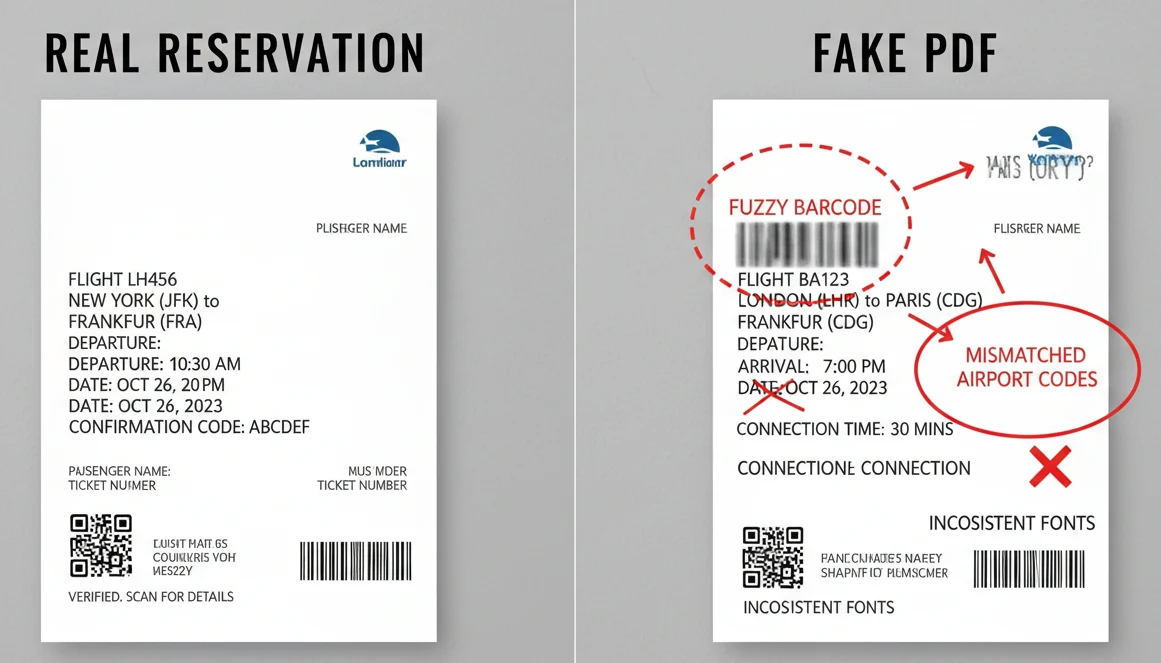
Watch for these tells:
Airport codes in all caps in one place and title case elsewhere.
Time zone or 24-hour format used inconsistently.
Flight numbers that do not exist on your travel date.
Fonts that do not match line to line.
Barcode that looks fuzzy when you zoom.
If anything looks off, it usually is.
“Held” But Not Real: The Expired Reservation Trick
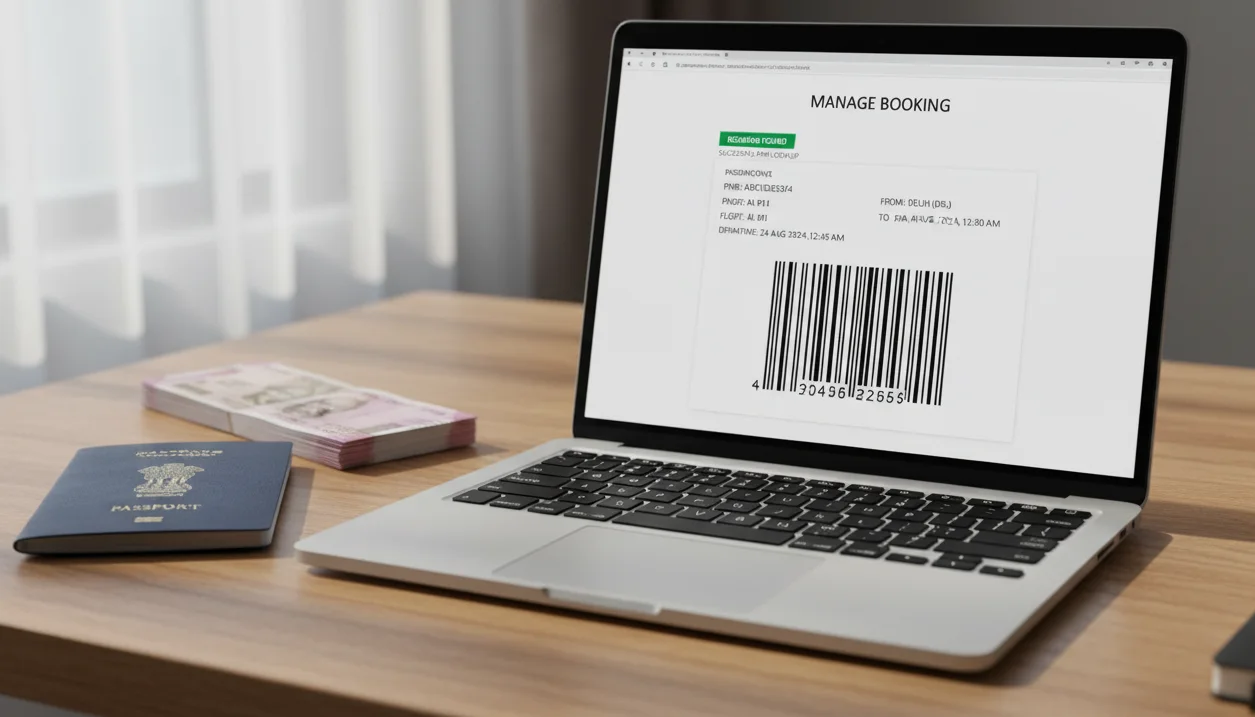
A genuine hold exists in the airline system. You can see it through Manage Booking with your surname. An image of a hold is not a hold. Scammers often reuse old holds.
Two common moves:
They send a screenshot with your name on top and a buried timestamp from last week.
They sell one hold to three buyers. The first person changes dates, which breaks the display for the rest.
Always check the status on the airline site yourself. If you cannot view it, do not submit it.
One PNR, Many Strangers: The Shared Locator Scam
A PNR is a record for a booking. If your locator shows someone else’s name or a different route, run. Shared PNRs are easy to spot once you look.
Why it happens:
The seller creates one dummy booking with flexible names.
They recycle the same code to dozens of buyers.
Airlines sometimes cancel when they detect abuse.
Visa-center staff and reviewers can notice these patterns and question the document.
If you see multiple passengers you do not know, it is not your file.
Late-Night Panic: “Pay Now Or Lose Your Slot”
Scams ride on pressure. The classic line is “UPI only, pay in the next 10 minutes.” They pick late evenings because you feel stuck before a morning VFS visit.
Break the loop with three questions:
Can I verify the PNR on the airline site right now?
Will you send a receipt with your legal name and email?
What is your change policy in writing?
If the answers are vague, step away.
The Street-Level Layer: Intermediaries And Vanishing Trails
In many neighborhoods, a print shop or a local “consultant” will say they can get it done faster. Maybe they can. Often they cannot. You pay by cash or QR, get a Gmail PDF, and have no invoice.
Why this is risky:
Your passport details move through unknown hands.
No GST invoice means no paper trail for disputes.
The person you paid cannot fix a broken PNR because they are not the source.
Ask who is issuing the reservation. Ask what system they use. If they refuse to say, you already have your answer.
Manufactured Popularity: Fake Reviews And “Embassy Accepted” Banners
Anyone can paste five stars on a landing page. You need signals that are harder to fake.
Quick checks you can do:
Search their brand name plus “review” on multiple platforms. Look for consistent stories, not identical wording.
Click profile photos in testimonials. If the same face appears on another site with a different name, the praise is fake.
Check date logic. If a seller claims thousands of Indian customers, but the domain was created last month, be cautious.
Look for clear, written policies on changes and validity windows. Professional operators publish them.
Your Simple Anti-Scam Routine
You do not need advanced tools. Just a steady process.
Price sense check. Real, verifiable holds usually sit in the ₹1,000 to ₹1,500 band.
PNR validation. Confirm on the airline site with your surname. If needed, call and ask whether the itinerary exists.
Document hygiene. Zoom to 200 percent and scan for font, spacing, and code irregularities.
Paper trail. Get a receipt, terms, and a named support contact.
Timing buffer. Verify again the day you submit, especially if your VFS slot moved.
Stay calm. Ask the boring questions. Scams rely on you skipping these steps. You will not.
Spot The Dummy Ticket Scams Fast: Red Flags And Quick Checks
You do not need advanced tools. You need a calm verification sequence that checks the booking record, the payment trail, the PDF quality and the document story before you upload anything.
| Signal | What it often means | Safer response |
|---|---|---|
| PNR does not retrieve with surname | The booking may be expired, fabricated or entered under the wrong name. | Ask for correction before submission; do not rely on a screenshot alone. |
| Seller demands instant UPI, crypto, gift card or cash-only payment | The seller may be trying to remove your dispute trail. | Use a provider with receipts, clear terms and traceable support. |
| PDF has strange fonts, fuzzy barcode or impossible flight timing | The file may be edited from an old itinerary template. | Check the route on the airline site and compare dates across your visa file. |
| One locator shows unrelated passengers | The PNR may be recycled across multiple buyers. | Stop using it and request a booking that matches only your submitted passengers. |
You do not need fancy tools. You need calm steps and a sharp eye. Use this India-focused routine to avoid dummy ticket scams and file with a cleaner file.
Fake Tickets: Two-Minute PNR Reality Check
Start with the source that matters: the airline website. Enter the booking reference and your surname in manage booking, then wait a beat. If it shows your sectors, great. If it does not, most travelers should call the carrier’s India line and ask if a record exists for the name and date. Keep it simple. Do not overshare. If the agent confirms segments, note the time limit and any hold expiry.
Reliable dummy ticket providers book you with major airlines like Qatar Airways, without letting you pick a carrier. That keeps things standard and predictable.
Tiny Typos, Big Trouble: Layout Clues Most People Miss
Plenty of forgeries look tidy at first glance. Slow down and scan for mismatches that point to a fake ticket.
The airline logo looks stretched or pixelated when you zoom.
The PDF quotes an e-ticket number, but the format is off.
You see both a ticket number and an internal code, where only one belongs.
A flight number exists on other days but not on your selected date.
Spacing, punctuation, or currency placement feels inconsistent.
If two or three items feel wrong, treat the file as suspect and move back to the carrier check.
Looks Real, Fails Logic: The Itinerary Sense Test
A neat layout can still be impossible in practice. Ask what a desk officer would see.
Your route promises overnight connections that do not meet minimum times at busy hubs.
The document mentions onward travel, but the return sector is missing for a short-stay plan.
Codeshares appear without the operating carrier being named as the official airline.
When in doubt, call and ask whether the record has the same sequence of sectors. The aim is clarity, not speed.
Money Trail Test: Payment And Paperwork
Fraud thrives where there is no paper trail. Keep yours clean.
Never send payment details via chat only. If someone demands a bank transfer without an invoice, pause.
Insist on contact details you can verify, plus a receipt that lists service scope and any change limits.
If a seller pushes you to pay in a hurry, step back. A desperate push usually means no accountability later.
If a counterparty can share a legal name, a working email, and a refund policy, you gain leverage if anything breaks.
Zoom In On The PDF: Metadata And Micro-Details
Right-click and read the properties. Compare what you see with what a carrier would store in an official database.
Creation time that predates your first message is a warning.
Fonts that switch mid-line suggest copy-paste.
Links that send you to fake websites rather than the airline's domain are a red flag.
If you spot oddities, go back to the carrier and verify the booking reference number again. Do not rely on screenshots.
Match VFS Rhythm Without Over-Submitting
Keep your file clean and consistent for visa applications.
Align your travel dates across air and lodging so officers see one story.
Avoid sending multiple documents that contradict each other.
Keep your receipt and the successful carrier lookup for your records in case the visa application process raises questions.
This approach helps students, first-timers, family visitors, and digital nomads keep stress low.
Is It Still Alive: Validity And Status Refresh
Holds expire. That is normal. Use simple checks to keep a valid reservation at the point of submission.
Recheck closer to your slot. If the status has moved, ask for a refresh and verify on the carrier page.
Watch for changes to the e-ticket or the reference number if the seller promises an update.
If you are told the system runs on global distribution systems, ask for the locator and confirm visibility before you proceed.
Avoid pushing a dying file to an upload portal. Fresh status wins.
If You Already Have A Suspicious PDF
Act methodically, not emotionally.
Stop sharing the file. Protect your data and avoid further spread.
Call the carrier. If nothing shows, request a fix in writing. If you used travel agents or a travel agency, escalate once. If they fail, rebuild with legitimate travel agencies that disclose their booking tools and support hours.
Do not hand over originals like boarding passes or an actual ticket to strangers. Share only what is needed.
If you paid by cash and the counterparty vanished, log evidence and move on to a source that issues a clear receipt.
Report obvious fake documents if asked, but keep your focus on replacing the file quickly and safely.
The Four-Point Quick Scan I Use Every Time
Keep this on your phone. It saves time and money.
Price sense If a quote feels good to be true, it usually is. Ask what the service includes, who issues it, and the cost of changes across the trip.
Carrier visibility Check airlines directly. Use the carrier page, cite the locator, and confirm the flight number sequence matches what you were given. If needed, ask whether immigration officers will see consistent sectors under exit visa procedures.
Documentation quality Look for clear signs of tampering: fake websites, mismatched formats, or sloppy edits. If you see signs of fraud, stop. Do not send multiple documents that complicate review.
Accountability Ask for a physical address, support hours, and a named contact. Professional sellers in the travel industry will never hide. They can explain the difference between a dummy flight ticket used for visa purposes and a real flight ticket intended for travel, and they can show proof of travel formats reviewed by visa offices.
Two bonus guardrails to stay safe: never share raw passport scans unless required, and never send bank numbers by chat. Identity theft is real. If anyone pressures you to purchase within minutes, breathe, double-check, and walk away from the deal.
If you want extra certainty, remember that reliable providers route files through systems that mirror airlines directly, not throwaway links. They also avoid fake ticket tactics and will help you confirm details without drama.
Why Fake PDFs Hurt Your Visa File And What Real Reservations Cost
You want a clean file that stays coherent during checks. Fake PDFs do the opposite. They trigger questions, slow your case, and sometimes sink it. Let’s map the real risks and the real costs so you can plan with clarity in India’s visa environment.
Reality Check At VFS And Visa offices
Officers and outsourcing staff do quick verifications. Sometimes it is a spot check on the airline site. Sometimes it is a call or a system view. If the record does not load or the names do not match, your application looks sloppy at best and misleading at worst. Even if nobody calls it fraud, you invite delay, extra queries, or a refusal for insufficient proof.
Students and first-time applicants get hit hardest because their paperwork is already long. A clean, verifiable reservation saves you from back-and-forth emails that burn precious intake timelines.
The Hidden Cost Of A “Cheap” Fake
That ₹299 bargain is never cheap. You pay later with resubmission fees, appointment rebooking, and wasted leave from work or college. If you plan to travel with parents or kids, the cost multiplies. You also lose momentum. A simple case becomes a project, and your energy goes to damage control instead of planning the trip.
Keep one number in mind. A normal range for a real, verifiable flight hold in India is roughly ₹1,000 to ₹1,500. Below ₹500 is the danger zone. That price almost always means a fake PDF, a dead hold, or a recycled PNR.
How Officers Read Your Story
Your documents must tell one clear story. Flights, hotels, insurance, and invitation letters should align on dates and cities. When a fake itinerary breaks that coherence, it creates contradictions that reviewers notice.
Think like an officer:
Do the arrival and hotel check-in match?
Does the return align with the leave letter or the university calendar?
Is the routing typical for an Indian passport holder on that route?
Are there logical layovers with realistic minimum times?
If your answers are yes across the board, the file is cleaner. If not, fix the plan before you submit.
Airline And Airport Ripple Effects
Fake bookings can cause trouble beyond the visa counter. Show up at the airport with an itinerary that never existed, and you will lose time at check-in arguing with ground staff who can see the system. In tougher cases, you can get noted for presenting bad documents. That memory lingers. You do not want extra questions on future trips.
For family visitors, this matters even more. Nobody wants a tense start to a long-awaited visit because the paper trail looked messy.
Why Real Reservations Cost What They Cost
You are paying for three things when you buy a legitimate reservation. First, access to booking systems that can create a live record. Second, the time and support to adjust dates if your appointment shifts. Third, document quality that matches airline formats and passes a close look.
There is also a practical limit to how long a hold can stay alive. Airlines set these windows. Many expire within 24 to 72 hours. That is normal. A good provider explains this upfront, renews or refreshes the record when needed, and tells you how to verify it yourself.
Date Flexibility Without Breaking The Record
Appointment slots move. Plans change. The best setup is a reservation that allows date adjustments without losing visibility on the airline site. That means the PNR remains valid and the names match exactly. Every change should end with you seeing the updated itinerary under Manage Booking. If you cannot view it after a change, do not submit it.
For digital nomads and frequent travelers, this flexibility is gold. You can lock the structure of your trip and fine-tune the dates once your visa steps are confirmed.
Avoiding The “Bundle Trap”
Bundles that promise flights, hotels, insurance, and tours for a tiny add-on price look convenient. They often hide weak documents that do not match each other. You end up with a hotel voucher that says one city, a flight plan that lands in another, and an insurance policy that starts on the wrong day.
Better approach:
Build a simple, consistent set of documents.
Keep your routes sensible and your dates aligned.
Add extras only if they serve a clear purpose.
Document Quality That Holds Up
A real reservation produces a clean PDF. Fonts line up. Barcodes look crisp. Flight numbers exist on your exact date. Names appear in the right order. The layout matches what airlines typically issue. If your file fails any of these checks, pause and verify the record on the airline site. Do not assume a pretty PDF equals a valid booking.
Data Safety And Peace Of Mind
Scams put your personal data in random hands. That is risky in any country and doubly risky when you are sharing passport details. Work only with sources that ask for the minimum information required to create a reservation, explain how they store it, and provide a written policy. You want receipts, not chat logs. You want support hours, not disappearing numbers.
Pay the realistic price. Expect ₹1,000 to ₹1,500 for a real, verifiable reservation. Verify the record yourself on the airline site before you upload. Keep your documents consistent and your story clear. This is how you reduce risk, save time, and keep your visa plan on schedule.
How To Choose A Verifiable Dummy Flight Ticket Provider
You need a booking that stands up to real checks. Not pretty PDFs. Not promises on chat. Use this quick, India-ready filter to pick a provider you can confidence.
Non-Negotiables You Should Demand
Ask for a live, verifiable PNR. You must be able to view the itinerary on the airline’s Manage Booking page with your surname. Get the provider’s change policy in writing. Holds expire. Date moves happen. You need clarity before you pay.
Proof You Can Check Without Help
Do a small test. After receiving the file, open the carrier site yourself. Confirm names, sectors, and dates. If anything is missing, stop and request a fix before you submit to VFS. Keep a timestamped screenshot for your records. You should never need a middleman to “confirm” your own booking.
Pricing That Makes Sense In India
Treat extreme bargains as a warning. A realistic range for a genuine reservation sits near ₹1,000 to ₹1,500. That price reflects system access and support time. Too low often means a dead hold, a recycled code, or a fabricated PDF. Too high without better service is also a red flag.
Support That Matches Your Timeline
VFS slots often run in the morning. Problems show up the night before. Look for evening availability in IST and clear response channels. Email plus chat is fine if someone actually replies. A receipt and terms should arrive automatically. If you only get a chat screenshot, that is not enough.
Respect For Your Data
Share the minimum details needed to create a reservation. Full document uploads are rarely necessary. A solid provider explains storage, retention, and who can access your file. If they cannot answer simple privacy questions, walk away.
One Last Sanity Test Before You Submit
Verify the PNR on the airline site.
Re-check the validity the day before biometrics.
Make sure flight and hotel dates align.
Keep the receipt and the successful lookup proof.
If all four pass, you are ready.
DummyFlights.com: A Simple Option When You Need It
If you want a service built for fast, verifiable reservations, you can use DummyFlights.com. You receive an instantly delivered PDF, a live PNR you can check yourself, and flexible date changes at a transparent price around ₹1,300 per booking. We can accommodate your tight timelines and shifting VFS slots by providing you with an instant download within minutes.
Use DummyFlights.com when you need a document-ready reservation with a checkable booking reference, clear passenger details and support for date changes. Always verify your record before submission.
Keep Your Visa File Clean After You Avoid the Scam
You know the traps now. The cheapest PDFs waste time and damage confidence. Real bookings show up on the airline site and align with your hotels and plans.
Use the routine we covered. Check the PNR yourself. Keep one clear itinerary. Expect a fair India price in the ₹1,000 to ₹1,500 range. Recheck status before biometrics. Save receipts and screenshots.
This is how we cut noise and keep control. Whether you are a student, first-time traveler, family visitor, or digital nomad, your file should read like common sense. Slow your pace, ask for proof, and walk if anything feels off. Do that, and your visa plan stays calm and on schedule.
Dummy Ticket Scam FAQs
How do I know if a dummy ticket is a scam?
A dummy ticket is suspicious when the PNR does not retrieve, the seller refuses written terms, the PDF has obvious editing marks, the route does not match real flight logic or the payment method gives you no dispute trail.
Can a fake dummy ticket cause visa problems?
Yes. A fake or inconsistent document can create questions about your travel plan and may lead to delays, document requests or refusal concerns. The safest approach is to submit only documents you can explain and verify.
Is a cheap dummy ticket always fake?
Not always, but extremely cheap offers are a serious warning sign. A live reservation requires booking access, support time and possible corrections, so unrealistic pricing often means a recycled PNR, expired hold or edited PDF.
How can I verify a dummy ticket PNR?
Use the airline Manage Booking page where possible. Enter the booking reference and surname, then confirm the passenger name, route, dates and flight sequence match the PDF and your visa application.
Should I submit a screenshot instead of a PDF itinerary?
A screenshot is usually weaker than a clean itinerary because it can miss routing, passenger and booking details. If you use a screenshot for your own records, still keep the full PDF and verify the booking reference.
What should I do if my PNR does not show online?
Do not submit it immediately. Ask the provider to correct or refresh the booking in writing, then recheck the details. If the seller cannot fix it, replace the reservation with a cleaner source.
Are Telegram or WhatsApp dummy ticket sellers risky?
They can be risky when they hide their identity, use only chat payments, refuse receipts or pressure you to pay quickly. A reliable provider should give clear terms, support contact details and a verifiable record.
Can one PNR be used for many applicants?
A family or group can share one itinerary when all names are correctly included. A PNR showing unrelated strangers, wrong names or different routes is a red flag and should not be used.
What payment red flags should I avoid?
Avoid sellers who demand wire transfer, gift cards, cryptocurrency, cash-only payment or urgent transfers without an invoice. A receipt and written service terms protect you if the booking fails.
How close to submission should I recheck the dummy ticket?
Recheck it after delivery and again before submission or biometrics. Holds can expire, so the important point is that your submitted document remains consistent with your application and supporting dates.
Can I repair a visa file after using a suspicious dummy ticket?
Often you can repair the file before submission by replacing the document, aligning dates and keeping only one clean itinerary. After submission, follow the visa center or consulate update process instead of sending competing versions.
Where can I get a safer dummy ticket for visa use?
Use a provider that gives a checkable booking reference, correct passenger details, realistic route logic, written support terms and a clear payment record. Always verify the reservation yourself before using it.