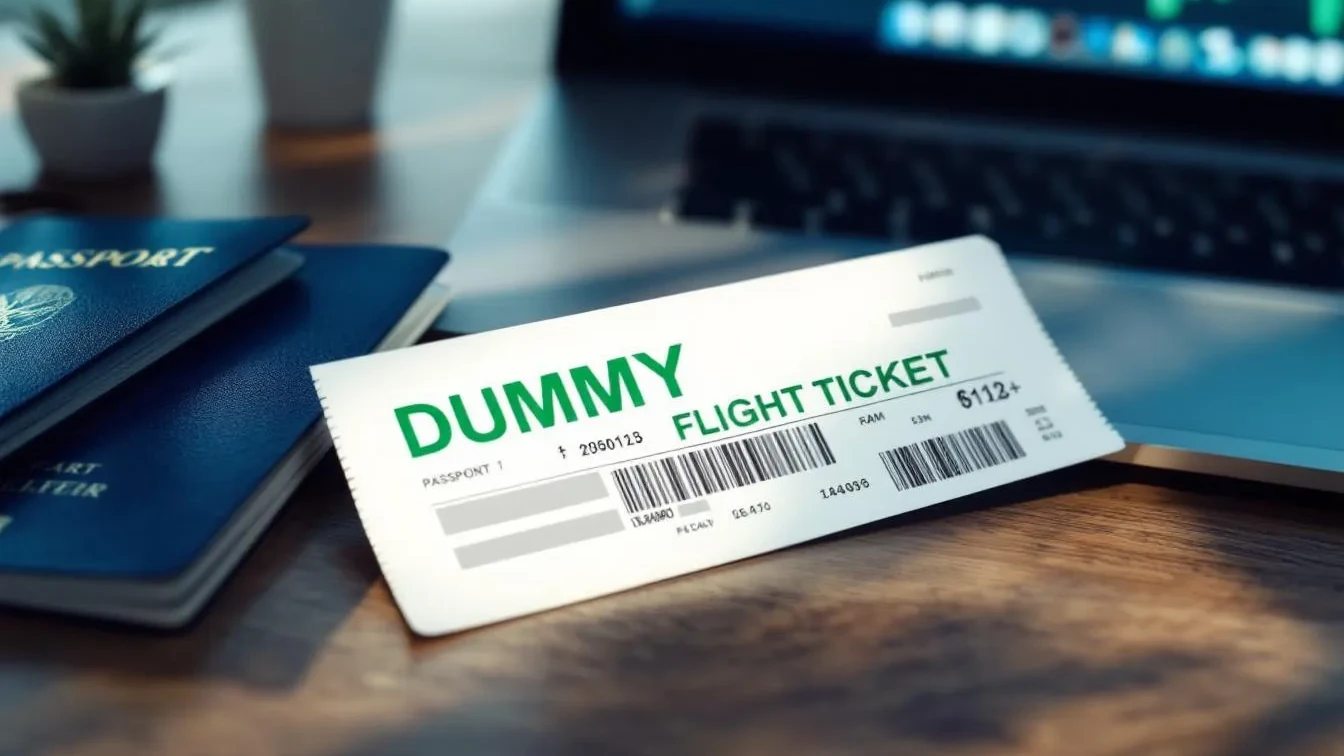

Short answer: When the visa applicant and cardholder are different, a dummy ticket for visa can support the file when the passenger name, route and dates are accurate. Treat the cardholder or sponsor as a separate funding question, verify the PNR while active and follow the destination checklist. A reservation cannot guarantee approval, boarding or entry. When you are ready to order, get a dummy ticket for visa from DummyFlights.
Key facts
- The reservation identifies the traveler; payment details may be held separately by the provider or airline.
- Passenger name, route, travel dates and a checkable PNR matter more than whose card paid.
- Use a sponsorship letter, bank evidence or employer letter for the funding explanation when required.
- Check the current embassy, consulate or visa-centre checklist because requirements vary by destination and case.
Need a verifiable dummy ticket with a different cardholder? Prepare the passport-matching passenger details and realistic route first, then keep the reservation and sponsorship evidence consistent.
Create your dummy ticketIn This Guide
- Why Embassies Care More About Your Name Than Whose Card Paid For It
- What Actually Happens When The Cardholder And Traveler Are Two Different People
- How Visa Officers Verify A Flight Reservation Booked On Someone Else's Card
- Sponsorship Letters And When Your File Actually Needs One
- Parents, Employers, Friends, And Agents: Who Usually Pays And Why It Rarely Raises Flags
- The Mistakes That Turn A Harmless Cardholder Mismatch Into A Red Flag
- Dummy Ticket Or Real Ticket: What Changes When Someone Else Is Footing The Bill
- How Cardholder Rules Shift Across Schengen, UK, US, And Other Visa Categories
- Keeping Your Flight Reservation Simple, Even With A Different Cardholder
Official-source check: Use the destination embassy or consulate’s current visa checklist and the airline’s own reservation lookup instructions for the latest travel-document and verification requirements. For passport, visa and entry rules, cross-check the IATA Travel Centre. A PNR’s status is controlled by the issuing system and may change.
Reviewed for: third-party cardholder scenarios, passenger-name and PNR consistency, sponsorship evidence, route-date alignment and claim-safe visa guidance.
A visa officer scanning your flight reservation does not care who booked it. She cares whether your name, dates, and route match everything else in your file.
But when the card on that booking belongs to your father, your employer, or a friend helping you out, a new question enters the room. Does a mismatched payment method change how your application gets read?
It does not have to. Visa officers see third-party payments constantly, and many checklists do not make the cardholder name the deciding issue, but destination rules still control. What matters is whether your file explains the gap cleanly enough that nobody has to ask twice. This guide walks through exactly how to make a dummy ticket booking booked on someone else's card work in your favor.
Why Embassies Care More About Your Name Than Whose Card Paid For It

Every visa file tells a story, and the flight reservation is one chapter of it. Embassies are not auditing your bank statements when they look at a flight booking. They are checking whether the trip you describe on paper matches the trip you are actually planning to take.
The Passenger Name Is The Anchor Point
A flight reservation exists to prove one thing: that a named passenger has a planned route and travel window. Embassies prioritize the passenger name over the payment method in many visa applications, because the passenger name is what ties the document to the applicant standing in front of them.
This is why a dummy flight ticket paid for by someone else still works the same way a self-funded one would. The reservation shows who is traveling, not who swiped the card. As long as the passenger name matches your passport exactly, the payment source is a secondary detail.
Flight Reservations Prove Intent, Not Finances
If a destination checklist specifically asks for a flight reservation for visa, keep that requirement separate from the cardholder and sponsorship explanation.
A common misunderstanding among first-time visa applicants is treating the flight reservation as a financial document. It is not. Flight reservations act as proof of travel intent rather than as financial proof, which is a separate category covered by bank statements, sponsorship letters, or income documents.
This distinction matters when the cardholder is not you. Officers already expect financial proof to come from a different, more detailed source. The reservation's job is narrower: it shows a route, a date, and a name. Nothing about a third-party card changes that job.
Why This Question Comes Up So Often
Global visa applicants frequently travel on funds provided by a parent, a spouse, an employer, or a sponsor. Booking a flight reservation on that same person's card is the most natural extension of that arrangement. It would be strange, in fact, for a sponsored applicant to somehow need a separate card just for the reservation step.
-
A student sponsored by a parent for a study-related trip
-
An employee whose company travel desk books all business trips
-
A visa applicant whose spouse manages the household's shared card
-
Someone using a trusted family member's card while their own is not yet active internationally
None of these situations are unusual to an embassy. They are unusual only when the applicant assumes they need to hide or explain away the mismatch, which usually creates more suspicion than the mismatch itself ever would.
How Embassies Actually Weigh Risk
Visa officers are trained to assess risk in terms of overstay likelihood and document credibility, not in terms of payment logistics. A file's risk profile is built from ties to the home country, financial stability, travel history, and the internal consistency of the supporting documents submitted.
Whether a flight reservation was paid for by the applicant or a relative simply does not sit on that list of risk factors in any meaningful way.
This is worth internalizing early, because it reframes the entire question global visa applicants tend to ask.
The productive question is not "will a different cardholder hurt my chances," but "does my file, taken as a whole, tell one clear and consistent story about who is traveling, when, and why." Once that story holds together, the cardholder detail fades into irrelevance.
A Quick Comparison Across Application Types
Tourist visas, business visas, and student visas all handle this question in the same underlying way, even though their specific paperwork differs.
A tourist relying on a parent's card, a business traveler on a corporate account, and a student on a scholarship sponsor's funds all submit flight reservations that look procedurally identical from an airline's perspective. The differentiating documents sit elsewhere, in invitation letters, employment verification, or enrollment confirmations, not in the flight booking itself.
Where the Real Risk Sits
The risk is not in a different cardholder name. The risk lives in inconsistency elsewhere in the file, things like mismatched dates between your visa form and your reservation, a name spelled differently than your passport, or a route that does not match your stated purpose of travel.
These are the details that actually shape a visa officer's read of your application, and they are worth understanding before you finalize any flight reservation.
How This Compares To A Fully Self-Funded Application
Applicants who pay for their own flight tickets often assume their file looks stronger by default. In reality, a self-funded booking and a sponsor-funded one are read almost identically once they reach a visa officer's desk. Both need the same supporting documents. Both need matching arrival date and departure date entries. Neither gets special treatment purely because of who paid.
The only meaningful difference shows up in your financial proof, not your flight proof. A self-funded applicant shows their own bank statement. A sponsored applicant shows their sponsor's. The flight reservation itself stays procedurally identical either way.
A Word On Corporate Cards And Business Travel
Business trip applicants are a useful case study here, since almost none of them pay for their own flights. Company travel desks routinely book flights on a shared corporate card for staff traveling to conferences, client meetings, or training sessions abroad.
Visa officers who handle a high volume of business trip applications treat this as the default, not the exception, which is part of why the passenger-name-over-payment-method principle holds up so consistently in practice.
What Actually Happens When The Cardholder And Traveler Are Two Different People
Once you accept that a different cardholder is not inherently a problem, the next question is practical. What does the booking process actually look like, and what should the paperwork reflect?
It Is A Normal Part Of How Travel Is Paid For
It is standard for one person to pay for another's travel arrangement using their card, both for real ticket purchases and for temporary flight reservations used for visa applications. Airlines, travel agencies, and reservation providers all build their booking systems around this reality. A booking reference does not encode who paid; it encodes who is flying.
This is true whether the reservation is a fully paid ticket, a fully refundable ticket, or a short-term dummy flight ticket built specifically for a visa file. The airline system stores passenger details separately from payment details, and the passenger record is what any embassy checks.
Names On Tickets Must Match Passports Exactly
The detail that most consistently matters is spelling. Names on tickets must match passports exactly, down to middle names, hyphenation, and the order surnames appear in. This has nothing to do with who paid and everything to do with how the passenger record is verified.
-
Double-check that the reservation matches your passport's Latin transliteration.
-
Confirm no autocorrect or booking software has swapped first and last name order.
-
Make sure any suffixes (Jr., II, etc.) are either consistently included or consistently dropped.
A cardholder mismatch is invisible to most verification checks. A name mismatch is not, and it is the more common reason a supporting document gets flagged for a second look.
When A Name Discrepancy Is Unavoidable
Sometimes a genuine discrepancy exists for reasons outside your control: a recent marriage changing a surname, a passport renewal that altered a middle name's formatting, or a booking platform that truncated a long name automatically.
In these cases, a brief clarifying note, along with supporting proof like a marriage certificate or old passport page, resolves the issue far more effectively than trying to force the reservation to match retroactively.
Reservation providers like DummyFlights.com, experienced with global visa applicants, can usually correct a formatting issue like a truncated name within minutes, so it is worth flagging early rather than discovering it the night before an appointment.
Sponsorship Needs Its Own Documentation
For a broader visa-file framework, compare this topic with the dummy ticket for visa 2026 complete guide and then follow the destination checklist.
Sponsorship or financial support must be clear and documented for visa applications involving third-party payments, particularly when the same sponsor is also covering accommodation, tuition, or daily expenses. This documentation usually lives outside the flight reservation itself, in a sponsorship letter or bank statement.
Think of it this way: the flight reservation answers "where and when." The sponsorship letter answers "who is funding this and why." Trying to make the reservation carry both jobs is where applicants sometimes overcomplicate a simple booking.
Consider Sarah, a graduate applicant preparing a Schengen visa file. Her uncle books her round-trip reservation using his corporate card while she assembles her financial documents separately.
Her passport name, dates, and route on the reservation match her visa form exactly. Her uncle's name never needs to appear on the flight document at all, because the airline record does not reference the payer.
Sarah's cover letter includes one line noting her uncle's support for the trip, and her sponsorship letter from him covers the financial side in more detail.
When her visa is approved a few weeks later, nothing about the process singled out the fact that a different person's card had funded her flight reservation. Her file simply told one consistent, verifiable story from start to finish.
This is the pattern worth repeating: keep the traveler-facing document clean and accurate, and let any funding explanation live in its own paragraph, letter, or bank record.
A Practical Walkthrough Of The Booking Step
Picture the actual sequence a sponsor follows when arranging a flight reservation for someone else. They select a reservation provider, or an airline directly, enter the passenger's full name and passport-matching details exactly as the applicant provided them, choose the intended route and travel dates, and complete payment using their own card.
The output, a confirmation showing the applicant's name, route, and dates, looks identical to one the applicant would have received booking it themselves.
This walkthrough matters because it shows there is no special "third-party" booking pathway that produces a different, flagged, or watermarked document. The process is the same process, just initiated by a different person holding the payment method.
Keeping A Record Of Who Booked What
Even though the flight document itself does not need to reference the payer, it is good practice for your own records to keep a simple note of who booked which reservation, especially if multiple family members or an employer are coordinating several bookings at once for a shared trip.
This is purely an organizational habit for you and your sponsor, not something submitted to any embassy, but it prevents confusion if a reservation needs to be reissued or extended later.
What To Do If The Sponsor Is Traveling Abroad Themselves
Some sponsors are not easily reachable during the exact window an applicant needs to finalize their reservation; for instance, a parent already traveling internationally when a visa appointment gets scheduled on short notice.
In these cases, many reservation providers allow the applicant to submit the sponsor's payment details digitally, or the sponsor to authorize payment remotely, without needing to coordinate a shared physical location. Confirming this flexibility with your chosen provider ahead of time avoids unnecessary last-minute stress.
Does The Airline Even Know Who Is Traveling With A Different Card?
Yes, and this is worth understanding because it removes a common source of anxiety. When a booking is made, the airline captures full passenger details independently of the card used.
Boarding passes, check-in records, and any airline check-in verification all reference the passenger, never the payer. This is true for a fully paid ticket, a fully refundable ticket, or a short-term dummy flight ticket used specifically for visa purposes.
In other words, the entire travel ecosystem, from the airline's own systems through to embassy verification, is built around passenger identity as the constant and payment source as an interchangeable detail behind the scenes.
What The Booking System Sees Versus What The Embassy Sees
An airline's booking system stores two layers of information: a payment record used for billing, and a passenger record used for travel. Only the second layer ever reaches a visa file. The airline system does not export cardholder details into the confirmation an applicant prints or forwards, which is exactly why embassies never end up reviewing whose card was charged.
This separation is intentional. Airlines need flexible payment options, including one traveler paying for several passenger details on a single itinerary, without complicating the travel document itself. A visa applicant benefits from this same structure: it keeps the paperwork simple regardless of the funding arrangement behind it.
Employer-Funded Business Travel
Consider David, applying for a business visa to attend a supplier meeting. His employer's finance department books his round-trip reservation directly, matching the meeting dates listed in his invitation letter from the host company.
David's own name appears throughout his visa form, his flight reservation, and his employer's letter. The corporate card used for the booking never appears on any document he submits, because it was never meant to.
How Visa Officers Verify A Flight Reservation Booked On Someone Else's Card

Verification is where anxiety tends to peak for applicants in this situation, largely because the process feels opaque from the outside. In practice, it is more mechanical than most people expect.
What A Verifiable Reservation Actually Contains
Embassies accept verified flight reservations as proof of travel, and "verified" has a specific technical meaning. A legitimate dummy ticket includes a verifiable PNR code, one that can be checked directly on the airline's own website or through the airline's reservation lookup tool.
A valid dummy ticket includes a PNR code for verification, and it should show passenger name, route, and travel dates clearly formatted the way an airline itself would present them. None of this changes based on who paid for the booking.
The PNR Is The Real Proof, Not The Receipt
Applicants sometimes assume a payment receipt is what gets checked. It rarely is. The PNR, entered directly into the airline's booking system, is what an officer or a visa center staff member uses to confirm a reservation is real. If that code returns a live, matching record, the payment trail behind it is irrelevant to the check.
Most embassies require a round-trip reservation rather than a one-way flight document, since a return flight is part of how officers judge whether an applicant intends to leave before their visa expires. This expectation exists independently of who is paying, and it applies just as firmly to third-party-funded bookings as to self-funded ones.
Where Applicants Get Into Trouble
Two shortcuts consistently cause problems, and neither has anything to do with cardholder identity.
-
Using free PDF generators creates unverifiable documents that cannot be checked against any airline's live system, and staff can usually tell the difference at a glance.
-
Fabricated tickets with false booking details can lead to visa denials or legal issues, since inventing flight numbers or PNR codes that do not correspond to a real reservation crosses from "temporary" into "fraudulent."
Fake tickets can lead to visa application rejection specifically because they fail this verification step, not because of anything related to who financed the booking. A verifiable reservation, even a short-term one, is more likely to pass this check. A fabricated one does not, regardless of whose card was used.
Why Verification Matters More Than Presentation
A polished-looking document with airline branding, a seat map, and formal-looking flight details can still fail verification if the underlying PNR is not real. Conversely, a plainly formatted confirmation from a reputable reservation provider passes easily if its PNR resolves correctly.
This is worth remembering because applicants sometimes judge a reservation's quality by appearance rather than by whether it actually works when checked, which is the only standard that matters to an embassy or visa center.
A Quick Self-Check Before Submission
Before attaching any reservation to your file, confirm the following:
-
Does the PNR return a live result on the airline's own site? If not, request a corrected version from your provider.
-
Do the passenger name, dates, and route match your visa form exactly? Any discrepancy here matters more than the payment method ever will.
-
Is it a round-trip record rather than one-way? Some visa categories expect this, while others assess one-way travel differently.
How Visa Centers Handle Third-Party Applications In Practice
Many visa applications today are processed through outsourced visa centers rather than the embassy directly, particularly for high-volume destinations. These centers typically follow a standardized checklist when receiving supporting documents, checking that a flight reservation exists, that it is round-trip, and that its dates align with the visa form.
Staff processing your file at this stage are generally not tasked with investigating payment sources at all, since that detail falls outside their standard checklist entirely.
This matters because it clarifies where scrutiny actually happens. If a visa center's intake staff have no field for "cardholder name" on their checklist, there is effectively no formal point in the process where a different cardholder would even be recorded, let alone flagged.
Once your reservation clears these checks, the payment source behind it becomes a non-issue for verification purposes, freeing you to focus on the parts of your file that genuinely need attention.
Why Some Reservation Providers Hold Up Better Than Others
Not every reservation provider builds documents the same way. A dependable reservation provider issues a confirmed ticket format that mirrors a real airline confirmation exactly, complete with a working PNR, correct flight details, and consistent passenger details. A weaker provider might generate something that looks plausible on screen but returns nothing when checked against the airline directly.
Before relying on any provider, run a quick test: take the PNR and passenger surname straight to the airline's own manage-booking page. If it resolves cleanly, the document is genuinely verifiable. If it does not, treat that as a signal to switch providers well before your visa appointment, not after.
What Happens If Your PNR Cannot Be Verified
An unverifiable PNR does not always mean fraud was intended. Sometimes a reservation simply expired, or a provider used a testing environment that never syncs with the live airline system. Either way, the practical outcome is the same: an officer or visa center cannot confirm your onward travel, which weakens an otherwise solid file.
If you discover this before submission, request a fresh reservation rather than submitting a questionable one. If it surfaces after submission, most visa offices allow supplementary documents to be added, so a corrected reservation can often still resolve the issue.
How This Fits Into Your Broader Visa Checklist
A verifiable flight reservation is one line item among many on a typical visa checklist, sitting alongside proof of accommodation, travel insurance, and financial documents. Treating it as equally important, rather than as an afterthought booked the night before an appointment, keeps your entire file consistent rather than having one weak link surrounded by otherwise strong supporting documents.
Applicants juggling a full visa application process sometimes leave the flight reservation for last, assuming it is the simplest item to arrange. In practice, giving it the same early attention as your financial documents avoids the last-minute scramble that leads to expired reservations or mismatched dates.
Comparing A Few Reservation Approaches Side By Side
Different reservation approaches suit different situations, and it helps to weigh them plainly rather than defaulting to whichever option comes to mind first.
-
A dedicated reservation provider offers speed, a low fixed cost, and a reservation built specifically to be visa-ready and verifiable.
-
A travel agency hold offers more flexibility toward an eventual real booking, at a higher cost tied to a percentage fee.
-
A direct airline hold offers the shortest window, typically 24 to 72 hours, and suits applicants confident about booking a real ticket soon after
Matching the approach to your actual timeline, whether your visa appointment is next week or next month, keeps you from paying for flexibility you do not need or settling for a hold that expires before your appointment arrives. That Explains The Payment Gap Before Anyone Asks
Even though a different cardholder rarely triggers scrutiny on its own, a well-organized file removes any need for an officer to ask a clarifying question in the first place. That is the real goal here: not concealment, just clarity.
Start With A Short, Honest Cover Letter
A cover letter accompanying your visa file is the natural place to mention, in one or two sentences, that a family member or employer arranged your travel booking. This does not need to be dramatic or defensive. A simple statement is enough.
For example: "My flight reservation was booked by my father as part of his ongoing support for this trip, detailed further in the enclosed sponsorship letter." That single sentence closes the loop before anyone has to wonder about it.
If your trip involves a host, a business partner, or a family member abroad, an invitation letter adds useful context around your travel dates. It reinforces the same story your flight reservation and visa form already tell, without adding new claims that need separate verification.
Keep Your Booking Reference Alongside Your Financial Documents
Rather than treating the flight reservation as an isolated file, place your booking reference in the same folder, physical or digital, as your bank statements and sponsorship letter. This makes it simple for you, and easy for any reviewing officer, to see that the reservation, the funding, and the visa form all describe the same trip.
-
Passport-style copy of your reservation confirmation
-
Sponsorship or invitation letter, if applicable
-
Bank statement or income proof supporting the trip
-
Your completed visa form with matching arrival date and departure date
The most overlooked step in this process is checking that your arrival date and departure date appear identically across your visa form, your reservation, and any letters you include. A sponsor's letter that references a different travel window than your flight reservation creates far more friction than a cardholder mismatch ever would.
Why This Approach Works Better Than Silence
Some applicants worry that mentioning a third-party payment draws attention to it. In practice, the opposite tends to be true. A file that proactively accounts for a sponsor or paying relative reads as more organized, not more suspicious.
Officers process thousands of files; a clear one-line explanation saves everyone time and rarely invites additional questions, which is exactly the outcome you want heading into your visa appointment.
Many visa offices now accept, or even prefer, digital supporting documents uploaded through an online visa application process. Where a physical appointment is still required, print your booking reference, sponsorship letter, and financial documents on clean, single-sided pages. Consistency in presentation, digital or physical, makes it easier for reviewers to move through your file quickly.
A Simple Structure For Your Cover Letter
If you have never written one, keep the structure predictable rather than creative. A short introduction stating your name and purpose of travel, a paragraph covering your itinerary and travel dates, one sentence addressing who booked your flight reservation and why, and a closing line referencing your attached supporting documents.
This structure covers everything an officer needs without turning a simple visa file into an essay.
How This Differs From Proof Of Accommodation
Applicants sometimes wonder whether the same third-party payment logic extends to hotel bookings and hotel proof, since a trip usually involves both a flight reservation and a place to stay. It does, largely.
A dummy hotel booking paid for by a sponsor follows the same principle: the guest name matters more than the payer, and a verifiable confirmation number matters more than which card was charged. Keeping your flight reservation and any accommodation proof consistent with each other- same travel dates, same destination, same traveler- reinforces the overall credibility of your file.
Sponsorship Letters And When Your File Actually Needs One
Not every applicant with a different cardholder needs a formal sponsorship letter. Knowing when one is necessary, and when it is overkill, saves you from over-preparing a straightforward file.
When A Sponsorship Letter Genuinely Matters
Sponsorship or financial support must be clear and documented for visa applications involving third-party payments, but this requirement is tied to your overall financial proof, not specifically to your flight reservation. A sponsorship letter becomes necessary when the person paying for your flight is also covering a meaningful share of your trip's cost.
-
Your sponsor is also funding your accommodation dates and daily expenses
-
Your own bank statements would not independently support the trip
-
The visa category explicitly asks for a financial sponsor declaration
-
Your relationship to the payer is not otherwise obvious from your application
If a relative simply booked your flight reservation as a one-time favor, but you are otherwise self-funded for the rest of your trip, a full sponsorship letter is often unnecessary. A brief mention in your cover letter, plus your own financial documents, usually covers this scenario without additional paperwork.
What A Strong Sponsorship Letter Includes
When one is warranted, keep it focused and specific rather than generic.
-
The sponsor's relationship to you, stated plainly.
-
A clear statement of what costs they are covering (flight, accommodation, or both)
-
Their financial capacity to support the trip, backed by their own bank statement
-
Their contact information, in case verification is needed
Understanding The Financial Risk On Both Sides
There is a financial risk worth naming here, though it rarely involves the visa process directly. If a sponsor books a fully paid ticket or a non-refundable ticket well before a visa decision, and the visa is later refused, that money is difficult to recover.
This is a separate concern from documentation, but it shapes which type of reservation makes sense for a sponsored applicant, a topic covered in more detail later in this guide.
Whatever your sponsorship letter says about who is paying for what, make sure it does not contradict your flight reservation's own details.
If the letter states your sponsor is covering "all travel costs" but your flight reservation shows a reservation provider's standard booking, keep the language general enough that it does not read as a mismatch with the type of document attached.
What Happens If You Skip A Sponsorship Letter You Actually Needed
Skipping a required sponsorship letter rarely causes an outright visa refusal on its own, but it does leave a gap an officer may need to fill by asking follow-up questions, requesting additional documents, or delaying a visa decision while your file is reviewed further.
None of that is catastrophic, but it does slow down a process that a one-page letter could have avoided entirely.
If you are unsure whether your situation calls for one, err toward including a short version. A brief, well-organized sponsorship letter almost never hurts a file, even in cases where it turns out not to have been strictly necessary.
How Sponsorship Interacts With Trip Length
Longer trips, and correspondingly longer trip length claims on a visa form, tend to draw closer attention to whether the funding behind them is credible.
A two-week visit funded by a sponsor with a modest income might prompt questions that the same sponsor covering a long weekend would not. Matching your sponsor's documented financial capacity to the actual scale of the trip, rather than leaving that connection implicit, strengthens the letter considerably.
Whatever your sponsorship letter states about the trip, double-check that it lines up with the form dates on your actual visa application. A sponsorship letter drafted weeks before your final flight reservation was confirmed can sometimes reference an earlier travel window that no longer matches, so give it a final read alongside your other documents before submission.
Parents, Employers, Friends, And Agents: Who Usually Pays And Why It Rarely Raises Flags
Different relationships between applicant and cardholder come with slightly different expectations. Understanding the common patterns helps you present yours without second-guessing a completely ordinary arrangement.
Parents Booking For A Child Or Young Adult
This is the most common scenario embassies encounter, and it rarely needs justification beyond a brief mention. A young visa applicant traveling for study, tourism, or a family visit, with a parent covering the flight reservation, matches an extremely familiar pattern for visa officers reviewing files from around the world.
Employers Booking Business Travel
For business-purpose visas, an employer or company travel desk frequently books flight bookings and hotel bookings on a shared corporate card. In this case, an employment letter describing the business trip, its purpose, and its dates typically does more explanatory work than any note about the card itself.
-
Employment verification letter stating your role and the purpose of travel
-
Confirmation that the company is covering flight reservations and, if relevant, hotel bookings
-
Your own visa form listing accurate flight dates matching the employer's booking
Friends Or Extended Family Helping Out
When a friend or extended family member books your reservation as a favor, rather than as part of formal sponsorship, this usually falls into the "brief mention, no extra documentation" category discussed earlier.
The key is making sure your own financial proof still stands on its own, since a friend's help with a flight reservation does not typically extend to full sponsorship in an officer's eyes.
Travel Agents And Reservation Providers
Many applicants go through travel agencies or dedicated reservation providers rather than booking directly with an airline. Travel agencies can hold reservations for a fee of 10-15%, which is a different arrangement from a specialized reservation provider offering a fixed-price temporary flight reservation built specifically for visa purposes.
Separately, airlines may allow holding a booking for 24-72 hours directly through their own systems, without any agency fee at all, though this option is far more limited in scope and typically does not produce the kind of verifiable, visa-ready document that dedicated providers offer.
Why None Of These Patterns Alarm Visa Officers
Across all of these relationships, the through-line is the same: officers have seen every version of this before. What earns attention is not the relationship between applicant and cardholder, but whether the resulting flight reservation is internally consistent, verifiable, and aligned with the rest of the visa file.
Keep that alignment intact, and the identity of the person who paid becomes a footnote rather than a headline.
Group Travel And Shared Family Bookings
Families traveling together for the same trip often book multiple flight tickets under one card, sometimes through a single travel agent handling several passenger details at once. This is another pattern embassies see constantly, particularly for tourism visas covering an entire household.
As long as each applicant's individual visa form matches their portion of the shared booking, group bookings rarely need any special explanation beyond what has already been covered in this guide.
Where families sometimes stumble is in assuming a single cover letter can speak for every applicant. In most cases, each traveler still needs their own supporting documents, even when the underlying flight reservation was booked as a group.
Extended Family Traveling Within The Same Travel Window
A related situation involves extended family members traveling within the same travel window but applying for their visas somewhat independently, such as cousins joining a wedding trip booked by one relative's card.
Each applicant's own visa form should reflect their individual travel dates and purpose, even if the flight reservation itself lists several passenger details under a single booking reference. Keeping each applicant's paperwork self-contained, rather than assuming the group booking speaks for everyone, avoids confusion if one application is reviewed separately from the others.
Travel Agencies Versus Dedicated Reservation Providers
It is worth being clear-eyed about the difference between a general travel agency and a dedicated reservation provider built specifically for visa purposes.
A travel agency is well suited to arranging a full travel plan, flights, accommodation, and sometimes travel insurance, for travelers who intend to fly regardless of visa timing. A dedicated provider, by contrast, focuses narrowly on producing a fast, verifiable, low-cost reservation for the visa file itself.
Sponsors and applicants sometimes default to whichever channel they already know, an existing travel agent relationship, for instance, without realizing a purpose-built reservation might better fit a visa-only need. Matching the tool to the actual goal, a confirmed itinerary versus a verifiable placeholder, tends to save both time and money.
Communicating Clearly With A Sponsor Who Isn't Familiar With The Process
Many sponsors, particularly parents or older relatives, have never heard the term dummy ticket and may feel uneasy about the idea until it is explained plainly. Framing it accurately, as a temporary, verifiable flight reservation used specifically to support a visa application rather than a final travel purchase, usually resolves any hesitation quickly.
It also helps to mention upfront that a legitimate version of this document is one that can be checked directly on the airline's website, which reassures sponsors who worry about anything resembling fake tickets.
Giving a sponsor a short, plain-language explanation before asking them to book anything tends to prevent confusion later, particularly if they are unfamiliar with how a reservation provider's process differs from a standard airline purchase.
A Simple Script For That Conversation
If you need a starting point for this conversation, a short version works well: "For the visa application, I need a flight reservation showing my name and travel dates. It doesn't need to be a real, paid ticket yet, just something verifiable that the embassy can check.
Would you be comfortable booking that on your card for around fifteen dollars?" This framing answers the three questions most sponsors have before they even ask: what it is, why it is needed, and roughly what it costs.
The Mistakes That Turn A Harmless Cardholder Mismatch Into A Red Flag
A different cardholder is rarely the actual problem. The problems that do arise tend to cluster around a small set of avoidable mistakes, most of which have nothing to do with payment method at all.
Mismatched Dates Across Your File
Mismatched dates can weaken your visa application far more seriously than a payment method ever could. If your flight reservation shows a departure date that does not match your visa form, your cover letter, or your sponsorship letter, that inconsistency is what actually draws a second look.
-
Confirm your arrival date and departure date match exactly across every document.
-
Recheck your visa form after any change to your travel plan
-
Update every linked document if your flight dates shift, not just the reservation itself
Booking Too Early And Letting Reservations Lapse
Booking too early can lead to expired reservations, since temporary reservations usually expire within 24 to 72 hours unless the provider specifically manages a longer hold. Expired reservations may create verification issues if an officer or visa center tries to check a PNR that is no longer active.
Some reservations can last up to 14 days depending on the provider, which is a better fit for applicants who cannot predict their exact appointment slot in advance. Reservations should be made 1-3 days before the appointment when possible, and you should refresh the ticket if the appointment date changes rather than submitting an outdated one.
Why Timing Discipline Matters More For Sponsored Bookings
When a sponsor is arranging the reservation rather than the applicant, timing mistakes become slightly more likely simply because there is an extra step of coordination involved.
A sponsor juggling their own schedule may book earlier than ideal, assuming it is one less thing to worry about, without realizing that a reservation made too far ahead of the appointment risks expiring before it is actually needed.
Setting a shared reminder, or simply agreeing on the exact date the reservation should be made, removes this coordination gap entirely. This small habit prevents the majority of timing-related issues applicants and sponsors run into together.
One-Way Tickets For Short-Stay Visas
One-way tickets may raise questions for short-stay visas, since a return flight is often the clearest signal an applicant intends to leave the destination country on schedule. This applies regardless of who paid for the ticket. A round-trip reservation, even a temporary one, tends to answer this question before it is asked.
Treating The Reservation As A Financial Document
Some applicants try to make their flight reservation "prove" sponsorship by adding notes or annotations about who paid. This blurs the reservation's actual purpose. Keep the reservation itself clean, standard, and airline-verifiable, and let your sponsorship letter or cover letter handle the financial explanation separately.
Assuming A Higher Price Automatically Means A Safer Document
Some applicants believe that a more expensive booking, such as a fully paid ticket instead of a temporary reservation, automatically looks more credible to a visa officer. This is not accurate.
A cheap, verifiable dummy flight ticket with a working PNR is treated identically to an expensive one, because verification, not price, is what an officer actually checks. Spending more on a reservation does not buy any extra credibility if the document itself is not properly verifiable.
Forgetting That Supporting Documents Need To Agree With Each Other, Not Just With The Form
A subtler mistake involves aligning documents with the visa form but not with each other. A cover letter, sponsorship letter, and flight reservation can each individually match the visa form's dates while still containing small inconsistencies between themselves, an easy oversight when documents are prepared at different times by different people.
A final read-through comparing every document side by side, not just against the form, catches this category of mistake before submission.
A Short List Of Details Worth A Second Glance
Beyond the major mistakes already covered, a handful of smaller details are worth a deliberate second check before your appointment:
-
Confirming your flight reservation lists the correct destination city if your trip involves connecting flights or a multi-city itinerary
-
Verifying that any translated or notarized supporting documents reference the same travel dates as your flight reservation
-
Making sure a sponsor's letter, if included, is signed and dated reasonably close to your actual submission date rather than months earlier
None of these are dramatic issues on their own, but each one adds a small amount of friction that a careful final review removes entirely.
Overexplaining The Cardholder Situation
Ironically, over-explaining a cardholder mismatch can sometimes create more suspicion than a brief, confident mention. A short sentence in your cover letter is usually sufficient. Lengthy justifications can read as anxious rather than transparent, so keep this part of your file proportionate to how minor an issue it actually is.
A Short Checklist To Run Before You Submit Anything
Before your visa appointment, run through this quick list rather than trusting memory alone:
-
Names: Passenger name matches passport exactly, on both the flight reservation and any sponsorship letter
-
Dates: Arrival date, departure date, and any event dates or meeting dates line up across every document
-
Verification: PNR resolves correctly on the airline's own system, not just on the provider's confirmation page
-
Trip type: A round trip reservation is included unless your visa category specifically allows one-way travel
-
Explanation: A brief note addressing the cardholder difference appears somewhere in your file, without over-explaining it
Running through this list takes a few minutes and catches the overwhelming majority of avoidable issues before they ever reach a visa office.
When A Sponsor's Own Habits Create Risk
Occasionally the issue is not the applicant at all, but a well-meaning sponsor who books a reservation far too early, forgets to check it before the appointment, or lets it lapse without realizing temporary reservations usually expire within 24 to 72 hours.
If someone else is handling this step for you, confirm directly with them, shortly before your appointment, that the reservation is still active and matches your current appointment date rather than assuming it was set correctly weeks earlier.
Confirmed Ticket Language
Some providers use the term "confirmed ticket" loosely, and it can create confusion about what has actually been booked. A confirmed ticket, in the strict sense, means a live PNR that resolves on the airline's system, not simply a document that looks finished.
When in doubt, confirm this distinction directly with whoever provided your reservation, whether that is a sponsor, a travel agent, or a dedicated reservation provider.
Handling A Last-Minute Appointment Change
If your visa appointment shifts unexpectedly, whether pushed earlier or delayed, treat your flight reservation as something that needs an immediate refresh rather than an afterthought. A sponsor who booked your original reservation weeks ago may not realize the appointment date moved unless you tell them directly.
A quick message confirming the new date, followed by a request to reissue or extend the reservation, keeps this detail from slipping through the cracks during an already stressful scheduling change.
Proper Flight Reservations Versus Shortcuts
A proper flight reservation, whether arranged personally or through a sponsor, always includes the same non-negotiables: a real PNR, accurate passenger details, and dates that match the rest of your file.
Shortcuts like screenshots of someone else's old booking, edited PDFs, or reservations copied from unrelated trips fall well outside this standard and carry meaningfully higher risk than a properly issued, verifiable document, regardless of how convenient they seem in the moment.
Dummy Ticket Or Real Ticket: What Changes When Someone Else Is Footing The Bill
Once your paperwork is in order, a practical question remains: should your sponsor book a real, paid ticket, or is a temporary reservation the smarter choice when someone else is covering the cost?
What A Dummy Ticket Actually Is
A dummy ticket is a temporary flight reservation showing intended travel dates and route details, used primarily for visa applications rather than as a final travel document. Using a dummy ticket is common for visa applications and proof of onward travel, and it is a widely used, legitimate step in the process when handled correctly.
A dummy ticket can be legal if used truthfully, meaning it accurately represents a real, verifiable reservation rather than a fabricated one. The distinction between a legitimate dummy flight ticket and a problematic fake ticket comes down entirely to whether it can be verified, not to who is paying for it.
Why This Matters More When A Sponsor Is Paying
Most embassies advise against buying tickets, meaning fully paid, non-refundable tickets, before visa approval, and this advice becomes especially relevant when someone else is covering the cost. If a sponsor purchases a full ticket and the visa application is later denied, that financial risk falls on them rather than on the applicant, often for a trip that never happens.
A temporary reservation avoids this exposure entirely. Dummy tickets are valid for 48–72 hours, giving your sponsor a document that satisfies the visa file without locking in a real purchase.
Cost And Practical Differences
Dummy tickets can be obtained online for $5-15, making them a low-cost alternative to a full airline ticket for a sponsor who simply needs a visa-ready flight document. Compare that to the cost and risk of a fully refundable ticket, which is more flexible than a non-refundable ticket but still typically far more expensive than a temporary reservation.
-
A dummy flight ticket works by providing verifiable passenger, route, and date details without requiring full payment for the flight itself
-
A refundable ticket offers a middle ground, allowing cancellation but at a higher upfront cost than a temporary reservation.
-
A final airline ticket, whether paid by the applicant or a sponsor, only makes sense once the visa decision is confirmed.
When A Real Ticket Does Make Sense
There are situations, such as extremely tight event dates or meeting dates that cannot shift, where a sponsor may choose to book a real ticket regardless of visa timing. In these cases, matching meeting dates precisely across the invitation letter, visa form, and flight document becomes even more important, since there is less room to adjust later.
How Providers Handle Date Changes After A Reservation Is Issued
A useful thing to ask about upfront, whether booking yourself or guiding a sponsor, is a provider's change policy; DummyFlights.com offers free date changes within the same day of booking, so book close to your visa appointment.
Providers built specifically around visa use cases tend to offer this flexibility as standard, recognizing that appointment dates are often outside an applicant's control. A provider that charges heavily for every adjustment, or requires a brand new purchase each time, adds unnecessary friction to a process that should be straightforward.
Weighing A Fully Refundable Ticket As A Middle Path
For applicants who want something closer to a real ticket without the full non-refundable ticket risk, a fully refundable ticket can serve as a middle path, particularly for visa categories with unusually strict documentation expectations.
The tradeoff is cost: refundable fares typically carry a meaningful premium over both temporary reservations and standard non-refundable ticket pricing. Whether that premium is worth paying depends largely on how confident your sponsor feels about the visa outcome and how much they value the flexibility a refundable fare provides.
Putting The Decision In Your Sponsor's Hands, With Full Information
Ultimately, the choice between a temporary reservation, a refundable fare, and a full ticket belongs to whoever is footing the bill.
Your job as the applicant is to make sure they have accurate information. That means what each option costs, what financial risk it carries if the visa is refused, and what the visa file actually requires versus what is simply nice to have.
Sponsors who understand these tradeoffs clearly tend to make faster, more confident decisions, which keeps your overall visa timeline moving smoothly.
A Simple Way To Decide
If your sponsor is comfortable absorbing the cost of a real ticket regardless of the visa outcome, a paid ticket is a valid option.
If that financial risk is not one they want to take on, a verifiable dummy ticket for visa purposes achieves the same documentation goal at a fraction of the cost and risk, and remains one of the most practical choices for sponsored applicants worldwide.
Weighing Cost Against Peace Of Mind
For a sponsor covering the expense, the math is usually straightforward. A temporary reservation costs a small fraction of a full ticket and carries no financial risk if the visa is refused.
A full ticket costs significantly more and only pays off if the visa is approved on the expected timeline. Framed this way, most sponsors find the lower-cost option easier to justify, especially for a first-time applicant whose visa outcome is not yet certain.
Some travel insurance policies and accommodation providers also expect a confirmed travel plan before locking in their own bookings, which is another reason many applicants wait until after visa approval to convert a temporary reservation into a full, paid itinerary.
What A Sponsor Should Know Before Booking
If you are advising a sponsor on this decision, a short summary helps. A full ticket only makes financial sense once a visa decision is final.
A verifiable dummy flight ticket serves the same visa file purpose at a much lower cost, with no risk if the trip does not go ahead.
Most sponsors, once this is explained plainly, prefer the lower-risk option without needing much further persuasion.
How Cardholder Rules Shift Across Schengen, UK, US, And Other Visa Categories
While the core principle that passenger identity matters more than payment source holds broadly true, the details of how flight reservations fit into a visa checklist do shift somewhat by destination.
Schengen Visa Applications
A Schengen visa file typically expects a round-trip reservation showing entry and exit within the same travel window as the rest of your application.
Schengen visa officers are accustomed to third-party-funded travel, particularly for tourism and family-visit purposes, and generally focus their attention on whether your flight dates align with your travel insurance and accommodation dates rather than on who paid for the flight.
UK Visitor Visa Guidance
UK visitor guidance tends to emphasize an applicant's overall credibility as a visitor, including their intention to return home, over the specific mechanics of how a flight was booked. A UK visa file that clearly documents a sponsor's relationship and financial capacity, alongside a standard flight reservation, fits comfortably within typical expectations for this category.
US Visa Applications
For a US visa, particularly nonimmigrant categories, officers weigh ties to the home country and trip purpose heavily, with the flight reservation serving a supporting role. A US visa file benefits from the same core habits described throughout this guide: matching dates, a verifiable PNR, and a brief, honest note if someone else funded the booking.
Destination Rules Vary, But The Core Habits Do Not
Destination rules vary in smaller ways, such as how strictly a particular consulate checks PNR codes or how much documentation accompanies a sponsorship claim. But across nearly every visa category global applicants encounter, the same fundamentals apply consistently:
-
A verifiable flight reservation with an active PNR code
-
Passenger details matching your passport exactly
-
Dates aligned across your visa form, reservation, and any letters
-
A brief, clear note if a sponsor or third party is covering costs
Other Popular Destinations
Canada and Australia, both frequent destinations for global visa applicants, follow a similar pattern to the categories above.
Neither country's visa validity rules hinge on who paid for a flight reservation, and both accept third-party-funded travel as long as the relationship and financial support are documented where relevant. The specific forms differ, but the underlying logic- verifiable reservation, matching dates, honest sponsorship disclosure- stays consistent.
Building A Checklist That Travels With You
Because these fundamentals hold steady across most destinations, it helps to keep a simple visa checklist you can adapt per country rather than starting from scratch each time.
Confirm your route and travel dates, verify your reservation provider's PNR is genuinely checkable, gather any required sponsorship documentation, and make sure your cover letter accounts for who financed the booking. From there, the specific requirements of your destination country layer neatly on top of a foundation that rarely changes.
Whatever country sits at the center of your visa process, remember that a refused application is rarely about who held the card. Visa refusal tends to trace back to inconsistent supporting documents, unclear travel intent, or unverifiable reservations, all of which are well within your control regardless of who books the flight on your behalf.
Schengen Documentation Habits
Schengen consulates, across the various member countries handling applications, tend to place noticeable weight on travel insurance and accommodation dates aligning precisely with the flight reservation's travel dates.
A sponsor-funded flight reservation that shows a slightly different window than the accompanying hotel proof or insurance policy is one of the more common avoidable errors in Schengen files specifically, regardless of who financed any part of the trip.
Where UK And US Files Tend To Differ
UK visitor guidance often asks applicants to demonstrate a credible reason for a short visit and sufficient ties to return home, with less emphasis on the granular mechanics of flight booking than some other categories.
US visa interviews, by contrast, are more conversational, and an applicant should be prepared to briefly explain their travel plan verbally, including who is funding the trip, without treating it as a sensitive topic to avoid.
Visa Validity And Timing
Visa validity periods and appointment scheduling vary widely by country and category, which is exactly why refreshing a temporary reservation close to your actual appointment date matters more than locking in a booking far in advance.
A reservation that was accurate three months ago may no longer reflect your current appointment date, your current sponsor's availability, or even your current passport details if anything changed in the meantime.
Keeping Your Flight Reservation Simple, Even With A Different Cardholder
A different cardholder on your flight reservation is one of the least risky details in a visa file, as long as your passenger name, dates, and route stay consistent everywhere they appear. The real work is in keeping your paperwork aligned, not in hiding who paid.
Treat your sponsorship letter and your reservation as two separate, honest documents that tell the same story from different angles. Verify your PNR, match your dates, and refresh your reservation if your appointment shifts. A dummy ticket booking built this way can be easier to assess when the file is consistent, regardless of whose card was on file.
Ready to prepare a consistent reservation? Keep the applicant’s passport name, route, dates and PNR aligned, and place any third-party funding explanation in the appropriate supporting document.
Create your dummy ticketFrequently Asked Questions
Can someone else’s card be used for a dummy ticket?
Yes, a parent, spouse, employer, friend or other sponsor may pay when the provider permits it. Keep the traveler’s name, route and dates accurate, and explain the funding separately if the checklist asks.
Does the dummy ticket need to show the cardholder’s name?
Usually the reservation is passenger-focused, so the applicant’s passport-matching name is the key identity field. Do not add or edit payer details to the document; use separate sponsorship evidence when required.
Will a visa officer ask who paid for the reservation?
It can happen if the wider file raises a funding question. Be ready with a short, truthful explanation and the sponsor or employer evidence requested by the destination checklist.
Does a different cardholder affect PNR verification?
No payment method can make an invented record verifiable. The PNR, passenger details, route and dates must resolve consistently through the permitted lookup channel while the reservation is active.
Should a sponsored applicant buy a fully paid flight ticket?
Not automatically. Compare the checklist and financial risk before buying a non-refundable fare. A truthful temporary reservation may be suitable where permitted, but it does not replace a required visa or guarantee a decision.
What should I do if the applicant’s name is wrong on the reservation?
Ask the issuing provider about a correction or reissue before submission. Do not edit the PDF yourself; keep the final passenger name aligned with the passport and every other document.
Friendly reminder: DummyFlights provides temporary travel-proof documents for planning and application support. Requirements vary by destination, airline, route and applicant situation. A dummy ticket can support a file, but it does not guarantee approval, boarding or entry.