
Short answer: The Philippines does not give every Indian traveler a tourist visa on arrival. Eligible Indian tourists may use a 14-day visa-free route; those with qualifying AJACSSUK visa or residence status may use a separate 30-day route. Both require a return or onward ticket, subject to the current official conditions. Use a genuine dummy ticket for planning only when its status fits the check; confirm an issued ticket for actual travel when required.
For an Indian traveler, the current Philippines question is usually not whether a visa can be bought on arrival. It is whether the traveler qualifies for a published visa-free entry route, and whether the return or onward ticket is valid for that route at check-in and immigration. Confirm the entry basis before choosing an exit date.
This is an entry-stage onward-ticket guide, not the consular sticker-visa application checklist. We compare the 14-day visa-free pathway with the qualifying 30-day AJACSSUK pathway, then show how to verify a dummy ticket or actual issued ticket without misdescribing its status.
Key facts for Indian travelers
- The published 14-day visa-free route requires a passport valid six months beyond the contemplated stay, confirmed accommodation, funds and return or onward ticket.
- A separate 30-day route requires qualifying AJACSSUK visa or permanent residence status plus the other stated conditions.
- The 14-day privilege is non-extendible and non-convertible; do not assume an airport extension.
- A booking reference or attractive PDF does not prove that a flight is ticketed.
- A consular sticker-visa application has a different flight-proof workflow.
Need an onward plan? Verify the entry basis and allowed stay first. Then compare an accurate temporary reservation with the issued ticket needed for boarding and entry.
Review flight optionsIn This Guide
- Visa on Arrival vs the Actual Visa-Free Rules for Indian Travelers
- At Check-In: Show the Ticket Required by Your Entry Route
- At Arrival: Match the Exit Ticket to the Authorized Stay
- Choose the Exit Date Under the 14- or 30-Day Rule
- Not Every Onward Itinerary Carries The Same Risk: Which Flight Setups Look Safer And Which Invite Questions
- How To Build An Onward Reservation File That Is Easy To Show, Easy To Explain, And Easy To Replace
- When Plans Change, The Onward Ticket Becomes The Weak Spot: How To Handle Last-Minute Changes Without Panic
- Leave For The Philippines With An Onward Plan You Can Defend
Official-source check: The Philippine Bureau of Immigration circular on Indian-national visa-free entry sets out the 14-day and qualifying 30-day routes, including the return/onward ticket condition. The Philippine Embassy in New Delhi explains the qualifying AJACSSUK route. Recheck current official instructions and your airline before travel.
Reviewed for: Visa-free entry versus “visa on arrival”; 14- versus 30-day eligibility; actual onward-ticket requirements at check-in and arrival; reservation status and genuine next-country travel. Examples are illustrations, not reported immigration outcomes.
If you instead need a consular 9(a) application in India, use the separate Philippines sticker-visa flight-proof checklist. For application-file planning beyond ticket status, see BookForVisa’s reservation guide.
Visa on Arrival vs the Actual Visa-Free Rules for Indian Travelers

“Visa on arrival” is often the wrong label for this trip. The Philippine Bureau of Immigration describes specific visa-free entry privileges for eligible Indian nationals; a traveler outside those conditions may need an appropriate visa before departure.
For eligible Indian tourists, current Philippine rules include a 14-day visa-free route. A separate 30-day route applies to eligible Indian holders of qualifying American, Japanese, Australian, Canadian, Schengen, Singapore or UK visas or permanent residence permits. Both have document and admission conditions.
That difference matters.
Use the actual rule, not a search phrase. Check nationality, passport validity, purpose, allowed stay, any qualifying third-country status and the required return or onward ticket. Do not plan to obtain a tourist visa at the airport based only on a blog description.
The Three Real Entry Scenarios Indian Travelers Tend To Confuse Under One “VOA” Search
Most confusion comes from mixing very different travel situations into one search.
Here are the three cases that usually get lumped together:
A short-stay traveler relying on an entry route that allows arrival without a pre-approved visa
A traveler using a valid visa or residence status from another country to support entry eligibility
A traveler who already holds a Philippine visa but is still worried about flying on a one-way ticket
These are not small variations. They change how your onward ticket should look.
For the 14-day route, the exit ticket must fit the permitted stay and the traveler must have the other published documents, including confirmed accommodation and proof of financial capacity. For travel after policy changes, recheck the Bureau of Immigration circular before booking.
For the qualifying 30-day route, the third-country visa or residence permit does not remove the return-or-onward-ticket requirement. Verify that the exact permit qualifies and is valid, and that the traveler satisfies the remaining admission conditions.
A traveler with a Philippine visa follows the terms of that visa and the actual carrier and immigration rules. Do not use the 14- or 30-day visa-free stay limit as though it automatically governs a different visa category.
Why The Onward Ticket Question Matters Even When The Traveler Thinks Entry Is “Visa-Free”
“Visa-free” makes many travelers feel safe too early.
Visa-free does not mean document-free. The Philippine Bureau of Immigration lists a return or onward ticket for the Indian-national 14-day and qualifying 30-day pathways, along with other conditions. Airline check-in staff may examine these before boarding.
Think about what your exit flight does in one glance. It shows:
How long do you plan to stay
Whether your timeline looks realistic
Whether you have thought beyond arrival
Whether your story sounds temporary, not open-ended
The onward ticket is not just a spare document in your folder. It helps define the shape of the whole trip.
A one-way arrival without the required exit ticket can cause a real eligibility problem, not merely a weak impression. Match the departure date to the permitted stay and keep the ticket status accurate.
This is also where many bad decisions happen. Some travelers book an onward ticket too late. Some book it too far out. Some choose a route that looks clever online but weak in person. The issue is rarely the concept of an onward booking. The issue is whether the reservation supports the exact version of the trip you are presenting.
That is why the onward ticket deserves its own decision process, even when the traveler believes entry should be straightforward.
How The Airline’s Understanding Of Your Entry Route Shapes The Boarding Conversation
Your first real audience is usually the airline, not immigration.
An airline checks whether a passenger appears to meet the destination’s document requirements before boarding. Its decision is not a visa adjudication, but a missing or unissued onward ticket can still stop travel.
If your explanation is fuzzy, the onward ticket gets pulled into the spotlight.
A check-in agent does not need a long speech. They need a clean story. That story usually sounds something like this: you are entering for a short stay, you have the documents that support that route, and you already have a flight out that fits the permitted timeline.
When the route is unclear, the conversation gets longer. When the conversation gets longer, small inconsistencies start to matter more.
For example, trouble grows when:
You describe one entry basis, but your travel dates suggest another
Your onward flight timing looks disconnected from the stay you claim
Your exit destination raises questions you are not ready to answer
Your documents suggest flexibility, but your explanation sounds improvised
This is why the phrase “visa on arrival” can hurt you if you use it loosely at the counter. It can make your own explanation sound less precise than it should be. You do not need broad travel language. You need a clear account of how you are entering and when you are leaving.
Once you understand that, the onward ticket stops being a backup document and becomes part of the boarding script.
Why Indian Travelers With A Pre-Approved Visa Still Should Not Ignore The Onward Flight Issue
A pre-approved visa can make travelers overconfident.
It solves one major question, but it does not remove all judgment from the trip. If your onward flight looks careless, the rest of your file can still feel loose.
This matters most when travelers assume the visa itself excuses a weak itinerary. It does not.
A poor onward setup can still create avoidable questions if:
The exit date feels out of sync with the trip purpose
The route out of the Philippines looks random
The reservation appears temporary in the wrong way
Your explanation depends on plans that are not yet booked
You do not need perfection. You need coherence.
What matters is a current, valid exit record that the carrier and immigration authority accept for the actual entry basis—not a document designed merely to look convincing.
That standard applies whether you are entering on a short-stay route or holding a visa already placed in your passport.
At Check-In: Show the Ticket Required by Your Entry Route
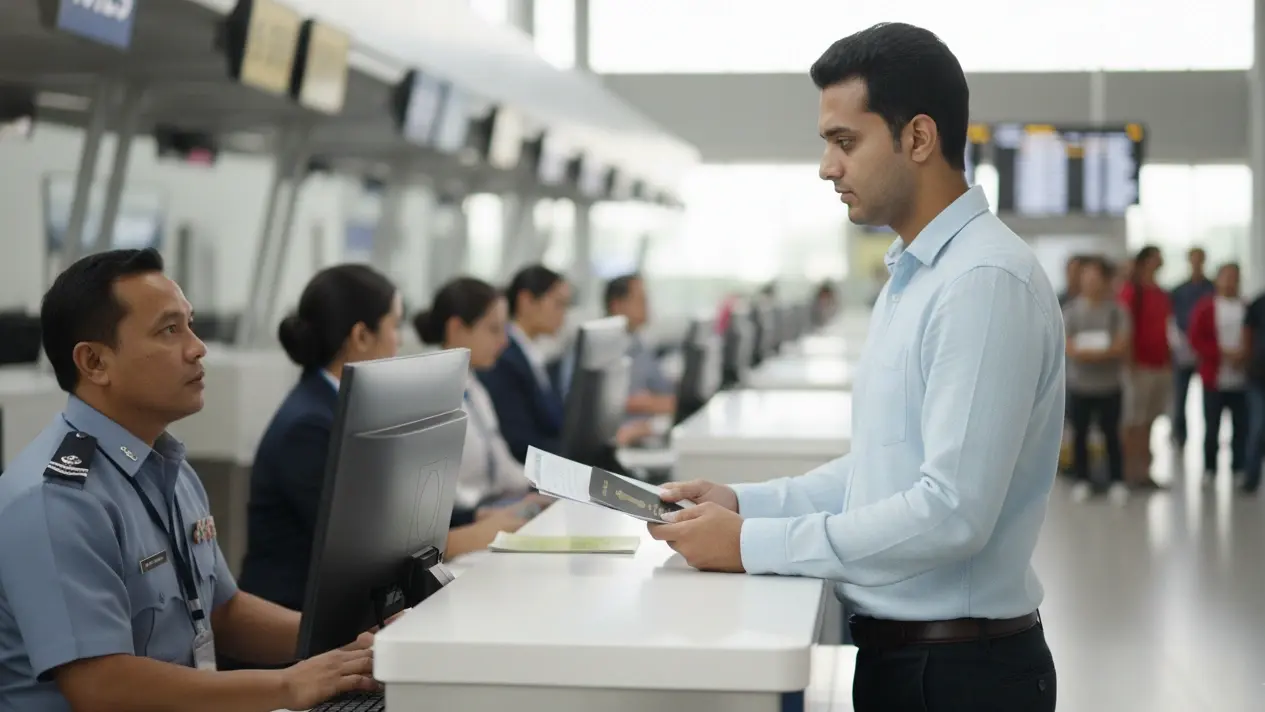
Your onward ticket usually faces its toughest review before you even board for the Philippines. For Indian travelers, the check-in counter is where a good reservation proves its value fast.
Why The First Real Decision Happens At The Departure Counter, Not At The Philippine Immigration
Most travelers picture immigration in Manila as the main hurdle. In practice, the airline desk often decides whether your trip even gets that far.
Airline staff have a simple problem to solve. They need to decide whether your documents look strong enough for boarding. If they think your Philippines entry basis is unclear, or your exit plan looks weak, they may stop the process and ask for more.
That is why the onward ticket matters so much at departure.
At check-in, the agent can compare your passport, entry basis and return or onward ticket with the published requirements. Have a current ticket or reservation status that meets the rule the carrier is applying; do not call an unticketed hold an issued ticket.
For Indian passport holders flying to Manila, that means your onward reservation should help answer three silent questions:
Are you leaving the Philippines within the stay period you appear to qualify for?
Does your exit plan look real enough to rely on today?
Can you explain your trip in one clean sentence if asked?
If your ticket helps answer those questions quickly, the check-in conversation usually stays short.
If it does not, the airline may start testing the rest of your file more aggressively. That is when a simple boarding process turns into a long desk-side review while other passengers move ahead.
What Makes An Onward Reservation Look Credible When An Agent Has Only A Minute To Review It
A credible onward reservation is not about looking fancy. It is about making it usable.
Airline staff often scan documents. They may not read every line. They look for signals. Your onward ticket should show those signals clearly.
The strongest version usually has:
Your name matches the passport
A visible booking reference or PNR
A clear departure date
A clear route out of the Philippines
Readable airline and flight details
A format you can show without hunting through your phone
That speed matters.
If an agent asks for proof of onward travel, you should be able to open it immediately, zoom in if needed, and let them see the key details without explanation first. A document that needs a long introduction already feels weaker.
A coherent route is easier to explain, but route aesthetics are not the legal test. The exit must be genuine and usable, inside the authorized stay, and compatible with entry into the next country.
Formatting helps too.
A clean PDF usually works better than a cropped screenshot with missing edges, hidden timestamps, or half-visible booking text. Printed copies still help in some airports, especially when a check-in counter is busy, and you want to avoid scrolling through email threads while the staff member waits.
The practical test is whether the document accurately answers who is traveling, which flight is booked, what status the record has and whether the planned exit falls inside the permitted window.
Why A One-Way Ticket To Manila Triggers More Questions Than Most Travelers Expect
A one-way booking into the Philippines is not automatically a problem. But for Indian travelers, it often creates extra work at check-in.
The issue is not the arrival flight itself. The issue is what that flight fails to show.
A one-way ticket tells the airline when you are entering. It says nothing about when you plan to leave. That gap is exactly what the agent may focus on, especially if your entry route depends on a short, temporary stay.
From the airline’s point of view, a one-way arrival can suggest several possibilities:
You have not finalized your exit
You plan to decide later
You expect to stay longer than you are saying
You do not understand the entry conditions fully
Even if none of that is true, the one-way ticket opens the door to those questions.
This is why many travelers get surprised at the counter. They assume their passport, booking, and hotel plan will carry the trip. Then the agent asks for onward travel, and suddenly the missing flight becomes the center of the entire interaction.
If your arrival is one-way, your onward reservation has to do more work.
If your inbound journey is one-way, obtain the return or onward ticket required by your entry route before the airline checks your file. A last-minute screenshot of an expired hold is not equivalent to an issued travel ticket.
An onward record cannot “neutralize” ineligibility for visa-free entry. It is one condition among several, and the traveler must still meet the passport, purpose, accommodation, funds and admissibility rules that apply.
The Difference Between A Reservation That Exists On Paper And One That Looks Operationally Believable
Not every reservation carries the same weight at check-in.
Some bookings technically show an onward flight, but still feel weak when a human reviews them. Airline staff are used to looking at travel documents all day. They notice when something feels incomplete, oddly timed, or too thin to trust.
Operational believability comes from the overall picture.
A usable exit plan has a real flight, a date within the authorized stay, accurate passenger details and a next destination the traveler can enter. If there are separate segments, account for transfers and other documents.
A weaker-looking reservation often has one of these problems:
The departure is unrealistically close to the arrival
The route out seems disconnected from your stated trip
The itinerary has awkward gaps or unclear flight details
The ticket appears temporary in a way that invites doubt
The document lacks enough information to be verified quickly
A good example of operational logic is a traveler arriving in Manila, staying for a short tourism window, then flying onward on a normal regional or return route that matches that timeline.
A weaker example is a traveler arriving in Manila with an onward booking that leaves from a different city without any obvious connection, on a date that seems chosen only to satisfy a rule.
The key is not to make a ticket appear plausible. It is to hold a genuine, current ticket or accepted reservation and describe it accurately.
A carrier or immigration officer may ask for proof that the exit plan works. A booking reference alone does not prove issuance, payment or acceptance for travel.
How Name Matching, Route Logic, And Travel Dates Quietly Influence Boarding Confidence
Small details shape the agent’s comfort level more than many travelers realize.
Name matching is the most basic. If the name on the onward reservation does not align cleanly with the passport and arrival booking, you invite avoidable questions right away. Even minor differences can slow the process when the staff member is already checking entry eligibility.
Route logic comes next.
Your onward destination should make sense in the context of your trip. A return to India is often easy to understand. A flight to another country can also work well, but it should fit the broader travel story you are ready to give. If the route looks random, the agent may want more explanation than you expected.
Travel dates are where many files get weaker.
The exit date should sit comfortably inside the stay period you appear to be using. If it looks too close to the limit, too far beyond it, or oddly disconnected from the trip's purpose, the staff member may stop trusting the file as quickly.
These details quietly build boarding confidence:
Same passenger name format across documents
Onward date that clearly fits the stay window
Departure city that matches your stated route
Timing that does not depend on a complicated explanation
Documentation that looks recent and readable
None of this is dramatic. That is the point.
The best onward ticket is the one that gives the airline no reason to turn a routine check into a document review exercise.
Why “I’ll Book My Exit Later” Is Usually The Wrong Script To Use At The Counter
This is one of the weakest answers you can give at check-in for the Philippines.
It sounds casual, but it creates a compliance problem for the airline. The staff member is not trying to help you sketch future travel ideas. They are trying to decide whether your file is boardable now.
When you say you will book later, you are telling them that a key part of your entry case does not exist yet. That puts pressure back on the agent, and agents usually avoid taking that risk.
The same problem appears in softer versions of the same script:
“We are still deciding where to go next.”
“We wanted flexibility.”
“We thought we could sort it out after landing.”
“We have enough money, so we can buy it anytime.”
Those answers may be true. They still do not solve the airline’s problem.
A better approach is to make sure your onward booking is already aligned before you reach the airport. Then you are not trying to persuade the airline with future intentions. You are showing a present document.
Check-in is not the place to improvise your travel logic. It is the place to present a finished version of it.
How To Answer Follow-Up Questions Without Sounding Like Your Itinerary Was Built Backwards
Good answers at check-in are short.
You do not need a speech. You need a clear, stable explanation that matches the booking in front of the agent.
If asked about your onward flight, your answer should usually cover:
Why are you visiting the Philippines
How long do you plan to stay
When you are leaving
Where are you going next
That can sound simple and natural. For example, a short tourism stay followed by a return or onward regional leg is easy to say and easy to verify.
What you want to avoid is sounding like the exit plan was built after the arrival flight was already locked. That usually happens when travelers over-explain. The more you add, the easier it becomes to reveal gaps between your words and your documents.
A stronger check-in style looks like this:
Answer the exact question asked
Keep the timeline clean
Do not volunteer side plans unless needed
Make sure your spoken dates match the reservation
Avoid speculative language about changing things later
If the agent asks where you are headed after the Philippines, give the destination shown on the ticket. If they ask how long you are staying, give the period supported by your exit date. If they ask why that route makes sense, answer in plain travel terms, not technical ones.
The goal is not to sound rehearsed. It is to sound settled.
At Arrival: Match the Exit Ticket to the Authorized Stay

At arrival, Philippine immigration may inspect the required return or onward ticket alongside passport, purpose and other entry conditions. The reservation used earlier for planning is not automatically sufficient as travel-day ticket evidence.
Why An Onward Ticket Is Not Reviewed In Isolation Once You Land
At immigration, your onward ticket is never judged alone.
It gets read beside your passport, your arrival details, your stated purpose, your expected stay, and the way you answer simple questions. That means a perfectly fine reservation can still create friction if the rest of your file points in a different direction.
This matters for Indian travelers because the officer is not trying to admire the ticket itself. They want to know whether your entry looks temporary and structured. The onward flight helps prove that, but only when it matches the broader picture.
Think of the ticket as one line in a larger chain:
Why are you entering
How long do you plan to stay
Where are you staying during that period
When you plan to leave
Where are you going next
If one of those pieces feels off, the onward flight starts getting more attention.
The exit ticket helps show that the intended stay is within the applicable visa-free period. It must also reflect a genuine plan. A document cannot cure a false statement about purpose, eligibility or next-country entry.
That is why travelers sometimes feel confused after landing. They assume the ticket should speak for itself. It rarely does. Immigration uses it as a test of consistency.
How Officers Connect Your Exit Flight To Purpose Of Visit, Funds, And Overall Travel Story
Your exit flight helps the officer decide whether your trip story hangs together.
If you say you are coming for tourism, your onward ticket should support a normal tourism timeline. If you say you are visiting briefly, the departure date should reflect that. If your answers suggest you have limited funds, but your exit plan depends on a more complicated route later, the officer may push harder.
Everything connects.
For the 14-day route, the published conditions include confirmed hotel accommodation and proof of financial capacity as well as a return or onward ticket. Confirm the current checklist for the traveler’s exact route.
It also affects how your visit purpose sounds.
A short tourist trip usually looks cleaner when the onward flight is easy to understand. If your departure is to India or to a nearby destination that fits the rest of your route, the story feels more natural. If the onward flight points somewhere unexpected and you cannot explain why, your trip can start sounding improvised.
The officer is often asking one quiet question: Does your flight out support the temporary visit you are claiming today?
That is why your exit plan should align with the rest of the file, not sit beside it as a separate item.
What Happens When The Outbound Date Feels Too Tight, Too Vague, Or Too Convenient
The date on your onward ticket sends a message before you say a word.
If it is too tight, the officer may wonder whether the trip itself is realistic. A traveler who lands in the Philippines and is due to leave very soon can look as though the exit was chosen only to satisfy a requirement. That can invite questions about what the traveler actually plans to do during such a short stay.
If it is too vague, usually because your answers about the timeline are loose or uncertain, the officer may focus on whether you truly know your own plan. A confirmed-looking flight means less if your explanation sounds like you have not committed to the dates yourself.
If it is too convenient, the reservation can start to feel engineered rather than natural. That usually happens when the departure sits right on the edge of the stay window or looks selected with no buffer at all.
Here is where date choice often gets weaker than travelers realize:
Arrival and onward dates leave no room for a normal tourist schedule
The exit sits exactly at the last possible point with no practical cushion
The traveler describes a flexible holiday, but the ticket looks mathematically tight
The booking was created to solve a document issue, not to support a believable trip
Immigration officers see these patterns often. A date that works on paper but feels thin in real life can still trigger follow-up questions.
You do not need a dramatic margin. You do need a date that looks like something you would have chosen even if nobody asked to see it.
Why An Onward Flight To A Third Country Can Raise Different Questions Than A Return To India
A return to India is usually easy to understand. It closes the loop.
An onward flight to a third country can also work well, but it creates one more question: why there next?
That question is not a problem if you can answer it simply. It becomes a problem when the route feels disconnected from the visit to the Philippines.
For Indian travelers, a third-country onward flight often attracts more attention when:
The destination has no obvious link to the rest of the trip
The timing suggests a rushed or awkward transfer between countries
The traveler has no clear plan for that next stop
The route seems chosen because it was available, not because it fits the journey
This does not mean you should avoid onward travel to another country. It means that the route must make sense in human terms.
A believable third-country exit usually has one of these strengths:
It is part of a broader Southeast Asia trip
It connects naturally with your return path
It reflects a destination you can explain in one sentence
It fits your time and budget without strain
The officer does not need a full travel diary. They need to feel that the next step in your itinerary is real and deliberate.
When the onward destination is India, that explanation is often built in. When it is another country, you need to supply the logic yourself.
How Secondary Inspection Risk Increases When Your Ticket And Verbal Plan Do Not Match
Many travelers focus on the reservation and forget the interview.
That is where small mismatches create bigger problems. If your ticket says one thing and your spoken plan suggests another, the officer may decide the main counter is no longer enough to clear the file comfortably.
Secondary inspection risk often rises for ordinary reasons, not dramatic ones.
A few common triggers are:
You mention a stay length that does not match the onward date
You describe moving around the Philippines, but your exit airport does not fit that route
You say you have not finalized the next destination, but the ticket shows a specific city
You sound unsure about a flight you are supposed to have already booked
You refer to future changes that are not reflected anywhere in the reservation
None of these issues automatically leads to refusal. But they change the tone of the interaction.
Once the officer believes the travel story is unstable, they may start reviewing the rest of the file more closely. That is why the strongest immigration conversations are usually the simplest ones. Your words should sit cleanly on top of the document, not compete with it.
A useful way to test your own file is to ask: if an officer reads the onward ticket, then asks two quick questions, do my answers repeat the same trip or introduce a new one?
If your answers create a different itinerary than the one on the reservation, the file gets harder to defend.
The Small Supporting Details That Make An Onward Ticket Easier To Defend
The onward ticket does not work alone, but a few surrounding details can make it much easier to support if questioned.
These are not extra tricks. They are the normal details that make your trip feel settled.
Helpful supporting points include:
A clear arrival flight that pairs logically with the departure date
Accommodation bookings that fit the number of nights you claim
Enough accessible funds for the stay you describe
A return path or broader regional route that sounds ordinary
Easy access to the reservation in a readable format
Familiarity with the city or country is shown as your next stop
Notice that none of these points requires a long explanation.
They help because they reduce strain. When the onward reservation is questioned, you should be able to support it with facts that are already part of the trip. If the officer asks where you stay, how long you have been in the country, or where you go next, the answers should already align.
The smaller the gap between your documents and your spoken plan, the easier the ticket becomes to defend.
Travelers often think strong files are built from more paperwork. Often, they are built from fewer contradictions.
What “Plausible Tourism Pattern” Looks Like In Practice For An Indian Passport Holder
A plausible tourism pattern is not about making your trip look perfect. It is about making it look normal.
For an Indian tourist using a visa-free route, the outward flight should fit the permitted stay and the traveler’s genuine journey. The exit ticket is an explicit condition, not just a credibility signal.
A plausible pattern often has these features:
Arrival on a normal commercial route into the Philippines
A stay length that matches the purpose you state
Accommodation and daily plans that fit that timeline
An onward or return flight that leaves within a believable window
No obvious signs that the exit date was chosen without regard to the trip itself
In practice, that can look like a short visit to Manila and one nearby leisure destination, followed by a return to India or a simple onward leg to another Asian city. It can also look like a compact multi-country holiday where the Philippines is one planned stop among several.
What usually feels less plausible is a file where the traveler says “tourism,” but the timing, onward route, or supporting details make the visit look unfinished, overly flexible, or built around technical compliance instead of real travel.
The legal baseline is whether the ticket meets the conditions of the specific entry route. A well-explained itinerary cannot replace an ineligible passport, missing qualifying status or ticket outside the allowed stay.
Choose the Exit Date Under the 14- or 30-Day Rule
Start with the authorized stay and the arrival date. The outward flight should be booked inside the applicable period. Route convenience and fare price come after that compliance check.
Why The Exit Date Matters More Than The Price, Airline, Or Airport On The Reservation
Most travelers spend too much time picking the airline and too little time choosing the date.
At check-in and on arrival, nobody is scoring your onward booking on comfort, baggage, or loyalty points. The first useful question is much simpler: Does your departure date fit the entry basis you are relying on?
That is why the date carries so much weight.
A low-cost regional flight can work well if it leaves within the right window. A full-service booking can create trouble if the departure date sits outside the stay period you appear to qualify for. The same logic applies to airport choice. Manila, Cebu, and other common departure points can all be fine, but the date printed on the reservation is still what shapes the first judgment.
Your onward date does several jobs at once:
It signals how long you plan to stay
It helps show whether the trip is temporary
It tells the reviewer whether you understand your own entry limits
It gives your travel story a fixed endpoint
That last point matters more than many travelers expect.
Without a clear exit date, your trip looks open-ended. With the wrong exit date, your trip looks misread. With the right exit date, the rest of the file becomes easier to process.
We should treat the onward date as the anchor of the reservation. The airline on the ticket is secondary. The fare type is secondary. Even the destination often comes second. If the date is wrong, the rest of the itinerary cannot rescue it.
How To Match Your Onward Flight To The 14-Day Route Without Creating A Stay-Window Problem
For the 14-day Indian-national visa-free route, choose a return or onward flight within the authorized period. The Philippine Bureau of Immigration states that this privilege is non-extendible and non-convertible; do not plan a longer stay on the assumption of an airport extension.
This is where Indian travelers get into trouble most often. They know they need proof of onward travel, so they book something that looks close enough. But close enough is not always enough when the stay window is already short.
The best approach is to work backward from the entry route you plan to use.
Start with the day you expect to land in the Philippines. Then choose an onward flight that leaves comfortably within the period you are relying on. The booking should not force you to explain why the departure is at the very edge of your permitted stay.
A safer approach usually looks like this:
You land with enough time to complete the trip you are claiming
Your onward flight leaves with a small practical cushion
The date supports tourism, not last-minute rule management
What tends to create friction is a booking that feels mathematically tight. If your departure sits right against the last possible day, it may still be technically inside the window, but it can feel brittle under review.
This is especially true when flights, time zones, and late-night departures complicate the calendar. A reservation that seems acceptable when you count casually can look much weaker when someone checks the exact timeline more carefully.
Leave a practical buffer rather than relying on a last-hour departure. Ask the airline or Philippine immigration how arrival and departure dates will be counted in any edge case; do not infer extra permitted time from an overnight schedule.
When The 30-Day Option Changes The Outbound Date Strategy For Eligible Indian Travelers
The separate 30-day visa-free route is available only when the traveler has qualifying AJACSSUK visa or permanent residence status and meets the other current conditions. It is not a generic longer version of the 14-day route.
That does not mean you should use all of that room automatically. It means you can choose an onward date that matches a fuller itinerary without making the stay look strained.
A 30-day window often supports travel plans that involve:
Manila plus one or two other destinations in the Philippines
A slower-paced holiday with internal flights
A longer regional trip that includes the Philippines as one stop
Because the window is wider, your onward reservation can reflect a more comfortable travel rhythm. You do not need to force the exit too early just to look compliant. In many cases, an exit that leaves reasonable room for the trip actually looks more believable than one that departs too soon.
Still, more time does mean no structure.
A 30-day-eligible traveler can create a weak file by choosing an onward date that feels lazy, vague, or overly ambitious. If the trip purpose sounds modest but the departure sits very late without a clear reason, the date can still invite questions.
The right strategy here is balance.
Use the extra time only if the traveler qualifies for that route. The outward date should still match the actual journey and remain inside the authorized period.
Why Travelers With A Longer-Stay Visa Still Need An Exit Date That Makes Sense On First Review
A longer-stay visa gives you more legal room, but it does not remove the need for a sensible outward-facing itinerary.
This is where some travelers relax too much. They assume the visa solves the timing issue entirely. In reality, your onward date still shapes how prepared and credible your trip looks on first review.
An officer or airline agent may not study every fine detail of the visa before reading the ticket. They often see the trip as a whole. If your onward date feels disconnected from the purpose you state, the visa does not stop the follow-up questions.
For example, a longer-stay traveler can still trigger doubt if:
The exit date seems random rather than planned
The stay length sounds much shorter than the ticket suggests
The outward reservation leaves no obvious link to the stated reason for travel
The traveler cannot explain why that departure date was chosen
A longer-stay visa should give you clarity, not looseness.
That means the onward date should still look intentional. Even when the rules allow more time, your reservation should fit the version of the trip you are presenting at the airport.
If you say you are visiting for a limited purpose, pick a date that reflects that. If you expect to stay much longer, make sure the rest of your file supports it.
The strongest date is not simply the latest date you can legally use. It is the date that makes the trip easiest to understand on first review.
How To Count Days Properly When Overnight Flights And Calendar Confusion Enter The Picture
Date problems often start with bad counting, not bad intentions.
This happens when travelers count casually from booking screens, forget the arrival date, or overlook the effect of overnight departures. A reservation can look fine in your email inbox and still create trouble when the actual calendar is checked line by line.
You need to count with the same precision that the reviewer may use.
That means paying attention to:
The date you land in the Philippines
The local date shown on the onward ticket
Whether your departure is late at night or after midnight
Whether a transit changes the calendar day in a way that matters
Use calendar dates rather than a vague two-week or one-month estimate. Verify the official admitted-until date at entry and resolve any overnight-flight ambiguity before departure.
Another mistake is relying on the booking day instead of the travel day. What matters is not when you made the reservation. What matters is when the flight leaves the Philippines, according to the itinerary you are presenting.
We recommend a simple cross-check before you travel:
Write down your arrival date in the Philippines
Write down your outward departure date from the Philippines
Count the days conservatively
Review the calendar again with local dates, not memory
Avoid any date that only works if nobody checks closely
This is one of the easiest problems to prevent, and one of the most frustrating to discover at the airport.
Why A Ticket That Leaves “Just Barely In Time” Can Still Create Unnecessary Scrutiny
A ticket can be technically inside the allowed period and still feel like a weak choice.
That is the danger of a “just barely in time” reservation.
When the onward date sits right on the edge, several things happen at once. First, the margin for error disappears. A delay, a schedule shift, or even a misunderstanding about the date can turn a manageable file into a stressful one. Second, the trip can start to look engineered around the rule instead of being built around normal travel.
That appearance matters.
A tightly timed onward booking may cause a reviewer to ask why you selected that exact date. If your answer sounds like you simply wanted the latest possible exit, the file can start feeling compliance-driven rather than travel-driven.
That does not mean every near-limit booking is bad. Some genuine trips do end close to the boundary. But if you have a choice, a little breathing room usually makes the reservation easier to defend.
A practical cushion helps in several ways:
It gives the itinerary a more natural shape
It lowers the chance of accidental overstays
It reduces pressure if flights move
It looks less optimized for the rule itself
The goal is not to leave half your permitted stay unused. The goal is to avoid dates that make the whole file feel fragile.
What To Do When You Want Flexibility But Still Need A Defensible Exit Date Today
Many travelers want options. That is reasonable.
You may not know your exact final day yet. You may still be comparing islands, domestic flights, or the next country in your regional route. But if you need to fly to the Philippines now, you still need an onward date that works now.
The solution is not to delay the decision completely. The solution is to choose a date that leaves room without undermining the file.
A good flexible strategy usually has three parts:
Pick a date comfortably inside the stay window
Choose a route you can still explain if your broader plans shift
Keep the departure aligned with the version of the trip you are ready to present today
That way, your onward reservation still does its job even if you later refine the journey.
Flexibility does not remove the ticket requirement. Keep the outward flight current, check its ticketing status and update it through the issuer when the genuine plan changes.
When travelers try to preserve too much flexibility, they often produce a reservation that looks temporary in the wrong way. The smarter move is controlled flexibility. Pick a sensible outward date, make sure it supports the entry route you are using, and build the rest of the trip around that anchor.
Not Every Onward Itinerary Carries The Same Risk: Which Flight Setups Look Safer And Which Invite Questions
Once your exit date is under control, the structure of the onward flight becomes the next pressure point. Two reservations can show the same departure day from the Philippines, yet one feels routine, and the other invites extra questions.
Return To India Vs Exit To Another Country: Which Story Is Easier To Explain And Why
A return flight to India is usually the easiest onward setup to explain.
It is familiar. It is clean. It closes the trip in a way that airline staff and Philippine immigration can understand immediately. If your plan is a short holiday in the Philippines and then back home, that return booking often needs the least verbal support.
That does not mean a third-country exit is weak. It just carries one extra burden. You need a clear reason why that destination is next.
A return to India usually works well because it signals:
A simple trip shape
An obvious endpoint
Lower room for interpretation
A travel plan that feels settled
An onward flight to another country can also look strong when it fits a broader Asia itinerary. The problem starts when the next stop seems random or disconnected from the rest of the journey.
For Indian travelers, a third-country exit tends to work best when:
The country is a realistic next stop from the Philippines
The route matches the length of your trip
You can explain the sequence in one sentence
The next leg does not sound more improvised than the Philippines stop itself
A weak answer sounds like you chose the destination because the ticket was available.
A strong answer sounds like the Philippines is one planned stop before the next one.
That distinction matters because officers do not only look at the route. They listen to whether the route was chosen for travel reasons or only for document reasons.
Why Separate Bookings Can Work But Often Need Cleaner Documentation
Separate bookings are common. They are not automatically risky.
Many travelers arrive in the Philippines on one reservation and leave on another. That is perfectly workable. The issue is not the separation itself. The issue is how clearly the second booking stands on its own.
When the onward flight is on a separate reservation, you lose some of the built-in logic that comes with a single continuous itinerary. That means the onward proof has to be cleaner.
With separate bookings, make sure the onward flight shows:
The same passenger name format as the arrival booking
A clearly confirmed route out of the Philippines
A readable booking reference
Enough detail to stand alone without your inbox open beside it
This matters because a separate onward ticket often gets reviewed as an independent piece of proof. If the document looks incomplete or half-captured, it can feel less reliable than a full itinerary on one booking.
Separate bookings also raise one practical question. If your plans shift, are you still tracking both reservations correctly?
That becomes important when the arrival flight changes, but the onward booking stays fixed. A date mismatch, airport mismatch, or route mismatch can make the file feel stitched together rather than planned.
Separate bookings work best when they look intentional, not fragmented.
How Self-Transfers, Ultra-Short Connections, And Disconnected PNRs Can Undermine Confidence
An onward ticket should not force the reviewer to imagine how the trip will function.
Self-transfers and very short connections often do exactly that.
With a self-transfer, allow enough time to collect baggage, clear any required immigration and check in again. A valid exit ticket may still be unusable if the connection requires documents the traveler lacks.
The same issue appears with ultra-short connections. If your onward route out of the Philippines depends on a narrow transfer that looks fragile, the reservation may appear less convincing as proof of a settled departure.
Risk increases when the itinerary includes:
Airport changes in the same city
Separate tickets with no protection between legs
Connection times that leave little margin
Overnight transfers with unclear continuity
Multiple booking references that are hard to present quickly
Separate booking references are not inherently disqualifying. Verify each leg independently and show how the connections work; a PNR alone does not establish ticket issuance.
For example, if your exit from Manila depends on one booking, then a second onward leg under another booking with no buffer, the route may seem less dependable as a real plan. You may still make it easily. But the question at review is different. The question is whether the itinerary looks like a stable exit.
For a Philippines entry file, the best onward proof usually looks simple enough to trust at a glance. The more mechanical the explanation it needs, the weaker it can feel under scrutiny.
Why Open-Jaw Plans Sound Sophisticated Online But Can Be Harder To Defend In Person
Open-jaw plans can make sense for real travel. You might arrive in Manila and leave from Cebu, or land in one city and exit from another after moving through the islands.
That is not inherently a problem.
The challenge is that open-jaw itineraries require the rest of your trip to support them clearly. If you cannot show how you get from one point to the other, or if your timing across the Philippines feels vague, the onward ticket becomes harder to defend.
Open-jaw routes look strongest when:
Your domestic movement inside the Philippines is believable
The stay length supports travel between the two cities
Your exit city matches the destinations you say you will visit
The route sounds like a normal tourism flow, not a forced workaround
They look weaker when the exit city appears disconnected from your stated plan.
For instance, if you say you are visiting Manila only, but your onward flight leaves from another island with no supporting domestic sector or explanation, the file starts to feel unfinished. The officer may wonder whether the exit ticket was chosen first and the trip story added later.
Open-jaw plans are best used when they genuinely reflect the trip. They are not ideal when you need the lowest-friction onward proof possible.
If your priority is simplicity at check-in and immigration, a same-city return or same-city onward exit is usually easier to present. If your real trip needs an open-jaw shape, then the surrounding details need to be tighter.
How Refundable Tickets, Hold Reservations, And Time-Limited Bookings Create Different Risk Profiles
Not all onward reservations behave the same way after you create them.
Some are fully ticketed and refundable. Some are held for a period. Some exist in a way that is useful now but may not stay stable for long. That difference matters because the reservation has to remain valid when you actually present it.
A refundable ticket often gives the most control. You know the flight is booked, and the document tends to look complete. The main trade-off is cost.
A held reservation can also work well, especially if it stays active through the period when you need to show it. The key issue is timing. If the hold expires before departure or before document review, the file weakens fast.
Time-limited bookings need careful handling because their strength depends on when you will use them. A reservation that looks solid on Monday but vanishes by Wednesday is only useful if your travel timeline matches that window.
Think about risk in practical terms:
Refundable bookings usually offer the highest stability
Hold reservations can be effective when timed properly
Short-life reservations need close attention so they do not expire before use
For Indian travelers going to the Philippines, the risk is rarely the reservation type alone. The risk is showing a booking that no longer matches the moment of review. A clean onward ticket loses value quickly if it cannot still be supported when asked for.
When A Cheap Regional Exit Flight Looks Smart On Paper But Weak At Scrutiny Time
A low-cost exit flight from the Philippines can be a smart choice. Price alone is never the problem.
The issue is when the cheap regional ticket looks disconnected from the rest of your trip. If it seems chosen only because it was the lowest-cost outward option, the route may feel less credible than a slightly more natural alternative.
A cheap regional exit can start attracting questions when:
The destination does not fit your stated plans
The departure airport is awkward for the trip you describe
The schedule is unusually tight or inconvenient
The next step after arrival in that country is unclear
The flight may still be real. But real does not always mean persuasive.
What works better is a low-cost regional route that still fits a normal travel pattern. If you are building a short Southeast Asia trip and the next stop genuinely follows from the Philippines, a budget onward flight can look completely reasonable.
The key is not price. It is coherence.
A cheap route becomes a weak route only when the rest of the file cannot explain why that city, why that airport, and why that timing.
How To Choose The “Least Surprising” Onward Route For The Specific Trip You Are Claiming To Take
The safest onward itinerary is often the least surprising one.
That does not mean boring. It means easy to understand.
When you choose the route, ask yourself what a check-in agent or immigration officer would think after seeing it for ten seconds. Would it feel like a normal next step for the trip you are describing? Or would it create a silent follow-up question?
A least-surprising onward route usually has these qualities:
The destination fits the travel story
The departure city makes sense
The timing looks comfortable
The route does not depend on a long explanation
The structure feels like a real trip, not a technical solution
This is why the best onward reservation is not always the cheapest, shortest, or most flexible one. It is the one that creates the smallest gap between the document and the trip you can calmly explain.
For some Indian travelers, that means a straightforward return to India.
For others, it means an onward flight to a nearby country that clearly belongs in the same journey.
Either can work. What matters is choosing the route that feels most natural for the exact version of the Philippines trip you are claiming at the airport.
How To Build An Onward Reservation File That Is Easy To Show, Easy To Explain, And Easy To Replace
Once you have the right route and the right date, the presentation starts doing real work. A strong onward ticket can still feel weak if your file is messy, slow to access, or hard to verify under pressure.
What To Carry Beyond The PDF So You Are Not Relying On A Single Screenshot
A single screenshot is rarely the best version of your onward proof.
It may cut off key details. It may hide the booking reference. It may look incomplete when zoomed in at a check-in counter. If the brightness is low, the internet is weak, or the image is buried in your gallery, even a valid ticket can become awkward to present.
Your onward reservation file should be built as a small set, not a single image.
A reliable setup usually includes:
The full PDF of the onward reservation
The confirmation email is in your inbox
One clear screenshot showing the flight number, date, and route
A saved offline copy on your phone
A printed copy in your passport wallet or travel folder
That mix gives you options.
If the airline agent wants a quick look, the screenshot may work first. If they want more detail, the PDF is ready. If your phone signal fails or the battery drops, the paper copy keeps the interaction moving.
This matters more than most travelers expect. Airport document checks happen fast. You do not want to unlock your phone, search your inbox, open the wrong attachment, and then explain why the page is taking time to load.
Your onward file should feel ready before anyone asks for it.
Why Verifiability Matters More Than Fancy Formatting
An onward reservation does not need to look polished. It needs to look checkable.
Use the issuer’s supported verification channel and confirm whether the document is a reservation, hold or issued ticket. Polished formatting is not a substitute for an active, appropriate record.
That is why verifiability matters more than design.
Useful signals usually include:
A visible PNR or booking reference
Readable airline and route details
A passenger's name that matches the passport
A clear travel date and departure city
A format that does not look cropped or manually altered
A cluttered email chain or a decorative layout does not add trust. In fact, it can distract from the only question that matters: can the person reviewing this understand and rely on it quickly?
This is where many travelers overdo presentation and underdo clarity.
Carry a clear copy with passenger name, flight details, date and record status, plus a way to retrieve the current version. If the airline asks for an issued ticket, an unticketed reservation may not meet the check.
DummyFlights.com can help compare a temporary reservation with the actual ticket you need for travel. Verify the live product terms, record status, expiry, change policy and price before ordering; do not rely on an unsourced flat-price or unlimited-change claim.
How To Keep The Reservation Consistent Across Passport Name, Arrival Flight, And Stay Length
Your onward reservation should not look like a separate document floating beside the trip. It should look like it belongs to the same travel plan.
Consistency is what makes that happen.
The most important match is the passenger's name. Use the same order and spelling style you use across your passport and travel bookings. If your surname appears first in one place and differently in another, the file can still be valid, but it may take longer to review. At an airport desk, any extra pause matters.
Next comes the link between the arrival flight and the onward flight.
The reservation should feel logically connected to how and when you enter the Philippines. If you arrive in Manila on a certain date and present an onward flight out of the country, the departure should fit the stay period you are relying on and the route you say you plan to follow.
Then there is the stated stay length.
If you say you are staying for ten days, the onward booking should support ten days, not six and not fourteen. If you say you are taking a short island trip and then leaving, the exit date should reflect that pace. A mismatch does not always create refusal, but it does create doubt.
Check these points side by side before travel:
Passport name
Arrival booking name
Onward booking name
Arrival city and date
Onward departure city and date
Spoken stay length
Claimed purpose of visit
If all of those points line up cleanly, your file becomes easier to defend without extra explanation.
When To Generate The Onward Reservation So It Still Looks Fresh At Check-In
Timing matters.
An onward reservation that was created too early can still work, but only if it remains current and usable by the time you travel. The risk is not age alone. The risk is that the booking has changed, expired, or no longer fits the updated trip.
You want the file to feel recent enough to reflect your present plan.
That usually means checking the reservation close enough to departure that you can confirm:
The travel date still fits your entry route
The booking is still active in the form you plan to show
The route still matches your latest arrival timing
The saved PDF is the final version, not an outdated one
This becomes even more important if you have changed your arrival flight, shifted your Philippines stay, or adjusted the next country in your itinerary. A reservation created weeks ago may still be valid, but if the rest of the trip has moved around it, the file can start looking stale.
The strongest approach is simple. Build the onward reservation when your travel window is stable enough to support it, then recheck it shortly before departure. That gives you a document that feels current without forcing you into last-minute scrambling.
How To Prepare A Backup Version Without Making Your Travel File Look Over-Engineered
Backup is smart. Too many versions can look confusing.
You do not need five outward options saved in one folder. You do not need multiple flight PDFs with different dates sitting beside each other. If you present the wrong one by mistake, the problem becomes self-created.
A good backup version should protect you from practical problems, not create new ones.
The cleanest setup is usually:
One primary onward reservation
One backup copy of the same reservation is stored in another place
One secondary access method, such as email plus downloads
One paper copy if you prefer physical support
That is enough for most travelers.
If you are carrying a replacement option because your plans are still moving, keep it separate. Do not place multiple outward flights in the same visible album or folder where they can be opened by accident. Name files clearly. Archive older versions. Remove superseded screenshots from your quick-access gallery.
You want backup to feel invisible until needed.
The best-prepared travelers are not the ones carrying the most documents. They are the ones who can open the right document immediately and show only what supports the current trip.
The Best Way To Store, Print, And Pull Up Your Onward Proof Under Time Pressure
Storage is not a minor detail. It shapes how calm you look when someone asks for proof.
Your onward reservation should be stored where you can reach it in seconds. Not in a deep downloads folder. Not buried under dozens of other travel files. Not dependent on searching old email threads while standing at the counter.
A practical storage setup can look like this:
Save the PDF in a clearly named folder on your phone
Favorite or star the email confirmation
Keep one cropped but complete screenshot in a travel album
Store a copy in a cloud folder for backup
Print one page and keep it with your passport
The printed copy still helps because it removes dependence on battery, signal, and screen glare. It also lets you hand over the key details without fumbling through your device.
When you pull it up, do it cleanly.
Open the exact page before you reach the desk if you expect the question. Increase screen brightness. Zoom only if needed. Do not scroll through multiple files in front of the agent. A fast, calm presentation makes the reservation feel stronger because it looks like part of a prepared trip, not a late fix.
Keep an Offline Copy and a Current Issuer Record
This part deserves one more practical layer because presentation under stress is where even good files fall apart.
Think of the airport flow in order. You may need to show the onward reservation at airline check-in, again near boarding, if there is a document recheck, and later on arrival in the Philippines. That means your file should survive repeated use without confusion.
A smart final check before you leave for the airport is:
Open the PDF once and confirm it loads offline
Confirm the printed copy is the latest version
Make sure the screenshot shows the full route and date
Check that your phone battery is not your only backup
Place the reservation where it sits next to your passport and arrival ticket
If you travel with a companion, send a copy to them as well. That is not because the airline needs it from both of you separately. It helps because one device problem should not stall the file.
What works best under pressure is not complexity. It is clean access.
When Plans Change, The Onward Ticket Becomes The Weak Spot: How To Handle Last-Minute Changes Without Panic
Your onward flight only helps if it still matches the trip you are actually taking to the Philippines. Once dates, routing, or entry basis shift, the safest move is to rebuild the file before the airport forces the issue.
What To Do If Your Travel Dates Shift After You Already Created The Reservation
A date change is not just a calendar issue. For indian nationals flying to the Philippines, it can change the entire logic of the onward flight.
First check whether the revised trip still fits the traveler’s actual entry route. The 14-day privilege is non-extendible and non-convertible, and the 30-day route has different qualifying conditions. A longer stay or different purpose may require an appropriate visa before travel.
Work through the update in order:
Your new arrival date
Your new exit date
The route you now plan to take
The length of the contemplated period
Whether the trip is still for tourism purposes or business purposes
If the change pushes you outside the shorter framework you first planned, you may need an appropriate Philippine visa instead of relying on a lighter route. That is where visa requirements, entry visas, and the wider application process suddenly matter. A traveler who revised a short holiday into a longer regional plan should not assume the same paperwork still works.
The practical rule is simple. If your dates changed enough to alter the entry story, rebuild the onward reservation before you fly.
How To Recover If Airline Staff Reject The First Onward Ticket You Present
If the airline pushes back, do not defend the weak version for too long. Airlines screen foreign nationals with a strong bias toward caution, especially when the Philippines trip depends on a clean return or onward ticket.
Usually, the objection comes down to one of these points:
The date no longer fits the stay you claim
The route does not look stable
The document is hard to read or verify
The name or booking details look inconsistent
At that moment, the strongest move is practical, not argumentative. Ask what exactly they want to see, then fix that point. If the issue is the date, update the outward leg. If the issue is format, open a clearer PDF. If the route looks odd, switch to a simpler exit plan.
Your passport should already be in order before you reach the counter. Make sure it is a valid passport, and make sure it stays passport valid for the required period. If your document must remain valid for at least six months, do not let an otherwise strong itinerary get dragged into a wider problem because the basic document check was too close for comfort.
If the trip changed and you are now flying under a different basis than originally planned, solve that first. A sharper onward file will not rescue a trip that now requires entry visas but is still being presented as though nothing changed.
What To Say If Immigration Questions Why Your Exit Flight No Longer Fits Your New Plan
At arrival, Philippine immigration can examine the return or onward ticket together with the other entry conditions. The official rule—not a guessed impression of the itinerary—governs the traveler’s eligibility.
If your travel plan changed after booking, keep the explanation short and grounded in the documents you can show right now.
Useful support usually includes:
A recent outward reservation
Proof of financial capacity
A current bank statement
Updated hotel accommodation
Confirmed hotel accommodation that matches the nights you still plan to stay
That matters because immigration is testing whether your revised plan still looks temporary and funded. If your outward flight changed but your proof of financial and lodging still lines up, the case remains easier to understand.
What hurts is the mismatch. If your reservation points to one departure city, your hotel booking covers another area, and your funds look thin for the timeline you describe, the file starts to wobble. That is how a simple travel change turns into a longer review at the Philippine port.
When answering, keep the trip story linear. Say when you arrived, how long you now plan to remain, and where you now intend to go. A calm explanation supported by the latest documents is much stronger than a perfect old flight that no longer matches reality.
Why Rebooking Quietly Before Departure Is Better Than Explaining Too Much At The Airport
The best time to fix an outward booking is before anyone asks for it.
Travelers often spend too much time reading screenshots, social posts, or second-hand summaries of updated visa-free privileges and not enough time checking whether the live itinerary in their hand still matches the trip.
That is risky because the Philippine government can update guidance through foreign affairs channels, the Department of Foreign Affairs, or notices that reflect subsequent executive issuances and even subsequent executive issuances amending an earlier executive order.
You do not need to become a policy analyst at the airport. You just need one current travel file that fits the present version of your trip.
Quiet rebooking works better than overexplaining because it removes ambiguity. Instead of telling staff how the route used to make sense, you show them a booking that makes sense now. That keeps the focus on your current travel plan, not the history of your planning.
This matters even more when travelers rely on broad phrases like Philippines visa-free or Philippines without a visa without checking whether their actual circumstances still fit that path. A small trip change can move you from a simple short visit into another category entirely.
So before leaving home, ask one blunt question: if someone at the desk opens this itinerary cold, will they understand it immediately? If not, replace it before the airport conversation starts.
How To Handle A Missed, Expired, Or Cancelled Onward Reservation Without Wrecking The Trip
A missed, expired, or cancelled outward booking is not the end of the trip. It only becomes dangerous when you keep treating the dead booking as though it still proves something.
This is where entry basis matters. Some indian nationals holding valid documents from other countries assume that any earlier outward proof is good enough because they also hold legal residence, a permanent residence permit, or a non-immigrant visa elsewhere. That can help with eligibility in some cases, but it does not make an expired flight look current.
The same goes for indian nationals transiting through other countries before reaching Manila. A transit plan does not rescue a cancelled reservation out of the Philippines.
Be careful with copied rule summaries, too. Travelers often rely on lists of countries following, pulled from old graphics or reposted text that mentions Barbuda, Slovenia, Solomon Islands, or Cambodia, Cameroon, Canada. Those fragments do not tell you whether your own file is current today, and they certainly do not repair a lapsed outward booking.
If the booking is gone, do this:
Stop using the old PDF
Create a replacement tied to your present dates
Make sure it matches the admission status categories you are actually relying on
Do not confuse those with other admission status categories that do not apply to you
Avoid importing assumptions from another country’s e visa system into the Philippines context
A live outward booking always carries more weight than a cancelled one paired with a long explanation.
The Smartest “Day Of Travel” Checklist For Indian Travelers Flying Under Tight Entry Rules
On travel day, the file should feel finished. That is especially important for indian citizens and indian tourists heading to the Philippines on a short schedule.
Your final check should cover more than the flight PDF. It should confirm that the whole travel story still holds.
Before leaving for the airport, review:
The outward reservation with a readable booking reference
The required documents for your actual entry basis
Whether you are entering without a visa or on a visa-based stay
Whether any old application form or visa application form is still sitting in your folder, creating confusion
Whether your onward date still fits your stay length
Whether your hotel and funds support the same timeline
Whether your phone and printed copies show the latest version
If you are not actually traveling on a route that allows entry to the Philippines without a visa, do not carry an outdated file that suggests otherwise. And if your revised plan now points toward a different track, do not let yesterday’s paperwork shape today’s explanation.
The cleanest travel-day file is one where the onward flight, passport, accommodation, and money all tell the same short story.
Book Now, Rebuild Now, Or Delay Travel Until The File Makes Sense
Use a simple three-part test.
Book now only if the traveler meets the current visa-free conditions and has a genuine return or onward journey within the allowed stay. Otherwise, obtain the correct visa or change the plan before departure.
Rebuild now if the trip moved from a short visit toward extended stays, if the file now looks like a single entry plan stretched too far, or if your route no longer fits the purpose you are giving. That is also the right move if the entry path you first assumed turns out to carry a non-extendible period or a non-convertible period, and your new dates no longer sit safely inside it.
Delay travel until the file makes sense if any of these apply:
Your outward flight no longer matches the stay you are claiming
You are still not sure whether your case falls under the current Philippines visa-free setup
Your purpose changed, and the file no longer reflects it
You now need a different visa route, but have not completed that paperwork
There is a derogatory record issue or another unresolved admissibility concern
Leave For The Philippines With An Onward Plan You Can Defend
For Indian travelers flying to the Philippines, the smart move is simple: match your return or onward ticket to your actual entry route, stay window, and trip story. Once your dates, route, and documents line up, you can approach check-in and the Philippine port with far more confidence and far less guesswork.
If your case still depends on updated guidance from the Philippine Embassy or the Philippine Consulate General in New Delhi, check that before you fly, especially if you are reviewing reposted lists of the following countries or older references that mention Barbuda, Argentina. Then lock your onward plan to the version of the Philippines trip you are actually taking.
Before you leave: Reconfirm the actual privilege, ticket status, exit date, passport validity, accommodation and funds. Correct changed plans through the issuer before check-in.
Check current booking optionsFrequently Asked Questions
Do Indian passport holders get a Philippines visa on arrival?
Do not assume a tourist visa will be issued at the airport. Current Philippine rules instead provide specified visa-free routes for eligible Indian travelers. If you do not qualify, obtain the appropriate visa before travel.
What is the 14-day onward-ticket rule?
Eligible Indian travelers on the 14-day visa-free route must have a return or onward ticket, plus the other published documents. The outward date must fit the authorized stay.
Who may use the 30-day visa-free route?
The separate route is for eligible Indian holders of qualifying American, Japanese, Australian, Canadian, Schengen, Singapore or UK visas or permanent residence permits, subject to the current official conditions.
Can an unticketed dummy reservation satisfy boarding and entry?
Do not assume so. Check the actual record status and the carrier’s and immigration authority’s requirement. A temporary hold or PNR is not automatically an issued travel ticket.
What if I will leave for a third country?
A genuine onward flight can fit the rule if you can enter the next country and the departure is within the authorized stay. Keep any separate visas and transfer documents ready.
Friendly reminder: Visa-free privileges, airline checks and immigration decisions can change. A reservation does not guarantee boarding or entry. Follow current official requirements for the exact traveler and route.