
Flying into Paris and leaving from Amsterdam makes sense to you. It can still make an embassy officer, airline agent or border officer pause for a second because the route is not a simple round trip. That pause is not a rejection signal by itself. It is a coherence test.
Proof of onward travel was built around a simple idea: the traveler must show a credible plan to leave. That exit does not always need to be from the same city or even the same country where the trip begins. The important question is whether the route, timing and explanation all point to one believable trip.
Key facts for different-country returns:
- An open-jaw route is normal when the trip covers more than one city or country.
- The exit country should match the actual travel path, not appear randomly chosen.
- Schengen-style routes need especially clear main-destination and first-entry logic.
- Overland or regional travel should be supported by dates, hotel logic or a short explanation.
- Your onward ticket should match the story you would calmly give at a counter.
Entering one country and leaving from another? Create a clean DummyFlights onward ticket that matches your real route before the mismatch becomes a question.
Create Your Onward TicketIn This Guide
Official-source check: The EU Visa Code uses sole destination, main destination and first entry to decide Schengen visa responsibility, which is why multi-country route logic matters. Immigration New Zealand says visitors must show they can leave New Zealand, including a ticket to a country they have the right to enter or proof they can buy one. Sources: EU Visa Code and Immigration New Zealand visitor visa guidance.
Reviewed for: different-country exit logic, open-jaw itinerary wording, Schengen route consistency, onward-ticket timing, overland travel explanation, claim safety and contextual-link accuracy.
How Officers Read Different Exit Countries
When your entry and exit countries do not match, the officer is usually not looking for a perfect round trip. They are looking for a route that makes sense. A traveler can enter France, spend several days there, continue to the Netherlands and fly home from Amsterdam. That is normal. What creates concern is a route that gives no visible reason for the exit point.
The three questions a mismatched itinerary raises
A different-country return usually triggers three silent questions:
- Why is this traveler leaving from another country?
- How will they get from the entry country to the exit country?
- Does the timing fit the visa, stay limit, accommodation and travel purpose?
If your documents answer those questions, the mismatch becomes ordinary travel planning. If they do not, the same mismatch can look like a vague or unfinished trip. That is why the route explanation matters as much as the ticket itself.
A different return country becomes stronger when the rest of the file supports it. Hotel dates should not end in Paris if the onward ticket leaves from Amsterdam two weeks later with no explanation. A cover letter should not say “France only” if the flight exits from the Netherlands. Travel insurance should cover the whole period, not only the entry country.
Why round trip to the same city is a habit, not a rule
Many travelers assume visa and border officers expect a neat round trip: enter one city, stay there, return from the same city. That route is common, but it is not the only legitimate travel pattern. Open-jaw travel is normal for multi-city holidays, regional backpacking, cruises, rail trips, business trips and digital-nomad movement.
The problem is not that the return is from another country. The problem is when the route looks like it was chosen only to satisfy a document requirement. A believable itinerary has a reason: cheaper flights, better connections, a planned second destination, regional travel, conference timing, family visit, or a practical exit from the travel zone.
This is where wording matters. Do not describe the different exit country as an accident. Present it as part of the route. “I enter France, spend five nights in Paris, travel by train to Amsterdam and fly out from there” sounds organized. “I just found a ticket from another country” sounds weaker.
When a different return country is normal, and when it looks risky
A different exit country is normal when the journey visibly moves in that direction. It looks clean when the traveler has accommodation, internal transport, event dates or a short explanation that bridges the entry and exit points. It also looks normal when the exit airport is a major hub with better long-haul routes than the entry city.
It can look risky when the exit country has no relationship to the itinerary. A traveler who enters Bangkok, claims a short Thailand-only holiday, but shows an onward flight from Vietnam without any hotel or route explanation invites questions. The officer may wonder whether the traveler understands the allowed stay, whether they are genuinely leaving, or whether the document was selected randomly.
The fix is not always to change the return country. Sometimes the fix is to make the route visible. A single sentence in the cover letter, a hotel booking in the second country, or a simple internal-travel explanation can turn a weak mismatch into a coherent open-jaw plan.
The Four Travel Patterns That Create This Issue
Different-country returns usually come from one of four travel patterns. Once you know which pattern applies, choosing the right onward proof becomes easier.
The Schengen loop: Paris in, Amsterdam out
Schengen is the classic example because travelers often enter through one country and leave from another within the same border zone. Flying into Paris and leaving from Amsterdam, Rome or Barcelona can make perfect sense if the itinerary shows movement across the zone.
The key is main-destination logic. If France is the main destination by stay length or trip purpose, entering through Paris and exiting elsewhere can still be coherent. If the stay is evenly split and no country clearly dominates, first entry may become more important. Your documents should not make the officer guess which country is central to the trip.
For Schengen routes, the onward ticket should sit beside a clear itinerary: entry city, nights in each country, transport between countries and final exit. The route does not need to be over-explained, but it should be easy to follow.
The overland border hop: Bangkok in, Ho Chi Minh City out
Southeast Asia creates many different-country exits because travelers move by bus, train, ferry or low-cost flights. Entering Thailand and leaving from Vietnam, Cambodia, Malaysia or Singapore may be normal, especially for regional travelers.
The risk is that the onward ticket only proves departure from the second country, not movement out of the first country. If a traveler enters Thailand and shows a flight from Vietnam, an officer may ask how and when the traveler leaves Thailand. The answer does not always need to be another flight, but it should be credible.
If the overland segment is already planned, show the date logic. If it is flexible, explain the regional route honestly and keep the onward proof inside the allowed stay window. The stronger the route story, the less pressure the onward ticket carries alone.
The digital nomad circuit
Digital nomads often travel without a fixed return to their home country. They may enter one country, stay for a month, continue to another country, then decide the next step later. This is normal travel behavior, but it can look vague if the documents do not show at least the next exit point.
For this type of traveler, a clean dummy ticket or onward ticket should show the next planned movement, not an entire life plan. The document only needs to answer the immediate concern: where does the traveler go after this country or travel zone?
The route becomes stronger when the exit date sits inside the allowed stay, the destination is realistic, and the traveler’s accommodation or work plan does not contradict the exit. A vague “I will decide later” is weaker than “I plan to leave Thailand for Malaysia before the 30-day stay ends.”
The one-way-plus-separate-leg mistake
Many travelers accidentally create confusion by booking one ticket into a country and a separate ticket out of another country. Each booking may be valid, but the file looks incomplete if the bridge between them is missing. The officer sees entry and exit, but not the connection.
This happens with cheaper fares, separate airline promotions, family visits, work stops, cruises, rail travel and last-minute route changes. The solution is not to hide the separate booking. The solution is to make the sequence obvious.
For separate-leg routes, make these details clear:
- Entry country and arrival date.
- Reason for moving to the second country.
- How you travel between countries.
- Exit country and onward departure date.
- Proof that the whole route fits the allowed stay.
How to Structure the Reservation
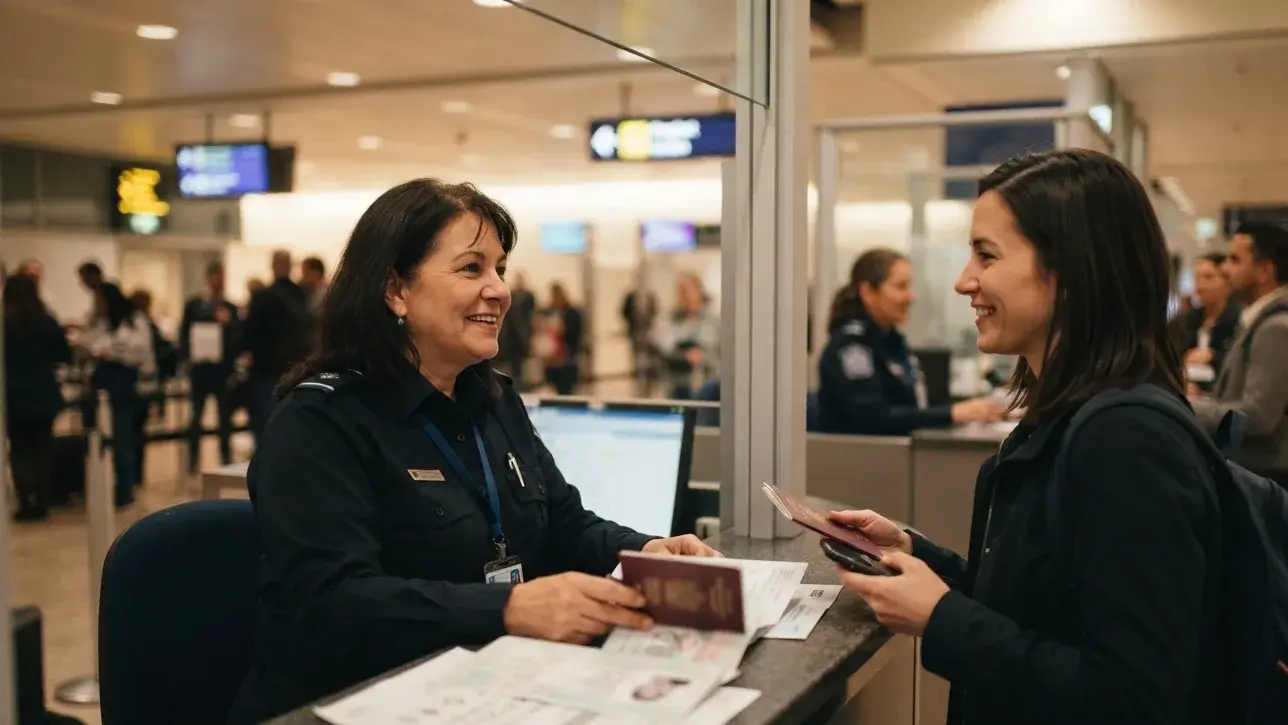
The reservation should mirror the trip you can explain. If your route is an open-jaw itinerary, make that structure visible. If your trip uses separate one-way bookings, make sure the documents do not contradict each other. If you genuinely do not know the exact exit city yet, do not create a random ticket that weakens the whole story.
Open-jaw itinerary vs two separate one-ways
An open-jaw itinerary is usually cleaner when the trip has a planned route: fly into one city, travel through the region, fly out from another. It tells the reviewer that the mismatch is intentional. Two separate one-way bookings can also work, but they need stronger surrounding logic because they look less connected at first glance.
If the trip is for a visa application, the safest approach is to keep the documents aligned with the same route narrative. If your accommodation, cover letter and travel dates all show a Paris-to-Amsterdam plan, then an Amsterdam exit flight looks normal. If every other document suggests a France-only trip, the Amsterdam exit looks unexplained.
For visa-side planning, a visa flight itinerary requirements guide can help you understand how route, accommodation and cover-letter details fit together. For this DummyFlights page, the important point is simple: the onward ticket should support the route you are actually presenting.
Matching dates to the actual border-crossing plan
Date alignment is where many different-country returns fail. The exit date should not only be inside the legal stay window. It should also match the route speed. If you enter France on May 1, claim five nights in Paris, and exit from Lisbon on May 3, the route looks compressed. If you enter France on May 1 and exit from Amsterdam on May 10 after planned train travel, the route feels more natural.
Hotel dates matter too. If your onward ticket leaves from another country, your accommodation should not suggest you are still in the entry country on that date. If you are staying with friends, using flexible accommodation or traveling overland, explain the gap briefly rather than leaving it invisible.
The document chain should feel like one calendar:
- Visa or entry date.
- Arrival flight date.
- Accommodation or host dates.
- Internal movement date.
- Onward or return flight date.
When you do not know the exact exit city yet
Some travelers genuinely have flexible plans. That does not mean the file should look unfinished. If you do not know the exact exit city, choose a realistic next step based on the route you are most likely to take. The onward ticket should represent a plausible plan, not a placeholder that makes no geographic sense.
For example, a traveler entering Thailand with loose regional plans might show onward travel to Malaysia or Singapore because those destinations fit common onward routes. A traveler entering Italy and planning a multi-country Europe trip might exit from a major hub like Paris, Amsterdam or Madrid if the route supports it.
If your plan changes later, update the document. A flexible route is normal. A stale or contradictory onward ticket is not.
Need an onward ticket for an open-jaw route? Prepare a DummyFlights document that matches your entry country, exit country and real travel timeline.
Create Your Onward TicketRegion-Specific Pitfalls
Different regions read multi-country routes differently. The same itinerary can feel perfectly normal in one context and under-explained in another. The safest strategy is to match the document style to the region’s usual checks.
Schengen visas
Schengen routes need the clearest logic because several countries can appear in one trip while one consulate still has to judge the application. If the applicant enters through France, spends most nights in Italy and exits from the Netherlands, the file must explain why the chosen consulate is correct and how the movement happens.
The onward ticket is only one piece. Hotel bookings, train or flight plans, day-by-day itinerary and cover letter should support the same route. A different exit country is acceptable when the trip structure is coherent. It is risky when it makes the main destination unclear.
Southeast Asia overland routes
In Southeast Asia, overland travel is common, but proof expectations can vary by airline, border point and nationality. A traveler may plan to enter Thailand, move by land to Cambodia and fly out from Vietnam. The onward flight from Vietnam proves one exit, but it may not fully answer how the traveler leaves Thailand.
If the first country has strict onward-proof checks, consider whether you need proof of departure from that first country as well as proof of later regional exit. The right answer depends on the route and the checkpoint. The more flexible the plan, the more useful a short explanation becomes.
Gulf and South Asian embassy checks
Some Gulf and South Asian visa files receive closer review when the exit country differs from the entry country because officers want to see a clear purpose and a realistic route. This does not mean a different-country return is wrong. It means the route should not look improvised.
Business travelers should align meeting dates, hotel dates and exit flights. Family visitors should make host location and travel sequence clear. Tourist travelers should avoid routes that jump between countries with no visible reason. If the exit country has a better international airport or cheaper connection, say so briefly.
A simple cover-letter line
One short sentence can prevent confusion before it starts:
“I will enter France through Paris, spend five nights there, continue by train to Amsterdam, and depart from Amsterdam on the onward ticket shown in my travel documents.”
That line does not over-explain. It simply connects the entry point, internal movement and exit country. When the documents, timing and explanation all point in the same direction, the mismatch stops looking like a problem.
Your Route Does Not Need to Match — It Needs to Make Sense

A different exit country is not a flaw. It is a detail that needs clarity. Once you know whether your trip is a Schengen loop, overland route, digital-nomad circuit or separate-leg booking, the reservation becomes easier to structure.
Use the simplest proof that answers the real question. If the officer asks how you leave the country or travel zone, your dummy ticket for visa or onward ticket should show the next believable movement. If the route involves another country before the flight home, make that step visible in the itinerary or cover letter.
The strongest plan has three layers working together: the ticket shows exit, the dates show legal timing, and the explanation shows why the exit country is logical. When those three layers align, your return from a different country looks like smart travel planning instead of a gap in the file.
Final route check:
- Does the exit country follow naturally from the entry country?
- Do the dates fit the permitted stay?
- Do hotel or host details support the movement?
- Can you explain the route in one calm sentence?
- Does the onward ticket match the documents already submitted?
If the answer is yes, the different-country return is not a weakness. It is just an open-jaw itinerary with proper support.
When the exit leg sits on its own reservation, read our guide on presenting a return flight booked separately from the outbound.
Building a multi-country route? Create an onward ticket with DummyFlights that supports your actual entry, exit and travel timeline.
Create Your Onward TicketFrequently Asked Questions
Can my onward ticket leave from a different country?
Yes. An onward ticket can leave from a different country when the route is logical and the dates fit your allowed stay. The key is showing how you move from the entry country to the exit country.
Is a different-country return risky for a visa application?
It can be risky only when the route looks unexplained. If your itinerary, hotel dates, cover letter and onward ticket all support the same travel path, a different exit country can be completely normal.
What is an open-jaw itinerary?
An open-jaw itinerary means you fly into one city or country and fly out from another. It is common for multi-city trips, Schengen travel, regional routes and travelers who do not return from the same airport.
Do I need proof of transport between the two countries?
Not always, but it can help. If the gap between entry and exit is not obvious, train, bus, ferry, domestic flight, hotel or cover-letter details can make the route easier to understand.
Can I enter Schengen through one country and leave from another?
Yes, many travelers do this. The important point is that the main destination, stay length, first entry and exit route should make sense together and support the visa application or travel plan.
What if I do not know my exact exit city yet?
Choose a realistic onward plan based on your likely route, then update the document if your route changes. Avoid using a random exit city that does not fit your accommodation, timing or travel purpose.
Should my cover letter mention the different exit country?
Yes, if the route could otherwise look confusing. One short sentence explaining entry city, internal movement and exit city can prevent unnecessary questions.
Is a return ticket better than an onward ticket?
A return ticket is simpler when you are going back to your origin country. An onward ticket can be better when your real trip continues to another country. The better option is the one that matches your actual route.
Can a dummy ticket support a different-country return?
Yes, when it is created around realistic dates, passenger details and route logic. It should support the travel plan rather than appear as a random placeholder.
Does an onward ticket guarantee approval or entry?
No. It can support your file or border explanation, but approval, boarding and entry depend on the full visa, passport, purpose, funds, accommodation and officer assessment.
Friendly reminder: DummyFlights provides temporary travel-proof documents for planning and application support. Requirements vary by destination, airline, route and applicant situation. A dummy ticket can support a file, but it does not guarantee approval, boarding or entry.