
Short answer: When you enter a country by air and leave by cruise, a return flight is not the only possible onward plan, but the airline may still demand clear proof before boarding. A dummy ticket booking can support the air-side document set while your cruise confirmation is available, provided the passenger name, dates, route and embarkation plan are truthful and consistent. It cannot replace a visa, transit authorisation, cruise booking or a destination’s current entry rule.
Entering by air and departing by cruise is legitimate, but it asks the document reviewer to connect an airport arrival with a later port departure. The safest file makes that connection easy to follow without pretending a cruise booking is a flight.
Key facts
- Entering by air and exiting by cruise creates two checkpoints: airline boarding and border or immigration review.
- A cruise confirmation may support onward travel, but the carrier or authority may require a readable port, date and traveler match.
- Leave a realistic buffer between landing and embarkation; a same-day connection can create avoidable risk.
- Check the permitted stay and any transit or port-entry requirements for every country on the route.
- Carry the cruise confirmation, accommodation, funds, passport and any temporary flight proof as one consistent file.
Need air-entry and cruise-exit travel proof? Match the reservation to the real arrival, cruise port, embarkation date and passenger details before you submit or check in.
Prepare your onward proofIn This Guide
Official-source check: Requirements can vary by nationality, carrier, port and destination. Use the IATA Travel Centre for current airline-facing passport and visa checks, then confirm the destination’s immigration guidance and the cruise operator’s document instructions. Neither a cruise confirmation nor a temporary reservation guarantees boarding or entry.
Reviewed for: air-entry/cruise-exit logic, airline versus border checks, embarkation buffers, port and passenger matching, onward-proof terminology and safe travel-document claims.
Picture landing at the airport with a valid tourist visa, only to realize your real way out of the country is a cruise ship departing from a different port days later. The immigration officer at passport control does not see a return flight on file. They see a gap in your travel plans, and gaps make officials cautious.
Before choosing a format, the what is a dummy ticket guide explains how temporary travel proof differs from a paid fare or a cruise contract.
This exact mismatch trips up travelers who fly in and sail out. Airlines and border agents are trained to look for a flight number, not a departure port, so your documents need to close that gap clearly. This guide walks through what actually counts as a valid onward ticket, how to time your booking against your embarkation date, and what to carry as a backup. A dummy ticket for visa can hold that gap closed while your cruise confirmation finalizes.
Why Airlines Still Ask for Onward Proof Even When Your Return Trip Is a Ship
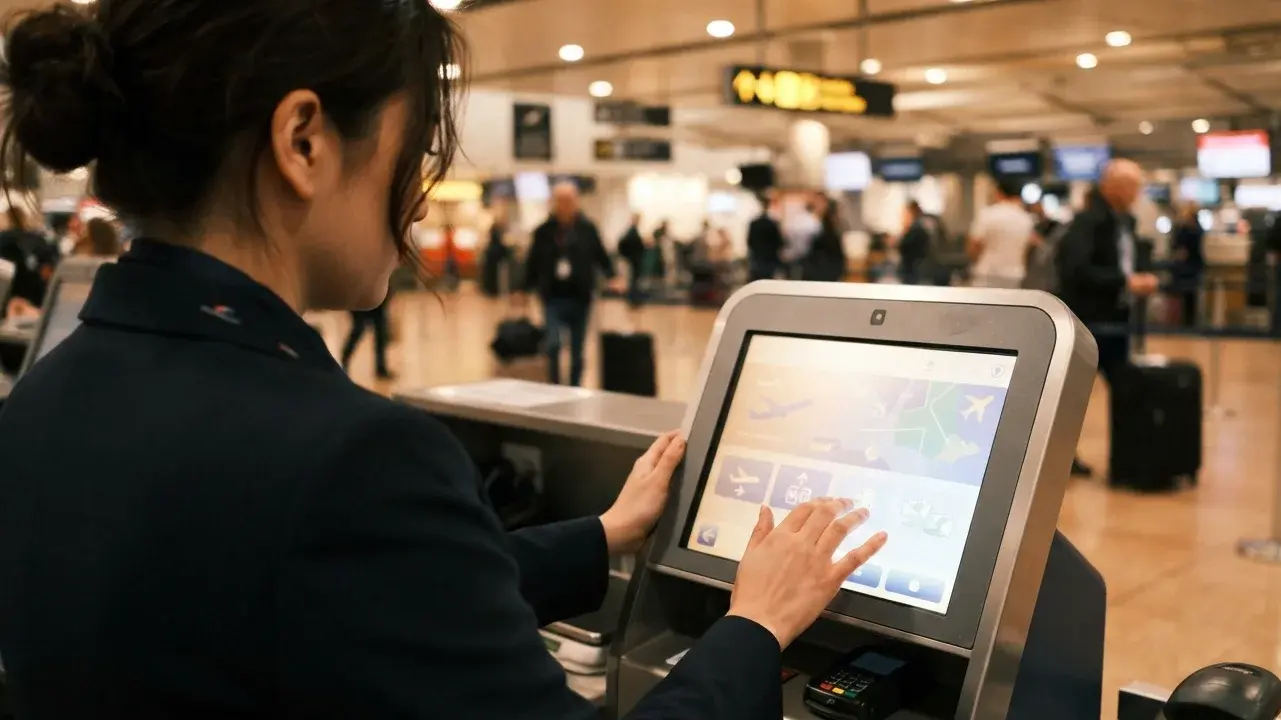
Boarding a flight does not end your relationship with the airline's paperwork. Airlines often check for onward travel proof at check-in, and again at the gate before boarding, so the staff checking you in still need to see how your trip closes out, even when your actual exit happens on water weeks later.
The Airline's Perspective: Fines and Liability When You Land
Airlines carry the financial risk when a passenger cannot meet a destination country's entry requirements. If passport control results in refused entry, the airline that flew you in is often responsible for flying you back out, sometimes at its own cost. Airline staff at the check-in counter, and at airline check-in kiosks before that, are trained to reduce that exposure before you ever board, since a denied entry on the other end reflects directly on them.
This is why airlines face fines for transporting passengers without proper documents in many jurisdictions. An airline employee scanning your passenger details is not being difficult. They are protecting the carrier from a bill that can run into thousands of dollars per denied passenger. If your onward plan is a cruise rather than a flight, that risk calculation does not change. Only the paperwork does.
Hurdles come up specifically when airlines require a return flight to allow boarding for a one-way ticket. A check-in agent scanning a one-way itinerary into the airline's system may not know how to classify a cruise booking, since most systems are built around a flight ticket, an airline ticket with a return date, or a connecting return flight, not a sailing schedule. That mismatch is the core tension this guide addresses, and in the worst case it ends with the airline choosing to refuse boarding rather than take on the risk.
Which Countries Are Strictest About Checking Before You Fly
Enforcement varies sharply depending on where you are headed. Over 50 countries require proof of onward travel in 2026, and immigration rules differ enough between them that a document accepted in one destination country can be rejected in the next.
The Philippines has the strictest enforcement of onward travel requirements, with immigration officials in Manila and at other entry points routinely asking to see a confirmed booking before stamping a passport. In practice, a confirmed ticket is required for proof of onward travel at most of these checkpoints, not just a reservation hold.
Thailand now checks for onward travel proof at boarding gates, meaning the request can come from airline staff before you even reach Thai passport control. Singapore requires confirmed onward tickets for short-term visitors, and Costa Rica enforces onward travel checks consistently at immigration, particularly for travelers arriving on a tourist visa rather than under a visa waiver program.
Destinations across Central America follow a similar pattern. Panama City immigration, along with counterparts elsewhere in the region, tends to ask the same question: how and when do you plan to leave? A confirmed cruise booking that departs from a nearby departure port can answer that question, provided the details line up with what you tell the immigration officer.
Some agents run a straightforward onward ticket check and expect a plain return ticket, so it helps to know in advance which of these two documents your specific destination rules actually call for.
When Your Cruise Ticket Doesn't Show Up in the Airline's System
Here is the practical snag. Check-in staff at your departure airport are looking at a screen built for flight reservation checks, not sailing schedules. A cruise confirmation number means nothing to a system designed to validate a flight number and a round-trip ticket.
This mismatch is exactly why some travelers get flagged for denied boarding even when they hold a completely valid onward journey by sea. The fix is not to argue with the airline's system. It is to carry documentation that speaks the airline's language, alongside your cruise paperwork, so the agent has something familiar to check. Kuala Lumpur, Bangkok, and other major transit hubs see this scenario often enough that airline staff there have learned to ask for a printed confirmation rather than relying on a verbal explanation.
A traveler flying into a Gulf hub before joining a Mediterranean sailing is a good example. Sarah, a US passport holder, had a confirmed cruise booking with a clear departure port and sailing date, yet the check-in agent at her originating airport still asked for something the airline's booking mask could recognize. She had not printed her cruise confirmation, and the agent had no easy way to confirm it on the spot. A five-minute delay turned into a longer conversation that a single printed page would have avoided entirely.
Does Your Cruise Booking Actually Count as Proof of Onward Travel
The short answer is sometimes. Your cruise booking serves as your legally recognized proof of onward travel in many places, but "many" is doing a lot of work in that sentence.
What Immigration Officers Look for in a Cruise Confirmation
Proof of onward travel shows you will leave a country, and an immigration officer reviewing your file is really just checking that the document tells that story clearly. A cruise confirmation can do this job, but only if it reads like a real, dated departure rather than a placeholder.
Officers typically want to see a booking reference, a departure port, and a departure date that fits inside the window your tourist visa or e-visa allows. Cruise lines generally require passengers to carry necessary travel documents for all destinations on the itinerary, which works in your favor here, since it means your cruise confirmation is usually detailed enough to double as valid proof at the border.
What officers do not want is ambiguity. A confirmed reservation with a clear sailing date answers the question on the spot. A loosely worded booking email that reads more like a marketing offer than a ticket does not.
Bring a printed copy in addition to whatever you have saved on your phone. A dead battery or a slow hotel wifi connection is a poor time to discover that your only proof of onward travel lives in an app that will not load. Officers at busy checkpoints move faster with paper in hand, and a printed page also survives a phone that gets lost or confiscated for inspection.
The Passport and Route Details That Must Match on Every Document
Every piece of paperwork you show, from your plane ticket to your cruise confirmation, needs to tell the same story. Your passport validity, your final destination, and the dates on each document all need to line up, because immigration officials are trained to spot inconsistencies quickly.
Your passport must remain valid for at least 6 months beyond your final date of travel, a rule that applies whether that final leg is a flight or a ship. If your cruise disembarks in a next country that requires its own visa, your passport needs enough runway left to clear that entry too.
Different visa rules may apply depending on whether you arrive by air or sea, which is easy to overlook when you are focused on the flight half of the trip. Some countries require formal visas for entry by air or sea that differ in processing time or supporting documents, so check the entry requirements for both your arrival method and your cruise's ports of call, not just the country you are flying into.
Situations Where a Cruise Booking Alone Won't Be Enough
A cruise booking works best when it is the only proof you need. It works less well as a standalone document when your travel plans include a long gap between landing and boarding, since some countries measure your permitted stay against the date on the document you present at entry, not the date you eventually board.
Budget airlines and full-service carriers alike may ask for a second layer of proof if your cruise departs from a different city than the one you land in. Tourist visas issued on arrival are often approved based on what the check-in staff and immigration officer see together, and a cruise booking that starts in another city, reached by a separate connecting flight, can look incomplete without that flight ticket attached.
This is where the timing of your bookings starts to matter as much as the bookings themselves.
Timing Your Flight and Cruise So Nothing Falls Apart at the Border

Good documents on the wrong dates cause the same problems as no documents at all. Getting the sequence right protects both your entry stamp and your embarkation.
Buffer Days Between Landing and Boarding the Ship
Arriving at your embarkation city at least one day early can prevent missing the cruise due to unforeseen delays. Flight delays, missed connections, and lost luggage all happen more often than travelers expect, and a same-day dash from the airport to the departure port leaves no room to recover.
Book flights with enough buffer time before the cruise embarks to avoid missing the ship, and treat that buffer as part of your onward travel ticket plan, not just a comfort measure. That buffer should exist well before you ever print a boarding pass, not as an afterthought once you are already at the gate. An immigration officer reviewing your travel plans may ask about the days between your landing and your sailing date. A clear answer, backed by a hotel booking or confirmed reservation for those buffer nights, closes that gap smoothly.
Buying separate one-way tickets can lead to higher overall costs compared to round-trip options in some cases, so weigh the cost of extra buffer days against the savings of a cheap ticket that lands you too close to your sailing date.
One day of buffer is a minimum, not a target. Weather delays, mechanical issues, and long immigration lines at busy arrival ports can each eat several hours on their own, and they tend to happen together rather than one at a time. Two full days between landing and your ship's scheduled departure gives you room to absorb a bad travel day without missing embarkation, and it gives you time to sort out any last-minute document questions an immigration officer or airline employee might raise.
How Layovers and Connecting Flights Change the Picture
Transport arrangements are essential when booking separate one-way travel components, and layovers add another layer of risk. Every connecting flight in your itinerary is another chance for a delay to eat into your buffer before boarding.
Travel insurance covering flight delays and missed cruise departures is recommended for exactly this reason. If your onward flight into the embarkation city gets cancelled, insurance can cover a same-day replacement or a night in a hotel while you wait for the next available seat. Airlines rarely compensate for a missed cruise, since the cruise line and the airline operate as separate businesses with no shared liability.
If your itinerary includes an international layover, check that country's entry requirements too. Some travelers assume a layover does not count as entering a country, but immigration rules vary, and a long layover can trigger the same proof of onward travel questions as a full stop.
Booking each leg with a different airline can also complicate things if one flight runs late. Without a single ticket linking the segments, the second airline has no obligation to hold your seat or rebook you, and a missed connection becomes entirely your problem to solve on the spot. Where possible, book connecting flights on a single itinerary, or leave enough time between them that a modest delay on the first leg does not cascade into a missed departure port deadline.
What Happens if Your Permitted Stay Expires Before Embarkation
Ensure your cruise itinerary matches your intended stay to satisfy immigration checks. If your visa or visa waiver program grants a fixed number of days and your permitted stay expires before your cruise departs, you have a problem regardless of how strong your cruise confirmation looks.
This scenario comes up more than travelers expect, especially when a good cruise fare has a sailing date further out than the visitor window allows. Passport control at your point of entry calculates your stay from your arrival date, not your planned departure date, so an extended layover strategy can quietly put you over the line. Cruises often require verification of vaccination certificates or health forms at various ports too, so build a few extra days into your planning to gather anything you are missing.
If your dates are tight, look into whether an extension is possible, or shift your departure date earlier so your arrival leaves enough runway before your ship sails. Either way, the goal is the same: make sure every date on your documents, from your entry stamp to your cruise confirmation, fits inside a window that actually holds up.
With your timing sorted, the last piece is making sure you are not relying on a single document if something changes.
Backup Documents Worth Carrying When Your Exit Plan Is a Cruise
A cruise confirmation is strong proof, but strong is not the same as bulletproof. Carrying one backup document costs you almost nothing and can save an entire trip.
A Refundable or Temporary Reservation as a Safety Net
A refundable ticket allows cancellation within a specified timeframe, which makes it a low-risk backup to carry alongside your cruise paperwork. A refundable ticket can serve as proof of onward travel just as well as a paid one, since most officers only check that a booking exists and matches your stated plans. If an immigration officer or airline employee wants to see something that looks more like a traditional exit ticket, a refundable ticket answers that request without locking you into a purchase you do not need.
Dummy tickets can serve as proof of onward travel in the same way, and it helps to be clear that a dummy ticket is not a fake ticket. A dummy onward ticket shows intended travel without an actual purchase, giving you a verifiable flight reservation to present at check-in or passport control while your real plan remains the cruise. Using a dummy ticket can help show intended onward travel when your actual exit does not fit neatly into an airline's booking system. Countries like the Philippines require strict proof of onward travel, which makes this kind of backup especially useful on that route.
A temporary reservation like this works well specifically because it is instantly verifiable. DummyFlights.com issues a confirmed booking with a real PNR you can check directly against the airline's system, delivered as a PDF, with unlimited date changes and pricing kept transparent at around $15, so you are not committing money to a flight you never intend to take.
Buying a cheap ticket can provide proof of onward travel too, though a genuinely cheap fare often comes with its own restrictions, like no free cancellation or a fee to shift the departure date later. Weigh that cost against a purpose-built temporary reservation before deciding which route fits your situation. If a plane ticket does not feel necessary, a bus ticket or ferry ticket can serve as proof of onward travel in places where road or sea travel to the next destination is common, particularly across Central America.
Keeping Proof of Funds and Booking References Together
A confirmed ticket is widely treated as the best proof of onward travel, but pairing it with sufficient funds evidence rounds out your file. Sufficient funds shows an immigration officer that you can afford both your stay and your eventual departure, which supports whatever exit proof you present.
Keep your booking reference, passport, and any supporting bank statement together, physically or digitally, so you are not searching for documents at the check-in counter while a line forms behind you. Not all countries ask for every piece of this file, but having it ready means you are never caught without an answer.
Your final destination matters here too. If your cruise itinerary ends in a next destination that requires its own visa applications or e-visa, sort that paperwork before you fly, not after you have already committed to a US passport stamp and a departure date you cannot easily change.
Keep a simple written itinerary alongside the official documents. A single page listing your arrival date, your buffer days, your cruise's departure port and sailing date, and your disembarkation plans gives an immigration officer a fast, human-readable summary instead of asking them to piece your trip together from three separate confirmations. It costs nothing to prepare and often speeds up a conversation that would otherwise take several extra minutes at the counter.
If your checklist specifically asks for a formal visa flight itinerary requirement, keep that flight-reservation evidence separate from the cruise-exit proof discussed here.
For the broader visa-file framework, use the broader visa-file dummy-ticket guide; this article remains focused on air entry followed by cruise departure.
Plan the Paper Trail, Not Just the Itinerary
Flying in and sailing out is a completely normal way to travel, and it does not need to be complicated at the border. The details that matter are simple: make sure your cruise confirmation reads clearly, keep your dates buffered, and carry one backup document that speaks the airline's language.
Get those three things right and passport control becomes a formality instead of a hurdle. If you need a verifiable flight reservation while your cruise details settle, DummyFlights can put one in your hands within minutes.
Ready to make an air-to-cruise itinerary easier to review? Keep the flight, cruise port, embarkation date and supporting documents aligned before departure.
Create your onward ticketFAQ
Can a cruise booking count as onward travel proof?
It may, depending on the destination, airline and border process. The confirmation should clearly identify the traveler, departure port, embarkation date and route, and the traveler must meet the next destination’s entry requirements.
Why might the airline still ask for a flight ticket?
Airline staff often use standardized document checks and may not be able to interpret a cruise itinerary quickly. Carry the cruise confirmation and any other truthful evidence the carrier or destination accepts.
How much time should I leave between landing and the cruise?
Use a realistic buffer for immigration, baggage, ground transport, port check-in and delays. A same-day embarkation can be risky unless the route and carrier explicitly make it practical.
What if the cruise leaves from another country?
Then the itinerary must show how you reach that port and whether transit or entry permission is required. A ticket that only proves the first flight out may not explain the complete route.
What documents should I carry together?
Carry your passport, visa or eligibility evidence, cruise confirmation, accommodation details, proof of funds and any temporary flight or onward reservation with matching names and dates.
Can a dummy ticket guarantee boarding for a cruise itinerary?
No. A truthful temporary reservation may support planning or an application where accepted, but it cannot guarantee airline boarding, cruise embarkation, visa approval or entry.
Friendly reminder: DummyFlights provides temporary travel-proof documents for planning and application support. Requirements vary by destination, airline, route and applicant situation. A dummy ticket can support a file, but it does not guarantee approval, boarding or entry.