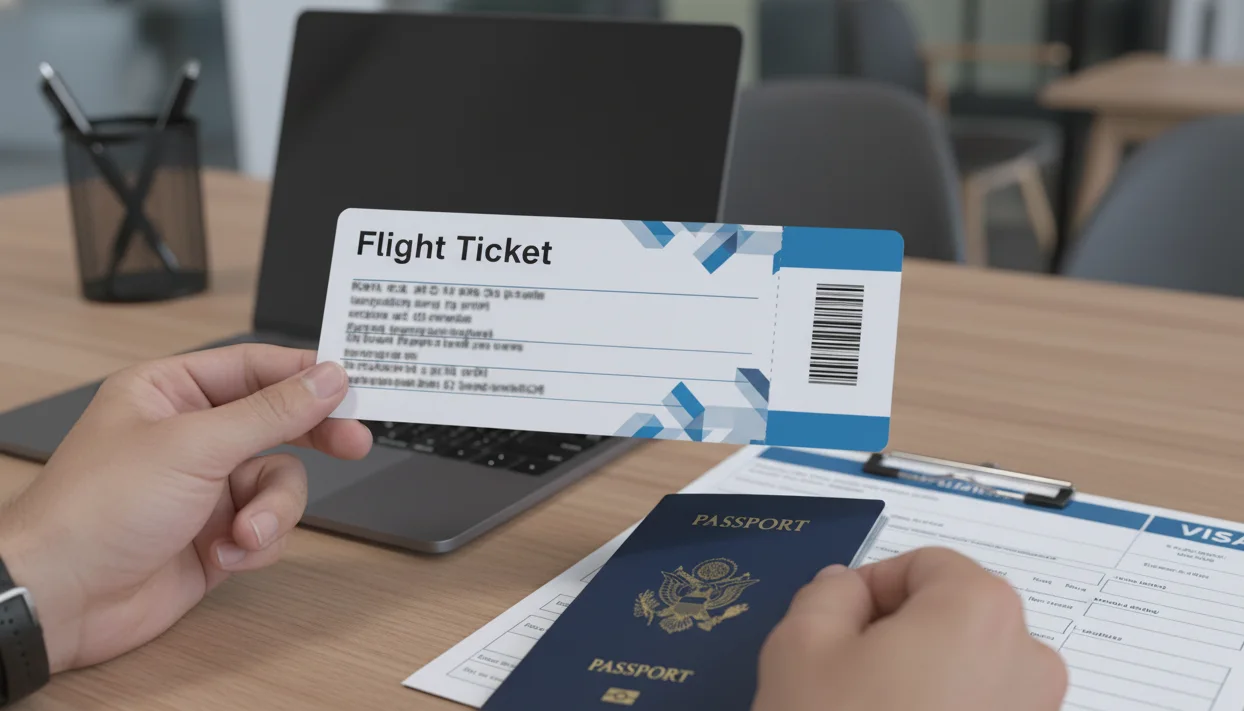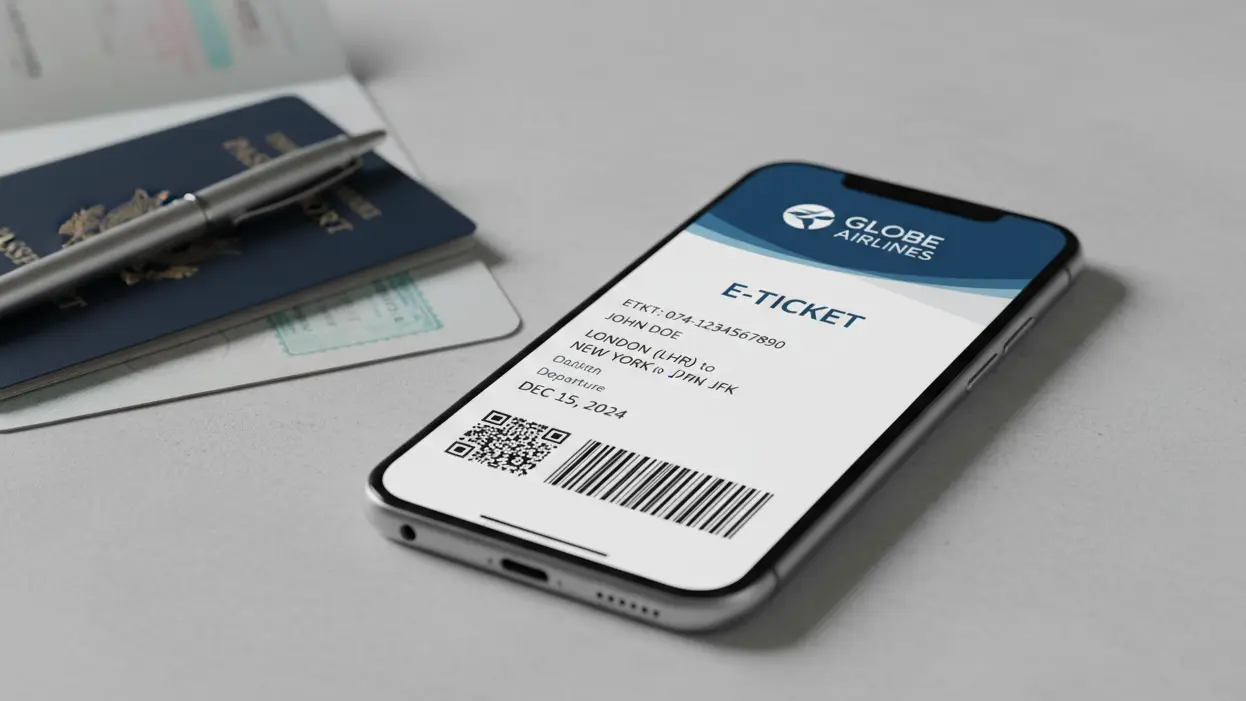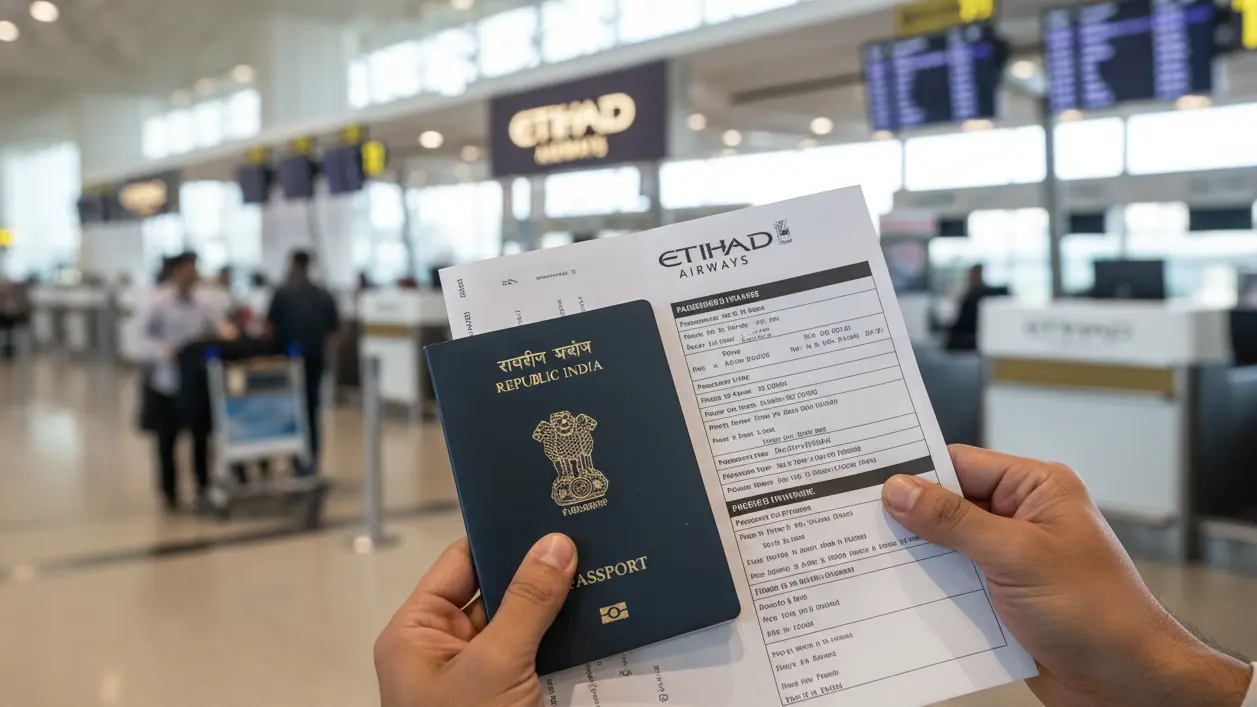
Short answer: If you plan to leave a cruise ship in Nassau and remain in The Bahamas, first confirm that your carrier permits permanent disembarkation and how immigration will record it. A same-vessel port-call itinerary no longer proves your own exit. Carry a route and departure date from The Bahamas that match your stay; an issued ticket is stronger than an unticketed dummy flight reservation. Neither document overrides visa, entry or carrier rules.
This guide is specifically for a passenger ending a cruise at a Bahamian port and remaining ashore. It is distinct from the ordinary visitor-onward-ticket question and a day visitor who re-boards the same vessel. We retain the source’s fictional passenger comparison, field-by-field table, booking-status explanation and departure-folder workflow, while correcting the cruise-law and carrier-policy caveats.
Key facts
- A routine port call and permanent disembarkation are different travel plans.
- Regulation 14 defines a cruise passenger for that regulation using a same-vessel, 72-hour condition; it is not a blanket stay rule.
- The carrier or agent may have an immigration-notification duty when a passenger does not continue the journey.
- Cruise-line policies may prohibit planned early departure; confirm with the actual line before changing your trip.
- An unticketed flight reservation is not an issued ticket, and official sources do not guarantee its acceptance.
- Match passport, cruise, accommodation and departure dates, and ask Bahamas Immigration about your individual case.
In This Guide
- What Do Bahamas Authorities Say About Leaving the Country?
- Is a Passenger Ending the Cruise Different From One Calling at the Port?
- How Do Two Departure Records Compare Field by Field?
- What Does a Worked Example Look Like for a Passenger Leaving the Ship in Nassau?
- Where Does a Reservation Stop and an Issued Ticket Begin?
- What Should You Verify Before You Leave the Ship?
- What Else Do Cruise Ship Passengers Ask About Leaving the Bahamas?
- Which Sources Does This Post Rely On?
- What Is the Safest Plan for a Passenger Staying Behind in Nassau?
- Frequently asked questions
Official-source check: Bahamas Immigration (General) Regulations 14–15 directly address cruise passengers and failure to continue a ship journey. The Immigration Act 35–37 covers permission to land and travel-document checks. Tourism’s visitor guidance lists return/onward tickets for relevant traveller categories. Royal Caribbean’s U.S. FAQ currently disallows planned early disembarkation for its ships; ask your own carrier about the particular sailing.
Reviewed for: cruise-port-call versus permanent-stay distinction, regulation 14–15 scope, current carrier policy, ticket versus reservation status and fictional Nassau document workflow on 22 October 2026
What Do Bahamas Authorities Say About Leaving the Country?

Bahamas Immigration's entry requirements page says all visitors must have a return or onward ticket.
Its Before Your Arrival page, last modified on 10 August 2026 according to the page metadata, words the duty differently: a valid return ticket or means of departing The Bahamas. The second phrase is wider. It does not say the means must be a flight, and it does not say the ticket must be paid for.
The Ministry of Tourism's official site, in its Immigration and Customs requirements section, sorts travellers by citizenship. Visitors from Latin America and from other countries need a return or onward ticket. Canadian citizens and permanent residents are told a return ticket is required. We found no page that explains which wording immigration officers apply to which traveller.
Funds and lodging are where the two authorities part ways. Before Your Arrival asks for financial means to sustain yourself, or a local sponsor who will receive you, and it lists no lodging booking. The Ministry of Tourism asks for proof of funds plus either a hotel confirmation or the name and address of your residence in The Bahamas.
Bahamas Immigration's entry page adds that visitors may be asked for evidence of sufficient funds. Our advice is to carry both sets of evidence.
Passport rules are steadier. Both authorities ask for at least six months of validity, and Before Your Arrival says passport cards are not accepted.
The Ministry of Tourism adds that if your next country requires six months beyond your departure date, that rule will be enforced. So the six months can apply twice: once on arrival, and again for wherever you fly next.
The visitor pages do not spell out every cruise-change scenario, but Bahamian law does address cruise passengers. Immigration (General) Regulations, regulation 14(3) defines a cruise-ship passenger for that regulation as someone arriving from a foreign port and leaving within 72 hours on the same vessel. That narrow definition is not a general permission to remain ashore. Regulation 15(1) addresses the carrier or agent notifying immigration when a passenger fails to continue a journey and appears to remain in The Bahamas. The Immigration Act, sections 35–37, separately covers permission to land, declarations and documents. Confirm the procedure for your actual voyage with the line and Bahamas Immigration.
The practical problem is a changed exit story: a passenger remaining ashore cannot rely on the same-vessel sailing as their own departure. Record the change with the line and immigration, then present departure evidence that genuinely fits the new stay.
The public visitor pages do not promise that an unticketed flight reservation will satisfy an officer or specify a universal deadline for this situation. Ask the line and Bahamas Immigration about the required process and evidence before relying on a planned flight or another sailing.
Two further limits matter for the dates you choose. Before Your Arrival says exempt visitors may stay up to three months, or eight months where an individual agreement allows, and that overstaying is a punishable offence.
Visa rules and visa requirements for your passport, including any tourist visa question, are a separate task, as are visa applications and visa runs.
A traveller refused entry or denied entry over a visa gap cannot fix that with a departure record. Your record has to sit inside whatever stay applies to you.
The immigration card is the last piece of paper in this picture. Before Your Arrival expects a completed card at the border, and the Ministry of Tourism tells visitors to keep a portion of it until departure.
Before booking a separate exit: Ask your cruise line whether permanent disembarkation at Nassau is permitted and how it will record your change. A flight reservation does not override the ship’s policy or Bahamian entry formalities. If you only need the general visitor rule rather than a cruise change, see our Bahamas onward-evidence guide.
Is a Passenger Ending the Cruise Different From One Calling at the Port?
Yes. The regulation 14(3) same-vessel definition illustrates why a routine port call and a permanent stay are not identical. A passenger who re-boards uses the same ship to depart; a passenger who remains ashore needs the line and immigration to record the change and must show a separate, credible way out.
The Bahamas pages speak to arrival in the country, not to the days a ship spends in international waters.
Holland America Line's travel requirements article, which is a cruise line's page and not an authority, lists what a cruise ship arrival needs: a customs clearance form, one immigration card per person, and a passport.
It also says only the captain may disembark until the vessel is cleared. The article repeats that travellers need a return ticket, which, for a passenger who sails on, we read as the confirmed cruise booking itself.
Carnival Cruise Line's safety information page puts the document duty on the guest. It says Carnival assumes no responsibility for advising guests of proper travel documentation. It says nothing about leaving a sailing early.
Do not infer permission from silence. Royal Caribbean’s U.S. FAQ currently says it no longer allows pre-planned early disembarkation or late embarkation; policies and circumstances differ by line and itinerary. Check your own carrier’s current terms before committing to a Nassau stay. A different regional FAQ may describe a different process, so ask the carrier directly and keep its written answer.
That leaves three situations, and they should not be mixed up:
-
A passenger who steps ashore at the cruise port for the day and re-boards. The cruise itinerary is the exit record, and the cruise line holds the paperwork.
-
A passenger who leaves the ship to stay in the Bahamas and then flies or sails out on their own. This is the case that needs a departure record of its own.
-
A passenger who arrived on an inbound flight, or is already staying on shore, and plans to leave on a later sailing. Here the sailing is the planned exit.
The third case is less clear than it looks. Bahamas Immigration's phrase "means of departing" is broad enough that a sailing might be offered, but the pages we read do not list a cruise voucher or a cruise itinerary as accepted departure evidence.
Nor do they rule it out. Our judgment is to treat a sailing as a possible answer, not a settled one, and to ask before relying on it.
The second case is the one this post follows. A passenger who gives up the rest of a voyage has to answer a plain question: how do you leave? The ship can no longer answer it.
An issued flight ticket from a Bahamian airport clearly documents a proposed exit; another vessel booking may also show a route out, subject to official acceptance and that operator’s terms. An unticketed flight reservation shows a plan, not an issued ticket. A bus ticket only to the harbour does not itself document departure from the country.
One thing is the same in all three cases. The record has to match the person. A cruise booking confirmation whose spelling differs from the passport raises a question before any date does. Check every name, every date, and the departure port against the passport and the immigration card before you leave the terminal.
The pages are silent on timing. A passenger who changes plans mid-voyage may have only a few hours between deciding and disembarking, so we would decide the departure record before the sailing, not at the gangway.
How Do Two Departure Records Compare Field by Field?

The table below sets two clearly fictional records side by side. Both belong to the same made-up passenger, Emily Carter, on a made-up sailing from the line "Aurora Coast Cruises".
Record A is what she holds if she calls at Nassau and sails on. Record B is what she would carry if she leaves the ship there and stays on shore. Neither is a real booking.
|
Field |
Record A: Port call, re-boards |
Record B: Ends the cruise in Nassau |
What the official wording speaks to |
|---|---|---|---|
|
Document type |
Cruise booking confirmation and cruise itinerary |
Flight reservation PDF with a booking reference |
Immigration: "means of departing" |
|
Name on record |
CARTER/EMILY, as in passport |
CARTER/EMILY, as in passport |
Our check, not a stated rule |
|
Arrival in the Bahamas |
Ship call at Nassau, morning |
Ship call at Nassau, morning |
Immigration card and entry |
|
Departure point |
Nassau, aboard the same ship |
Nassau airport |
Departure from The Bahamas |
|
Departure date |
Same evening |
Nine days after the ship call |
Permitted stay of the visitor |
|
Status of the record |
Paid cruise contract |
Reservation only, not an issued ticket |
"Ticket" in both authorities |
|
Issuer |
The cruise line |
A reservation provider |
Neither authority names an issuer |
|
After the Bahamas |
Next port on the itinerary |
Nassau to New York to Mumbai |
Next country's own rules |
|
Lodging and funds |
Not a stated concern in the pages read |
Local address plus proof of funds |
Tourism: hotel or address; Immigration: means or sponsor |
|
Open question |
None the pages describe |
How early the record must exist |
Not stated on any page read |
The third column marks where a sourced rule applies and where it does not. The word "ticket" appears in both authorities, and a reservation is not a ticket. The phrase "means of departing" appears only in Before Your Arrival, so the stronger claim for a reservation rests on one page.
Row five carries the most weight. A departure date that falls inside the permitted stay tells the officer the visit has an end.
A date that falls far outside it, or one that sits on the arrival day while the passenger plans a long visit, raises a different question. In Record B, nine days after the ship call is consistent with the lodging row and with the funds row.
Three evidence states sit behind these rows, and they should stay separate in your folder:
-
A reservation: a booking with a booking reference that you have not paid a fare for, which shows planned travel.
-
An issued ticket: a paid, ticketed booking, which is the strongest paper for a "ticket" wording.
-
Boarding or entry evidence: a boarding pass, a ship's sail-away record, or a stamp, which only exists after the event.
Record A is a paid cruise contract, which many people call a cruise ticket, so it sits closest to an issued ticket, but it answers a different question. It proves that the ship leaves. It does not prove that Emily does. That is why the same cruise itinerary cannot simply be reused for Record B.
The last row is blank on purpose. The Bahamas pages we read do not say when the departure record must exist, whether a cruise voucher is acceptable, or how early disembarkation changes the paperwork.
The safe step is to put those three questions to the authority, and the verification section later in this post shows how.
What Does a Worked Example Look Like for a Passenger Leaving the Ship in Nassau?
Take Emily Carter again, a fictional passenger who lives in Mumbai. She boards a seven-night sailing from Miami on 8 November, and the cruise itinerary has a Nassau call on 10 November.
Weeks before sailing, she decides to leave the ship at Nassau and spend nine days on shore instead. We leave her nationality out, because it determines the visa answer.
Her first move is a written question to her cruise line, sent before the sailing: can she leave at Nassau, what does the line need from her, and what happens to the unused nights? She keeps the reply. We found no published rule to quote here, so this step replaces a guess with an answer.
Her second move is the departure record. She builds a reservation for Nassau to New York to Mumbai on 19 November, nine days after the ship call.
The date sits well inside the three months that Before Your Arrival gives exempt visitors, and it matches a rental she has booked.
Here is what the top of that fictional record looks like, with every identifier removed:
FLIGHT RESERVATION (FICTIONAL EXAMPLE, NOT A REAL BOOKING)
Passenger:      CARTER/EMILY
Booking ref:    [REDACTED]
Segment 1:      Nassau to New York, 19 Nov 2026, flight number [REDACTED]
Segment 2:      New York to Mumbai, 19 Nov 2026, flight number [REDACTED]
Record status:  Reservation, not ticketed
Her third move is the folder. She prints the reservation, the cruise booking confirmation that shows the Nassau call, the cruise line's written reply, the rental address and host name, and a recent bank statement. She adds the passport and checks that it has more than six months of validity, since both authorities ask for that on arrival.
Each item answers a line from the official pages. The reservation speaks to the return or onward ticket and the means of departing. The rental speaks to the Ministry of Tourism's lodging line. The statement speaks to funds, and the written reply speaks to the one thing neither authority covers.
At passport control, she hands over the passport and the immigration card, and she keeps the card portion for her departure. What she cannot know in advance is whether anyone asks for the rest. The pages do not promise a particular question, and neither do we.
A failure case shows why matching matters. Suppose her cruise confirmation reads "Em Carter" and her reservation reads "Emily Carter". Nothing in either authority's wording forgives that, and a mismatch costs more time than a missing page. The fix is simple: correct the spelling with the cruise line and the reservation provider before printing, not at the terminal.
A second failure case is a date problem. If her reservation showed a departure four months out, it would sit outside the three months Before Your Arrival gives most exempt visitors, unless an individual agreement allows eight.
The fix is to choose a date inside the stay that applies to her, or to look into an extension before the permitted period ends.
Where Does a Reservation Stop and an Issued Ticket Begin?
A reservation is a held booking with a booking reference. A verifiable flight reservation means that reference can be checked, not that anyone will check or accept it. It is not a fake ticket either: it is a booking that is not yet ticketed, and it says so.
An issued ticket, whether you call it a flight ticket, a plane ticket, or an airline ticket, is paid for and ticketed, and it carries an e-ticket number. A line reading "confirmed" on a reservation does not make it a confirmed ticket, so look for that number.
Both can show a departure date and a route, but only the second is a ticket in the sense the Bahamas pages use. Neither authority says whether a reservation satisfies the wording, and we will not say it for them.
Labels such as onward ticket and onward proof are not interchangeable guarantees. Check the actual requirement for your passport and journey. At minimum, the document should identify the real traveller, show an exit date and route from The Bahamas, and have a status you can explain accurately. An airline may apply additional document checks for the next country.
That gap affects which route you choose. If your only task is to show a planned exit and your stay is short, a reservation may be the lighter option.
If the wording is read strictly, or if someone wants proof you have committed money to leaving, an issued ticket removes the question. A refundable ticket sits between the two: it is issued, and the fare rules decide what comes back and whether free cancellation applies. Airlines face fines for transporting passengers without proper documents.
DummyFlights offers temporary flight-reservation options, not an issued airline ticket by default. Check the current product terms, live booking status, issuer and expiry before relying on a document. Do not describe a reservation as paid or ticketed if it is not.
The Extension of Stay page changes the picture. Bahamas Immigration lists a return ticket or a Temporary Cruising Permit among the documents for an extension application, and it charges a non-refundable processing fee of $200 that took effect on 18 September 2024.
The page also requires an in-person interview and warns that missing documents may lead to denial. For an extension, a reservation is a weak fit, because the page says ticket.
Airlines are a separate check. Whoever flies you out of Nassau looks at your documents for the next country, and a short document set can lead to denied boarding at airline check-in. Airline staff decide that at the desk.
That check belongs to the airline and the destination, not to the Bahamas pages we read.
A one-way ticket from Nassau to Mumbai satisfies a Bahamas exit wording on its face, but it may not satisfy the airline or the destination country, which can ask for exit proof from their own territory. If your next stop is Costa Rica or anywhere else, read that country's entry rules before you buy, not the Bahamas pages.
If you hold a round-trip ticket, check that its return flight leaves from the Bahamas and that the return date sits inside your stay. A return trip that starts in another country says nothing about leaving the Bahamas.
If you are staying a short time and the next country asks for nothing more, a reservation can document the plan.
If you may extend, face a strict airline check, or want the least argument, buy a refundable ticket and keep the fare rules with it. No single record is a perfect solution. In both cases, keep the documents consistent with the rest of your travel plans.
What Should You Verify Before You Leave the Ship?
Work through these checks in order, starting as early as you can.
Several weeks before sailing, write to your cruise line, or to the travel agent who booked the cruise. Ask whether you may leave the ship at a Bahamian port, what the line needs from you, and what happens to the remaining nights.
Ask whether the line will treat your cruise itinerary as a record of your departure from the Bahamas. Keep the written reply, since the pages we read are silent on all of it.
Next, reread the two official wordings on the day you decide. Bahamas Immigration's Before Your Arrival page and the Ministry of Tourism's Immigration and Customs requirements section can change. Note the exact phrase each uses for the departure duty: return ticket, onward ticket, or means of departing. Print both with the date you read them.
Then put your specific question to the Bahamas Immigration Department through the contact route on its website.
Keep it narrow: say you will leave a cruise ship at Nassau on one date and depart by air on another, then ask what departure evidence you should hold. Save the answer with the date. An email you can show is worth more than a forum reply.
After that, choose the record type and the date. Pick a departure date inside the stay that applies to your passport. Decide between a reservation and an issued ticket using the reasoning in the previous section. Make sure the name, route, and date match the passport, the cruise booking confirmation, and your lodging.
Check the next destination at the same time. Its immigration rules and your airline's rules apply to the leg after the Bahamas, and the six-month passport rule may apply twice.
Immigration checks at the border and onward travel checks at the airline are separate, so a short check now beats a refusal at airline check-in.
Check the card you will be handed, too. The Ministry of Tourism announced a digital arrival card pilot on 5 May 2026, offered to selected visitors on selected flights, and said the paper process stays in place alongside it. The announcement does not address sea arrivals, so expect the paper card and ask the cruise line what it will distribute.
Finally, build the folder and print it. Include the passport, immigration card portion, cruise booking confirmation, your travel itinerary, the cruise line's written reply, the departure record, lodging details, funds evidence matched to the payment options you plan to use, and travel insurance papers if you hold a policy. Keep electronic copies as a backup.
The final test is simple. Could someone who has never seen your trip read the folder and see how you arrived, where you will stay, how you will pay, and how you will leave? If one answer is missing, add the document before you leave the ship.
These checks do not guarantee entry. Immigration officials decide at the border, and nothing in a folder changes that. The folder shows your plan clearly and leaves no gap you could have closed.
What Else Do Cruise Ship Passengers Ask About Leaving the Bahamas?
Does a cruise booking count as an onward ticket? Neither Bahamas Immigration nor the Ministry of Tourism says so for a passenger who leaves the ship. For a passenger who sails on, the cruise is the exit. Ask before relying on it.
Do you have to buy a flight before you disembark? The pages require a ticket or a means of departing. They do not state a deadline, so we would hold the record before the sailing.
What if you want to stay longer than planned? Bahamas Immigration's Extension of Stay page asks for a return ticket or a Temporary Cruising Permit, a $200 fee, and an in-person interview.
Will your passport need six months after you leave? Both authorities ask for six months at entry. The Ministry of Tourism adds that the next country's own six-month rule is enforced.
What if your case is not covered here? Send the Immigration Department your dates and route, along with any more comments about your plans, and keep its reply.
What if you only get off for the day? That is the port-call case. The cruise line's documents lead, and this post's departure record is not aimed at you.
Which Sources Does This Post Rely On?
Sources were checked on 22 October 2026. The general visitor pages discuss departure evidence; the law separately addresses cruise passengers and carrier reporting. Neither source guarantees that a temporary reservation will be accepted in an individual case. Carrier policy must also be checked for the actual sailing.
-
Bahamas Immigration Department, "Extension of Stay". Last modified 9 September 2025, per page metadata.
-
Bahamas Ministry of Tourism, Immigration & Customs Requirements.
-
Bahamas Ministry of Tourism, press release on the soft launch of the digital arrival card, 5 May 2026.
-
Holland America Line, "Bahamas Travel Requirements". A cruise line's page, not an authority. No page date shown.
-
Bahamas Immigration (General) Regulations, regulations 14–15, and Immigration Act, sections 35–37; check current applicability with the department.
-
Royal Caribbean U.S. FAQ on early departure; this carrier policy is not a rule for every cruise line.
What Is the Safest Plan for a Passenger Staying Behind in Nassau?
For a passenger who leaves a cruise ship in Nassau to stay, the safest plan is a departure record that matches the passport, sits within the permitted stay, and comes with a written reply from the cruise line.
The visitor guidance asks for return/onward evidence, while the immigration regulations explicitly address cruise passengers and carrier notification. Verify the actual disembarkation process, entry status and departure document with the relevant authorities and your cruise line.
Choose the record that fits your risk: a reservation to show a short plan, an issued or refundable ticket if you may extend. Our broader list of countries that require proof of onward travel shows how many countries have the same duty.
Need to document a genuine exit plan? Get written confirmation from your cruise line and check the required Bahamian process first. If a temporary flight reservation is appropriate for your circumstances, review DummyFlights options, verify its current status and do not present it as an issued ticket. For visa-file alignment across transport and accommodation, see BookForVisa’s reservation guide.
Frequently Asked Questions
Can I leave a cruise ship in Nassau and stay in The Bahamas?
Only after checking the specific cruise-line policy and Bahamian entry procedure. Some lines currently prohibit planned early disembarkation; a flight booking alone does not grant permission.
Is a routine Bahamas port call the same as ending the cruise there?
No. A day visitor who re-boards leaves on the same ship. A passenger remaining ashore needs the change recorded correctly and a separate, credible departure plan.
Does Bahamas law mention cruise passengers?
Yes. Immigration (General) Regulations 14–15 address cruise-passenger cards and a carrier-notification scenario. The 72-hour same-vessel definition applies within regulation 14, not as a blanket permission rule.
Will a dummy ticket guarantee acceptance at the Bahamas border?
No. A temporary reservation can document a proposed flight but is not an issued ticket and cannot guarantee entry or satisfy every officer or carrier check.
What should my onward document show after disembarkation?
Use your true passport name, a realistic departure date within your allowed stay, a route that leaves The Bahamas and a booking status you can accurately verify.
What if my cruise line refuses early disembarkation?
Do not assume you can bypass that decision by holding an onward ticket. Ask the line about permitted alternatives and confirm any revised itinerary with the relevant authority.
Friendly reminder: DummyFlights provides travel-planning documents; a temporary reservation is not a purchased ticket, a visa, or permission to enter a country. Check live booking status and current airline, immigration and transit rules. No document guarantees boarding or entry.