
Short answer: When family members leave from different airports, map each person’s true origin, segments, local arrival, hotel nights and exit date before requesting genuine dummy tickets. Different origin groups often receive separate booking references. Verify each record and its expiry with the issuer; identical fares or PDF layouts are not visa requirements.
Your parents fly from Delhi. Your sister leaves from Mumbai. You depart from Bengaluru. All four of you applied for the same Schengen visa, and the officer now sees three starting points on one file.
That detail can slow a review if nothing explains it. The fix is a set of separate reservations that land together and tell one clear story. Below, you will decide how many bookings to make, how to align them, and how long to keep them active during review.
We also cover the paperwork that backs them up, the costs involved, and the small mistakes that quietly trigger follow-up questions. Reserve each traveler's dummy ticket from their own airport before the appointment dates arrive.
Key facts for multi-origin families
- Build a traveler-by-traveler route matrix before requesting reservations.
- Ask the issuer how different origin groups will be recorded and cross-referenced.
- A live PNR is not necessarily an issued ticket.
- Check the official checklist and each hold’s actual expiry.
- Explain genuine differences instead of forcing visual uniformity.
Planning several departure cities? Assemble the route matrix first, then request authentic holds for the actual travelers and origins.
Review reservation optionsIn This Guide
- Why Split Departures Raise Questions at the Visa Desk
- Mapping Your Family's Airports Before You Book Anything
- How Reservation Records Behave When Origins Differ
- Making Every Itinerary Land Together in Europe
- Timing the Bookings So Every PNR Stays Active
- Building the Application Packet Around the Split
- Three Family Layouts Worked Through
- What Multi-Origin Families Actually Spend
- Mistakes That Quietly Sink Split-Airport Files
- Ready to File Your Family's Schengen Application?
Official-source check: The European Commission’s Schengen guidance explains the main-destination and first-entry rules. See the applicable consulate’s current checklist for its evidence requirements. The IATA PNR toolkit explains how reservation data is used; a locator alone is not proof of ticketing.
Reviewed for: multiple origin airports, realistic family meeting plans, PNR grouping, issuer verification, expiry and the Schengen main-destination rule. This guide addresses origin differences, not just split dates or PNR lookup errors.
For different travel dates, see our split-date family guide. For a separate-record problem, see family PNR troubleshooting. For the visa-file choice, see BookForVisa’s application guide.
Why Split Departures Raise Questions at the Visa Desk
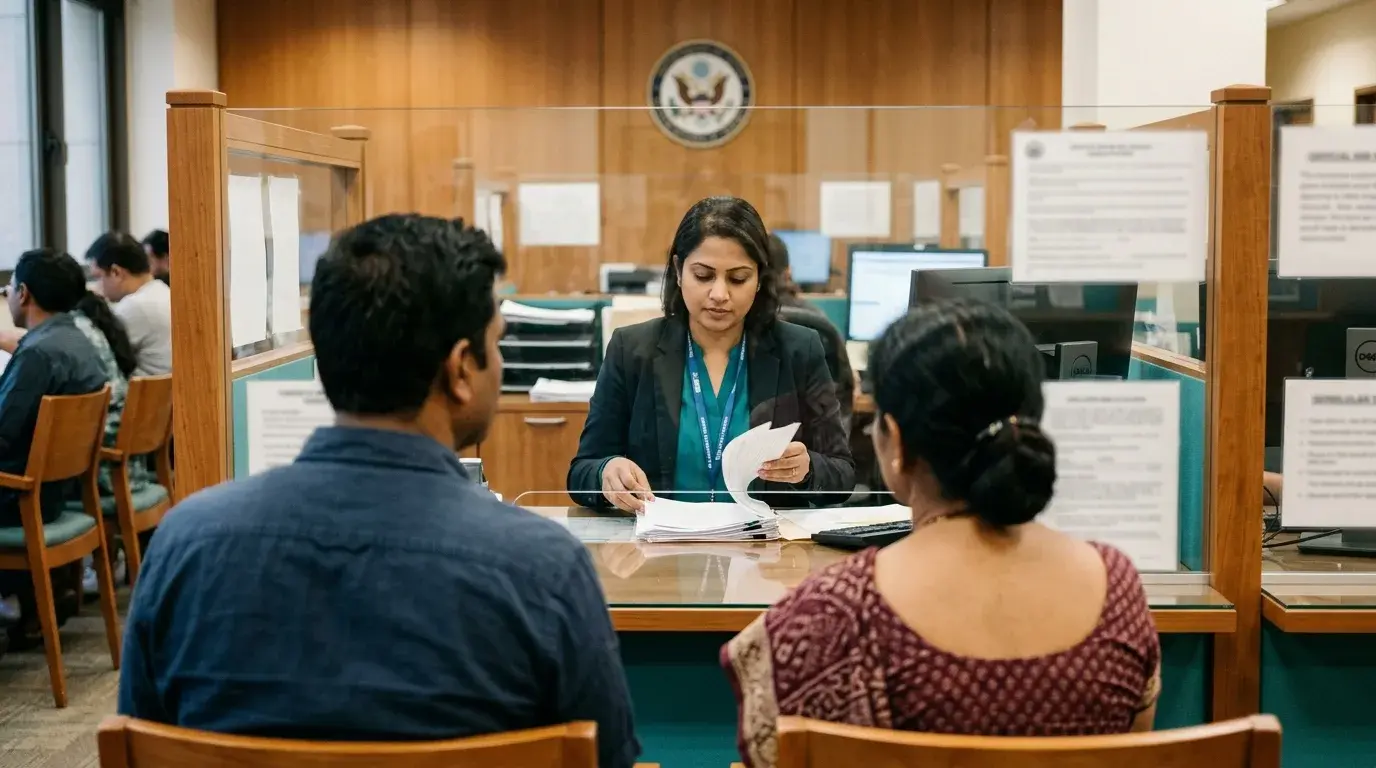
Family files rarely reach a consular desk in neat order. When relatives apply together but start from different cities, the flight itinerary is where an officer looks for logic.
What Consular Staff Notice When Surnames Match but Cities Do Not
Visa officers read family files in clusters. They see shared surnames, shared addresses, and shared sponsors. Then they reach the flight pages and find one traveler leaving Delhi while another leaves Mumbai.
Nothing about that is wrong. Students, professionals, and retirees often live in different cities. But an officer cannot assume that. The file has to show it.
Three patterns draw attention first:
-
Departure points that differ with no matching home address
-
Arrival dates that drift apart by more than a day
-
Final destinations that change from one traveler to the next
Each pattern invites a question. A clean set of bookings answers all three before anyone asks.
Think of your family's file as one story. The opening scenes can happen in separate cities. But everyone should converge on the same main destination, stay for the same period, and leave on coordinated dates. That is the story a reviewer wants to read.
Why Embassies Care About Onward Travel More Than Payment
Many visa checklists ask for an intended itinerary or flight reservation rather than a paid ticket. Requirements vary by destination, visa category and consulate; read the current official checklist before choosing a temporary hold.
A payment receipt records a transaction; a reservation describes proposed flights and passengers. A locator can help an issuer trace a record, but no single airline site displays every genuine agency or partner booking.
A genuine temporary reservation can document proposed travel where the checklist allows it. Check the issuer, passenger details, record status and expiry. A PNR is not automatically an issued ticket, and the hold may have a fee or replacement cost.
Never present a fabricated or altered document. Whether a temporary reservation is acceptable depends on the official application instructions; a valid-looking PDF alone is not approval.
How Rejection Risk Grows When a Family File Looks Inconsistent
There is no reliable refusal percentage specific to multi-origin families, and split departure is not itself a refusal ground. The controllable risk is a route that conflicts with the real plan or supporting documents.
Picture two files. In the first, four relatives show four unrelated flight tickets with different arrival days. In the second, four reservations converge on the same city within one morning window, and a short note explains the origins. The second file reads as planned. The first reads as chaotic.
No booking guarantees visa approval or a faster decision. Truthful, consistent documents make the real plan easier to explain while authorities assess the whole application.
Your goal is not to hide the split. Your goal is to make it obviously deliberate.
How Reviewers Cross-Check the Reservations Against the Rest of the File
Officers compare documents against each other. The name on the booking should match the passport. The arrival date should fall inside the accommodation dates. The departure leg should sit inside the stay you are requesting.
Embassy documentation requirements usually list the flight reservation as one item among many. But it is the one item that touches every traveler. That is why it gets checked so closely.
When bookings come from different cities, the comparison takes longer. Reviewers want the exit dates to match the length of stay stated in the application form. A mismatch of even one day invites a question.
Keep one rule in mind. Every document should agree with every other document, and each traveler's reservation should agree with the group's plan. When a difference exists, explain it in writing before the officer has to ask.
Which Applications Get the Closest Reading
Do not assume a particular family profile receives extra scrutiny. For minors or travelers who need assistance, check the relevant consent and carrier-support requirements separately.
For Schengen, identify the main destination under official rules. If no main destination can be determined, first entry matters. A connection or first landing in another Schengen state does not alone mean the wrong consulate was chosen.
Applicants traveling from a different city than their parents face a similar test. A student leaving from Hyderabad while the family leaves from Delhi needs a visible reason. A line in the cover letter and a matching booking are usually enough.
Reading Your Own File Through an Officer's Eyes
Before you submit anything, review the file the way a stranger would. Imagine you have never met your family. You have ninety seconds per application and a stack of others waiting.
What stands out first? Probably the flights. So check that the pages tell a clear story at a glance. Names, dates, and cities should jump out without explanation.
Use this quick self-audit:
-
Do all travelers land in the same city on the same day?
-
Does each departure airport make sense for that person's address?
-
Do the return flights fall inside the requested stay?
-
Is anything on the page unexplained?
Then compare the file with the official visa requirements for your consulate. Each country lists what it expects, and the list often changes. Read it again a few days before you submit, not weeks in advance.
Ask someone outside the family to read the folder. A friend who knows nothing about your plans will spot gaps you have stopped noticing. If they ask a question, an officer will probably ask it too.
Fix every question with a document or a sentence in the cover letter. A file that answers its own questions rarely draws follow-up requests.
Before you choose any airport, you need a clear picture of where each person really starts. That is where the planning begins.
Mapping Your Family's Airports Before You Book Anything
Good bookings start on paper, not on a booking screen. A simple map of who leaves from where saves you from rebuilding reservations later.
Listing Each Traveler's Realistic Starting Point
Write down every traveler, their home city, and the airport they would genuinely use. Keep it honest. An officer may ask how your cousin in Pune reached an airport three hundred kilometers away, and the answer should be easy.
A quick table helps:
-
Traveler name: exactly as printed in the passport
-
Home city: where they live now
-
Nearest practical airport: the one they would really use
-
Ground travel time: how long it takes to reach it
If a traveler lives in Pune and plans to fly from Mumbai, note why. Better fares or direct routes are fine reasons. Write them down so the cover letter can mention them if needed.
Do this before you open any booking page. Changing a departure city after you have created four files means repeating work.
Comparing Price Trends Across Several Origin Airports
Use aggregator tools to compare pricing trends across multiple origin airports. You are not shopping for the cheapest seat. You are checking which routes look normal.
Fares vary by origin, date and inventory. Use route searches to confirm flights actually operate and connections are feasible; no family-wide price pattern is required.
Compare each origin on three points:
-
Typical price range for your travel month
-
Common connecting cities on that route
-
Usual flight duration, including layovers
That price view also tells you which airports offer direct routes. Fewer connections make your family's arrival times easier to align.
If another date truly works, compare the change with the family plan and visa application before booking. Do not adjust dates merely for visual uniformity.
Choosing a Shared Connecting Hub
Choosing a major connecting airport can simplify booking for family members from different airports. When everyone passes through the same hub, the final leg into Europe can be the same flight or at least the same arrival window.
Think of a hub as a meeting point. Delhi and Mumbai travelers can both connect through a Gulf or European hub. Bengaluru travelers often can too. From there, the last leg to your main destination is shared or closely timed.
A common hub can simplify the practical meeting plan, but is not a visa requirement or proof that the rest of the route is valid.
When you pick a hub, check these points:
-
Whether all three origins have regular service to it
-
Minimum connection time for each incoming flight
-
Whether the onward flight runs on your chosen dates
Hubs with several daily flights to your destination give you flexibility. If one leg is unavailable, another is nearby.
Weighing Direct Routes Against Cheaper Connections
Direct flights look tidy on a reservation. They show one leg, one number, and one landing time. But direct service is not available from every Indian city to every European one.
Compare what each origin offers. Delhi and Mumbai often have direct options to major European cities. Bengaluru may have fewer. Smaller cities usually rely on connections.
Let the real network guide your choice. A reservation that shows a direct flight from an airport with no such service is easy to question. Choose routes that actually operate.
Use this simple test for each traveler:
-
Does a direct flight exist on those dates?
-
If not, what is the most common connection?
-
Does the connection city match what other relatives use?
If the answer to the last question is yes, you have found your shared hub. If not, consider whether one traveler could move to a different departure date to meet the group.
Remember that fewer legs mean fewer things to match. A direct flight from one origin and a one-stop route from another is perfectly normal. The goal is not identical routes. The goal is believable routes that arrive together.
Also look at the total journey time. If one traveler would spend twenty-two hours in transit while everyone else takes ten, the plan feels unrealistic. A reasonable difference in duration looks natural. A huge one looks forced.
Deciding Which Airport Counts as the Official Departure for Each File
Every reservation shows one departure airport. For each traveler, that airport should be the one they genuinely use. Do not borrow a parent's airport to make the files look uniform.
Let the differences stand. What should match is everything after the departure: the destination city, the arrival date, and the stay length. The departure airport is allowed to vary because your family's real lives vary.
Matching Ground Transfers to the Airports You Pick
An airport choice only works if the traveler can reach it. Check the ground journey for each person before you lock the departure. A route that looks perfect on screen can fall apart if the trip to the terminal takes five hours.
Consider the practical side. Does the traveler live near a metro line, an airport train, or a major highway? Is an early morning departure realistic, or would it mean leaving home at midnight?
Make the choice convenient for each person. A relative in Gurgaon will find Delhi easy. A cousin in Navi Mumbai will find Mumbai easy. Forcing someone to cross a country to match a neater plan makes the story weaker.
Write the transfer details in your shared sheet:
-
Home address and nearest airport
-
Estimated travel time to the terminal
-
Who will drive or accompany them
-
Planned time of arrival at the airport
This detail helps in two ways. First, it keeps the departure airport believable. Second, it prepares you for questions at the interview. If an officer asks how your uncle reaches his airport, the answer is already written down.
Also think about elderly relatives and children. A short, simple transfer protects them from stress and delays. Choose the airport that makes their day easiest, then build the rest of the plan around it.
Once you have the map, each traveler needs their own reservation file. How those files connect, and why they cannot be merged, is the next piece to understand.
How Reservation Records Behave When Origins Differ

Flight reservation systems follow strict rules about who can share a record. Knowing those rules helps you avoid trying to force a single booking where it will not fit.
Why One Record Cannot Cover Two Departure Points
Booking references group passengers and segments according to airline or agency systems. Different origins often lead to separate records, but multi-city or linked arrangements can exist. Ask the issuer how the intended journey will actually be recorded.
Do not assume one PNR can or cannot cover every origin combination. For a straightforward family plan, create a clear reservation for each origin group and ask whether records can be linked or cross-referenced.
The goal is to reflect the actual routes and travelers, not to force a single reference for visual convenience.
Start with one route plan per departure group and let the issuer confirm the PNR structure. Avoid merging unlike journeys just to make documents look uniform.
If two relatives leave from the same city, they can share a file. Your parents in Delhi can be on one record. Your sister in Mumbai gets another. You in Bengaluru get a third.
Keeping Passenger Details Identical Across Files
Enter passport names following the carrier’s name-field instructions. Booking systems may normalize spaces, hyphens or middle names; identity must remain unambiguous.
Cross-check passenger information for accuracy before you finalize anything. A swapped letter in a surname is easy to miss when you are entering four travelers across three bookings.
Use this short checklist for every file:
-
Surname and given name in the same order as the passport
-
Date of birth entered the same way
-
Gender marker matching the travel document
-
Title (Mr, Ms, Mrs) consistent with the passport
Read each file aloud against the passport one traveler at a time. It takes two minutes and prevents most verification problems.
Using One Flight Reservation Source for Every File
Using one issuer may make changes easier to coordinate, but matching PDF layout is not evidence of a valid family itinerary. Compare each traveler’s route and record status.
Different issuers can format documents differently without making them invalid. Check the substantive fields and status of each booking.
If using DummyFlights, confirm current delivery, PNR visibility, expiry and change terms for each route at checkout or with support. No airline-site lookup or delivery time is guaranteed by this guide.
Whatever you choose, use that same source for all files. The look of your file is part of its credibility.
Handling Children and Infants Who Travel With One Parent
Tell the issuer which adult accompanies each child and confirm how the operating airline records that child. Carrier and ticketing rules determine whether the same PNR is needed.
Create the reservation under the departure airport of the accompanying adult. The child's name sits in the same record as that parent. Match every detail to the child's own passport, including date of birth.
Infants need particular care. Their reservations often carry different rules from those for adults, so confirm how the record shows them. A missing infant entry on a parent's file creates avoidable confusion.
Check these points for every child:
-
Child's name appears in the same file as the accompanying adult
-
Date of birth matches the passport
-
The cover letter states who travels with whom
-
A consent letter is ready if one parent travels alone with the child
That last item deserves attention. Consulates often ask for a letter from the non-traveling parent when a child leaves with only one adult. Keep it signed and dated.
Do not place a child in a file from an airport the child will not use. If the child travels from Delhi, the child belongs in a Delhi record, even if the other parent flies from Mumbai.
Explain the arrangement in your cover letter in a single sentence. Clear wording prevents any assumption that the family is traveling apart without reason.
Confirming That Each Dummy Ticket PNR Is Verifiable
Ask the issuer how each booking can be verified and whether it should display on the operating airline’s website. A genuine agency or partner booking may need a different locator or issuer assistance.
Test the issuer’s stated verification method for every record. A successful lookup is useful but does not prove ticketing or future validity. If lookup fails, confirm code, surname, operating carrier and timing with the issuer.
Record the verification method and current status for each family booking separately.
What Each Reservation Should Show on Its Face
A complete reservation page carries specific fields. Reviewers scan for them quickly, and a missing field slows everything down. Check each file for the following before you accept it.
-
Passenger name as printed in the passport
-
Booking reference in PNR format
-
Airline name and flight numbers for each leg
-
Departure and arrival airports with times
-
Travel date for each segment
-
Issue date of the reservation
If any field is blank or unclear, ask for a corrected file. Do not submit a page that looks unfinished.
Pay attention to the flight numbers. They should correspond to real services on those dates. A flight number that does not operate on the day shown is easy to spot, and it damages trust in the entire set.
The same goes for times. A connection of twenty minutes between two terminals looks impossible. Choose layovers that a normal traveler could actually make.
PDF quality matters too. A clear, well-formatted document prints cleanly and reads easily. Blurry screenshots or cropped pages look careless. Ask for the PDF version of each reservation, and print them at full size.
Finally, keep the files named clearly on your computer. Use the traveler's name and the departure city, such as the first name followed by the city. When four files sit in one folder, clear names stop you from attaching the wrong document to the wrong application.
With separate verified records ready, the real work becomes making them agree with one another once the flights reach Europe.
Making Every Itinerary Land Together in Europe
Separate departures only look natural when they end in the same place. This is where you shape each itinerary so your family arrives as a group, even if the journeys begin in different cities.
Coordinating Landing Windows to Avoid Long Waits
Coordinate arrivals around the family’s real meeting and ground-transfer plan. There is no universal two-to-three-hour landing window; account for immigration, baggage, traveler needs and schedules.
Start with the earliest practical landing time. Then work backward for each origin. A Delhi flight with one connection may need a different departure time than a Mumbai flight with a direct route.
Use this order of work:
- Choose a feasible destination meeting time.
- Check each origin, connection and local arrival date.
- Allow for baggage, border formalities and any separate-ticket transfer.
- Record a practical meeting or hotel plan even if arrival times differ.
A traveler who lands eight hours after everyone else invites an obvious question. Why wait that long? Unless you have a real reason, adjust the booking.
Long gaps also create practical trouble. Elderly parents or children waiting alone in a terminal is not a plan a reviewer wants to imagine. Keep the windows tight and the story simple.
Syncing Arrival Dates and Exit Dates Across Every File
Each family's booking should synchronize on destination and arrival dates. This is the single most important match in the whole set. The departure airports can differ. The arrival date and city cannot.
Return dates may legitimately differ. If they do, keep the real dates in each application and explain the family’s actual departure plan.
Compare intended entry and exit dates with the visa category and itinerary. The visa ultimately issued may impose different validity dates or conditions.
Check these alignment points for all files:
-
Same arrival city and arrival date
-
Same return date, or a stated reason for any difference
-
Stay length within the days you requested
-
Travel dates matching the accommodation stay
Write the dates on one page and compare them side by side. Errors hide easily when the files sit in separate PDFs.
Aligning Fare Classes Across Every Booking
Fare class and baggage rules matter for the actual trip. Family members may legitimately book different cabins or fares; do not misstate a fare to make the PDFs match.
Avoid basic economy fares if family members need flexibility in seating or baggage. Those fares often restrict both. In a real trip, a parent traveling with a child would want seats together and a checked bag included.
Choose the actual fare that fits each traveler. Check baggage, change and seating terms on the eventual issued tickets.
Keep the cabin consistent too. If three travelers show economy and one shows business, expect questions about funds and purpose. A uniform class avoids that distraction.
When you create reservations, check the fare details on each document. The baggage line should read the same across all of them. This is a small detail that makes the set look professionally planned.
Handling Different Layover Cities Without Raising Eyebrows
Your family does not need identical connections. Different origins naturally lead to different layovers. One traveler may connect in Doha while another connects in Istanbul. Both are normal.
What matters is that each routing makes geographic sense. A route from Delhi through a hub on the way to Europe is believable. A route that doubles back through an unrelated region is not.
Keep layovers between one and four hours. Very short connections look unrealistic. Overnight layovers look odd unless the cover letter explains them.
If you choose a shared hub, as discussed earlier, the final leg may be the same flight number. That is the cleanest option. Two or three travelers sharing the last flight into Europe makes the family plan visible on paper.
Where a shared hub is not possible, make sure each final leg lands in the same city. Different airports in the same metropolitan area, such as two airports serving one large city, can work if the transfer is easy. Still, one airport is simpler.
Building a Backup Routing for Each Traveler
Plans change. A flight may be retimed, or an appointment may move. A backup routing for each traveler keeps you from starting over when that happens.
For every origin, identify a second realistic option. It might use the same hub with a different departure time. It might use a different hub that still lands in your destination city on the same day.
Record both options in the shared sheet. If the first plan breaks, the second is ready.
A good backup follows the same rules as the main plan:
-
Same destination city and arrival date
-
Landing time inside the family's window
-
Same fare class as the rest of the group
-
A layover that a real passenger could make
This approach saves hours when a schedule shifts. Suppose the Delhi flight is retimed by three hours and now lands outside your window. With a backup ready, you swap to the alternative and issue a fresh reservation within minutes.
It also helps when appointment dates change. A later appointment may mean later travel dates, and the best routing in March may differ from the best in April. Having alternatives in hand removes guesswork.
Do not overbuild this step. Two options per traveler are enough. More than that creates confusion without adding value.
After the itineraries are built, a new risk appears. The reservations only help while they remain valid, so timing becomes the next task.
Timing the Bookings So Every PNR Stays Active
Reservations expire. When you manage four of them at once, a lapse in one can leave a hole in your family's file. Planning the timing protects the whole set.
Working Backward From the Appointment Date
Work backward from the appointment and issuer’s written expiry terms, but do not assume every PNR must remain active throughout the whole visa review.
Here is a sample schedule for a family with a consular appointment on a Monday:
- Before booking: finalize origins, dates and passenger names.
- Before submission: obtain genuine holds with written expiry terms.
- Near submission: check each record with its issuer.
- Appointment day: bring the documents required by the current checklist.
Creating records together can simplify coordination, but different products may still have different expiry times. Track each deadline individually.
Add a buffer for processing time as well. After the appointment, your file may spend several days under review. The reservations should still be active during that stretch, or you should be ready to refresh them.
Write the dates on a shared calendar your family can see. Every traveler should know when the files expire.
What Reservation Expiry Means for Separate Family Records
There is no universal three-to-seven-day validity period for temporary reservations. Each record may have its own expiry, so track the actual deadline supplied by its issuer.
Issuers and fare products can have different hold rules. Put each record, expiry and verification method in the family route matrix instead of assuming the clocks run together.
Use the earliest actual expiry to plan any pre-submission recheck. If a hold expires, ask the issuer whether it can be updated or must be replaced.
Choose the booking date from the issuer’s written expiry and the actual submission deadline. A universal two-day rule will not work for every carrier, fare or visa center.
If review runs long, follow the consulate’s instructions on updates. Refresh only records that need changing and check whether fees or fresh inventory apply.
Checking Temporary Bookings With the Issuing Provider Directly
Double-check any temporary bookings' validity with the issuing provider directly. Do not assume that a reservation is active simply because the PDF exists. Confirm the date it expires and what happens afterward.
Ask the provider these questions before you rely on a file:
-
What is the exact expiry time of this record?
-
Can the reservation be renewed, and at what cost?
-
Does the reference remain visible on the airline website until expiry?
-
What happens if my travel dates change?
Keep the answers in writing. If an officer checks a reference and finds it expired, you will want proof that it was valid on the day you submitted.
Also test the reference yourself near the end of the validity window. A code that works on day one may behave differently on day six. Knowing that beforehand lets you plan a refresh.
Many embassies check the reference at the time of review, not at the time of submission. That is why the buffer matters so much.
Keeping Flexibility While the Decision Is Pending
A temporary hold may be flexible, but a date change can require a new booking or a fee. Paid fares also vary widely in refund and change terms; compare the real terms before deciding.
Consider a family whose appointment is rescheduled by a week. If they had bought real fares, they would face change fees or lose the fare entirely. With reservations, they simply update the dates and issue new files.
Fine print matters here. Read the terms for date changes before you pick a provider. Some allow changes freely. Others charge for each one. Since you are managing four files, the difference adds up.
A family file benefits from this flexibility more than a single traveler's does. One change to the appointment date means four changes to the bookings. If every change is easy, the process stays calm. If every change is costly, stress builds quickly.
Scheduling Flight Itinerary Refreshes When the Review Runs Long
Sometimes a consulate takes longer than expected. Your reservations may expire while the file is still under review. A refresh plan keeps the set intact.
Decide in advance who handles renewals. One person should contact the provider, collect the new files, and update the shared sheet. If three relatives do this separately, versions get mixed up.
When you refresh, renew all four files together. Do not replace only the one that expired. Matching issue dates keep the set uniform and make the file easier to read.
Follow this short routine each time:
- Check each reference using the issuer’s stated method.
- Ask whether an expired or changed record can be updated or must be replaced.
- Reconfirm passenger names, local dates, routes and status.
- Send updates to the consulate when its instructions request them.
Do not send unrequested updates. Officers do not always want new pages. Wait for an instruction, or carry the refreshed set to the interview if one is scheduled.
Keep a record of every version. A simple folder with dated subfolders works well. If an officer asks about an earlier reference, you can show it.
Also decide when to stop refreshing. If the review stretches beyond a few weeks, call the visa center and ask about the expected timeline. A direct answer helps you plan and spares you from repeating the cycle needlessly.
Once the reservations are timed and verified, you need the rest of the file to support them. The surrounding documents are where your split-airport story becomes believable.
Building the Application Packet Around the Split
The bookings tell part of the story. The rest of the packet must agree with them and explain anything an officer might question.
Writing a Cover Letter That Explains Three Starting Cities
A short cover letter removes guesswork. It should state, in plain language, that the family travels together even though members depart from different cities. Keep it to one page.
Cover these points:
-
Who is traveling and how they are related
-
Where each person lives and why they depart from that airport
-
Where and when the family meets in Europe
-
The shared purpose of the trip
For example, you might write that Daniel and Susan Harper live in Delhi, their daughter Emily studies in Mumbai, and their son Michael works in Bengaluru. All four meet in the destination city on the same date and share one itinerary and one accommodation.
That paragraph answers the question before it is asked. It also supports your travel intent by showing that the trip is organized and deliberate.
Avoid long justifications. Officers read many letters. A clear, short letter helps more than a detailed one.
Pairing Reservations With Accommodation Proof
Accommodation should reflect the actual travelers and nights, including staggered arrivals. One hotel can be convenient, but separate rooms or properties are fine when they match the real plan.
Accommodation should cover the actual nights and travelers, including any staggered arrival. An apparent gap needs a real explanation or the correct booking.
Check the names on the accommodation as well. Every traveler on the visa application should appear, or the lead guest should be clearly linked to the group.
Keep the hotel reservation consistent with the cover letter. If the letter says the family stays together, the document should show that. The match between these papers builds trust in the whole file.
Do not mix accommodation types without reason. If some travelers stay with relatives and others at a hotel, explain it in the cover letter and attach the relevant invitation.
Travel Insurance for Travelers Starting From Different Places
Travel insurance is a requirement for many Schengen applications. Each traveler needs coverage that spans the full stay and meets the minimum coverage amount. Check the figure on the embassy's list.
Check the consulate’s required insurance coverage period and the insurer’s start and end rules. Do not assume cover can begin only on arrival; travel days can matter.
Choose insurance that meets the requirements for each person. Matching policy layouts are not evidence of coverage.
Verify that the traveler names on the insurance match the passport exactly. The same standard applies to every document in your file. Small spelling differences are easy to miss on a long form.
If a family member has a pre-existing condition, read the policy terms carefully. Coverage rules vary, and a refusal at the claim stage is worse than a refusal at purchase.
Running a Final Check Against the Embassy's List
Before you submit, go through the official visa checklist line by line. Embassy requirements differ slightly from one consulate to another, and the official list is the only source that counts.
Compare every item against your folder:
-
Application form signed by each adult
-
Passport valid for the required period, with blank pages
-
Photographs in the stated format
-
Flight reservations for every traveler
-
Accommodation proof for the full stay
-
Insurance certificates
-
Financial documents and other documents requested for your category
If you apply for a tourist visa, check whether the consulate wants a day-by-day plan of your travel plans. Some do. Others accept a simple outline.
Organize documents in the consulate’s requested order so each required item is easy to locate. Presentation cannot cure a missing or inaccurate record.
Organizing Documents So the Folder Reads as One Application
A family file works best when it feels like one package. Sort the papers by traveler first, then by document type. Place the group papers at the front.
A clean order looks like this:
-
Cover letter and shared itinerary summary
-
Hotel reservation for the group
-
Individual folders for each traveler, with passport copy, reservation, insurance, and financial papers
Use clear dividers. Label each section with the traveler's name. A reviewer should find any page in seconds.
Number the pages if the consulate allows it. Page numbers help officers refer to documents during the interview.
Make two copies. One goes to the consulate, if required. One stays with you. Carry the originals separately in a folder you will not need to open.
Check the format rules. Some consulates want single-sided prints. Others want no staples. Following those small instructions shows respect for the process and avoids delays at the counter.
Scan everything as well. A digital copy protects you if a page goes missing. Store the scans in a shared folder, and name each file clearly.
Check every page against the actual timeline. Arrival and exit dates can differ across relatives, but the cover letter, flights, hotels and insurance must explain the genuine plan.
Next, it helps to see how these ideas play out for real family layouts, so we walk through three examples.
Three Family Layouts Worked Through
Rules are easier to apply once you see them on real families. These three layouts cover the most common split-airport situations and show how the bookings, dates, and paperwork fit together.
Parents in Delhi and an Adult Child in Bengaluru
Meet the Whitfields. Robert and Helen live in Delhi. Their son Adam works in Bengaluru. The family wants to visit Rome for ten days on a Schengen tourist visa.
Robert and Helen share one reservation from Delhi, since they depart from the same airport with the same routing. Adam gets a second file from Bengaluru. Two records, two origins, one destination.
Here is how the dates line up:
-
All three land in Rome on the same morning
-
Robert and Helen connect through a Gulf hub, and Adam connects through the same hub
-
The return flights leave Rome on the same evening ten days later
Because both origins connect through one hub, the final leg into Rome can be the same flight. That gives the file a visible anchor. An officer sees two origins joining at one point, then continuing together.
The cover letter explains in two sentences that Adam lives and works in Bengaluru and joins his parents in Rome. The hotel reservation lists all three guests under one booking.
Total documents for flights: two PDFs. The set is simple and easy to review. Most split families look like this one, and most files like this move through review without trouble when the dates agree.
Siblings in Mumbai and Hyderabad Joining a Cousin in Chennai
Now consider the Carters. Olivia lives in Mumbai. Her brother Ethan studies in Hyderabad. Their cousin Grace lives in Chennai. The three are traveling to Paris and Amsterdam for twelve days.
This case needs three separate reservation files, one for each origin. It also needs a clear main destination, because the trip touches two countries. The applications should go to the consulate of the country where they spend the most nights, or the first point of entry if nights are equal.
The group decides to enter through Paris. That means every flight lands in Paris, and the application goes to the French consulate.
Their plan looks like this:
-
Olivia flies from Mumbai with one connection
-
Ethan flies from Hyderabad with one connection
-
Grace flies from Chennai with one connection
-
All three land in Paris within a two-hour window
-
Return flights depart from Amsterdam on the same day
The return from Amsterdam is a point worth explaining. Open-jaw routing is normal for multi-city trips, so the cover letter states the plan and the dates. The accommodation documents show the nights in each city.
Fare classes are standard economy for all three, with the same baggage allowance. That keeps the files uniform. The result is a cleaner picture than three unrelated bookings would offer.
Because the group is young, the cover letter also mentions their ties at home: studies, work, and family. That supports their intent to return.
A Grandparent Flying Alone From Kolkata
The third layout is trickier. Dorothy Bennett is seventy-three and lives in Kolkata. Her daughter and grandchildren live in Delhi. Dorothy wants to join them on a Schengen visit to Vienna, but she prefers to travel from her own city.
Dorothy needs her own reservation from Kolkata. The Delhi family has a separate one. Both land in Vienna on the same day.
The main risk is the gap between landing times. A seventy-three-year-old arriving alone hours after her family raises practical concerns. So the group plans for Dorothy to land first, with her daughter's family arriving within ninety minutes.
Alternatively, Dorothy could fly to Delhi and connect on the same itinerary as her family. That removes the split entirely. It also costs more time, so the choice depends on her comfort.
Either way, the cover letter explains that Dorothy lives in Kolkata and joins her family. It also lists who meets her at the airport in Vienna and where she will stay.
Insurance matters more here. Coverage for a senior traveler needs careful review. Confirm the policy covers age-related conditions, and attach it to the file.
Tracking Everyone From One Shared Sheet
Communicate and track flights centrally to manage multi-origin travel efficiently. A simple spreadsheet or shared note works. Every traveler needs to know every other traveler's plan.
Include these columns:
-
Traveler name and passport number
-
Departure airport and date
-
Connection city and landing time
-
Reservation reference
-
Expiry date of the reservation
-
Hotel check-in date
Update the sheet whenever a date changes. Share it with every adult in the group. If one person changes a booking without telling the others, the file breaks.
Appoint one person to own the sheet. That person checks it before submission and again the day before the appointment. A short habit like this prevents the errors that cost families the most time.
When real tickets are eventually purchased, the sheet becomes the master record. Every confirmation, baggage rule, and seat assignment goes in the same place.
A Family of Five Split Across Three Departure Points
Larger groups raise the stakes. The Mitchells have five members. Charles and Margaret live in Pune. Their daughter Rachel lives in Delhi with her husband Peter. Their youngest, Sophie, is a student in Bengaluru.
They plan to visit Zurich and Lucerne for nine days on a tourist visa. Pune and Mumbai are close, so Charles and Margaret choose to fly from Pune with a single connection.
Three reservation files result:
-
Pune: Charles and Margaret
-
Delhi: Rachel and Peter
-
Bengaluru: Sophie
The family selects one hub for all three routes. Each file ends with the same flight into Zurich, which lands at 10:40 in the morning. Return flights leave on the same afternoon nine days later.
Their cover letter is short. It lists each person, home city, and relationship. It states that Rachel and Peter host the trip because they have visited Switzerland before.
The accommodation shows one apartment booking for all five. The insurance certificates share a common start date.
What makes this layout work is discipline. Every file shares the same destination, arrival time, and return date. Only the origin changes.
Notice also how the family handled Sophie. As the youngest and a student, she carries the most scrutiny on ties to home. The cover letter mentions her university and her enrollment dates. That gives her file the support it needs.
Those three layouts show how small adjustments keep split families consistent. Of course, any plan also has to fit a budget, so the next question is what this approach really costs.
What Multi-Origin Families Actually Spend
Money is often the deciding factor for a family. When four people fly from three cities, the numbers grow quickly, and a plan that looks fine for one traveler can become very expensive for the group.
Comparing the Cost of Dummy Reservations With Paid Fares
Reservation service fees and live airfares change by route, issuer, date and currency. Compare current checkout prices and refund conditions rather than relying on fixed figures.
Here is a simple comparison for four travelers:
- Reservation fees: multiply current per-record quotes by the number of records.
- Paid tickets: add current live fares, baggage and separate-ticket costs.
- Cancellation exposure: calculate each fare’s actual refund and change terms.
A reservation may cost less up front than four paid international tickets, but it expires and may not satisfy a checklist requiring issued tickets. Calculate current fees, replacement costs and fare-change exposure before deciding.
A genuine reservation is useful only where proposed travel is acceptable. It documents an itinerary, not a purchased seat or guaranteed visa result.
How Non-Refundable Fares Lead to Losing Money
A nonrefundable fare creates financial exposure according to its actual rules. A visa refusal is only one possible reason a family might need to change plans.
Do not use a generic refusal-rate estimate to budget for this family. Compare each actual fare’s cancellation rules with the cost and expiry of a genuine temporary reservation.
For the Whitfield example, compare a live fare quote for each passenger with its written cancellation and refund terms. Do not treat the entire ticket price as an automatic loss after a refusal.
Even a low-cost airline may charge a cancellation fee or refuse refunds on its cheapest fares. Taxes may come back, but the base fare often does not.
A reservation still has a fee, possible replacement cost and expiry risk. If refused, follow the issuer’s terms; if approved, buy flights that fit the actual permission granted.
That order of events, reservation first and purchase second, protects your savings.
When Booking Directly With the Airline Makes Sense
Booking directly with the airline can simplify managing itinerary changes once your visa is approved. The airline holds the record, so changes go through one place.
For a split-airport family, that matters. Each member has a separate record. If one flight changes, the airline can reschedule only that file.
Buy the actual flights when the family is ready under the applicable checklist, fare terms and visa timing. The final tickets should fit the permission granted and the real trip, which may differ from an earlier hold.
Use this short sequence:
-
Receive the visa decision for every traveler
-
Compare current fares for each origin
-
Buy each real ticket from the airline website
-
Update the shared sheet with the new references
If travel dates change, check the visa’s issued validity and conditions and update the trip records. Do not assume the dates requested are the dates ultimately authorized.
Keeping the Whole Process Cost-Effective
Managing the entire process well means avoiding extra spending at every step. A few habits keep the total down.
Coordinate record creation around each issuer’s actual expiry. Recheck before submission and whenever schedules change; obtain current pricing before purchase.
Plan your documents together as well. Printing, courier fees, and translation add up for large families. Prepare one folder per traveler and one shared folder for the group.
Avoid paying for services you do not need. A family does not need seat selection or meal choices on a reservation. It needs a valid record with the right names and dates.
Keep the focus on what the embassy accepts. Many travelers spend money on extras that never reach the officer's desk. Spend on accuracy, not on decoration.
Splitting Costs Fairly Among Relatives
Multi-origin trips often involve several households. Money questions can cause friction if nobody agrees on who pays for what. Settle the rules early, before any bookings are made.
Start with a simple list of shared and personal costs:
-
Shared: visa fees, hotel reservation, group insurance, local transport
-
Personal: each traveler's reservation, passport photos, and transfers to the airport
Agree on one payer for shared items. That person keeps the receipts and shares a short summary at the end. Everyone else pays their part in advance, so there are no awkward chases later.
Multiply the current fee by the actual number of records and allow for stated revision costs. Relatives can then choose how to split that real amount.
Real flights are a different matter. After the visas arrive, each household usually pays for its own actual ticket, since fares vary by origin. A Delhi fare will differ from a Bengaluru fare, and nobody should subsidize a route they did not take.
Write the agreement down, even in a short message. A shared note that says who pays what removes most misunderstandings.
Also set a date for the final settlement. Families that wait until after the trip often forget the details. A short call the week after the visa decision settles most questions.
Having covered the budget, we turn to the last piece: the specific errors that cause split-airport families the most trouble.
Mistakes That Quietly Sink Split-Airport Files
These are avoidable documentation errors, not proven frequencies or causes of refusal. Correct factual mismatches before submission.
Name and Passport Mismatches Across Files
Enter each traveler’s identity accurately from the passport and follow the carrier’s name-field instructions. Booking systems can normalize spaces, middle names and hyphens; resolve material errors with the issuer.
With four travelers, the risk multiplies. A father with a long surname, a mother with two given names, and a child with a hyphenated name all need to be entered correctly.
Common slips include:
-
Dropping a middle name that appears in the passport
-
Reversing given name and surname
-
Misspelling a letter in a long name
-
Using a nickname instead of the legal name
Ask the issuer about correction fees and deadlines before submitting a mismatched record.
Ask each adult to check their own file, and ask the group to check the children's files. Fresh eyes catch what the person who typed it will miss.
Editable Templates and Why Officers Spot Them
A fabricated template is not a genuine reservation and can have serious consequences. A reference must be traced through its issuer; online lookup alone is not a universal authenticity test.
Fabricated or altered travel documents can have serious visa and legal consequences. Use authentic records and a truthful itinerary; a locator alone is not proof of an issued ticket.
The distinction matters for your family. A fake file in one traveler's folder can damage every file in the set. Officers see the group as one application.
Use the issuer’s stated verification channel. A website lookup alone is not conclusive: valid agency or partner bookings may use another reference, while displayed holds can be unticketed or expired.
Confirm the exact booking status, expiry and ticketing status with the issuer rather than equating a PNR with an issued ticket.
Letting a Reservation Lapse Before the Interview
A lapsed record is a quiet failure. Nothing looks wrong on paper, but the reference no longer works when an officer checks it.
This happens most often with families who book early. They create files weeks ahead, then wait for an appointment. By the day of the interview, the validity period has passed.
Avoid it with the timing rules covered earlier. Create the files close to the appointment, and verify them the day before. Carry a second set of printed documents, in case you need to explain.
If an appointment is moved, check every file again. A shifted date means a shifted clock for all four reservations.
Assuming Every Embassy Follows the Same Rules
Document requirements vary by consulate and visa category. Some accept reservations; others require a different form of itinerary evidence. Read the current official checklist.
Read the instructions for your specific consulate and visa category. Do not rely on a friend's experience from a different country. Rules change, and what worked last year may not apply now.
If the list is unclear, contact the consulate or the visa center and ask directly. Keep the reply for your records.
Treat the official list as the final word, and build your split-airport plan around it.
Submitting Files in the Wrong Order or Format
Even a perfect set of bookings can stumble at the counter. Order and format affect how quickly an officer understands your family's plan.
A frequent slip is placing one traveler's reservation in another traveler's folder. With three origins, files look alike at first glance. Check each page against the name on the divider.
Another slip is mixing formats. Some pages are printed from a PDF, others from a screenshot, and a few are handwritten notes. The set looks unplanned. Use one consistent format across all files.
Watch for these issues before you hand over the folder:
-
Reservation pages out of order or upside down
-
Pages cut off at the edge during printing
-
Different paper sizes within one application
-
Missing signature on the cover letter
Also pay attention to timing at the visa center. Arrive early, and keep the folder in the order of the checklist. If the staff asks for a document, you can hand it over in seconds.
Remember that a reservation is meant to show a plan, not to replace the actual ticket you will buy later. Do not describe it to anyone as a paid purchase. State plainly that you hold reservations and will buy real flights after approval.
That honesty keeps the application consistent with the rest of your file. When the plan, the paperwork, and the rules agree, your family's file is ready.
Ready to File Your Family's Schengen Application?
Different origin airports can support one coherent family plan when routes, dates and accommodation honestly fit together. The official checklist, not a visual template, determines what to submit.
Our final thoughts are simple. Map the airports, align the arrival dates, verify every PNR, and time the files to your appointment. Then explain the split in one clear cover letter. Your family's dummy ticket booking is ready once every detail agrees.
Before submitting: Verify every traveler’s real origin, name, route, meeting plan, status and expiry. A temporary hold does not guarantee boarding, entry or a visa.
Check current reservation optionsFrequently Asked Questions
Must relatives leaving different airports have separate PNRs?
Often separate origin groups receive separate references, but booking systems vary. Ask the issuer whether records can be linked or cross-referenced.
Do all family members need to land within three hours?
No. Choose a feasible meeting and accommodation plan for the real routes; a longer gap can be legitimate.
Does the same fare class strengthen a family visa file?
No. Accurate names, routes, dates and genuine supporting documents matter more than visually matching fares.
Does an airline-site lookup prove that a ticket is issued?
No. It may show a temporary hold. Confirm both the booking status and ticketing status with the issuer.
When should several temporary reservations be created?
Work backward from the official checklist, submission deadline and each issuer’s actual hold expiry.
Can one relative enter Schengen through another country?
Yes, depending on the itinerary. The competent consulate is based on main destination, or first entry if no main destination can be determined.
Friendly reminder: Airline and visa rules vary. Use authentic records and follow the relevant current official checklist; no reservation guarantees a visa, boarding or entry.