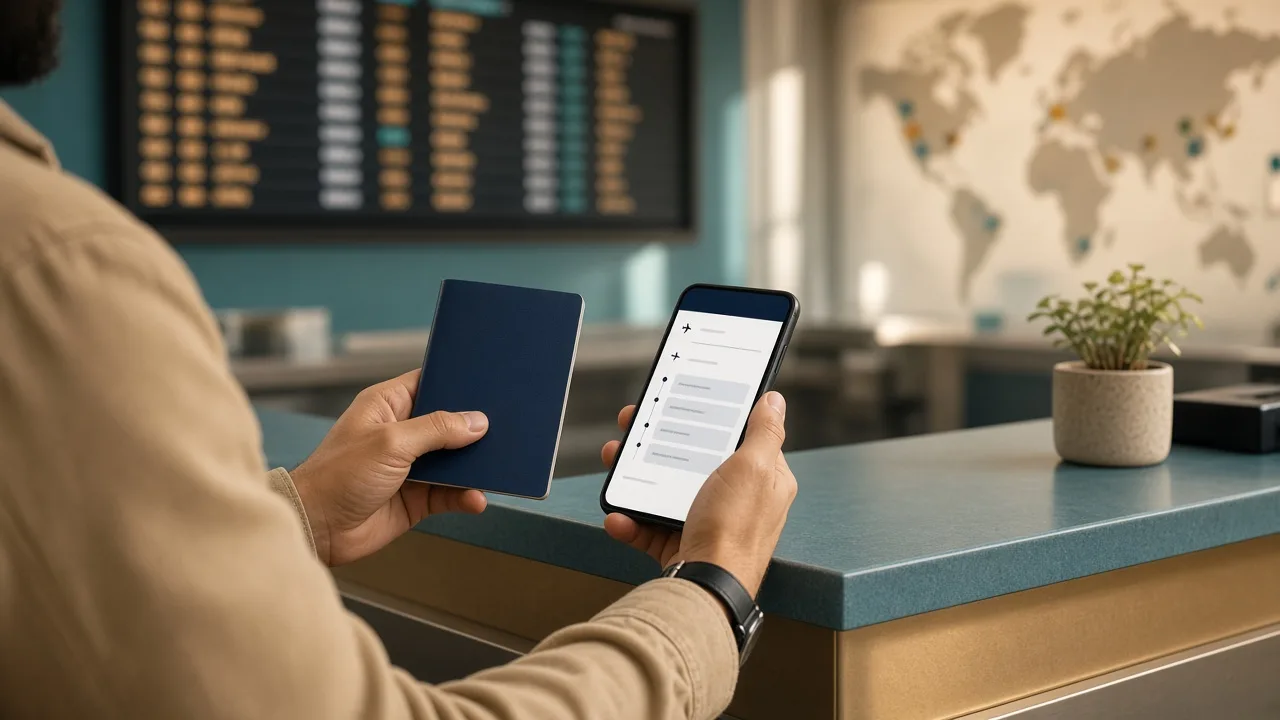
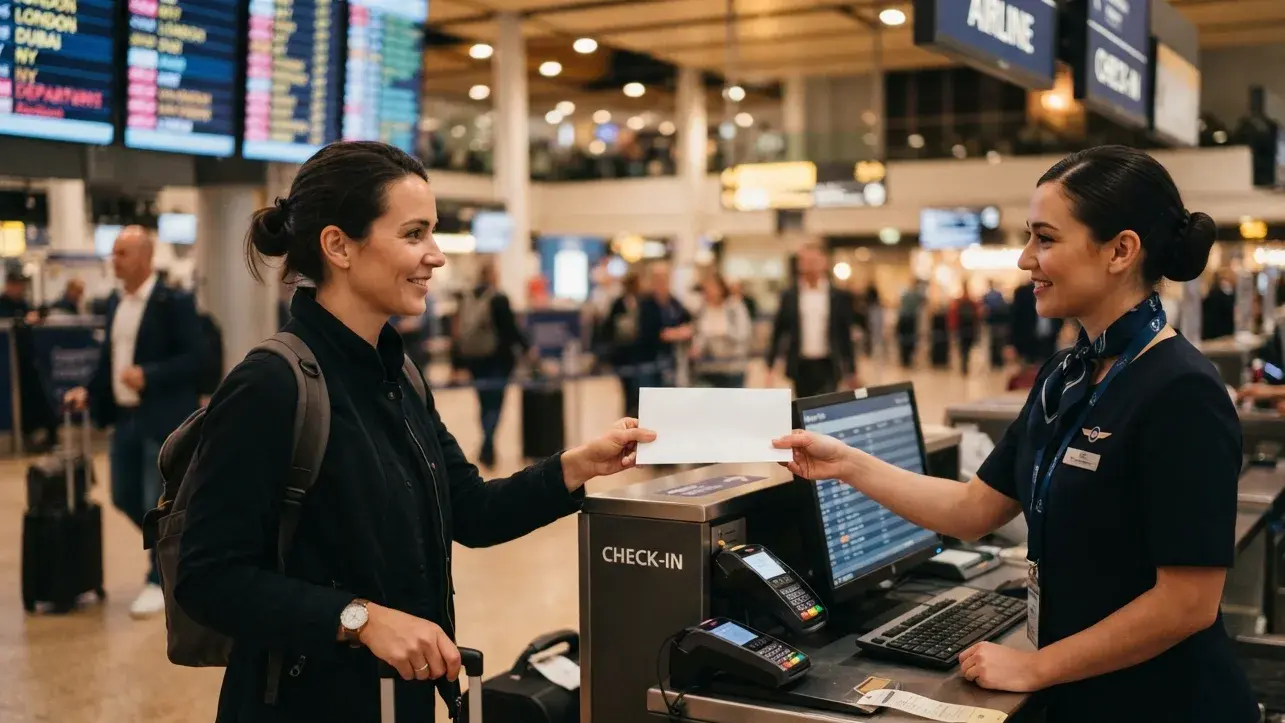
An onward ticket matters most with low-cost carriers because the document-check desk may review your exit proof before boarding, even after your visa is approved. The strongest proof is clean, current and easy to scan: passenger name, route, onward date, destination logic and booking-reference details should all match the trip you are actually taking.
Low-cost carrier document checks can feel sharper than an embassy interview because the agent has only a few seconds to decide whether your paperwork satisfies the route rules. A visa approval helps, but it does not always answer the airline’s own boarding question: can this traveler enter, transit and leave according to the destination’s requirements?
This guide keeps the focus on practical airport proof: how a dummy ticket or onward-proof document should look, when screenshots become weak, how to avoid two-ticket mismatches, and how to prepare one clean paper trail for both embassy and gate checks.
Key facts before flying a low-cost carrier:
- Budget airlines may run strict document checks because they carry boarding and inadmissible-passenger risk.
- Your visa approval does not always remove the need to show onward or return proof at check-in.
- The onward ticket should match the name, route, entry date and realistic next destination.
- A screenshot is weaker than a clean PDF or booking-style document with readable details.
- Separate PNRs, self-transfer routes and long layovers need extra consistency.
Flying a budget airline that may ask for exit proof? Create clean onward-ticket proof with DummyFlights before the document-check desk turns a simple boarding step into a delay.
Create Your Onward TicketIn This Guide
Official-source check: IATA says its Travel Centre and Timatic data support passport, visa and health requirement checks used by airlines. Jetstar says international passengers may need visas or proof of onward journey and are responsible for arranging the right documents. Ryanair says passengers must carry documents that meet immigration requirements and may need desk checks for visa documentation. Sources: IATA Travel Centre, Jetstar international travel identification, and Ryanair Travel Documents.
Reviewed for: low-cost carrier document-check logic, onward-ticket wording, route-date consistency, PNR clarity, airport-counter practicality and safe travel-proof claims.
Why Budget Airlines Police Onward Tickets Harder Than Full-Service Carriers
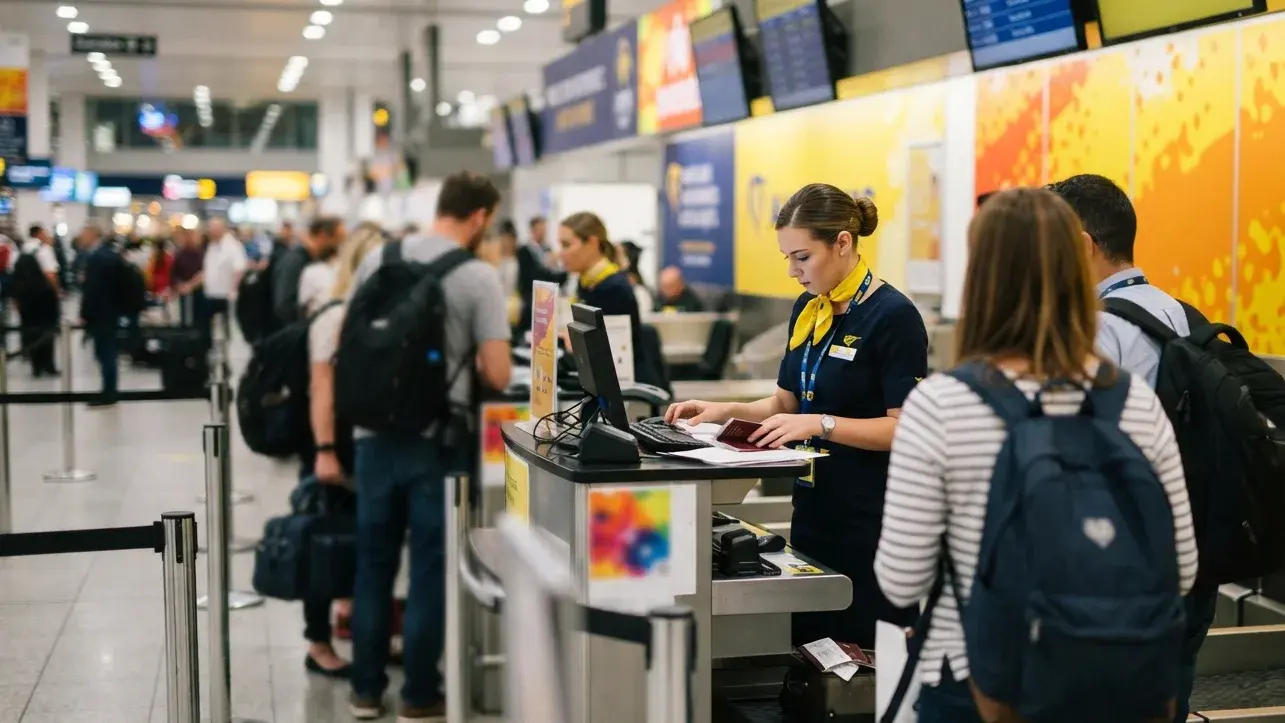
Most travelers assume that once a visa is stamped, the paperwork battle is over. It isn't. Budget airlines run their own screening process at check-in, and it often catches people who sailed through their visa application without a second look.
The Fine-Liability Problem LCCs Can't Ignore
Airlines carry legal responsibility for who they fly into a country. If a passenger lands without valid proof of onward travel and gets rejected at immigration, the airline is the one that pays for it, not the traveler.
That penalty is steep. Airlines face fines up to $5,000 for transporting undocumented passengers, and some countries apply this per passenger, per violation. For a low-cost carrier operating on thin margins, one fine can wipe out the profit from dozens of seats sold at discount fares.
This is why missing an onward ticket leads to denied boarding for 35% of travelers at certain checkpoints. It isn't random enforcement. It's a direct financial risk that airlines actively train their staff to avoid.
Budget airlines enforce strict onward ticket policies specifically to sidestep these penalties, and airlines have the right to deny boarding without compensation when a passenger can't produce the required document. A traveler holding a confirmed visa can still be turned away at the gate if the airline's own proof-of-exit requirement isn't met.
No Interline Safety Net Means No Second Chances
Full-service carriers often belong to alliances or hold interline agreements with partner airlines. If a passenger runs into a documentation issue, staff sometimes have options: rebooking on a partner flight, adjusting an itinerary, or escalating to a supervisor with more flexibility.
Budget airlines typically operate outside these networks. A Cebu-based backpacker flying a European LCC route, or a solo traveler connecting through a Gulf hub on a no-frills carrier, won't have that fallback. If the counter agent isn't satisfied, there's no partner airline to lean on and no easy workaround.
This is one reason low-cost carriers train staff to be strict rather than flexible. Without a safety net to fall back on, the airline's only protection is refusing boarding until the paperwork checks out. It also means travelers can't rely on "figuring it out later" the way they sometimes can with legacy carriers.
A few document basics make a real difference here:
-
A return ticket includes a return leg to the original country, which is generally the strongest form of proof an agent can check.
-
One-way tickets do not indicate future travel plans on their own, which is exactly why they trigger extra scrutiny at LCC counters.
-
Onward tickets can be flights, buses, or trains out of a country, depending on what the destination country and airline accept, though flight proof is the most universally recognized format at airline counters.
Staff Incentive vs. Consulate Incentive — Two Different Filters
A visa officer is trained to assess intent. They look at ties to your home country, financial stability, travel history, and whether your stated trip makes sense as a whole. It's a judgment call built on context.
A check-in agent isn't making that kind of judgment. Their job is narrower and more mechanical: does a document exist showing you'll leave the destination country before your permitted stay ends? That's a yes-or-no check, not an assessment of character or intent.
This difference matters more than most travelers realize. An itinerary that convinced a consulate officer of genuine travel plans can still get flagged at the counter if it isn't immediately verifiable. Airline document check agents verify the authenticity of onward travel bookings using tools built for speed, not context, which means presentation matters as much as substance.
Two things make this check reliable from the airline's side:
-
A verifiable Passenger Name Record (PNR) is crucial for proof of onward travel, since it lets an agent confirm the booking exists in a real reservation system rather than trusting an email or PDF at face value.
-
Airlines use the IATA Timatic database to verify onward ticket requirements, cross-referencing destination country rules against what the passenger presents, often in seconds.
Some immigration authorities go a step further and require confirmed and usable onward reservations, not just any document that mentions a future date. Immigration officers themselves may also apply this standard directly. Travelers without onward tickets may face immediate rejection at immigration, separate from anything the airline decides at check-in, which is why the two checkpoints, airline and immigration, tend to reinforce each other rather than operate independently.
Where This Shows Up Most: Gulf, Southeast Asian, and European Budget Routes
Certain routes have earned a reputation among frequent flyers for strict document checks, and it's worth knowing which ones before you're standing at the counter.
Gulf transit hubs see heavy volumes of one-way travelers heading onward to South Asia, Africa, and Southeast Asia, which makes onward ticket checks routine rather than occasional. Southeast Asian low-cost carriers apply similar scrutiny on international sectors. Thailand strictly enforces onward ticket requirements at immigration, and airlines flying into Bangkok or Phuket often mirror that same standard at their own check-in desks to avoid liability.
European budget carriers operating Schengen-adjacent routes apply comparable pressure, particularly for passengers arriving from countries with higher visa refusal rates. An American traveler connecting through Milan on a low-cost European carrier, for instance, may face a more thorough document check than someone flying the same route on a legacy airline.
The practical takeaway is simple. If your route touches one of these regions, build in extra time before your flight, and have your onward proof ready to present the moment you reach the counter rather than searching for it while the queue builds behind you. Understanding why these specific routes are stricter sets up the next question every traveler needs answered: what exactly is the agent looking for when they ask to see it?
What a Document-Check Agent Is Actually Trained to Look For
Once you understand why budget airlines take onward tickets seriously, the next logical question is what their staff are actually checking for. The process is faster and more mechanical than most travelers expect.
The Three-Second Scan — PNR, Name Match, Date Logic
Document-check agents rarely spend more than a few seconds reviewing your onward proof. They aren't reading your itinerary the way a visa officer would. They're running a quick, almost reflexive check against three things.
First, they look for a Passenger Name Record that appears legitimate and traceable in a real booking system. Second, they confirm the name on the ticket matches your passport exactly, down to spelling and order. Third, they check the date logic, making sure your onward departure falls within the window your visa or permitted stay actually allows.
Documentation must match the traveler's passport precisely to be valid. A middle name left off, a hyphenated surname written differently, or a passport number that doesn't align with the booking can all trigger a second look, even when the underlying trip is completely legitimate.
This is also where date logic becomes critical. A valid onward ticket must show departure before the visa expires, and agents are trained to flag anything that cuts it close or falls outside the permitted window. It doesn't matter how solid the rest of your documentation looks if the dates don't line up.
None of this is personal. Agents at busy LCC counters process dozens of passengers an hour, and this scan is designed to be quick precisely because they don't have time for anything else.
Why a Screenshot Often Isn't Enough
A common mistake travelers make is assuming any confirmation email or booking screenshot will satisfy the counter. It usually doesn't, and it's worth understanding why.
Using a simple screenshot of a reservation is inadequate for proof of onward travel in most airline document-check systems. Screenshots are easy to edit, don't always display a verifiable PNR, and often lack the formatting an agent recognizes from a legitimate airline confirmation. When an agent can't quickly verify what they're looking at, the safer move for them is to escalate rather than wave you through.
A few practical habits reduce this risk significantly:
-
Carry the actual PDF itinerary rather than a cropped image or forwarded email.
-
Make sure the PNR is clearly visible and formatted the way the issuing airline typically presents it.
-
Avoid relying on a booking confirmation that only shows a reference number without route or date details.
Travelers should carry offline copies of their onward tickets in case of poor Wi-Fi, since airport connectivity is unreliable and fumbling to load an email at the counter only adds friction. A saved PDF on your phone, plus a printed copy as backup, removes that risk entirely.
This is also where a temporary flight reservation booked through a dedicated service becomes genuinely useful. DummyFlights.com issues a real, checkable PNR tied to an actual airline booking system, which gives agents something they can verify directly instead of a document they have to take on faith.
The "Too Perfect" Red Flag
It sounds counterintuitive, but an onward ticket that looks too neatly arranged can sometimes draw more attention than one with ordinary imperfections.
Agents who process onward tickets daily develop a feel for what a typical booking looks like. A return date that matches your visa expiry to the exact day, a ticket purchased the morning of travel, or an itinerary with an unusually convenient routing can read as manufactured rather than organic, even when it's entirely genuine.
This doesn't mean your documentation needs to look messy. It means small, natural buffers help. Booking a departure a few days before your visa or permitted stay actually expires, rather than on the exact final day, tends to look more like a real travel plan and less like a document built purely to satisfy a checkpoint.
The same logic applies to refund flexibility. A refundable onward ticket can be canceled after passing the check-in process, which means travelers don't need to lock themselves into a rigid, artificial-looking itinerary just to get through the counter. Building in a small margin, both in timing and in flexibility, tends to work in your favor rather than against it.
What Happens If the Agent Isn't Satisfied
Understanding the escalation path helps put the stakes in perspective, and it's a good reason to get your documentation right before you ever reach the desk.
If an agent isn't satisfied with what you present, the interaction usually doesn't end there. Most counters follow a fairly predictable sequence: the agent flags the issue, a supervisor is called over to review the documentation, and if the supervisor still isn't convinced, you may be asked to purchase a same-day onward ticket on the spot, often at a steep last-minute fare.
If none of that resolves the situation, boarding can be denied outright. Airlines have the right to deny boarding without compensation for missing documents, which means there's no guaranteed rebooking, refund, or apology waiting for you if the flight closes without you on it.
This is exactly the outcome that solid preparation is meant to prevent. Once you know what agents are trained to check and how the escalation plays out when something looks off, the next step is making sure your visa itinerary and your actual travel plans tell one consistent story from booking to boarding.
Matching Your Visa Itinerary to Your Actual Boarding Itinerary

A ticket that gets you through the visa application stage isn't automatically the same ticket you'll board with, and that gap causes more confusion at the counter than most travelers expect. Getting these two documents to align is where careful planning starts to matter.
The Two-Ticket Mismatch Problem
Many travelers buy an onward flight ticket specifically for their visa application, then book their real flight itinerary separately once actual plans firm up. On paper, this seems harmless. In practice, it creates two records that don't always agree with each other.
Say a traveler applies for a tourist visa using a round-trip ticket showing a departure date three weeks out, then later books an entirely different outbound flight with a different airline and a different final destination. If a gate agent or check-in agent asks to see the itinerary tied to the visa, and it doesn't match what's actually being boarded, that inconsistency can trigger questions the traveler never anticipated.
This isn't about dishonesty. Plans change constantly, especially for long trip itineraries that span multiple countries. But airline staff and immigration officers aren't always equipped to distinguish between a traveler adjusting their exit plan and one who never had a legitimate onward journey to begin with.
When Mismatches Are Normal and When They Become a Problem
Not every change between your visa paperwork and your final flight itinerary is cause for concern. Shifting your departure date by a few days, switching airlines, or adjusting your route within the same country rarely raises red flags, since most visas aren't tied to a specific flight itinerary.
The risk zone is different. It shows up when the destination country itself changes, when a traveler who declared a return flight to their home country ends up flying one way instead, or when the number of stops on the route grows in a way that wasn't part of the original visa application. These kinds of shifts can look like an undisclosed change in intent, even when there's a perfectly reasonable explanation behind them.
Frequent travelers who move through multiple countries on a single visa often run into this more than occasional visitors, simply because their exit proof needs to keep pace with an itinerary that keeps evolving. A visitor visa holder connecting through a third country before reaching their next destination should expect slightly more scrutiny than someone flying a straightforward round trip.
Keeping a Paper Trail That Tells One Consistent Story
The simplest way to avoid trouble at the counter is to keep every version of your travel documentation together and easy to explain. That means holding onto the original onward flight ticket used at the visa application stage alongside the fully paid ticket or booking reference for your actual flight, ideally in the same folder or device.
If a check-in agent or immigration officer ever asks about a discrepancy, being able to show the logical progression, from initial exit proof to confirmed booking, reads very differently than fumbling through unrelated documents that seem to contradict each other. It signals a traveler who planned carefully, not one improvising an exit plan on the spot.
Flexibility also plays a role here. A refundable ticket or one that allows date changes lets travelers update their onward flight as real plans solidify, rather than juggling two disconnected bookings that drift further apart over time. This matters even more for travelers navigating visa requirements in countries where visa validity is tightly linked to a specific exit window, since any gap between paperwork and reality narrows the margin for error.
It's worth remembering that a dummy ticket, used properly for visa or check-in purposes, is not the same as a unsupported ticket-style document. A dummy ticket references a real, verifiable flight reservation in the airline system, while a unsupported ticket-style document typically cannot be confirmed at all. Airline staff is trained to catch the difference quickly, which is exactly why a verifiable reservation matters more than how convincing a document looks on the surface.
Round-Trip vs. One-Way-Plus-Onward: Which Structure Reduces Friction
The way you structure your ticket has a direct effect on how smoothly it gets read at the counter, and this is where many travelers make avoidable choices.
A single itinerary that clearly shows arrival and a corresponding return flight or onward flight ticket is far easier for a gate agent to process than two unrelated one-way bookings on different airlines with no obvious connection between them. When a check-in agent asks for proof of onward travel, a clean round trip structure answers the question in seconds. Two disconnected non-refundable tickets, by contrast, often require more explanation, since nothing on paper visibly links them together.
Flying one way without any onward flight attached is where problems tend to concentrate. Countries like Costa Rica are known for enforcing exit proof strictly at both the airline counter and immigration, and a one-way ticket alone rarely satisfies that requirement. In these cases, pairing the outbound flight with a best onward ticket booked for the same general timeframe, ideally departing from the same arrival city, gives agents a complete picture rather than half of one.
Departure city consistency matters more than travelers usually assume. An onward flight ticket that leaves from a different departure city than where the traveler actually landed, with no explanation, tends to draw more questions than one that logically continues from the same location. This applies whether the onward document is a flight ticket, a bus ticket, or another form of exit ticket accepted for international flights, since the underlying goal is the same: showing a clear exit plan that immigration and airline staff can verify without friction.
Some countries also grant visa-free entry under specific conditions, which can shift what counts as sufficient exit proof entirely. Understanding whether your route falls under those exceptions, rather than assuming standard onward ticket rules apply, is worth confirming before you build your itinerary around the wrong requirement. From here, the next step is making sure the ticket itself, whatever structure you choose, is formatted and timed in a way that holds up the moment you reach the desk.
Building an Onward Ticket That Survives Both the Embassy and the Gate
Everything covered so far points to one practical goal: a ticket that holds up twice, once during your visa application and again the moment you reach the counter. Getting the timing and format right is what makes that possible.
Timing the Booking Relative to Your Actual Travel Date
Booking your onward proof too far ahead of your actual travel date can work against you. Systems and staff attention are sharpest closer to departure, and a booking that sat untouched for months can look stale or disconnected from your real plans when an agent reviews it.
A temporary reservation generated closer to your actual travel window tends to hold up better under review. It reflects current flight availability, current pricing, and a departure date that still makes logical sense against your visa validity. If your travel plans shift even slightly, refreshing the booking closer to departure keeps everything aligned rather than leaving you with an outdated document that no longer matches reality.
Formatting the Document for a Fast Counter Scan
An agent reviewing your documentation isn't reading it closely. They're scanning it, and how the document is formatted determines how quickly it clears that scan.
A few habits make a real difference:
-
Carry a PDF version rather than a screenshot pulled from an email or app.
-
Make sure the booking reference and passenger details are clearly visible, not buried in fine print.
-
Confirm your name is spelled and ordered exactly as it appears on your passport.
-
Keep departure and arrival details unambiguous, including city names rather than only airport codes.
A verified flight reservation formatted this way gives an agent everything they need in a single glance. It also reduces the odds of being pulled aside simply because the document was hard to read or verify quickly, not because anything about the trip itself was questionable.
The Layover Trap — Booking Onward Tickets With Connections
A layover routed through an unfamiliar next country can create complications that have nothing to do with your actual destination. Some agents aren't familiar with the transit rules of every third country a connection might pass through, and that unfamiliarity sometimes leads to extra questioning that a direct route would have avoided entirely.
Where possible, choosing a direct onward flight ticket removes this variable altogether. If a layover is unavoidable, it's worth checking the transit visa rules for that connecting country before finalizing the booking, since some layover points require documentation of their own regardless of your final destination. A route that seemed convenient on price can end up creating friction that a slightly more direct option wouldn't have.
Handling the "Why Is This So Cheap" Question
Occasionally, an agent familiar with typical fare levels may notice that an onward ticket looks unusually inexpensive and ask about it directly. This tends to catch travelers off guard, mostly because they assume a lower price automatically signals something suspicious.
In most cases, it doesn't. A real flight ticket issued specifically for short-term use, rather than actual travel, is priced differently than a full ticket meant for someone boarding that exact flight. As long as the underlying reservation is genuine and appears correctly in the airline system during check-in, the price point alone rarely causes a denied entry or any real complication.
A transparent, fixed cost reflects standard pricing for this category of document. Visa applicants shouldn't feel the need to overpay for a booking simply to make it look more convincing, since a valid exit ticket doesn't need to match the price of a passenger's actual travel plans to be accepted. What matters is whether the reservation checks out, not what it cost.
Getting the timing, formatting, and structure right at this stage is what separates a smooth departure from an unnecessary delay at the gate, and understanding that distinction is really the difference this entire guide has been building toward.
Getting Through The Gate As Smoothly As You Cleared The Embassy
Your visa approval and your boarding pass answer two different questions, and now you know exactly what each one is checking for. A clean, verifiable onward ticket, formatted well and timed close to your actual travel date, is what carries you through both without friction.
Budget airline counters aren't trying to catch you out. They're following their own rules to avoid liability, and understanding those rules puts you back in control. Build your exit plan with that in mind, and the counter becomes a formality rather than a surprise. A reliable onward ticket proof, prepared with clean route and date logic, helps you reach the counter with confidence.
Need onward proof before low-cost carrier check-in? Prepare a clean document that matches your passenger name, route, date logic and next-destination plan.
Prepare Onward ProofFrequently Asked Questions
Do low-cost carriers check onward tickets more strictly?
They often do, especially on international routes where the airline may face cost or compliance risk if a passenger is refused entry. The check is usually practical: visa, passport, route, onward proof and whether the document looks consistent.
Can I board with only a visa approval and no onward ticket?
Sometimes yes, but not always. A visa approval does not automatically prove that your airline, transit point or destination will accept one-way travel without exit proof.
What should an onward ticket show at the document-check desk?
It should show a readable passenger name, route, travel date, next destination and booking-reference logic that fits the journey. The agent should not need a long explanation to understand where you go next.
Is a screenshot enough for low-cost carrier document checks?
A screenshot can work in some relaxed situations, but it is weaker than a clean PDF or booking-style document because screenshots are harder to verify and easier to misread at a busy counter.
Should my onward ticket match my visa itinerary exactly?
It should support the same travel story. Minor practical differences can be normal, but the entry date, stay length, exit plan and accommodation logic should not contradict the visa file.
What if my budget airline flight and onward ticket are on separate PNRs?
Separate PNRs are common, especially with low-cost carriers. The important part is that the documents do not overlap incorrectly and the connection or onward plan looks realistic.
Can an airline refuse boarding over onward proof?
Yes. Airlines can refuse travel when required documents are missing or appear not to meet destination or transit requirements. That is why the onward proof should be prepared before check-in.
How close to travel should I create an onward ticket?
Create it close enough to your real departure that the document is current, but early enough that you can correct mistakes before going to the airport.
Does an onward ticket guarantee boarding?
No. It can support your exit-proof requirement, but boarding still depends on passport validity, visa rules, airline checks, transit rules and the final decision at the airport.
Can DummyFlights help with onward ticket proof for low-cost carriers?
DummyFlights can help you prepare temporary onward-ticket proof for planning and document-check support, as long as your details, route and dates are realistic for the trip you intend to take.
Friendly reminder: DummyFlights provides temporary travel-proof documents for planning and application support. Requirements vary by destination, airline, route and applicant situation. A dummy ticket can support a file, but it does not guarantee approval, boarding or entry.