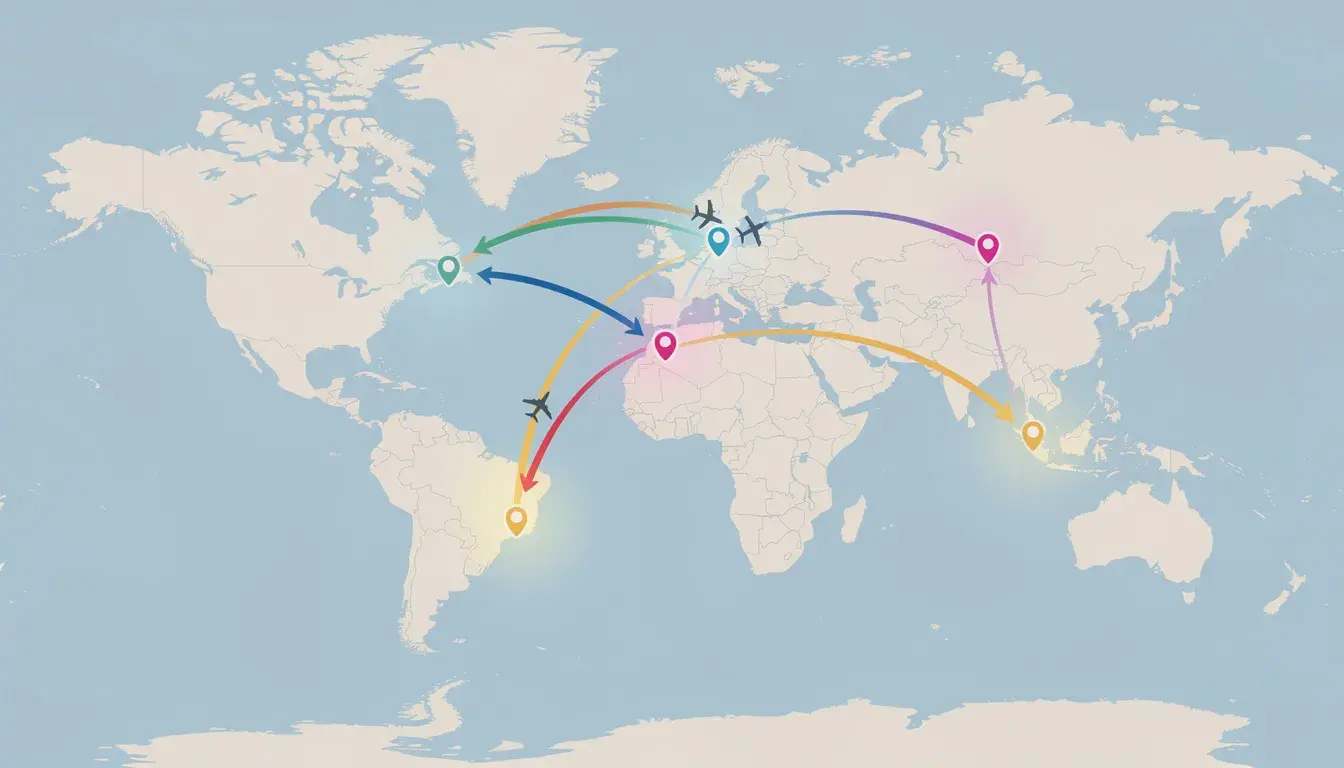
On a multi-country Schengen trip you apply to one consulate: the main destination by length or purpose of stay, or the first country of entry if stays are equal. Your flights should show where you enter and leave. A dummy ticket with a real PNR costs $15 per person, valid 48-72 hours.
Visiting several Schengen countries on one visa means one itinerary and one consulate. The rule is simple once it is written down: you apply to the country that is your main destination, and if you cannot name one, to the country where you first cross the external border. Your flights then have to show that route clearly, from the first entry to the final exit, and every other paper has to agree with them.
This guide explains which consulate handles a multi-country trip, how common route shapes should look on paper, edge cases under Article 5, six fictional route examples, how hotels, insurance and the cover letter should follow the route, a decision table, and what the itinerary does and does not prove.
Key facts
- Main destination by length or purpose of stay decides the consulate; with equal stays, the first country of entry (Visa Code Art. 5).
- Apply no more than six months and at least 15 days before travel (Art. 9).
- A DummyFlights reservation costs a flat $15 per person, with a real PNR valid 48-72 hours.
- For visa files and onward-travel proof at immigration; it is not a paid ticket for flying.
In This Guide
- Which Consulate Handles a Multi-Country Trip?
- Edge Cases Under Article 5
- Route Types and What the Flights Must Show
- Planning the Route Logic
- Example 1: Two Countries With a Clear Main Destination
- Example 2: Entering Through a Country That Is Not the Main Destination
- More Route Examples
- Onward Travel After the Schengen Area
- Matching the Route to Hotels, Insurance and the Cover Letter
- Route Decision Table
- What a Dummy Ticket Itinerary Does and Does Not Prove
- Timing the Application
- Frequently Asked Questions
Official-source check: The main-destination and first-entry rules come from the Visa Code, Regulation (EC) No 810/2009 (Articles 5, 8, 9, 14 and 15, published on EUR-Lex), the European Commission page on where to apply for a Schengen visa, and NetherlandsWorldwide guidance on trips to several countries, checked 1 November 2026. Your consulate's own checklist takes priority over any summary.
Reviewed for: main-destination and first-entry rules, open-jaw and multi-country route layouts, internal legs, onward exits from the Schengen area, and itinerary consistency.
Which Consulate Handles a Multi-Country Trip?
The Visa Code (Regulation (EC) No 810/2009), Article 5, sets the rule. If you visit one Schengen country, you apply to that country. If you visit several, you apply to the country that is your main destination, judged by the length of stay or the purpose of the trip. If no main destination can be determined, you apply to the country whose external border you will cross first.
The European Commission's page on applying for a Schengen visa puts it in two lines: apply at the consulate of the country where you will spend the longest time, and if your stays are of equal length, apply at the consulate of the first country you will visit.
Purpose can outweigh days. The Dutch government's guidance on visiting more than one Schengen country gives the example of a business trip to the Netherlands followed by a holiday in Sweden: the business trip is the main reason, so you apply to the Netherlands even if the Swedish stay is longer. Where the purpose is the same in every country, the longest stay decides, and with equal stays the first country visited decides. It also warns that applying to the wrong country gets the application rejected.
- One purpose, unequal stays: apply to the country with the most nights.
- Different purposes: apply to the country linked to the main purpose of the trip.
- One purpose, equal stays: apply to the country you enter first.
- Timing: under Article 9, you lodge the application no more than six months and no later than 15 calendar days before the start of the trip.
Edge Cases Under Article 5
Article 5 reads cleanly on paper, but real trips rarely fit the textbook pattern. The cases below come up often on multi-country routes. Each one is decided by the same three steps: main destination by length or purpose of stay, then first external border if no main destination can be determined.
Transit Through Another Schengen Country
A connection in Frankfurt, Amsterdam or Paris on the way to your real destination is not a stay. If you land in one Schengen airport, change planes and fly on to another Schengen country the same day, the connecting airport is where you cross the external border, but it does not count as a destination. The consulate is still the country with the main stay. The itinerary should show the connection as part of one journey, with no hotel night, so nobody reads it as a second destination.
Several Separate Visits Within Two Months
Article 5 also covers travellers who plan more than one separate visit in a short period. Where several separate visits are to be carried out within two months, the main destination is judged across all of them, by length of stay counted in days or by purpose. List each visit with its own entry and exit dates and its own night count, then add the totals per country. The country with the largest total, or the main purpose, is the consulate.
Equal Stays, Different Order
With equal stays, the order of the trip decides the consulate. Five nights in Spain followed by five nights in Portugal goes to Spain; the same nights in reverse order go to Portugal. Small changes matter: adding one extra night to the second country moves the main destination there, and the first-entry rule no longer applies. Settle the order before you build the file, because changing it later can mean a different consulate.
When Your Destination Has No Consulate Nearby
Under Article 8 of the Visa Code, a Schengen country can arrange for another Schengen country to examine visas on its behalf at a given location. If the country of your main destination has no consulate where you live, check its official visa page for a representing state. You still name the real main destination on the form; only the office that handles the file changes. As a general rule, you also apply where you are legally resident, which the European Commission page confirms.
Route Types and What the Flights Must Show
Your flights are the backbone of a multi-country file, because they fix the first entry and the final exit. The table sets out the common route shapes, what the flight reservation should show for each, and which other papers must agree with it.
| Route | What the flights show | What must match |
|---|---|---|
| One country, round trip | Arrival into and departure from the same Schengen country | Hotel nights in that country cover every night; insurance covers the whole stay |
| Enter A, exit B (open-jaw) | Inbound flight to country A; outbound flight from country B | Hotels show the move from A to B; the cover letter names the internal leg |
| Several countries, clear main destination | Entry and exit flights; the longest stay is in the country you apply to | Night count per country matches the hotels and the form; the main destination is the consulate you applied to |
| Several countries, equal stays | Entry flight into the first country, which is the consulate you apply to | The first night's hotel is in the first-entry country; the itinerary shows the order |
| Onward travel outside Schengen | Entry flight, then an exit flight to a non-Schengen country rather than home | The exit date sits inside the visa period you request; the onward stop is named in the cover letter |
The table explains what the reservation needs to show. For the document checks themselves, read the separate guide to Schengen visa flight reservation requirements. For the layout of the PDF, read what each field on the PDF shows.
Planning the Route Logic
Start with the order of countries, because the order decides two things at once: which country you enter first and, when stays are equal, which consulate you apply to. Write the trip out as a simple list of nights per country before you book anything. If one country clearly has the most nights, or carries the main purpose, that is your consulate. If two countries tie, the one you enter first becomes the consulate, so check that your entry flight really lands there.
Next, decide how you move between countries. Most travellers inside the Schengen area use trains, buses or short flights, and the itinerary only needs to explain each move clearly. Your flight reservation normally covers the journey into and out of the Schengen area. Internal legs can be shown in a day-by-day itinerary or cover letter: "Day 5, train Paris to Brussels." You do not have to book every train in advance to show the plan, unless your consulate's checklist asks for it.
Finally, check the dates against each other. The last night in one country should be the day you travel to the next, the hotel check-out should match the travel day, and the insurance should run from the entry date to the exit date. A route that reads cleanly on one page is much easier for a case officer to follow than a pile of separate bookings.

- List the nights per country and mark the main purpose.
- Identify the main destination; with equal stays, the first country of entry.
- Book or reserve the entry and exit flights to match that order.
- Note each internal leg (train, bus or flight) in the itinerary.
- Line up hotels, insurance and the application form with the flight dates.
Route Mistakes That Break the Logic
- Applying to the country you land in by default. The landing country decides the consulate only when no main destination can be determined. Count the nights and check the purpose first.
- Night counts that differ between documents. If the form says eight nights in one country but the hotels show seven, the main destination looks uncertain. Recount from the bookings, not from memory.
- A gap night. A night with no hotel, host or transport explained leaves a hole in the route. Add the booking or a line in the cover letter.
- Exit flight from a country that is not on the itinerary. If you leave from a city you never mention, the officer has to guess how you got there. Add the internal leg.
- Insurance that stops early. Cover should run from the first entry to the final exit, including any days spent in transit inside the Schengen area.
Each of these is easy to fix before submission and awkward to explain afterwards. Read the whole file in date order once, as a stranger would, and correct anything that makes you stop and work out where you are on a given night.
Example 1: Two Countries With a Clear Main Destination
Priya (fictional) plans a 12-night holiday: eight nights in Country A and four nights in Country B, both in the Schengen area, with the same tourism purpose throughout. Country A has the most nights, so her main destination is Country A and she applies to its consulate.
Her flights arrive in Country A on day 1 and leave from Country B on day 13, an open-jaw route. On day 9 she takes a train from Country A to Country B. Her hotel bookings cover nights 1-8 in Country A and nights 9-12 in Country B. Her insurance runs from day 1 to day 13, and the form lists Country A as the main destination and the date of first entry as day 1.
Nothing in this plan asks the officer to work anything out. The longest stay matches the consulate, the entry and exit flights match the first and last hotel nights, and the internal train is written into the itinerary. The example shows how the papers fit together; it does not predict the outcome of any application.
Example 2: Entering Through a Country That Is Not the Main Destination
Marco (fictional) is visiting a friend in Country C for nine nights, but the cheapest flight lands in Country D, where he will spend two nights before taking a bus to Country C. His purpose is the same throughout, and Country C has the most nights, so Country C is his main destination and he applies to the Country C consulate, even though he first enters the Schengen area in Country D.
His itinerary has to make the entry point obvious. The inbound flight lands in Country D on day 1; the hotel covers nights 1-2 there; the bus to Country C is written into the itinerary for day 3; the host's invitation covers nights 3-11; and the return flight leaves from Country C on day 12. The form names Country C as the main destination and Country D as the country of first entry.
Applicants often think the first-entry rule applies to every trip. It only decides the consulate when no main destination can be determined, for example when stays are equal. Here the longer stay in Country C decides, and the entry through Country D is simply part of the route.

More Route Examples
The two examples above cover the most common patterns. The four below show how the same rules handle less tidy trips. All names are fictional, and the countries are placeholders so the logic stays the same for any combination of Schengen states.
Example 3: Equal Stays, Decided by First Entry
Leila (fictional) plans a holiday with four nights in Country E and four nights in Country F. Her purpose is the same in both, and the night counts are equal, so no main destination can be determined. Her inbound flight lands in Country E, so Country E is both the first country of entry and the consulate she applies to.
Her file has to make that order unmistakable. The inbound flight arrives in Country E on day 1, the first hotel is in Country E for nights 1-4, a train to Country F is listed for day 5, and the return flight leaves Country F on day 9. If she later swapped the order and flew into Country F, the consulate would change too, so she fixes the order before booking her appointment.
Example 4: Main Destination by Purpose, Not Days
Tomas (fictional) attends a three-day trade fair in Country G, then spends seven nights touring Country H. Country H has more nights, but his main reason for the trip is the fair. Following the purpose rule shown in the Dutch guidance, he applies to Country G.
His cover letter states the purpose first: the fair, its dates and his invitation from the organiser. The tour in Country H appears as a second part of the trip. The flight reservation enters Country G before the fair and leaves from Country H at the end, an open-jaw route that matches the order in the letter.
Example 5: Entering by Land or Train
Not every multi-country trip starts with a flight into the Schengen area. Ana (fictional) lives near the border and plans to cross by train into Country J for two nights before travelling on to Country K for eight nights, then fly home from Country K. Country K is the main destination, so she applies there, even though she enters by train through Country J.
Her file shows the train ticket or its route for day 1, the hotel in Country J, the internal leg to Country K and the one-way flight home from Country K. The only flight reservation in the file is the exit, and that is enough to show how she leaves. The form lists Country J as the country of first entry.
Example 6: Open-Jaw With an Onward Leg Outside Schengen
Daniel (fictional) flies into Country L, spends nine nights there, travels to Country M for three nights, then flies from Country M to a non-Schengen country for a week before going home. Country L has the most nights, so he applies there. His exit from the Schengen area is the flight from Country M, not the flight home.
He asks for a visa period that ends on the day of that exit flight, names the onward country in his cover letter, and notes whether he needs a separate visa for it. The flight home can appear in the cover letter for context, but the date that matters to the Schengen file is the day he leaves Country M.
Onward Travel After the Schengen Area
Some trips do not end with a flight home. You might leave the Schengen area for the United Kingdom, Türkiye or another non-Schengen country before returning. In that case, the exit flight in your file is the one that takes you out of the Schengen area, not the eventual flight home.
Article 14 of the Visa Code lets consulates ask for information that shows you intend to leave the territory of the Member States before the visa expires. A clear exit flight dated inside the visa period you request answers that question directly. Name the onward stop in your cover letter, and if you need a visa for the next country, mention how you will get it.
Keep the requested visa period aligned with the exit date. A visa request that runs well beyond the exit flight, or an exit flight that falls after the requested period, is the kind of mismatch that slows a file down.
Matching the Route to Hotels, Insurance and the Cover Letter
A multi-country file has more places for the route to drift. The flights fix the first and last points; everything in between is carried by hotels, insurance and the cover letter. The aim is a route that reads the same in every paper, country by country.
Hotels in Route Order
Put the accommodation in the same order as the countries in your itinerary, and make each check-out fall on the day you travel to the next country. The hotel nights per country are how an officer counts your main destination, so they should give the same total as the form. If you stay with a host in one country, include the invitation or host letter for those nights in the same position in the sequence.
Insurance That Covers Every Country
Article 15 of the Visa Code requires travel medical insurance valid for the whole territory of the Member States, with minimum cover of EUR 30,000, for the entire period of stay. On a multi-country trip, check that the policy names the Schengen area as a whole, not only your main destination, and that it runs from your first entry to your final exit, including any land crossing days.
A Cover Letter That Explains the Route
The cover letter is where you tell the consulate why you applied to it. One short paragraph is enough: name the main destination, give the reason (most nights or main purpose), list the countries in order with their dates, and name the entry and exit points. If your first entry is in a different country, say so plainly. That paragraph answers the question the officer would otherwise have to work out from the bookings.
Route Decision Table
Use this table to settle the route before you gather documents. Each row is a question about the trip, not about the documents themselves.
| Question | If yes | If no |
|---|---|---|
| Are you visiting only one Schengen country? | Apply to that country | Go to the next question |
| Does one country carry the main purpose of the trip? | Apply to that country, even if another stay is longer | Go to the next question |
| Does one country have the most nights? | Apply to that country | Stays are equal: apply to the country of first entry |
| Do you land and leave from different countries? | Show an open-jaw route and list the internal leg | Show a round trip from one country |
| Do you enter by land or train? | Name the crossing point as first entry; a flight is needed only for the exit | Your entry flight marks first entry |
| Do you leave for a non-Schengen country before home? | Use that flight as your exit and end the visa period there | Use the flight home as your exit |
| Does your main destination lack a consulate near you? | Check its official page for a representing state | Apply at its own consulate where you live |
For the documents an officer checks on the flight reservation itself, see the requirements guide linked earlier. This table is only about choosing the consulate and the shape of the route.
What a Dummy Ticket Itinerary Does and Does Not Prove
A flight reservation in a multi-country file supports the travel plan. It shows where you enter, where you leave and on which dates, so the officer can check the route against the hotels, the insurance and the form. For the general steps of getting and timing one, read our dummy ticket for visa guide. It does not prove that you will travel, and it does not guarantee a visa. The decision rests on the whole application, including funds, ties and purpose.
Treat the reservation as a planning document. Buy the actual flights after the visa is issued, when the dates are confirmed. If you need a reservation to place in the file, see the guide to a dummy ticket for Schengen visa applications.
Timing the Application
Under Article 9 of the Visa Code, you can lodge a short-stay application no more than six months before the start of the trip and no later than 15 calendar days before it. Build the route first, then work out your appointment date, and order any reservation close to that appointment so it reflects the final dates. Timing advice for specific visa centres and countries of residence sits on the DummyFlights Schengen pages linked above.
Route and consulate settled? Order a reservation close to your appointment: a real PNR, valid 48-72 hours, for a flat $15 per person.
Get your $15 reservationFrequently Asked Questions
Which country do I apply to if my stays are equal?
Apply to the country you will visit first. The European Commission says that when you visit several Schengen countries for stays of equal length, you lodge the application at the consulate of the first country you will visit. This follows Article 5 of the Visa Code, which uses first entry when no main destination can be determined.
Can I fly into one Schengen country and out of another?
Yes. An open-jaw route, entering in one country and leaving from another, is common on multi-country trips. Show the inbound and outbound flights clearly, explain the internal leg in your itinerary, and apply to the main destination by length of stay or purpose, not automatically to the country where you land.
Do I need to book flights between Schengen countries?
Not as a rule. The Visa Code asks for information on your journey, and many consulates accept a day-by-day itinerary that names each internal leg. Check your consulate's checklist, because some ask for more detail. Whatever you show, the internal travel dates must match your hotel bookings and the application form.
Does a dummy ticket itinerary need to show trains or buses?
The flight reservation covers entry and exit, and internal trains or buses can be listed in the itinerary or cover letter. Booking them is not required by the Visa Code itself. Make sure each move between countries appears on the right day and agrees with the hotel check-in and check-out dates.
Does purpose matter more than the number of nights?
It can. Dutch government guidance says that if you have different purposes, such as business in one country and a holiday in another, you apply to the country of the main purpose even if another stay is longer. Where the purpose is the same everywhere, the longest stay decides.
Does a connection in another Schengen airport change where I apply?
No. A same-day connection is part of your journey, not a stay, so it does not count as a destination. You still apply to the country with the main stay or main purpose. The connecting airport may be where you cross the external border, so list it as the point of first entry on the form when it applies.
Where do I apply if I make two separate trips within two months?
Article 5 of the Visa Code treats several separate visits within two months together. Add up the nights per country across all the visits, or identify the main purpose, and apply to that country. If no main destination can be determined, apply to the country whose external border you will cross first on the first visit.
When should I apply, and when should I order a dummy ticket?
Article 9 of the Visa Code allows you to lodge a short-stay application no more than six months before the trip starts and no later than 15 calendar days before it. Plan the route and choose the consulate first, book the appointment, then order any reservation close to that date so it shows the final route.
Friendly reminder: DummyFlights provides dummy tickets and dummy hotel bookings to support visa applications and onward-travel proof at immigration. Requirements vary by destination, consulate, visa category and traveller situation. A dummy ticket supports your file; it is not a paid ticket for travel and does not guarantee visa approval or entry.