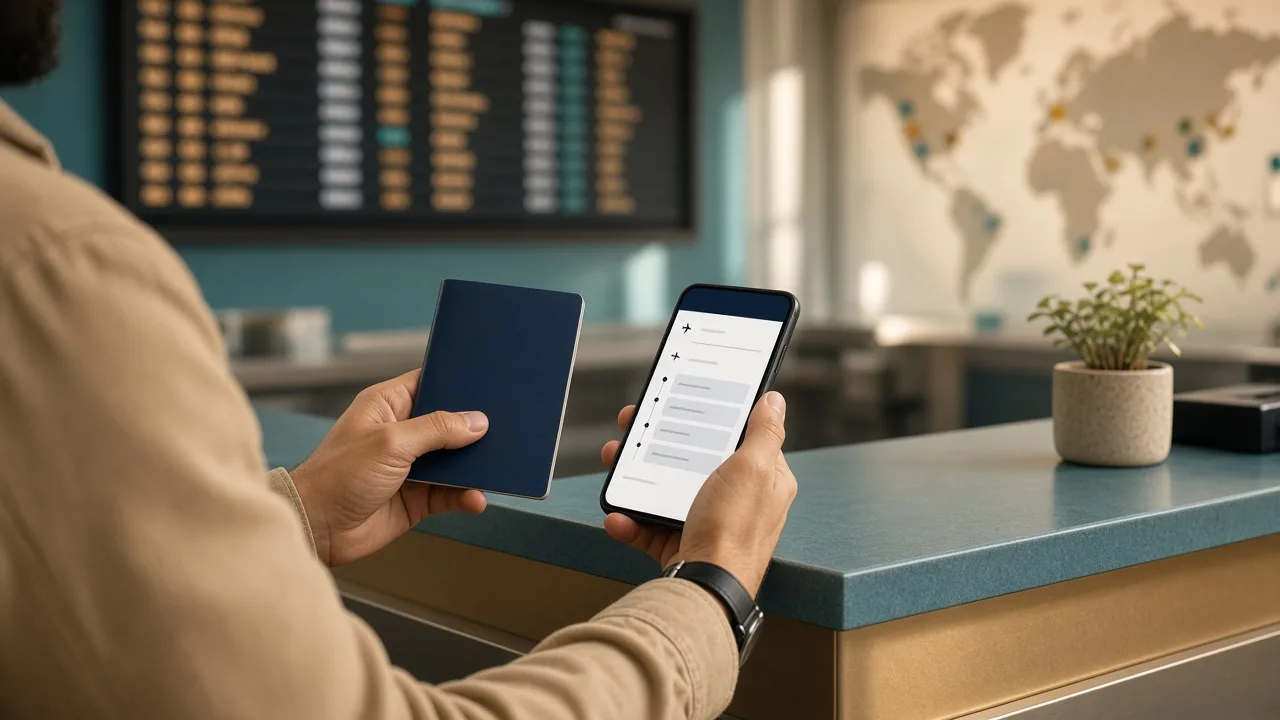
Short answer: Curaçao’s DI Card confirms an arrival form; it does not book your flight to the next island. For a genuine Curaçao–Aruba, Curaçao–Bonaire or Curaçao–Sint Maarten trip, keep the card, a dated inter-island onward reservation or issued ticket, and the next island’s separate entry documents. A temporary reservation can support planning where permitted, but you need a usable ticket for the flight you actually board.
This island-hop guide answers a narrower question than the general Curaçao onward-proof article: what changes when your exit is a specific flight to another Caribbean island, and how do you keep the next destination’s requirements from being lost in the Curaçao paperwork?
Key facts
- The DI Card concerns Curaçao arrival and must be completed within the official window.
- Curaçao may ask for onward or return evidence; a dated island-hop record should reflect the real next leg.
- Aruba’s ED Card, Bonaire’s visitor entry tax and Sint Maarten’s entry process are separate from Curaçao’s card.
- Visa status can cover more than one Caribbean part of the Kingdom, but forms and border checks are still local.
- An unticketed reservation is not a boarding pass or an issued flight ticket.
In This Guide
- What Does the Digital Card Record, and Who Has to Complete It?
- Does the Card Prove Your Exit, or Is That a Separate Record?
- Do Aruba, Bonaire, and Sint Maarten Share Curaçao's Entry Permission?
- Which Evidence State Holds Up Better: Card Only or Card Plus Exit Flight?
- What Does an Example Delhi to Curaçao to Bonaire Record Set Look Like?
- Where Does the Curaçao Express Pass Fit Into This Record Set?
- What Is the Safe Next Verification Step Before You Fly?
- Your Curaçao Digital Immigration Card, Your Exit Record, and the Island After
Official-source check: Curaçao’s DI Card FAQ explains the form, timing and repeat trips; Curaçao Tourism discusses possible onward proof. NetherlandsWorldwide explains the regional Caribbean visa. Check Aruba’s ED Card, Bonaire’s tax guidance or Sint Maarten’s entry guidance for the actual next island.
Reviewed for: inter-island exit evidence, separate island entry steps, Caribbean-visa scope, DI Card timing, Express Pass eligibility and reservation-versus-ticket language.
The Curaçao Digital Immigration Card (DI Card) is an arrival form, not a ticket out of the island. An island-hopping itinerary should separately show the Curaçao arrival, a real dated onward leg to Aruba, Bonaire or Sint Maarten, and the next island’s own entry documents. Whether a reservation or issued ticket is needed depends on the stage of travel and the applicable checklist.
Aruba, Bonaire and Sint Maarten have separate arrival procedures. A Caribbean visa, where required, may permit travel among the Caribbean parts of the Kingdom, but the Curaçao DI Card itself does not replace the next island’s form, tax or border check. This guide is about the inter-island document handoff, not general Curaçao entry eligibility.
If a checklist accepts a temporary onward reservation while plans are open, use a genuine verifiable record matching the intended inter-island route. Before actual flight check-in, obtain the ticket and travel documents the operating carrier requires.
What Does the Digital Card Record, and Who Has to Complete It?

The official Curaçao portal says foreign visitors who clear immigration must complete a DI Card; registered Curaçao residents are exempt. The form supports arrival processing, not admission by itself or proof that an onward leg has been booked.
The official portal says the DI Card can be completed within seven days before departure and, according to its FAQ, as late as one hour before arrival. Do it earlier in that window so you can correct errors and save the confirmation before airline check-in.
Complete the DI Card at dicardcuracao.com. The official form is free when filled out through the official Curaçao portal. Filling in the DI Card online takes one sitting if your passport and an email address you can access are in front of you.
Each traveler must fill out their own Digital Immigration Card, so a separate DI Card must be completed for each individual traveler, children included. A parent or guardian enters their own email address for the children traveling with them.
You need a valid passport and an email address you can open. If the passport upload fails, type the passport number and the other fields exactly as printed, with no nicknames.
Residents registered in Curaçao are exempt, and a resident is a person who holds a valid registration of residency. Anyone born in Curaçao who chooses to live abroad still completes the card.
The DI Card portal describes a visitor category that includes overnight leisure, business or family trips, but those form definitions do not set every traveler’s permitted stay. Check the current entry or visa rules for your passport and the admission period granted by Curaçao immigration.
The Digital Immigration Card form walks through travel, passport, contact, and personal information, followed by a disclaimer, a review, and submission. Its flight lookup starts from the flight number, then lists active carriers and the port of embarkation. If your flight information does not appear, type the flight number again and pick the carrier from the list.
The Digital Immigration Card registry is valid from the moment it is completed until the flight mentioned in the registry has arrived and the visitor has been granted permission to enter Curaçao. In short, the Digital Immigration Card is valid until your flight arrives in Curaçao.
After submission, a confirmation email contains a PDF or download option of the DI Card. Travelers must present the DI Card confirmation at airline check-in and immigration, as a printed copy or on a screen. Airline check-in is the first place it is checked, so save it where you can open it offline.
Travelers can edit their DI Card information through the official portal after submission, using the same details you entered the first time.
Does the Card Prove Your Exit, or Is That a Separate Record?
The card is an arrival record. NetherlandsWorldwide separately says visitors must show that they can return or travel onward; depending on the situation, this may involve a passport, residence permit or visa. Curaçao’s current tourism guidance says immigration may also ask for proof of onward or return travel. A dated inter-island booking helps explain a genuine island-hopping route but is not automatically mandatory for every traveler.
NetherlandsWorldwide also lists evidence of the reason for a stay, sufficient funds and medical insurance. Its current guidance gives a hotel-stay funds range of US$150–200 per person per day and US$100 with family, subject to the actual situation. Check the applicable rules for your nationality and trip rather than assuming an old fixed amount.
For an island-hopping itinerary, carrying the actual dated exit flight or reservation makes the next move easy to explain. This is practical advice, not a claim that every traveler must buy an extra ticket solely for the DI Card. At travel time the operating carrier will require a usable booking and, where applicable, an issued ticket.
Think in moments rather than documents. At your origin airport, the card confirmation is the item staff looks for. At the arrival desk in Curaçao, officers may ask about your stay and your next move, and that is where an exit record earns its place.
At the departure counter for the inter-island leg, the operating carrier usually runs its own check, and that check looks at the booking for that leg. No single record serves all three moments, which is why the folder holds more than one.
Keep three kinds of flight records apart, because they prove different things:
Reservation: a booking record with a PNR. It shows a planned flight and may be a hold or an agency booking. It does not mean a ticket was issued.
Issued ticket: a booking with ticket details, normally including an e-ticket number. It is still not a boarding pass; check-in, valid travel documents and carrier rules remain separate.
Boarding and entry evidence: the boarding pass for the day, and the admission decision at the immigration desk.
A card confirmation is none of these. It sits beside them as an arrival form.
Other destinations treat onward proof differently, and the list of countries that require proof of onward travel covers that wider picture. This guide stays on Curaçao and its neighbors.
The card also matters for people who never plan to stay. Visitors in transit who must check in again with a different carrier are required to complete it. If you land at Curaçao International Airport on one carrier and leave for Bonaire on another carrier, with separate bookings, you fall into that group.
Foreign travelers in that position complete the card even when the layover is short, because the second check-in is what triggers the rule, not the length of the wait.
Do Aruba, Bonaire, and Sint Maarten Share Curaçao's Entry Permission?
No. Aruba, Curaçao, Sint Maarten, and the Caribbean Netherlands belong to the same Kingdom and sit under a common Caribbean visa framework, yet each island sets its own entry steps. Other requirements may apply depending on the island, such as registering with local authorities.
Local authorities can also refuse entry or allow a shorter stay even when you meet the listed requirements. An exit flight from Curaçao to a neighbor therefore shows where you are going. It carries no permission with it.
Here is how the three neighbors differ:
Aruba’s official ED Card guidance covers travelers to Aruba, including children and infants, within the seven days before travel. Aruba also describes a US$20 sustainability fee for air arrivals, subject to exemptions; do not assume the same fee applies to every sea arrival.
Sint Maarten has its own digital entry form. The tourism bureau recommends completing it before flight check-in, but its page also says advance completion is not mandatory for departure and that travelers can still check in without it. Follow the current official instructions for the actual route.
Bonaire has a visitor entry tax and QR-code process separate from Curaçao’s DI Card. Its tourism guidance lists US$75 for non-residents aged 13 and older and US$10 for younger children or specified exempt-status groups; check the official tax portal for the current amount and your category.
The Curaçao card has no role on those islands, and their forms have no role in Curaçao. Complete each one in its own window from its own official page, and keep each confirmation separate.
Planning the hop itself takes more care than most people expect. Flight networks in the Caribbean are decentralized and require more planning than domestic travel. There is no centralized hub for all Caribbean island flights, and inter-island flights in the Caribbean are run primarily by regional carriers.
There are no major global airlines dominating domestic routes in the Caribbean, so plan each leg as its own booking. Regional carriers do operate Curaçao to Aruba, Bonaire, and Sint Maarten, and schedules shift from season to season.
Caribbean airlines may have strict baggage limitations due to the use of smaller aircraft. That matters when you arrive on a long-haul allowance and leave on a short hop with a lower limit.
High-speed ferries are a popular alternative for closely grouped islands, though the route out of Curaçao to its neighbors is usually a flight. If you ever use a ferry, treat its ticket as another separate record with its own name, date, and route.
Which Evidence State Holds Up Better: Card Only or Card Plus Exit Flight?
Both states below assume the same traveler, the same card, and the same next island. Only one row changes, which is the point: the card, the passport, and the next island's own step stay constant, and the exit flight is the one record you control.
Record or check | State A: card and passport only | State B: card, passport, and dated exit flight | Source |
|---|---|---|---|
Arrival form | Confirmation shown at airline check-in and at immigration, printed or on screen | Same | Official Curaçao Entry Portal (Digital Immigration Card application process and FAQ) |
Card validity | Runs from submission until the flight in the card arrives and permission to enter is granted | Same | Official Curaçao Entry Portal (FAQ) |
Proof you can return or move on | Evidence of return or transit varies by traveler; no specific island-hop shown | Applicable travel documents plus a dated flight or reservation matching the actual next island | Curaçao Tourist Board (entry requirements); Netherlands Ministry of Foreign Affairs (NetherlandsWorldwide) |
Next island's own entry step | The next island may require its own ED form or visitor tax; check current rules | Still required; the exit flight does not replace it | Aruba Tourism Authority; Sint Maarten Tourist Bureau; Government of Canada (Bonaire travel advice) |
Admission decision | Made by officers at the desk, and a shorter stay can be set | Same | Netherlands Ministry of Foreign Affairs (NetherlandsWorldwide) |
Express Pass lane | Optional for eligible travelers; does not replace DI Card or passport | Same | Airside, an Entrust company (Curaçao Express Pass FAQ) |
State B adds a single line to the folder, yet it changes how the whole file reads. Someone looking at it sees an arrival record, an exit record, and an arrival-island step, each with its own job. State A leaves the question of where you go next to your passport and your explanation.
State A may meet the published return-or-transit evidence rule in some circumstances, but it does not describe a specific island-hop. State B is clearer when you genuinely intend to fly onward; the reservation must remain current, and an issued ticket may be needed to board that flight.
DummyFlights offers temporary flight-reservation options. Check the current price, change terms and verification details before ordering. A verifiable PNR is not an issued ticket and does not guarantee that a border officer or airline will accept it.
Label State B honestly. If your folder holds a reservation, call it a reservation. If you buy the real flight, the issued ticket replaces it. Never present one as the other, because the difference matters to anyone who reads the record closely.
What Does an Example Delhi to Curaçao to Bonaire Record Set Look Like?
Everything below is fictional; no real booking, PNR or passport data appears. Emma Clarke plans to fly Delhi–Curaçao on 13 November 2026, arrive on 14 November, and continue to Bonaire on 20 November. Because visa eligibility depends on passport and supporting visas, assume she has separately checked and obtained all entry permissions required for her actual nationality.
The official DI Card window is within seven days before departure. In this fictional example, Emma submits it on 6 November for departure on 13 November, then checks that her arrival flight, passport name and email match the actual journey. The island-hop reservation remains a separate record.
Moment | Record Emma shows | What it proves | What it leaves open |
|---|---|---|---|
Delhi check-in, Fri 13 Nov | Card confirmation, saved as an offline PDF | She completed the arrival form for Curaçao | Where she goes after Curaçao |
Curaçao immigration, Sat 14 Nov | Passport, card confirmation, and an exit record for Curaçao to Bonaire on Fri 20 Nov, marked "reservation, REF-EXAMPLE" | A dated way to move on from the island | Admission itself, which officers decide |
Curaçao to Bonaire check-in, Fri 20 Nov | Ticket for that leg, plus the Bonaire entry tax receipt | An issued ticket for the real leg and the Bonaire entry-tax QR code if applicable | Nothing from the Curaçao card carries over |
Bonaire to Curaçao, Mon 23 Nov | The existing card, edited with the new flight and date | A new arrival into Curaçao | The admission decision on that second arrival |
Look at the third row. Emma will actually fly that leg, so the ticket she buys for it is the real record, and a reservation would not get her onto the aircraft. A reservation earns its place only where plans are still open, and she needs to show an exit date, as in the second row.
The fourth row follows a portal rule: it allows one application per person per trip. For the next trip, you retrieve your previously submitted card and make the necessary edits to add your new travel details. Emma keeps the same name spelling, dates, and flight numbers across the card, the exit record, and the Bonaire receipt.
Consistency is the quiet test here. A reader comparing Emma's three documents should find one person, one set of dates, and one route that reads in order: Delhi, Curaçao, Bonaire, back to Curaçao, home.
One more detail concerns her stay. Emma spends six nights in Curaçao before Bonaire and one night after, seven in all. That sits well inside the published visitor definition, so nothing about her length of stay needs special handling.
Where Does the Curaçao Express Pass Fit Into This Record Set?

The optional Curaçao Express Pass is a mobile-based pre-processing service for eligible travelers at the airport. It does not replace the DI Card, passport, visa if needed, or inter-island exit booking. Treat it as a separate convenience layer, not another form of onward proof.
Because the service is mobile-based, a laptop or tablet will not do. The Airside app is compatible only with smartphones, whether an iPhone or an Android phone.
The process has three parts. After online check-in with the airline, travelers complete the DI Card. Next, they use the free Airside app to verify and share a passport with immigration officials. Upon arrival, they follow the signs to the Curaçao Express Pass lane and look at an eGate camera.
The official Express Pass FAQ lists smartphone owners aged 16 or older with eligible e-passports from specified countries, while the DI Card FAQ separately describes eGate use for visitors 18 and older with certain nationalities. These are different program descriptions; check current eligibility and the lane instructions before relying on either. An Indian passport in the fictional example should not be assumed Express Pass-eligible.
Do not infer Express Pass or eGate eligibility from age alone. The DI Card FAQ describes eGate conditions differently from the Express Pass FAQ, including an 18-year threshold for the former. Families and ineligible travelers should follow the standard immigration-officer lane.
Inside the app, tap the Curaçao Express Pass tile, read the program information, and tap continue. Select your passport, choose your arrival location and date, review the consent form, and provide permission to share your biometric information by tapping I Consent. Once you submit your information successfully, a confirmation screen appears.
Your shared details go to the Curaçao border management system. The Curaçao Express Pass can be added to digital wallets, and the app offers Add to Apple Wallet or Add to Google Wallet once you finish. The pass then opens without Wi-Fi.
Airport staff check the wallet pass or the app at the designated lane in the immigration hall, and they look for the DI Card number or checkmark. Without a completed DI Card, you cannot use the designated fast lanes. Using the Airside app expedites your border crossing, but you must still carry your physical passport to cross borders.
According to the official Express Pass FAQ, passport data is encrypted on the device and in transit when consent is given to share it with Curaçao border management. Review the app’s current privacy information before consenting; this is optional and unrelated to the exit-flight record.
The official program FAQ says Airside does not use a central database for its traveler-held data and describes limited availability of shared details to the eGates. That is the provider’s published description, not an independent audit of every system involved.
If you change your mind, tap Services at the bottom of the app, select Curaçao Express Pass, and tap the box with the consent you want to remove. Then tap Revoke Consent and confirm.
The shared data also vanishes the day after your stated arrival. A flight that slips by more than a day therefore means resubmitting with the new date.
Residents of Curaçao skip the card. They simply download the free Airside app, enroll, and submit their passport to use the lane.
None of this replaces an exit record. The pass speeds up arrival, so you can enjoy Curaçao and its Curaçaoan spirit sooner, and the exit flight stays a separate item in your folder.
What Is the Safe Next Verification Step Before You Fly?
Check each record against the party that issues it, in this order, and stop at the first mismatch.
Submit the card within the window. Open the card portal within the seven days before departure, submit the card, and download the PDF. Compare the passport details to your passport and the arrival flight to your booking.
Find the confirmation in your inbox and spam folder, and save the PDF offline.
Read the next island's own page. Use that island's official tourism or immigration page in the same week you fly, since its form, fee, and timing are its own.
Decide what the exit leg needs. If you will fly it, buy the ticket for it. If plans are still open and you need to show an exit date, a reservation can hold that slot.
Ask the operating carrier about its limits. Smaller aircraft often mean tighter baggage allowances, and check-in rules belong to the carrier for that leg.
Keep your passport, the card confirmation, the exit record, and the next island's confirmation together, on paper and offline.
Some things cannot be checked in advance. Nobody can confirm your admission before you reach the desk. A PNR can be looked up with the airline named on it, but that lookup says nothing about entry. The card confirmation shows you completed a form, not that you will be admitted.
Your Curaçao Digital Immigration Card, Your Exit Record, and the Island After
For a real trip from Curaçao to Aruba, Bonaire or Sint Maarten, keep three checks separate: the Curaçao DI Card, the actual dated inter-island flight, and the next island’s current entry step. A Caribbean visa may cover multiple islands where applicable, but none of these individual documents alone guarantees admission.
Complete and check the DI Card in its seven-day window; verify the onward booking with the relevant carrier or issuer; and obtain whatever ticket is needed for actual travel. Then check the next island’s official entry rules and keep each confirmation available offline.
Build one honest island-hop sequence. Verify the Curaçao arrival form, your actual exit leg and the next island’s entry documents independently.
Review onward reservation optionsFrequently Asked Questions
What If My Flight Is Delayed or Canceled After I Submit the Card?
You do not apply again. The card stays active for at least one day after your initial arrival date, and officers update your travel date and flight number on the day you actually arrive. The Express Pass works differently, as described earlier, because its data is cleared the day after your stated arrival.
Do I Edit the Card If I Extend My Stay?
No. Extending your stay in Curaçao does not require editing the length of stay on the card.
What If the Confirmation Email Never Arrives?
Check spam first, since the message comes from Office Curaçao. Otherwise, go back to the portal and choose the button for editing an existing card, then fill in the same details as the first time. If that fails, write to the card support contact on the portal with your email address, date of birth, and passport number.
Who Can Check a PNR on an Exit Reservation?
The airline named on the booking holds the record, so a lookup on that airline's own system is the check that means something. It tells you the reservation exists. It does not tell you whether an officer or carrier will accept it, and you should not describe it as more than that.
Friendly reminder: Airline, visa and border rules can change. A DI Card, temporary reservation or regional visa does not guarantee boarding or admission. Follow each authority’s current instructions for your nationality and route.