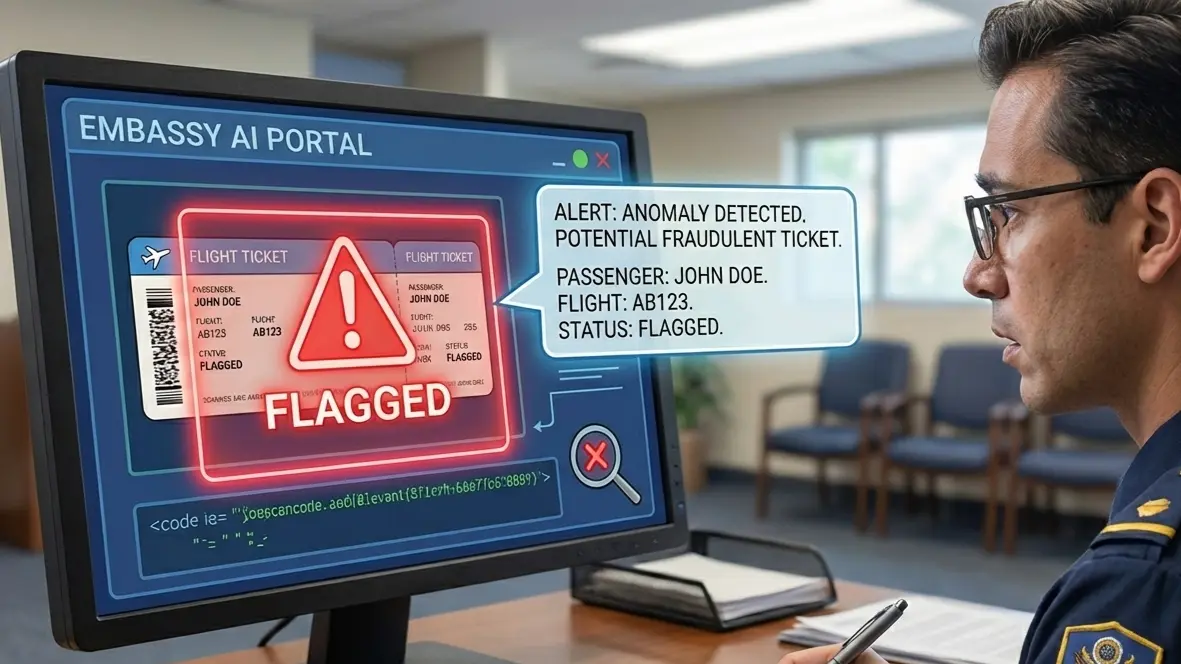
The phrase “visa AI” should be used carefully. Most applicants never see the internal review workflow, and different governments use different mixes of intake software, data matching, fraud filters and human casework. What you can control is the document signal: whether your dummy ticket looks like one stable, realistic piece of a wider travel plan.
This guide focuses on the dummy-ticket risk signals that a data-assisted review can notice. If you need the foundation first, read what is a dummy ticket. For the wider application framework, use the complete dummy ticket for visa guide. For country and document examples, continue with dummy ticket for visa.
In This Guide
How Automated Screening Reads a Flight Reservation
A human sees a PDF. A data-assisted workflow can read fields, compare dates, compare names, detect inconsistencies and surface a file for extra attention. It does not need to “understand travel” the way a person does. It only needs to notice that one piece of the file does not line up with another.
That is why the PDF design is not the strongest signal. The stronger signals are the passenger name, booking reference, travel dates, route sequence, airline logic and whether the flight plan matches the application story. A beautiful reservation with a stale locator is weaker than a plain document with a coherent record behind it.
What a system can read from the file
- Passenger name and spelling pattern.
- Departure and destination city pairs.
- Flight dates and return or onward date.
- Booking reference or record locator.
- Airline, flight number and operating-carrier fields.
- Whether document dates conflict with other uploaded documents.
The review does not always need a full airline lookup to create concern. A route can look strange on its own. A date gap can be visible from the form. A name mismatch can appear before anyone checks the PNR. The safest dummy ticket is therefore designed as part of the whole file, not as a standalone PDF.

The Consistency Score Problem: One Detail Can Break the Whole File
The source article’s strongest idea is the “consistency score” problem. That is the right mental model. Visa documents are often evaluated as a story: who is traveling, where they are going, why they are going, when they return and whether the supporting evidence agrees. A dummy ticket only helps when it reinforces that story.
One mismatch may be harmless if it has an obvious explanation, such as an overnight flight arriving the next day. But several mismatches create a pattern: hotel starts late, insurance ends early, invitation says different dates, and the PNR no longer retrieves. That pattern makes the reservation look less like a genuine travel plan and more like a document assembled for submission.
Common consistency breaks
- The visa form says one travel window while the ticket shows another.
- The hotel booking begins after arrival without an explanation.
- The return flight leaves after insurance has ended.
- The invitation date does not match the arrival date.
- The booking name drops or rearranges key passport-name elements.
- The route enters one country but the main stay is somewhere else with no logic.
Synthetic pattern flags that humans often miss
Some dummy tickets look fine to the applicant because the logo, passenger name and flight number are visible. The weaker signals are more subtle. A booking can look like it was generated from a fare-search screen rather than from a settled trip: unusual same-day backtracking, a connection that no normal traveler would choose, or a return date that seems selected only to satisfy a form field.
Automated review does not need to prove intent. It only needs to surface the file as inconsistent or worth a second look. That is why the safest route is usually the most boring route: one reasonable hub, enough connection time, a clear arrival city and a return or onward sector that matches the stated purpose.
When a reservation looks made for a visa, not for travel
A reservation starts to look manufactured when it ignores traveler behavior. For example, a first-time tourist with modest funds may show a premium multi-city route, or a seven-day holiday may include four countries and several airport transfers. The issue is not that multi-city travel is impossible. The issue is that the itinerary must match the traveler profile, budget, leave window and supporting documents.
The Dummy Ticket Triggers That Most Often Get Flagged
Most dummy-ticket flags come from ordinary operational problems: stale holds, schedule changes, route artifacts, name mismatches and over-edited PDFs. These are preventable if you check the record before submission and avoid last-minute document improvisation.
| Trigger | Why it creates risk | Cleaner fix |
|---|---|---|
| PNR does not resolve | The record may be expired, entered under the wrong name or not visible through the claimed channel. | Refresh or correct the booking before submission. |
| Schedule changed after PDF creation | The PDF and live lookup no longer describe the same itinerary. | Download an updated version and align supporting dates. |
| Implausible route | The itinerary looks like a fare-search artifact rather than a trip a person would take. | Choose a simpler route with realistic layovers. |
| Name mismatch | The record may not map cleanly to the passport or application form. | Use passport spelling as the master source. |
| Manual PDF edits | Fonts, spacing, timestamps or metadata can create tampering signals. | Correct the booking through the provider workflow. |

PNR That Does Not Resolve Cleanly
This is the fastest way for a dummy ticket to lose credibility. A booking reference is useful only when it supports the same passenger and itinerary shown in the PDF. If the record does not display, ask whether the hold expired, whether the surname was entered differently or whether the booking is visible only through an agency channel.
Do not submit a file just because the seller says “it is in the system.” Ask for the correction, verify the new output and save one final version. If the provider cannot explain retrieval, the document should not be treated as strong evidence.
Schedule Changes and Mismatched Snapshots
Airline schedules move. Flight numbers change. Departure times shift. A dummy ticket created before the change can still look polished while no longer matching the current route. That gap matters because the uploaded PDF, airline lookup and application dates should tell the same story.
Before submission, check whether the record still shows the same route, dates and sequence. If a schedule moved by minutes, it may be harmless. If it moved the calendar date, changed a connection or affected the return, refresh the document and recheck hotels and insurance.
Route Risk and Synthetic Traveler Behavior
Automated or human review can notice when routing looks unnatural. A short tourist trip with several countries, a strange backtrack, a risky self-transfer or an unnecessary long loop can make the travel plan look manufactured. This is especially true when the applicant has limited travel history or thin supporting documents.
Use one clear entry, one clear exit and one main destination logic. If the route is unusual, the supporting documents should explain why: event city, family host, cheaper hub, limited flights or a legitimate open-jaw plan.
Name, Passport and Profile Mismatches
A name mismatch can look more serious than it feels to the applicant. Long names, middle names, hyphens and spacing differences are common, but the record must still map clearly to the passport. If your passport was renewed, do not mix old and new passport identity details across documents.
Profile mismatch is broader. A premium-looking route can conflict with modest funds. A long trip can conflict with short leave. A last-minute departure can conflict with slow visa processing. The reservation should fit the person, not just the keyword.
Over-Editing the Reservation
Many applicants try to “fix” a reservation by editing the PDF. That is dangerous. Manual edits can change fonts, spacing, metadata, line breaks and barcode quality. If a date or name is wrong, correct the booking and regenerate the document. Do not patch the PDF like a poster.
Build a Dummy Flight Ticket That Survives Screening and Human Review
The safest build sequence is simple: build the route, verify the record, freeze the submission version and submit one coherent set. The mistake is treating each document as a separate task. The better approach is to treat the flight reservation, hotel booking, insurance and form as one calendar.

Should you use a dummy reservation or buy a refundable ticket?
A refundable ticket can make sense if your dates are certain, the refund terms are clear and you can afford the temporary hold on funds. But it is not automatically better. Refund policies can be restrictive, and a fully paid ticket can still create problems if the visa decision arrives late or with a different validity period.
A dummy reservation makes more sense when the checklist allows a reservation, the travel plan is still flexible and you need a document that supports the application without full airfare exposure. The choice should follow the visa type, timing and financial risk — not fear.
Build → Verify → Freeze → Submit
- Build a route that matches the destination and purpose.
- Verify the passenger name, dates, route and PNR where possible.
- Freeze one final PDF after the checks pass.
- Submit that version with matching hotels, insurance and form dates.
After freezing, avoid unnecessary changes. Every new version increases the chance that one document in the folder falls out of sync. If a change is necessary, change the full file calendar, not only the flight PDF.
Airline lookup is not the only review layer
Applicants often think the entire risk is “will the officer check the airline website?” That is too narrow. A file can be questioned before anyone touches an airline page because the data inside the application already conflicts. A date gap, a name mismatch, a route that contradicts the main destination, or a hotel stay outside the flight window can all create review friction.
Think in layers. Layer one is visual document quality. Layer two is booking-record visibility. Layer three is cross-document consistency. Layer four is traveler plausibility. Strong files pass all four layers without needing a long explanation.
The freeze point matters
Many problems happen after the applicant receives a good reservation. They keep shopping, ask for a better flight time, change hotels, move the appointment, then forget which version was uploaded. By the time the file is submitted, the folder contains three itineraries and two hotel windows. That version drift is more dangerous than a simple flight-time change.
Set a freeze point. Once the reservation, hotels, insurance and form dates match, stop editing unless a material change forces a full refresh. If you refresh, refresh the whole story instead of only the flight PDF.
How to Stress-Test Your Reservation Like a Screening System Would
Before submission, run the ticket through a blunt checklist. The goal is not to prove that every system will accept it. The goal is to remove the avoidable signals that make a reservation easy to question.
| Stress test | Question to ask | Pass condition |
|---|---|---|
| Identity | Does the name map to the passport? | Same surname and given-name logic across documents. |
| Dates | Does the trip window match every document? | Flights, hotels, insurance, invitation and form align. |
| Route | Would a real traveler choose this route? | Simple path, realistic layovers, clear entry and exit. |
| PNR | Can the booking reference be checked or explained? | Record supports the PDF or provider explains visibility limits. |
| Version | Are there competing files? | Only one final reservation is submitted. |
The two-minute final scan
- Open the final PDF.
- Check the name against the passport.
- Compare entry and exit dates with the visa form.
- Compare hotel and insurance dates.
- Check the route for impossible or unnecessary connections.
- Confirm the booking reference where possible.
Why Dummy Tickets Get Flagged Even When Everything Looks Correct
Some files face tighter scrutiny because the overall profile needs more evidence. A first-time applicant with a thin travel history, a multi-country Schengen route, uncertain funds or a vague purpose may get more questions than a frequent traveler with a simple plan. The dummy ticket is then judged inside a wider risk picture.

High-scrutiny profiles
High scrutiny does not mean refusal. It means the document set must work harder. The flight reservation should be conservative, the trip length should match funds and leave, and the route should avoid unnecessary complexity. If the rest of the file is weak, do not ask the ticket to carry the whole story.
Multi-country itineraries and “too much trip” problems
A multi-country itinerary can be legitimate, but it adds more points of failure. Every hotel night, city move and border crossing must make sense. For short Schengen visits, the main destination should be obvious. If a seven-day trip tries to cover four countries, the issue is not the dummy ticket — it is the itinerary logic.
Last-minute submissions and freshness problems
Last-minute files are risky because the applicant has less time to detect changes. A reservation generated at midnight for a morning appointment may be correct, but there is little margin for repair. Build earlier when possible, verify again near submission and avoid panic edits.
Airline inventory behavior
Some holds expire quickly because of airline rules, fare class, route or booking channel. That is normal. What matters is whether the applicant understands the validity window and refresh process. A stale hold becomes risky only when it is submitted as if it were current.
If an officer asks for more proof
Respond with one clean version and a short explanation if requested. Do not send several conflicting reservations. If the question is about travel intent, support the itinerary with hotel dates, invitation details, leave letters or a revised reservation that matches the full file.
What if the PDF looks correct but the record is not current?
This is the awkward middle case. The document may not be fake, but it may no longer be useful. Holds expire, schedules change and booking channels can stop exposing a record after a certain period. If the file is still consistent with the application and the checklist does not require live airline retrieval, it may remain understandable; if the record is central to your proof, refresh it.
The safer move is to avoid submitting a stale document when a fresh one is available. A current reservation that matches the same trip story is cleaner than an old PDF supported by screenshots and explanations.
How to answer a follow-up without creating a second problem
If a visa office or visa center asks for updated travel proof, answer with one updated reservation and a short, factual note. Do not send every draft you have. Do not add unrelated routes. Do not change the destination just because the first booking expired. Keep the trip length and purpose stable unless your actual plans changed.
- Use one updated reservation.
- Match the same passenger spelling.
- Keep the same destination logic.
- Update hotels or insurance if the dates moved.
- Keep the explanation short and factual.
Timing Rules That Reduce Automated Review Friction
Timing is one of the least glamorous parts of a dummy ticket, but it is often where the file breaks. Create the reservation too early and it may be stale by the time the file is reviewed. Create it too late and you may not catch a route, name or date mismatch. The best timing depends on appointment stability, destination rules and how many supporting documents must move with the ticket.
- If your appointment is stable, create the reservation after the travel window is locked.
- If your appointment may move, choose a trip window that can shift without changing the story.
- If the visa review is likely to take longer, avoid a departure date that is too close to the appointment.
- If you refresh the ticket, recheck hotel, insurance and invitation dates.
The goal is not to keep changing the reservation. The goal is to create it at the moment when it is most likely to remain consistent through submission and any reasonable follow-up.
How to Keep Your Schengen File Clean Under Automated Screening
Schengen files are especially sensitive to entry-exit logic, main destination and date consistency. The EU Visa Code’s supporting-document structure is broad, but the practical file still has to read as one trip. Your flight reservation should support the stated main stay, not create a hidden second story.
- Choose one main destination and make it obvious.
- Keep entry and exit dates aligned with the form.
- Use hotel dates that cover the same travel window.
- Avoid complex routes for short stays unless there is a clear reason.
- Refresh stale reservations before submission.
- Keep only one final PDF in the upload set.
If you need a cleaner reservation after your dates are locked, DummyFlights.com can help create a document-ready dummy ticket with route, passenger and date details you can check before submission.
Create the reservation after your travel window is clear, then verify the PNR, route and dates before using it in your visa file.
Visa AI and Dummy Ticket FAQs
Do visa AI systems really check dummy tickets?
Visa systems vary by country, and not every application is checked the same way. A safer way to think about it is that visa files may pass through automated data capture, consistency checks, fraud filters and human review. A dummy ticket can create risk when the booking data, dates or route do not match the rest of the file.
What makes a dummy ticket look low trust?
The highest-risk signals are a PNR that does not retrieve, name or passport mismatches, expired booking data, impossible route logic, duplicated PDFs, inconsistent dates and a document that looks manually edited.
Can a perfect-looking PDF still get flagged?
Yes. A PDF can look polished while the booking reference fails, the schedule has changed, the route is implausible or the document conflicts with hotels, insurance, invitations or leave letters.
Is PNR verification enough to avoid every flag?
No. PNR visibility is important, but it is only one layer. The file also needs consistent dates, realistic routing, correct passenger details and one final version that matches every supporting document.
Why do schedule changes create problems?
A schedule change can make the PDF, airline lookup and visa form describe slightly different trips. If the flight number, departure date, connection or return date changes, the applicant should check whether the submitted file still tells one coherent story.
Can multi-country Schengen itineraries be flagged more easily?
They can create more consistency risk because every city, hotel night, entry point and exit point must fit the main-destination logic. Short trips with too many countries can look less plausible than a simpler itinerary.
Should I buy a refundable ticket instead of using a dummy reservation?
A refundable ticket may fit some applicants, but it can create cash-flow and refund-policy risk. A dummy reservation is often more practical when the checklist allows a reservation and the applicant wants to avoid paying for final airfare too early.
How should I freeze a reservation before submission?
After checking the PNR, dates, passenger name and route, save one final PDF and stop creating new versions unless something material changes. Version drift is one of the easiest ways to create contradictions.
What should I do if the booking reference stops working?
Do not submit the stale file. Ask the provider to refresh or correct the booking, then verify the new record and make sure all supporting dates still match before upload or printing.
Can over-editing a dummy ticket make it worse?
Yes. Manually editing a PDF can create font, spacing, timestamp, barcode and data mismatches. Corrections should be made through the booking or provider workflow, not by altering the document yourself.
What is the safest dummy ticket structure for automated checks?
The safest structure is a simple route, correct passport-name spelling, realistic connection timing, matching hotel and insurance dates, a checkable booking reference where available and one final version used across the file.
Where can I get a cleaner dummy ticket for visa use?
Use a provider that gives a document-ready reservation, realistic routing, correction support and enough information to check the booking details yourself. Always verify the final itinerary before submission.