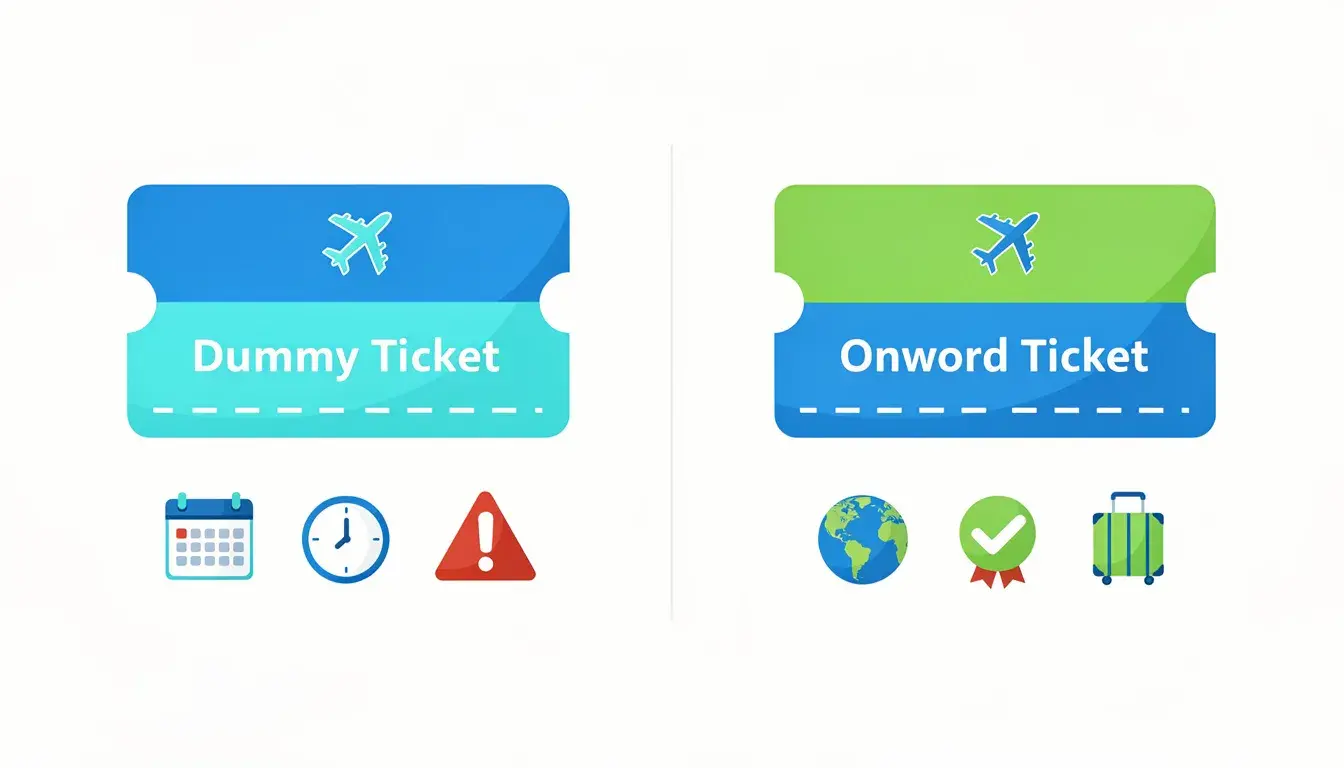

When the request arrives with hours left, panic is the enemy. The goal is not to find the cheapest PDF or the fanciest itinerary. The goal is to choose the proof type that matches the checker, verify it quickly and keep it consistent with the travel story you already gave.
This page owns the urgent onward-proof workflow inside the DummyFlights keyword kingdom. For the basic term, read what is a dummy ticket. For visa-specific document planning, use the complete dummy ticket for visa guide. For broader visa use cases, continue with dummy ticket for visa.
In This Guide
Your visa appointment is tomorrow, and the portal just flagged your itinerary for missing onward travel. Or you are at check-in, and the agent asks for evidence that you are leaving the country today. You have minutes, not days, and the wrong move can cost real money or raise doubts during verification.
In this guide, we will choose the lowest-risk same-day onward option based on who is checking you, how they verify it, and how much flexibility you need right now, with fewer avoidable mistakes. You will learn a fast workflow to generate proof, self-check the PNR and PDF, and carry a backup plan that does not contradict your story. For same-day visa or check-in proof, rely on our verifialbe dummy ticket booking .
The 10-Minute Reality Check: Who Needs Your Onward Proof Today And How They’ll Verify It

A Japan visa reviewer, a Thailand check-in agent, and a UAE immigration officer can all ask for onward travel, but they verify in different ways. If we spot which checkpoint you are facing, you can choose proof that survives the exact test in front of you.
The Three Checkers Behave Differently: Visa Office, Airline Check-In, Border Control
| Same-day situation | Best first move | When to escalate |
|---|---|---|
| Visa upload portal asks for onward travel | Create or refresh a reservation that matches the form, hotels and insurance. | If the PNR cannot be checked and the deadline is close, use a more traceable option. |
| Airline check-in desk asks before boarding | Show a clear onward or return itinerary, email copy and booking view where possible. | If the agent insists on ticketed proof, buy a refundable or change-flex option only after reading rules. |
| Border officer asks on arrival | Answer briefly and show the same onward plan you used at check-in. | If plans changed mid-journey, show the updated document and explain the change plainly. |
Visa office checks are about narrative alignment. In a French Schengen C file or a UK Standard Visitor upload, the reviewer compares your onward date to your itinerary and declared length of stay. They look for contradictions like “10 days in Italy” with an exit flight dated day three.
Airline checks are about boarding liability. On routes like Dubai to Bangkok or London to Manila, the agent is applying destination rules that often include onward travel for short stays. They need something that appears valid now, because they must clear you to board.
Border checks are about credibility. Entering Singapore visa-free or Mexico as a visitor, the officer cares whether your departure plan fits your allowed stay and the story you tell in person. They will challenge gaps, not formatting.
Think of three different pass criteria:
Schengen or UK paperwork: consistency.
Thailand or Philippines check-in: instant verifiability.
UAE or Mexico arrival: believable intent.
The Fastest Way To Identify Your Checker: The Exact Moment You’re Being Asked
Where you are standing tells you who is checking. If a Schengen appointment checklist asks for an onward itinerary, it is an visa office-stage check. If online check-in fails for an Indonesia flight and asks for onward proof, it is an airline-stage check. If an officer at Dubai immigration asks, “When do you leave?”, it is a border-stage check.
A quick label that can work in real life:
Canada TRV portal upload: visa office-stage.
Airport counter for Thailand: airline-stage.
Arrival desk in Singapore: border-stage.
Then match your goal to the moment. In a Schengen file, proof must match your declared dates. At a Thailand check-in desk, proof must be verifiable under time pressure. At Singapore, proof must support what you say out loud.
“Looks Legit” Vs “Is Verifiable”: Why Pretty PDFs Fail Same-Day
Same-day breakdowns happen when someone tries to verify and cannot. This is most common at airline counters for Thailand, Indonesia, and the Philippines, because boarding checks happen minutes before a flight. A clean PDF that cannot be confirmed becomes a denial risk.
Red flags that trigger fast follow-ups on a Dubai to Bangkok route:
Name does not match the passport spelling.
City pair or date differs between pages.
The booking reference cannot be found when checked.
Status language suggests “pending” instead of confirmed.
Visa office staff can also question the flight proof later in a Schengen review, but the urgent failure mode is usually the airline desk, because you cannot “fix it tomorrow” after a missed flight.
What “Verifiable” Really Means In Practice (PNR Consistency, Name Match, Live Status)
For same-day onward proof, verifiable means three things hold together, whether you are submitting for a Japan tourist visa or boarding for Thailand.
PNR consistency: route and date match everywhere.
Name match: passport spelling and order match.
Live timing: the proof looks active at the moment it is checked.
A quick self-check before you show anyone:
On a Thailand itinerary, keep the onward date inside your stated stay window.
On a Schengen trip entering France, keep the onward departure airport plausible for your plan.
Save the PDF offline so you can show it at a Manila check-in desk with weak airport connectivity.
A 60-Second Decision Tree: Pick The Lowest-Risk Option Based On Your Situation
Answer three questions before you upload to a Schengen portal or step up to a Thailand boarding desk.
Who checks first?
Visa office first (Schengen, UK, Canada): date alignment matters most.
Airline first (Thailand, Indonesia, Philippines): instant verification matters most.
Border first (UAE, Mexico): explanation and coherence matter most.
How soon is the check?
Same day, like a Bangkok departure: you need immediate confirmation.
At the gate, like a Manila connection: you need offline access and zero ambiguity.
How much money risk can you accept today?
High, like when you must satisfy a UK timeline: refundable tickets can be simplest.
Low, like when you are flying to Bali tomorrow: reduce cash lock-up and validate immediately.
Apply it fast:
One-way to Bali tomorrow: optimize for airline verification.
Schengen appointment this week: optimize for date consistency.
When You Should Stop Trying To Be Clever And Just Buy A Real Refundable Ticket
Sometimes the lowest-risk move is to pay more. If your situation is high-stakes, like a US B1/B2 interview after a prior refusal or a long-haul check-in to Canada, we should remove verification uncertainty.
Go refundable when:
You have little time to troubleshoot, like a late-night Manila departure.
You cannot miss the flight, like a fixed Japan tour start.
Your dates may shift, like a UK visitor visa timeline.
Still read the refund rules closely for your route to Indonesia or the Philippines, because processing delays can affect your backup plan.
An Airline Desk Asks For Onward Proof At T-3 Hours-What Matters And What Doesn’t
You are checking in for Dubai to Bangkok, and the agent says onward travel is required for boarding.
What matters:
Offline-ready PDF on your phone.
Exact passport name match.
Onward date that fits your stated stay in Thailand.
A simple next step you can explain, like Bangkok to Kuala Lumpur, after two weeks.
What does not matter as much for a Bangkok boarding decision:
Fare codes and price lines.
A “perfect” destination, as long as it is plausible.
Once we know the checker and the verification style for Thailand, Indonesia, or a Schengen file, we can rank same-day onward options by risk instead of guessing.
Same-Day Options Ranked By Risk: What Actually Can Work When Time Is Tight

Once you know who is checking you, the next move is choosing an onward option that survives that specific verification style. We will rank the realistic same-day paths, then map them to the situations where they hold up best.
Option A: Fully Refundable Onward Ticket-Safe, But Only If You Understand The Refund Traps
A fully refundable ticket is the cleanest answer when an officer or airline agent might challenge you, and you cannot afford uncertainty. It can work well for high-friction moments like a one-way check-in to the UK, Canada, or Australia, where the agent may want a straightforward, ticketed booking that stays valid during the whole travel window.
But “refundable” can still create same-day problems if you treat it like a risk-free placeholder.
Watch for these traps before you pay:
Refund timing vs your cash flow: Some refunds take days to settle, which matters if you need the funds immediately for the rest of your trip.
Refund form: some fares refund to the original payment method only, some issue a travel credit depending on fare rules.
Fare difference exposure: you may cancel and rebook later, but the price you see tomorrow may be higher, which can matter if your onward date changes after a visa appointment.
Currency and bank friction: if you pay in one currency and your bank settles in another, the refund can land differently than you expect.
Use this option when the proof must remain stable through multiple checks. A Schengen application routed through one consulate and a later airline check can mean your onward proof gets viewed more than once, by different people, at different times.
Option B: Change-Flex Tickets-Why Flexibility Can Beat Refunds When Decisions Are Unpredictable
Change-flex tickets are often the smarter “same-day” choice when your onward date is likely to move, but you still need a real booking now. This shows up in places where appointment timing is uncertain, like a Japanese tourist visa with document resubmission, or a Schengen file where the consulate requests an updated itinerary after you upload.
The benefit is not the marketing label. The benefit is control.
Before choosing a change-flex fare, confirm what flexibility actually means:
Change fee vs fare difference: many fares remove a change fee but still charge any price difference, which can be substantial close to departure.
Allowed change window: Some fares allow changes only before departure, which matters if you get delayed and need to push the onward segment.
Route lock: Some fares let you change dates but not origin or destination, which matters if your entry city shifts after you book.
Name correction limits: if your passport name formatting is tricky, you want a fare that does not turn a minor correction into a reissue headache.
This option is strong when your immediate goal is to pass a visa review or airline check with a valid booking, while keeping a realistic path to adjust after your plans firm up.
Option C: Airline Holds And Time-Limited Reservations-When They’re Perfect And When They Vanish
Airline holds and time-limited reservations can be ideal for visa office-stage checks where you need a coherent itinerary now, but you do not want to commit funds immediately. They can also work for certain airline check-ins if the hold is visible in the carrier’s system in real time.
The risk is simple. Holds can expire at the worst moment.
Holds tend to fail the same day when:
The hold expires during transit: you check in successfully, then a second agent at a connection airport cannot see a valid onward booking.
The hold converts unpredictably: some holds require a follow-up payment step and may auto-cancel if payment verification fails.
The display is inconsistent: a confirmation email exists, but the PNR view shows incomplete passenger details or missing segments.
Holds are best when you can control the timeline tightly. For example, if you are uploading onward proof for a Schengen appointment happening in a few hours, a time-limited hold can be enough because the check is immediate and document-focused.
Holds are weaker when you face multiple live checks, such as an airline desk plus immigration on arrival, especially on routes where onward travel questions are common.
Option D: Reservation Services That Issue Verifiable PNR + PDF-What To Check Before You Rely On One
A reservation service can be a practical same-day solution when you need a PNR and PDF quickly, and you want to avoid locking a large amount of money into a refundable fare. The success depends on whether the reservation behaves like something an airline agent can confirm during a real boarding check.
Before you rely on a service for onward proof, verify these points:
PNR retrievability: You should be able to pull up the booking details using the booking reference in a standard airline-style interface.
Passenger data integrity: your full name should match your passport format, including spaces and order, if the system enforces it.
Segment clarity: the onward date and route should be unambiguous, with no “floating” placeholders that invite questions.
Stability window: know how long the reservation stays valid, especially if you will transit or arrive after midnight local time.
Support response time: if an airline agent cannot see the PNR, you need a path to resolve it quickly, not “within 24 hours.”
If you choose DummyFlights.com for this use case, it offers instantly verifiable reservations, a PNR with PDF, unlimited date changes, transparent pricing at $15 (about ₹1,300), is credible worldwide for visa use, and accepts credit cards, which can fit a same-day need where you want verifiability without overcommitting.
The “Risk Ladder” For Same-Day Proof: What Fails Most Often And Why
When onward proof fails, it usually fails fast and in predictable ways. Use this ladder to pick the lowest-risk option for your exact checkpoint.
Lowest risk for live checks:
Ticketed, active booking that remains valid through departure and arrival windows.
Clear PNR and consistent passenger name across every view.
Medium risk for live checks:
Time-limited holds that are visible now but may expire during transit or before arrival.
Reservations that are verifiable now but have a shorter stability window than your travel day.
Highest risk for live checks:
Anything you cannot re-open and verify within two minutes when asked at check-in.
Anything with mismatched dates compared to your stated length of stay.
A practical way to use the ladder is to match it to common checkpoints:
A consulate reviewing a Spain Schengen itinerary cares most about date logic and city sequencing.
An airline agent checking a one-way ticket to the Philippines cares most about a PNR that validates immediately.
An immigration officer in Singapore cares most about whether your onward date fits the permission you are requesting at the desk.
Timing Pitfalls: Late-Night Issuance, Time Zones, And “It Exists But Doesn’t Show Yet” Moments
Same-day onward proof breaks in the cracks between systems and clocks. You can avoid most timing issues with two habits: book earlier than you think you need to, and validate immediately after issuance.
Timing pitfalls to plan for:
Crossing midnight locally: your onward date can look wrong if the system displays in a different time zone than the person checking you.
Short verification windows: you may receive a confirmation, but the details may not populate instantly in every lookup view.
Airport connectivity: if you depend on a live lookup while standing at a check-in counter with a weak signal, you want offline copies ready.
A good discipline is to keep a small buffer. If your flight leaves at 19:00, aim to have onward proof locked and verified by 15:00. That gives you room to reissue or switch options without panic booking.
Payment And Reversal Risks: How Last-Minute Transactions Get Flagged (And How To Avoid Self-Sabotage)
Last-minute purchases get flagged more often because fraud controls tighten around travel-related transactions. That matters because a payment failure can leave you with a half-created booking that looks unstable when someone checks your onward proof.
Reduce payment friction with these steps:
Use a card that has passed travel purchases before: new cards and first-time international charges are more likely to trigger verification steps.
Keep billing details consistent: mismatched address formats can cause silent failures on some payment flows.
Avoid rapid repeat attempts: multiple failed charges can lock you out right when you need to rebook.
Save every confirmation instantly: keep the PDF, the confirmation email, and the booking reference accessible offline.
If you are booking onward proof while already in transit, treat your device battery like a document requirement. A dead phone at a boarding gate turns a valid booking into an unusable one.
Now that you know which same-day options are lowest-risk and where they fail, the next step is learning how to self-check your onward proof so you never discover a verification problem at the counter.
Verification Without Guesswork: How To Self-Check Your Onward Proof Before Anyone Else Does

Before you upload to a Japan eVisa portal or step up to a Thailand check-in counter, you want to know one thing. If someone tries to verify your onward booking in the next five minutes, will it hold up?
The Self-Check Sequence: What To Validate First So You Don’t Waste Time
Start with the checks that fail fastest at airline counters on routes like Dubai to Bangkok or Istanbul to Manila. If these fail, nothing else matters.
Use this sequence:
Passenger Name First: Match your passport exactly, especially for Schengen applications, where the consulate compares documents line by line.
Date and City Pair Second: Confirm the onward date fits the stay you are claiming for Singapore entry or a Philippines visit.
Booking Reference Third: Make sure the PNR actually pulls up somewhere, not only inside an email.
Status Last: Look for a state that behaves like an active reservation right now, not a “we will confirm later” situation that collapses at a UK check-in desk.
If you start with PDFs and formatting, you can miss the one issue that gets you denied boarding to Thailand. Name mismatch beats design every time.
PNR Checks: What You Can Confirm, What You Can’t, And What “Pending Ticketing” Implies
A PNR can exist in multiple states, and that matters most at airline verification points like a Bangkok departure or a Manila transit.
What you can usually confirm quickly:
The itinerary segments exist for your Bangkok to Kuala Lumpur onward route.
Your name appears on the booking in a consistent way for a Canada boarding check.
The booking reference returns an itinerary view, even if you are checking from a phone at an Indonesian gate.
What you cannot reliably confirm without deeper access:
Whether the airline will treat it as fully ticketed in every internal screen, which is why Australia and Canada check-ins can be strict.
Whether the reservation will remain active for your full travel day, which matters for multi-leg routes like Doha to Bangkok to Phnom Penh.
If you see language like “pending ticketing” or “on request, treat it as a warning for live checks. For a Schengen visa file, it may still look consistent on paper. For an airline counter, it can trigger “this is not valid” in seconds.
A practical test for a Thailand or Philippines check-in is simple. If you cannot retrieve your booking twice in a row using the same reference, you should not assume an agent will retrieve it under pressure.
Name, Passport, And Format Mismatches That Trigger Instant Scrutiny
Name mismatch is the most common reason onward proof gets questioned on one-way travel to the UAE, Singapore, or Thailand. It is also the easiest to prevent.
Check these name points against your passport:
Order: If your passport lists surname first, confirm the booking does not swap it, because Japan and Schengen reviewers often compare your passport scan with your itinerary page.
Spacing: Some systems compress names, but you still want a consistent appearance between the PDF and the PNR view for a UK Standard Visitor upload.
Middle Names: If your passport includes a middle name, do not drop it on one document and include it on another, especially for a Canada TRV itinerary, where document cross-checks are common.
Special Characters: If your name includes accents, expect a simplified version on airline systems. Keep the simplified version consistent across the reservation and PDF for a France Schengen file.
If you have only minutes at a Thailand check-in desk, a clean name match reduces questions. It also keeps your answers short if an immigration officer in Singapore asks to see the booking on your phone.
Route Logic Checks: Onward Date, Destination Plausibility, And “Why This Airport?” Questions
Route logic is where visa office reviewers and border officers focus. A Schengen reviewer for Italy or France may accept many flight shapes, but they will question contradictions.
Run three logic checks:
Stay Window Check: If you claim 14 days in Thailand, your onward date should not be day two. If you claim 10 days in Japan, your onward journey should not be beyond your stated period.
Airport Geography Check: If your Schengen itinerary says you are in Barcelona, an onward flight departing from Paris invites follow-up unless you show a clear transit plan.
Purpose Fit Check: If you tell Singapore immigration you are visiting friends, an onward flight that implies a rapid multi-country sprint can look odd unless it fits your story.
Pick a destination that matches how people actually travel. For example, Bangkok to Kuala Lumpur reads as a normal onward plan for Southeast Asia. Tokyo to Seoul reads as plausible for East Asia. These choices reduce “why?” questions at borders like the UAE or Mexico.
Airline-Specific Weirdness: When The PNR Exists But The Itinerary View Is Inconsistent
Airline systems do not always display the same way across channels, and this can surface at check-in for destinations like Indonesia or the Philippines.
Common weirdness you should anticipate:
Segment Visibility Gaps: A booking may show in one view but omit a segment in another, which can confuse an agent checking onward eligibility for Thailand.
Different Date Displays: Time zones can cause the date to appear off by one day in some views, which matters if you land in Singapore after midnight and an officer looks at your onward date.
Name Truncation: Long names can truncate differently across views, which can trigger a “not matching” reaction at a Canada or Australia counter.
Your job is not to fix airline IT. Your job is to carry a version that stays coherent when viewed quickly.
If you see an inconsistency, choose the most conservative representation and stick with it. For a Schengen submission to the Netherlands, consistency across your uploaded PDF and your booking view matters. For a Thailand boarding check, consistency in the live retrieval matters more.
PDF Integrity: What Raises Eyebrows (Fonts, Missing Metadata, Strange Fare Lines) Without Being “Fake”
Visa office reviewers for Schengen countries, Japan, and the UK often skim dozens of files. They notice when a document looks unusual, even if it is technically correct.
You are not trying to make a PDF “look expensive.” You are trying to make it look like a normal itinerary.
Watch for avoidable presentation issues:
Odd formatting shifts: Mixed font sizes or misaligned passenger fields can look careless in a Spanish Schengen bundle.
Missing key fields: If the PDF omits the booking reference or passenger name, it forces extra verification steps in a Japan visa review.
Unnecessary price clutter: Some fares display strange tax lines. That is not automatically a problem, but if it distracts from the route and date, it can slow a UK visitor review.
Inconsistent headers: If the top of page one shows one date format and page two shows another, a France Schengen reviewer may question whether the itinerary was reassembled.
A clean PDF is not about design. It is about quick scanning. For a Schengen file, put the reviewer’s eyes on the name, route, and dates within two seconds.
A Quick Screenshot Plan: What To Capture On Your Phone For Backup At The Counter
At airline counters in Thailand, Indonesia, and the Philippines, proof fails in the moment because you cannot open what you already have. Screenshots solve that.
Capture these items right after booking:
Itinerary Summary Screen: One screen with passenger name, route, and date. This is useful at a Bangkok gate when your email app stalls.
Booking Reference Screen: A screen that shows the PNR clearly, useful if a check-in agent asks for the code to look it up.
Email Subject Line Screen: A screenshot showing the subject line and timestamp, useful for a UK check-in desk where staff want quick context.
Offline PDF Saved View: Open the PDF once, then screenshot the first page, useful if airport Wi-Fi fails in Manila.
Keep screenshots in a dedicated album named “Onward Proof.” At Singapore immigration, you want to access it without searching your inbox under pressure.
You Have A PNR, But The Agent Can’t See It-What You Do In The Next 90 Seconds
Picture a one-way check-in for Bangkok, and the agent says they cannot retrieve your onward booking using the reference.
Do this, in order:
Confirm Spelling Out Loud: Ask the agent to read back the passenger name they entered, because one letter off can break retrieval on airline systems used for Thailand checks.
Offer The Alternate View: Show your itinerary screenshot and the PDF first page, because it may help the agent search by route and date on a Philippines-style boarding checklist.
Switch Retrieval Method: If the agent’s system fails by reference, ask if they can search by name and date, which sometimes can work at UAE departure counters.
Avoid Over-Explaining: Keep your phrasing simple: “This is my onward flight on this date,” which aligns with what Singapore officers typically want.
Trigger Your Backup Threshold: If retrieval still fails after a short attempt, you pivot immediately to a different same-day option so you do not miss boarding.
The key is speed. At a gate, you do not win by debating. You win by producing a verifiable view and moving the process forward.
Once your proof passes your own checks, we can move to the exact same-day workflow that gets you from “I need proof now” to “I’m checked in” without panic changes.
The Same-Day Workflow: From “I Need Proof Now” To “I’m Checked In” (Without Panic Booking)
Same-day onward proof can work best when you treat it like a short operational sprint, not a shopping exercise. We will move from decision to booking to verification to a counter-ready pack, with clear pivot points so you do not get stuck.
Step 1: Decide Your Target Window-Proof For Submission Vs Proof For Boarding, Vs Proof For Landing
Start by naming the exact checkpoint you must pass today. Different checkpoints punish different mistakes.
Proof for submission means a consulate or visa portal will review it later, like a Japan eVisa upload or a Schengen appointment bundle. Your risk is inconsistency across documents.
Proof for boarding means an airline agent will verify it now, like a one-way check-in to Thailand, Indonesia, or the Philippines. Your risk is non-retrievable bookings.
Proof for landing means an immigration officer may ask on arrival, like in Singapore, Mexico, or the UAE. Your risk is a story that does not match your onward date.
Set a time horizon:
If your check is in hours, you need immediate retrievability and offline access.
If your check is in days, you need date logic that matches your itinerary narrative.
This one decision prevents the classic same-day mistake: choosing a document that looks perfect for a portal, then failing at a boarding desk.
Step 2: Choose The Booking Method Using The Decision Tree (And Commit-No Tab-Hopping)
Same-day mistakes often come from running five options in parallel. That creates duplicate bookings, mixed dates, and confusing emails, which look messy in a Schengen file and create delays at check-in.
Commit to one path based on your checkpoint:
If you need boarding proof today for Thailand or the Philippines:
Prioritize an option that creates a stable, retrievable booking reference right away.
Avoid anything that might sit in a “processing” state while you stand at the counter.
If you need submission proof today for a Schengen appointment:
Prioritize a clean itinerary that matches your stated entry date, exit date, and internal route.
Avoid an onward date that conflicts with your cover letter or travel plan.
If you need landing proof today for Singapore or Mexico:
Prioritize an onward date that matches what you can confidently explain in person.
Avoid complex multi-leg routings that invite extra questions.
Then stop. Do not keep searching for a “better” option after you book. Every extra attempt increases the chance you mix dates or names.
Step 3: Build An Itinerary That Doesn’t Invite Questions (Dates, Layovers, Destination Logic)
Same-day onward proof gets challenged most often when the route feels like it was built for a document, not for travel.
Use these design rules:
Rule A: Keep the onward date inside a believable stay window. If you are flying to Bangkok and you say you are staying for two weeks, set the onward roughly in that window. If you are entering Japan for a short visit, keep your onward travel within your declared days.
Rule B: Match your onward airport to your stated plan. If your Schengen plan lists Rome, Florence, and Milan, an onward departure from Paris creates friction unless you can justify the extra movement. If you say you will stay in Bangkok, an onward journey from Phuket can raise “how are you getting there?” at a border desk.
Rule C: Avoid ultra-tight layovers on paper. If your onward proof includes a connection, do not choose a 35-minute layover that looks implausible. Border officers in the UAE and airline agents for Australia-bound routes often notice unrealistic connections.
Rule D: Keep the destination simple. For Southeast Asia, Bangkok to Kuala Lumpur is easy to understand. For East Asia, Tokyo to Seoul is easy to understand. For Schengen, exiting from a major hub close to your last city is easy to understand.
If your itinerary involves multiple countries, reduce complexity on the onward segment itself. You want the onward to answer the question “When do you leave?” without triggering “Why is this so complicated?”
Step 4: Validate Immediately-What To Do The Moment You Receive The PNR/PDF
Your goal is to catch problems while you still have time to pivot.
Do this within two minutes of receipt:
Check the passenger's name against your passport screenshot. Look for missing middle names or swapped surname order.
Check the onward date in the local time context. If you depart late at night, confirm the displayed date matches your intended day.
Check the city pair and flight numbers. Ensure the segment is clearly an onward departure from your destination country or region.
Check that the booking reference pulls up consistently. Try it twice, with a fresh app or browser tab.
If anything fails, do not “wait and see.” Same-day verification problems rarely improve under time pressure. Fix it or pivot immediately.
A useful rule for live checks: if you cannot retrieve your booking on your phone in under 30 seconds, you should assume a check-in agent cannot retrieve it during a busy counter rush.
Step 5: Create A “Counter-Ready” Pack: PDF + Email + Verification View + Payment Receipt (If Helpful)
A counter-ready pack is not about looking official. It is about reducing friction when someone asks fast questions.
Build one folder on your phone and one in your email drafts.
Include:
PDF itinerary saved offline.
The booking confirmation email is openable without a search.
A verification view, like a screenshot, showing the booking reference and itinerary summary.
Passport photo page screenshot, so you can confirm spelling quickly if questioned.
Payment receipt only if it clarifies legitimacy at an airline desk. This can help when a staff member asks whether the booking is ticketed, but it is not always needed for a Schengen file.
Label the files clearly:
“Onward Flight PDF”
“Onward PNR Screenshot”
“Passport Name Screenshot”
At busy airports, the person checking you may not have time to scroll. Your job is to show the key fields instantly.
Step 6: Set Your Fallback Trigger: The Exact Point You Switch To A Different Option
Same-day success depends on not getting trapped in a failing approach.
Set a clear trigger based on your checkpoint:
For airline boarding checks to Thailand, Indonesia, or the Philippines:
If the agent cannot retrieve the booking after one clean attempt using the reference, you pivot.
If your booking shows “pending” language at the counter, you pivot.
If your onward date looks off by a day because of the time zone display and the agent hesitates, you pivot to a simpler segment.
For visa office submission, like Schengen or Japan:
If your itinerary date conflicts with your application form dates, you must reissue or change the itinerary before uploading.
If the route conflicts with your hotel city sequence, you adjust the exit city to align with your declared plan.
For landing checks like Singapore or Mexico:
If you cannot explain the onward route in one sentence, you pivot to a simpler onward destination.
Your fallback trigger should be tied to time. For example:
“If I cannot produce a retrievable onward booking by T minus 90 minutes, we switch options.”
This removes emotion from the decision and prevents a last-minute scramble.
Departing From Delhi On A Midnight Flight-How To Avoid Time-Zone And After-Hours Verification Issues
A midnight departure amplifies timing problems. The date displayed on your itinerary can shift based on time zone settings, and support channels may be slower late at night.
If you are departing from Delhi close to midnight:
Book your onward proof earlier in the evening, not during the final hour.
Check the itinerary date in both local time and the airline’s display view.
Save the PDF and key screenshots offline before you reach the airport.
Choose an onward segment that is easy to read at a glance, with no ambiguous overnight timing.
This reduces the risk of an agent reading your onward date as the wrong day while you are already in the security queue.
Now that you have a workflow to generate and package same-day onward proof, the next step is spotting the specific failure modes that cause document risks or on-the-spot refusals even when your document looks correct.
Same-Day Mistake Checklist For Onward Proof
Same-day onward proof usually fails for boring reasons, not dramatic ones. The key is catching the specific mistakes that trigger a Schengen reviewer’s doubt or an airline agent’s “no board” decision in under a minute.
The 12 Errors That Blow Up Fastest (Wrong Date Logic, Mismatched Name Order, “Too Perfect” Routing)
Use this checklist before you upload to a Japan eVisa portal, print documents for a Schengen consulate appointment, or walk up to a Thailand check-in desk with a one-way ticket.
Exit Date That Conflicts With Your Declared Trip Length If your France Schengen form says 12 days but your onward shows day 4, your file reads inconsistent even if the ticket looks clean.
Onward Date Outside The Allowed Stay You Are Claiming At The Counter If you tell Singapore immigration you are staying one week but show an onward ticket in three weeks, you invite questions you cannot solve with a PDF.
Name Order Or Spelling Not Matching The Passport MRZ A UK Standard Visitor reviewer may not care about spacing, but an airline agent for Indonesia can fail to retrieve the booking if one letter is off.
Passport Number Inserted On One Document But Missing On Another Some Schengen applicants add passport numbers to one itinerary and not others, which makes the package look edited rather than issued.
Departure City That Does Not Match Your Itinerary Geography If your Spain Schengen plan ends in Barcelona but your onward departs from Amsterdam, you force the reviewer to guess how you move across Europe.
Onward Flight That Leaves Before You Even Arrive This sounds obvious, but it happens on overnight routes like New York to Tokyo , where time zones can flip dates and make your onward look impossible.
“Transit” Itinerary That Requires A Visa You Do Not Hold If your onward routes through a country where you need a transit visa, a Canadian boarding check may treat the plan as not credible for immediate travel.
A Reservation That Cannot Be Retrieved Twice In A Row If your onward for Philippines check-in loads once and fails the second time, assume the counter system will fail when it matters.
PDF Pages That Do Not Match Each Other A German Schengen reviewer will notice if page one shows one date format and page two shows another, even if you meant no harm.
Itinerary That Looks Algorithmic, Not Human Four countries in five days on a Schengen tourist visa can read like “document-first planning,” which can cause deeper scrutiny.
Mixed Currencies Or Tax Lines That Suggest Re-Assembly A Japan visa reviewer may not care about price, but inconsistent currency lines can make the file feel stitched together.
Onward Destination That Contradicts Your Stated Purpose If your Mexico visitor entry story is “family visit in Cancun” but the onward is a complicated loop to three unrelated cities, it invites “why?” on arrival.
The “Cancellation Paradox”: Why Canceling Too Quickly Can Backfire Even If Your Visa Is Submitted
Cancel timing can create trouble when there is a second check after the first one. This shows up when your Schengen visa is still processing, and you later fly your entry leg, or when you submit a Japan tourist visa and then get asked for proof again at airline check-in.
Here is the paradox. You cancel to reduce cost risk, but cancellation can create a record mismatch if someone checks again.
Situations where quick cancellation is risky:
Schengen consulate asks for an updated itinerary after submission, which happens in some cases when dates shift or documents are incomplete.
Airline check-in re-checks onward even after online check-in, which can occur on routes to Thailand and Indonesia.
Transit checkpoints where a second agent verifies documents during a connection, which can happen on long-haul routings through major hubs.
A safer approach for a Netherlands Schengen file is to keep onward proof stable until you are past the last point it could be requested. For a Thailand boarding scenario, “past the last point” may mean you have physically boarded, not just checked in.
Refund Misconceptions: When “Refundable” Is Not Refund-Now
Refundable tickets solve many verification problems, but they create a different same-day risk: people assume the money returns instantly. On a tight timeline like a UK visitor visa appointment tomorrow, a refund delay can leave you short on funds for accommodation holds, insurance, or onward changes.
Common misconceptions that cause panic:
“Refundable” equals instant reversal: many refunds take days, which can matter if you must book a replacement onward for a Philippines flight the same afternoon.
“Free cancellation” equals free at any time: some fares require cancellation before a cutoff, which can be unforgiving on routes with delays into Dubai.
“Same airline means same policy”: policies differ by fare class and market, which matters when you buy a refundable leg for Canada travel and later need to adjust.
If you pick refundable for a Japan trip, treat it like a controlled expense, not a temporary authorization. Your workflow should include a cash buffer if you might need to book again before a refund lands.
Over-Editing Documents: The Quiet Line Between “Formatted” And “Suspicious”
Over-editing is most dangerous at document-heavy checkpoints like Schengen and UK applications, because the reviewer has time to compare details across pages. A small cosmetic change can accidentally create inconsistencies that look intentional.
Edits that often create problems:
Changing date formats on a France Schengen itinerary, but forgetting to change it on the second page.
Cropping out booking references on a Japan eVisa upload, which removes the one field that supports verification.
Replacing airline logos or headers to “clean it up,” which can make the document feel manufactured.
If you must adjust presentation for a Spain Schengen bundle, limit changes to file naming and page order, not content. The lowest-risk document is the one that matches itself across every view.
Using Unrealistic Onward Destinations: How To Pick A Destination That Won’t Trigger “Why?”
Unrealistic destinations cause different problems depending on who is checking you. A Schengen reviewer questions itinerary credibility. A Singapore immigration officer questions intent. An airline agent for Indonesia questions whether the plan is usable.
Avoid destinations that create obvious follow-up questions:
Routes that require a visa you do not hold, especially for transit-heavy plans when flying to Australia or Canada.
Ultra-long repositioning flights that make no sense for your stated trip, like leaving Bangkok for a far-away city when your story is a short regional visit.
Airports that do not match your plan, like departing from a different Schengen country than the one you claim to spend most time in, without explanation.
A better strategy is to choose a destination that fits common travel patterns for your region and visa context. For example, if your plan is Southeast Asia tourism and you are dealing with a Thailand onward check, pick a nearby onward that reads as normal. If your plan is Schengen tourism, exit from a city that aligns with your final stop.
Multiple Overlapping Itineraries: When It Looks Like You’re Gaming The System
Overlapping itineraries are a hidden risk in same-day stress. People book three different onward options “just in case,” then accidentally upload one to a Japan visa portal, email another to a Schengen appointment, and show a third at check-in for Indonesia.
This creates contradictions fast:
A UK reviewer sees one exit date, then your supporting documents show another.
An airline agent for the Philippines sees a different onward than the one you claim verbally, which can trigger deeper checks.
An immigration officer in Mexico asks why your email shows a different plan than your printed page.
If you must hold multiple options for a Schengen file due to appointment uncertainty, control it like a version system:
Keep only one “active” itinerary in your phone’s offline folder.
Archive the rest in a separate folder labeled “Do Not Use.”
Use consistent file names with dates, like “Onward 14 Mar 2026.”
Your goal is not to hide flexibility. Your goal is to avoid presenting conflicting evidence.
You Submit Onward Proof, Then Your Appointment Gets Rescheduled-What To Update And What To Leave Alone
This happens often with Schengen consulate appointments and occasionally with Japan visa processing timelines. The mistake is updating everything at once and creating a new inconsistency.
If your Schengen appointment moves by a few days:
Update: the onward dates if the new appointment date changes your stated travel window.
Update: your cover letter trip dates to match the new onward.
Leave alone: your city sequence if the trip plan is unchanged, because changing cities can create new questions about accommodation and internal travel.
Leave alone: passport and personal info files, so your document set stays stable.
If the consulate or portal does not request re-uploads, do not rush to replace files unless the date mismatch is obvious. For a German Schengen reviewer, a neat, consistent set of documents is often better than a patchwork of last-minute revisions.
The next step is handling the exceptions where onward rules get weird, like transit-only routings, separate tickets, and border situations that do not follow the usual patterns.
Exceptions, Risks, And Uncommon Cases: Where Onward Proof Rules Get Weird
Most onward checks are predictable, but the edge cases cause the real stress. These are the situations where a normal-looking onward itinerary can still get questioned at a Schengen desk, an airline counter to Indonesia, or an arrival booth in Singapore.
One-Way Entry With High Scrutiny: When Onward Proof Becomes A “Story” You Must Be Able To Explain
One-way entry is where onward proof stops being a document and becomes a narrative test.
This shows up on routes like:
Gulf hubs to Southeast Asia, such as Doha to Bangkok.
Europe to Mexico, where officers may probe intent for visitor entry.
One-way arrivals into Singapore, where short-stay rules are strict even for visa-free visitors.
What makes scrutiny higher is not the one-way itself. It is the mismatch between your one-way arrival and your explanation.
Build a one-sentence story that matches your onward:
“We are touring Thailand for 12 days, then flying to Kuala Lumpur.”
“We are visiting Japan for a week, then returning via Seoul.”
“We are doing a two-city Mexico trip, then flying home.”
Avoid stories that trigger follow-ups:
“We will decide later” paired with an onward that looks overly structured.
“We might extend” paired with an onward that is outside the stay you request at the desk.
If you cannot say your plan in one clean sentence, simplify the onward segment. Officers in the UAE and Singapore often accept simple clarity over elaborate detail.
Visa-Free Vs Visa-Required Onward Destinations: How It Changes The Credibility Of Your Plan
A surprising number of onward plans fail because the onward destination creates a new visa question.
Example: you show an onward from Bangkok to a country where you need a visa, but you cannot show that visa. Even if your goal is only to prove you will leave Thailand, a boarding agent may still evaluate whether your onward plan is usable.
This matters in three common contexts:
Airline checks for Thailand, Indonesia, and the Philippines: staff may not want to board you if your onward flight looks impossible.
Transit-heavy routes to Canada or Australia: the airline may check onward plus transit legality.
Border checks in Singapore or Mexico: officers may ask where you are going next and whether you can enter.
A safer design principle is to choose an onward destination you can plausibly enter under your current passport and visa situation, or where you can clearly explain your entry plan.
Quick credibility check:
Do you need a visa for the onward country?
If yes, can you show it instantly if asked?
If not, is the onward stay window believable?
If you cannot answer yes to the first two, do not pick that onward in a same-day rush.
Transit-Only Itineraries: When “I’m Just Transiting” Still Needs Onward Evidence
Transit itineraries cause confusion because people assume transit means fewer questions. Often, it is the opposite.
Consider a routing like Nairobi to Dubai to Manila. You may be “just transiting” Dubai, but the airline still needs to confirm you meet entry or transit rules at every point, especially if you have separate tickets.
Transit pain points:
Transit visa misconceptions: some airports have rules that depend on passport, terminal change, or overnight transit.
Onward proof ambiguity: if your onward is on a separate ticket, staff may treat it as uncertain.
Timing gaps: long layovers can look like an attempted entry, which changes what proof is expected.
If you are using onward proof to support a transit plan, keep the itinerary simple:
One onward segment that clearly continues the journey.
A layover time that looks realistic, not extreme.
Clear dates that do not flip due to time zones.
For visa office submissions like a Schengen file, transit segments can be included, but the onward proof still needs to show you exit the region within your requested stay.
Low-Cost Carriers And Separate Tickets: Why Your Onward May Not “Connect” In The Agent’s Worldview
Low-cost carriers and separate tickets are common in Southeast Asia and parts of Europe, and they create a specific verification challenge. Your onward flight is real, but it does not live in the same system as your incoming flight.
Airline agents often think in “single itinerary” terms. If your onward is on a separate ticket, the agent may worry you will miss it and overstay, especially on routes to Thailand and Indonesia.
We should prepare for that mindset.
If your onward is on a separate booking:
Keep the onward departure from the same city you arrive in, when possible.
Avoid tight onward departures that require domestic repositioning, like arriving in Bangkok but departing onward from Phuket the next morning.
Carry the onward proof in a format that shows passenger's name and date clearly, because the agent cannot see it in their own booking.
If your travel day includes multiple separate tickets, the lowest-risk onward proof is the one that is easiest to explain at a counter:
“This is our onward flight from Bangkok on this date.”
“Here is the booking reference and the PDF.”
This approach helps with airline checks and also reduces confusion if an immigration officer asks for onward details on arrival.
Land/Sea Onward Plans: How To Present Proof When Your Onward Isn’t A Flight (Without Forcing A Fake Flight Narrative)
Sometimes your onward is real but not a flight. You may plan to leave Thailand by bus to Cambodia, or exit Mexico by land into the US, or take a ferry out of an island region.
The problem is that many airline and border checks are optimized for flights. They ask for a “ticket” even when your plan is not air.
Two principles keep you safe:
Do not claim you have a flight if you do not.
Do provide a clear, checkable exit plan.
If the checker is an visa office reviewer for Schengen or Japan:
A land or sea onward plan can work if your itinerary narrative supports it.
Your dates still must show you leave within the stay you request.
If the checker is an airline agent for Thailand or the Philippines:
Some agents will insist on seeing a flight onward, because that is the fastest to evaluate.
If your plan is land exit, be ready to explain it briefly and show any booking you have, but understand that the airline may still prefer flight proof for boarding liability.
If you know you will face a strict airline check, it can be safer to carry flight-based onward proof even if your intended exit is by land, as long as your story remains coherent and you do not present contradictions. The goal is to satisfy the border rule set without creating a false narrative at the border.
Traveling With Family Or A Group: Matching Names, Split PNRs, And Why Partial Proof Causes Trouble
Group travel creates a unique trap. One person has onward proof, the rest do not. That can trigger questions, especially at airline counters in Indonesia or the Philippines, where agents verify each passenger.
Common group failure modes:
Split bookings with different dates: one person’s onward is day 10, another’s is day 14.
Name mismatch across family members: one passport includes middle names, another does not, and the onward proof is inconsistent.
Only the lead traveler has the document: the rest cannot show it at a separate counter or gate.
If you travel as a group, build a clean structure:
Keep the same onward date for everyone, unless you can explain why someone leaves earlier.
Store the proof on more than one phone, especially if you expect secondary checks in places like Singapore.
If split PNRs are unavoidable, label them clearly so you do not show the wrong reference for the wrong passenger.
A small operational fix helps a lot: create a shared folder or offline album on two devices, so you can produce the right itinerary even if the group gets separated at the airport.
A Tight Connection Via Mumbai With Separate Tickets-How To Avoid An Onward-Proof Mismatch At The First Check-In
You have separate tickets with a tight connection via Mumbai, and your final destination requires onward proof at check-in. The first airline may ask for onward proof even though your onward is on a different booking.
What keeps this smooth:
Carry the onward proof for the final destination in an offline PDF and a screenshot.
Make sure the passenger's name matches your passport exactly, because the first airline cannot “see” the onward booking in their system.
Avoid presenting multiple versions of onward proof, because separate tickets already make staff cautious.
If the connection is very tight, keep your onward itinerary simple and easy to verify, so the check-in conversation stays short.
The goal is to reduce the number of questions the first airline feels responsible for answering.
These uncommon cases set up the final practical skill: what you say and do when someone challenges your onward proof in real time, and how you recover without creating contradictions.
If Someone Challenges Your Proof: On-The-Spot Scripts, Recovery Moves, And Plan B Bookings
Challenges happen fast, especially when immigration checks or a busy counter turns your flight reservation into a yes or no decision. We will keep your proof of onward travel clean, verifiable, and easy to defend without creating new problems.
When An Airline Agent Says “This May Not Be Ticketed”: The Calm Response Flow That Can Work
This moment is common when countries require proof at check-in, and the agent must confirm a valid onward ticket before boarding. The goal is not to convince them with extra talk. The goal is to show a verifiable flight reservation that they can verify quickly.
Use this calm flow:
Ask The Exact Question They Are Asking Say: “Is the issue that the pnr code does not pull up, or that the e-ticket number is missing?”
Show A Minimal Proof Set Open one screen that shows your flight itinerary with passenger information, plus the booking reference. Keep the view simple so the agent can confirm flight details without scrolling.
Confirm The Basics Out Loud Say: “This onward flight ticket departs from these departure and arrival airports on this date.” Then point to the destination city and the time.
Offer A Search Alternative Say: “If the code search fails, can you search by name and date?” Some systems find a real flight reservation more reliably that way.
Pivot Fast If The System Will Not Retrieve It If the agent cannot retrieve it after a clear attempt, we switch to a new onward ticket that can be checked immediately. That is often faster than debating whether the record exists.
Avoid two things that raise risk:
Do not present a fake ticket. It creates trust issues on the spot.
Do not argue about policy. The agent is preventing denied entry liability.
If you need a real airline ticket for the fastest resolution, book it and present only the updated record. That keeps the interaction short and protects your boarding outcome.
When An Immigration Officer Asks “Why This Itinerary?”: Answers That Don’t Overexplain
Border questions are often about intent, not formatting. Many countries accept simple plans, but they still want valid proof that you will exit before your visa expires or your permitted stay ends.
Use a three-part answer that stays consistent with your onward travel proof:
Purpose: tourism, family visit, or short business visit
Duration: a clear number of days
Exit plan: your return flight or onward segment
Examples that stay calm:
“We are visiting for five days. Our return ticket is on this date.”
“We are here for a short trip. Our next destination is South Korea on this date.”
Keep it short because long explanations create new questions. If asked why your onward is not a round trip, do not defend it emotionally. Say: “We are using flexible travel plans, and this is our current exit proof.”
If you have supporting documents that match your story, keep them ready, but do not over-share:
travel insurance that covers your dates
a hotel reservation that matches your stay window
Officers respond well to clarity. They respond poorly to multiple destinations that sound like a script.
How To Pivot In Real Time: Switching Options Without Creating Contradictions
Pivoting can work when you change the proof method without changing your story. That matters most when you are mid-check, and your temporary flight reservation is not retrieving properly.
Follow these pivot rules:
Rule 1: Keep Dates Stable If you told the counter you leave in 10 days, your replacement flight ticket should keep that same exit date. Changing dates mid-conversation looks inconsistent.
Rule 2: Change One Variable Only If the issue is verification, keep the same arrival airports and route. Change only the booking channel or fare type so the record becomes a verified flight reservation.
Rule 3: Present One Active Document Close older PDFs and emails. Present one set of real reservations, not a stack.
Rule 4: Match Your Other Documents If you are in the middle of visa applications, align your updated itinerary with your submitted documents. If your hotel bookings are dated for eight nights, do not show a flight itinerary that exists on night three.
A good way to avoid confusion is a simple folder system:
Active: current, valid proof only
Archive: older versions you will not show
This keeps your case clean at a Schengen desk and at a boarding gate.
What To Do If Your Proof Expires Mid-Journey (Delays, Missed Flights, Rebooking Chaos)
This is the nightmare scenario for frequent travelers, digital nomads, and spontaneous travelers who book late and move fast. Your temporary reservation was fine this morning, then plans changed after a delay, and you face a second check.
Your move depends on where you are:
If You Are Still Before Departure Re-issue your onward travel proof immediately so it stays valid during the travel day. If you wait until the last-minute ticket window, you lose options.
If You Are In Transit Assume you will be asked again at the next counter. Build a fresh onward ticket that matches your new timeline and your exit proof story.
If You Are At Arrival Immigration Do not lead with the chaos. If asked, show the updated, valid ticket that fits your stay. Keep your explanation factual: “Our connection changed, so we booked this real ticket.”
When delays happen, keep the replacement simple:
same departure and arrival airports if possible
One clear segment that shows you will leave
a booking that can be verified quickly
This is also where knowing the onward ticket cost matters. If your budget is tight, decide in advance what you are willing to pay for a real flight ticket versus a temporary reservation.
Email + Document Hygiene: Keeping Your Story Consistent Across Edits And Re-Issues
Most same-day failures are not about rules. They are about file chaos. You can have a valid proof, but you show the wrong PDF.
Use a hygiene system built for fast checks:
One email thread for your current airline ticket and attachments
One offline folder on your phone for your active proof of onward travel
One file name format that includes date and route
Keep your packet aligned with your visa requirements:
If your visa applications include a specific entry date, your onward flight ticket should not contradict it.
If your hotel reservation covers your planned nights, your return flight should match that window.
Avoid mixing documents:
Do not keep two versions with different dates in the same folder.
Do not screenshot one itinerary and save a different PDF next to it.
Agents and officers read fast. Help them by making your documents unambiguous.
The “Do Not Argue” Rule: When It’s Faster To Rebook Than To Debate
Some counters will not troubleshoot long. If a staff member says they need a real flight, they can confirm, and they cannot retrieve your record; debating rarely can work.
Use the do-not-argue rule when:
The agent has tried the booking reference once and moved on
The line is long, and the staff member is applying a strict checklist
You are close to boarding time
At that point, we choose speed. We pivot to a valid ticket that can be checked in seconds, and we present only that.
This approach also helps at borders. If an officer in Mexico doubts a complicated route, a simpler exit plan can reduce questions and protect your entry.
You’re Asked For Onward Proof At The Gate-How To Produce It In Under 3 Minutes
Gate checks are common on routes where countries require proof, and staff do final document verification. Your goal is to show onward travel proof that is easy to read, even if your phone signal is weak.
Minute 1: Open The Right Items Open the PDF and take a screenshot that shows the pnr code clearly. Set the brightness high so the agent can read it quickly.
Minute 2: Point, Don’t Explain Point to the departure time, route, and passenger name. If asked for booking status, show the retrieval screen that supports a verifiable flight reservation.
Minute 3: Pivot If Needed If the agent cannot verify, switch options immediately. Use an onward ticket service that can ticket instantly, then show only the new record.
What you should not do:
Do not show a dummy ticket and a real ticket side by side.
Do not scroll through unrelated files like hotel bookings while the agent waits.
Do not complicate the story with bus ticket plans unless the airline explicitly accepts non-flight proof.
If you prepare this routine, you can travel smart, keep it stress-free, and avoid a gate delay that turns into a missed flight.
Create a clean onward-ticket document through DummyFlights.com, then verify the passenger name, route, date and booking details before showing it at the visa desk, airline counter or border.
Your Next Step Before The Schengen Desk Or The Thailand Check-In Counter
When you are uploading a flight itinerary for a Schengen consulate or facing a Thailand check-in agent, your goal is simple: show proof that fits visa requirements and supports visa decision without last-minute confusion. If you choose a dummy flight ticket or a genuine dummy ticket, treat it like a verification task, not a guess, and keep your options aligned with flexible schedules.
We have built the process so you can pick reliable services, confirm a valid onward record with major airline's systems when needed, and move through checks with instant peace. If you want stress free travel and to travel stress-free, choose the best onward ticket service for your timing and keep one clean onward proof ready.
Last-Minute Onward Ticket FAQs
What is a last-minute onward ticket?
A last-minute onward ticket is travel proof arranged shortly before a visa submission, airline check-in or border check to show that you plan to leave the destination country. It may be a real ticket, refundable ticket, flexible ticket, airline hold or reservation document depending on the situation.
Can I get onward proof on the same day?
Yes, but the safer choice depends on who is checking it and how urgent the situation is. Same-day proof should be checked immediately for passenger name, route, date, booking reference and consistency with your other documents.
Is a dummy onward ticket enough at airline check-in?
Sometimes a reservation can satisfy an onward-travel question, but airline staff may apply destination rules and carrier policies differently. If the agent insists on ticketed proof, you may need a refundable or change-flex ticket.
What should I check first after receiving onward proof?
Check the passenger name, onward date, destination, route logic, booking reference and whether the document matches your visa form, hotel dates, insurance and trip purpose.
What if the PNR does not show immediately?
Some records may take time or depend on the booking channel, but a same-day situation leaves little margin. Ask the provider for clarification or a refreshed document before relying on it at a counter.
Should I buy a refundable onward ticket instead?
A refundable ticket can be safer when an airline or border officer clearly wants ticketed proof, but read refund rules carefully. Refundable does not always mean instant refund or no penalty.
Can I cancel onward proof right after submission?
Canceling too quickly can create problems if the document is checked later or if your appointment is rescheduled. Keep proof aligned with your process until the relevant check is complete.
What destination should I choose for onward travel?
Choose a destination you can legally enter or transit through and that makes sense for your route, budget and travel story. A strange onward city can create more questions than it solves.
Can land or sea tickets work as onward proof?
They may work when the destination rules and checker accept non-flight onward evidence. Use them only when they match your real plan and can be explained without inventing a fake flight story.
What if an airline agent says my proof is not ticketed?
Stay calm and ask what exact proof they need. If they require ticketed travel, it may be faster to buy a suitable refundable or flexible onward ticket than to debate the reservation format.
How do families handle last-minute onward proof?
Every traveler should be covered. Names must match passports, and split PNRs should still show a complete onward plan for each passenger. Partial proof can create counter-level confusion.
Where can I get urgent onward proof?
Use a provider that gives a clear document, realistic route, support contact and booking details you can check quickly. Verify the final version before using it for visa submission, check-in or border questioning.