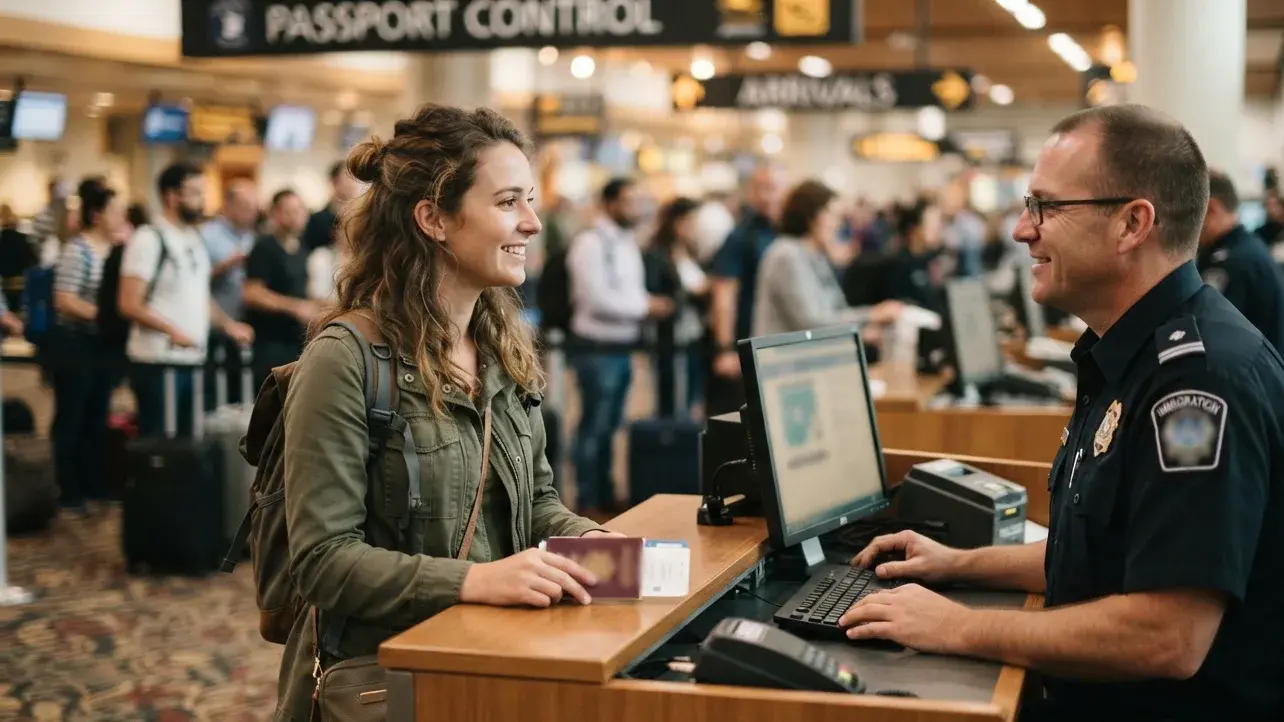
Short answer: Paraguay's written entry list asks for a valid passport and the entry record you receive at the border, not a ticket out. Officers can still ask how you will leave for Argentina, so an onward ticket for the exit leg is a cheap backup: a real PNR, valid 48-72 hours, $15 per person.
Entering Paraguay from Brazil over the Friendship Bridge and leaving for Argentina is one of the most common overland routes in South America, and it produces one of the most confused sets of advice. The onward-evidence question comes down to two layers. The written Paraguayan rules ask for a valid passport (or a Mercosur ID card for eligible nationals) and an entry record, with no named ticket. Immigration officers can still ask how you will leave, so a reservation for the next leg makes a sensible backup.
That reservation is not an issued ticket, and it never replaces the Paraguayan entry record you must keep until you exit. Rules differ by passport, so this guide follows the route border by border, shows two worked folders, and flags what to confirm before you travel.
Key facts
- Dummy ticket: a flat $15 per person, with a real PNR (booking reference) you can check.
- Valid for 48-72 hours, so order it close to your appointment or travel date.
- Dummy ticket dates can be changed free of charge on the booking day only.
- Can be issued even while you are at the embassy or visa centre.
- For visa files and onward-travel proof at immigration; it is not a paid ticket for flying.
- Accepted by embassies worldwide as travel-plan evidence.
Leaving Paraguay for Argentina? Show a planned exit with a real PNR, valid 48-72 hours, for a flat $15 per person.
Get your $15 onward ticketIn This Guide
- What Counts as Onward Proof for Paraguay When You Arrive From Brazil?
- Which Paraguayan Records Matter Between Entry and Exit?
- How Do a Reservation and a Paid Ticket Compare as Departure Evidence?
- What Changes at Each Border Between Brazil, Paraguay, and Argentina?
- How Should You Read Forum Advice About This Crossing?
- What Does an Example Trip Look Like on Paper?
- What Should Your Route Checklist Look Like?
- Frequently Asked Questions
Official-source check: Paraguay's entry and exit documents, the entry-record rule, the Gs. 702,462 fine and the optional pre-registro come from the Dirección Nacional de Migraciones (migraciones.gov.py; its pages block automated link checks, so it is named here without a link). Argentina's tourist stay comes from Argentina's Dirección Nacional de Migraciones. Brazil's electronic visa comes from Brazil's Ministry of Foreign Affairs. Check each page for your own passport before you travel.
Reviewed for: Paraguay entry-record and exit-fine wording, the Friendship Bridge registration rule, Brazil-Paraguay-Argentina route order, onward-proof wording at immigration and PNR clarity.
What Counts as Onward Proof for Paraguay When You Arrive From Brazil?
Start with what the rules put in writing. Paraguay's entry requirements cover a valid passport, the entry record you receive at the border, and a limit on how long you may stay. An onward ticket is not among the listed documents.
Practice adds a second layer. An immigration officer can ask any visitor about their plans, and a short answer backed by one document is the quickest way through. Departure plans are a normal question for tourist entries everywhere, even where the written list is silent.
The question can therefore come up even when the written list is silent. Immigration may ask for proof of onward travel at the counter, and you answer it on the spot.
If you are asked, one clear document for the leg out is enough to answer the question; you do not need one per possible route. On this route, the leg that counts is the one leaving Paraguay for Argentina. A return ticket to Brazil describes a different plan and says nothing about where you go next.
Airports are a different setting from a land crossing. Arriving at Asunción's Silvio Pettirossi airport, you meet the same migration officers, but you have also passed through your carrier's own document checks on the way. Carriers set their own document rules, so check with your carrier before you fly; a smaller terminal is no reason to relax.
Arriving by land from Brazil is a different test. Traveling from Brazil to Paraguay typically involves specific immigration checkpoints, and the person at the counter is a migration officer rather than an airline agent. Whatever you hold has to be quick to show: one phone screen or one printed page.
The exchange itself is short. The officer asks where you go next, you name the city, and you show one document. A flight means the reservation with its booking reference. A bus means the fare and the date. Hand over more only if asked, because a stack of papers slows the window.
Three kinds of evidence get confused, so keep them apart. A reservation shows a planned seat. An issued ticket shows a paid seat. Entry and exit records, such as your Paraguayan entry stamp, show what actually happened.
Across South America, each country keeps its own list of what it asks at the counter, and a rule from one border does not carry to the next.
For the wider picture of how officers use exit evidence at land and air borders, see how onward proof works at the border. Aim for enough proof to end a short conversation, not a folder of paper.
Which Paraguayan Records Matter Between Entry and Exit?
One small record does most of the work in Paraguay. It is the Comprobante de Entrada al País: an entry stamp in the passport or a migration card, depending on how you arrive. Keep it, because you present it when you leave.
Paraguay's migration authority tells non-resident visitors to keep the entry record and present it when they leave, to avoid sanctions, and to check the data and the permitted stay on it at entry, because later complaints are not accepted. Under Article 87 of Law 6984/2022 the fine is six minimum daily wages, currently Gs. 702,462, for overstaying the permitted stay or for having no record of entry. For most tourist visits the practical risk is the missing record rather than the clock.
Ciudad del Este sits across the Friendship Bridge from Foz do Iguaçu, on the Brazilian side. Day visitors are often seen walking across without stopping, but Paraguay's migration authority states that the free-transit regime between border cities does not exempt anyone from the travel documents both countries require, and that everyone must register entry and exit.
Foz do Iguaçu sits in the state of Paraná, written PR, so a tag such as PR Foz on a bus sign or booking means the Brazilian side of the bridge. Do not copy the day visitor's habit for a longer stay.
You must stop at both countries' immigration windows when crossing borders.
Anyone who wants to enter PY for more than the same day should head straight to the Paraguayan counter and ask for the record before walking on.
Skipping official border posts may lead to fines when exiting. Whether the officer at the exit is migration staff or border police, the question is the same: where is the record?
If the record is lost or was never issued, do not wait for the exit counter. Ask Paraguay's immigration authorities how to regularize the stay, because the answer depends on how long you have been in the country.
Border control works the same way at a land crossing as at an airport desk. It is the same rule, one record, shown at exit. Paraguay's immigration authorities set the fine, and the exit counter is where the gap shows.
Documents depend on the traveler. Citizens of Mercosur can use a national ID card or passport for entry. Non-Mercosur citizens must present a valid passport for entry. Paraguay's own wording asks for a passport in force, and its migration authority recommends at least six months of validity from departure to avoid problems in the next country, which is the safe planning figure.
The online pre-registro does not replace any travel document.
The pre-registro is a free, optional web form, completed within the 48 hours before entry or exit at designated land posts such as the Friendship Bridge, with a single-use QR confirmation sent by email. Show the QR together with your passport. It speeds up the window; it does not replace travel documents.
One more record is not for you. The border-neighbor transit document, the DTVF, is not meant for tourists.
How Do a Reservation and a Paid Ticket Compare as Departure Evidence?
Two folders can look equally complete and still behave differently at a counter. State A holds the Paraguayan entry record plus a reservation for the exit leg. State B holds a paid ticket but no entry record, because the bridge crossing never stopped at a window. The table sets them side by side.
| Record or check | State A: entry record kept, reservation held | State B: ticket held, entry record skipped | Source (publisher) |
|---|---|---|---|
| Entry record (Comprobante de Entrada al País) | Stamp or migration card kept with the passport | Never obtained at the border | Paraguay Dirección Nacional de Migraciones |
| Exit check in Paraguay | Record shown, exit proceeds | Record missing, a fine can follow | Paraguay Dirección Nacional de Migraciones |
| Fine for overstay or no proof of entry | Not triggered by the record | Gs. 702,462 under Law 6984/2022 | Paraguay Dirección Nacional de Migraciones |
| Stay length | The period written on the entry record | Same limit applies | Paraguay Dirección Nacional de Migraciones |
| Ticket out listed as an entry document | Not listed; reservation is a backup | Not listed; ticket is a backup | Paraguay Dirección Nacional de Migraciones |
| Online pre-registration with QR | Optional, within 48 hours before crossing, shown with passport | Same, and it replaces nothing | Paraguay Dirección Nacional de Migraciones |
| Argentina entry record | Check the record issued at entry | Same | Argentina Dirección Nacional de Migraciones |
| Argentina tourist stay | Up to three months, extendable once | Same | Argentina Dirección Nacional de Migraciones |
Read the table by row. A ticket leaving Paraguay does nothing for a missing entry record, and the entry record does nothing for a question about plans. State A answers both questions with the cheaper document. State B answers one and still risks the fine.
Reservation and issued ticket also differ from each other. A reservation holds a seat plan under a booking reference that can be checked against an airline system. It is not an issued ticket and has not been paid to the airline. An issued ticket is the paid document. Only the exit record shows the trip happened.
If a reservation is the backup you want, a DummyFlights reservation carries a real PNR, stays valid 48-72 hours and costs a flat $15 per person. It is not a paid ticket and not for flying. Nobody can promise how an officer will read it, since the officer decides. To understand how the window works, read what happens when a reservation expires before you pick the order date.
For a road exit, a bus ticket leaving for Argentina matches the plan better than a flight. Transport options differ at each border, and not every carrier sells in advance, so ask at the terminal. We would hold the flight reservation as a precaution that costs little in most cases, then buy the bus ticket once the day is fixed.
Two smaller items travel in the same folder. Proof of accommodation may be required by immigration officials, so keep the first night's booking where you can reach it. Money is a separate question: an officer can ask about enough money for the stay, and the answer is a figure, not a document.
The written Paraguayan list does not call for a ticket out, so a reservation is not a need in itself. It earns its place only if the officer asks, or if your plans are open and a clear answer would help.
A traveler who already holds a paid ticket for the next leg has the answer in hand and gains nothing from a second document.
Keep the files in one offline album: a photo of the entry record, the pre-registro QR, the reservation PDF, and the accommodation booking. Border crossings can have weak signal, and an album opens without it.
Carriers apply their own document rules to passengers flying in. A flight to Asunción is therefore a separate matter from a bus across the bridge, so check with your carrier before you fly.
What Changes at Each Border Between Brazil, Paraguay, and Argentina?

Four border moments make up this route: leaving Brazil, entering Paraguay, leaving Paraguay, and entering Argentina. Each has its own rules, and none borrows from the others. Start with Brazil.
To enter Brazil, US, Canadian and Australian citizens need an electronic visitor visa, a requirement in force since 10 April 2025; check the current fee on the Brazilian government's e-visa page. It belongs to the Brazil leg, not to Paraguay.
Before traveling, verify your passport and visa requirements per nationality. Other passports follow other rules, so check the tourist visa requirement for yours. Brazilian officers may also ask how you plan to leave, so the same onward evidence is useful on that side. This guide does not cover visa applications.
To exit Brazil at Foz do Iguaçu, you walk or ride onto the Friendship Bridge, and the Paraguayan window waits at the far end. Paraguay's Ministry of Health requires a yellow fever vaccination certificate for travellers aged 1 to 59 arriving from or going to risk areas, so check the current list against where your trip started.
Health certificates may be required for entry into Paraguay from certain risk areas. A route that began elsewhere, in Rio de Janeiro, for instance, needs the current list read state by state. Paraguay's own visa position depends on the passport, so check citizens' visa requirements before booking.
Geography causes the next trap. Ciudad del Este to Puerto Iguazu overland goes back through Brazil, because the Tancredo Neves bridge links Foz do Iguaçu with Puerto Iguazu.
A day trip to Iguazu Falls on the Argentine side therefore means leaving Paraguay and entering Brazil again. You then exit Brazil and cross into Argentina. Searches about crossing the Brazil-Argentina border times usually describe that bridge, a different crossing from the one that ends your Paraguay stay.
Direct land crossings between Paraguay and Argentina sit elsewhere: Encarnación to Posadas, and Puerto Falcón to Clorinda near Asunción. Traveling from Paraguay to Argentina requires distinct immigration procedures from the Brazil crossing, so treat the exit from Paraguay as its own event and carry the entry record to it.
Argentina asks less on paper. Its migration authority describes a tourist stay of up to three months, extendable once for a similar period. Many travellers report receiving no passport stamp and a digital record instead, so ask the officer what record you have been given and keep it.
Argentina's published rules mention a return ticket for some nationalities, so confirm whether yours is one of them. Some searches also mention an Iguazú Argentine reciprocity fee. Whether any reciprocity fee applies to your passport today is a question for Argentina's migration authority, not for a traveler's memory of an old trip.
Keep whatever Argentine entry record you receive. It is the nearest thing to proof of your last crossing if a later question arises, and Argentina charges an exit authorisation fee to visitors who overstay.
At each window the same items come out in the same order: passport, then the entry record or the pre-registro QR, then the onward reservation only if asked. That order keeps the line moving and keeps your folder from spilling across a counter.
Drivers and families carry extra paper. Drivers need the vehicle's registration documents and the regional insurance their insurer confirms for Mercosur travel. Paraguay asks minors travelling with one parent, alone or with third parties to carry a legalised travel authorisation, so prepare it before leaving home.
If you stay on the Foz side for a night before crossing, finish the Brazilian exit the next morning rather than leaving it for the bridge. Whichever way you go, the entry record from Paraguay is the item to protect.
How Should You Read Forum Advice About This Crossing?
Forum threads are the most common source of advice on this route, and also the most common source of outdated rules. Treat a reply as a lead to check, not as a rule.
Pasted replies often carry page clutter, menu text and vote counters from the site they came from. Popularity counters measure how many people read a reply, not whether it was right, and a reply with no date or no source cannot be traced back to anything you can check.
Answers on these routes also disagree for honest reasons. One person crossed the Friendship Bridge on foot and was never stamped. Another entered Argentina and saw no stamp either. Both stories may be true, yet neither describes what Paraguay expects of a visitor who stays, and Paraguay's rule is that every crossing is registered.
The pattern repeats on every route in the region. A rule that holds for a day visitor on foot gets quoted to a visitor who stays a week, and a rule for one nationality gets quoted to another. The words stay the same while the situation changes, which is why the source of a rule matters more than how often it is repeated.
A four-point test before you rely on a reply
- Date: is the reply recent enough to reflect current rules?
- Passport: did the writer hold the same nationality as you?
- Direction: were they travelling the same way, Brazil to Paraguay to Argentina?
- Source: does the reply name a document or an official page you can look up?
A reply that fails two of the four is a lead to confirm, not a rule. Then confirm it where it is published: Paraguay's migration authority for entry and exit records, Argentina's migration authority for tourist stays, and Brazil's foreign ministry for the electronic visa. Carriers publish their own document conditions, and those apply to flights, not to the bridge.
What Does an Example Trip Look Like on Paper?
Meet Daniel Foster, a fictional Australian traveler. Every detail below is invented, and the booking reference and document numbers are withheld on purpose. His plan: cross the Friendship Bridge from Foz do Iguaçu to Ciudad del Este, spend three nights in Paraguay, travel to Asunción by road, and fly to Buenos Aires.
Two versions of Daniel's record show how the same trip can end differently.
| Moment | Folder A (prepared) | Folder B (rushed) |
|---|---|---|
| Brazil entry, weeks earlier | Electronic visa granted, reference withheld | Same |
| Friendship Bridge, Day 1 | Stops at the Paraguayan window; entry record received | Walks across with the day crowd; no record |
| Onward evidence in phone | Flight reservation, Asunción to Buenos Aires, PNR withheld, marked as a reservation | Screenshot of a bus fare with no booking |
| Accommodation | First-night booking saved | Not saved |
| Day 4, Asunción exit | Entry record shown, exit registered | Officer asks for the record; none exists |
| Argentina entry | Entry recorded by Argentina | Same |
| Outcome on paper | Entry, exit, and next-country records all line up | Exit record has a gap that may mean a fine |
Folder A, as it would sit in Daniel's phone album, holds four items with personal details hidden.
- Entry record photo, stamp date visible, document number blurred.
- Pre-registro QR screenshot, code hidden.
- Reservation PDF, booking reference hidden, labelled as a reservation.
- First-night accommodation confirmation, address blurred.
Here is Folder A as a timeline.
- Day 1: exit Brazil, cross the bridge, stop at the Paraguayan window, and photograph the entry record.
- Days 1 to 3: stay in Ciudad del Este, with the record kept in the passport and not in the luggage.
- Day 4: travel by road to Asunción in the morning and fly to Buenos Aires that evening.
Folder A cost Daniel a stop of a few minutes at a window. Folder B cost him nothing on Day 1 and a possible fine on Day 4, at a counter where he had no way to fix it.
Notice what the reservation did and did not do in Folder A. It answered the question about departure plans. It did not replace the entry record, and it was not an issued ticket. When Daniel bought the actual ticket for Buenos Aires, the reservation became redundant, and his exit record became the proof of what happened.
Had Daniel left by road instead, the flight reservation would have been the backup and the bus ticket the actual plan. The entry record would still have been the item that decided his exit. Add the pre-registro QR if he chose to use it, shown with the passport and nothing else replaced.
The timing of the reservation matters too. Because a DummyFlights reservation stays valid for 48-72 hours, Daniel would order it on Day 1, before the bridge, so that it covers the Paraguayan entry window, rather than weeks earlier in Brazil.
What Should Your Route Checklist Look Like?
Use this list the evening before you cross. Each line maps to one of the four border moments.
- Brazil: electronic visa (if your passport needs one) saved offline.
- Bridge: pre-registro QR, if you chose to use it, completed within 48 hours of crossing.
- Paraguay entry: stop at the Paraguayan window and check the data and stay period on the entry record before walking on.
- Paraguay stay: keep the entry record with the passport, not in the luggage.
- Exit leg: one onward reservation or ticket for the leg to Argentina, dated inside your permitted stay.
- Health: yellow fever certificate if your route started in a listed risk area.
- Argentina: know your stay limit and keep whatever entry record you receive.
If any line is open, fix it before the bridge, not at the exit counter.
Crossing the Friendship Bridge soon? Carry a planned exit to Argentina with a real PNR, valid 48-72 hours. Order your dummy ticket for a flat $15 per person.
Get your $15 onward proofFrequently Asked Questions
Does Paraguay require an onward ticket from every tourist?
Paraguay's published entry requirements list a valid passport (or eligible Mercosur ID), a visa where your nationality needs one, and the entry record you must show at exit. An onward ticket is not on the list. An officer may still ask about your plans, so carrying a reservation or a ticket for the leg out costs little.
Is a reservation enough for Paraguay, or must the ticket be bought?
A reservation is a plan under a booking reference, not a paid ticket. Whether it answers a particular officer's question is up to that officer. A DummyFlights reservation carries a real PNR, stays valid 48-72 hours and costs $15 per person, so you can buy the real ticket only once your dates are fixed.
What if I walked across the Friendship Bridge without a stamp?
Go back to the Paraguayan window and register your entry before you go further. Paraguay fines visitors who cannot show a record of entry when they leave, currently Gs. 702,462 under Law 6984/2022, so waiting until the exit counter is the costly choice. Rules on regularising a stay are set by the migration authority.
Does Argentina need anything extra when I arrive from Paraguay?
Argentina's migration authority describes a tourist stay of up to three months, extendable once. Its published rules can mention a return or onward ticket for some nationalities, so check the current requirements for your passport, including any fees, before the day you cross and keep whatever entry record you receive.
What changes if I fly into Asuncion instead of crossing the bridge?
The carrier's document checks come before the migration desk. Carriers set their own document rules, so check with your carrier before you fly. At Asuncion you still receive a Paraguayan entry record, and you still need to keep it until you leave the country for Argentina or anywhere else.
How early should I complete Paraguay's pre-registro?
Paraguay's pre-registro is free and optional, and it is completed within the 48 hours before entry or exit at designated land posts such as the Friendship Bridge. It produces a single-use QR code by email. Save it so it opens offline and show it with your passport; it does not replace any travel document.
What goes in the travel folder for this route?
Passport, the Paraguayan entry record, the pre-registro QR if used, a first-night accommodation booking, and one onward reservation or ticket for the leg to Argentina. Add the Brazilian electronic visa if your passport needs one, and a yellow fever certificate if your route started in a listed risk area.
Friendly reminder: DummyFlights provides dummy tickets and dummy hotel bookings to support visa applications and onward-travel proof at immigration. Requirements vary by destination, consulate, visa category and traveller situation. A dummy ticket supports your file; it is not a paid ticket for travel and does not guarantee visa approval or entry.