Short answer: If your land-border exit changes after an onward ticket was issued, do not keep presenting the abandoned route as your current plan. Compare the old and new crossing, date, mode, issuer record and next-country entry permission. Amend or replace only the affected booking. For Costa Rica, official guidance accepts certain pre-purchased bus, flight or cruise exits; another destination may differ.
This is a change-control guide for a ticket already in hand—not a general overview of unusual routes or the question of whether border control asks for onward proof. It uses the Costa Rica-to-Panama versus Costa Rica-to-Nicaragua switch to show which old evidence stays valid, which becomes obsolete and how to check the replacement.
Key facts
- A still-booked ticket for an abandoned route is not truthful evidence of the current intended exit.
- Check the new border’s transport, next-country entry permission and local dates.
- Costa Rica recognizes specific pre-purchased commercial exit tickets; do not generalize that rule.
- Funds, later flights and temporary reservations do not universally replace a required immediate exit ticket.
In This Guide
- When a Land Crossing Changes, Audit the Old Exit Proof First
- Replace the Changed Exit With the Evidence the Destination Accepts
- Recheck Entry Rules for Both Sides of the New Border
- Costa Rica: Replace a Panama Exit With a Nicaragua Exit
- At the Airline Counter When Your Itinerary Has Already Changed
- Matching Names, Dates, and References So Nothing Looks Off
- Choosing a Refundable Ticket, a Reservation or a Separate Booking
- A Change-Control Workflow for the Old and New Exit
- Staying on the Right Side of Immigration After You Land
- Cross With Current Proof, Not the Abandoned Route
- Frequently asked questions
Official-source check: Costa Rica’s entry guidance lists pre-purchased bus, flight and cruise passage as possible return/onward tickets. Immigration New Zealand shows why funds and ticket conditions must be read by stage. The US DOT explains the conditional 24-hour rule.
Reviewed for: Costa Rica onward-ticket modes, New Zealand ticket/funds distinction and US fare-hold conditions on 20 October 2026
Before the next check-in: request issuer changes to the affected bus, flight or hotel record. A temporary flight reservation can support a real air leg where allowed, but it cannot invent or replace a land crossing you actually intend to use.
When a Land Crossing Changes, Audit the Old Exit Proof First
This guide addresses a narrow problem: you already hold onward proof, but the specific land crossing or exit country changed. Mark which old segments remain real, which were abandoned and which new evidence is needed. Do not present a superseded plan as current.
The Moment a Planned Exit Route Quietly Falls Apart
Suppose the original itinerary exits Costa Rica by bus to Panama, but the traveler now plans to cross into Nicaragua. The old bus booking may still exist; it no longer describes the intended Costa Rica exit. Confirm the new route and entry permission before replacing it.
Onward evidence answers how and when a traveler intends to leave the country being entered. An unused future booking does not automatically become false, but it is not a substitute for the real current exit plan.
Separate three statuses: currently booked and still intended, booked but abandoned, and not yet booked. Keep the original record for your history, but put only current truthful evidence in the travel folder.
Consider the small details that shift when a route changes:
-
The onward destination is now a different city or country.
-
The onward date may move by days or weeks.
-
The onward route may switch from air to road or rail.
-
The onward journey may now include a third country.
Each of these can turn a clean document into a question mark. Officers do not need to prove your plan is false. They only need to see that your paperwork and your story do not line up.
Treat every route change as a paperwork change. Update the proof the same day you update the plan.
Which Check Happens Before and After a Changed Crossing?
Two checkpoints matter. The first is the airline. The second is border control at the destination country.
Airline document checks occur before carriage; immigration may inspect entry conditions on arrival or at a land frontier. They can ask different questions. Confirm rules for the country you are entering and the country you are leaving.
Onward requirements vary by passport, status, destination and mode. Passing an airline desk does not guarantee admission, and a border officer’s prior acceptance does not bind a later carrier.
Think of the two checks like this:
-
Airline check-in: Staff confirm that you can probably enter before they let you board.
-
Border control: Immigration officers decide whether you may enter and how long you may stay.
-
Anywhere in between: You may be asked about your next destination at any moment.
A traveler with a one-way ticket and no visible exit is the easiest person to question. A traveler holding a clear exit that matches the stated plan is the easiest person to wave through.
That is why consistency matters more than volume. One clean document that fits your story beats a folder full of papers that disagree.
Reading the Warning Signs Before You Reach the Desk
You can often spot trouble a day before the border. A few small signals tell you that your proof no longer fits your plan.
The first signal is a new route. If you booked a bus to one city and now plan to leave from another, your document is out of date. The second is a new date. If your stay grew or shrank, the exit date should move too.
The third signal is a change of companion. Traveling with someone who holds a different passport can change the rules you face. Their country may need different entry permission.
Before each check, ask: “Does this document describe my current intended exit from this country?” If not, update the booking with its issuer or obtain the form of evidence the destination accepts.
Do this check at your hostel, not in the queue. A quiet table and a charged phone give you room to rebook, print, and double-check.
Make the habit automatic. Each time you pick a new destination, open your folder and compare the document with the plan. It takes two minutes and prevents most desk problems.
Travelers who skip this step usually describe the same feeling later. The problem was obvious in hindsight, and it was easy to solve a day earlier.
Why Airlines Care More Than You Expect
Carriers check travel documents because they may face costs or penalties for carrying inadequately documented travelers under relevant laws. The exact obligation varies; do not assume a universal fine specifically for lacking an onward ticket.
A carrier may refuse carriage if the passenger cannot satisfy its document check. Its decision may reflect destination rules, liability exposure and airline policy; it is not a visa or entry decision.
Ask the operating airline about its document requirements for the actual route. Do not assume a flight is always preferred over an officially accepted bus ticket.
Picture a traveler named Daniel Foster flying from Mumbai to San José. He holds a one-way ticket and a vague plan to head south by bus. The agent has no way to know whether Costa Rica will admit him. She only knows what happens to the airline if it will not.
So she asks for proof. Daniel shows a bus booking that he changed last week. The booking now leaves from a town he no longer plans to visit.
That mismatch is exactly the kind of detail that slows a queue. The agent may accept it, ask for a replacement, or escalate to a supervisor. None of those outcomes is pleasant at 11 p.m. with a flight closing.
Nobody in this story did anything wrong. Daniel simply forgot to update a document after changing his plan. The airline could not know that. It saw a mismatch and reacted to the risk, which is exactly what its policy tells staff to do.
A changed border crossing is not only your problem. It becomes the airline's problem the moment you reach the counter with outdated proof, which is why the next question is what actually counts as proof once you leave by land.
Replace the Changed Exit With the Evidence the Destination Accepts
Most advice assumes you leave a country by plane. Overland travelers face a different puzzle. Here is what officers and airline staff tend to accept when your exit is a road, a rail line, or a river.
Flight, Bus, or Train: What Officers Tend to Accept
A flight, bus, rail or cruise record may document departure only if the destination and carrier accept that mode. Check whether it must be prepaid, confirmed or simply reserved.
Costa Rica’s official entry guidance lists a pre-purchased bus ticket, flight ticket or cruise passage as possible commercial return/onward evidence. For another country, verify its own rule rather than copying this list.
Still, a bus ticket carries a weakness. Many operators sell tickets on the day, so officers may not know what a genuine one looks like. Airlines, by contrast, rely on a flight ticket they can verify against a system.
Here is a practical way to rank your options:
-
Flight reservation with a booking reference: Easy to verify, easy to read, and recognized almost everywhere.
-
Train ticket on an international line: Works well in Europe and parts of Asia, where rail crossings are common.
-
Bus ticket with your name and date: Useful in regions where buses cross borders daily.
A flight is not automatically the strongest evidence. For Costa Rica, a genuine pre-purchased bus ticket for the real overland exit can be more accurate than a flight the traveler does not intend to take.
Before you buy anything, confirm which format your airline will accept at check-in. A quick message to the carrier can save an argument at the counter.
Can Funds Replace the Ticket After a Route Change?
Do not treat a bank balance as a universal substitute for onward travel. New Zealand’s rules vary by visa category and travel stage; its visitor guidance says ticket or funds can satisfy some visa conditions, while arrival documentation may still require a ticket. Check the exact rule.
That question is simple. Can this person pay for a way out, or for their stay?
Do not assume that funds will satisfy the airline, though. Counter staff often follow a script. The script says "ticket," not "balance." Some agents will accept supporting documents showing funds. Others will not, and you cannot argue them into it.
If you plan to rely on funds, prepare for both outcomes:
-
Carry a printed bank statement that shows your name and a recent date.
-
Keep a card with enough available credit to buy an exit if asked.
-
Hold a backup reservation in case the agent insists on a ticket.
The backup is the part most travelers skip. It costs little and removes the biggest single point of failure.
Countries also differ in what they allow. Some accept funds readily. Others treat funds as a second choice.
Combining Documents for a Broader Picture
One document rarely answers every question. Officers like a broader evidence set that shows you can leave and that you can afford to stay.
Think of three layers. The first is your exit, such as a flight, bus, or train booking. The second is your funds, shown through a recent statement or card access. The third is your stay, shown through a lodging booking or an address.
When these layers agree, your story feels solid. When one is missing, the officer may probe the gap.
Here is a simple pairing for an overland traveler:
-
A bus ticket to the next country for the near term.
-
A flight reservation out of the region for the longer term.
-
A bank statement showing a healthy balance.
-
A lodging booking for the first nights.
This mix also protects you if one piece fails. If the bus company changes its schedule, the reservation still shows a planned exit.
Do not overload the folder. Five clean pages beat twenty mixed ones. The officer does not want a pile. The officer wants an answer.
Arrange the pages in the order a question is likely to arrive. Exit first, funds second, stay third.
Keep a Later Return Separate From the Immediate Exit
An onward ticket is not the same as a return ticket. This distinction matters even more when your route changes.
A return booking may show travel home much later; an immediate bus crossing shows departure from the first country. If the route changes, identify which country each document proves you leave.
A return flight from a later country does not itself prove how you will leave the current one. Explain or document the intervening land segment if the entry rule calls for it.
There is a second wrinkle. A return flight to your home country can look reassuring, yet it may leave a gap of weeks between your arrival and that date. Officers sometimes ask what you will do in between and where you will go. A clear onward plan fills that gap.
Gaps like this are common for people who book a cheap return in advance and then stretch the trip. If you recognize yourself, add a second document for the exit you really intend to use.
Use this quick test:
-
If the document leaves the country you are entering, it may count as onward proof.
-
If the document returns you home on a date that matches your stay, it may count as proof of a planned exit.
-
If it points somewhere you will not go, it does not help you.
Keep your proof aligned with your actual intentions. Once you know what counts, you also need to know which rules actually apply to your passport.
Recheck Entry Rules for Both Sides of the New Border

Entry rules decide whether proof is even required. They also decide what kind and how long you may stay. Read them early, and read them again after every major route change.
Checking Your Destination's Entry Requirements Early
Check your destination's entry requirements before traveling. This sounds obvious, yet it is the step most people skip when they are excited about a new route.
Use current official immigration or government travel information for each passport, destination and mode. Airline document tools may add operational checks; do not rely on a generic travel blog.
If you hold a US passport, the rules for Costa Rica, Panama, or Nicaragua are not the same as the rules for a different nationality. The country may admit you visa-free for a set number of days. That detail changes what the officer expects to see.
Gather these answers before you book any exit:
-
Does the destination country require proof of onward travel for your nationality?
-
How many days does your permitted stay allow?
-
Does the entry permission depend on a valid visa, or can you enter without one?
-
Does your valid passport need a minimum number of months beyond your stay?
Write down the date you checked. Rules change, and officers apply the version in force on the day you arrive.
Screenshots help. A dated capture of the official page shows exactly what you read, which is useful if an agent quotes an older rule or a different fee.
If your route changes mid-trip, repeat the check for your new destination. The country you are about to cross into may have its own rules, even if the previous one did not.
Keep the New Exit Inside the Actual Permitted Stay
Compare the newly planned departure with the actual visa, waiver or entry-stamp limit. A ticket dated beyond permitted stay may not satisfy an onward requirement.
If Olivia is admitted for 90 days, a planned departure on day 120 would not fit that permission. The example does not predict the officer’s response; she must choose a lawful plan or obtain the proper status.
The reverse can also cause trouble. If your onward date is only a few weeks away but you told the officer you plan a long trip, the two stories clash.
Compare your documents against the rules in this order:
-
Your permitted stay on arrival.
-
The date on your onward proof.
-
The dates on any lodging or tour bookings.
-
Any long stay visa or residence permit you hold.
Residence or long-stay status can change the onward-evidence requirement, but it does not eliminate all document checks. Read the conditions on the traveler’s actual permission.
Match the dates, and the questions mostly disappear. Where the dates do not match, expect follow-ups.
Keeping a Running Record of Rule Changes
Entry rules move. A country may change its stay limit, adjust its fee, or update the proof it asks for. Travelers who rely on old information are the ones surprised at the desk.
Make a habit of checking official pages one week before each crossing. Check again two days before. That second look catches last-minute announcements.
Keep a simple log in your notes app. Write the country, the date you checked, the source, and the rule you found. If an agent disagrees, you can show what you read.
Pay attention to the wording on official pages. Terms such as "may be required" and "must hold" carry different weight. The first leaves room for discretion. The second does not.
Also note any link between your passport and the rule. A rule that applies to one nationality may not apply to another. Do not copy advice written for a different traveler.
If an airline posts its own policy, read that too. Airline pages often describe what the staff will ask for at the desk. That policy may be stricter than the national rule.
A written log also helps you decide quickly. When your plan shifts, you already know which countries ask for proof and which do not.
Costa Rica and New Zealand: Why the Exact Rule Matters
Countries have varying requirements for onward travel proof. Comparing a few of them shows how much the rules can differ.
Do not transplant a generic Schengen or German onward-ticket statement to a Central American crossing. Check each destination’s official entry conditions and permitted stay.
Immigration New Zealand’s visitor conditions mention ticket or funds during the stay, yet also state that, unless an exemption is endorsed, a ticket must be held when travelling there. Check the exact visa and arrival requirements; funds are not a universal substitute at the airport.
Some destinations explicitly require a pre-purchased exit ticket; others impose different proof or exceptions. The changed crossing must be evaluated under the rules of the country being entered.
That is why a blanket rule never works. Each border has its own rules, and each airline has its own policy on top of them.
A useful habit is to keep a short comparison for every country on your route:
-
Requirement: Is onward proof mandatory, optional, or unstated?
-
Accepted formats: Flight, bus, train, or funds?
-
Stay limit: How long are you allowed to remain?
-
Airline policy: What does your carrier ask at check-in?
Fill this in before you leave and update it as you go. It takes ten minutes, and it turns a stressful border into a predictable one.
With the general rules mapped, the next step is to look at the region where changed crossings happen most often.
Costa Rica: Replace a Panama Exit With a Nicaragua Exit
Costa Rica is a useful worked example because official guidance recognizes pre-purchased commercial bus, flight and cruise exits. The point is not that all Central American borders share one rule; it is how to replace one genuine exit plan with another.
Why Overland Travelers Rebook Their Exit So Often
A traveler can leave Costa Rica for Panama or Nicaragua in a single morning. That makes fixed plans rare. Many backpackers start with a loose idea and change it three times before the first border.
Think about how a typical route develops. You arrive in San José, hear about a surf town on the Pacific coast, and then a friend suggests the Caribbean side. A few weeks later, you are in a different country than the one you planned.
Each change has a paperwork cost. Your original onward flight may sit in your inbox while your real exit is a shuttle van. The ticket you showed at the airline desk no longer describes your trip.
Here are the common triggers for a change in Central America:
-
A closed or delayed land crossing that forces a detour.
-
A better fare from a different airport in the region.
-
A visa-free stay that ends sooner than expected.
-
A new travel companion with a different route.
-
A weather event that closes a road or a ferry.
None of these is unusual. Officers know that overland trips drift. What they want is a plan that is believable on the day you stand in front of them.
A believable plan does not need to be rigid. It needs to be current, consistent, and easy to explain. Officers accept change. They struggle with change that has not been reflected on paper.
If the Costa Rica exit changes, obtain truthful evidence for the newly intended destination before the next airline or border check. Confirm you can enter that next country.
Costa Rica Check-In Questions You Should Expect
Costa Rica’s entry guidance describes return/onward evidence for non-residents in circumstances such as one-way arrival. It identifies pre-purchased commercial bus, flight or cruise passage; check the live rule for your nationality and entry status.
An operating airline may ask for proof before boarding, but do not imply that every one-way passenger on every route will be questioned in the same way.
One way travelers may face checks is at airline check-in and immigration. The airline asks first. Costa Rican officers may ask again after you land.
Prepare short, clear answers to the likely questions:
-
Where are you going after Costa Rica? Name a specific onward destination, not a region.
-
When are you leaving? Give a date that matches your document.
-
How are you leaving? Say flight, bus, or shuttle, and have the proof ready.
-
How long will you stay? Keep the answer within your permitted stay.
If you hold a US passport, you may find that the stay allowed is generous. That does not remove the need for proof, because the airline's policy is separate from the country's stay rule.
A short, calm answer works best. Long explanations about shifting plans invite more questions.
Handing over a printout or a clear phone screen also helps. The agent can read it in seconds and move on. A scattered answer without a document slows everyone down.
Border Day Habits That Keep Overland Plans Smooth
Land crossings are less formal than airports, yet the same checks apply. A few habits make the day easier.
Arrive early. Many crossings close at set hours, and queues grow by midday. An early arrival gives you time to fix a document problem.
Carry small amounts of local and US cash for fees. Some crossings charge an exit or entry fee and accept only cash.
Keep your folder on top of your bag. Do not dig through your luggage in front of an officer.
Check your phone battery the night before. A dead phone cannot show a booking.
Know your next move. If the officer asks where you sleep tonight, answer with a place and a town. A vague reply slows the line.
Stay patient with queues and shuttle drivers. Helpers on the border sometimes offer to "assist" with paperwork for a fee. You do not need them. Use official counters only.
Finally, take a photo of your entry stamp and the date. It gives you a record of your permitted stay and helps you set your next exit date.
Latin America Routes That Trigger Extra Scrutiny
Across Latin America, some routes draw more attention than others. A common one is a flight into a hub, followed by a land border with no obvious exit ticket.
Imagine a traveler named Sophie Walker flying from Delhi to Mexico City, then planning to bus south through several countries. Her next destination is Guatemala, yet she has no booking beyond the first week. The airline agent sees only a one-way ticket and a long trip with no visible end.
An agent in that position tends to think about the worst case. If Guatemala refuses her, the airline pays. So the question arrives early.
Routes that attract extra checks tend to share a few features:
-
A one-way ticket from a country far from the destination.
-
A stated plan that spans several borders.
-
No document showing how or when you leave the region.
-
A history of recent border crossings visible in the passport.
None of this means you will be refused. It means you should carry more clarity than the average traveler.
A document for a later country does not necessarily answer the immediate exit question. Keep separate records for the first country’s departure and any later flight from a second country.
Think in stages. Prove the next exit, not the last one.
If a ticket still shows the old border or departure city, be ready to explain whether it is still intended. An unrelated later flight cannot automatically replace a required immediate exit ticket.
A third-country flight can be part of an honest multi-country route when the intervening border transfer and entry rights are clear. No amount of explanation guarantees acceptance.
Once you understand the pressure points in the region, it helps to know exactly what happens at the desk when your itinerary has already changed.
At the Airline Counter When Your Itinerary Has Already Changed
The counter is where plans meet policy. A changed itinerary does not have to ruin that conversation. It helps to know what staff look at, what they can decide, and what you can say.
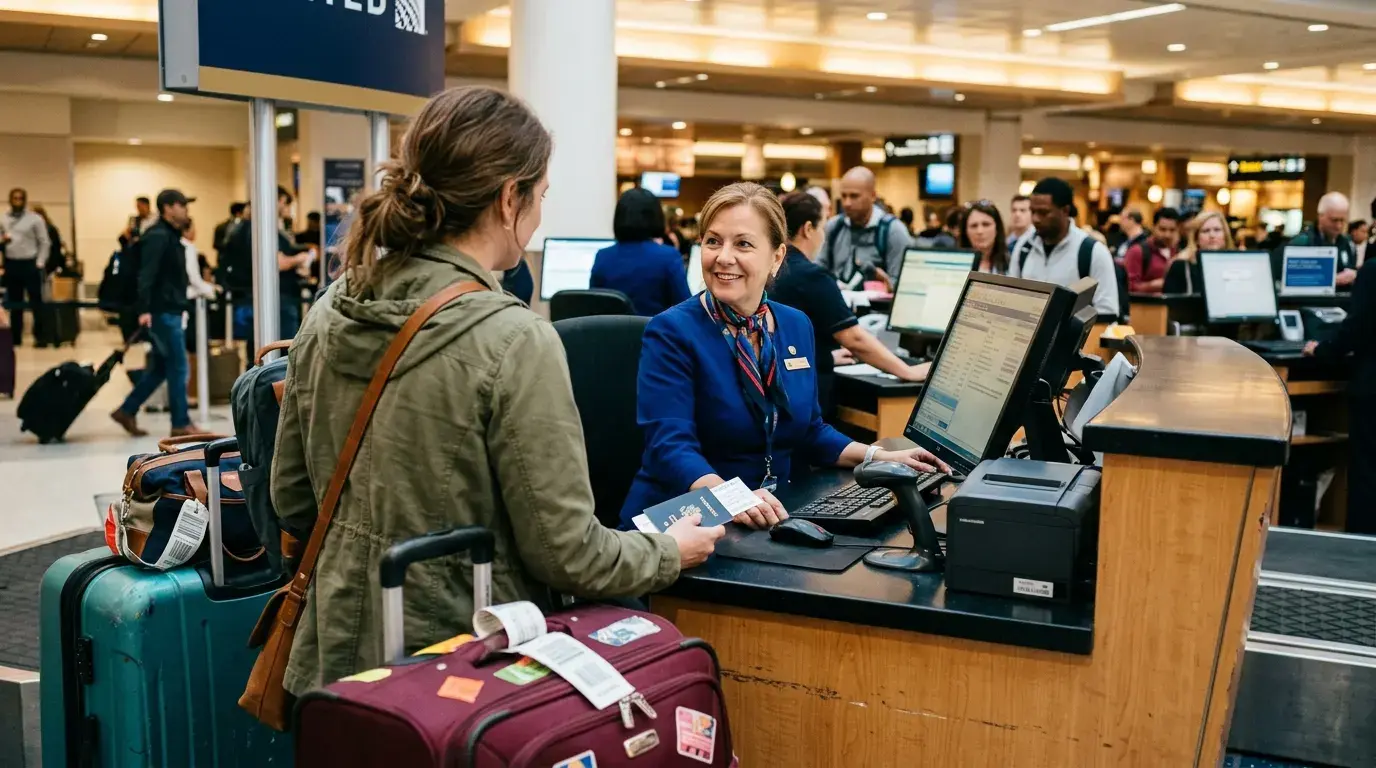
What Check-In Staff Look at First
Check-in staff start with your passport. They then look at your airline ticket and compare names, dates, and destinations. Only after that do they ask about your plans after landing.
Airlines check documents before boarding flights. The check is routine, and most travelers pass without noticing it. It becomes visible when something does not match.
Here is the usual order of review:
-
Passport: Is it a valid passport with enough remaining validity?
-
Visa or entry permission: Does your nationality need a valid visa for this country?
-
Onward proof: Do you hold a ticket or reservation that leaves the country?
-
Passenger details: Do names and dates match across all documents?
An airline employee may also check your booking reference in the system. If the record shows a recent change, the screen may flag it. That is normal. A changed booking is not a suspicious booking.
Airline staff are trained to look for gaps, not to catch you out. They want a record that shows the airline did its job. If your document fills the gap, the process moves on.
Keep your documents in the order the agent will ask for them. Passport first, then your airline ticket, then onward proof. That small habit saves a minute and signals that you are prepared.
A tidy stack also makes your boarding pass arrive faster. The agent can print it without waiting for you to dig through a bag.
Talking Through a Changed Plan Without Panic
You will sometimes arrive at the counter with a plan that has changed since you booked. This is more common than most travelers admit.
Explain the changed plan truthfully and concisely. Present the current documents first; keep abandoned reservations out of the active proof set unless asked about them.
That sentence does three things. It shows that you know the rules. It shows that the update was deliberate. It shows that you are not trying to slip anything past the desk.
Then hand over the new document. Keep your tone calm and your sentences short.
If the agent hesitates, stay patient. The airline decides what it will accept, and that decision may involve a supervisor. Ask politely whether there is anything else they would like to see.
Useful phrases for a tense moment include:
-
"I can show you the new reservation on my phone."
-
"I can also show a bank statement if that helps."
-
"Is there a document you would prefer for this route?"
Avoid arguing about the rule itself. The agent cannot change airline policy at the desk. An argument only burns time you may need.
Do not offer a long backstory. Agents hear a dozen stories a day. They respond to documents and clean answers.
If you hold both a flight reservation and a bus ticket, show the one that best fits your actual plan. Showing two conflicting documents invites a question about which one is real.
A short airline check at the desk is not a judgment. It is a process, and you can help it finish quickly.
Small Courtesies That Make Agents More Flexible
A counter conversation is a human one. Agents handle long queues, strict rules, and anxious travelers. A little courtesy goes a long way.
Greet the agent and wait for the question. Hand over your passport and your ticket without being asked. That small move signals that you know the process.
Speak slowly and clearly. Agents often work in a second language and hear many accents. Short sentences help.
If something is wrong, say so early. "My plan changed last week, and here is the update" lands better than a late surprise.
Avoid phrases that sound like pressure, such as mentioning a tight connection or a hurry. Time pressure rarely changes policy, and it can make an agent more cautious.
Thank the agent when the check ends, even if it was tough. Courtesy costs nothing, and you may meet the same agent on a later trip.
If a supervisor steps in, repeat the same calm answer. Do not change your story to please a new listener. Consistency is your strongest asset.
If the New Evidence Is Not Accepted at Check-In
Airlines may deny boarding if onward proof is insufficient. This is the outcome every traveler fears, and it is worth understanding in advance.
If boarding is refused, ask which document or rule is missing and whether an issuer correction or acceptable new booking can resolve it. A desk decision may be reviewable under airline procedures, but do not assume it will be reversed in time.
If this happens, stay calm and ask three questions:
-
What exactly is missing? Ask the agent to name the document.
-
Can you fix it here? A phone call and a quick booking may solve it.
-
Is there a later flight? You may be able to rebook without losing the ticket.
Many problems are fixable within an hour. A new reservation, a printed statement, or a corrected name can change the decision.
Do not buy anything impulsively under pressure. A rushed non-refundable ticket can become a second problem if your plan changes again.
Verification of onward travel may happen at check-in or immigration. That means a fix at the desk does not end the checks. Keep the same document ready for the officer who may ask after landing.
Write down the name of the agent and the time. If you later need to dispute a fare or a refund, those details help.
Remember that a boarding pass is not a guarantee of entry. It only means the airline accepted your documents. The next discussion turns to the details that make those documents look right at first glance.
Matching Names, Dates, and References So Nothing Looks Off
Small mismatches create big delays. A single misspelled name can undo a perfect plan. Here is how to make your documents read as one clean story.
Passenger Details That Must Match Your Passport Exactly
Match the booking name to the passport and issuer rules. Middle-name display and ordering can differ by system; ask the issuer to correct a material error rather than editing the PDF.
Imagine a traveler named William James Hartley whose passport reads "HARTLEY WILLIAM JAMES." His onward reservation lists "James Hartley." An agent may accept it, or may ask for a correction. Either way, he has created a risk for no reason.
Check these fields before you accept any booking:
-
Surname and given names: Spelled as on the passport, in the same order.
-
Date of birth: Matches the data page exactly.
-
Passport number: Included only if the document asks for it, and correct.
-
Title and gender marker: Consistent with the passport.
If you hold a valid passport with a new number after renewal, make sure older bookings do not show the old one. Mixed numbers confuse systems and agents.
Double-check the spelling of long or hyphenated names. Many booking systems shorten them or drop punctuation. Compare the confirmation line by line, not by glance.
A hotel or tour booking with a different spelling can also raise questions at the border. Keep your supporting documents in line with the same version of your name.
Fix errors early. Most platforms allow a name correction within a short window after booking, and some allow it only once.
Keep proof of the correction request too. If the system lags, an email showing that you asked for the fix can calm an agent while the record catches up.
Booking References, Flight Numbers and Fare Class on the Page
Officers and agents often scan for a booking reference first. It is the item that proves the reservation exists in a system.
Make sure the reference appears clearly on your document. A flight number, a date, and a route should sit near it. That gives the reader what they need in one glance.
A good document shows:
-
The booking reference in a visible place.
-
The flight number and the departure and arrival cities.
-
The departure date and time in a clear format.
-
The fare class and any note about changes or cancellation.
Fare class is easy to ignore and easy to misread. It tells an agent whether the ticket is flexible or restricted. Fare rules may also show whether you can cancel or change the booking. That is useful when your route might change again.
If you are holding a ticket you may need to alter, read the fare rules now. Do not wait until the border.
Some travelers keep the confirmation email as a screenshot. That works if the screenshot is sharp and includes the whole page. A cropped image with half the details missing creates doubt.
Print one copy if you can. Phones die, and airport Wi-Fi fails at the worst moments.
Keep the reference consistent across emails, PDFs, and apps. If one record shows a new reference after a change, delete or label the old one so you do not show the wrong page.
Fixing an Error After the Booking Is Already Made
Even careful travelers sometimes spot an error after they pay. The best response is a fast one.
Contact the booking source as soon as you notice. Many systems allow a name correction within a short window, often free of charge. After that window, the fee may rise.
Ask for the correction in writing. A short email with your booking reference, the wrong detail, and the right one is enough.
Keep the reply. A confirmation that says "name corrected" can be shown to an agent if the old page is still floating around.
If the system refuses the change, consider a new booking. A fresh reservation with the correct name may cost less than a long dispute.
Delete the old document from your phone. If you cannot delete it, rename the file so that you do not show it by accident.
Never edit a document by hand. A manual change looks like tampering, and it can cause far worse trouble than the original typo.
If you find the error at the airport, tell the agent at once. Honest correction beats a hidden mismatch.
Date the Replacement Exit Within the Allowed Stay
Your onward date must make sense against the stay you describe. A mismatch is one of the simplest ways to invite a question.
A departure after the permitted period is a real problem. An early departure is not inherently suspicious if it is the genuine plan. Use the actual stay conditions, not a made-up “natural-looking” date.
Choose a date for the real intended exit that the route can operate. If the date changes again, use the issuer’s amendment process.
Here is how to test your date:
-
Count the days from your arrival to the onward date.
-
Compare that number to your permitted stay.
-
Check that the date fits any lodging or tour you have booked.
-
Make sure the planned departure falls on a day when the route actually operates.
That last step matters for buses and trains. Some routes run only on certain days. A document showing a service that does not exist raises doubts quickly.
If your plan has some flexibility, choose a date near the middle of your allowed stay. That gives you room to move without leaving the legal limit.
When the plan changes, update the date and the document together. A new date on the plan and an old date on the paper creates the exact mismatch officers look for.
With names, references, and dates aligned, the next question is which type of booking best protects you when plans keep moving.
Choosing a Refundable Ticket, a Reservation or a Separate Booking
Not every proof works the same way once plans start moving. Some options cost you money when you change them. Others bend with you. This part of the guide helps you pick the one that fits a route you may rewrite.
Refundable Versus Non-Refundable Tickets for Shifting Plans
A refundable ticket allows cancellation within a specified timeframe, and often with a fee. A non-refundable ticket does not. When your plans might change, that difference matters more than the headline price.
A paid ticket proves an issued booking, not that the traveler will necessarily use it. A refundable fare can still have conditions and cancellation cutoffs.
The weakness is cost. If you buy a non-refundable ticket and then change your route, you may lose the full fare. Many travelers learn this at a border they did not plan to cross.
Read the fare rules before you buy. They tell you whether you can cancel, change the date, or receive a credit. Some low fares allow none of these.
Use this quick comparison:
-
Refundable ticket: Higher upfront cost, lower risk if the route changes.
-
Non-refundable ticket: Lower price, high loss if the plan shifts.
-
Changeable fare: Mid price, with a fee for each new date.
Even a low-cost fare can look tempting when you are racing a check-in deadline. Slow down for a minute. A cheap outbound ticket that you cannot use is not cheap.
Compare the actual change, refund and no-show terms before choosing. Flexibility can cost more, and no fare automatically grants an unrestricted right to change countries.
Keep the receipt and the cancellation terms together. If you need a refund later, you will want both.
Photograph the fare rules screen at the time of purchase. Terms can change after the sale, and your photo shows what applied when you paid.
The US 24-Hour Rule Is Conditional, Not Global
The US Department of Transportation requires airlines to offer either a 24-hour fare hold or a 24-hour penalty-free cancellation for a ticket bought at least seven days before departure. They need not offer both; the rule is not worldwide and does not make a cancelled ticket valid onward proof.
Suppose you are in San José and your flight into Panama is tomorrow. You book an exit ticket today, show it at the counter, and cancel it within the window if your plan truly changes. You pay nothing if the airline's rule applies to your fare.
Check three details before relying on this:
-
The airline's cancellation policy for your exact fare.
-
The cutoff time for the free window.
-
Any rule that excludes tickets booked close to departure.
Some carriers shorten the window when the flight is very soon. Others exclude certain fares altogether. Read the terms rather than assuming.
Do not use the window as a habit. Airlines notice patterns, and the rule exists for genuine mistakes and changes of mind. Use it when your plan is truly uncertain.
Another point is the refund method. Some airlines refund to the original card within days. Others issue credit. Confirm which one applies before you buy.
If you plan to cancel, set a reminder for a few hours before the cutoff. Time zones create confusion, and a missed window can turn a free cancellation into a lost fare.
A short cancellation window is not a sound plan for evidence needed later. If the trip is imminent, verify the precise supplier terms and whether the booking will still exist when checked.
Budgeting for the Cost of Changing Your Mind
Flexibility has a price, and it is worth deciding in advance how much you will pay for it.
Start with your own risk. If your route is stable, a low-cost fare may be enough. If you expect to change plans twice, set aside a small buffer for fees.
Add up three numbers: the ticket price, the change fee, and the lost fare if you do not use it. The smallest sticker price is not always the cheapest outcome.
A refundable ticket often costs more upfront. Yet if it saves a lost fare once, it pays for itself.
Think about timing as well. A change made earlier is usually cheaper than a change made on the day. Airlines price flexibility in steps.
Keep your budget separate from your daily spending. Mixing the two makes it easy to underfund your exit.
If you travel with others, share the risk. One traveler can hold the flexible fare while others hold simple proof.
Finally, treat the cost of proof as part of the cost of the trip. It is a travel expense, like a visa fee or a bus fare, and it keeps the rest of your plan intact.
When a Temporary Reservation Makes More Sense
A flight reservation can sometimes be accepted as proof. That is the key phrase. Acceptance depends on the airline, the country, and the officer.
A temporary flight reservation can serve as proof if accepted. It gives you a booking reference and an itinerary without paying for a full fare. For a route that may change, that flexibility is valuable.
Travel-agency confirmation may serve as acceptable evidence. Some agencies provide a reservation document that includes the passenger name, dates, and a booking reference. Officers read it like any other flight itinerary.
A paid refundable ticket and a genuine temporary reservation are different products. Use whichever form the destination and carrier accept for the specific crossing; neither guarantees entry.
When a reservation fits better:
-
Your route is not final, and you may cross into a different country.
-
You want to avoid tying up money in a fare you may not use.
-
Your airline has said that a verifiable reservation is acceptable.
-
You are traveling for a few weeks and want a clean exit date.
A separate booking is another option. You can buy a one-way ticket for your arrival and a second, separate booking for your exit. This works when the exit airline is different from the arrival airline.
The risk is that the two bookings are unconnected. If your inbound flight is delayed, the airline for the second booking has no duty to help. Keep a buffer between them.
Whatever you choose, ask the airline first when you can. An agent's written answer is worth more than any guess.
A Change-Control Workflow for the Old and New Exit
At some point, your plan will change, and your document will be wrong. What you do next decides whether the change costs you minutes or a flight. Here is a calm way to rebuild.
Updating the Onward Route Without Starting From Scratch
You rarely need to throw away everything. Start by listing what changed and what did not. Your passport details, your arrival date, and your permitted stay probably stayed the same.
Create a two-column audit: old border, date, mode and issuer record; new border, date, mode and issuer record. Mark what can be amended, cancelled or retained. Do not “update” a PDF by hand.
Use this sequence:
-
Write down the new onward destination and date.
-
Check the entry rules for that destination country.
-
Choose a proof type that fits the new route.
-
Replace the old document and delete or label the old one.
-
Print or save the new proof where you can access it offline.
Step four is where many travelers slip. They keep both documents on their phone and show the wrong one. Label the old one "outdated" or remove it.
Check that the new document uses the same passenger details as before. A fresh booking is a chance to introduce a spelling error.
If your new route crosses into a third country, read that country's rules too. Do not assume they match the last one.
Check lodging and later transport only where the changed border actually affects them. Avoid rewriting unrelated documents just to make every page look identical.
When a new border changes an overnight stop or later flight, request issuer corrections to those records and keep their local dates consistent with the real sequence.
Following Emily From San José to Panama City
Emily is a hypothetical traveler. Her actual exit evidence must be valid for Costa Rica and for the country she next enters; her passport alone does not establish the outcome.
Two weeks into the trip, she decides to travel south by bus instead. Her new plan is to cross into Panama and reach Panama City.
Here is what she does:
-
Day 1: She checks Panama's entry requirements on an official page.
-
Day 2: She buys a refundable bus ticket from San José to Panama City.
-
Day 3: She replaces her Mexico City flight with a reservation out of Panama City.
-
Day 4: She prints both documents and saves them offline.
At the border Emily presents the new genuine bus record and any later flight only if relevant. The officer decides entry under current law; the example cannot promise a stamp.
Notice what she did not do. She did not wait for the officer to ask about the old flight. She did not carry both the old and new documents in the same folder.
She also kept her stay within the permitted limit. Her exit date fell within her allowed days, and the dates matched her lodging.
If Emily had arrived without updating anything, the officer would have seen a flight to Mexico City and a bus ticket to Panama City. Two exits, one traveler. That is a conversation she did not need.
The lesson is simple. Change the plan, then change the proof, then move.
Checking Your New Proof Before You Rely on It
A new document is only useful if it is right. A short checklist catches most errors in under five minutes.
Read the document top to bottom. Check your name, the date, the route, and the booking reference. Compare each with the passport and your plan.
Open the file on a different device. A document that looks fine on your laptop may display poorly on your phone.
Check that the booking reference exists. Many airlines let you retrieve a trip by reference and surname on their website. That check shows that the reservation is real.
Look at the time and time zone. A departure listed in local time can appear to fall on a different day.
Confirm that the onward date falls inside your permitted stay and on a day the route runs.
Save the file in two places. One copy should stay offline, and one should sit in cloud storage.
Print one copy if you can. It will not fail when a signal does.
If any detail looks wrong, fix it now. Waiting until the border only adds pressure.
Where a Temporary Flight Reservation Fits—And Does Not
A genuine temporary flight reservation may be useful for an intended air leg where accepted. It is not a replacement for a pre-purchased bus exit when that is the actual route or when the authority requires paid transport.
A reservation of this kind works best when it comes with a booking reference you can check. Officers and airline staff can verify the reference against the airline's system. That is what separates a real reservation from a made-up page.
Check DummyFlights’ current terms for delivery, reservation status, validity, price and change rights. Do not rely on an old promise of instant verification or unlimited changes.
Use accurate documents for each leg. Proof of funds and lodging may support the broader entry case, but neither automatically replaces a required onward ticket.
A reservation also suits travelers who want to keep options open until the last moment. Your real exit might be a bus or a ferry. The reservation covers the airline's check while you decide.
Be honest about how you plan to use it. If an officer asks, explain that it is a reservation for your planned departure and that you may adjust it.
Accuracy matters more than anything else here. The name, date, and route should match your real plan as closely as you can make them.
Staying on the Right Side of Immigration After You Land
The airline is only the first gate. After landing, immigration decides whether you enter. Knowing what the officer sees helps you prepare answers and documents that fit.
What Border Officers Are Really Assessing
Immigration authorities assess whether travelers meet entry requirements. That is the entire job in one sentence. Everything the officer asks flows from it.
The officer applies the destination’s entry conditions to the traveler and actual route. An onward document is one piece; it does not guarantee admission.
Immigration officers and immigration officials may ask a few simple questions. Where are you staying? How long will you stay? Where do you go next?
A one-way ticket does not guarantee entry into a country. The same is true of a return flight, a hotel booking, or a reservation. Entry permission always rests with the officer on the day.
Each country applies its own rules, and the destination rules may change without notice. Document rules vary, and the officer may accept one form of proof and reject another. This is why consistency matters so much.
A clear answer helps. If you say you are going to Panama City by bus in two weeks, and your document shows that, the officer has no reason to doubt you.
Officers also read behavior. Calm, direct answers read as honest. Long, rehearsed stories read as nervous.
Border checks can be brief or detailed. Prepare truthful records, but do not predict the duration or the decision.
That speed depends on you. When your papers are ready, and your answers match, the officer has little left to ask, and you move on to your trip.
Keep your valid passport and any valid visa in hand before you reach the desk. Fumbling at the counter creates the first impression.
Why Fake Ticket Generators Backfire
Avoid using fake ticket generators to prevent penalties at the border. This is one of the clearest rules in the whole topic.
A fake ticket has no booking reference that exists in an airline system. An agent or officer who checks it will find nothing. The result can be a refusal, a ban, or worse.
The difference between a real reservation and a fake ticket is verification. A real one can be checked. A fake one cannot.
Signs of a made-up document include:
-
A booking reference that returns no record.
-
A flight number that does not operate on the stated date.
-
Formatting that does not match the airline's usual layout.
-
A name or date that looks edited.
A genuine booking avoids the fabricated-document problem, but it can still be refused as inadequate for a particular rule. Never promise risk-free acceptance.
There is also a practical point. Officers see thousands of documents. They recognize odd ones quickly.
False evidence can have serious consequences that vary by jurisdiction. Do not claim every failed lookup creates a lasting travel record.
Choose proof that you can explain. If someone asks how you got it, you should be able to answer in one sentence.
Planning for Return Visits and Future Borders
Future officials may review prior travel history under applicable systems, but do not invent a universal cross-border database. Keep truthful current documents for each new trip.
Keep a list of your entries and exits with dates. Some forms ask for your travel history, and a clear list saves time.
Respect your permitted stay. Leaving on or before the last day keeps your record clean. A short overstay can lead to fines or questions on a later visit.
If your plan needs more time, apply for an extension before the stay ends. Do not wait until the final day.
A tidy folder helps the traveler answer accurately; it is not evidence that officers recognize or reward a “calm traveler.”
Share lessons with fellow travelers. Many people learn the rules from one another at hostels and bus stations. A short tip about proof can spare a friend a rough morning.
Finally, treat each crossing as a fresh start. The documents you used last month may not fit the next border. Update, check, and carry only what fits the plan you have today.
A Document Folder That Answers Questions Before They Are Asked
Keep copies of travel confirmations to show at immigration or check in. A small folder can save a long conversation.
Build the folder before you leave and update it as your route changes. Keep one printed set and one digital set.
A strong folder includes:
-
Your passport copy and any visa or residence permit.
-
Your current onward proof, printed and saved offline.
-
Your lodging booking for the first few nights.
-
A recent bank statement or card proof of funds.
-
A short note of your route with dates and cities.
Label each page clearly. A handwritten note on the back can help you remember what each paper is for.
Keep the folder in your carry-on bag. A checked bag may not reach you in time, and you may need the papers at the counter.
Check the folder the night before each border. Remove outdated pages and add new ones. That ten-minute habit prevents the most common mistake.
If your route changes mid-trip, update the folder at once. Do not rely on memory when you are tired.
Share a digital copy with someone you trust. If you lose your bag, they can send it to you.
A well-organized folder tells the officer that you planned your trip. It also tells you that you are ready.
Cross With Current Proof, Not the Abandoned Route
When a Costa Rica exit shifts from one land border to another, rebuild the current evidence chain: the newly intended commercial departure, lawful entry to the next country, local dates and any later onward flight.
Ask each issuer to amend or replace the affected booking, keep the original history private and present only accurate current proof. A visa, boarding decision or entry stamp remains subject to the relevant authority.
Carry the current route: put the updated immediate exit first, next-country entry documents second and any later flight third. Remove abandoned plans from the active folder while retaining a private record of changes.
Frequently Asked Questions
Can I use the original onward ticket after changing the border?
Only if it still describes a genuinely intended exit and meets the destination’s rule. A booked but abandoned route should not be presented as current proof.
Does Costa Rica accept a bus ticket out?
Its official guidance lists a pre-purchased bus ticket out of the country among accepted commercial exit modes. Check current entry conditions for your nationality and status.
Can a flight from the next country prove I leave the first country?
Not by itself. It may explain a later leg, but an immediate land exit may need its own accepted evidence.
Can funds replace onward proof?
Only where the specific visa or entry rule allows it. Do not assume funds replace a ticket at check-in or arrival.
Does the US 24-hour cancellation rule apply everywhere?
No. The US rule has conditions and offers either a hold or cancellation option for qualifying purchases; a cancelled ticket is not current onward proof.
Should I edit my old ticket PDF?
No. Ask the airline, bus operator or issuing service to amend or replace its record and retain truthful documentation of the change.
Friendly reminder: DummyFlights provides travel-planning documents; a temporary reservation is not a purchased ticket, a visa, a guarantee of accommodation, or permission to enter a transit country. Check the live booking and the applicable embassy, airline, airport and border rules before relying on it. No document guarantees a visa, boarding or entry.