IndiGo’s 6E Fare Hold sounds attractive when you need a travel document but do not want to buy the final ticket yet. You choose a flight, pay a small hold fee, and keep the fare available for a limited time while you decide. For Indian visa applicants, that can feel close to a dummy ticket.
The important word is “limited.” A fare hold is useful when the timing is tight and the document will be checked soon. It is weaker when your appointment, biometrics, embassy review or second document check happens after the hold expires. The best decision depends on your calendar, not just on the fact that a PNR or hold confirmation exists.
In This Guide
How IndiGo 6E Fare Hold Actually Works

6E Fare Hold is an IndiGo add-on that lets you block the fare for a selected flight for a short period. It is designed for travelers who need time to finalize plans, arrange payment or decide whether to proceed with the booking.
According to IndiGo’s own page, the hold fee starts from ₹99 for domestic flights and ₹199 for international flights. The available hold period depends on how far the flight departure is from the booking date. The longer windows apply only when the flight is far enough away.
What Gets Locked
The main thing being protected is the fare for the selected itinerary. IndiGo says the blocked fare will not change during the hold period, regardless of fare movement on the website. That makes it useful when prices are rising or when you need a little time before paying.
But the hold is still tied to a specific flight option and passengers. It is not an open-ended voucher. It is not a final e-ticket. It is not a long-validity visa document. If you do not complete payment before expiry, the hold booking is cancelled automatically.
The Hold Windows Matter
IndiGo lists multiple hold windows based on advance purchase timing. The shortest window is for flights departing soon; longer windows are available only when the departure date is farther away. This makes the hold useful for quick decisions, but not always useful for visa applications that may sit in review.
- A very close appointment may fit a short hold.
- A visa file reviewed several days later may outlive the hold.
- A processing delay can make the held booking stale.
- A route or date change cannot be freely edited inside the hold.
Using It on the IndiGo Website or App
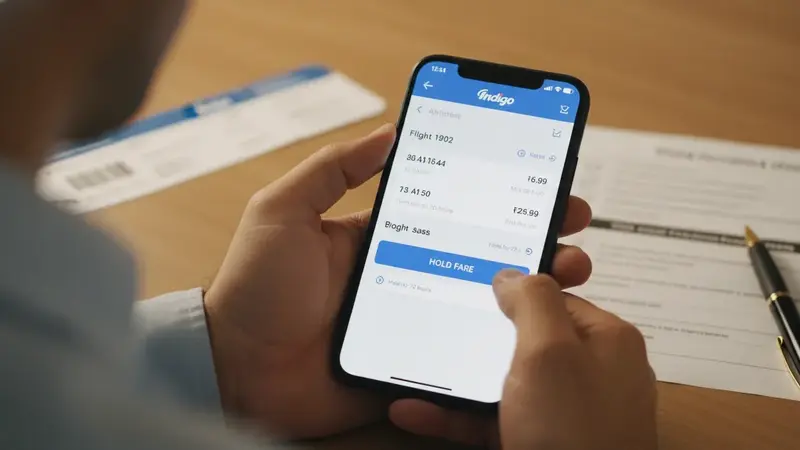
The basic flow is straightforward. Select your route, dates and fare, enter passenger details, choose the hold option where available, pay the hold fee and keep the confirmation details. Later, you must complete full payment within the hold period if you want the booking to become a paid ticket.
For visa-document use, screenshot-only handling is weak. Save the confirmation, passenger details, route, dates and booking reference if shown. Compare the name and route against your passport and application before uploading anything.
Website Flow vs App Flow
The website flow is usually easier when you need to download, print or save documents for a visa file. You can review the passenger details on a larger screen, check spellings slowly, and save the final confirmation in a folder with your other documents.
The app is convenient when you are moving quickly, but it can also make mistakes easier to miss. Autocorrect, small fields and rushed payment screens can create name or date errors. If you use the app, pause before confirming the hold and compare every passenger field with the passport.
For family or group applications, the website is often safer because you can review multiple passengers in sequence. A 6E hold with one incorrect child name or missing middle name can create more work than it saves.
What to Save After Creating the Hold
- The hold confirmation page.
- Passenger name and route details.
- Booking reference or hold reference, if shown.
- Hold expiry date and time.
- Payment link or Manage Booking instructions.
- Fare amount and route summary.
Do not rely only on an email subject line. If you need the document for a visa appointment, save the actual details in a readable format. If you need it for internal planning, write the expiry time on your checklist so you do not accidentally use stale proof.
Classic Mistakes With 6E Fare Hold
- Creating the hold too early for a later visa appointment.
- Assuming the hold is a paid ticket.
- Forgetting the hold fee is separate and usually not part of the ticket fare.
- Using a hold that expires before the visa file is reviewed.
- Choosing a route that does not match the visa form.
- Expecting to modify the held booking during the hold period.
If those mistakes apply to your situation, a normal 6E hold may not be the best dummy-ticket strategy. You need a document that fits the visa timeline, not just an airline feature that looks convenient today.
Can You Use 6E Fare Hold as a Dummy Ticket for Visa?
You can use 6E Fare Hold as short-term travel-proof support when it accurately shows your intended trip and remains current during the relevant check. But you should not describe it as a final paid ticket unless you complete payment. The safer wording is that it shows an intended IndiGo itinerary or held fare for planning.
A dummy ticket is usually a temporary reservation or itinerary used to show planned travel without paying the full fare upfront. A 6E Fare Hold overlaps with that idea in one narrow way: it can show an intended flight while payment is deferred. Its weakness is the short hold period.
When It Works Best
- Your appointment or upload deadline is within the hold window.
- Your route is an actual IndiGo route you may use.
- Your travel dates are already aligned with your visa form.
- You are comfortable completing payment quickly if needed.
- You only need short-term proof, not document support for a long review.
For example, if your appointment is tomorrow and the hold can remain active through the appointment window, the document may support your intended route. If your visa review may happen a week later, the same hold may not remain useful.
What Visa Officers Usually Need to Understand
Visa officers are not mainly impressed by an airline brand. They need to understand route, dates, passenger identity, stay length and consistency with the rest of the file. An IndiGo hold is helpful only if it answers those points cleanly.
If your hotel dates show March 5 to March 12, your IndiGo hold should not show March 20 unless the cover letter explains the gap. If your leave letter supports seven days, a three-week hold can create doubt. The dummy ticket for visa 2026 complete guide explains how to keep the flight document aligned with the full visa package.
How to Describe a 6E Hold in a Cover Letter
Use accurate wording. Do not write, “I have purchased my final ticket,” unless you have paid the full fare and the booking is ticketed. Instead, describe the document as an intended IndiGo itinerary or held fare that supports your planned travel dates while you wait for the visa result.
A clean sentence can be enough: “The attached IndiGo itinerary shows my intended travel dates, which match my leave approval and accommodation plan. I will complete final ticket purchase after the visa decision.” This keeps the document honest and avoids overstating what the hold means.
India Departure City Scenarios
IndiGo is especially relevant for Indian applicants because many visa trips start from Delhi, Mumbai, Bengaluru, Hyderabad, Chennai, Kolkata, Kochi or Ahmedabad. A simple India-origin IndiGo itinerary can make the travel plan easy to understand when the route is domestic-to-international or India-to-nearby-country.
For example, a Delhi to Dubai visit, Bengaluru to Singapore conference, Hyderabad to Bangkok holiday or Mumbai to Doha family visit may all use IndiGo routes or IndiGo-style short-haul planning. The hold should still match the visa type and stay duration. Airline familiarity does not fix a mismatched date.
Hold Email, PNR or E-Ticket?
These labels matter. A hold confirmation shows that a fare or booking has been held under IndiGo’s rules. A PNR can identify a booking record. An e-ticket normally suggests ticketing/payment status. Do not mix the labels casually.
If the document is only a hold, treat it as a hold. If you later pay the fare, then the travel document changes status. Visa and airline staff may read those signals differently, so use accurate language in your cover letter and internal notes.
Where a Short Fare Hold Fails
The biggest 6E Fare Hold problem is not legitimacy. It is timing. Visa workflows often last longer than airline hold windows. A document that was current when created may expire before the person reviewing the file sees it.
The 48/72-Hour Problem
Many applicants think a two- or three-day hold is enough because they only care about the appointment date. But some visa files are reviewed after intake, not only at intake. If the hold has expired by then, the document may no longer support the file as intended.
This is especially important for Schengen, UK, Canada, Japan, Korea and other files where travel dates, accommodation and supporting evidence are read together. A stale hold does not always cause a problem, but it weakens the proof value.
No Modifications During the Hold
IndiGo says no modifications can be made to the hold booking during the hold period. That matters if your date, passenger or route changes. You may need a new hold or a different proof strategy instead of editing the original.
For visa files, changes need to be mirrored everywhere: ticket, hotel, insurance, leave letter and cover letter. A hold that cannot be modified may become inconvenient when the visa appointment or travel window shifts.
Availability and Exclusions
IndiGo says 6E Fare Hold is subject to availability and exclusions. It may not appear for every fare, every channel or every booking type. Group and corporate contexts can have different rules. Do not build your visa strategy around a hold option that may not be available when you need it.
When a Hold Is Too Short
- Your visa appointment is several days away.
- Your document may be reviewed after submission.
- You expect date changes after biometrics.
- Your hotel or invitation dates are not final.
- You need proof for a family group and cannot risk multiple expired holds.
- The destination expects a longer-visible travel plan.
In these cases, a dedicated dummy ticket can be cleaner because it is created for visa-document timing, not fare-price protection. The broader dummy ticket for visa guide can help you decide when temporary proof is enough and when to buy the real ticket.
The Second-Review Problem
Many applicants think only the appointment counter matters. But some files are reviewed later by a caseworker, consular officer or back-office team. If the travel proof has expired by then, it may no longer support the file as strongly as it did at submission.
This does not mean every expired hold causes refusal. It means the hold is a short-lived document. If your file depends heavily on flight proof, use a document that is still sensible when the file may actually be read.
When Fare Protection Is the Wrong Goal
6E Fare Hold is built around fare protection and deferred payment. Visa applicants sometimes need something different: document consistency over a review period. These goals overlap only when the appointment timing is close.
If your main fear is a fare increase, 6E Fare Hold may be the right tool. If your main fear is submitting a stale travel document, a visa-focused dummy ticket may be better. Decide based on the problem you are solving.
Other Ways to Use IndiGo in a Visa-Friendly Plan

Turn the Hold Into a Paid Ticket
If your visa timing becomes certain and the fare makes sense, you can complete payment within the hold period. Once paid, the document moves from a held fare to a ticketed booking. That may be the right move when your travel date is fixed and you are comfortable with the fare rules.
Before paying, check change and cancellation conditions. A cheap fare can become expensive if the visa decision is delayed or if your travel date changes. Do not assume payment removes all risk.
Use a Dedicated Dummy Ticket
A dedicated dummy ticket is often better when the visa timeline is longer than the hold window. It can be generated around the appointment or upload timing, with route and date details aligned to the visa file. It should still be genuine, accurate and consistent.
This is useful when you want an IndiGo-like route or domestic India departure logic but do not want to depend on a short airline hold. The document should support your file without pretending to be something it is not.
What a Stronger IndiGo-Style Dummy Ticket Should Include
- Passenger names matching passports.
- Route that fits the visa destination and travel purpose.
- Travel dates that match forms, hotels, insurance and leave approval.
- A realistic connection pattern if the route is not direct.
- Clear document formatting that does not look manually edited.
- Current details at the time of submission or appointment.
The goal is not to force IndiGo into every visa file. The goal is to show a believable trip from India. If IndiGo is a natural airline for the route, it can make sense. If another airline gives a cleaner route, choose the route that best supports the visa story.
Use a Flexible IndiGo Ticket
In some cases, paying for a more flexible fare is the right choice. If the visa is already issued, your trip is important, and you are likely to fly regardless, flexibility can protect against date changes. But it still ties up more money than a dummy-ticket approach.
Compare the cost of flexibility with the risk of delay. If the visa decision is uncertain, a temporary document may be smarter. If the trip is confirmed, a flexible ticket may be simpler.
Agent or GDS Holds
Some travelers use travel agents or reservation services to arrange temporary itineraries. This can be useful when a route needs more control than a website hold. But the document must still be genuine and consistent. Avoid providers that only create edited PDFs.
For visa purposes, the quality of the document matters more than the label. It should show the right name, route, dates and booking information without unsupported claims.
Third-Party Reservation Services
Some services create temporary dummy tickets specifically for visa or onward-proof preparation. These can be useful when airline website holds are too short or unavailable. The key is to avoid services that only generate fake-looking PDFs with no real booking logic.
Before using any document, check the basics: name, route, dates, passenger count and consistency with the rest of the file. A third-party reservation should make the file easier to read, not introduce a new contradiction.
6E Fare Hold vs Dummy Ticket vs Paid Ticket

| Option | Best for | Main risk |
|---|---|---|
| IndiGo 6E Fare Hold | Very short timing, quick appointment, fare-price protection | Expires before visa review or cannot be modified |
| Dedicated dummy ticket | Visa-document support when final ticket purchase is not ready | Must be genuine, current and consistent |
| Paid IndiGo ticket | Actual travel or locked plans | Fare changes, cancellation charges or date-change costs |
| Flexible fare | Confirmed trip with possible date movement | Higher upfront cost |
Real-World Scenario: Appointment Tomorrow
If your appointment is tomorrow and IndiGo 6E Fare Hold is available for your route, it may be enough to show intended travel at intake. Check the hold expiry carefully. Save the document clearly. Make sure the name, date and route match the application.
Real-World Scenario: Visa Review Takes Two Weeks
If the visa file may sit for two weeks, a short hold is weak. It may expire before review. In that case, a dummy ticket timed closer to submission or a more durable travel-proof strategy is usually cleaner.
Real-World Scenario: Family Application
For family files, a short hold can be awkward because each passenger must be correct and the hold may expire quickly. If one name is wrong or one passenger is missing, the whole set can look inconsistent. A dedicated dummy ticket may give more control over the family itinerary.
Real-World Scenario: Destination Requires Return Proof at Boarding
If you are using IndiGo for actual travel to a destination that may ask for return or onward proof at the counter, do not rely on an expired hold. Carry current onward proof or the actual ticket needed for the journey.
Real-World Scenario: Visa Dates Shift After Submission
If your visa appointment is rescheduled or the decision arrives later than expected, your original 6E hold may no longer match the trip. Do not keep the old document simply because it was the first one you created. Update the itinerary proof and mirror the change across hotel booking, insurance and cover letter if needed.
This is where a dedicated dummy ticket can be useful because you can create it around the new timeline instead of stretching an expired airline hold. The revised document should preserve the same travel purpose and trip length unless the change is clearly explained.
Real-World Scenario: You Want to Lock Fare but Not Visa Proof
Sometimes 6E Fare Hold is useful even if you do not use it in the visa file. You may simply want to protect a fare while waiting for family confirmation or payment arrangement. In that case, treat it as a booking tool, not a visa document.
Separating these goals keeps the decision clean. You can use 6E Fare Hold to manage fare risk and use a dummy ticket for visa-document timing if the hold window does not fit.
Checklist Before You Submit or Travel
Before using 6E Fare Hold as a dummy-ticket-style document, check the timing first. Most mistakes happen because the traveler creates the hold when it feels convenient, not when the visa or airline check will actually happen.
Before Visa Submission
- Confirm the hold remains current through the submission or appointment moment.
- Match passenger names exactly with passports.
- Match travel dates with the visa form and cover letter.
- Match hotel, invitation or insurance dates if included.
- Do not call the hold a paid ticket unless full fare is paid.
- Save the confirmation and booking details as a clean PDF.
- Prepare a new document if the hold expires before use.
Before Actual Travel
- Carry the actual paid ticket for the flight you will board.
- Carry current onward or return proof if the destination may require it.
- Check visa, transit and entry rules for every country on the route.
- Do not show an expired hold as if it were current proof.
- Keep documents offline and printed for strict counters.
- Use one clear itinerary, not multiple conflicting versions.
Create your dummy ticket with DummyFlights after your route, passport name and travel dates are clear.
Final Takeaway for IndiGo 6E Fare Hold
IndiGo 6E Fare Hold can be useful, but it is not a universal visa solution. It works best when you need short-term proof and the hold remains current through the moment of review. It becomes weaker when the visa process takes longer than the hold window.
If your visa timing is short, use the hold carefully and describe it accurately. If your visa timing is longer or uncertain, use a dummy ticket designed for visa-document preparation. If you are actually flying, use the real ticket and current onward proof required for the route.
FAQ
Can I use IndiGo 6E Fare Hold as a dummy ticket?
You can use it as short-term travel-proof support when it accurately shows your intended route and remains current, but it is not the same as a longer-validity dummy ticket.
How long does IndiGo 6E Fare Hold last?
IndiGo lists hold windows such as 6, 50, 72 and 96 hours depending on advance purchase timing and availability. Always check the exact expiry before using it.
Is 6E Fare Hold a paid ticket?
No. It blocks the fare for a selected booking. You must pay the full fare within the hold period for it to become a paid booking.
What happens if I do not pay before the hold expires?
IndiGo says unpaid hold bookings are automatically cancelled after the hold period expires, and the hold fee is not adjusted toward the ticket fare.
Can I modify an IndiGo hold booking?
IndiGo says no modifications can be made to the hold booking during the hold period. If details change, you may need a new proof strategy.
Is 6E Fare Hold enough for a visa appointment?
It may be enough when the appointment is within the hold window and the details match your file. It is weaker when review may happen after the hold expires.
Should I use a dummy ticket instead of 6E Fare Hold?
Use a dummy ticket when your visa timeline is longer or uncertain and you need travel-proof support without buying the final ticket too early.
Can I use an expired 6E Fare Hold for visa proof?
No. An expired hold is weak travel proof and may create consistency problems. Use a current document that matches your route and dates.
Does a PNR mean my IndiGo ticket is confirmed?
Not always. A PNR can identify a booking record, but ticketing/payment status matters. Do not treat a hold as a paid ticket unless full fare is paid.
What is safer for actual airport travel?
For actual travel, carry the paid ticket for the flight you will board and current onward or return proof if the destination or airline requires it.