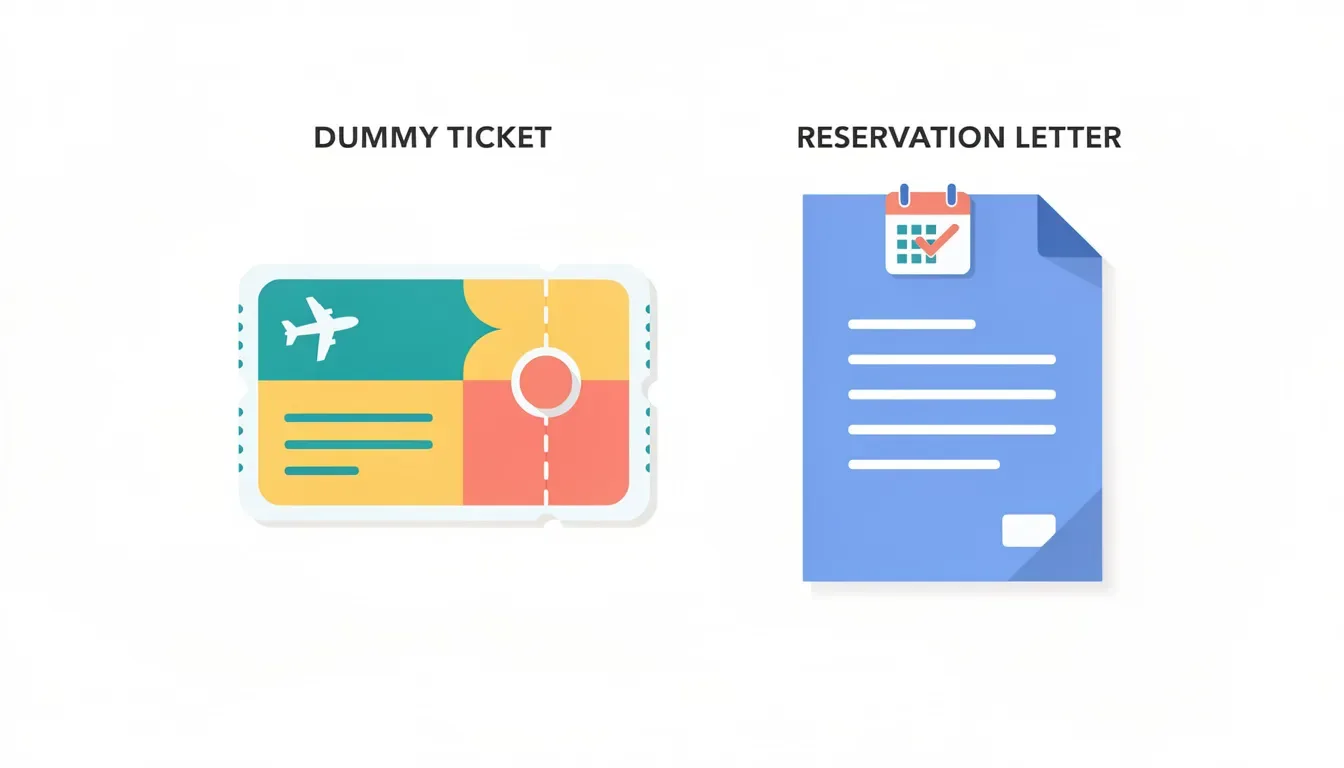
Your appointment is on Monday. On Friday night, you upload your flight proof and realize the real risk is not the price. It is credibility. Some visa offices may review a clean reservation footprint. Others doubt anything that cannot be checked quickly. And if your dates shift after submission, the wrong document can turn into a contradiction.
We are going to help you pick the low-riskr option between a dummy ticket and a reservation letter for your exact situation. We will cover how officers verify flight proof, what triggers quick document problem, and how to keep your itinerary consistent through processing. If you need a verifiable itinerary today, use a dummy ticket booking that stays consistent through visa checks.
Compare a flight reservation with a reservation letter by checking what each document actually confirms, which details can be verified and what your current visa checklist requests. Choose the document type that fits the requirement, then check its dates and status before submission.
If you need the broader framework first, use the complete dummy ticket for visa guide. It explains how flight proof connects with forms, accommodation, insurance and travel-window planning.
For practical submission details, the dummy ticket for visa guide shows when a reservation can support your file without committing to a paid ticket too early.
If you are still unclear on the term itself, start with what a dummy ticket is. That foundation helps you separate a real temporary reservation from a letter, a hold, a paid ticket or an edited PDF.
In This Guide
The Real Choice: Dummy Ticket Vs Reservation Letter For Visa

Most visa problems with flight proof do not start at the airline. They start at the visa desk, where someone has minutes to decide if your itinerary feels real, stable, and checkable.
| Proof type | Best when | Main risk | What makes it stronger |
|---|---|---|---|
| Dummy ticket / flight reservation | You need route-and-date proof that behaves like a retrievable reservation. | It may expire or drift before review if timing is handled badly. | Matching name, realistic route, PNR/reference behavior and stable dates. |
| Reservation letter | Your dates may shift, or the checklist asks for intended travel proof rather than a paid ticket. | It can look like a decorative PDF if it lacks checkable details. | Clear passenger block, route table, issue date, issuer details and restrained wording. |
| Paid/refundable ticket | Your case supports a real booking and cash-flow/refund rules are manageable. | It can contradict a “buy after visa decision” story or create refund exposure. | Only use when the rest of the file supports the commitment. |
Start With The Only Question That Matters: “Can Someone Else Confirm This Exists?”
When an officer looks at your flight proof, they are not admiring formatting. They are hunting for confirmation. Confirmation means a neutral third party could verify that your reservation exists in some system, at least at the time you submitted it.
That is why the first decision is not “dummy ticket or reservation letter.” The real decision is this: Will your proof behave like something that can be checked, or will it behave like a claim on paper?
We should be clear about what “checked” looks like in real life. Officers do not all follow the same routine, but the logic is consistent.
They want signals that reduce guesswork:
- A traceable reference that matches the passenger and route
- A stable itinerary footprint that does not vanish before processing begins
- Internal consistency across dates, airports, and traveler details
- A document tone that does not overpromise what it cannot prove
If your proof gives those signals, you lower friction. If it does not, the officer is forced to interpret. Interpretation is where negative decisions and “please provide updated itinerary” messages are born.
“Confirm this exists” also includes a quiet second layer. It is not only about the existing reservation. It is about whether it exists in a way that matches what you are claiming.
A common break downure is not fraud. It is a mismatch.
For example, your PDF shows one routing, but the underlying record shows something slightly different. Or the name spacing is off. Or the date format creates doubt about which day is the departure. Small issues can become big because visa processing rewards clarity.
Here, we focus on a simple mindset shift. Instead of asking, “Which document do visa offices want?” ask, “Which document makes it easiest for an officer to believe my trip plan without doing extra work?”
That mindset also protects you when timelines change. Because travel plans change. Visa processing does not care that the airline changed schedules. The file only cares that your proof still reads as coherent.
If your itinerary can be independently confirmed, it carries its own weight. If it cannot, you need other parts of the file to carry it. That is where applicants get surprised, because they assume flight proof stands alone.
It rarely does.
When A Reservation Letter Is Strong, And When It Is Just A Pretty PDF
A reservation letter can be excellent proof, but only when it is written like a document that expects scrutiny.
The strongest reservation letters have one defining feature. They do not rely on vibes. They rely on the specificity that can be cross-checked.
A strong letter usually shows:
- Your name exactly as on your visa form and passport
- Clear flight routing with airport codes or unmistakable city pairs
- Dates that align with the trip duration stated in the application
- A booking reference or traceable reservation identifier, when applicable
- Issue date and time that makes sense with your submission timeline
- Issuer identity that feels accountable, not anonymous
Accountable does not mean famous. It means the letter reads like someone could contact the issuer and get a consistent answer.
A weak reservation letter is usually weak for one of three reasons.
First, it is too generic. It reads like a template that could fit any trip. That makes an officer wonder if it was generated to satisfy a checkbox, not to reflect a real plan.
Second, it is too confident in the wrong places. Words like “confirmed,” “ticketed,” or “paid” can create risk if the underlying reservation is not actually in that state. Officers may not even verify payment, but they will notice overclaiming if anything else looks off.
Third, it is visually polished but logically thin. A clean header, a logo, and neat spacing do not substitute for checkable details.
Here is a practical test we can use. Read the letter and ask, “If someone challenged this, what would we point to?” If the answer is “the letter itself,” you have a problem. If the answer is “the reference, the dates, the issuer details, and the consistent itinerary logic,” you are closer to low-risk.
We also want to avoid the trap of stuffing details that create new questions. Some letters add cost breakdowns, random booking class codes, or extra airline jargon to look official. That can create extra doubt if the details are wrong, inconsistent, or unrealistic.
A reservation letter does not need to impersonate an airline system. It needs to look like a credible record of intent that stays consistent with the rest of the file.
If you want a letter to work, treat it like a piece of evidence, not like a decorative attachment.
When A Dummy Ticket Wins By Default
There are cases where a dummy ticket is simply the cleaner answer because it gives the officer what they want with less interpretation.
A dummy ticket tends to win when your situation has any of these traits:
- The visa office is known for tighter document checks
- Your trip is short and date-specific, with little flexibility
- Your route is simple and should be easy to validate
- Your appointment is close, so you need proof that looks “live” now
- Your broader file is strong, and you want the flight proof to be equally tight
In these cases, the advantage is not that a dummy ticket looks better. The advantage is that it creates a reservation footprint that can be checked in a way a vague letter cannot.
There is also a psychological factor at play. Officers handle a huge volume. They do not want to debate whether your flight plan is plausible. They want to see something that behaves like a booking.
If you are applying for a visa where entry and exit dates are central to the decision, a dummy ticket often reduces back-and-forth.
That matters for visas where the overstay risk is part of the lens, because timing signals intent. A stable entry and exit pattern makes the trip easier to believe.
We should also talk about how dummy tickets help when the file is being reviewed by multiple people. Some applications are touched by a receptionist, a document screener, and a decision-maker. A verifiable reservation makes your story easier to hand off. A vague letter forces each person to reinterpret.
That said, dummy tickets still need discipline. If the reservation expires before the application is reviewed, you lose the main benefit. We do not want “checkable for two hours.” We want “checkable long enough to survive the workflow.”
So when a dummy ticket wins, it wins because it reduces ambiguity. Not because it is “more official.”
When A Reservation Letter Can Be The Low-riskr Choice
A reservation letter can be low-riskr when you genuinely do not want to lock yourself into a specific itinerary shape yet, but you still need to show credible travel intent.
This comes up when:
- Your travel window depends on leave decision or event confirmation
- You have two possible return dates and need a buffer
- You are coordinating with family in different cities
- You expect a reschedule and do not want multiple itinerary versions in your file
In those cases, the “lowest-risk” move is the one that avoids future contradictions. A letter can describe your plan without creating the illusion that your flights are already settled.
But a letter only stays low-risk if it avoids a common mistake: pretending to be a ticket.
We can keep it credible by staying disciplined with wording. The letter should reflect what is true. If it is an intended itinerary or a reservation request, it should read that way. You do not want a letter that claims certainty, then collapses when the officer looks for confirmation signals.
A reservation letter is also low-riskr when the route itself is still being decided. For example, you might enter through one city and exit another, but your final choice depends on local ground plans. A dummy ticket that hard-locks the route can create problems if you later adjust.
This is where many applicants unintentionally create risk. They submit one itinerary, then later attach another, and now the file contains two conflicting stories. A careful reservation letter can prevent that spiral.
We can also use a letter when the visa office’s main need is that you have thought through dates and routing, not that you have paid for flights. Some visa offices prefer applicants not to commit money before a decision. A letter can match that posture, as long as it is not vague.
The best reservation letters do not try to win on polish. They win on coherence.
A Fast Decision Filter You Can Use In 3 Minutes
If you want to choose quickly without overthinking, use this filter. Answer each line honestly.
- Do you need something that can be independently verified during processing?If yes, a dummy ticket is usually the low-riskr choice.
Are your dates likely to change after you submit?
- If yes, a reservation letter is often low-riskr unless you can keep the reservation stable and update it cleanly.
Is the route straightforward and easy to believe?
- If yes, a dummy ticket can reduce questions.
- If no, a careful letter can avoid locking you into a weird routing that invites scrutiny.
Is your appointment close, with little time for follow-up requests?
- If yes, lean toward the option that minimizes ambiguity from day one.
Can you keep one clean version of flight proof in your file from submission to decision?
- If you cannot, you are choosing chaos. Fix that first.
The point is not to chase a “perfect” document. The point is to submit the document that survives how visa offices actually work: quick screening, occasional verification, and constant consistency checks.
Once you choose verifiable proof over vague proof, the next question becomes more tactical: what exactly do officers check, and which small mistakes cause a file to break down faster than you would expect?
How Visa Offices Commonly Validate Flight Proof, And Why Some Files Break down In Seconds

Visa office teams do not read flight proof like a traveler reads it. They read it like a risk document, and they scan for anything that breaks under a quick check.
The Three Common Verification Paths Officers Use
Most visa desks use one of three verification paths, depending on workload, country practice, and how clean your file looks at first glance.
The first path is the plausibility scan. A Schengen short-stay file often gets this treatment at the document intake stage. The officer checks your entry date, exit date, and trip length. They compare it to your stated plan and leave dates. They also check if your route makes sense for your chosen destination and first entry.
The second path is reference-based validation. This is common when a visa office expects a reservation footprint that can be confirmed quickly. An officer may look for a booking reference and treat it as a credibility anchor. If the reference format, passenger name, or segment details look inconsistent, the file can get flagged for clarification.
The third path is the consistency cross-check. This shows up in visitor visas like the UK Standard Visitor or US B1/B2, where the officer often weighs your travel story against your timeline and ties. Here, they compare your flight dates with your job letter dates, your stated length of stay, and sometimes even the cadence of your bank activity around your intended travel period.
These paths are not mutually exclusive. A Canadian TRV review can start as a plausibility scan and move into cross-check mode if your itinerary dates conflict with your employment leave window.
Your goal is simple. Make sure your flight plan survives all three paths without forcing an officer to guess what you meant.
The Quiet Red Flags: What Looks “Normal” But Reads As Risky
Visa office reviewers develop a fast pattern sense. They do not need to prove that something is wrong to slow your file down. They only need to see signals that suggest the itinerary might not be stable.
One quiet red flag is an airport and city mismatch. A Schengen application that claims “Paris” but shows an arrival in a secondary airport far from the stated accommodation area can trigger questions, especially when your itinerary narrative does not explain the transfer.
Another is connection logic that ignores reality. An Australian visitor visa file with a 45-minute international-to-domestic connection at a major hub can look careless. Even if the route is technically possible on paper, it reads like something assembled for documentation rather than travel.
A third is date symmetry that feels manufactured. Officers see many itineraries that depart on the same weekday and return exactly seven days later, with no reason tied to leave decision, event dates, or personal schedule. In a high-volume post, symmetry can look like a placeholder rather than a real plan.
There is also name formatting drift. A UKVI application where the passport shows a middle name but the reservation drops it can create identity friction. A US visa post may not refuse for that alone, but it can reduce trust when other details also look light.
Even formatting can matter when it changes meaning. A day-month swap in a reservation PDF can look like a different travel date to an officer in a country that reads dates differently.
These flags rarely cause negative decision by themselves. They raise the chance of a request for updated proof, which can become a timing problem if your appointment window is tight.
Why The Japanese Visa office May Question Your Flight Itinerary
Japan is a useful example because many applicants underestimate how strict “clean paperwork” can be at certain posts. The issue is often not the concept of a reservation. The issue is whether your itinerary reads as dependable under scrutiny.
A Japanese visa file can run into trouble when the flight proof and the day-by-day plan do not align. If your schedule says you will be in Osaka on Day 2, but your arrival is late evening in Tokyo, the officer sees a planning gap. The gap can look like carelessness, and carelessness is treated as risk in document-driven systems.
Japan also tends to punish overly complex routings that do not match the purpose of travel. A first-time tourist file that shows three internal hops and multiple open-jaw segments can look like a constructed itinerary rather than a practical holiday plan. If your stated purpose is sightseeing, the routing should support that story.
Another break downure point is unclear entry and exit logic. If your itinerary shows entry into Japan but your exit segment is missing, delayed, or described vaguely in a letter, the officer can question whether you understand the trip boundaries. Japan often wants your trip boundaries to look stable.
Japan also exposes the document tone problem. If a letter claims you have “confirmed tickets” but the itinerary behaves like a hold, the mismatch can damage credibility. The Japanese post does not need to verify payment to detect overclaiming.
If you are applying through a Japan visa process that relies on a strong, consistent bundle, your flight proof must match your plan with almost no interpretive work required.
Time Sensitivity: The Hidden Problem With Holds That Expire
Visa office processing timelines do not respect reservation expiry windows. That mismatch is a common reason “perfect” flight proof breaks down later.
A Schengen application might be submitted on Day 1, pre-checked on Day 3, and fully reviewed on Day 10. If your reservation disappears on Day 2, the file can look unstable when the officer checks it during review. Even if the itinerary was valid when you uploaded it, the officer evaluates what they can confirm at review time.
This time sensitivity shows up in places with longer queues. Some Canadian TRV files sit in a digital line before a detailed review starts. If the reservation footprint cannot be found when a reviewer opens the file weeks later, the reviewer may treat the flight proof as unreliable intent.
It also matters for countries where third-party submission routes exist. When a visa center scans and uploads documents, time passes before a visa officer sees the same PDF. If your itinerary is only “live” for a short window, you risk a credibility drop that has nothing to do with your travel plans.
Here, we focus on stability. Your flight proof should remain coherent and confirmable across the likely review window. You should also keep your dates aligned with your appointment and submission timeline, so the officer does not see a reservation created after the file was supposedly finalized.
If you expect a longer processing cycle, you need flight proof that does not expire in silence.
What You Should Never Force An Officer To “Assume”
Visa officers do not like assumptions because assumptions create liability. When the file is unclear, they protect themselves by asking for more proof or by treating the plan as weak.
Do not force an officer to assume your trip boundaries. A US B1/B2 file that lists “two weeks” but shows a nine-day round trip makes the officer guess which one is true.
Do not force an officer to assume your route purpose. A UK Standard Visitor file with a zigzag route across multiple countries can look like unstated transit or unstated work activity unless your stated purpose clearly explains the structure.
Do not force an officer to assume your identity match. A Schengen application where the reservation shows a different last name order than the passport can trigger needless doubt, especially when the post is strict on identity consistency.
Do not force an officer to assume your date interpretation. If your PDF uses a date format that can be read two ways, you create a problem that does not need to exist.
Do not force an officer to assume your version of events. If you upload two itineraries with different dates, you ask the officer to choose which story is real, and that choice can go against you.
The lowest-risk flight-proof removes guesswork. It gives the officer one clean, stable itinerary that matches the rest of your submission, which sets us up for the next step: building a reservation letter that stays specific, credible, and carefully worded.
Reservation Letter Done Right: Make It Specific Enough To Be Credible, But Not So Strong It Becomes A Lie

A reservation letter can carry your flight intent cleanly, but only if it reads like it was written for an visa desk, not for a traveler’s inbox. The goal is precision without overclaiming, so your file stays believable even under a quick check.
The Anatomy Of A High-Credibility Reservation Letter
A strong reservation letter behaves like a document that expects cross-checking. Schengen short-stay applications are a good example, because entry, exit, and trip length often get scanned against your application form and your stated itinerary.
Start with identity details that match your file exactly. That means your name order and spacing should mirror the passport data page and the visa form fields. If your UK Standard Visitor application uses a middle name, your letter should not “simplify” it unless you also simplified it everywhere else.
Then anchor the travel structure in a way an officer can read fast:
- Route In Plain Sight: city pairs plus airport codes, such as CDG, AMS, JFK, DXB
- Trip Boundaries: your first arrival date and final departure date, clearly labeled
- Segment Clarity: one line per flight segment, not a paragraph narrative
- Issue Timestamp: the date the letter was generated, aligned with your submission timing
- Issuer Accountability: company name, support contact, and a consistent formatting style
For a Canadian TRV file, officers often weigh whether your plan matches your reason to travel and your timeline. Your letter should make the travel window obvious without adding extra claims. For an Australian visitor visa, the letter should avoid messy multi-routing if your stated purpose is simple tourism.
A credibility detail that many applicants skip is time context. If your letter lists a departure date, but your application appointment is after that date, you create instant doubt. The letter should reflect a travel window that logically follows the submission timeline.
A high-credibility letter does not try to look like an airline ticket. It tries to look like a consistent, checkable record of your planned itinerary that matches the rest of your visa story.
The Most Dangerous Sentence In A Reservation Letter
The sentence that causes the most trouble is the one that claims a booking status you cannot support.
Phrases like “confirmed ticket,” “paid booking,” “ticket issued,” or “finalized itinerary” sound reassuring to an applicant. To a visa reviewer, they can become a liability if anything else in the file suggests flexibility or uncertainty.
This matters in posts that cross-check intent hard. UKVI often looks at overall credibility, not just one document. If your letter says the flight is “paid and confirmed,” but your bank activity does not show any travel-related spending, and your cover letter says you are “waiting for visa decision before purchasing,” you have a contradiction. The officer does not need to prove fraud. They only need to decide that the file feels inconsistent.
It also matters in Schengen files, where officers sometimes request updated flight proof. If your letter overclaims certainty and you later submit a different itinerary, your second submission looks like a correction of an earlier “final” claim.
A low-riskr approach is to keep wording aligned with what the document actually represents. Use language that states intent and structure without inventing finality:
- Low-riskr: “Flight reservation details for intended travel dates.”
- Low-riskr: “Proposed itinerary for visa application purposes.”
- Low-riskr: “Reservation record issued on [date] reflecting planned routing.”
Avoid status words that imply ticketing or payment unless the document truly reflects that, and you are prepared for the rest of the file to match that certainty.
Your letter should also avoid strong promises about immovable dates unless your trip is truly date-locked. Conference travel to Germany on a specific event date is different from general tourism planning. The wording should match the reality of your travel reason.
“Letter Vs Itinerary” Confusion: Fix The Format Before You Submit
Many reservation letters break down because they look like something else. Not because they are “wrong,” but because they trigger the wrong mental category for the reviewer.
If your letter looks like an invoice, a Schengen intake officer may wonder where the actual itinerary is. If it looks like a travel advertisement, it can read as non-evidence. If it looks like a ticket, but lacks ticket-level details, it invites a “this does not match” reaction.
We get cleaner outcomes when the format answers the exact question the visa office is asking: “What flights are you planning to take, and do the dates and routing align with your application?”
A practical structure that works across many visa offices is:
- A header that identifies the document as a reservation letter or flight itinerary statement
- A passenger block with your full name exactly as in your application
- A segment table with columns like From, To, Date, Flight (if listed), Departure Time, Arrival Time
- A footer with the issue date and the issuer contact
This format is especially useful for Schengen and Japan visitor visa submissions, where reviewers often compare your day-by-day plan with arrival timing. If your plan says “arrive morning and travel onward,” but your itinerary shows a late-night arrival, a table makes that conflict visible, which lets you fix it before submission.
Also, watch for airport naming confusion. “London” can mean multiple airports. A UK transit routing that says “London” without an airport code can create avoidable ambiguity. If your route involves multiple airports in a single city, use airport codes to remove guesswork.
Finally, keep the document calm. Avoid excessive stamps, badges, or loud trust language. A visa officer is trained to distrust persuasion. They trust consistency.
When The Letter Needs A Backup Attachment
Some reservation letters stand on their own. Others need a supporting attachment to prevent questions that commonly appear during review.
This is most relevant when your letter does not include a traceable booking reference, or when your route is complex enough that an officer could misread your intent.
Here are flight-focused cases where a backup attachment helps:
- Open-Jaw Trips: entering one city and exiting another in the Schengen Area
- Transit-Heavy Routes: a visitor visa plan that includes major hub connections that could be mistaken for a different destination
- Date Flex Windows: where you must show a travel range without creating two competing itineraries
The attachment should not be a pile of extra PDFs. It should be one clean page that reinforces the logic of your flight plan.
Good options include:
- A one-page itinerary note that matches the same dates and cities in your visa form
- A short “travel timing” statement tied to a fixed event date for business or conference travel
- A single, updated itinerary page if your visa office requested clarification after submission
For Canada TRV and Australia visitor visas, officers sometimes focus on whether the trip structure fits your stated purpose and time away from work. A backup attachment can show the trip window and return intent without adding new claims about ticketing.
The rule is simple. The attachment must reduce officer effort. If it creates new details to reconcile, it hurts more than it helps.
Your Consistency Checklist Before Uploading
A reservation letter becomes risky when it conflicts with a single field elsewhere in your application. Here, we focus on the exact items that get cross-checked in real visa workflows.
Use this checklist right before upload:
- Name Match: passport name order, spacing, and any middle names match your visa form
- Date Match: arrival and departure dates match the dates you entered in the application portal
- Trip Length Match: the number of days implied by flights matches the number of days you stated
- Airport Code Match: city names are not doing extra work, airport codes remove ambiguity
- Route Match: entry city aligns with “first point of entry” requirements when relevant, such as Schengen rules
- Purpose Match: flight dates align with event dates for business travel or conference visas
- Timeline Match: the letter issue date makes sense relative to appointment and submission dates
- Single Version Rule: you upload one final letter, not multiple versions with different dates
If anything breaks down this checklist, fix the letter before it enters your file. A reservation letter is supposed to remove doubts, not create a second story for the officer to untangle.
Once your letter is tight, the next risk area is different. It is not wording. It is how dummy ticket reservations can drift, mismatch, or expire, creating avoidable scrutiny.
Dummy Ticket Risk Management: Avoid The Exact Issues That Trigger Suspicion Or Negative decision

A dummy ticket can be a clean solution for a Schengen appointment or a Japan tourist file, but only if you manage it like a living record. The visa office does not judge the idea. The visa office judges the details that survive checking.
The “Looks Fake” Problem Is Usually A Consistency Problem
In a Schengen short-stay review, the fastest credibility test is whether your flight proof matches your own application fields. If your France plan lists entry on 12 April but your reservation shows 13 April, the problem is not the reservation type. The problem is the mismatch.
In a UK Standard Visitor file, inconsistency reads like uncertainty. If your cover letter says “10 days in London” but the itinerary shows a 7-night window, UKVI can treat your travel story as loose.
In a US B1/B2 interview context, officers often rely on quick cues. If your itinerary shows a New York arrival but your DS-160 travel plan mentions Los Angeles first, the officer may push you to explain the gap on the spot.
Name inconsistencies are the most common trigger across visa offices. A Canada TRV reviewer can see a missing middle name as a minor issue, but if the same file also has date drift, the pattern becomes “careless documentation.”
Route consistency matters too. A Schengen file that says “first entry Italy” but shows a first landing in Frankfurt can create a rules question, even if you plan to connect onward.
Time zone and date formatting can quietly break a Japan visa bundle. If your itinerary shows “03/04/2026” and your other documents use day-month format, the Japanese desk may read a different date than you intended.
You can prevent most of these outcomes with a single discipline. Treat your dummy ticket as the master reference, then align every other field to it, especially in Schengen applications where “intended date of entry” and “intended date of departure” must match.
Before you upload, run a file-wide match check for:
- Passport Name Spelling and Order for Schengen, UKVI, and Canada TRV portals
- Exact Entry and Exit Dates across the application form and your itinerary PDF
- First Point of Entry Logic for Schengen routing expectations
- Stated Duration Of Stay for US B1/B2 interview credibility and UKVI consistency
- City Sequence for Japan day-by-day plans versus flight arrival time
When officers say an itinerary “looks fake,” it is often a polite summary of these mismatches in a Schengen or Japan file.
PNR-Based Reservations: What Can Go Wrong Even If You Have A PNR
A PNR can help in Schengen files where officers or intake staff look for a reservation footprint, but a PNR is not a magic shield. Different systems expose different details, and visa offices do not all check the same way.
In a Schengen visa center workflow, staff may only see your PDF and do a plausibility scan, but a visa reviewer may later expect the reference to still correspond to the same itinerary. If the PNR record changes, your PDF can become a snapshot that no longer matches.
Codeshares can confuse UKVI reviewers when the PDF lists one airline code, but the route appears under a different marketing carrier. If your London routing shows a partner flight number on paper and a different operating carrier pattern in the record, a reviewer may question whether you understand your own itinerary.
Segment status is another issue that matters in Japan and Schengen contexts, where “hold-style” bookings can behave differently over time. If one segment drops while another remains, the itinerary becomes incomplete, and the visa office sees an unstable travel plan.
Name field truncation can also create identity friction in Canada TRV files and US B1/B2 interviews. If your passport has a long surname and the reservation system truncates it, you need your PDF and your form to reflect the same consistent representation.
Route normalization can shift airport labels. A Schengen itinerary that shows “Rome” can later display “FCO” only, and a Japan visa desk that compares your day plan to airport codes may get confused if your PDF uses city names loosely.
Here, we focus on preventing “PNR drift” across review time. You can reduce drift risk by keeping the itinerary simple, avoiding unnecessary multi-carrier complexity, and ensuring your PDF captures the same segments, dates, and passenger name format that the record shows at issuance.
If you have a PNR-style reference, check for these stability points before submission to a Schengen or Japan desk:
- All Segments Present from outbound through return
- Same Passenger Name Format as your passport and application fields
- Same Dates and City Pairs as your uploaded PDF
- No Duplicate Itinerary Versions attached in the same Schengen or UKVI upload batch
A PNR is useful in many visa offices, but it must stay aligned with the file you submitted.
Multi-Leg Flights Are Where Most Applicants Accidentally Create Red Flags
Multi-leg itineraries are where Schengen and Japan files most often create plausibility stress, even when the applicant has real travel intent. Officers do not hate connections. They hate routes that look like they were built to satisfy paperwork rather than travel reality.
A Schengen itinerary that enters via Paris, connects through Zurich, and then backtracks to Amsterdam can look like a constructed pattern unless your plan explains why. A visa reviewer sees backtracking as a sign of low planning quality.
A Japan tourist plan that includes an arrival in Tokyo at 22:30 but shows a connection to Sapporo at 23:40 creates a practical problem. The Japan desk may read that as unrealistic timing, which weakens the credibility of your day-by-day schedule.
A UK Standard Visitor file that shows three European transits on the way to London can trigger a question about your real destination. UKVI may wonder why your route looks like a tour when your stated purpose is a single-city visit.
A Canada TRV file that includes an overnight layover in a third country can raise unstated transit questions. A reviewer may expect you to show you understand the transit requirement, or at least reflect a practical routing.
The fix is not to avoid connections. The fix is to make connections look normal for the route and visa purpose.
If you need multi-leg flights in a Schengen file, keep the connection story clear:
- Use one sensible hub for the region, not multiple hops
- Avoid tight international connections that do not match real airport flow
- Avoid unexplained open-jaw complexity unless your itinerary narrative supports it
- Keep entry and exit points aligned with your Schengen plan and first-entry expectation
If you need multi-leg flights for a US B1/B2 plan, keep the route consistent with your stated city of stay. A New York stay with a first landing in Boston can be fine, but the file should not look like you forgot to update your story.
When a multi-leg itinerary looks plausible, it stops being a red flag and starts being a normal traveler pattern that a Schengen or Japan reviewer can accept without extra questions.
Price, Payment, And “Ticketed” Signals You Should Not Invent
Pricing details can be harmless in some contexts, but they can also create unnecessary risk in strict document environments like Japan or in credibility-heavy reviews like UKVI. Visa offices do not need your fare to evaluate your intent, but they can react to fare claims that feel off.
A Schengen file that shows an unusually low fare for peak season can raise doubts if the itinerary also has other inconsistencies. A reviewer does not need to be a revenue manager to notice pricing that looks too perfect.
A UK Standard Visitor file can run into trouble when a letter claims “paid and ticketed,” but your financial evidence and travel statement suggest you are waiting to purchase after decision. UKVI reads contradictions as a credibility weakness.
A US B1/B2 interview can also become awkward if you claim you already paid for flights but cannot answer basic questions about your trip schedule. The officer may see “paid ticket” as a forced proof tactic rather than a real plan.
A Japan visa desk may treat “ticket issued” language as a hard claim. If anything later changes, the file can look like it contains overconfident statements.
Here, we focus on restraint. Only include payment or ticketing claims when your file is designed to support them consistently. In most tourist visa files, your low-riskr move is to keep your flight proof about routing and dates, not about price and payment status.
If your PDF or letter includes any of these terms, pause and check your consistency story for Schengen, UKVI, or Japan:
- Ticketed
- Issued
- Paid In Full
- Non-Refundable Fare Purchased
If your broader file does not support those claims, remove the claims instead of trying to prove them.
The One Rule That Prevents 80% Of Dummy Ticket Mistakes
In Schengen, Japan, UKVI, and Canada TRV workflows, most dummy ticket problems come from one habit. Applicants submit a reservation, then change plans, then upload another version, and the file becomes a timeline puzzle.
The one rule that prevents most of this is simple. Submit a reservation that you can keep stable through processing, and if you must change it, replace the old version cleanly rather than stacking versions.
A Schengen file should not contain two different entry dates across two PDFs. A UKVI upload should not contain multiple itineraries with different routes unless the earlier one is clearly removed and the new one is clearly the single current plan.
A Japan tourist application should not contain a day-by-day schedule tied to one arrival time and a flight schedule tied to another arrival time. Japanese reviewers notice timing conflicts fast.
A Canada TRV file should not show a reservation that expired long before review, then a second reservation created much later, unless you present a consistent explanation and keep only one final proof.
If you need to update your itinerary for a visa office request, keep the change controlled:
- Keep the same trip purpose and city plan for UKVI and Schengen narratives
- Update only the dates that changed, not the whole route unless needed
- Upload one final document set, not a bundle of old and new versions
- Make sure your application form dates match the updated reservation
Once your dummy ticket risk is under control, the next decision becomes more personal and more strategic: which proof type fits your visa category, your timeline, and how likely your dates are to move.
Match Your Flight Proof To Your Visa Type, Your Timeline, And Your Likelihood Of Changing Dates
The same flight proof can look perfect in one visa file and unnecessary in another. The smarter move is to match your proof to what that specific visa office is trying to confirm, and how stable your dates will stay while they process.
Short-Stay Tourist Visas: The Officer Wants A Coherent Trip Shape
Short-stay tourist visas are where flight proof gets treated like the skeleton of your trip. Schengen is the clearest example. Your entry date, exit date, and first point of entry create a timeline that the officer uses to interpret everything else.
In a Schengen file, the officer usually wants to see a simple shape:
- You enter the area on a date that matches your application form
- You spend a reasonable number of days based on your stated plan
- You exit within the same window you claimed
- Your route supports your main destination and first entry logic
If you plan to visit Spain but your first landing is in Vienna with no onward segment shown, you create a story gap. The officer may wonder if Austria is your real destination or if your itinerary is incomplete.
For Japan tourist visas, “trip shape” also includes how your arrival time fits your schedule. If your plan says you will start sightseeing on arrival day but your flight lands near midnight, your story stops looking practical.
For the US B1/B2 tourist use case, many applicants are not required to submit flight bookings, but flight intent still gets tested in conversation. If you bring flight proof, it should support a coherent plan that you can explain in one breath. A messy, overbuilt itinerary can create more questions than it answers.
Here, we focus on choosing the proof type that supports trip shape without locking you into a fragile plan.
If your dates are stable and your route is straightforward, a dummy ticket can be a strong anchor for a Schengen tourist file. It shows clear trip boundaries and helps your file survive quick scanning.
If your dates might shift because you are waiting on leave decision, a reservation letter can be low-riskr for a tourist file, as long as it stays specific and does not overclaim ticketing. It lets you show intent without creating a conflict later.
The wrong choice in a short-stay tourist context is the one that forces the officer to interpret your trip shape. Officers reward clean geometry. They punish uncertainty.
Business Visas And Conference Travel: Precision Matters More Than Flexibility
Business and conference visas change the rules because your travel window is tied to an external event. Germany for a trade fair, France for a client meeting, Japan for a conference, or the UK for short business meetings. In these cases, precision is part of credibility.
If your invitation letter lists a conference date range and your flight proof does not bracket those dates, the officer sees a mismatch. This can matter in Schengen business visas, where event dates are often cross-checked with your intended stay dates.
A strong business travel flight proof has three traits:
- It arrives early enough to make the first meeting plausible
- It departs after the final commitment, not before
- It reflects a route that fits business timing, not a cheap-looking detour
For example, if a conference in Berlin starts Monday morning and your flight arrives Monday afternoon through two long layovers, the plan reads carelessly. That can create doubt about whether the trip is truly for the stated purpose.
In business contexts, a reservation letter can work when it is tight and aligned with the invitation letter. But the letter must show the exact dates that support the schedule, not a vague week-long window.
A dummy ticket can also work well here because it gives the officer a stable bracket around your event. The key is that your proof must not look like it was built without regard to the meeting schedule.
We also want to avoid overloading the file. Business visa reviewers already see invitation letters, employer letters, and sometimes event registration proof. Your flight proof should complement that stack, not compete with it.
If your dates are truly fixed, lean into precision. If your dates could shift by a day, keep your proof structured but avoid hard claims that could break under a change request.
Transit And Onward Travel Cases: The Fastest Way To Trigger Doubt
Transit and onward travel cases are where flight proof becomes a credibility gate, not just an intent signal. Many countries focus on whether you will leave on time, and onward proof is a direct answer to that concern.
This shows up in multiple ways:
- A traveler entering the UK as a visitor after a prior long stay may face a stronger “will you leave” lens
- A traveler transiting through a Schengen airport may need to show onward movement, depending on nationality and route
- A traveler visiting a country with strict immigration controls may be asked to show proof of exit at check-in or entry
In onward-heavy contexts, vagueness becomes expensive. If your onward segment is unclear, missing, or inconsistent, the officer can treat the trip boundary as weak.
A dummy ticket often helps in onward scenarios because it provides a concrete exit segment that can be read quickly. It tells the reviewer, “This trip has an endpoint.”
A reservation letter can still work if it is specific and includes the onward routing clearly, but it must not read like a placeholder. Onward proof is not a place for soft language.
Be careful with open-jaw shapes in onward cases. If you enter one country and leave from another, your file must show how you move between them. Schengen reviewers and Japan desks both notice when the exit city appears without a credible path from your entry city.
Also, watch for timing. Onward cases are where expiring holds become visible problems. If your onward reservation disappears before review, you lose the strongest part of your exit story.
Here, we focus on building flight proof that answers the one question officers care about in transit and onward contexts: “How do we know you are leaving on time?”
Long-Stay, Study, And Work Visas: Avoid Over-Commitment Too Early
Long-stay visas often work differently because your start date can be moved. Universities shift intake timelines. Employers change joining dates. Relocation depends on housing and onboarding.
In these files, overly rigid flight-proofing can create unnecessary contradictions.
For example, a German national visa for study or work may involve a longer processing window and coordination with local registration steps after arrival. If you present a fixed flight itinerary too early and later adjust based on visa issuance timing, you can end up with multiple versions that complicate your file.
In Canada study permit contexts, applicants often plan travel around program start dates, but visa issuance timing can vary. A hard-locked flight plan that does not match the final decision window can become clutter.
For Australia long-stay cases, the officer may care more about eligibility and intent than the exact flight segment you will take on Day 1. Flight proof is not always required, and when it is provided, it should not overclaim.
In these long-stay categories, a reservation letter can be low-riskr if it communicates planned travel timing without pretending to be final ticketing. It gives structure while respecting uncertainty.
A dummy ticket can still be useful if your visa office expects a clear travel plan close to the final stages, such as when you are preparing for issuance, or you need to align arrival with a fixed reporting date. The key is timing. Use stronger, more fixed proof when your file is closer to a decision or when the start date is genuinely confirmed.
Here, we focus on protecting you from a common long-stay mistake: treating a flexible start date like a tourist itinerary. Long-stay applications often reward measured planning, not early over-commitment.
Make Your Flight Reservation Match The Rest Of Your File Without Creating Contradictions
Visa officers rarely question flight proof because it is “wrong.” They question it because it clashes with something else you submitted, and the clash makes your story feel unstable.
The Story Must Flow: Your Flight Booking Dates Should Not Fight Your Own Paperwork
Here, we focus on the most common contradiction pattern across Schengen, UKVI, Japan, Canada TRV, and US B1/B2 files. Your flight dates must match the dates your application is already committed to.
A Schengen short-stay form usually asks for intended entry and exit. Those dates become the reference point. If your itinerary shows different dates, the officer does not know which one you actually plan to follow.
UKVI visitor applications often include travel dates inside the online form and in any supporting letter you upload. If your itinerary shifts by even two days, UKVI can treat it as a credibility slip, especially if your employer letter lists fixed leave dates.
Japan tourist files are especially sensitive to day-by-day alignment. If your itinerary claims Day 1 is Tokyo sightseeing, but your flight lands late evening, your schedule reads like a copied plan, not your plan.
Canada TRV reviewers often cross-check how long you say you will stay against your job tie documents. If your flight proof implies 21 days but your leave letter implies 10, you force the reviewer to decide which document is real.
Even in US B1/B2 contexts, where you may not submit flight proof in advance, you can still create a conflict if you present a printed itinerary at the interview that does not match what you stated in DS-160 travel plans.
Fixing this is not hard, but it must be systematic. Use one “date authority” and align everything to it.
Most applicants should use the application form dates as the authority, then generate flight proof that matches exactly. If you already submitted and your dates changed, update your file cleanly where the visa office allows it, instead of letting contradictions live inside the same submission.
If your visa type or visa office expects flexible planning, keep the flexibility consistent across documents. Do not write “fixed dates” in one place and “approximate” in another.
A fast consistency scan that works for Schengen and UKVI files is:
- Compare the flight entry date to the form’s intended entry date
- Compare the flight's exit date to the form’s intended exit date
- Compare the trip length in nights to the number of days you stated
- Compare the employer leave start and end dates to your flight window
- Compare any itinerary narrative to your actual arrival time
If even one line breaks down, adjust before you upload, because officers interpret conflicts as either carelessness or misrepresentation.
Name Formatting And Identity Consistency: Small Errors That Look Like Big Lies
Identity mismatches are the easiest way to make a clean flight proof look suspicious. This hits Schengen and Japan hard, and it can cause friction in Canada TRV and UKVI files as well.
Start with the passport data page. Your reservation name should match the passport name format as closely as your reservation system allows. If the system drops punctuation or compresses spaces, keep that change consistent across the PDF and any supporting letter.
Common identity issues that trigger questions:
- Missing a middle name that appears everywhere else in your application
- Reversing the given name and surname compared to your passport and form fields
- Using a shortened first name in the itinerary while your form uses the full legal name
- Inconsistent spelling across documents, even by one letter
- Titles or prefixes that appear in one document but not the others
Schengen visa centers often do quick intake checks. If they see a mismatch, they may ask you to correct documents or may mark the file as weak. That slows your process and creates extra steps.
Japan tourist visas often run as a bundle review. A mismatch between the flight proof and your application form can make the whole bundle look less trustworthy.
UKVI reviewers tend to care about overall credibility signals. A name mismatch may not end the application by itself, but it can lower confidence if other parts of the file also feel thin.
Canada TRV reviewers sometimes handle high volume. When they see identity inconsistencies, they may treat the itinerary as not reliably linked to you, which weakens its value as intent proof.
We also want to manage transliteration issues. If your passport uses a specific Roman spelling, do not “correct” it to a more common spelling in your flight proof. Use the passport spelling. Visa files reward sameness, not elegance.
Before uploading, do a three-way match:
- Passport name line
- Visa application form name fields
- Flight-proof passenger name
If the three are not aligned, fix the flight proof first, because it is usually the easiest document to regenerate cleanly.
“Too Many Versions” Problem: How Multiple Itineraries Can Sink Trust
Multiple itinerary versions create a time-travel problem for the reviewer. They open your file and see two different departure dates. Now they must guess which one is current.
Schengen files are especially vulnerable because applicants often upload early drafts, then upload updated versions. Visa centers may scan and forward everything, even if you intended to replace older files.
UKVI uploads can suffer the same issue. The system allows multiple documents, and applicants sometimes attach both an earlier itinerary and a later one “just in case.” UKVI does not want “just in case.” UKVI wants one coherent story.
Japan tourist files can get flagged when the day-by-day plan matches one itinerary, but another itinerary is also included. That looks like you did not control your submission.
Canada TRV portals can also hold multiple files. Reviewers may not spend time sorting which one is final. They may treat the presence of multiple versions as uncertainty.
Here, we focus on version control discipline.
If you must change your itinerary, do it in a way that keeps the reviewer’s view clean:
- Keep one final itinerary PDF in the flight-proof slot
- Remove or avoid uploading older versions when possible
- If the portal does not allow removal, label the final version clearly in the filename
- Make the final version match the dates you entered in the application form
If a visa office asks for updated flight proof after submission, respond with a single updated document, not a bundle of “old plus new.” Officers do not want an archive. They want a current plan.
If you are working with a visa center that scans documents, keep your submission tidy from the start. Scanned bundles often preserve everything. That means your first upload choices matter.
Plausibility Checks You Should Run Before The Officer Does
Plausibility is not about luxury. It is about whether your flight plan fits your stated travel purpose in a way that makes sense to an officer.
Schengen tourist itineraries should align with realistic travel flow. If you say you will spend most nights in Italy but your flights suggest your real entry and exit revolve around another country, your story becomes harder to believe.
Japan tourist itineraries should respect time. If your flight arrives late and your schedule starts early, the plan looks borrowed. Japanese reviewers often look for practical sequencing.
UK Standard Visitor travel plans should not look like they hide a different purpose. A route with multiple European stops when your stated purpose is “visit one friend in London” creates questions you do not need.
Canada TRV files should align with leave and ties. A long trip window may be fine, but it must fit the leave decision you claim and the job responsibilities you describe.
US B1/B2 interview discussions often test whether you understand your own plan. If you bring an itinerary that includes three connections and two cities you cannot explain, you create avoidable interview friction.
Run these checks before you submit:
- Connection Reality Check: Are connection times realistic for that airport and route type?
- Purpose Fit Check: Does the routing match the reason you stated for travel?
- First Entry Logic Check: For Schengen, does your first landing align with your declared entry plan and main destination?
- Arrival-Time Check: For Japan schedules, does the arrival time fit your Day 1 plan?
- Return Logic Check: Does your exit date match your stated duration and any employer leave dates?
If one of these checks breaks down, adjust the itinerary shape. Do not try to “explain it away” later. Officers prefer clean structure over long explanations.
A Clean Upload Strategy That Prevents Confusion
Even a perfect flight plan can break down if you upload it in a messy way. Officers and visa centers handle thousands of files. They reward clarity.
Use filenames that make the reviewer’s job easier, especially in Schengen and UKVI uploads, where multiple documents are combined into a single list. A simple pattern works well:
- Flight_Itinerary_FullName_EntryDate-ExitDate.pdf
Keep your flight proof in one primary document. If you add a supporting letter, keep it short and aligned, and do not duplicate itinerary details with different formatting. Duplication is where mismatches appear.
If you are applying for Schengen, keep flight proof and itinerary narrative aligned. If you upload a daily schedule, ensure it references the same arrival and departure dates that the flight proof shows.
If you are applying for Japan, ensure your day plan starts when you actually arrive. Do not use generic “Day 1 morning” language if your flight lands at night.
If you are applying for UKVI, ensure your flight dates align with your stated travel dates and your accommodation plans. UKVI reviewers like coherent timelines, even when they do not require a booking.
If you are applying for a Canada TRV, ensure your intended stay length aligns with your ties documents. Do not make the officer reconcile a 30-day flight plan with a 10-day leave letter.
A final upload habit that prevents confusion is keeping your submission consistent in time. Generate your final flight proof close enough to submission that the timestamps make sense, but stable enough that the record does not expire during review.
Once your file is contradiction-proof, the last practical challenge is speed, because sometimes you need visa-ready flight proof quickly, and you still need it to stay stable through processing.
If You Need Visa-Ready Flight Proof Fast, Here Is The Lowest-risk Way To Get It And Keep It Stable
When the visa application process moves fast, your flight proof has to be ready fast, too. The goal is a ticket for visa purposes that stays consistent when visa checks happen later, not just on the day you upload.
Timing Strategy: Don’t Create A Reservation That Dies Before Your Application Is Even Opened
Speed matters, but timing protects you. A temporary flight reservation that vanishes before review can create avoidable questions, especially when visa offices worldwide process files in queues.
Many visa offices start with a scan, then return to visa checks days later. If your travel itinerary cannot be confirmed at that second step, the file can feel unstable even if it looked fine at submission.
Treat your timing like a runway. Build enough buffer between your appointment date and your departure date so your travel details do not look rushed.
Also, match the issue date to reality. If your pdf itinerary is generated after you claim your file was finalized, it can look like you patched the record.
If your visa office is strict, aim for a verifiable flight reservation that can survive the review window, not a temporary reservation that fades quickly.
Avoid creating flight proof too early, then letting it expire unnoticed. Avoid creating it too late, then scrambling and uploading multiple versions.
Your best move is one clean set of flight details that stays coherent through the entire review cycle.
Date-Change Planning: How To Adjust Without Leaving A Contradiction Trail
Changes happen. Work schedules shift. Appointments move. The destination country may take longer than expected to issue a decision.
The risk is not changing dates. The risk is creating two different stories across your booking details, your forms, and your supporting letters.
Pick one anchor first. In most cases, your application form dates become the anchor, and your flight ticket proof should match them exactly.
If you must adjust, change in one controlled step. Do not create a trail of versions that forces an officer to guess which one is current.
Keep your change strategy tight:
- Keep the same city pair and route intent unless a real reason forces a redesign
- Keep one final document set and remove older copies where possible
- Keep your confirmed booking aligned with your written schedule and leave dates
- Keep the passenger name record consistent across every file you upload
If you plan to use a dummy, treat it like a record that must stay consistent, not a disposable screenshot.
Also, be careful with money decisions. Buying a fully paid airline ticket too early can create financial risk if processing drags on. A non-refundable ticket can lock you into a timeline that the visa office does not control.
If you are close to travel and you truly need an actual ticket, choose deliberately. A refundable ticket can reduce risk compared to non-refundable flights, but it can still be a large full airfare commitment.
If you are not ready to risk that, a dummy air ticket or dummy flight ticket can keep your itinerary stable while you wait, as long as you manage booking changes cleanly and keep one final version.
What To Do If The Visa office Asks For Clarification Or Updated Travel Proof
A clarification request usually means the officer wants cleaner proof, not more documents. Your response should reduce friction and show a real reservation structure that matches your story.
Start by answering the request literally. If they ask for updated flight ticket proof, send an updated itinerary that matches your form dates and your supporting letters.
Do not send a bundle of old and new files. That turns your response into a sorting problem.
Keep your reply simple:
- One updated pdf itinerary with clear travel details
- One brief note if the date shift is relevant to the request
- No extra attachments that introduce new contradictions
If your file involves onward travel proof, keep the exit segment clear and stable. For many visa offices, proof of onward travel is the quickest way to close the “will you leave” question.
If you are dealing with a US visa, bring the same version you uploaded to your visa interview. Do not show one itinerary on paper and a different one in the portal.
If the officer asks how you will confirm the reservation, be ready to reference the airline website or airline site where a verified reservation or confirmed flight reservation can be checked, depending on how your booking is structured.
Also, avoid claiming a fully paid ticket if you are not prepared to support that claim consistently across your file.
If you need verifiable dummy tickets quickly, DummyFlights.com provides a confirmed flight reservation with a PNR and a PDF, offers free date changes within the same day of booking, and uses transparent pricing at $15 (about ₹1,300). It is a credible provider that accepts credit cards and is built for travelers who need a verifiable flight reservation without risking money on a real ticket before the visa is approved.
Before uploading, run a rapid check:
- Your booking details match the portal fields
- The passenger name record matches your passport spelling
- Your onward travel proof aligns with your stated duration
- Your travel details do not conflict with your leave letter or schedule
- Your pdf itinerary is the only version in your submission
Reliable dummy ticket providers may place reservations with major airlines like Qatar Airways, which can help your record look like a regular airline ticket entry, but you still must keep the file consistent across your documents.
A strong response to time pressure is one coherent file: a temporary flight reservation that reads like a verified reservation, without pretending it is an e-ticket number or an actual ticket, and without forcing you into a non-refundable ticket or a fully paid ticket commitment before you have a decision.
Your Next Step Before You Hit Submit
For Schengen files, Japan tourist bundles, and UKVI visitor submissions, your flight proof has one job. It must stay clear when the visa office scans it fast and when they check it later. Keep one final itinerary. Keep the dates and route aligned with your form, your leave window, and your trip plan. Do that, and you remove the confusion that slows decisions.
Now, choose the option that fits your timeline. If your dates are stable, use proof that stays verifiable through processing. If your dates may move, keep the wording and version control tight so your file stays consistent. Then upload one clean PDF and move on.
Dummy Ticket vs Reservation Letter FAQs
Is a dummy ticket better than a reservation letter for visa applications?
A dummy ticket is usually stronger when the reviewer needs route-and-date proof that can be checked. A reservation letter can be better when dates are flexible and the checklist allows intended-travel proof rather than a live reservation.
What is the difference between a dummy ticket and a reservation letter?
A dummy ticket is a temporary flight reservation or itinerary with booking details. A reservation letter is a written confirmation or itinerary statement that may describe planned travel, sometimes with a reference, but it may not behave like a retrievable booking.
Do visa offices require a paid flight ticket?
Many visa workflows do not require a paid ticket before the visa decision. Some official guidance warns applicants to be careful with bookings because a visa or entry decision is not promised.
When should I use a dummy ticket instead of a letter?
Use a dummy ticket when the route is simple, the dates are stable, the application asks for flight itinerary proof, and you need a document with clearer reservation behavior than a generic letter.
When is a reservation letter enough?
A reservation letter may be enough when the checklist accepts intended travel evidence, your dates may move, and the letter clearly shows passenger details, route, dates, issuer information and restrained wording.
Can a reservation letter hurt my visa file?
Yes, if it overclaims ticketing, lacks a traceable reference, uses vague route language, or conflicts with your application form, hotel booking, leave letter or travel itinerary.
What wording should a reservation letter avoid?
Avoid “paid,” “ticketed,” “confirmed ticket,” “guaranteed,” or “finalized” unless those claims are true and supported by the rest of the application.
Does a PNR make a dummy ticket automatically strong?
No. A PNR helps only when the record behavior, passenger name, dates and route match the PDF and remain coherent long enough for the review workflow.
Should my flight proof match hotel and insurance dates?
Yes. Flight dates should align with hotel bookings, travel insurance, leave letters, event invitations and the travel dates entered in the application form.
What if my flight reservation expires before the visa decision?
If the reservation expires silently, it can weaken the file if checked later. Refresh only when needed, keep the route story stable, and update any document that references changed dates.
Is a letter safer for long-stay, study or work visas?
Often yes, if the final travel date depends on visa issuance, school reporting, employer timing or relocation steps. Avoid making the file look over-committed before the decision.
What is the best final check before upload?
Compare the flight proof against your passport name, application dates, hotel dates, insurance dates, invitation timing, leave approval and route logic. Submit one clean version, not multiple competing itineraries.