
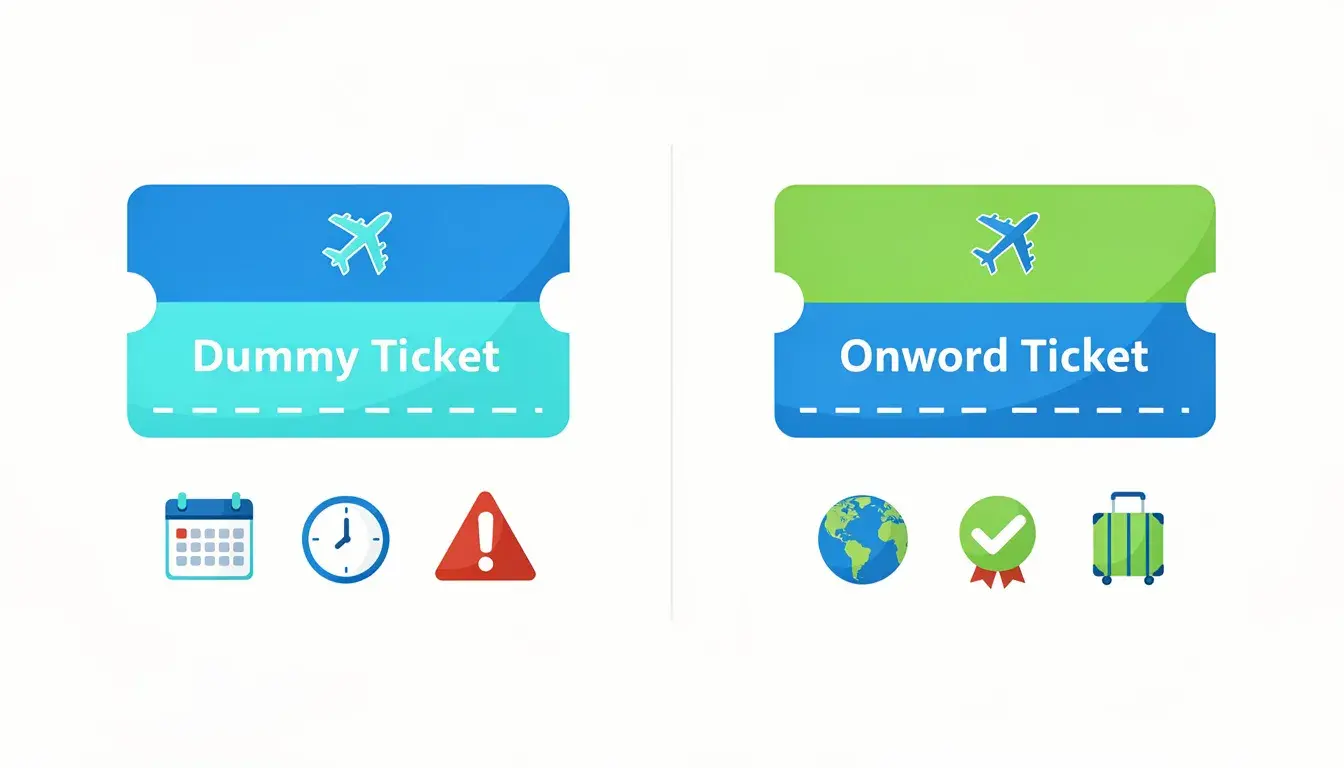
Your visa file looks clean until one travel-proof detail cracks it. A dummy ticket that works fine for an embassy can still fail at airline check-in. An onward ticket that satisfies a gate agent can look oddly final inside a visa application. When the appointment date shifts, processing runs long, or your route changes after approval, the wrong choice turns into a mismatch you cannot explain fast.
This guide separates the two proofs by what they are meant to solve. We map who checks them, when they get checked, what a failure looks like in real life, and how to choose the right document without buying the wrong thing. The goal is simple: keep the visa story clean, keep the travel-day compliance proof ready, and avoid using one document to solve two different problems when it was not designed for both.
For embassy submission, a dummy ticket for visa can support the intended travel plan when the checklist accepts an itinerary or reservation. For airline check-in or border entry, onward proof may need to answer a sharper question: “How and when will this traveler leave?” Those two questions overlap, but they are not identical.
- A dummy ticket usually solves the visa-office question: does the route and date plan make sense inside the application?
- An onward ticket usually solves the airline or border question: can the traveler leave within the permitted stay?
- The same PDF can sometimes work for both, but only when it matches the file, remains valid, and is easy to explain.
- One-way travel, visa-free entry, visa-on-arrival entry, long stays, self-transfers and land exits raise onward-proof risk.
- The safest strategy is to separate visa-file proof from travel-day proof when the checkpoints are asking different things.
If your visa checklist asks for a reservation or itinerary, create one clean dummy ticket that matches your application. If your airline or destination asks for onward proof, make sure the exit plan is valid for travel day too.
Create Your Dummy TicketIn This Guide
Official-source check: IATA describes its Travel Centre as a passport, visa and health-requirements source used by airlines for international travel documentation. GOV.UK visitor guidance says applicants must show they can pay for return or onward travel, but also lists flight bookings as less useful evidence for visit applications unless transiting. U.S. State Department visitor visa guidance warns applicants not to make final travel plans or buy tickets until a visa is issued. The EU Visa Code lists itinerary-related documents, return or round-ticket reservation, accommodation and intention-to-leave evidence among possible supporting documents depending on the journey. Sources: IATA Travel Centre / Timatic, GOV.UK visitor supporting documents guidance, U.S. State Department visitor visa guidance and EU Visa Code.
Reviewed for: dummy-ticket versus onward-ticket distinction, airline check-in risk, immigration exit-proof logic, visa-file consistency, transit and self-transfer handling, PNR terminology, route-date alignment and claim-safety boundaries.
The Difference Isn’t The Document — It’s Who You’re Proving It To
Most people treat dummy ticket and onward ticket like two names for the same thing. That mistake usually appears at the worst moment, because different checkpoints look for different proof in different ways. A visa office may read your flight proof as part of the application story. Airline staff may read it as a carrier-liability problem. Immigration may read it as a stay-limit and intent-to-leave signal.

Visa Proof Of Travel vs Carrier Compliance vs Immigration Entry
Your trip can be judged three times, not by the same person and not with the same goal. First, a visa office looks at your file and asks whether the plan makes sense. They are not trying to help you board a flight. They are measuring intent, consistency and credibility. Second, the airline looks at you before travel and asks whether carrying you creates a risk. If you are refused entry, the airline may face cost, disruption or return-carriage obligations. Third, immigration looks at you at the border and asks whether you are entering within the rules you claim and whether you will leave as expected.
That is why the difference is often not the PDF. It is the checkpoint. Visa-office doubt sounds like: “Is this a real trip plan that fits the applicant’s situation?” Airline doubt sounds like: “Will this passenger be accepted at the destination or transit point?” Immigration doubt sounds like: “Is this person consistent with the purpose and length of stay they state now?”
When you pick a document without choosing which doubt you are solving, you create mixed signals. Mixed signals do not always lead to refusal, but they invite questions. Questions create delays. Delays create mismatches. A flight document should remove friction, not add a second story.
Here is how that plays out. You apply for a short-stay Schengen visa with a clean itinerary. The reservation fits the route, the dates match the leave letter, and insurance covers the right window. The embassy can treat that as planned travel evidence. Weeks later, you fly on a one-way ticket because you plan to buy the return later. At check-in, the airline agent is not scoring your cover letter. They may ask for exit proof because your one-way route triggers a practical rule: show how you leave, or boarding may pause.
Now flip it. You enter a visa-free destination where onward proof is enforced at the gate. You buy a real onward ticket to satisfy boarding. Then you submit that same onward ticket in a visa file for another country, where the final-looking ticket locks dates you cannot explain if the appointment shifts. This is not about which document is better. It is about using the right tool for the right gatekeeper.
Dummy Ticket As Plan Evidence: When A Reservation Is Enough
When a visa officer asks for flight proof, they are often not demanding that you take financial risk before approval. They want evidence of a coherent plan that matches the rest of the file. A dummy ticket works best when your goal is to show a believable entry and exit sequence, dates aligned with leave or event timing, a route that fits your trip purpose, and a stay length that makes sense for the visa requested.
In a visa file, a dummy ticket is usually judged like a supporting exhibit, not like a boarding pass. The strongest dummy ticket is not the one that looks most ticket-like. It is the one that is hardest to question because it fits your story cleanly.
Clean fit looks like this: your dates have one obvious logic. If the cover letter says seven nights in Spain, the flight dates should frame seven nights, not five or nine. If hotel bookings or insurance cover eight nights, flights should not cover six. Staff notice gaps because gaps suggest improvisation. Your route should match the story you are telling. If you say conference in Berlin but enter through Munich and exit through Amsterdam with no explanation, you create a puzzle. Visa officers do not love puzzles; they love simple narratives.
Your entry and exit should also reflect the visa you want. For a single-entry visa, a plan that quietly implies exits and re-entries can create confusion. For a multi-country itinerary, the entry and exit should look intentional rather than random. Your timing should respect processing reality too. A reservation that expires tomorrow can be valid today and still feel unstable if the file will be reviewed next week.
A useful check is simple: if a visa officer reads only this flight proof and the cover letter, will they see one consistent plan? If yes, a reservation is usually enough for the plan-evidence role. But do not assume that the same reservation protects you at the airport. A dummy ticket can be perfect for an embassy and still weak at check-in if the airline wants proof that you will exit the country by a certain date.
Onward Ticket As Exit Proof: When They Want A Real, Usable Way Out
An onward ticket is not a vibe. It is a trigger. It becomes relevant when someone wants to reduce the chance that you will arrive and then be unable or unwilling to leave. Airlines care because they must manage document compliance before boarding. Immigration cares because they must enforce the conditions of entry.
Onward checks often appear in three situations. One-way travel is the fastest trigger because it invites the question, “How will you leave?” Visa-free or visa-on-arrival entry can also make airline staff stricter, because there is no pre-approved visa sticker to lean on. Long stays near the maximum permitted period raise another question: if you say you will stay close to the limit, where is the exit plan?
The practical difference is that onward proof is often judged with a yes-or-no mindset. Do you have a plausible exit ticket? Does it fall within the allowed stay? Does it match your passport name? Is it for the same traveler standing at the counter? Airline staff usually do not want to debate itinerary elegance. They want to clear a risk flag fast.
A good onward ticket is inside the allowed stay window, simple at a glance, aligned with your stated plan, and not full of fragile complexity like self-transfers that could strand you. You do not need the most expensive ticket to prove onward travel. You need something that answers the exit question cleanly.
One important nuance: onward does not always mean return to your home country. It can mean onward movement out of the country you are entering, including to a third country. What matters is the rule enforced at that moment. Still, do not create an onward plan that conflicts with your visa file. If your application says you will return home after France but your onward ticket shows France to Morocco without explanation, you now have a split story.
The Overlap Zone: When Either Can Work, And The Tie-Breakers That Decide It
There are cases where both a dummy ticket and an onward ticket appear to solve the same requirement. This overlap zone usually happens when the wording is vague: show proof of onward travel, provide flight itinerary, submit a reservation, provide evidence of exit. These phrases sound similar, but they are not always asking for the same thing.
Use tie-breakers that match enforcement. First, ask when the next check happens. If the next check is a visa appointment next week, focus on planning evidence that stays consistent with the file. If the next check is boarding tomorrow, focus on exit proof that reduces airline risk. Second, ask whether you are traveling one-way or round-trip. One-way travelers get more onward questions. Third, ask whether dates may change. A visa file does not reward rigidity; it rewards consistency.
Fourth, ask whether the route is high friction. Self-transfer onward tickets, tight connections and multi-airline separate bookings can create friction at the counter. Fifth, ask whether you are solving one checkpoint or two. Sometimes you need one proof for the visa file and a different proof for travel day. Using one artifact for both can work, but it can also combine risks.
A clean separation looks like this: submit a visa itinerary that matches your stated dates and trip plan, then carry onward proof that satisfies airline concerns without changing the visa narrative. If asked, explain the onward ticket as travel-day compliance proof, not as a new trip purpose. That prevents the common failure pattern: using one document to solve two problems, then getting questioned on the part it was never designed for.
Use This Workflow To Avoid Buying The Wrong Thing
Once you know who is judging the proof, the next problem is speed. You need a clean way to choose the right flight document without creating contradictions later. The decision should be made by checkpoint, risk and timing, not only by price.

Are You Solving A Visa Application Problem Or A Boarding/Entry Problem?
Start with the first fork: are you trying to satisfy a consulate’s document checklist, or are you trying to avoid getting blocked at the airport counter? Ask one concrete question: what is the next checkpoint that can stop the trip?
- Visa application checkpoint: online submission, biometrics appointment, interview or document re-check.
- Boarding checkpoint: airline check-in, bag-drop, gate staff or transit desk.
- Entry checkpoint: immigration at arrival, sometimes before baggage claim.
Do not pick one proof and expect it to solve all three checkpoints. Sometimes it can. Often, it creates confusion. If your travel date is weeks away and you are assembling the file, you are usually solving a visa-application problem. If you have a one-way route or visa-free entry, you are often solving a boarding or entry problem even if the visa side is fine. If you transit through a country with strict transit rules, you may be solving a boarding problem at the origin airport and again at the transit desk.
A practical example shows the split. You apply for a UK visitor visa with a clear trip window. The visa office wants a coherent plan that matches your stated schedule. A reservation may work there. But if you then fly onward from London to a visa-free destination on a separate ticket, the airline may ask for proof that you can continue or leave the next country. That second check is not your UK visa file. It is travel-day compliance.
If It’s A Visa Application: Which Trip Shapes Trigger Dummy Ticket Preference?
When the main problem is a visa file, the strongest move is to submit flight proof that behaves like a stable plan artifact. Not a last-minute scramble. Not a document that forces you to defend a fare rule. Trip shapes where a dummy ticket is often the cleaner fit include a straight round trip with fixed dates, a multi-city visit with one clear entry and exit, a business visit where meeting dates may shift, and a short-stay visa where processing uncertainty makes early ticket purchase risky.
A straight round trip is the easiest case. You tell one story: one entry, one exit, one trip length. The flight proof supports it. Use this when the leave letter, school calendar or event dates are fixed. Keep flight dates aligned with accommodation and insurance if those are in the file.
A multi-city visit can work for Schengen, Japan and other short-stay visitor files when the movement is readable. Entry city should match the first stay. Exit city should match the final stay. The route should not jump between distant cities without a reason. If the plan is Paris, then Rome, then Milan departure, the flights should reflect that sequence in a way a reviewer can follow in ten seconds.
A business visit creates a different risk. Meetings can shift, but the application cannot look unstable. The file needs a credible arrival window tied to meetings, an exit plan that matches trip length, and supporting letters that do not contradict the flight dates. The mistake is locking a flight date that conflicts with the invitation letter, then trying to patch it in a cover letter.
For wider visa-file planning language, BookForVisa’s flight reservation for visa guide is a useful cross-platform reference. This page stays on the DummyFlights side of the question: whether you need dummy-ticket-style plan evidence or onward-ticket-style exit proof.
If It’s Boarding/Entry: Which Trip Shapes Trigger Onward Ticket Requirements?
Now switch gears. Here we focus on travel-day gatekeepers who can deny boarding even when a visa file looked fine. The biggest trigger is simple: one-way travel into a country where exit proof is commonly enforced. This is not limited to one region. It can appear across Southeast Asia, parts of the Americas, island destinations and transit situations.
Trip shapes that often trigger onward enforcement include one-way travel into visa-free or visa-on-arrival destinations, long stays near the maximum allowed period, unclear land-exit plans, and country pairings where carriers are cautious. Airlines do not want to guess whether you will be allowed in or stay too long. They often solve the uncertainty by asking for onward travel.
A practical boarding-day checklist:
- Are you flying one-way?
- Are you entering visa-free or on arrival?
- Is the planned stay close to the maximum allowed period?
- Is the exit plan by land, ferry, bus, train or “we will decide later”?
- Are you on separate tickets where the onward segment is not protected?
If you hit two or more, onward proof is often the safer travel-day move regardless of what you submitted to a consulate. The airline’s question is narrower than the visa office’s question: can this passenger continue or leave in a way that satisfies the destination rules?
Transit-Only Itineraries: When Onward Means Next Flight, Not Return Home
Transit is where language gets slippery. Onward can mean the next flight out of the transit airport, not your eventual return home. Same-day protected connections are usually easiest because the onward segment appears inside one booking. But problems can still appear when the final destination has strict entry rules, the transit airport has special transit-visa rules, or the passenger’s passport requires transit authorization.
Overnight transit changes the question. Are you staying airside or entering the country? Do you have the right transit permission if you must clear immigration? Does the onward flight depart within the allowed transit time? A plan to sleep in the city can convert a transit into an entry attempt, and that may require different proof.
Self-transfer and separate tickets are the biggest transit risk zone. If your onward flight is on a separate booking, staff may treat the first destination as your entry point because the airline carrying you there cannot assume the next carrier will accept you. If you must collect bags and re-check, your onward ticket may not count unless you can enter the transit country and complete the transfer.
This is where travelers get annoyed because, technically, they do have a next flight. The counter question is not only “does another flight exist?” It is “can you realistically reach that flight under the destination and transit rules?” If you cannot pass immigration, collect bags, change terminal and check in again, the onward segment may not reduce the first airline’s risk. A protected through-ticket behaves differently from two separate bookings stitched together by the traveler.
For same-day protected transit, keep the through itinerary ready and check whether your passport requires a transit visa or authorization. For overnight transit, assume the airline may ask whether you will enter the transit country and whether you have the right documents to do so. For self-transfer, choose a generous connection window and avoid using a fragile onward ticket that depends on a perfect airport transfer. The more your onward proof depends on everything going perfectly, the less persuasive it becomes under pressure.
The Both Cases: When Submitting A Dummy Ticket But Carrying An Onward Ticket Makes Sense
Sometimes the cleanest strategy uses both documents for different moments. You submit a dummy ticket or reservation for the visa file because it matches the application dates and avoids premature purchase. Later, after approval or near travel day, you carry onward proof because the airline or destination may enforce exit evidence.
This can be smart if you keep the story aligned. The onward ticket should not contradict the visa file. If the application says you return home on 20 June, travel-day proof showing a departure to another country on 28 June creates a new question. If your plan changed, update the explanation and dependent documents. If your onward proof is simply a continuation after the visa-covered stay, make that sequence clear.
The “both” strategy works best when the visa itinerary is a stable planning document and the onward ticket is a live compliance document. Do not mix them casually. Label them mentally by job: embassy evidence versus airport proof.
A common “both” case is a traveler applying for a Schengen visa with a planned round-trip itinerary, then later adding an onward segment after Europe because the next country has entry rules that require exit proof. Another case is a traveler entering Thailand visa-free after a visa-approved trip elsewhere; the embassy proof for the first trip and the airline proof for Thailand should not be treated as one universal document. Keep each checkpoint clean. If the travel-day proof changes the route after visa approval, carry the current proof for the airport and be ready to explain the sequence calmly.
The danger is carrying both documents without knowing which one is current. If the airline asks when you leave, do not show an old visa reservation if you already bought a newer onward ticket. If immigration asks where you are going next, answer from the live travel-day plan, not from a PDF created for a visa application weeks earlier. This sounds obvious, but many travelers fail exactly there because their phone contains five versions with similar file names.
What Actually Gets Checked — And The Quiet Ways People Fail
The phrase “they will check it” is too vague to be useful. Different people check different things. Some checks are visual. Some are consistency-based. Some involve systems. Some happen only when a detail already feels off.

The Verification Spectrum: From Visual Plausibility To System Validation
At the soft end of the spectrum, a reviewer checks whether the itinerary looks plausible and complete. Are there dates? Passenger names? Route details? Arrival and departure cities? At the middle, they compare the proof against other documents. Do the dates match the form, cover letter, insurance, accommodation and invitation? At the stricter end, someone may look up a booking reference, ask the airline, or request updated proof.
Do not build your strategy on the assumption that every embassy verifies every airline record. That leads to over-optimization and too many regenerated files. Also do not assume nobody checks anything. That leads to fake-looking documents and careless contradictions. Build for both possibilities: the file should make sense on paper and avoid claims that collapse if checked.
Timing Is A Hidden Requirement: Valid When Submitted vs Valid When Reviewed
Timing is where many clean-looking documents fail. A reservation may be valid when submitted but no longer useful when reviewed. A document may satisfy upload day but look stale after processing delays. An onward ticket may be fine for a visa file but expired or changed by travel day.
For visa submission, plan around the realistic review window, not only the moment you upload. For boarding, plan around the exact travel day and route. If you know processing may run long, do not keep generating new versions out of anxiety. Instead, use one stable document and refresh only when a real contradiction appears or when the authority asks.
The Consistency Audit: How One Bad Date Ripples Across Your Application
One bad date can ripple everywhere. The inbound flight arrives on the 13th, but the hotel starts on the 12th. The return flight lands after the employer leave ends. The travel insurance ends one day before departure. The onward ticket leaves after the visa-free stay limit. The cover letter says round trip, but the proof shows open-jaw travel. Each mismatch may look small alone. Together, they create doubt.
Run a consistency audit before upload and again before travel:
- Names match passport and application forms.
- Entry date, first-night accommodation and stated arrival city align.
- Exit date, return obligation and onward proof align.
- Trip length matches leave approval, funds and insurance.
- Route sequence matches cover letter and purpose documents.
This audit matters more than the label on the document. A paid ticket with contradictions can hurt you. A reservation with perfect consistency can be easier to understand.
One helpful method is to read the file from the reviewer’s chair. Start with the application form, then open the flight proof, then the hotel or host proof, then the insurance, then the cover letter. If the story changes as you move through those documents, fix the story before you fix the ticket. If the story stays the same, the specific proof type becomes easier to defend. This is why consistency often beats intensity: a simple reservation that agrees with everything else can be stronger than an expensive ticket that forces explanations.
Airline Staff Are Not Visa Officers: Their Checklist Is Brutally Simple
Airline staff work under time pressure. They are not usually trying to evaluate the entire purpose of your trip. Their practical checklist is much simpler: passport, visa or authorization if required, destination entry conditions, transit conditions, return or onward proof when required, and whether the passenger appears likely to be accepted.
This is why a beautifully written cover letter does not help much at a check-in counter. The agent wants fast proof. If your onward ticket is buried in a long PDF, mismatched with your passport, or tied to a self-transfer that looks impossible, the document may not solve the problem. Make travel-day proof simple, readable and current.
Immigration Questions That Trigger Proof Requests Even When Rules Don’t Require It
Immigration officers may not ask every traveler for onward proof. But they can ask when a detail creates uncertainty. Triggers include one-way entry, vague accommodation, insufficient funds, unclear purpose, long intended stay, inconsistent answers, previous overstays, or a route that does not match what the traveler says at the booth.
When asked, answer with the current travel plan, not an older visa-file version. If your onward ticket shows departure on 28 June, say 28 June. If your visa application originally showed 20 June but the plan changed after approval, make sure you can explain the change simply. The problem is not change; the problem is confusing change.
Keep border answers short and factual. “I am leaving on 28 June to Singapore; here is the booking” is stronger than a long explanation about price changes, old reservations and why your first itinerary was different. Border and airline conversations reward clarity. The document should support the answer in seconds. If it takes three minutes to explain why the onward proof is valid, the proof is probably too complicated for the checkpoint.
From Visa Submission To Departure Without Rebooking Chaos
The safest travel-proof system has two layers: the file you submit and the proof you carry. They should support the same story, but they do not always need to be the same document. This workflow keeps the layers aligned from application day to departure day.

Step 1 — Lock Your Travel Story First, Then Generate Proof To Match It
Before choosing dummy ticket or onward ticket, lock the travel story. Decide entry city, exit city, trip length, main destination, purpose, first-night accommodation and final-night plan. If the trip is multi-country, decide why the sequence makes sense. If the trip is for business, tie the arrival and departure dates to meeting or event dates. If the trip is family travel, tie the dates to invitation and leave documents.
Once the story is fixed, generate proof to match it. Do not generate a flight plan first and then bend the file around whatever route appears. That is how applicants end up with cheap but strange itineraries that raise more questions than they solve.
Step 2 — Pick Your Proof Type Based On Risk, Not Price
Price matters, but risk matters more. A cheap onward ticket that does not satisfy the airline is not cheap if you miss the flight. A paid ticket that becomes unusable because the visa date changes is not safer if it creates financial loss. A dummy ticket that conflicts with the application is not useful just because it was easy to obtain.
Use the proof type that matches the checkpoint:
- Visa file with itinerary/reservation wording: dummy ticket or flight reservation may fit.
- Visa file with paid-ticket wording: use paid proof or follow the authority’s exact instruction.
- Airline check-in with one-way or visa-free entry: onward proof is often the practical priority.
- Immigration entry with unclear exit: carry a simple exit plan that matches your spoken answer.
Step 3 — Create A Date Strategy That Survives Processing Delays
Visa processing can run longer than the applicant expects. If your reservation collapses quickly, your file can look unstable by the time it is reviewed. That does not mean you should buy a rigid ticket early. It means you should choose dates and proof that can survive normal delays.
For visa submission, avoid a reservation that becomes unusable before the likely review window. For travel day, avoid onward proof dated so close to the stay limit that one delay creates a technical problem. For long stays, do not use the final allowed day as your only exit plan unless you are comfortable defending that risk.
Step 4 — Do A Consistency Sweep Across Every Document Before Upload
Before upload or appointment day, sweep every dated document. Check the flight reservation, onward ticket, hotel booking, host letter, insurance, employer leave, invitation, application form and cover letter. If one item changed, check every item connected to it.
Use a one-folder rule. Keep the final travel-proof PDF in one folder. Delete older versions from the upload folder. Print only the current version. Save the same version on your phone. Many problems happen because applicants do not know which PDF they actually submitted.
Step 5 — Post-Submission Changes: How To Update Plans Without Undoing Your Application
Plans can change after submission. The safe response is controlled updating. First decide whether the change is core or minor. Core changes include entry date, exit date, entry country, exit country, trip length or purpose. Minor changes include flight number, terminal, same-day timing shifts or aircraft changes that do not alter the story.
If the change is minor, you may not need to update the visa file unless asked. If the change is core and the authority allows updates, replace the relevant documents together. Do not send one new flight document while hotel, insurance and cover letter still show old dates. That creates two timelines.
Also avoid “just in case” updates. Sending a new onward ticket to a consulate that did not ask for it can create a new review path. Sending a new dummy ticket after approval can confuse the paper trail. Keep updated proof ready for yourself, but submit changes only when the process asks for them or when the mismatch is material enough that leaving it unresolved would be worse.
Step 6 — Pre-Departure: What To Carry And What Not To Volunteer
Before departure, carry the documents needed for travel day: passport, visa or authorization, current itinerary, onward or return proof if required, accommodation details, and any transit documents. Do not carry five conflicting versions. Do not volunteer old dummy-ticket PDFs unless someone asks about the visa file. The airline and border check should see the current travel plan.
If asked why the visa-file itinerary differs from the final ticket, answer plainly if the change is legitimate: “The visa was approved later than expected, so I bought final tickets within the approved window.” Keep it boring. Boring is underrated. Boring boards planes.
Before you leave home, do one final travel-day check that is separate from the visa-file check. Confirm the visa validity, allowed entry count, passport validity, transit documents, onward proof, final ticket, hotel or address details, and any entry authorization for the next country. A traveler can have an approved visa and still run into trouble if the next country, transit airport or airline has a separate proof requirement. Visa approval is a milestone, not the whole journey.
Mistake Checklist — The Exact Traps That Get Dummy Tickets And Onward Tickets Rejected
Most failures are not mysterious. They come from contradictions, route logic, identity hygiene, timing or using the right document in the wrong place. This checklist catches the traps before they become counter or interview problems.
Contradiction Traps: When Your Documents Fight Each Other
Contradictions make reviewers work too hard. The application form says 10 days, but flights show 13. Hotel dates start after arrival. Insurance ends before return. The employer letter says you resume work Monday, but the return flight lands Tuesday. The invitation says London, but the flight plan centers on Manchester. None of these are exotic errors. They are ordinary mismatches that create doubt.
Fix contradictions before choosing between dummy ticket and onward ticket. If the underlying story is inconsistent, either document can fail. The document type does not rescue a broken timeline.
Route Logic Traps: When Your Itinerary Looks Like A Placeholder
Route logic matters because people instinctively understand travel. A simple city break should not look like an airport-hopping exercise. A business trip should not look like a vacation circuit. A family visit should not route through distant cities without reason. If your itinerary looks like it was generated only to satisfy a field, it may invite questions.
Good route logic is easy to explain: first city, main purpose, last city, exit. If you need more than one sentence to explain the route, either simplify it or add a clear explanation in the itinerary narrative.
Open-Jaw And Multi-Country Traps: Where Onward Gets Misinterpreted
Open-jaw routes are not bad. They are just easier to misread. Arriving in Madrid and leaving from Paris can be completely reasonable if your day-by-day plan supports it. But if the application reads like a Spain-only visit and the onward ticket exits France, the route may look contradictory.
Multi-country trips need visible sequencing. Show how you move from first country to second country and where you leave. If the onward ticket is to a third country, make that country part of the plan. Do not hide onward proof as an emergency escape hatch while the visa file says something else.
Name And Identity Traps: Tiny Errors That Trigger Big Doubt
Identity issues are easy to check and hard to explain away. Middle names, surname order, hyphens, long names, no-surname passports and group applications all create risk. If the passport shows one format and the ticket shows another, the document can feel careless even if the trip itself is real.
For group travel, verify every traveler. One adult’s name on a child’s itinerary, one missing passenger, or one different date can slow the entire file. If passport numbers appear anywhere, they must be correct everywhere they appear. Do not manually edit a PDF to fix identity. Regenerate the document properly.
Timing Traps: Reservation Expiry, Appointment Dates, And Processing Surprises
Timing mistakes look like manipulation even when they are accidental. A reservation may expire before review. A rushed document created after biometrics may show a different plan than earlier documents. Approval may arrive early and tempt you to shift dates too aggressively, leaving employer letters and insurance behind.
Use one rule: if you shift dates, shift every dependent document you will rely on during travel, not only the flight proof. If you refresh proof, replace the old version everywhere. If the appointment moves, update only what must move.
There is also a psychological timing trap: applicants often refresh documents because newer feels safer. Newer is not automatically safer. A new PDF can change the airline, airport, arrival date, transit point or booking reference without the applicant noticing. If nothing in the file changed, do not create a fresh contradiction just to make the document look recent. Refresh when it reduces risk, not when it reduces anxiety.
Myths That Keep Getting People Flagged — And The Safer Way To Think About It
Bad advice spreads because it sounds simple. Visa and travel checks are not simple. These myths push applicants into the wrong proof, at the wrong time, with the wrong story attached.
Myth: Onward Ticket Means A Return Ticket To Your Home Country
Onward usually means a confirmed way to leave the country you are entering within the allowed stay. It can be a return flight home, a flight to a third country, or a continuation that makes sense for the trip. The core is leaving the country within the permitted window.
The problem appears when onward proof looks like a random escape hatch. If your Japan tourist narrative says Tokyo and Kyoto, then return home, but your onward ticket shows Japan to Seoul without explanation, the file now has a second story. Third-country onward travel can be fine. Make it part of the plan, keep dates aligned, and explain it in one sentence.
Myth: Embassies Always Verify With Airlines
This myth leads to over-optimization and, ironically, more mistakes. Applicants keep generating new versions to stay current, or they add complex routes they cannot defend. In reality, the most common scrutiny in visa review is consistency and plausibility within the file. Even when verification is possible, many problems are visible before anyone checks an airline system.
The safer mindset is: assume the file will be read by someone looking for contradictions and weak logic. Build one consistent trip window, one coherent route story, and one stable flight-proof version that fits the review timeline.
Myth: A One-Way Looks Cleaner And Less Risky
One-way travel can be valid. It can also be the fastest way to trigger questions at the airport and border. The problem is not the one-way ticket itself. The problem is what it implies: possible overstay, unclear funds, or no clear plan to leave.
One-way is easier when you hold a residence permit, long-stay visa, relocation document, or authorization that explains why a return ticket is not expected. Even then, airlines may still ask for onward proof depending on route and destination. For most short-stay travel, do not let one-way be the only story your documents tell.
Myth: If My Visa Is Approved, I’m Done
Approval means you satisfied the visa office’s requirements. It does not cancel airline compliance rules or destination entry conditions. You may have an approved visa for one part of the trip, then fly onward to a visa-free destination where exit proof is enforced. Your boarding eligibility resets under the rules of the next destination.
Keep two readiness checks: visa-file readiness and travel-day readiness. Visa-file readiness means the documents remain consistent with what you submitted. Travel-day readiness means you can satisfy the carrier and entry enforcement for the actual route you fly.
Myth: Any PDF That Looks Like A Ticket Works
Looks real is not the same as answers the checker’s question. At visa stage, a PDF fails when it does not support a coherent plan. At airline stage, a PDF fails when it does not clearly prove exit within the permitted stay or looks impractical.
For visa review, the PDF should show entry and exit dates that match the file, a route matching the narrative, passenger identity details consistent with other documents, and no new story elements. For airline and immigration, the PDF should prove exit within the allowed timeframe, be easy to interpret in seconds, avoid risky self-transfers, and match what you say when asked.
A useful two-question test catches weak PDFs quickly. First, if someone reads only this flight plan, do they understand your route and timeline? Second, if someone asks “when do you leave?” can you point to one clear exit date that matches your spoken answer? If either answer is no, the document is not doing its job. It may look like a ticket, but it is not solving the actual proof problem.
We also avoid overloading the visa file with travel-day documents. Onward proof can be essential at check-in. It can be confusing in a visa file if it introduces a different trip story. The safer move is to keep the visa narrative clean and carry additional compliance proof for travel day only when needed.
Dummy Ticket vs Onward Ticket: Situations Where The Wrong Proof Backfires
Some routes look simple on paper, then blow up under airport enforcement. These are the flight-specific situations where the wrong document choice creates friction with visa authorities, airlines or immigration checks.
Visa-Free Or Visa-On-Arrival Entries: Why Onward Proof Becomes Non-Negotiable
Visa-free entry can still come with strict travel-document requirements at the airline counter. Many countries expect airlines to confirm that a passenger can exit within the allowed stay. That is why onward travel proof becomes the make-or-break item on one-way routes.
Many travelers assume a dummy flight ticket solves this automatically. Sometimes it does not. Airline staff may want a valid onward ticket that clearly shows a planned departure date, not just a plan-style itinerary. A common backfire happens when proof answers the embassy but not the airline. Embassies may accept reservations for visa purposes in many situations, while airline policy is built around liability and destination-entry rules.
For visa-free and visa-on-arrival trips, build proof around the allowed stay. If the permission is 30 days, the exit proof should sit comfortably inside that window. If the destination counts arrival day as day one, do not cut the exit date so close that one misunderstanding creates a problem. If the onward flight goes to a third country, make sure you are allowed to enter that third country too. An onward ticket to a place that will not accept you can fail the same practical test.
Long Stays, Flexible Returns, And I Don’t Know My Exit Date Yet
Long stays create a different kind of scrutiny. You can be a digital nomad, visitor, remote worker or flexible traveler, and still need documents that show an exit inside the permitted window. If you are applying for a short-stay visa, a temporary reservation may support the file without locking you into final tickets too early. If you are entering visa-free or on arrival, the airline question is blunt: how will you leave and when?
Avoid the final-day departure habit. It looks risky because one delay can push you over the allowed stay. Choose an exit date comfortably inside the limit, keep the route plausible, and make sure the ticket dates match what you will say out loud.
Flexible travelers should separate flexibility from vagueness. “I may adjust the final ticket after approval” is reasonable in a visa-file context. “I do not know when I will leave” is much weaker at a border or check-in counter. If the trip is genuinely flexible, create an exit plan that shows compliance and keep the later flexibility in your own planning, not as a gap in the proof.
Separate Tickets And Self-Transfers: The Case Where Your Onward Proof Might Not Count
Separate tickets create confusing failures because you can have onward proof and still get treated as if you do not. This happens when staff think your onward plan is not workable. If you must enter the transit country to collect bags and re-check, you may need entry permission for that country. If you cannot enter, the onward segment becomes less useful to the airline’s risk assessment.
Make self-transfer plans defensible. Choose a connection window that matches the airport process. Keep proof that shows you understand the transfer. Carry one clean document set, not five screenshots. If staff ask for identifiers, be ready to show a booking reference, valid PNR or ticket number depending on the carrier and document type. Avoid the dangerous shortcut of presenting fake documents because you assume nobody checks.
Land Exits And Mixed Transport Plans
Land exits can be real, but they can be hard for airlines to evaluate quickly. If you fly into a country and plan to exit by bus, train or ferry, some agents may still ask for onward proof by air because it is easier to validate. If you want the smoothest airline outcome, an onward flight out of the country is often easier than arguing policy at the counter.
If you stick with a land exit, make it specific. Know the border point and approximate date. Keep stay length conservative. Avoid saying “we will figure it out later.” Do not submit flight proof that contradicts the land plan. If your file implies you will fly out but you claim a land exit at the border, the story splits.
Mixed transport plans work best when the story is visible. If you fly into Bangkok and exit by train to Malaysia, say that in the itinerary if it belongs in the file, and carry proof that makes the plan understandable. If you fly into one Schengen country and leave by train to another country before flying home, make sure the sequence supports your main-destination logic. The problem is not land, ferry or rail. The problem is unsupported movement that appears only when someone asks.
Last-Minute Travel Changes: What Happens If Your Proof No Longer Matches Reality
Last-minute changes do not automatically create a problem. Confusion does. The backfire pattern is carrying multiple documents that disagree, then giving answers that match none of them.
If travel dates change after approval or after buying the real flight, keep one current set for travel day. It should match actual flights and the current exit timeline. Carry one primary PDF itinerary. Ensure flight details show correct departure and arrival times. If asked, state the exit date that appears on the current document, not the date originally planned. If you switched to a confirmed flight ticket, do not volunteer older temporary-reservation versions unless someone asks.
Your Next Step Before The Embassy And The Airport
When you apply for Schengen, the UK, Japan or another visa, the flight proof in the file is judged as part of a story. At check-in for visa-free or one-way travel, the airline cares about exit proof. We win by matching the document to the checkpoint and keeping one clean timeline across forms, letters and itinerary documents.
Pick the proof you will submit, pick the proof you will carry, and keep dates and routing aligned. Do a final consistency sweep before upload and again before travel. If the visa file needs a reservation, keep it coherent. If the airport needs onward proof, keep it current. If both are needed, let each document do its own job without creating a second story.
If you need a wider current-year framework before making the choice, use the Dummy Ticket for Visa 2026 complete guide. It explains the full visa-file side of route logic, PNR expectations, timing and document consistency.
Need visa-file travel proof without buying the wrong final ticket too early? Create one clean dummy ticket for the application, then keep separate onward proof ready only when the airline or destination requires it.
Create Your Dummy TicketFAQ
What is the difference between a dummy ticket and an onward ticket?
A dummy ticket is usually used as visa-file travel-plan evidence, while an onward ticket is usually used to prove you can leave a country by a required date. The main difference is the checkpoint: embassy file review versus airline or immigration exit-proof checks.
Can a dummy ticket be used as an onward ticket?
Sometimes, but not always. It depends on whether the document clearly proves exit, remains valid, matches your passport name, and satisfies the airline or destination rule. Do not assume a visa-style reservation will automatically satisfy travel-day onward proof.
Can an onward ticket be used for a visa application?
Sometimes it can support a visa application if it matches the checklist wording and the travel story. But an onward ticket can also create confusion if it shows a route, date or third-country plan that does not match the application narrative.
Does onward ticket mean return ticket?
No. Onward ticket usually means proof that you will leave the country you are entering. It can be a return ticket home or a ticket to a third country, as long as it satisfies the rule and fits your stated plan.
Which is better for a Schengen visa, dummy ticket or onward ticket?
For a Schengen visa file, a coherent flight reservation or itinerary usually matters more than the label. It should match main destination, entry and exit dates, accommodation, insurance and purpose. Travel-day onward proof is a separate question.
Which is better for airline check-in?
For airline check-in, onward proof is usually more relevant when the route triggers exit-proof checks. Airline staff need quick evidence that you meet destination and transit requirements, especially on one-way or visa-free routes.
Can I submit one document to the embassy and carry another for the airport?
Yes, if both documents support the same travel story. A visa-file reservation can show intended plans, while travel-day onward proof can satisfy airline or immigration checks. The documents should not contradict each other.
What if my onward ticket is to a third country?
That can be acceptable for many onward-proof situations if it shows you leaving the country within the allowed stay. For a visa file, make sure the third-country movement is part of the itinerary narrative and not a surprise.
Do airlines check onward tickets differently from embassies?
Yes. Airlines usually care about boarding eligibility, destination rules, transit requirements and whether the passenger may be refused entry. Embassies usually care about application credibility, purpose, dates and consistency with supporting documents.
What is the safest strategy if I need both visa proof and onward proof?
Use one coherent visa-file itinerary for the application and carry current onward proof for travel day if the route requires it. Keep dates, passenger details and route logic aligned, and avoid carrying conflicting old versions.
This guide is general travel-document information, not legal advice or a guarantee of visa approval, boarding or entry. Always follow the checklist and instructions from the embassy, consulate, visa center, airline, transit authority or border authority handling your case.