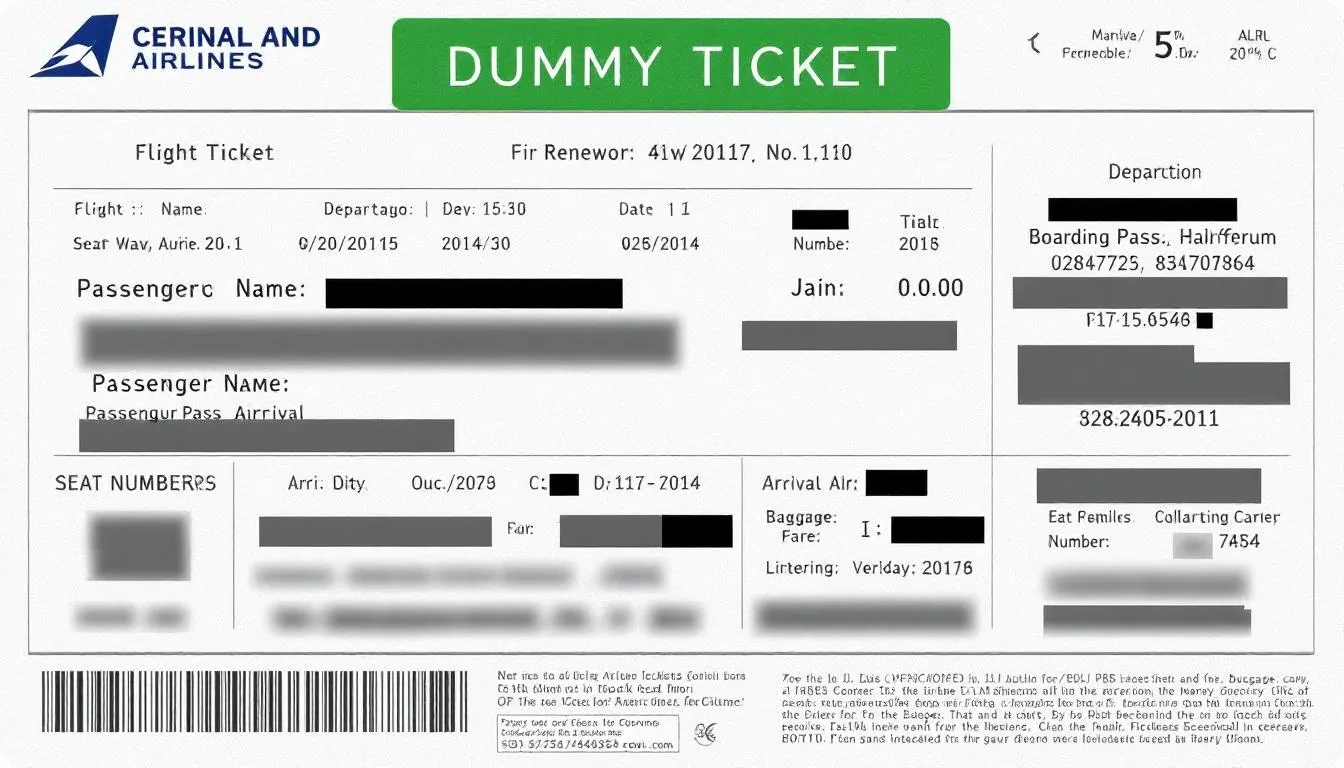

Short answer: Your dummy ticket, route and stated travel purpose should describe one coherent trip. Match the first arrival city, main destination, dates, accommodation and return or onward plan to your application and supporting documents. A dummy ticket for visa can support intended travel where permitted, but it cannot repair a route that contradicts your purpose or guarantee approval.
Key facts
- Consular officers compare the route with your form, letter and accommodation.
- The first arrival point and main destination must make sense together.
- Return dates should fit the requested stay and leave or event evidence.
- Multi-city routes need a clear reason for every major stop.
- Never edit a PDF to hide a mismatch; correct the reservation and supporting file instead.
Need a route-consistent dummy ticket? Use passenger details, dates and cities that your visa file can honestly support, then cross-check every document before submission.
Create your dummy ticketIn This Guide
- How a Consular Officer Reads Your Route Against Your Stated Purpose
- Choosing a Route That Matches the Story You Told in Writing
- Return Leg Timing Inside Your Requested Visa Duration
- Multi-City Trips: Matching Several Stops to One Application
- Names, Numbers, and Small Details That Must Line Up Exactly
- Timing the Booking Around Your Embassy Slot
- What Makes a Reservation Verifiable Rather Than Just Printed
- Why Embassies Prefer a Held Seat Over a Bought One
- A Final Walkthrough Before You Submit Your Route
- Read Your Route the Way an Officer Will
Official-source check: For Schengen examples, review the European Commission Schengen visa overview and the current checklist of the consulate responsible for your main destination. The destination authority controls the final document and route requirements.
Reviewed for: route-purpose alignment, main-destination logic, return timing, multi-city consistency, passenger-data accuracy and official-source alignment.
A consular officer opens your file and finds a booking from Delhi to Rome. For terminology and document scope, review the what a dummy ticket means guide before preparing the route. Your cover letter says you are attending a trade fair in Munich. Nobody has to accuse you of anything. The mismatch alone slows the file down, and sometimes ends it.
Route and purpose must tell one story. Dates, entry point, hotel plan, and reason for travel all get read together, line by line. Before you book, you need to decide which route fits your stated purpose and how long the reservation must hold.
We compare routes, return timing, and multi-stop plans, using Schengen filings as the main example, so you can spot problems before an officer does. Once your route is settled, a matching dummy ticket for visa keeps your whole file consistent.
How a Consular Officer Reads Your Route Against Your Stated Purpose

An officer never reads your flight in isolation. It sits beside your form, your letter, and your bookings, and all of them need to agree.
The Cross-Check That Happens Before You Hear Back
Consulates cross-reference flight reservations with declared travel intent. That check often happens early, well before anyone studies your bank statements or employment letter.
The officer starts with your visa application form. It states why you are traveling, when you plan to arrive, and how long you plan to stay. Next, the officer opens your flight itinerary and asks whether the route supports those statements.
Three quick questions drive that check:
-
Does the route make sense for the purpose you declared?
-
Do the travel dates match the dates on your visa form?
-
Do the passenger details match the passport?
When all three answers are yes, the reservation fades into the background. The officer moves on to your finances and your ties to home. When even one answer is no, the reservation becomes the first thing that gets questioned.
That is why Schengen embassies place so much weight on consistency. They process large volumes of files and rely on fast pattern checks. A clean match passes quickly. A messy one earns a second look, and a second look costs you time you may not have.
A flight reservation showing a trip that differs from your declared plan does more than look careless. It gives the officer a reason to doubt the rest of your supporting documents.
Think of the reservation as a witness. It does not need to say much, but it must not contradict anyone else in the room. Your cover letter, your hotel booking, and your visa application all give testimony. The flight simply confirms the same story with dates and airports.
Tourism and Business Purposes Leave Different Route Fingerprints
Tourism and business visas both require that the travel itinerary matches the stated purpose. The route shapes differ, though, and officers know what each shape should look like.
A tourism route follows leisure logic. You land in a recognizable destination, spend several days in one or two places, and fly home at the end. The stay usually runs between one and three weeks, and your hotel nights follow the same rhythm.
A business route follows event logic. You land in or near the city where the meeting, fair, or client visit happens. The stay is short and wraps around the schedule. Nobody expects a business traveler to spend nine days on a coast three hours from the conference.
Here is how the two shapes usually compare:
-
Tourism: Arrival in a popular city, a moderate stay, and a return that closes the leisure plan.
-
Business: Arrival near the meeting site, a short stay, and an exit soon after the last commitment.
Consider Daniel, a sales manager in Mumbai. His invitation letter names a two-day supplier meeting in Frankfurt. His reservation should land in Frankfurt and leave a day or two after the meeting. A route that lands in Lisbon and departs from Athens does not support that invitation.
Now consider Sophie, who plans ten days of sightseeing in Rome and Florence. A reservation that leaves Rome after three days contradicts her own plan, even though nothing about the route looks unusual on its own.
Mixed signals cause a different problem. If your cover letter promises sightseeing but your reservation ends the day after a trade event, the officer must guess which purpose is real. Build the route from one purpose only, then let every other document follow it.
What a Mismatch Looks Like on the Desk
Mismatches rarely announce themselves. They appear as small differences that only show up when documents sit side by side. Mismatches between ticket details and travel purpose can lead to visa refusal, and inconsistencies can lead to visa application denials.
These are the patterns officers see most often:
-
The cover letter promises ten days, but the reservation covers four.
-
The reservation lands in Spain, while the first hotel night is in Italy, with no explanation.
-
The return flight departs after the requested visa duration ends.
-
The ticket says Emily Carter, while the passport says Emily Jane Carter.
Each of these can end in a refusal. The officer does not need to assume bad intent. The file simply cannot be confirmed as consistent, and refusing is easier than reconciling.
Keep in mind that genuine dummy tickets must match supporting documents like hotel bookings. A reservation can be perfectly verifiable and still fail if it disagrees with the rest of the file.
Mismatched dates across documents can lead to visa rejection even when your purpose is honest. Officers rarely have time to ask which document is the wrong one. They treat the visa decision as a risk question, and unexplained differences raise risk.
Small Routing Details That Quietly Raise Flags
Some problems hide inside routes that look fine at first glance. They do not break a rule, but they make an officer pause.
Watch for these quiet signals:
-
A long gap between arrival and your first commitment. Landing eight days before a conference invites the question of what you will do in between.
-
A departure city far from where you live. If you file in Mumbai but fly from Bangkok, the officer wants a reason.
-
A stopover in a country that needs its own transit visa. The officer may wonder whether you hold one.
-
A return flight that lands in a different country than your residence. That can suggest you do not plan to go home.
None of these automatically leads to refusal. Each one asks the officer to do extra thinking, and extra thinking rarely works in your favor.
Before you book anything, print your form answers and your letter. Keep them beside you while you choose the route. Any line that disagrees with the reservation gets fixed first, and the next discussion shows how to build a route that never gets into that position.
Choosing a Route That Matches the Story You Told in Writing
Your cover letter is the one place where you explain the trip in your own words. The route you reserve should read like a footnote to it.
| Travel purpose | Route evidence that fits | Mismatch to avoid |
|---|---|---|
| Tourism | Arrival city, accommodation and return plan form a believable holiday route | A booking that points to a different main destination |
| Business or event | Arrival, venue city, dates and invitation or event evidence align | Landing far away without explaining the connection |
| Family or host visit | Entry route, host address, stay dates and onward plan agree | A hotel or city that contradicts the invitation |
Start From the Purpose Statement, Not the Airfare
Most applicants pick a route the wrong way around. They search for a convenient flight first, then bend the story to fit. Reverse that order.
A dummy ticket shows planned journey details without full fare payment, so you are free to choose the route that fits your purpose, not the one with the lowest price. Price plays no role in what the officer sees. Logic does. A flight reservation should reflect the intended travel route, not a placeholder path.
Work through these steps in order:
-
Write your purpose in one sentence, such as "ten days of sightseeing in Rome and Florence starting 12 May."
-
List only the cities you will genuinely visit.
-
Choose arrival and departure airports that connect those cities without backtracking.
-
Pick dates that match your leave approval and your accommodation plan.
-
Reserve the flights last.
This order keeps the reservation from becoming the tail that wags the dog. It also gives you a single sentence to test every other document against. If your hotel plan, your insurance, or your form answers disagree with that sentence, you know what to change before you submit.
Dummy tickets serve as proof of intended travel plans, so they should look like a plan you would actually carry out. A dummy flight ticket that mirrors your real intentions is easier to defend if an officer calls you in for an interview. You can describe every leg from memory because you designed each one.
Realistic Routing: Why Delhi to Rome Beats an Invented Detour
Dummy tickets should show a realistic travel route. Realistic means a path that airlines actually fly, with connection times a traveler could actually make.
Officers who see hundreds of Delhi to Europe filings know the common corridors. A direct Delhi to Rome flight or a single stop through a major hub looks normal. A route that loops through three unrelated countries for no reason does not.
Reliable providers book you with major airlines such as Lufthansa or Emirates, on routes those airlines already operate. That is one reason a well-built reservation looks natural beside a genuine one.
Use this quick realism test:
-
Does the departure city match where you live or where you file the application?
-
Does the arrival city match your first night's accommodation?
-
Are connection times long enough to make the transfer, but short enough to be believable?
-
Does the return end in the country where you reside?
Layovers deserve special care. If a connection passes through a country that demands its own transit visa, the officer may wonder whether you hold one. Choose connections that need no extra paperwork.
Check that each flight operates on the day you choose. Some routes run only on certain weekdays, and a reservation showing a flight on a day it does not fly can draw attention. A quick look at the airline's schedule for that week confirms the flight is real.
Also keep the number of legs modest. A tourist heading to one city rarely needs three connections. Fewer legs mean fewer places for the story to wobble.
When Your Letter and Your Route Disagree
Sometimes you notice the conflict after the reservation exists. Your employer approved leave from 5 to 15 June, but your letter says 3 to 17 June. Decide which document is fixed and which can move.
Documents that are hard to change:
-
Leave approval letters from your employer
-
Event invitations with printed dates
-
Visa form answers you already submitted
Documents that are easy to change:
-
The reservation itself
-
A letter you have not sent yet
-
Hotel plans you have not paid for
Marcus, a designer in Delhi, learned this the practical way. His employer approved leave from 5 to 15 June, but his reservation showed 3 to 17 June. He changed the reservation, not the leave letter, and the file became consistent within an afternoon.
Write two short lines for yourself: what the letter says and what the route says. If they differ, change the flexible one. Every document should describe the same trip, whether the officer starts with the form, the letter, or the flight.
Use identical city names and airport codes wherever they appear. If your letter says Frankfurt, the reservation should not quietly land in Munich. Small swaps like that feel harmless to you, but they read as a different journey to an officer.
Reading Your Form Fields as a Route Brief
Your visa form already contains most of the route brief. You just need to read it that way.
Open the Schengen visa application and find the fields that shape the journey: purpose of travel, the states of destination, the state of first entry, the number of entries requested, and the intended arrival and departure dates. Each field limits what your reservation can show.
Take the entries field. A single-entry request calls for a route with one arrival and one exit. If you request multiple entries, the officer expects a reason, and the reservation should not contradict it. Most applicants with one trip in mind should request a single entry and keep the route simple.
Next, look at the destination fields. Whatever country you name there should show up in the reservation as an arrival point or a clear stop. If it never appears, the route and the form describe different plans.
A short field-to-flight table keeps this straight:
|
Form Field |
What the Reservation Should Show |
|---|---|
|
Purpose of travel |
A route that suits it, as covered above |
|
State of first entry |
An arrival airport in that country |
|
Entries requested |
The number of arrivals and exits the plan needs |
|
Intended arrival and departure |
The identical dates on the flights |
Put the flight details in your own notes before you upload anything: airports, dates, flight numbers, and times. Then read the form again with those notes beside it. You are hunting for any line that describes a different intended journey than the one your reservation shows.
Your actual travel plans should be visible in all of it. If the route, the dates, and the destination match the form, the officer has no reason to look further.
Return Leg Timing Inside Your Requested Visa Duration

The return leg is the shortest line in your file and one of the lines officers read most carefully.
Counting Days From Landing to Leaving
A return flight must be within the visa's requested duration. Start your count on the arrival date and end it on the day you physically leave, then compare that span with what your application asks for.
Suppose you request a visa from 12 to 26 May. Your outbound reservation should land on or after 12 May. Your return should depart on or before 26 May. A departure on 27 May puts you outside the window you asked for, and the officer will notice.
Leaving early is fine. Leaving late is not. A trip that ends two days before the requested window closes still fits. A trip that runs one day past it does not.
Overnight flights need a quick check. A flight that departs at 11:30 p.m. on 26 May still counts as leaving on 26 May, even though you land on the 27th. Read the departure date, not the landing date, when you count your exit.
Schengen short-stay visas allow up to 90 days in any 180-day period. That is a ceiling, not a target. Most tourists and business travelers ask for far less, and your reservation should mirror the smaller number you actually need.
Line up three dates and keep them identical across your paperwork:
-
The date on the outbound flight
-
The exit dates on the flight home
-
The visa dates you enter on the form
Your travel insurance should cover the same span. If the policy starts a day late or ends a day early, the mismatch is easy to spot and easy to avoid.
Why a One-Way Ticket Raises Questions
A one-way ticket may not demonstrate intent to leave. An officer who sees only an arrival has nothing showing where you go afterward.
Schengen visas require proof of onward travel, and embassies may require the same evidence for visa applications more broadly. The reservation answers a simple question: when this trip ends, where do you go?
A one-way reservation leaves that question open. The officer must fill in the blank, and officers rarely fill it in generously. You remove the doubt by showing the departure leg yourself.
There are honest reasons someone might want a one-way route. You may be moving between countries, or your plans after Europe may be flexible. Even then, the file needs a documented exit. An onward reservation from the last stop gives the officer that exit without forcing you to commit to fixed spending.
Think of it as answering the question before it gets asked. A short reservation with a clear exit is stronger than a long trip with an open ending.
Return to Home Versus Exit to a Third Country: Which Fits Your Visa
Both formats prove that you plan to leave, but they suit different applicants.
A round-trip reservation departs from your home country and returns to it. It suits most tourist and business filings because it shows that the trip starts and ends where your life is based. A round-trip ticket also keeps outbound and return dates side by side, which makes the duration easy to verify at a glance.
An onward ticket departs from the Schengen area and heads to a third country. It suits applicants who live elsewhere and pass through Europe, or who continue to another destination afterward. It proves you will not stay on.
A quick way to choose:
-
You live in your home country and plan a normal visit: Choose a simple return itinerary.
-
You continue to another country after Europe: Choose an onward reservation from your exit point.
-
You visit several countries before leaving: Choose a multi-stop route, which we cover next.
Whichever format you pick, a Schengen dummy ticket should show the same dates you declare in your application. Format matters less than consistency. A simple return that matches your dates beats a clever onward route that does not. Both formats also prove that you plan to leave, so the officer gets the answer either way.
Validity Windows Versus Days of Stay
Two numbers often get mixed up: the validity window printed on a visa and the number of days you may stay. They are related, but they are not identical.
Validity is the range of dates during which you may enter. Duration of stay is how many days you may spend inside the area once you are in. A visa valid for 30 days that allows a 15-day stay does not let you remain for the full 30.
Your reservation should respect the smaller number. Count the days between arrival and departure, and confirm they fit inside the authorized stay, not just inside the validity range.
Here is a worked example. You request 15 days starting 1 June, and your reservation departs on 15 June. That fits. If the departure were 20 June, the stay would exceed the request, even if a longer validity window appeared on the visa.
Build a small buffer where you can. Returning one day before the last permitted day protects you from a delayed flight or a strike, and it costs nothing on paper. An officer reading that reservation sees a traveler who plans to leave with room to spare.
Do not overdo it, though. A reservation that ends four days before your requested window closes makes your own request look inflated. Aim for a return at or just inside the edge of what you asked for, and keep the arithmetic simple enough for anyone to check in ten seconds.
Keep the stay consistent with your leave as well. If your employer approved ten days, a fifteen-day request contradicts your own paperwork, even if the visa would allow it. Ask for the number of days you can honestly account for.
Multi-City Trips: Matching Several Stops to One Application
One application with several cities is where route and purpose drift apart fastest. Every extra stop adds another line that must agree with your letter.
Building a Multi-Stop Plan Officers Can Follow
A multi-city itinerary works when the order of stops makes geographic sense. Officers read it like a story, and a story that jumps back and forth loses them.
Say you plan Amsterdam, Brussels, and Paris. The natural order runs north to south. You land in Amsterdam, move through Brussels, and leave from Paris. A route that lands in Paris, doubles back to Amsterdam, and leaves from Brussels needs an explanation you probably do not have.
A multi-city dummy ticket handles this pattern well. It can show an open-jaw journey, where you arrive in one city and depart from another. That shape proves you plan to travel through the region instead of sitting in one place.
Keep these rules in mind:
-
Put the stops in a logical geographic order.
-
Give each stop a believable number of days. Two nights in each of six cities looks rushed.
-
Match the first and last cities on the reservation to the first and last cities in your letter.
-
Keep the total trip length inside your requested window.
Only flights appear on the reservation. Trains and buses between cities belong in your letter and are supported by your hotel nights. Officers do not expect rail tickets, but they do expect the plan to be clear.
Consider Claire, who flies from Mumbai. Her reservation flies Mumbai to Amsterdam on 12 May and Paris to Mumbai on 26 May. Her letter names four nights in Amsterdam, three in Brussels, and five in Paris. The two flights and the hotel nights fit together without gaps.
Choosing Where You Land and Where You Leave
Your entry country is the first Schengen state you land in. Your exit point is the last one you leave from. They can differ, and leaving through a different Schengen country is normal on a multi-stop trip.
Where you apply depends on where you spend the most time. As a general rule, you file with the consulate of the country that hosts your longest stay. If your days split evenly, the country of first entry usually handles the file.
Your reservation should support that choice. If your letter names Italy as your main destination, arriving in Germany raises a question. The officer wants to see that the route and the consulate you chose belong together.
Ask yourself three things before you lock the route:
-
Is the arrival airport in or near the main destination?
-
Does the exit airport make sense for your final stop?
-
Does the entry country match the consulate where you are filing?
A ticket for Schengen visa use is easiest to review when it lands in the country you applied to. When it does not, add a sentence to your letter explaining the route, such as a cheaper connection or a train link to the main destination.
Schengen embassies do not demand a perfect route. They demand one that makes sense, and one that you can explain in two sentences.
Hotel Nights as the Anchor for Each Leg
Flight dates must align with hotel booking dates. Arrival and departure dates must align with hotel bookings as well. Your accommodation nights form the skeleton of the trip, and the flights hang on it.
If your flights and hotel plan suggest two different trips, the officer will believe neither. A reservation that lands on 12 May while your first hotel night starts on 14 May leaves two unexplained nights.
Use this simple table as a model:
|
Milestone |
Flights |
Hotel Plan |
|---|---|---|
|
Arrival |
Delhi to Amsterdam, 12 May |
Check-in Amsterdam, 12 May |
|
Mid-trip move |
None, travel by train |
Check-out Amsterdam and check-in Brussels, 16 May |
|
Departure |
Paris to Delhi, 26 May |
Check-out Paris, 26 May |
Every row should tell the same story. The flight lines set the outer edges of the trip, and the hotel nights fill everything in between.
Many applicants also present a dummy hotel booking as accommodation proof for the same nights. The rule stays identical. The hotel dates must match the flights, and both must match the dates on the application.
If you stay with a host instead, the invitation letter should carry the same arrival and departure dates. Officers check that letter against the flight the same way they check a hotel.
Trimming a Wish List Into a Defensible Route
Many applicants start with six cities and a tight schedule. Then they try to squeeze everything into ten days. The reservation ends up looking like a checklist instead of a plan.
A defensible route usually has two to four stops. Pick the ones that matter most to your purpose, and drop the rest. You can always add a day trip later, because short local trips inside the Schengen area do not need to appear on the reservation.
Here is a helpful way to cut the list:
-
Circle the stops your purpose truly requires, such as a meeting city or a family visit.
-
Add one or two leisure stops that fit within an hour or two of those cities.
-
Remove anything that requires a long backtrack.
-
Recount the nights so each stop gets a believable stay.
Trimming has another benefit. A shorter route leaves fewer spots where your documents can disagree. Each stop you remove is one fewer date to align across the reservation, the hotel plan, the letter, and the insurance.
If a stop must stay for a personal reason, keep it and explain it in one sentence in your letter. Officers respond well to a clear reason. They respond poorly to silence.
Names, Numbers, and Small Details That Must Line Up Exactly
Big mismatches get all the attention, but small ones cause just as many refusals. Names, codes, and dates deserve a slow read.
Passport Name Versus Ticket Name
Names on documents must match the passport exactly. Names on the ticket must match the passport exactly, and dummy tickets must match the passport name exactly. There is no room for nicknames, shortened versions, or dropped middle names.
Open your passport to the data page and copy each name element as printed. That includes middle names, hyphens, and the order of given names and surname. Then compare it letter by letter with the passenger name on the reservation.
Here is how a typical problem looks:
-
Passport: Emily Jane Carter
-
Reservation: Emily Carter
-
Result: The officer must decide whether both records belong to the same person.
Most officers will not gamble on that decision. A one-word difference can turn a routine check into a clarification request, and a clarification request can delay your file past your travel date.
Check the spelling before the reservation is generated, not after. Changing a name on a real airline booking is often restricted, so the safest path is to provide the correct name the first time. Read it out loud once as well. Your eyes skip small errors that your ears catch.
Reading Your Own PNR Like an Officer
An officer looks at two identifiers when they check a reservation. One is the booking reference. The other is a ticket number, which only appears after a ticket is issued.
A real booking reference is a short code of six letters and numbers. The officer types it into an airline's manage-booking page along with the surname. If the record exists and the name matches, the check passes in seconds.
That number is longer, usually thirteen digits, and it is assigned when payment is complete. A reservation without payment normally shows a PNR but not the longer number. That is expected, and it should not worry you.
Make these quick checks on your own document:
-
The code has six characters.
-
The surname you type into the airline page returns your reservation.
-
The itinerary on the airline page matches the itinerary in your document.
If any of the three fails, do not submit. A reservation that cannot be looked up is the same as no reservation at all. We return to how verification works later, but you can run this check yourself right now.
Airline-Style Formatting Quirks That Look Like Errors
Airline systems store names in a fixed format. Surname first, then given names, followed by a title such as MS or MR. That is why your reservation may read CARTER/EMILY JANE MS while your passport reads Emily Jane Carter. Both are the same person.
Do not panic when the order flips. That format is normal. What matters is that the letters are identical and nothing is missing.
A few quirks to expect:
-
Hyphens and apostrophes are often dropped or replaced with spaces.
-
Titles are appended to the given name field.
-
Very long names may be trimmed by the airline, and the reservation should follow the passport as closely as the system allows.
If your passport has only one name, or your name includes unusual characters, mention that in your letter. A single line saves the officer a guess.
One Trip, Same Dates, Every Document
Travel dates must align across all submitted documents. Your flights must match the visa form, the letter, the accommodation plan, and the insurance. If one line is off, the whole set looks unreliable.
This table shows what to check on each piece of paper:
|
Document |
What to Confirm |
|---|---|
|
Application form |
Arrival and departure dates, purpose, and duration |
|
Reservation document |
Flights, route, and traveler name |
|
Hotel plan |
Check-in and check-out dates |
|
Travel insurance |
Coverage start and end dates |
|
Your letter |
Purpose, cities, and total duration |
Use your visa checklist as the master list, and tick each date off one document at a time. Do it twice. The second pass catches things your eyes skipped the first time.
If you need to change any date, change it everywhere in the same sitting. Partial updates are the single most common reason for a mismatch that nobody meant to create.
A Two-Person Cross-Read That Catches What You Missed
Your eyes know what you meant to write, so they skip what is actually on the page. A second reader does not have that problem.
Ask a friend or family member to read your documents without any context. Give them one task: list every date, name, and city they see. Do not explain the trip beforehand.
Then compare their list with yours. Any line that differs is a candidate for a mismatch. A city spelled two ways, or a date written day-first in one file and month-first in another, shows up quickly.
Date formats deserve their own check. The string 05/06 means 5 June in one country and 6 May in another. Write dates with the month spelled out in every document you control. That single habit prevents a whole class of mistakes.
Flight details deserve the same care. Compare the flight number, departure time, and arrival time on the reservation with your notes. Then compare the arrival time with your hotel check-in. A 2 a.m. landing and a 2 p.m. check-in are both normal, but mention early or late arrivals in your letter so the gap does not look like a mistake.
When the second reader finishes, fix everything they found. Then read the set once more yourself. A fresh reader finds errors, and a final pass makes sure your fixes did not create new ones.
Timing the Booking Around Your Embassy Slot
A perfect reservation created on the wrong day is worth nothing. Timing is part of the route.
The 24 to 72 Hour Window and What It Means for You
Most dummy tickets are valid for 24 to 72 hours. That window reflects how long an unpaid hold usually stays active in an airline's booking system before it lapses.
Dummy tickets are valid for 24 to 72 hours typically, so plan around the shorter end. A dummy ticket valid on Monday may no longer be checkable by Thursday. Your job is to make sure the reservation is alive when someone actually looks at it.
A dummy ticket is a temporary flight reservation, and temporary reservations behave like this by design. They exist to support a decision that happens soon, not a decision that happens next month. That is exactly what a visa filing is: a short window of review with a clear end.
Ask yourself two questions:
-
When will my file be reviewed, not just submitted?
-
Will the reservation still exist on that day?
Submission and review are not the same day. At some consulates, the file sits for a few days before an officer opens it. Book with that gap in mind, not just with the day you hand over the papers.
Booking Too Early and Losing the Reservation Before the Appointment
Booking a flight too early risks expiration before the appointment. It feels responsible to sort the ticket weeks ahead. In practice, it can backfire.
Imagine Tom books his reservation on Monday. His appointment is on Friday. The reservation lapses on Wednesday. On Friday, the officer tries to check the PNR and finds nothing. Tom's file now carries a cloud he did not deserve.
The fix is simple. Match your booking day to your submission day, not to the day you finish the rest of your paperwork.
Three habits protect you here:
-
Finish every other document first, so nothing shifts after booking.
-
Book the reservation as close to the appointment as your provider allows.
-
Save the PDF and screenshot the booking page on the same day.
Those small steps matter because a same travel window on paper is worthless if the reservation behind it has already expired.
A Simple Schedule for Booking Backward From Your Slot
Work backward from the appointment date. Your appointment sets the clock, and the rest of the schedule follows.
Use this sequence:
-
Confirm the appointment date and time. Write it down.
-
Finalize the route and dates. Match them to the leave approval and hotel plan.
-
Assemble every other document. The letter, insurance, and accommodation should be ready.
-
Book the reservation. Aim for the day before or the morning of the appointment.
-
Download the PDF and test the PNR. Confirm the airline page returns your record.
-
Print and file everything. Keep a digital copy as well.
A dummy ticket for Schengen filings should arrive at the appointment fresh. A dummy ticket must match the travel dates in your visa application word for word. If you leave the booking to the last minute, leave time for a spelling check as well.
Booking the day before gives you room to test the code, fix a typo, and print the pages calmly. Booking on the morning of your slot leaves none of that room, and rushed corrections are how new mismatches appear.
When the Embassy Reschedules You
Appointments move. A consulate can cancel a slot, a visa center can run out of capacity, and your own plans can shift. When the date changes, the reservation needs a second look.
Ask what changed:
-
Only the appointment date moved: The route and travel dates may stay the same. Check that the reservation will still be active on the new date.
-
The trip dates also moved: Update the reservation, the hotel plan, the insurance, and the form answers together.
-
The trip is postponed by months: Rebuild the route from the purpose statement, as though you were starting fresh.
Do not assume the old reservation still works. Test the PNR again before you go in. A thirty-second check on the airline page is far cheaper than a delay at the counter.
Keeping Evidence That the Reservation Was Live on Submission Day
A dummy ticket expires by design, so it helps to keep a record showing it was valid when you filed. Most officers will never ask for that record. If a question does arise, you will be glad you have it.
Collect these small pieces of evidence on submission day:
-
A screenshot of the airline's manage-booking page showing your name, route, and dates
-
The confirmation email or PDF, with the date and time visible
-
A phone note with the PNR and the time you last tested it
Take the screenshot after you test the reference, not before. That way, it shows the reservation returning a real record on the day you filed.
This habit helps in one common situation. Some visa centers forward files to the consulate, which reviews them days later. If the reviewer cannot find the reservation by then, you can point to the timestamp and to documents that were valid when you applied. It does not guarantee a result, but it gives you something concrete to show.
It also helps if your visa appointment gets pushed after you book. You can see exactly how long the reservation has been active and decide whether to refresh it.
Refreshing means creating a new reservation with the same route and dates, then swapping the PDF everywhere. Do not upload both. Two different codes for the same trip confuse a reviewer and offer no benefit.
Store the evidence in the same folder as your other documents and label it by date. When a file feels complicated, organization is the cheapest kind of protection.
What Makes a Reservation Verifiable Rather Than Just Printed
A document can look flawless and still fail, because officers judge what sits behind the page and not the page itself.
The PNR Check an Embassy Can Run
Dummy tickets must include a verifiable PNR for acceptance. A dummy ticket needs a verifiable PNR code, not a decorative one. The PNR is the record locator, the short code that points to your reservation inside the airline's system.
Here is what a check looks like in practice. An officer or visa center staff member opens the airline's manage-booking page. They type the booking reference and your surname. If the record exists, the page shows your name, route, flight numbers, and dates.
Then they compare that screen with your document. Everything must match:
-
The traveler name
-
The airports and cities
-
The flight numbers
-
The dates and times
That comparison is what it means to verify reservations in real life. A verifiable flight reservation returns a record that mirrors the PDF line by line. A reservation that returns nothing, or returns different details, fails immediately.
Many visa centers run this kind of check routinely for a Schengen flight reservation. It takes seconds, which is exactly why it is worth passing cleanly.
You can run the same test before submission. Open the airline's page yourself, enter the details, and look at what appears. If it matches, you can submit with confidence. If it does not, you have time to fix it while the appointment is still ahead of you.
Why Verification Protects You From Suspicion of Forged Papers
Officers see fake documents regularly. Edited PDFs, borrowed names, and invented codes reach their desks every week. Because of that, they treat unverifiable papers with caution, even when the applicant is honest.
A fake ticket usually reveals itself at the lookup stage. The code does not exist, or it belongs to someone else. The officer does not need to prove anything. A failed lookup is enough to raise a flag.
A legitimate dummy ticket works differently. It rests on an underlying reservation in the airline system. The lookup succeeds, the name matches, and the officer moves on. That is the difference between a real record and a picture of one.
It helps to understand the distinction between a real ticket and a reservation:
-
Issued ticket: Payment is complete, and a ticket has been issued.
-
Reservation: A seat is held under a PNR, and no payment has been taken.
Both can be checked. Both show the same route and dates. The reservation simply asks less of your wallet while your visa is undecided.
One habit matters more than any other. Never edit the PDF yourself. Changing a date or a name in a document editor breaks the link with the underlying booking. What used to be flight proof becomes a mismatch, and a mismatch is the fastest way to look suspicious.
Adjusting Dates Without Restarting the Whole Process
Dates move more often than people expect. An appointment shifts, a leave approval changes, or a conference gets rescheduled. When that happens, you need a reservation you can adjust quickly.
If your plans shift, choose a provider only after checking how its reservation is issued, where the PNR can be verified, how long it remains valid and what its current update terms are. Do not edit the PDF yourself or treat an outdated record as current.
Whatever provider you use, follow the same discipline whenever you change the dates:
-
Change the reservation first, and wait for the new PNR or confirmation.
-
Test the reference on the airline page.
-
Download the new PDF and delete the old one from your submission folder.
-
Update the hotel plan, insurance, and form answers to the same dates.
-
Reread your letter for any date that still shows the old plan.
Version control saves applicants from the most common mistake at this stage. They upload the old PDF by accident. Name your files clearly, such as "reservation-final-12-May.pdf," and remove the earlier versions.
A quick log helps as well. Write down the date you changed the reservation, the new PNR, and the moment you last tested it. If a question comes up later, you can answer it in one glance.
Reading Your Reservation PDF Before You Upload It
Take two minutes to read the reservation document as an officer would. Do it slowly, from top to bottom.
Look for these elements:
-
Traveler name: Exactly as printed in the passport.
-
Reference code: Clear, complete, and not cropped.
-
Route details: The right departure and arrival airports, with city names or codes that match your letter.
-
Flight numbers and dates: Present for every leg.
-
Status: A confirmed reservation status, not a placeholder or a draft label.
Then check the file itself. It should be a clean PDF, not a screenshot cut at the edges. The text should be sharp enough to read when printed. If the visa center asks for a hard copy, the reference code should still be legible.
A document that is easy to read is also easy to verify. Officers appreciate that more than most applicants realize.
Finally, treat the document and the airline page as a pair. A verifiable flight itinerary is one where both agree on every line. If you can place a screenshot of the airline page beside the PDF and see identical names, airports, and dates, you have exactly what an officer wants to see.
Try one more test with a friend on a different device. Ask them to enter your PNR and surname on the airline page. If they see the same record, the reservation is not tied to your device, your session, or a cached page. It is a real record that anyone with the right details can pull up.
That extra test takes two minutes. It also gives you something rare in a visa file: certainty that the most checkable document in your folder will pass the check.
Why Embassies Prefer a Held Seat Over a Bought One
Ask ten experienced applicants how they handled the ticket question, and most will describe a reservation. There is a solid reason.
The Money Nobody Wants Tied Up Before a Decision
Dummy tickets help avoid financial risk before visa approval. A visa can be refused for reasons entirely outside your control, and a purchased fare does not care why.
Embassies prefer dummy tickets over fully paid tickets for applications, and especially before visa approval. They do not want applicants tying up money in a fare that depends on the outcome.
Think about the numbers. A fare for a Europe trip can cost several hundred dollars. If the visa decision goes the wrong way, a non-refundable ticket may return only a small share of that amount. Some airlines also add change fees on top.
Many consulates go further and advise applicants not to buy a final ticket until the visa is approved. The instruction appears in their own checklists and appointment guidance. Embassies accept dummy tickets in that spirit, as a way to show the plan without forcing the spend.
Here is the practical comparison:
-
Buying a fare at application stage: Money is committed before the outcome is known.
-
Reservation at application stage: The plan is documented, and no fare is paid.
A dummy ticket shows planned journey details without full fare payment. That is all the officer needs to see at this stage. The plan is credible, the dates fit, and you keep your money until it matters.
Where Legal Questions Actually Sit
Applicants often ask whether a reservation is allowed at all. Dummy tickets legal for embassy use hinge on one thing: the reservation must be real, and the details must be accurate.
The trouble never comes from the reservation. It comes from altered papers, invented codes, and details that do not match your real plan. Those problems fall into the fake documents category, and they can carry serious consequences for a visa file.
The EU Visa Code gives consulates the job of assessing your purpose and your intention to leave before the visa expires. Consulates generally ask for a reservation or itinerary, and many say plainly that you should not buy the final ticket first. A reservation that reflects your actual plan fits that framework.
Three habits keep you on solid ground:
-
Give the accurate names, dates, and routes.
-
Use a reservation that can be looked up on the airline's own page.
-
Never edit or recreate the document yourself.
We are not legal advisors, so read the current checklist on your consulate's website before you file. Requirements differ by country and can change.
How Exit Proof Affects Boarding and Entry
Exit proof matters at more than one desk. Airlines and immigration officials may deny boarding or entry if onward travel proof is missing. The check at the airline counter often comes before the check at the border.
Airline agents want to avoid carrying a passenger who is refused entry, because the carrier usually pays to fly that passenger home. That is why counter staff ask about exit plans. So they ask to see a way out of the destination. That can be a flight home or an onward flight to a third country.
Dummy tickets serve as proof of onward travel for visa applications, and the same principle applies at the counter: you need a documented exit. Once your visa is approved, your purchased return or onward ticket takes over that role.
Keep the exit date consistent with your visa validity. A departure date beyond your permitted stay can create a problem even if the airline lets you board. Officers at the border compare dates too.
What Changes After Approval
Approval changes the money question. The reason to avoid buying a full fare disappears once the visa is in your passport.
At that point, buy the real ticket. Use dates that fit within the visa's validity and match what you declared. The purchased ticket replaces the reservation, and the rest of your documents should already agree with it.
Take a few steps before you pay:
-
Compare the visa's validity dates with your planned dates.
-
Confirm the name matches the passport exactly.
-
Check that the route still fits your original purpose.
If the trip changed between filing and approval, adjust the plan calmly and keep the entry and exit inside the visa window. Your final ticket should never contradict the visa printed in your passport.
Reading Consulate Wording on Ticket Requirements
Checklists use different words for the same request, and those words tell you what to do.
-
"Flight booking" or "itinerary": A booking that shows your route and dates. A reservation fits.
-
"Proof of exit": Evidence that you leave the Schengen area, such as a return or onward flight.
-
"Do not purchase tickets before approval": An explicit instruction to hold off on fares, so a reservation is the safe choice.
-
"Confirmed ticket": Rare at the application stage. If you see this, ask the visa center whether a reservation is acceptable.
Look for these phrases on your consulate's page before you book. If the wording says reservation or itinerary, you have a direct match. If it says nothing, follow the common pattern: a verifiable reservation that matches your dates.
Watch for country-specific notes too. Some consulates want a return leg. Others want to see the full multi-stop route. A few ask that the reservation show the PNR. Read the note twice, then build the route around it.
When the wording is unclear, ask. Most visa centers answer quickly, and a short written reply gives you something to point to later. Save it with your other documents.
The point is simple. The consulate decides what it wants to see, and your route should give it exactly that, with no extra spending attached.
A Final Walkthrough Before You Submit Your Route
You now have every piece. This last pass ties them together in the order an officer would read them.
A Document-by-Document Check
Pull out every document and read them in this order. Tick off each item as you go.
-
Application form: Purpose, arrival, departure, and duration.
-
Letter of explanation: Same purpose, same cities, same dates.
-
Reservation document: Name matches the passport, route matches your plan, dates match the form.
-
Hotel plan: Check-in matches your arrival, check-out matches your departure.
-
Travel insurance: Covers the full stay from the first day to the last.
-
Employer or invitation letter: Confirms the same dates and purpose.
Read the whole set once more, this time asking a single question. Does this look like one trip? If the answer is yes, the file is ready. If any document tells a slightly different story, fix it before you go further.
Visa applicants who do this pass rarely face a mismatch question. The check takes fifteen minutes, and it protects weeks of preparation.
Fixing a Mismatch You Spot Late
Sometimes you find the problem at midnight before the appointment. Stay calm. Most mismatches can be fixed in an hour if you follow a clear order.
-
Identify the fixed document. Leave letters and invitations rarely change.
-
Adjust the flexible ones. Update the reservation, the hotel plan, or the letter.
-
Test the new reservation. Run the PNR through the airline page.
-
Update everything together. Change all dates in one sitting.
-
Reprint the full set. Do not mix old and new pages.
If the appointment is only hours away, prioritize the reservation and the letter. Those two documents carry the most weight on route and purpose. Small details in secondary papers can be explained in person if necessary.
If the mismatch is in a form that has already been submitted, contact the visa center. Ask how to correct or supplement the file. Do not hope the officer will overlook it.
Questions Applicants Ask Right Before Filing
Can you arrive in one city and leave from another? Yes. An open-jaw route is common on multi-stop trips. Make sure the cities match your letter and your hotel nights.
Should the reservation cover your whole visa validity? No. It should cover the trip you actually plan. Your requested duration sets the outer limit, not a target.
What if your appointment moves after you book? Check whether the reservation will still be active on the new date. If not, rebook and update every document that shows dates.
Do you need an accommodation plan that matches the reservation? Yes. Your flights and accommodation dates should align, because officers compare them directly.
Can you choose an entry country that differs from the consulate you applied to? You can, but explain it in your letter. Officers respond better to a stated reason than to an unexplained gap.
Is it a problem if the return lands in a different city than you left from? It can be. Prefer a return to your home city or country so the route ends where it began.
Does every family member need a separate reservation? Yes. Each traveler needs a reservation under their own passport name. Family members on one trip should show identical routes and dates.
Can you change the route after you file? Only with care. Tell the visa center, update every document, and never let two versions of the trip sit in the same file.
A Ten-Minute Rehearsal of the Question Every Officer Might Ask
If you are called in for an interview, the route is an easy topic for an officer to test. Practice the answers now.
Expect questions like these:
-
Why are you flying into this city?
-
Why does your return leave from a different city?
-
How did you choose your dates?
-
Where do you stay each night?
Answer in one or two sentences, using the same facts as your documents. A good answer states them plainly: the flight lands in Amsterdam on 12 May because the first two hotel nights are there, and it leaves from Paris on 26 May after the final night. Short, factual answers show that you designed the route yourself.
Do not memorize a speech. Memorized answers sound rehearsed and break under a follow-up. Know the outline instead: arrival city and date, main stops, departure city and date, and the reason for each. If you can say it in thirty seconds, you know it.
Practice once out loud. It feels silly, but it uncovers gaps quickly. If you cannot explain a leg in one sentence, that leg probably needs rethinking.
A Route Card You Can Keep in Your Folder
A single index card can hold the whole trip. Write it once, then check every document against it.
Include these lines:
-
Purpose: One sentence, in plain words
-
Arrival: City, airport, and date
-
Stops: Cities in order, with nights per stop
-
Departure: City, airport, and date
-
Total days: The count from arrival to departure
-
Reservation: The PNR and the date you last tested it
Here is a sample for Daniel from Mumbai: "Purpose: two-day supplier meeting in Frankfurt. Arrival: Frankfurt, 9 September. Stops: Frankfurt, three nights. Departure: Frankfurt to Mumbai, 12 September. Total days: four."
Keep the card in your folder and carry it to the appointment. If you get nervous, the card returns you to the facts. If a document changes, update the card first, then update the documents to match.
The card also makes a strong final test. Before you submit, hold every document next to it. If each one agrees with the card, the file is ready.
What to Carry to the Appointment
A tidy folder signals a tidy plan. Assemble it the night before, not the morning of.
Bring these items in the same order as your application form asks for them:
-
The application form and your passport
-
The letter of explanation, signed and dated
-
The reservation PDF, printed in full with the reference code visible
-
The hotel plan or the host's invitation letter
-
The insurance certificate
-
Your employer letter or event invitation
-
The route card from the previous step
Add a second set of copies if the visa center allows it. Keep a digital version on your phone as well, in case a page needs reprinting.
Arrange the papers so each one supports the next. An officer who flips from your form to your reservation to your hotel plan should see the same trip three times. That rhythm builds confidence before a single question is asked.
Finally, arrive with the reservation still active. Test the reference on the morning of your slot, when the sequence of documents is ready, and only the last check remains. If something has changed, you will know while there is still time to react.
For broader visa travel-proof planning, see the complete dummy-ticket guide.
If the checklist specifically calls for a flight reservation rather than a dummy ticket, see BookForVisa's flight reservation for visa guide so the document type stays clear.
Read Your Route the Way an Officer Will
Route and purpose stand or fall together. Your reservation, dates, names, and reason for travel must describe one intended journey, from the Schengen entry point to the flight home. When every document reflects your actual travel plans, an officer has nothing to reconcile and nothing to doubt.
Read your file once more the way an officer will. Match the dates, test the PNR on the airline page, and time the reservation to your appointment. If plans shift, fix every document in one sitting. You do not need a clever route. You need an honest one. Consistency is the one thing you fully control.
Ready to check the route like an officer? Compare the dummy ticket with your form, purpose, accommodation and return plan before uploading the file.
Prepare your dummy ticketFrequently Asked Questions
Why must a dummy ticket match my travel purpose?
The route is read alongside your form, cover letter, accommodation and supporting evidence. A mismatch can make the file harder to trust or explain.
Does the first arrival city have to be the main destination?
Not always, but the route should explain the connection and support the destination authority's rules for where you apply.
How should I handle a multi-city itinerary?
Show each major stop, explain why it belongs in the trip and keep dates, hotels, transport and purpose consistent across the application.
Can I change dates after creating the dummy ticket?
If plans change, update the reservation through the issuing process, test the new record and update the rest of the file. Never edit the PDF manually.
What if my route changes after I submit?
Assess whether the change affects the main destination, purpose, duration or entry logic. Use the official update channel if the application needs correction.
Does a matching dummy ticket guarantee visa approval?
No. It can make intended travel evidence clearer, but the authority decides from the complete application and current requirements.
Friendly reminder: DummyFlights provides temporary travel-proof documents for planning and application support. Requirements vary by destination, airline, route and applicant situation. A dummy ticket can support a file, but it does not guarantee approval, boarding or entry.