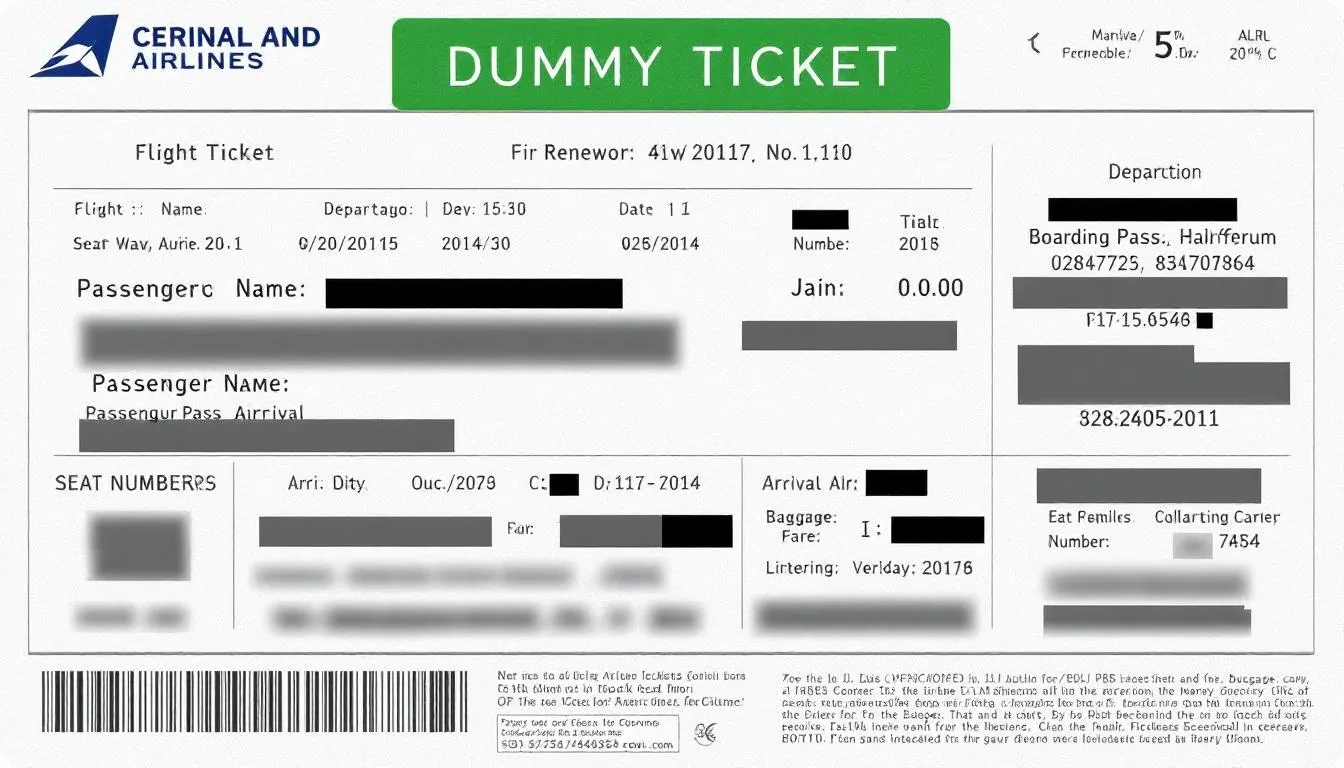
Short answer: When a passport contains accents, apostrophes, hyphens or other special characters, enter the plain-letter name format accepted by the issuing airline and keep every letter in the same order. A dummy ticket for visa should carry the same passenger identity as your passport and application, but a temporary reservation cannot guarantee approval, boarding or entry.
Key facts
- Use the passport machine-readable zone as a reference when the booking form cannot store punctuation.
- Strip a mark only when the airline system requires it; do not remove, add or reorder letters.
- Check given names, family names, particles and middle names before submitting the reservation.
- Review the PNR on the issuing airline's official page and keep the displayed name consistent across the visa file.
- Airline, consular and border rules can differ, so verify the current requirement before travel.
Need a temporary reservation with the right passport name? Prepare a truthful record using the permitted airline format, then compare the PNR with your passport before uploading it.
Create your dummy ticketIn This Guide
- Why Apostrophes, Accents, And Hyphens Fail Inside Airline Name Fields
- Turning Your Passport Name Into A Format Airlines Will Actually Store
- Tricky Passport Name Patterns And How To Enter Each One
- Checking Your Reservation Before The Embassy Does
- Match Your Passport Spelling And Your Reservation Will Hold Up
Official-source check: Confirm the airline's name-entry rules and current passport or travel-document requirements before submission or departure. The IATA Travel Centre can help with passport and destination checks; the issuing airline controls how a name appears in its reservation record.
Reviewed for: passport machine-readable-zone logic, special-character handling, PNR name consistency, airline verification and safe visa-document wording.
Name-format check: Before you upload a reservation, compare the passport data page, machine-readable zone, visa form and PNR in one pass.
- Every letter is present and in passport order.
- Only unsupported punctuation or diacritics was converted.
- The airline lookup shows the same passenger identity and route.
Your passport reads Zoë O'Brien-Núñez. The airline system cannot store the ë, the apostrophe, the hyphen, or the ñ. So the reservation attached to your visa file carries a different spelling, and the reviewer spots it in seconds.
Now you have a decision: leave it and hope the reviewer understands, or rebuild the name in a format both sides accept. This guide shows you how to format your name so airline systems accept it and your passport still lines up.
You will learn what to strip, what to keep, and how to handle single names, long names, married names, and the final check before you upload your file. Start with a dummy ticket booking that carries your exact passport name in its plain airline format.
Why Apostrophes, Accents, And Hyphens Fail Inside Airline Name Fields
A name like Zoë O'Brien-Núñez looks harmless on paper. Inside an airline system, every symbol in it becomes a problem.
How Reservation Systems Handle Symbols In Your Name
Airlines do not store names the way you write them. Your name passes through airline reservation systems built around a narrow set of plain letters. Those systems expect A to Z and very little else.
Many airline reservation systems normalize or reject special characters, so the exact treatment depends on the carrier and booking channel.
Legacy airline booking systems generally block or reject symbols and special characters. Newer airline sites look modern, yet they still feed the same back end.
Most airline booking platforms do not accept special characters, symbols, or diacritics. Some forms throw an error the moment you type an apostrophe. Others accept it and alter the name afterward.
Airline systems may ignore or strip special characters when processing names. That is the risky part. You may not notice the change until the itinerary lands in your inbox.
Here is what usually happens to a name on its way through:
-
An apostrophe disappears, so O'Neil may become Oneil.
-
A hyphen turns into nothing or a blank, so Smith-Jones may become SmithJones or Smith Jones.
-
An accented letter loses its mark, so José becomes Jose.
-
A symbol the system cannot read may trigger an error, so the booking fails before it starts.
Your flight reservation is created inside that same environment. For a plain-language explanation of the document itself, see what a dummy ticket means before you compare the name fields. The name printed on the PDF is the name the system stored. You cannot ask a system to display a symbol it cannot hold.
So the goal is not to protect your punctuation. The goal is to give the system the cleanest version it will store without changing it. Different systems convert symbols in different ways, and you should never leave that choice to them.
Do not treat one airline's conversion as a rule. One system may delete a hyphen while another turns it into a space. Both outputs are valid inside their own system, but only one of them can match your paperwork.
What The Two Lines At The Bottom Of Your Passport Reveal
Open your passport to the photo page. Two lines of capital letters and angle brackets run along the bottom. Your passport's machine-readable zone already shows how your name behaves inside a computer.
The machine-readable zone of a passport shows how international aviation systems parse identity. Accents disappear there. Apostrophes are dropped. Hyphens and spaces turn into filler characters.
Take our example. The name line for Zoë O'Brien-Núñez reads OBRIEN<NUNEZ<<ZOE. Nothing in that line needs a special key on your keyboard.
Use that line as your cheat sheet. Compare it with the printed name on the data page before you open any booking form. Check three things:
-
How each accented letter appears in plain form.
-
Whether a hyphen splits your surname into two name parts.
-
Whether the given names appear in the same order as the printed line.
If anything differs in a way you did not expect, sort it out now. It is far easier before a reservation exists.
Why Visa Reviewers Notice A Different Spelling On The Reservation
Many embassies require a flight reservation for visa applications. A broader dummy ticket for visa strategy guide can help you keep the flight, accommodation and appointment dates aligned. Dummy tickets are primarily used for visa applications. So your reservation sits right beside your passport copy in the file.
Reviewers compare the two documents line by line. Visa reviewers check for exact name alignment with passports. A different spelling creates confusion, and confusion invites extra questions.
Picture Lena Müller-Hayes applying with a reservation that reads Lena Miller Hayes. One letter differs. The reviewer now has to decide whether these are the same person, and nobody wants to leave that call to a stranger.
Embassies check that the name on the reservation matches the passport as used by the airline system. That wording gives you room. Reviewers know that systems strip symbols, so they expect the plain-letter version.
They do not expect a new spelling. Airline and travel-document rules generally require the passenger identity to remain consistent with the passport; confirm the carrier's current policy. Plain letters in the same order satisfy that rule. Extra, missing, or swapped letters do not.
Timing matters too. Reviewers often handle dozens of files in one sitting. A clean match clears in a second. A near match slows the whole file, because the reviewer has to stop and think.
Reviewers usually cross-check the same few points:
-
The order of the given names and the surname.
-
Every letter of the family name.
-
Any name part that is missing or added.
Treat the reservation as one more identity verification checkpoint in your file. Once you know the logic, the next step is converting your own name, letter by letter.
Turning Your Passport Name Into A Format Airlines Will Actually Store
Every international flight booking starts with the name field, so this is the step to get right. Convert your name one part at a time, and slow down at the start of the booking process.
Swapping Accents And Diacritics For Plain Letters
Accented characters should be converted to their base English letters. Swap letter by letter and change nothing else. Base letters are the simplest choice because the system already knows them. A base letter never adds information your passport lacks.
-
é, è, and ê become E.
-
ü becomes U.
-
ñ becomes N.
-
ç becomes C.
-
å and ä become A.
Some passports go further. A German umlaut may appear as UE in the zone, and ß may appear as SS. In those cases, copy what your passport prints.
The zone is the safest reference because officials read it by machine. Add no letters that the zone does not show.
Nordic and other letters follow the same logic. ø becomes O, æ becomes AE, and ł becomes L. When your passport zone shows a different pairing, the zone wins over any chart you find online.
Many travelers try to invent a friendlier spelling, and that is where mismatches begin.
Dropping Hyphens, Apostrophes, And Spaces Without Losing Letters
Standard industry practice requires stripping punctuation to match system limits. Follow it, and keep every letter.
When entering names, drop hyphens, apostrophes, and spacing for dummy tickets. Here is how that looks:
-
D'Angelo-Smith becomes DAngeloSmith.
-
Van Der Berg becomes VanDerBerg.
-
St. John becomes StJohn.
Here is a full example. Take María José Peña-D'Arcy. The booking form should read Maria Jose as the given names and PenaDArcy as the surname. Every letter survives. Only the marks and symbols are gone.
Avoid these slips:
-
Replacing an apostrophe with a space, which splits one surname into two.
-
Keeping the hyphen because the form seems to accept it.
-
Adding a comma between the surname and the given names.
Do not add stylistic punctuation to names in bookings. That covers periods after initials, commas between name parts, and quotation marks around a nickname. The system would remove them anyway.
Airlines require exact name matching with passports. That is why you strip symbols but never letters. Removing a hyphen keeps every letter in place. Removing a letter breaks the match.
Once you settle on a format, keep it everywhere. Use the passport name format for all travel documents. The reservation, the travel insurance certificate, and the visa form should all carry one spelling.
Entering A Single Name When Your Passport Has No Given Name
Some passports show only one name. There is no first name to split from a surname, yet every booking form asks for both.
An Indian passport may show a single name in the given name field and leave the surname blank. If your passport lists one name only, the airline form still expects a last name.
Enter single names in the Last Name field. That field carries the identity in the airline record.
Use a title as a placeholder for the First Name field. Mr or Ms works well. Do not invent a given name to fill the gap, because a made-up first name creates the exact mismatch you are trying to avoid.
Read the confirmation page after you submit. If the name looks doubled or shifted into the wrong field, ask the provider to correct the entry before you upload anything.
Staying Inside The Character Limit With Long Names
Airline systems cap the space available for names. Two surnames plus two given names can pass the limit faster than you expect. A long double surname plus several given names may hit the character limit.
Type the full name into the booking form and watch for a cut-off or an error message before you confirm. Test the length before you pay for anything. Count the characters yourself first. Stripping hyphens and apostrophes already saves a few, which sometimes solves the problem without touching a single letter.
When the form cuts you off, protect the surname first. Shorten a given name to its initial only if the form forces it. The family name must stay whole because reviewers read it first.
Never fix a long name by editing the PDF yourself. Dummy flight tickets should not be manipulated or fabricated. If the name will not fit, rebook in the shorter format the system permits. A reservation is not a place to test spellings. Enter the final version once, then check it, because repeated edits leave extra records and extra doubt.
Clean conversion handles the simple cases. Real passports throw harder ones at you, and middle names are the first hurdle.
Tricky Passport Name Patterns And How To Enter Each One

Most name trouble comes from a handful of repeat patterns. Each one has a safe way to enter it.
Middle Names That Appear On The Passport But Not On Your Visa Form
Your passport may print a middle name that your visa application leaves out. The reservation follows the passport, not the shorter version you typed into an online form.
Enter every given name exactly as the passport shows it. A missing middle name is one of the fastest ways to make two documents look like they belong to different people.
Some airline forms include a separate box for the middle name. Others expect it after the first name in the same field. Follow the layout the booking form gives you, and never skip a name your passport prints.
Two quick examples show the rule:
-
Passport: Anna Marie Keller. Reservation: Anna Marie Keller.
-
Passport: Anna Marie Keller. Visa form: Anna Keller. Reservation: still Anna Marie Keller.
Double given names work the same way. Enter a name like Mary Ann exactly as the passport splits or joins it. Do not merge two names or split one because it looks tidier.
If the visa form has no space for the extra name, do not trim the reservation to match. Keep the reservation faithful to the passport, and add the full name where the application allows it.
Married Names, Maiden Names, And The Marriage Certificate Question
Name changes create the trickiest files. Your current passport decides which name appears on the reservation, and nothing else does.
If the current passport shows your married name, book under it. The maiden name has no place on the ticket, even when older documents still carry it.
If the passport still shows the maiden name, book under that name, even after the wedding. A marriage certificate proves the link between the two names, but it does not change the airline record.
Airlines match every passenger name record to the passport, not to family paperwork. Keep the marriage certificate in your visa folder for the interview, not for the booking form.
Consider Emma Carter, who married and became Emma Nolan-Carter but has not renewed her passport. Her reservation still says, Emma Carter. Once she renews, new reservations follow the new passport and read NolanCarter.
Two Surnames, Particles, And Names Spelled Differently Across Documents
Double surnames and particles like De, Van, and Von cause the most confusion. Enter the full family name in the exact order the passport shows it.
If the booking form has one surname field, place both parts of a double surname in it. Apply the same stripping rules you used for hyphens and spaces.
Now think about your older paperwork. Bank letters, school records, and old insurance papers may show your name spelled differently from the passport. Ignore them when you book. The passport controls the airline record, and your other papers should follow it.
Your visa file often needs more than a reservation. A Schengen visa file usually needs travel insurance as well, and that certificate should carry the same name as the reservation. Aim for the same name on every page.
What Small Errors Cost You With Different Carriers
Rules differ by carrier, but the principle does not. Carrier handling varies, so apply the issuing airline's name-entry rules to the reservation you actually receive rather than relying on a provider label.
Whether the reservation sits with Air India, United Airlines, or Air Canada, the ticket name must line up with your passport. Airline and travel-document rules generally require the passenger identity to remain consistent with the passport; confirm the carrier's current policy.
Even a single letter difference can cause major issues. A name mismatch can prevent check-in entirely. At the counter, the agent will check in each passenger by comparing the passport with the record.
Airlines manage name and document mismatches carefully because an error can create check-in, servicing or compliance problems. That is why agents guard the name line closely. Airlines may charge fees for name changes after booking.
Many airlines treat the name as fixed once the ticket is issued. Even a low cost carrier like Air Asia or Air Arabia may treat a spelling edit as a paid change, so plan to get it right the first time.
The boarding pass copies the ticket name. A single letter difference can cause boarding issues. Some domestic flights accept a national ID, so the rules feel relaxed there. International flights read the passport, and the boarding pass must match it.
Ask yourself one question before you pay: does every letter on the reservation appear in the zone at the bottom of my passport? If yes, the reservation is ready. If no, fix it now, while a new booking costs less than a correction.
The name on the ticket is settled. What remains is proving that the reservation is real and readable before the embassy sees it.
Checking Your Reservation Before The Embassy Does
A clean name still needs proof. Check the reservation the way a reviewer would, and fix any gap while fixing it is easy.
Verifying The PNR On The Airline Side Before You Upload
It is crucial to ensure the PNR is verifiable on the airline's website. If you need a temporary dummy booking, use the issuing process and check the record rather than editing a PDF. A dummy ticket includes a valid PNR for verification. Use it before anyone else does.
Open the airline website and find the manage booking page. Enter the booking reference with your surname. Only the airline's official page counts as confirmation, so ignore third-party pages that repeat your data.
Your booking reference number is usually six characters long. Some airlines also show an e-ticket number, which is a 13-digit code. Either one should lead you to the same record. Repeat the check whenever you change dates. A date change updates the reservation, so read the name line again after every edit.
Then read the screen slowly. Confirm three things:
-
Passenger details show your name in plain letters, in passport order.
-
Booking details show the route and dates from your flight itinerary.
-
The status reads confirmed, not pending.
If the page returns an error, try the surname only, then try the reference in capital letters. Some systems read the entry in a picky way, and a second attempt often works. Save a copy of the confirmed status page for your own records.
A temporary reservation should be checked close to your submission date. Use the PNR and PDF supplied through the issuing process, and follow the current service terms for any reissue or date update.
What To Do When The Spelling Still Comes Out Wrong
Sometimes a booking form converts a name in a way you did not expect. Act quickly, because your options shrink as the travel date nears.
Contact the airline immediately to resolve name mismatches. Send a correction request with a passport copy attached, and ask what the airline can change.
Correction rules and fees vary by carrier. Ask the issuing airline for the permitted correction, cost and turnaround time before you agree.
Follow this order when a mismatch appears:
-
Compare the reservation against the zone at the bottom of your passport.
-
Contact the airline with your booking reference and a passport copy.
-
Ask for the fee and the turnaround time in writing.
-
Rebook if the fee or the wait exceeds what your appointment allows.
For a dummy reservation, the faster fix is often a new ticket with the right spelling. Treat an airline ticket with the wrong name as unusable for your file. Compare the fee with the risk of losing money or losing time on a stalled application.
Dummy tickets help avoid financial loss if travel plans change. The same logic applies when a spelling needs to change.
Keeping Every Document In Your Visa File Consistent
Your reservation is one page in a larger folder. If the checklist calls for a flight reservation rather than a dummy-ticket explanation, compare the separate flight reservation for visa guide so the document type stays clear. Every page should agree on the name.
Share the same spelling with anyone who helps you. A travel agent, a sponsor, or an inviting host may type your name into their own forms. Send them the plain-letter version you settled on, so their paperwork follows yours. Copy the name from the passport data page each time, not from old emails, because signatures often keep accents and nicknames.
Dummy tickets can be used as proof of return travel. Your return ticket or onward ticket must show the same spelling as the outbound leg, and both must match the visa application.
If your file also includes a dummy hotel booking, the guest name follows the same plain-letter format. A hotel booking that spells you differently raises the same question again.
Group your travel documentation in one folder, with the passport data page on top. Compare the name details on each page against it. Then compare the travel details, such as dates and cities, against your appointment.
Immigration authorities may see the same reservation on arrival, so a clean file helps there too. No reservation can guarantee visa approval. A consistent file still removes one avoidable reason for doubt.
Before you submit, confirm this short list:
-
Every name matches the passport zone letter for letter.
-
The PNR opens on the airline's official page.
-
The outbound and return legs show the same spelling.
Once those three checks pass, the technical work is done.
Match Your Passport Spelling And Your Reservation Will Hold Up
Special characters do not have to derail your visa file. Strip the symbols, keep every letter, and follow the zone at the bottom of your passport. Then verify the PNR on the airline side before you upload it.
A reservation that reads exactly like your passport gives the reviewer nothing to question. Whether your passport carries an accent, an apostrophe, or a long double surname, the method stays the same. Check the spelling once, confirm the booking online, and submit knowing every page tells the same story.
Ready to check your reservation? Keep the passport spelling, airline record and visa documents aligned before you submit or travel.
Prepare your dummy ticketFrequently Asked Questions
How should I enter accents and apostrophes on a dummy flight ticket?
Use the plain-letter form shown by the passport machine-readable zone where the airline system requires it. Remove punctuation without dropping letters, and confirm the issuing airline accepts the format.
Should the reservation include every name printed on my passport?
Normally, yes: keep the given names and family name in the passport order, using the airline's permitted plain-letter format. Never invent or silently omit a name to fit a PDF.
What if a hyphenated surname appears without the hyphen?
A system may remove the hyphen while retaining every letter. Compare the resulting name with the passport zone and ask the airline or provider to correct any missing, added or reordered letters.
Can a single-name passport be used for a dummy ticket?
It can be, but booking forms may require both fields. Follow the airline's instructions, keep the one legal name intact and review the confirmation before using it in a visa file.
How do I verify a name after the PNR is created?
Open the airline's official manage-booking page with the reference and surname, then compare the displayed passenger name, route and dates with the passport and application.
Does a correctly formatted dummy ticket guarantee a visa or boarding?
No. It is supporting travel proof only. The airline, consulate and border authority apply their own current rules, and a reservation cannot guarantee approval, boarding or entry.
Friendly reminder: DummyFlights provides temporary travel-proof documents for planning and application support. Requirements vary by destination, airline, route and applicant situation. A dummy ticket can support a file, but it does not guarantee approval, boarding or entry.