
Your visa file can be strong while the flight piece quietly starts wobbling. The embassy wants clear entry and exit dates, but your leave approval is pending, fares are changing, your hotel dates are not final, and your appointment sits weeks away. In that gap, a dummy ticket can shift, expire, look too polished, or stop matching the rest of your paperwork.
This guide pinpoints the situations where a dummy ticket is the wrong tool and what to do instead. You will learn the warning signs that trigger verification, the itinerary patterns that invite doubt, and safer ways to lock consistency across your forms, cover letter, accommodation, insurance and travel timeline.
The goal is not to scare you away from every dummy ticket. A clean dummy ticket for visa can be useful when the checklist asks for an itinerary or reservation and your file is stable. The issue is fit. When embassy scrutiny is likely, the flight proof must support the file instead of becoming the easiest thing to challenge.
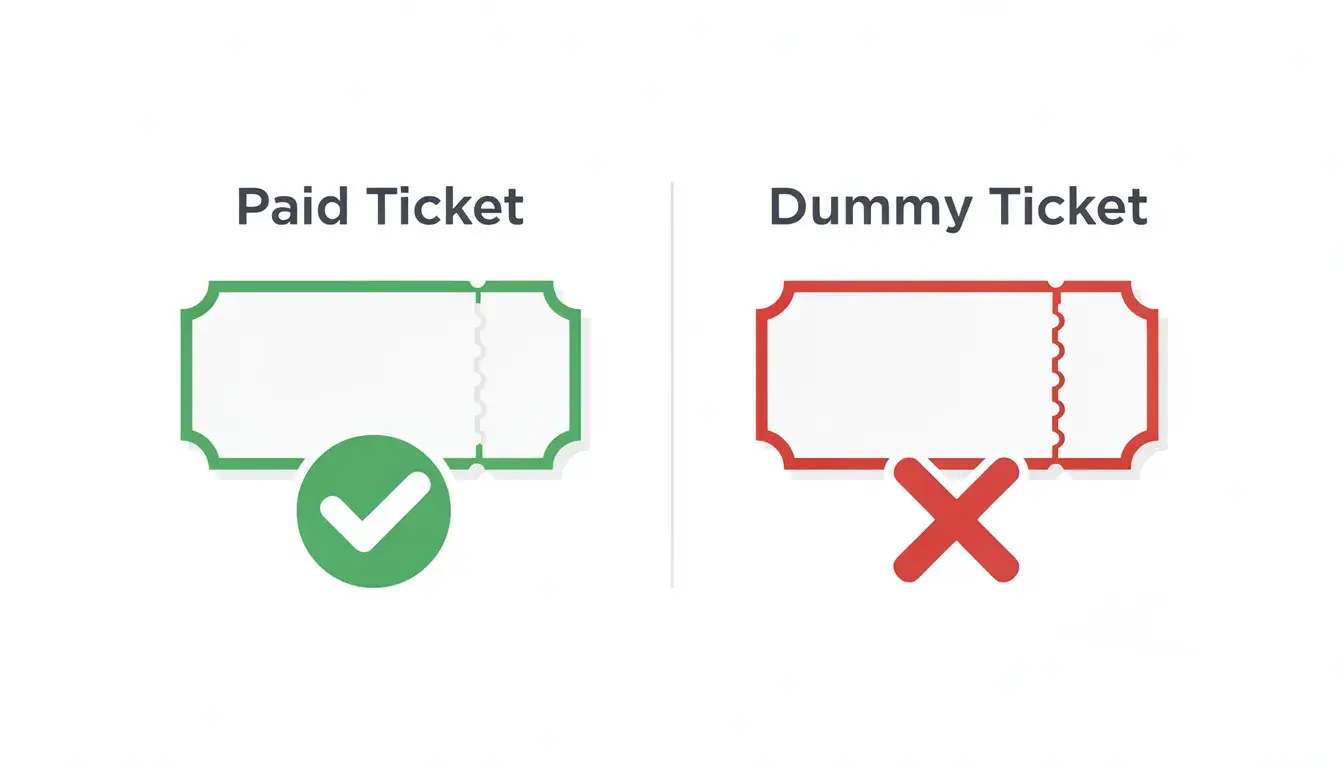
- Do not use a dummy ticket when the instruction clearly asks for a paid ticket, proof of payment, or confirmed ticket.
- A dummy ticket becomes risky when your dates, route, leave letter, hotel proof, insurance or cover letter do not match.
- High-scrutiny files need a conservative route and stronger supporting logic, not louder ticket wording.
- If your appointment or travel date may move, choose a strategy that can absorb changes without creating multiple conflicting PDFs.
- The safest alternative may be a refundable ticket, delayed purchase with a stable itinerary, or a simple verifiable reservation that fits the checklist.
If your checklist accepts a reservation and your route is stable, create one clean dummy ticket that matches the final document set. If the checklist asks for payment proof, follow the checklist instead.
Create Your Dummy TicketIn This Guide
Official-source check: U.S. State Department visitor visa guidance says there is no guarantee a visa will be issued and applicants should not make final travel plans or buy tickets until they have a visa. GOV.UK visitor guidance says applicants must show they can leave at the end of the visit and pay for return or onward travel, but also warns that submitted documents do not guarantee success and lists flight bookings as less useful evidence for visit applications unless transiting. The EU Visa Code lists itinerary-related documents and onward-journey tickets among possible supporting documents depending on the journey purpose. VFS Global’s fraud-awareness guidance says appointment availability, visa decisions and processing timelines remain at the discretion of the relevant governments. Sources: U.S. State Department visitor visa guidance, GOV.UK visitor supporting documents guidance, EU Visa Code and VFS Global fraud-awareness guidance.
Reviewed for: dummy-ticket risk boundaries, paid-ticket wording, embassy verification triggers, route-date consistency, PNR stability, high-risk visa-file handling, safer alternative selection and claim-safety language.
The Red Flags That Make A Dummy Ticket A Bad Move And Why They Matter
A dummy ticket can be the right document in the right file. The problem starts when your case has signals that make an embassy treat your flight plan like a credibility test rather than a formality. In that moment, the question changes from “did you provide a travel document?” to “does this travel document make the whole application more believable?”

When Your Application Is Likely To Be Verified, Not Just Glanced At
Some visa streams attract extra checking because the officer expects more follow-through. A Schengen short-stay file with a first-time traveler profile often gets a closer consistency read, especially when the trip length is ambitious for the applicant’s financial footprint.
A UK Standard Visitor application can also invite verification behavior when the story depends on tight dates, such as attending a wedding and returning to work on Monday. If your itinerary is the hinge, the flight detail becomes the easiest part to challenge.
Watch for these verification magnets across embassies and visa types:
- An interview-based process, such as a U.S. B1/B2 appointment, where officers may ask you to confirm route logic on the spot.
- A thin travel history on a Japan tourist visa, where the file leans heavily on clear intent and a clean travel timeline.
- A long stay request, such as 60 to 90 days for a Canada TRV, where the return intent must look structured and realistic.
- An unusual purpose claim, such as a short business visit with multiple city hops that reads like leisure travel.
- A previous refusal, administrative processing history, or weak return-ties profile where every document is likely to be read more carefully.
If any of these fit, a dummy ticket needs to be stable and defensible. Otherwise, it becomes the weak link that invites follow-up. High scrutiny does not automatically mean the applicant is doing anything wrong. It means the document must be chosen with more care.
When Your Itinerary Has Too Many Moving Parts To Stay Stable
Complex routing multiplies failure points. A Schengen trip that starts in Paris, jumps to Milan, exits via Amsterdam, and uses mixed carriers is not just detailed. It creates several places where times, connection windows, airports and internal movement can shift.
Embassies do not need a perfect travel masterpiece. They need a plan that holds together under light pressure. Overbuilt itineraries crack fastest when:
- You rely on tight connections, like a 55-minute transfer in Frankfurt on separate tickets.
- You mix airports in the same city, such as arriving at Tokyo Haneda and departing from Narita, without a clear reason.
- You stack segments for a short trip, like four flights inside seven days for an Australia Visitor plan.
- You use third-country transits that look avoidable, like routing to Spain through two hubs when a simpler path exists.
- You enter through one Schengen country, spend most time in another, and exit through a third without a matching day-by-day plan.
If your itinerary requires the officer to do math to believe it, scrutiny rises. This is where a dummy ticket can be the wrong tool, because the more segments you add, the harder it is to keep every line consistent with the rest of your file.
When Your Dates Are Not Truly Fixed Yet And You’re Trying To Freeze Them Anyway
This is the most common silent trigger. Your appointment is weeks away, your employer has not confirmed leave dates, your conference schedule is still shifting, or your sponsor cannot confirm the exact arrival window. Yet your application demands entry and exit dates today.
A Japan eVisa or tourist visa file often looks cleaner when the trip window is stable because small inconsistencies stand out quickly. If your leave approval could move by even three days, locking a tight flight window can create problems you did not intend.
Date instability usually shows up like this:
- Your UK visitor cover letter says “10 to 18 March,” but the flight shows “09 to 19 March.”
- Your Schengen itinerary lists a first hotel check-in on the 12th, but the inbound flight arrives on the 13th.
- Your Canada TRV supporting documents show payroll or shift schedules that make the stated return date unrealistic.
- Your conference invitation says the event starts Wednesday, but the flight arrives after the first day.
- Your insurance starts on the day after arrival because the flight crosses midnight.
A dummy ticket is not bad here. The mismatch is. If your dates are still floating, you need a strategy that keeps the application coherent even when one piece changes.
When The Airline Or Route Combo Is Known For Record Volatility
Some routes change more often than people expect. Seasonal schedules, frequency reductions, equipment swaps and route suspensions can all alter timing. If your plan depends on a specific departure time to make your story work, you are building on sand.
This matters in places where timing signals intent. A U.S. B1/B2 applicant who claims a two-day meeting but submits flights that land at midnight and depart at dawn creates unnecessary questions. A Schengen applicant who uses an odd overnight layover for a simple city break can also look like the plan was generated, not chosen.
Treat these as volatility risks:
- Newly launched routes with limited weekly frequency.
- Seasonal routes that shift around summer and winter timetable changes.
- Multi-carrier itineraries where one segment change cascades into missed connections.
- Routes that depend on a short transit window in a country with separate transit rules.
- Low-cost-carrier combinations where the traveler must self-transfer and re-check baggage.
If your file cannot tolerate a time shift without breaking the narrative, your flight evidence needs to be exceptionally stable. In that case, a simpler route or a refundable-ticket strategy may be safer than a fragile dummy flight record.
When Your Supporting Documents Don’t Back The Trip Window
Embassies read your file like a single story. A flight plan that conflicts with supporting documents does not just create a date error. It can create a truth doubt.
A Schengen application with a leave letter that ends on Friday but a return flight on Monday forces the officer to guess what you will do about work. A UK visitor file that claims a two-week family visit but shows financial activity more consistent with a three-day trip can feel mismatched. A Canada TRV file where trip duration clashes with employer obligations can raise return-intent questions.
Do a fast alignment check before you lock any flight evidence:
- Leave approval dates match your entry and exit days.
- Purpose dates match your travel days, such as conference start and end.
- Financial rhythm supports the trip length, not a much shorter or longer one.
- Entry and exit cities match the story in your cover letter and forms.
- Accommodation dates match arrival night, internal travel, and final night.
When these pieces do not line up, the smarter move is not to force a dummy ticket into the gap. The smarter move is to decide which path fits your risk level and how to build a flight plan that stays consistent.
Use A Dummy Ticket, Or Choose A Safer Alternative
Once you spot risk signals, choose flight evidence without guessing. The right decision depends on consequence: what happens if the flight proof is challenged, expires, no longer verifies, or stops matching the story?

What Would Be The Worst-Case Outcome If Your Flight Itinerary Fails?
Ask one question before anything else: if the flight record changes or cannot be confirmed, what happens to this specific visa file?
For a Schengen short-stay application, a shaky itinerary often turns into a consistency problem across the day-by-day plan, entry-state logic, accommodation and dates on forms. For a UK Standard Visitor file, it can create a credibility gap if the visit purpose depends on exact timing, like a short family event with a tight return-to-work schedule. For a U.S. B1/B2 interview, the worst case is not a missing paper. It is being asked to explain an itinerary that no longer matches your own story.
Score your consequence level using these triggers:
- High consequence: interview is likely, file has past refusals, trip duration is long, or routing is complex.
- Medium consequence: purpose is clear, but dates might shift, or you have moderate travel history.
- Low consequence: dates are firm, routing is simple, and supporting documents already lock the trip window.
If you cannot name the worst-case outcome in one sentence, treat the case as medium-to-high consequence and choose the safer path.
If You’re High-Risk, Don’t Use A Dummy Flight Ticket Unless It Is Clearly Accepted
High-risk does not mean you are doing anything wrong. It means your file is more likely to be challenged on logic, timing or follow-through. In high-risk cases, a dummy ticket should not be the document holding the story together.
For U.S. B1/B2, high-risk profiles often appear when the trip is short but the routing is odd, or when the purpose is business and the timing is tight. In those cases, choose an approach that remains credible if an officer probes it. For Schengen applications with multi-country movement, choose a path that reduces variables and shows you can execute the plan.
Safer paths that work in high-scrutiny contexts:
- Buy a real ticket with a refund plan if the official instruction or personal risk level justifies it.
- Buy the real ticket later, but lock the trip logic now across forms, cover letter and supporting documents.
- Use a single-carrier or simple routing strategy instead of a stitched, multi-carrier plan.
- Use a proposed itinerary when the checklist allows planning evidence rather than ticket evidence.
- Use a stable reservation only when the checklist accepts reservations and the route is simple enough to defend.
A short example: a U.S. B1/B2 applicant flying for a two-day meeting should not rely on a fragile chain like arriving at 23:40 and connecting at 00:35. A safer plan is one leg each way, with arrival that supports the meeting schedule and a return that aligns with work obligations.
If You’re Medium-Risk, A Dummy Might Work Only If You Can Keep It Stable
Medium-risk is the most common category for UK Standard Visitor and many Schengen files. You have a valid reason to travel, but one piece is still moving, usually dates.
Here, your goal is stability, not perfection. If you use a dummy ticket, keep it resistant to normal disruption.
- Keep segments minimal. One stop maximum is easier to defend than a chain of cheap connections.
- Keep connection windows realistic. A 45-minute cross-terminal transfer invites questions.
- Keep airports consistent with your story. If your UK visit is in Manchester, do not fly into London unless the internal travel plan is clear.
- Limit changes. If you already changed the travel window once after booking, treat that as the last change unless the embassy timeline forces another.
- Keep one version. Printed copy, upload copy and phone PDF should all match.
A practical medium-risk case: a UK Standard Visitor applicant visiting family for 12 days may have a leave letter that can shift by a day or two. If that is you, do not anchor the whole file to a departure time that could move. Anchor it to the dates and cities that match the supporting documents.
If You’re Low-Risk, Your Goal Is Still Consistency, Not Cleverness
Low-risk files still fail for simple reasons, especially in cases where officers compare documents quickly for mismatches. Low-risk usually means firm leave dates, fixed purpose dates, simple routing, and no obvious credibility friction.
Even then, avoid clever routing. A one-week Australia Visitor trip with three domestic flight legs can look inconsistent with a simple tourism plan. A Schengen city break should not read like a mileage run. A Japan tourist trip should not bounce between distant cities faster than a normal traveler could enjoy them.
Keep it believable:
- Use entry and exit cities that match the itinerary narrative.
- Keep trip length aligned with your financial footprint.
- Avoid flight times that clash with hotel check-in logic.
- Do not add extra countries just because a route is cheaper.
Some Scenarios Where Flight Reservations Get Complicated
An applicant departing from Delhi with a same-day domestic connection into an international departure faces a timing risk: if the first leg shifts, the stated arrival day in the visa itinerary can break. A U.S. B1/B2 applicant transiting through a third country for no clear reason may invite “why this route?” questions at interview. A Schengen applicant exiting from a different country than the entry state needs a clear internal travel plan, not just a return booking from a random airport.
Complication is not automatically bad. Unexplained complication is. If the route has a reason, make the reason visible in the cover letter or itinerary. If it has no reason beyond price or availability, simplify the plan before it weakens the file.
The Do This Instead Workflow When A Dummy Ticket Isn’t Recommended
When a dummy ticket is not the smartest fit, you still need a clean flight story on paper. The answer is not always “buy a ticket now.” The answer is to choose a flight-proof strategy that matches the official wording, your risk level and your real timeline.

Step 1: Freeze Your Trip Logic Before You Freeze Your Dates
Start by locking the logic of your travel intentions, not the minute-by-minute schedule. Officers look for a plan that matches purpose, home-country ties, funding and the shape of the trip.
Make three decisions and keep them stable:
- Your entry city and exit city.
- Your trip length in nights.
- Your reason for that route.
For a Schengen visa, this matters because entry point, main destination and exit point set the tone for the whole file. If you are applying with a Schengen visa itinerary, keep it consistent with where you say you will spend most of your time.
Write the travel details in one master note. Keep it simple enough to defend in one breath: “Arrive in Paris, depart from Amsterdam, 12 nights, tourism plus museum visits.” Or: “Arrive in Tokyo, depart from Osaka, 9 nights, tourism and a pre-booked event.” Only after that should you choose travel dates. If leave approval is not final, choose a window that can move by a day without breaking the story.
Step 2: Choose A Purchase Strategy That Won’t Force Panic Later
Next, decide how you will show flight proof without creating unnecessary financial risk. The best option depends on how close the appointment is, how confident you are about dates, and what the checklist actually says.
- Refund-first approach: buy refundable tickets when you can and when the case justifies stronger proof.
- Delay-with-structure approach: hold off on a full ticket until closer to the decision, but keep the route logic locked.
- Risk-managed purchase: if you must buy early, avoid a non-refundable ticket that would hurt if plans change.
- Reservation approach: use a reservation only when the wording accepts itinerary, booking or reservation proof.
A practical rule: if a date change would cause stress, do not anchor the file to a fare that cannot move. Booking too early can be expensive if you pay twice to correct dates. Booking too late can force a strange route. A good strategy gives you room to react without making the application look improvised.
For a broader view of the reservation route, compare this page with BookForVisa’s flight reservation for visa 2026 complete guide. That helps separate when you need a reservation strategy from when this DummyFlights article is warning against the wrong use of dummy tickets.
Step 3: If You Buy A Real Ticket, Make Your File Resilient To Changes
If you decide to buy an actual ticket, build the file so a schedule update does not derail the visa application. Airlines adjust timetables. That can happen even on reputable routes.
- Capture the booking reference once, then keep the same document version across the submission.
- Avoid building the narrative around a specific connection time that could change.
- Keep the ticket, cover letter, hotel dates and insurance dates aligned after any schedule update.
- Do not mix screenshots from different airline or agency portals unless they match perfectly.
Airline reservation systems may display details differently across carriers, agents and manage-booking pages. What you want is one real reservation or paid ticket record that can be understood without contradiction. If your confirmation shows a PNR code or ticket number, keep the document intact and do not manually edit it.
Step 4: Align Every Other Document To The Flight Window
Now make the application feel like one coherent package. This is where many applicants accidentally raise suspicion.
Run this alignment checklist before submission:
- Flight reservation dates match leave-letter dates.
- Travel insurance starts on arrival and ends after departure.
- Hotel bookings match arrival night, internal movement and final night.
- Forms and cover letter use the same entry and exit cities.
- Purpose documents, such as invitation or conference letters, sit inside the travel window.
- Financial documents support the length and style of the trip.
Also match your language to the embassy requirement. If you claim business meetings, the flight pattern should not look like leisure hopping. If you claim one city break, the booking should not show a confusing loop. If you cite an airline confirmation, use the same source consistently. Mixing multiple layouts can create contradictions in flight times, terminals or city codes.
Step 5: What To Submit If You’re Not Buying Yet Without Looking Empty-Handed
Sometimes the smartest move is to avoid purchasing while dates are still moving. You can still submit a temporary flight reservation or proposed itinerary if the checklist allows it and if it supports the story.
Use these guardrails:
- Keep the route simple and believable.
- Keep duration aligned with supporting documents.
- Do not promise exact seats, upgrades or unrealistic connection windows.
- Make sure the authority accepts the format for your destination and visa type.
- Keep the reservation within the period you expect the file to be reviewed, when possible.
A legitimate dummy ticket or verifiable reservation can be useful when the goal is structure, not final commitment. What matters is that the document reads like travel proof, not a patched set of screenshots. If you use a dummy flight ticket, avoid multiple reissues that create competing versions.
When Dummy Tickets Are Not Recommended: Quiet Failure Risks People Don’t See Coming
Even when flight documents look clean, some problems only appear after submission. These quiet failure modes show up in Schengen reviews, UK visitor processing, U.S. interview contexts and other visa systems where timing, consistency and intent matter.
The Quiet Failure: When Your Dummy Looks Fine But Becomes Unverifiable Later
A common surprise is timing. Your file may sit in a queue longer than expected, and an officer may check flight proof after the reservation has changed state. It does not mean your intent is wrong. It means the evidence no longer behaves the way the reviewer expects.
Protect yourself by planning for delayed review:
- Assume the itinerary might be checked weeks after submission, not only in the first 48 hours.
- Keep one stable document version in the file, not a chain of updated PDFs.
- Avoid last-minute swaps that create multiple flight confirmations with different dates.
- If the route is high-risk, choose a document type that stays valid longer or is easier to explain.
For interview-driven visas, quiet failure looks different. You can walk into the appointment with a printout, but the officer may focus on your story. If the flight evidence looks too fragile to support the stated purpose, you end up explaining logistics instead of intent.
When A Too-Perfect Itinerary Triggers More Doubt Than A Simple One
Some itineraries look engineered. Officers see many applications and recognize patterns that do not match normal passenger behavior.
Examples that often feel unnatural:
- A 10-day Schengen application with three internal flights, tight transfers and no clear reason.
- A UK Standard Visitor plan that lands at 05:10 and claims an immediate full-day event with no rest buffer.
- A Japanese tourist file that bounces between distant cities in two days, with flight times that do not match a realistic sightseeing flow.
- A business trip that uses leisure-style routing while the invitation points to one city.
A too-perfect itinerary can also include improbable efficiency: zero downtime, same-day city hops, and connections that only work if every step is on time. The boring version is often stronger. Use one arrival day that leaves room for real-life delays, flight times that match the purpose, and a return plan that supports home obligations.
When Your Travel Purpose Doesn’t Match Your Flight Behavior
This is one of the fastest ways to invite questioning because the mismatch is conceptual, not clerical. A business visitor to the UK who claims two client meetings in London but submits flights that arrive in one city and depart from another with no internal travel plan creates a gap. A Schengen tourist who claims a single-base stay but shows flights that imply constant movement creates the same gap.
Before locking flight evidence, run a purpose-fit check:
- Does the arrival time support your first stated activity?
- Does the departure time support your last stated activity?
- Do the cities match the purpose narrative, or create unanswered “why there?” questions?
- Does the route look like something a passenger would choose for that trip?
- Do hotel bookings, host letters and transport plans support the route?
If you also include hotel bookings or a dummy hotel booking, make sure accommodation does not contradict flight logic. A mismatch between accommodation dates and flight dates is a common follow-up trigger, especially in Schengen files where the day-by-day plan is reviewed as one story.
When You’re Applying With Past Refusals Or Thin Travel History
Past visa refusal history changes the lens. The officer is not only checking compliance. They are checking the pattern. Two recurring pitfalls appear in these files: the itinerary is overly ambitious, like a long multi-country Schengen tour without strong anchors, or the itinerary is too optimized, like complex routing that saves money but creates logic gaps.
If you have thin travel history, keep the flight plan defensible in plain language. A direct route or standard hub is easier to explain than a multi-stop path that looks built only to satisfy paperwork. If you have a prior refusal, do not introduce avoidable contradictions. Even small inconsistencies can become a repeat concern in the officer’s mind.
Make the file easy to audit:
- One clear route.
- One clear trip window.
- One consistent explanation.
- Supporting documents that match the same dates and cities.
If You Already Submitted A Dummy And Things Changed, What Now?
Sometimes travel dates move after submission. Sometimes the airline changes a schedule. Sometimes an employer adjusts leave. What matters is how you respond.
First, decide whether the change affects the core of the application:
- Core changes: entry date, exit date, entry city, exit city, trip length or purpose.
- Non-core changes: flight number, small departure-time shift, same-day connection adjustment or terminal change.
For a Schengen visa application, core changes can collide with itinerary, insurance and accommodation dates. If a change is core, you need a controlled update plan, not a patchwork. Replace the flight document with an updated version that still matches purpose and window. Keep formatting consistent so the reviewer sees one narrative, not a revision trail. If you submit additional documents, reference the same application or visa-center number so the update lands in the correct file.
Avoid sending multiple partial updates. One email with three different versions can look messy even when the reason is legitimate. If your flight evidence comes from a service that issues reservations for a small fee, keep the change count low. Each reissue creates another record in your own paper trail, and the goal is to keep the file readable for the person reviewing it.
Lock A Flight Plan That Survives Embassy Scrutiny
For Schengen, UK visitor, U.S. B1/B2, Japan tourist and similar files, the win is not a fancy itinerary. It is a flight plan that stays consistent from submission day to review day. Choose the route and dates that match your purpose, your supporting documents and the way a real passenger would travel.
You should now be able to decide when a dummy ticket fits and when a real-ticket or reservation strategy is safer. If you are unsure, take one hour to audit dates, cities and supporting documents against one master itinerary before submitting. That hour can save weeks of document repair later.
If your situation is low-risk and the checklist accepts reservations, use one clean dummy ticket. If the checklist demands paid proof, use the required proof. If the case is high-risk, simplify the route and strengthen the supporting documents before you worry about the ticket format.
For the wider foundation behind dummy-ticket use, timing and visa-file consistency, start with the Dummy Ticket for Visa 2026 complete guide. Then return here when you need to decide whether a dummy ticket is appropriate for the specific risk level of your application.
If your checklist accepts a reservation and your file is stable, create one clean dummy ticket that supports the exact route and dates you will submit. If your case falls into the risk zones above, choose the safer proof path first.
Create Your Dummy TicketFAQ
When are dummy tickets not recommended?
Dummy tickets are not recommended when the official checklist asks for a paid ticket, proof of payment, confirmed onward travel, or a document that must remain verifiable for a long review period. They are also risky when your dates, route or supporting documents are unstable.
Can a dummy ticket hurt a visa application?
Yes. It can hurt if it conflicts with your cover letter, hotel dates, insurance, leave approval, passport details or interview answers. The problem is usually inconsistency or misrepresentation, not the idea of a reservation itself.
Should I use a dummy ticket if the embassy asks for proof of payment?
No. If the embassy or checklist clearly asks for proof of payment or a paid ticket, a dummy ticket alone is not the right document. Follow the checklist or use a ticket strategy that provides the required proof.
Is a refundable ticket safer than a dummy ticket?
It can be safer in high-scrutiny cases or when paid proof is required, but it may also create financial risk. Choose refundable or changeable options only after checking the official wording and your ability to absorb changes.
What if my travel dates are not fixed yet?
Do not lock a narrow dummy ticket around unstable dates. First stabilize the travel window, leave approval, hotel dates and purpose documents. If dates may move, use a flexible strategy and avoid multiple conflicting versions.
Are dummy tickets bad for Schengen visa applications?
No, not automatically. Schengen applications may use itinerary-related supporting documents depending on the case. A dummy ticket becomes risky when it conflicts with main-destination logic, accommodation, insurance, stay length or return intention.
Are dummy tickets bad for U.S. B1/B2 interviews?
They are not the main proof for most U.S. visitor interviews. U.S. guidance warns applicants not to buy tickets before visa issuance, and officers usually focus on qualification, purpose, ties, funds and intent to depart. If you bring a reservation, describe it honestly.
What should I use instead of a dummy ticket?
Depending on the checklist, use a proposed itinerary, a stable flight reservation, a refundable ticket, a delayed purchase plan, or a paid ticket if required. The safest alternative is the one that matches the official wording and your risk level.
What if I already submitted a dummy ticket and my route changed?
Decide whether the change is core or minor. If entry date, exit date, city, trip length or purpose changed, update the whole document set consistently. Do not send several partial versions that create a confusing revision trail.
Can I still use DummyFlights if my case is low-risk?
Yes, if the checklist accepts reservations or itineraries and your file is stable. Use one clean document, check every detail, and do not claim it is a paid ticket if it is a temporary reservation.
This guide is general travel-document information, not legal advice or a guarantee of visa approval. Always follow the checklist and instructions from the embassy, consulate, visa center, airline or border authority handling your case.