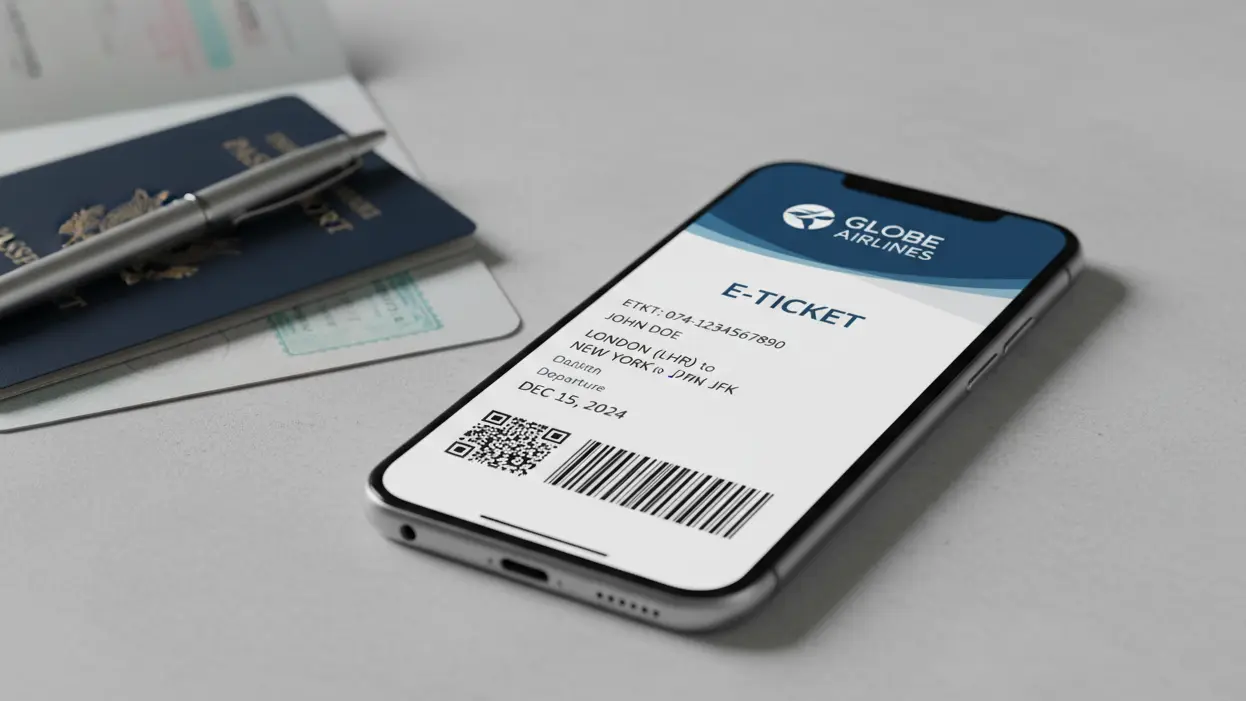

A transit layover sounds simple until the check-in agent pauses and asks, “Where do you go next?” That question can appear even when you never plan to leave the airport. In real airport workflows, the first decision is often made by the airline before the transit country sees you. If the airline cannot clear your route confidently, you can be delayed, sent to a document desk, or refused boarding.
This guide explains when onward proof gets checked during transit, why airside and landside transfers are treated differently, how separate tickets raise risk, and what kind of document survives fast airport scrutiny. The focus is practical: build a clean onward-ticket proof pack before travel day, then present it in a way that makes the route easy to approve.
Key facts before you rely on transit onward proof:
- Airline staff may ask for onward proof before the transit country sees you.
- Airside transit is safer only when baggage, boarding passes and terminal movement can stay airside.
- Self-transfer, airport changes, overnight layovers and low-cost onward legs increase manual checks.
- A clean onward ticket should show name, route, date, flight number and reference details without scrolling.
- Old PDFs, mismatched dates and impossible transfer times cause more trouble than the word “dummy.”
Need onward proof before a transit check? Create a clean onward ticket with DummyFlights before the airline counter turns your layover into a documentation problem.
Create Your Onward TicketIn This Guide
Official-source check: GOV.UK says UK transit visa needs depend on whether the traveler goes through UK border control, with Direct Airside Transit and Visitor in Transit paths separated by border-control status. The U.S. Department of State explains that transit can involve immediate and continuous travel through the United States and may require evidence of onward travel arrangements or permission to enter the next country. European Commission guidance says some nationals need an airport transit visa even for the international part of an EU airport, and Schengen countries can impose additional airport-transit requirements. Sources: GOV.UK transit visa guidance, U.S. Department of State transit visa guidance and European Commission visa policy.
Reviewed for: transit-layover wording, UK and Schengen airside/landside logic, U.S. transit proof expectations, self-transfer risk, PNR terminology, airline-counter practicality and onward-ticket claim safety.
The Two Gatekeepers Who Decide If Onward Proof Counts
You might think the transit country decides everything, but the airline often decides first. The check-in counter is where many onward-ticket problems begin because the airline is responsible for carrying a passenger who may be refused later. If the route, passport, visa status or onward plan looks unclear, staff can ask for proof before a boarding pass is issued.
The airline can block you before transit immigration sees you
At the counter, the airline is not judging your vacation dream. It is deciding whether boarding you creates a compliance problem. That is why a traveler with a simple-looking layover can still be asked for proof of onward travel.
You are more likely to get pulled into an onward check when the itinerary has one or more of these patterns:
- One-way travel through a country where airport transit visas apply to some passports.
- A UK connection where Direct Airside Transit rules or border-control status matters.
- A Schengen hub connection where nationality and airport-transit rules must be checked.
- A U.S. connection, where “transit” often still involves entry processing.
- A self-transfer that may force baggage reclaim, landside check-in or new document verification.
- A terminal change, airport change, long layover or overnight connection.
The counter interaction is short. The cleanest move is to make the proof easy to scan: show the onward document first, point to the name, date and flight number, and describe the connection type in one calm sentence. “Same airport, single ticket” feels different from “separate tickets, onward at 17:40.” Both can work, but only if the proof matches the mechanics.
Document databases shape the questions you hear
Airline agents usually follow document-check systems and carrier guidance. That is why the questions sound repetitive across airports: airside or landside, single ticket or separate tickets, same airport or airport change, final-destination permission confirmed or unclear. The system is trying to classify your trip into a safe boarding decision.
Make your proof system-friendly:
- Keep routing consistent across ticket, hotel, visa and cover-letter documents.
- Use a current PDF, not an old file after a route or date change.
- Match passenger name formatting with the passport.
- Make the flight number, departure date and booking reference visible without login steps.
The easiest way to fail manual review is to make the agent interpret. Interpretation creates delay. Delay creates supervisor checks. Supervisor checks create a higher chance that someone asks for stronger proof or refuses the boarding decision altogether.
Carrier liability is the hidden pressure behind strict checks
Airlines police onward proof because they can face consequences when a traveler is refused by a border authority. If your plan depends on everything going perfectly, staff may treat it as risky. A missed self-transfer, baggage issue or overnight airport closure can turn “I will stay airside” into “I need to enter the country.”
You reduce that perceived risk with operationally believable choices:
- Use an onward departure that is plausible for the airport, terminal and baggage process.
- Choose timing that survives normal delays instead of a perfect-world connection.
- Carry proof offline so Wi-Fi, apps and email search do not become part of the problem.
That is also why a dummy ticket must still look like a real travel-proof document. The issue is not whether you bought the final fare months early. The issue is whether the document gives the airline a clean answer for the next departure.
Your proof must satisfy two standards
Onward proof has to pass both a rule test and a verification test. The rule test asks whether you can legally transit that airport or country. The verification test asks whether staff can confirm your next flight quickly enough to clear boarding.
| Test | What staff are checking | What your onward proof should show |
|---|---|---|
| Border-rule fit | Whether you can stay airside or have permission to go landside. | Route, airport, timing and next-country eligibility that match the transit setup. |
| Airline verification fit | Whether the onward departure is current, plausible and easy to validate. | Passenger name, flight number, departure date and booking reference on one clean page. |
| Disruption fit | Whether your plan still works if delay, baggage or terminal changes force a new process. | A conservative onward time and one current proof file, not multiple conflicting versions. |

The Transit Decision Tree That Predicts Onward Proof Checks
Before you worry about what document to show, classify the connection. Most problems come from travelers calling something “just a layover” when the airport workflow treats it like entry, re-check or a second journey.
First split: airside connection or border crossing
An airside connection only stays airside if you can remain inside the international transit area from arrival to departure. Three details commonly break that assumption: baggage is not through-checked, onward boarding pass cannot be issued airside, or the terminal movement forces border control.
Run this test before travel day:
- Do both flights appear under one itinerary or protected connection?
- Will baggage be through-checked to the final destination?
- Do you already have the onward boarding pass, or can it be issued airside?
- Does the airport support sterile transfer between the exact terminals and airlines?
If the answer is uncertain, treat the layover as a possible border-crossing case. That is when onward proof becomes more important, and when the agent may care about your right to enter or pass through the transit country.
Second split: single ticket or self-transfer
A single ticket does not remove every question, but it lowers friction because the connection is usually protected in the airline system. A self-transfer changes the psychology. Staff see two separate journeys, not one seamless itinerary, and they may not be able to verify the onward leg internally.
Self-transfer risk rises when:
- The flights are on different bookings or different carriers.
- The onward airline is low-cost and requires separate check-in.
- The layover is tight for immigration, baggage, security and re-check.
- The onward flight departs from another terminal or another airport.
If two or more of those are true, expect the origin check-in counter to ask for onward proof before you board the first flight. Do not wait for the transit airport to solve it.
Third split: same airport, same city or airport change
Same airport is usually easiest. Same city with a different airport is not simple transit. If you land at one airport and leave from another, you normally need to cross the border, travel through the country and check in again. That makes the onward ticket part of an entry-style assessment.
Use this decision rule: if ground transport is needed between airports, prepare as if you are entering the transit country. Confirm entry permission, allow realistic travel time and keep the onward proof tied to the correct airport code.
Fourth split: layover length and forced landside situations
Short layovers trigger feasibility questions. Long or overnight layovers trigger transit-validity questions. A two-hour protected connection can be cleaner than a six-hour self-transfer if the second journey needs baggage reclaim and landside check-in.
Forced landside risk appears when:
- The transit area closes overnight or does not support your route overnight.
- Your onward airline only checks in landside.
- You must retrieve and re-check baggage.
- Security and transfer corridors do not operate continuously.
Classify your layover in practical terms. Under 4 hours often faces feasibility scrutiny. Four to 12 hours is mixed scrutiny. Twelve hours or overnight can become a higher-risk review if the airport cannot keep you airside.
The 90-second onward-ticket flow
Run this quick sequence before booking or before heading to the airport:
- Is the onward flight on the same ticket as the inbound flight?
- Will bags be through-checked to the final destination?
- Can the onward boarding pass be issued before or during airside transfer?
- Do you change airports during the layover?
- Is the layover overnight or longer than 12 hours?
- Is the onward leg on a separate carrier with separate check-in steps?
If the answers are mostly clean, basic proof may be enough. If separate tickets, baggage uncertainty or low-cost carriers appear, prepare robust proof. If airport changes, overnight layovers or transit visa sensitivity appear, treat the proof pack as critical.
Outcome map: basic, robust or bulletproof check
Once you run the flow, classify the route before you decide how strong the onward proof needs to be. This prevents the common mistake of showing a weak proof format on a high-friction route.
| Outcome | Route pattern | Likely checkpoint | Proof strength |
|---|---|---|---|
| Basic check | One ticket, through-checked bags, same airport, no overnight layover. | Online check-in, bag drop or gate check. | Readable current proof, kept offline as backup. |
| Robust check | Separate tickets, uncertain baggage or different carrier, but no airport change. | Origin check-in counter or transfer desk. | Clean onward ticket with visible name, flight number, date and reference. |
| Bulletproof check | Airport change, overnight layover, forced landside steps or transit-visa sensitivity. | Origin counter, document desk and possibly transit border control. | Fully consistent proof pack with route, timing, permission and backup plan aligned. |
Two route patterns often get misclassified. The first is “same airport, separate tickets, no checked bags.” It feels simple, but the first airline may still treat it as a self-transfer because the onward boarding pass or document check is outside its system. The second is “single ticket, but last flight of the day onward.” If a delay pushes you overnight, staff may want clearer proof that the trip will still continue.
Before heading to the airport, write five notes in your phone: airside or landside, single ticket or self-transfer, same airport or airport change, overnight or same-day, and who can verify the onward segment fast. Those five answers make the counter conversation calmer because you are not improvising under pressure.

What Kind of Onward Proof Survives Airport Scrutiny
When a transit check happens, you rarely get time to explain. You get seconds to show proof that fits the route and can be verified at the counter, gate or transfer desk. This is where formatting and status matter.
PNR-only, ticketed itineraries and receipts are not the same
Airport staff do not reject proof because it looks informal. They reject proof when they cannot verify it quickly or when it does not match the connection rule. A receipt that says “travel service” is weaker than a route-specific itinerary. A login-only email is weaker than a PDF. A screenshot with the name cut off is weaker than a one-page document.
Counter-ready onward proof should show:
- Passenger name exactly as the passport presents it.
- Departure airport and next destination.
- Flight number, date and departure time.
- Booking reference or PNR when available.
- E-ticket number if the document is fully ticketed.
- A clean PDF or itinerary page that can be opened offline.
The format matters because every extra step creates doubt. A one-page itinerary PDF with the essential fields visible is stronger than a pretty receipt that hides the route. A booking reference is useful only when it is tied to a readable itinerary. A screenshot can help in an emergency, but it is usually weaker because it may cut off the passenger name, flight number or status field.
| Proof format | When it works | Why it can fail |
|---|---|---|
| Clean itinerary PDF | Best for fast airport scanning when name, route, date and reference are visible. | Fails if it is stale, edited, mismatched or missing the onward segment. |
| PNR or booking reference | Useful when staff can match it to the route and passenger name. | Weak if the reference cannot be checked or no longer pulls up the trip. |
| Receipt or payment email | Can support the file if paired with a real itinerary page. | Weak alone because it may not show the exact onward flight. |
| App screenshot | Useful as emergency backup if it shows complete flight details. | Often questioned when name, flight number or reference is cropped. |
If your trip is tied to a visa-file stage as well as airport transit, keep the concepts separated. DummyFlights should carry the dummy ticket for visa and onward-ticket intent; if your requirement is specifically a route-heavy visa flight itinerary requirement, BookForVisa is the cleaner reference point for that owned topic.
The ticket-status trap
A document can look right but fail because the status behind it changed. This happens when a held booking expired, a route was edited, the onward segment was canceled, or the passenger saved multiple PDFs and showed the wrong one.
Do this the day before travel, and again on travel day for high-risk routes:
- Confirm the date and flight number match your current plan.
- Check that the booking reference still pulls up the correct details when applicable.
- Generate a fresh PDF after any change.
- Delete or archive old versions so you do not show stale proof under pressure.
Status risk is highest when your onward is on a different airline, your layover is overnight, you edited dates within the last 48 hours, or your onward departs from a different terminal or airport. In those cases, staff are not nitpicking. They are trying to avoid approving a traveler whose exit plan may disappear mid-transfer.
One-way onward proof should not look like a gamble
One-way travel is normal. The problem is when one-way travel creates a transit compliance question. If your onward date is vague, the airport changes are unrealistic, or the next country is not clearly reachable, the agent has to wonder what happens if your connection breaks.
Reduce that doubt with two layers:
- Alignment: onward departure city, date and passenger details match the trip.
- Plausibility: timing, airport movement and carrier check-in steps look executable.
If your broader trip has several later legs, show the next departure after the transit point first. A transfer desk does not need your whole travel biography. It needs to know how you leave the transit country or continue to the next destination.
Low-cost carriers and no-interline onward legs
Low-cost onward segments can work, but they create operational gaps. Baggage may not be through-checked. The first airline may not issue the onward boarding pass. A missed connection may not trigger protection across carriers.
That matters when the transit plan depends on staying airside. If the onward airline requires landside document verification, the route may be treated like a border-control case. Strengthen the proof by keeping the onward flight active, accessible offline and timed with enough buffer for check-in cutoffs.
The “too perfect” itinerary problem
Some onward proof gets questioned because the itinerary looks engineered rather than believable. A 55-minute self-transfer through a large airport, an airport change with no ground-transfer time, or a departure that leaves at the last possible minute before a claimed transit window can trigger deeper review.
Stress-test the route with three questions:
- If the first flight is 90 minutes late, can you still complete the onward leg?
- If baggage is not through-checked, can you reclaim and re-check legally?
- If asked how you get the onward boarding pass, do you have a clear answer?

Timing Strategy for Transit Limits, Visa Windows and Real Life
Transit onward checks fail most often on timing. The proof can be formatted well and still look wrong if the dates, connection length or airport movement do not match the rules and operational reality.
Do not assume transit always means 24 hours
Transit is not a universal clock. It depends on how you transit. A long airside connection can be acceptable in one airport and impossible in another. A same-day self-transfer can still be treated as landside if you must collect bags, change airports or check in again.
Timing mismatches that trigger scrutiny include:
- Overnight connections where airside access may not be continuous.
- Separate-ticket transfers where the onward check-in closes before you can reach it.
- Airport changes that require entry, transport and re-check.
- U.S. transit where the traveler may still need to clear entry processing.
- UK or Schengen transit where airside eligibility depends on passport, route and border-control status.
The safer timing strategy is to plan around forced landside risk, not just hours. Ask whether you can stay airside the whole time, whether the onward airline requires landside steps, and whether the connection crosses overnight operations.
When to lock the onward segment while a visa outcome is pending
Visa processing and airport checks happen on different timelines. An embassy may accept a planned itinerary weeks ahead, but airline staff care about the document you can verify now. If the destination visa is pending and the first flight date is fixed, your onward proof should stay fresh enough for the counter.
Choose the lock-in approach based on the risk:
- Embassy-first, transit-sensitive routing: lock a clean onward segment after the transit point and keep later legs flexible.
- Airline-first, visa pending: prepare a verifiable onward reservation inside the realistic connection window.
- High uncertainty, multi-checkpoint travel: keep the next flight after the transit country current and easy to regenerate if dates move.
For broad planning, the dummy ticket for visa complete guide is useful when the same trip also needs appointment timing, hotel alignment and visa-file consistency.
Build a controlled change window
Flexibility is good. Visible chaos is not. Frequent edits create multiple versions, mismatched timestamps and stale attachments. A controlled change window keeps the document clean across embassy review, airline check-in and transit checkpoint stages.
Use these rules:
- Keep one current onward-proof file in a quick-access folder.
- Archive old versions away from the file you will show at the counter.
- Preserve the transit story when you change dates.
- Avoid same-day multiple edits unless a real disruption forces it.
Handle visa delays and rebookings in the right order
When a visa appointment moves or a flight is rebooked, do not randomly update documents. Use a sequence: update the main travel date first, update the transit-sensitive onward segment second, then update the supporting PDFs, itinerary notes and offline copies.
The sweep is not just for accuracy. It is for transit contradictions:
- Inbound arrival after the onward departure time.
- Arrival at Airport A but onward proof from Airport B with no realistic transfer time.
- Overnight layover presented as airside when the booking mechanics imply landside check-in.
Scenario Lab: Routes That Trigger Onward Proof Checks
Some routes invite proof requests even when the traveler is organized. These scenarios show how the same onward ticket can be read differently depending on airport, country and ticket structure.
Schengen-area connections
Schengen hubs become strict when the system is unsure whether you can remain in the international transit area. This is especially sensitive for passports subject to airport-transit visa rules or country-specific transit requirements.
Scrutiny rises when:
- You connect through a Schengen hub on separate tickets.
- The onward carrier uses a different terminal with unclear airside transfer paths.
- The layover is long enough to look like a stop rather than transit.
- The onward proof shows a different departure city than the airport you enter.
A cleaner Schengen transit pack shows arrival airport, onward departure airport, flight number, departure time and passenger name clearly. If self-transfer is involved, do not hand-wave it. Say whether you have no checked baggage, whether the onward boarding pass is ready and whether the timing is realistic.
UK connections
UK transit checks often turn on whether you pass through border control. A same-airport connection can still feel like two trips if the boarding pass, baggage or terminal flow requires landside processing.
Prepare for two possible conversations. If the plan is airside, keep the proof narrow: onward flight, same airport, same-day departure. If the route may require border control, make sure the timing can survive entry, transfer and re-check. When in doubt, use GOV.UK’s transit visa checker before travel day.
United States transits
U.S. transit deserves special caution because many travelers still go through entry-style processing even when the U.S. is not the final destination. Onward proof matters because it supports the story that the traveler is proceeding onward and has permission to enter the next country when required.
For a U.S. transit, keep the line short: arriving at this airport, departing this airport, on this onward flight, at this time. Avoid an onward plan from a different city unless you can explain the ground movement and legal permission clearly.
Gulf mega-hubs
Gulf hubs handle huge transfer traffic, but scrutiny often happens before you board the first flight. The trigger is usually the final destination risk profile, one-way route shape or separate-ticket connection.
Keep the onward proof instantly clear. Put the next flight details on the first page. Do not bury the actual exit leg under hotel confirmations, screenshots or later optional routes. The question is simple: can you continue without becoming a border issue?
Southeast Asia mixed-carrier transfers
Short transit in Southeast Asia can be smooth on protected itineraries and stressful on self-built mixed-carrier trips. A full-service inbound plus a low-cost onward often means separate check-in steps, different terminals or document verification at a landside desk.
The question to answer before departure is: how will you get the onward boarding pass? If the answer depends on landside access, plan your proof and timing like an entry-sensitive transfer.
A two-hour same-terminal protected connection can be easier than a four-hour self-built connection if the self-built route requires immigration, baggage reclaim and a new check-in queue. Do not judge risk only by the number of hours. Judge it by how many airport processes must happen between arrival and the onward flight.
Departing from India on separate tickets
For travelers leaving Delhi, Mumbai, Bengaluru, Chennai or Hyderabad on separate-ticket routes, the origin counter may treat onward proof as the core requirement. Staff may not see the second booking in their system, so your document must do the explaining.
Use a single PDF that shows passport name, transit airport, onward flight, date and reference. Avoid showing extra unrelated legs when the agent only needs the next departure after the hub.
If the agent challenges feasibility, show that you planned for mechanics rather than arguing that you will move quickly. For example, no checked baggage, boarding pass already issued, realistic terminal transfer and a conservative departure time are stronger than “I have done this before.”
Leaving Mumbai with an overnight layover
Overnight layovers create a different proof problem because the transit area may not be designed for every passenger to sleep airside until morning. If you land late and depart the next day, staff may ask whether you can remain in the transfer flow or whether you will need to enter the transit country.
Build two paths before departure. Path one is the airside path: you already have what you need to continue, your baggage is handled, and the onward details are current. Path two is the landside possibility: your timing can survive immigration, baggage, hotel or waiting-area rules, and re-check. If neither path is clear, choose a simpler route before you travel.
Tight Changi-style transfer with a low-cost onward leg
Some airports are excellent for transfer passengers, but mixed-carrier low-cost onward legs still create questions. A traveler may arrive on a full-service airline and depart on a low-cost carrier that requires separate document verification, app check-in or counter validation.
The proof that works in this scenario is not a thick bundle. It is one clean onward page that answers: who is traveling, where do they depart from, when do they leave, and what reference proves the booking exists? If you also have the onward boarding pass, keep it beside the itinerary instead of buried in a different app.
Airport change inside the same city
An airport change is not simple transit. If you land at one airport and leave from another, you normally need permission to enter, ground transport time, baggage control and a new check-in. The onward ticket must support that reality.
For airport changes, the clean proof set is route-first: arrival airport, ground transfer plan, onward departure airport, enough time between them and one current onward document. If the transfer time is unrealistic, the problem is not the document. The problem is the route.
Visa-free transit facility claims
Some travelers rely on visa-free transit facilities, short-stay transit permissions or airline-supported transfer exemptions. Those can work, but they are not magic words. The airline still needs to see that the route fits the facility and that the onward departure actually exists.
If your plan depends on a visa-free transit rule, carry two layers:
- The onward ticket showing the next flight out of the transit country.
- The rule or eligibility evidence that explains why your passport and route can use the transit path.
Show the flight proof first. If the staff question eligibility, then show the rule layer. Starting with a long explanation can make a simple flight check feel more complicated than it is.
When staff ask for money or backup exit capacity
Most onward-ticket checks are about the next departure, but some conversations widen into funds or backup capacity. This is more common when the onward plan looks fragile, the route is high scrutiny, or the traveler may need to rebook after disruption.
Keep the answer factual. If asked, show that you can manage the trip and continue onward. Do not volunteer bank details unless requested, and do not replace onward proof with a funds argument. Money can support the story, but it does not answer the flight question by itself.
Exceptions, Risks and Uncommon Transit Cases
Most onward-ticket advice assumes the trip goes as booked. Real travel includes delays, rebookings, airport changes and family groups. These cases are where normal advice breaks.
Denied boarding for insufficient onward proof
If staff say your onward proof is insufficient, do not argue policy first. Ask what is failing: verification, timing or transit permission. That turns a vague refusal into a fixable problem.
Use this escalation ladder:
- Ask which field cannot be verified.
- Ask whether the issue is airside transit, landside entry or unknown status.
- Show the latest PDF only, with the route and reference visible.
- If needed, ask for a supervisor or document-check desk.
Keep your phone on the proof page. Scrolling through old screenshots and alternate routes signals uncertainty and invites deeper review.
Delays that turn transit into border crossing
A delay can convert an airside connection into a border-control problem. You might miss the only same-day onward flight, arrive after check-in cutoffs, or get rebooked onto a carrier that uses a different terminal flow.
When disruption happens, update the proof around the new reality:
- Confirm whether you are still airside or being directed toward immigration or baggage reclaim.
- Get the new onward flight number, date and airport in writing.
- Stop showing the original onward proof if it no longer matches the current route.
Mixed-nationality family groups and split bookings
Family groups can be slowed down because transit rules may apply differently by passport. If one traveler is unclear, the whole group waits. Split bookings make this worse when one traveler is ticketed through and another is self-transfer.
Build a group-facing packet:
- One page listing every traveler’s passport name.
- One onward itinerary page showing the shared next flight.
- Separate confirmation pages placed together if the group is split across PNRs.
- A clear note when one traveler has a different onward route.
Do not average eligibility across a family. Build the route around the strictest passport case in the group.
Last-minute swaps and auto-rebooking chaos
Auto-rebooking can make old onward proof wrong even when it looked perfect yesterday. This happens after Schengen hub disruptions, UK terminal-flow changes, U.S. missed connections or airline schedule changes. Staff care about internal consistency; if your documents conflict, they treat the onward plan as unverified.
Use a consistency-lock approach after any disruption:
- Use the airline’s latest rebooking confirmation as the primary proof.
- Stop showing older PDFs, even if the old version looks cleaner.
- Check that the new onward flight matches the correct airport and date.
- Ask for a printed or emailed itinerary that includes the next departure after the transit point.
Printed or emailed rebooking details often clear faster than a chain of app screens because staff can attach them, read them and pass them to a supervisor without interpreting your whole phone.
Auto-rebooking chaos
Airline rebooking can make a previously valid proof file stale. If your inbound changes and the onward proof does not, the staff may read the mismatch as no onward travel.
After a rebooking, ask for one output: a printed or emailed itinerary that shows the next departure after the transit point. Then use that as the current proof. Stop showing older PDFs, even if they are prettier.
The rare transit refusal outcome
Transit refusal is uncommon, but it can happen when transit becomes an entry event and the documents do not support entry or onward movement. The fastest de-escalation is a verifiable, immediate onward plan from the airport you are actually in.
Contain the issue with three checks:
- The next departure is from the correct airport.
- The date and time support transit rather than an unexplained stop.
- The proof is current and not contradicted by older files.
The Onward-Proof Workflow You Can Reuse
The strongest strategy is repeatable. Every trip gets the same workflow: classify the layover, build the proof pack, verify status, store one current file offline and present the document in the right order.
Build the proof pack in scan order
Agents ask for the next step, not the full life story. Place the documents in the order they are likely to be checked:
- One-page route summary with transit airport and onward departure.
- Confirmed onward ticket proof PDF with name, date, flight and reference visible.
- Onward boarding pass if already issued.
- Visa or entry permission for the next country if relevant.
- Backup rebooking evidence only when a disruption has already happened.
If you need a fast travel-proof document and do not yet want to buy final airfare, a clean dummy flight ticket or onward reservation can work better than a messy screenshot, provided the route and timing are honest.
Verify before leaving home
Most failures happen because the traveler assumes the PDF is enough. Verification starts at home.
Open the proof and confirm:
- Name matches the passport.
- Flight number and date are visible.
- Booking reference or e-ticket number is readable when applicable.
- Departure airport matches the transit reality.
- Time zones do not make the onward look impossible.
- The file opens offline in airplane mode.
What to show and say at the airport
At the airport, speed matters. Open the onward proof to the exact page. Point to the flight number and date. Use one sentence: “Same airport connection, onward at 18:25,” or “Separate ticket, onward from this airport at 21:10.” Then stop. Let the document do the work.
Avoid phrases that weaken the proof:
- “It is only for formality.”
- “I will decide later.”
- “I might cancel after arrival.”
- “Can you just accept it?”
Those phrases shift attention from route evidence to intention. The onward ticket should answer through its route, date, passenger name and reference details.
If you get stuck, ask process questions rather than broad permission questions:
- “Is the issue verification, or does the system think I need to enter the transit country?”
- “Do you need the booking reference visible, or the e-ticket number?”
- “Are you clearing this as airside transit or treating it as a landside departure?”
Those questions tell you what to fix. If the issue is verification, show the latest proof page. If the issue is timing, adjust the onward option to a more realistic departure. If the issue is transit permission, you may need a different routing, longer buffer or clearer eligibility evidence.
If you need a placeholder, choose one that is easy to verify
A placeholder can still be strong if it behaves like clean travel proof. It should not look edited, vague or detached from the trip. It should show the next flight after the transit point and match the timing you will explain at the counter.
Choose a placeholder that gives you:
- Clear route and date details.
- Passenger name matching the passport.
- Reference details when available.
- A clean PDF suitable for airport or visa-file review.
- A simple update path if appointment or flight timing changes.
If the placeholder is being used for both a visa stage and an airport stage, keep the audience difference clear. A visa officer may review whether the journey is believable across the application file. Airline staff usually care about the next departure after the transit point. That means your airport-facing file should not bury the onward leg under supporting papers that belong to the visa file.
What not to over-show during a transit proof check
More documents do not always create more confidence. At a transit desk, extra papers can distract from the question being asked. If the agent asks for onward travel, lead with onward travel. If they ask about overnight stay, then show accommodation. If they ask about the next country’s entry permission, then show visa or eligibility proof.
Keep these documents out of the first screen unless requested:
- Hotel bookings for later cities that do not explain the transit point.
- Travel insurance pages when the question is only the onward flight.
- Receipts that show payment but not the actual route.
- Old confirmations that include outdated flight numbers.
- Chat messages from agents or friends explaining what you “plan” to do.
The best proof order is simple: onward itinerary first, supporting eligibility second, and backup documents only when the staff ask for that layer.
Counter scripts that keep the conversation narrow
The best airport script is short, factual and mechanical. You are not trying to sell the agent on your travel plans. You are helping the agent clear the route.
- For same-airport airside transit: “This is the onward flight from the same airport, departing today at this time.”
- For separate tickets: “The onward leg is on a separate booking, and here is the flight number, date and reference.”
- For no checked baggage: “I have cabin baggage only and the onward boarding pass/proof is here.”
- For a long layover: “The onward departure is still from this airport, and this is the next confirmed flight.”
What you avoid is just as important. Do not say the proof is “only a formality,” do not say you may cancel after arrival, and do not make the document sound disconnected from the real route. Those phrases move the conversation away from verifiable details and toward intent.
Mistake checklist for onward travel proof
These are the mistakes that cause valid-looking proof to get questioned:
- The onward departs from a different airport than the arrival airport with no transfer plan.
- The PDF hides the flight number behind an app login.
- The name format does not match the passport or visa application form.
- The document reads like a receipt instead of a flight itinerary.
- The traveler shows multiple versions with different dates.
- The layover assumes airside access, but the booking requires landside check-in.
- The connection is so tight that staff believe the traveler may miss it.
There are also presentation mistakes that make a valid document look weak. Showing receipts before the itinerary, scrolling through multiple versions, opening email threads instead of PDFs, or presenting hotel proof during a flight-question moment all create extra friction. Lead with the single flight document that answers the onward question first.
Final pre-airport checklist
Before leaving for the airport, confirm:
- Your onward departure is from the airport the transit story requires.
- Your passenger name matches the passport and booking.
- Your onward date and time are later than your inbound arrival in the correct time zone.
- Your booking reference or ticket detail is visible without logging in.
- Your proof opens offline in airplane mode.
- Old versions are archived so you do not show mismatched dates under pressure.
- Your answer to “airside or landside?” is clear before check-in.
- Your answer to “how do you get the onward boarding pass?” is practical.
Fast correction plan if the desk finds a mismatch
If the counter catches a mismatch, do not try to explain around it. Fix the exact mismatch. If the date is wrong, regenerate the proof. If the airport code is wrong, correct the route. If the reference is stale, show the current booking or create a fresh proof document that matches the real trip.
Use this order:
- Identify the broken field: name, date, airport, flight number, status or reference.
- Confirm whether the issue is only the document or the actual route.
- Replace the document if the route is still valid.
- Change the route if the document exposed a real timing or airport problem.
- Return to the counter with one corrected PDF, not a stack of explanations.
This is the difference between aggressive preparation and risky improvisation. Strong travelers do not argue with bad data. They fix the data so the itinerary becomes easy to clear.
Your Next Transit Process Should Feel Predictable
Transit onward-ticket checks are not random when you understand the triggers. Airlines look at carrier risk. Transfer desks look at operational feasibility. Border officers look at permission, timing and intent to continue. A clean onward ticket gives all three groups a visible answer.
For every transit layover, run the same process: classify airside versus landside, confirm single ticket versus self-transfer, check baggage and boarding-pass mechanics, verify the onward document, and keep one current proof file offline. If the itinerary changes, update the next departure after the transit point first.
If you are still learning the basics of temporary travel proof, start with the complete dummy-ticket guide and then come back to this transit-specific workflow. The goal is not to over-explain at the counter. The goal is to make your next departure easy to see, easy to verify and hard to misunderstand.
Facing a transit layover with one-way or separate-ticket travel? Prepare clean onward proof before check-in so the airline can see your next departure without a long explanation.
Create Your Onward TicketFrequently Asked Questions
Do I need an onward ticket for a transit layover?
You may need one if the airline, transfer desk or border officer must confirm that you can continue after the transit point. The risk is higher with separate tickets, self-transfer, airport changes, overnight layovers, UK transit, Schengen airport-transit sensitivity or U.S. connections.
Can an airline ask for onward proof even if I stay airside?
Yes. Airlines often check onward proof before boarding because they carry the risk if your transit cannot be completed. Airside plans are stronger when baggage is through-checked, boarding passes are ready and terminal movement does not require border control.
Is a dummy ticket acceptable as onward proof for transit?
A dummy ticket can support transit proof when it is clean, current and consistent with your real route. It should not be an edited screenshot or fake paid-ticket claim. The details should match your passport name, next departure airport, date and flight logic.
What details should my onward ticket show?
It should show passenger name, route, flight number, departure date, departure time and booking reference or e-ticket number when available. The document should open offline and be readable without login steps.
Are self-transfer layovers more likely to trigger onward checks?
Yes. Self-transfer means the first airline may not see or protect the onward leg. If baggage reclaim, landside check-in or terminal movement is required, staff may treat the connection like a border-crossing case.
Do UK transit layovers require special caution?
Yes. GOV.UK separates transit by whether you go through UK border control. If your route, baggage, terminal movement or overnight timing creates border-control risk, onward proof and visa/ETA status become more important.
Why are U.S. transit layovers different?
Many U.S. transits involve entry-style processing even when the U.S. is not the final destination. That makes onward proof important because it helps show immediate and continuous onward travel to another country.
Can an overnight layover weaken onward proof?
Yes. Overnight layovers can raise questions if airside access is not continuous, baggage must be reclaimed, or the onward airline requires landside check-in. Your onward proof should match the realistic overnight process.
What should I do if staff reject my onward proof?
Ask what is failing: verification, timing or transit permission. Then show one current PDF with the required fields visible. If needed, ask for a supervisor or document-check desk and avoid scrolling through multiple conflicting files.
Should I show hotel bookings during a transit proof check?
Only if they are relevant, such as an overnight landside stay. For most transit checks, lead with flight proof first. Extra documents can distract staff if they do not answer the question of how you leave the transit point.
Friendly reminder: DummyFlights provides temporary travel-proof documents for planning and application support. Requirements vary by destination, airline, route and applicant situation. A dummy ticket can support a file, but it does not guarantee approval, boarding or entry.