Short answer: Yes, for air and sea arrivals. Under 8 CFR 217.2(c), Visa Waiver Program travellers arriving by air or sea must, at the time of arrival, hold a round-trip ticket that takes them out of the United States, and that trip cannot end in Canada, Mexico or an adjacent island unless they live there. The rule defines "round trip ticket" broadly, including electronic ticket records. If your plans are open, an issued onward ticket is safest for the carrier and the officer; a temporary onward reservation can help with planning, but ask your airline whether it will accept anything other than an issued ticket.
Travellers from Visa Waiver Program countries often treat ESTA as a visa-free pass and forget that the programme has conditions attached to the trip itself. One of them is an onward or return ticket. It is written into US regulations, and airlines check it at boarding because they carry the consequences if a passenger is refused.
This guide explains what the regulation says, what counts as a qualifying ticket, the trap for trips that end in Canada, Mexico or the Caribbean, what changes for land arrivals and what to carry on travel day. It is specific to the United States. Our general guide on onward tickets for visa-waiver travellers carrying hotel bookings covers other visa-free destinations.
Key facts
- The Visa Waiver Program allows stays of 90 days or less for tourism or business, with a valid ESTA approval before boarding a US-bound air or sea carrier (Department of State).
- 8 CFR 217.2(c)(1): air and sea arrivals must travel on a signatory carrier and, at arrival, hold a round-trip ticket out of the US.
- That ticket cannot terminate in contiguous territory or an adjacent island unless the traveller is a resident of that destination.
- The regulation’s definition of round-trip ticket includes an electronic ticket record and certain vouchers and passes.
- An approved ESTA does not guarantee entry; CBP officers decide admission at the port of entry.
- The State Department says VWP travellers need a passport valid for at least 6 months after their planned departure from the United States, unless exempted by country-specific agreements, and it must be an e-passport.
- VWP travellers cannot extend their stay beyond the initial admission period or change status in the United States.
- CBP says ESTA determines eligibility to travel under the Visa Waiver Program but does not determine admissibility, which CBP officers decide on arrival, and recommends applying as soon as travel planning starts or before buying airline tickets.
In This Guide
- What Does US Law Say About Return Tickets for ESTA Travellers?
- What Counts as a "Round Trip Ticket"?
- Why Do Trips Ending in Canada or Mexico Cause Problems?
- Who Checks the Ticket, the Airline or CBP?
- Does the Rule Apply at Land Borders?
- What If Your Plans After the US Are Still Open?
- What Should You Carry on Travel Day?
- Who Can Travel on ESTA in the First Place?
- Can You Leave and Re-Enter Within the 90 Days?
- What If You Need to Stay Longer Than 90 Days?
- How Does a Previous Visa Refusal Affect ESTA Travel?
- What About Guam and the Northern Mariana Islands?
- What Do Three ESTA Exit Plans Look Like?
- What Should You Check Before an ESTA Trip?
- Which Activities Fit an ESTA Trip?
- What Mistakes Cause Trouble With ESTA Exit Tickets?
- Does an Approved ESTA Guarantee Entry?
- What If Your Trip Continues to Canada?
- Which Official Sources Does This Guide Use?
- Your ESTA, Your Exit Ticket and the 90 Days
Official-source check: The text of 8 CFR 217.2 (Visa Waiver Program eligibility) sets the round-trip ticket rule and its definition. The Department of State’s Visa Waiver Program page explains the 90-day limit, ESTA, the Canada-Mexico-islands rule and that ESTA does not guarantee entry. Check your ESTA status on the official CBP ESTA site only.
Reviewed for: 8 CFR 217.2 round-trip ticket rule, contiguous-territory exception, ESTA versus admission, airline boarding checks, land arrivals and temporary onward reservations.
The regulation does not say "onward ticket", it says "round trip ticket", but its definition makes clear that what matters is a ticket that takes you out of the United States, not necessarily back home. A London to New York flight followed by New York to Tokyo satisfies it as well as a return to London.
What Does US Law Say About Return Tickets for ESTA Travellers?

The Visa Waiver Program rules sit in Part 217 of Title 8 of the Code of Federal Regulations. Section 217.2(c) restricts the manner of arrival. For air and sea arrivals, applicants must arrive on a carrier that has signed a Visa Waiver Program agreement and, at the time of arrival, must have a round-trip ticket that will transport the traveller out of the United States to any other foreign port or place.
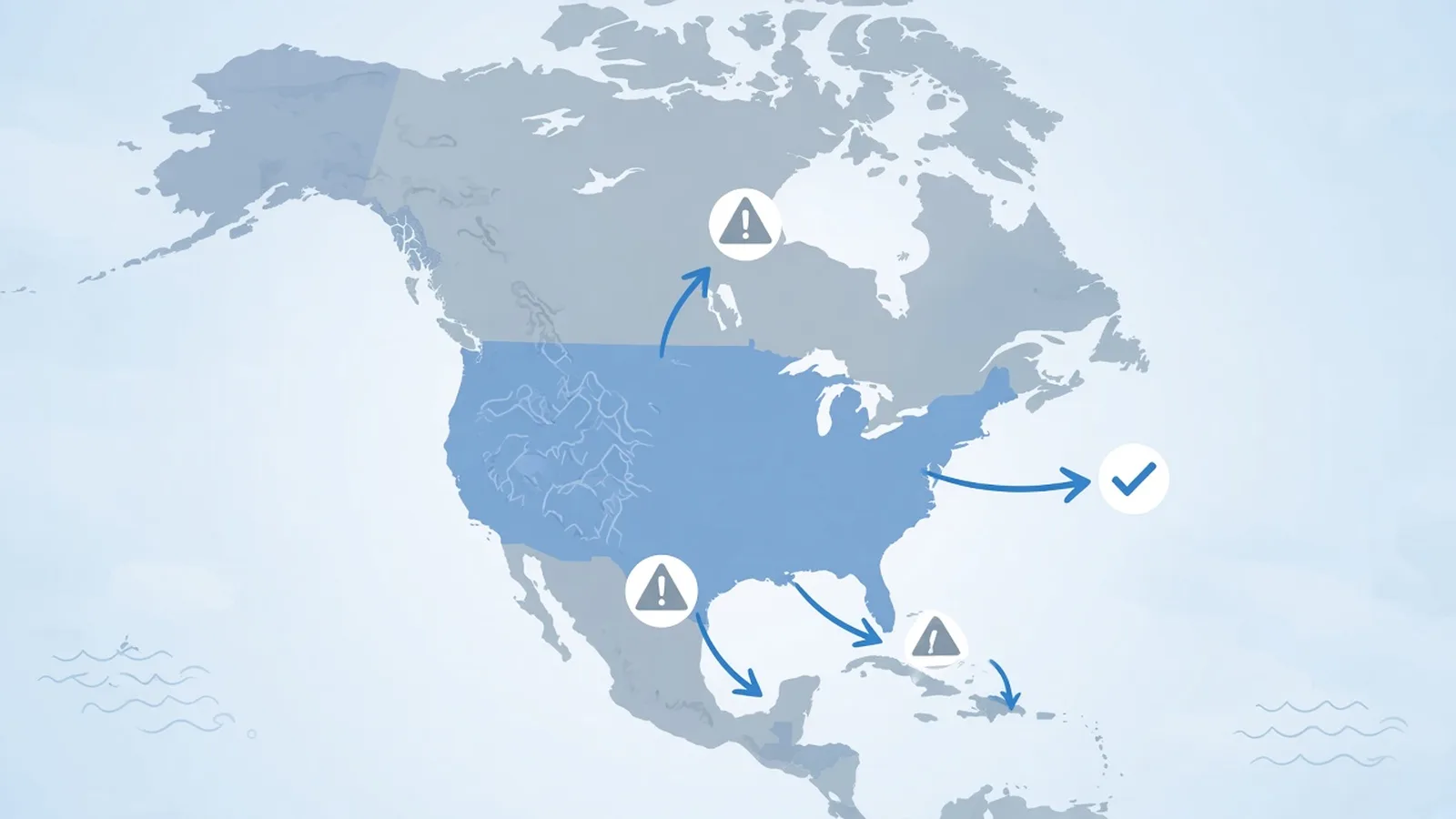
The same paragraph adds the condition most people miss: the trip must not terminate in contiguous territory or an adjacent island, unless the traveller is a resident of the country of destination. Contiguous territory means Canada and Mexico.
Plain reading: You need a ticket that leaves the US. If your exit ticket ends in Canada, Mexico or a nearby island, it does not satisfy the rule unless you live there.
What Counts as a "Round Trip Ticket"?
The regulation defines it broadly. A round-trip ticket includes any return trip transportation ticket in the name of the arriving Visa Waiver Program applicant on a participating carrier valid for at least one year, an electronic ticket record, airline employee passes indicating return passage, individual or group vouchers for return passage on charter flights, and military travel orders that include military dependants returning to duty stations.
|
Document |
Meets the definition? |
Notes |
|---|---|---|
|
Issued e-ticket out of the US |
Yes |
Listed as an electronic ticket record |
|
Return leg on the same booking |
Yes |
The common case |
|
Separate one-way ticket out of the US |
Yes, if it leaves the US |
Must not end in Canada, Mexico or an adjacent island unless you reside there |
|
Ticket to Canada or Mexico only |
No, unless resident there |
The contiguous-territory restriction |
|
Unticketed reservation (PNR only) |
Not named in the definition |
Ask your airline before relying on it |
The definition lists tickets, electronic ticket records, passes and vouchers. A reservation that has not been ticketed is not named. That does not mean every officer or airline will reject one, but it is the reason we recommend an issued ticket for the actual flight to the US.
Why Do Trips Ending in Canada or Mexico Cause Problems?
Many visitors plan a US trip with a short hop to Toronto, Vancouver or Cancún at the end. Under 217.2(c), a ticket whose trip ends in contiguous territory or an adjacent island does not count, unless you live there. You need onward travel beyond those places, for example Toronto to London.
The Department of State adds a related point. If you are admitted under the VWP, you may take a short trip to Canada, Mexico or a nearby island and generally be readmitted for the remainder of the original 90 days. Your total stay, including the side trip, must be 90 days or less. Citizens of VWP countries who reside in Mexico, Canada or a nearby island are generally exempt from the onward-travel requirement.
-
Plan the final exit from North America on a ticket that ends beyond Canada, Mexico and the islands.
-
Count the side trip inside the 90 days.
-
Carry the final exit ticket, not just the hop to Canada or Mexico.
Who Checks the Ticket, the Airline or CBP?
Both, at different moments. Airlines check before boarding because the regulation ties VWP arrival to signatory carriers that must transport inadmissible passengers back. CBP officers check at the port of entry, where they decide admission. The Department of State says an approved ESTA allows you to travel to a port of entry and request permission to enter, but does not guarantee entry.
Our guide to who checks onward tickets, airline or immigration explains how the two checks differ.
Does the Rule Apply at Land Borders?
Section 217.2(c)(1) covers air and sea arrivals. Land arrivals are dealt with separately in paragraph (c)(2), and the ticket requirement in (c)(1) is written for air and sea. If you enter by land from Canada or Mexico, check CBP’s current guidance for land ports. The 90-day limit still applies.
What If Your Plans After the US Are Still Open?
Long trips and round-the-world plans often leave the exit open. You have three practical choices.
-
Buy a flexible issued ticket out of the US that you can change later.
-
Buy a cheap issued onward ticket to a third country that you are willing to use.
-
For planning and itinerary purposes only, hold a temporary reservation, and confirm with your airline before travel whether it will accept anything other than an issued ticket at check-in.
A DummyFlights onward reservation costs $15 per person, carries a PNR valid for 48-72 hours and comes with free date changes within the same day of booking. It is a real reservation you can verify with the airline, not an issued ticket. For a US arrival under the VWP, treat it as a planning tool and follow your airline’s instructions on what it accepts. Our guide on when airlines refuse boarding without an onward ticket covers what happens if a carrier says no.
What Should You Carry on Travel Day?
-
Your e-passport, which the VWP requires.
-
Your ESTA approval, checked on the official CBP site before travel.
-
Your exit ticket or e-ticket record, with a final destination outside Canada, Mexico and the adjacent islands unless you live there.
-
Your first address in the US.
-
Evidence of funds and return ties if your trip is long or unusual.
Our page on whether airlines ask for proof of return before boarding describes typical check-in questions.
Who Can Travel on ESTA in the First Place?
The State Department’s Visa Waiver Program page says most citizens or nationals of participating countries can travel to the United States for tourism or business for stays of 90 days or less without a visa, provided they hold a valid ESTA approval before travel and meet all the programme requirements. The return-ticket rule in 8 CFR 217.2 only matters once you meet those basic conditions.
|
Requirement |
What the State Department says |
Practical check |
|---|---|---|
|
Nationality |
Citizen or national of a designated VWP country (the page lists them, including the UK, most EU states, Japan, South Korea, Australia, New Zealand, Israel, Qatar and others) |
British citizens must have the unrestricted right of permanent abode in the UK, Channel Islands or Isle of Man |
|
Passport |
Valid at least 6 months after planned departure from the US, unless exempted by agreement; must be an e-passport |
Look for the e-passport symbol on the cover |
|
ESTA |
Valid approval before boarding a US-bound air or sea carrier |
Check status before booking |
|
Purpose |
Activities permitted on a visitor (B) visa |
Tourism, visits, meetings, conferences, short courses |
|
Stay |
90 days or less |
Plan exit inside 90 days |
|
Carrier |
Arrival on an approved air or sea carrier |
Private aircraft need a visa |
Some nationals of VWP countries cannot use the programme at all. Under the Visa Waiver Program Improvement and Terrorist Travel Prevention Act of 2015, travellers who have been present in North Korea, Iran, Iraq, Libya, Somalia, Sudan, Syria or Yemen on or after 1 March 2011, or in Cuba on or after 12 January 2021, or who are also nationals of certain of those countries, must obtain a visa, with limited exceptions for diplomatic or military travel.
Can You Leave and Re-Enter Within the 90 Days?
The State Department explains that if you are admitted under the VWP, you may take a short trip to Canada, Mexico or a nearby island and generally be readmitted under the VWP for the remainder of the original 90 days granted on your first arrival. The total length of your stay, including the short trip, must be 90 days or less.
|
Plan |
How the 90 days work |
Exit record to carry |
|---|---|---|
|
US 30 days, Canada 5 days, back to US 20 days, fly home |
One 90-day period from first US arrival; the Canada trip does not reset it |
Ticket home dated inside the original 90 days |
|
US 60 days, Mexico 20 days, back to US 20 days |
Total 100 days exceeds the 90-day limit |
Change the plan or apply for a visa |
|
US 40 days, fly to Europe, return weeks later |
Each arrival is a new request for admission, and officers may look at time already spent in the US |
A return or onward ticket for each US arrival |
That readmission rule is why a short trip to Canada or Mexico is not a reset button. It also explains the regulation’s focus on tickets that leave contiguous territory: a ticket that only takes you across the border does not show departure from the region within the time allowed.
What If You Need to Stay Longer Than 90 Days?
The State Department is clear that VWP travellers are not permitted to extend their stay beyond the initial admission period and must depart on or before the date on their admission record. They are also not permitted to change status in the United States. If you intend to stay longer than 90 days, you need to apply for a visa before you travel.
-
Plan your exit ticket inside the 90-day period from the day you are admitted.
-
If plans may run longer, apply for a visitor (B) visa instead of using ESTA.
-
Remember that a short trip to Canada, Mexico or a nearby island counts inside the same 90 days.
-
Keep evidence of departure, such as the boarding pass of your exit flight, after the trip.
Officers at the port of entry decide whether to admit you. The State Department says an approved ESTA allows you to travel to a US port of entry and request permission to enter, but does not guarantee entry.
How Does a Previous Visa Refusal Affect ESTA Travel?
If you were refused a US visa before, the State Department says a recent visa refusal for any reason could result in denial of ESTA authorization, additional review at the port of entry or denial of admission. If you are uncertain whether you qualify for VWP travel, you may apply for a visa instead.
For travellers in this position, a clear exit plan matters even more. A ticket that leaves the region inside the 90 days, together with evidence of your home, job or studies, answers the questions an officer is likely to ask during additional review.
What About Guam and the Northern Mariana Islands?
The State Department notes a separate Guam-CNMI Visa Waiver Program. Citizens of Australia, Brunei, Hong Kong, Japan, Malaysia, Nauru, New Zealand, Papua New Guinea, South Korea, Singapore, Taiwan and the United Kingdom do not need a visa or ESTA to visit both Guam and the Northern Mariana Islands, but must complete Form I-736 before travel. Holders of People’s Republic of China passports can also be admitted temporarily to the Northern Mariana Islands with Form I-736.
Those visits follow their own programme rules. If you plan a Pacific trip that includes Guam or Saipan and the US mainland, check which programme applies to each part of your journey and carry an exit ticket for each.
What Do Three ESTA Exit Plans Look Like?
A German couple on a three-week road trip
They fly Frankfurt to Los Angeles and back from San Francisco 21 days later. Their return ticket leaves the region inside 90 days, which is the simplest case under 8 CFR 217.2. They carry the e-ticket receipt and the ESTA approval for each of them.
A Japanese student taking a gap trip
He flies Tokyo to New York, stays 50 days, then plans to continue to Mexico City and later fly home from there. A ticket that ends in Mexico does not satisfy the round-trip requirement for a non-resident, because it terminates in contiguous territory. He buys a ticket from Mexico City onward to Tokyo before he travels, so his itinerary shows departure from the region.
A British consultant with an open project
Her client meetings may last six or ten weeks. She books her return flight at ten weeks, well inside 90 days, and keeps a note of the date stamped or recorded on arrival. If the project runs longer than 90 days, she knows she cannot extend on ESTA and would need a visa for a later trip.
What Should You Check Before an ESTA Trip?
|
Check |
Where to confirm |
Pass |
|---|---|---|
|
VWP nationality and no disqualifying travel |
State Department VWP page |
Eligible to use the VWP |
|
E-passport, valid 6 months after departure |
Passport cover and data page |
Symbol present; validity sufficient unless exempt |
|
ESTA approved |
Official ESTA site |
Approval valid on travel date |
|
Exit ticket |
Your booking |
Leaves the US and contiguous territory within 90 days, unless you reside there |
|
Approved carrier |
Your airline or cruise line |
On the approved list; not a private aircraft |
|
Purpose |
Your plan |
Permitted on a visitor (B) visa |
If you need an onward record while your final plans are open, a DummyFlights reservation costs $15 per person, carries a PNR valid for 48-72 hours and includes free date changes within the same day of booking. Use it for planning records and airline questions only where it is accepted, and hold an issued ticket for the journey you will take.
Which Activities Fit an ESTA Trip?
Your exit ticket answers when you will leave; your purpose answers why you are there. The State Department says the travel purpose must be permitted on a visitor (B) visa, and gives examples.
|
Permitted examples |
Not permitted examples |
|---|---|
|
Tourism, holiday, visiting friends or relatives |
Study for credit |
|
Medical treatment |
Employment |
|
Consulting business associates, negotiating a contract |
Work as foreign press, radio, film or other information media |
|
Attending a scientific, educational, professional or business convention or conference |
Permanent residence in the United States |
|
Short-term training not paid by any US source, apart from incidental expenses |
|
|
A short recreational course not for credit, such as a two-day cooking class |
|
The State Department adds that transiting through the United States to other countries is generally permitted for VWP travellers. For a transit, your onward ticket to the next country is the exit record, and it must still satisfy the round-trip rule if the final destination is in contiguous territory or an adjacent island.
What Mistakes Cause Trouble With ESTA Exit Tickets?
-
A one-way ticket into the US with no booked departure.
-
A departure ticket that ends in Canada, Mexico or a nearby island for a traveller who does not live there.
-
A return date beyond 90 days from arrival.
-
Assuming a side trip to Canada or Mexico restarts the 90 days.
-
A passport that expires less than 6 months after departure, where no exemption applies.
-
Booking travel before checking that the ESTA is approved; CBP strongly recommends checking ESTA status before making travel reservations.
Each of these is easy to check at home and hard to fix at the airport. Look at the final destination and date of your exit ticket before anything else.
Does an Approved ESTA Guarantee Entry?
No. CBP says ESTA is an automated system that determines whether a visitor is eligible to travel to the United States under the Visa Waiver Program. It does not determine whether the traveller is admissible. CBP officers decide admissibility when you arrive. The application collects biographic information and answers to the programme’s eligibility questions.
|
Stage |
Who decides |
What they look at |
|---|---|---|
|
Before booking |
You |
Whether you meet the Visa Waiver Program conditions |
|
ESTA application |
CBP’s automated system |
Biographic data and eligibility answers |
|
Check-in |
Airline |
Approved ESTA, e-passport and a ticket that meets the round-trip rule |
|
Arrival |
CBP officer |
Admissibility, including purpose and how you will leave |
CBP recommends applying as soon as you start preparing travel plans, or before buying airline tickets. Applying first means you do not buy a ticket for a trip you cannot take under ESTA.
What If Your Trip Continues to Canada?
The CBP ESTA page also points out that Canada requires an Electronic Travel Authorization (eTA) for visa-exempt foreign nationals flying to Canada, with exceptions including US citizens and travellers with a valid visa. If your onward ticket from the United States goes to Canada, you need the Canadian eTA as well as the ESTA.
-
Apply for the ESTA first, as CBP recommends.
-
Apply for the Canadian eTA if your passport needs one.
-
Check whether your ticket out of North America satisfies the round-trip rule, since time in Canada can count toward your Visa Waiver Program stay if you return to the United States.
-
Carry both approvals and the full itinerary on travel day.
Note: CBP says you must hold an e-passport, with an embedded electronic chip and the international symbol on the cover, to use the Visa Waiver Program.
Which Official Sources Does This Guide Use?
-
8 CFR 217.2, Eligibility, Visa Waiver Program (text via Cornell LII).
-
Visa Waiver Program, US Department of State.
-
ESTA, US Customs and Border Protection.
-
U.S. Customs and Border Protection: Electronic System for Travel Authorization
Your ESTA, Your Exit Ticket and the 90 Days
For a VWP air or sea arrival, the rule is clear: hold a ticket out of the US at arrival, and make sure the trip does not end in Canada, Mexico or a nearby island unless you live there. Keep your total stay, side trips included, within 90 days. An issued ticket is the safest document; any temporary reservation should be checked with your airline first.
Plan the exit before you fly. Make sure your exit leg leaves North America, then confirm with your airline which document it will accept at check-in.
Review onward reservation optionsFrequently Asked Questions
Does ESTA require a return ticket?
For air and sea arrivals, yes. 8 CFR 217.2(c) requires a round-trip ticket out of the US at arrival, and the trip must not end in Canada, Mexico or an adjacent island unless you live there.
Can my onward ticket be to a different country than home?
Yes. The rule requires a ticket that takes you out of the US to any other foreign port or place, subject to the contiguous-territory restriction.
Does a ticket to Canada count as onward travel?
Not unless you are a resident of Canada. A trip ending in contiguous territory does not satisfy the rule for non-residents.
Is a flight reservation enough for ESTA travel?
The regulation names tickets and electronic ticket records, not unticketed reservations. Ask your airline before relying on a reservation.
Does ESTA guarantee entry?
No. The Department of State says an approved ESTA lets you request entry at the port, and CBP officers decide admission.
Can I visit Canada or Mexico during a VWP trip?
Yes, generally, and you can be readmitted for the rest of the original 90 days. The total stay including the side trip must be 90 days or less.
Can I transit the US on ESTA?
The State Department says transiting through the United States to other countries is generally permitted for VWP travellers. Carry your onward ticket.
Do VWP citizens living in Canada or Mexico need onward travel?
The State Department says VWP citizens who reside in Mexico, Canada or a nearby island are generally exempted from showing onward travel to another country when entering the US.
Can I extend my stay on ESTA?
No. The State Department says VWP travellers cannot extend beyond the initial admission period and must leave on or before the date on their admission record.
Does a trip to Mexico reset my 90 days on ESTA?
No. The State Department says you are generally readmitted for the remainder of the original 90 days, so the total stay, including the short trip, must be 90 days or less.
Does my passport need 6 months validity for ESTA travel?
The State Department says it must be valid at least 6 months after your planned departure from the United States, unless your country has an exemption agreement, and it must be an e-passport.
Does an approved ESTA mean I will be admitted?
No. CBP says ESTA determines eligibility to travel, while CBP officers determine admissibility on arrival.
When should I apply for ESTA?
CBP recommends applying as soon as you start planning, or before you buy airline tickets.
Friendly reminder: Airline, visa and border rules can change. An approved ESTA or a temporary reservation does not guarantee boarding or admission to the United States. Follow CBP’s and your airline’s current instructions for your nationality and route.