
Short answer: An international travel checklist should start with documents, then money, then packing, then the airport day. For India-outbound trips, lock passport validity, the visa or eTA decision, hotel proof, funds evidence, insurance and a verifiable return or onward flight reservation before you worry about adapters and outfits. Packing lists fail trips less often than mismatched dates across the visa file.
This checklist is for first-time India-outbound travellers and for anyone who wants a documents-first order of work before an international trip. It stays globally usable: the same sequence — documents, money, packing, airport — applies whether you are flying to Southeast Asia, the Gulf, Europe or further. Destination rules differ; the order of checks does not.
Work the list in that order. A neat suitcase does not fix a passport that is too close to expiry, a visa form that disagrees with your hotel nights, or a return date that sits outside the stay you asked for. Put a verifiable flight reservation or return proof in the file before the embassy or VFS appointment when the checklist asks for it, then pack.
In This Guide
- International travel checklist at a glance
- Documents required for international travel (India outbound)
- Flight reservation, return ticket and onward proof
- Money — forex card vs cash
- Packing list for international travel
- Things to carry for an international trip (day-of)
- Immigration questions at the airport
- Day-before and airport-day timeline
- Frequently Asked Questions
Official-source check: Document and money guidance below points to the MEA passport services page, Passport Seva, the RBI miscellaneous forex facilities FAQ (updated 28 November 2025), the U.S. State Department traveler checklist, GOV.UK Standard Visitor and the EU Your Europe entry page for non-EU nationals. Rules change; read the page that applies to your passport and destination before you travel.
Reviewed for: Documents-first international travel checklist coverage for India-outbound trips, return or onward flight proof wording, forex-versus-cash guidance tied to RBI FAQ language, compact packing and airport immigration questions — without targeting forex-card or eSIM head terms.
International travel checklist at a glance
Use this numbered master list as the spine of the article. Tick each item only when the detail matches every other document in the file.
- Passport — valid for the destination’s rule (often several months beyond the trip; confirm on the destination page), undamaged, with blank pages if visas need stamps.
- Visa, eTA or visa-free status — approved, printed or saved offline, and matching the passport number you will carry.
- Flight proof — paid ticket, or a verifiable return or onward reservation when the checklist or entry rule asks for one.
- Hotel or lodging proof — dates that cover every night between arrival and departure.
- Funds proof — bank statements, sponsor letters or other evidence your checklist names.
- Travel insurance — cover window that includes every flight day and the full stay.
- Money for the trip — card plus limited cash within official carriage rules.
- Packing — documents pouch first, then medicines, then clothes and adapters.
- Airport day — offline copies, answers that match the file, and time for security and immigration.
If two items disagree — for example, hotel nights that end after the return flight — fix the file before you pack. Consistency beats completeness.
Documents required for international travel (India outbound)
Search phrases such as “documents required for international travel from India” usually collapse into one practical folder. Build that folder once, then reuse it for the visa appointment and the departure day.
Passport
Start with the physical passport you will travel on. Check the expiry date against the destination’s published rule, not against a rumour. Many destinations want validity beyond the stay; some also care about blank pages. For Indian passport issuance and re-issue processes, use the Ministry of External Affairs passport services page and the Passport Seva portal rather than third-party blogs. Carry the passport in a dedicated pouch, and keep colour photocopies or encrypted scans separate from the original.
Visa, eTA and entry status
Confirm whether you need a sticker visa, an eVisa, an eTA or whether you are visa-free. Save the approval PDF offline. Check that the name, passport number and travel window match the passport biographic page exactly. If you changed passports after approval, read the destination’s rule before you fly — some approvals are passport-number specific.
Photocopies and digital backups
Keep paper copies of the passport biographic page, visa or eTA, insurance certificate, hotel confirmations and return or onward reservation. Store the same files in an offline folder on your phone and in one cloud account you can open without the travelling SIM. Do not rely on a single email thread at the counter.
Hotel or lodging proof
Embassies and border officers often want to see where you will sleep. Booking dates should cover arrival through departure. If you will move cities, show each segment or a clear day-by-day plan. A gap of unbooked nights in the middle of a short tourist stay invites questions.
Funds proof
Follow the checklist for your visa type. Typical asks include recent bank statements, salary slips, or a sponsor letter with the sponsor’s statements. The point is the same: show you can pay for the trip you described. Inflated last-minute deposits that do not match your income history create new questions.
Travel insurance
Where the checklist asks for medical cover, match the policy dates to the full trip, including flight days. Schengen short-stay files commonly expect a minimum medical cover amount; read the mission checklist rather than assuming a generic figure from a blog. Carry the certificate PDF and a claim contact number offline.
Supporting letters
Employer leave letters, student enrolment letters, invitation letters and cover letters should all tell the same story as the flights and hotels. One wrong return date repeated across three letters is still wrong.
For India-outbound travellers, also keep a photocopy of your PAN or other ID only if a specific checklist asks for it — do not add random IDs that the mission never listed. Extra unsolicited documents can create contradictions. If you are travelling with family on one file, every passport number on the flight reservation must match every applicant, including children.
Flight reservation, return ticket and onward proof
Flight proof is the document that most often sits between “I have a passport” and “I can submit the file.” Embassies, airlines and immigration desks ask for related but different things.
- Visa file: many short-stay checklists ask for a round-trip or return flight reservation, sometimes with a booking reference, rather than a fully paid fare. The German tourist checklist circulated by VFS, for example, asks for a round-trip reservation with reservation code. Always read the checklist for your mission.
- Airline check-in: carriers may ask for return or onward proof before they let you board a one-way or open-jaw itinerary, especially on routes where the destination has a strict exit rule. Carrier policy is separate from the visa decision.
- Immigration on arrival: border officers may ask how long you will stay and how you will leave. The EU Your Europe page for non-EU nationals notes that border officers can ask non-EU travellers for documents that show the purpose of the stay and sufficient means, including return or onward arrangements. The UK Standard Visitor guidance says you must be able to show you will leave at the end of the visit and can pay for the return or onward journey — it does not say you must buy a ticket before you apply.
A paid return ticket is one form of proof. An open-jaw return (arrive in one city, leave from another in the same country or area) is still a return if it ends in your country of residence. An onward ticket to a third country is the better fit when you are genuinely continuing the trip and can enter the next country. A temporary verifiable reservation is the form many applicants use at the visa stage so they do not buy a fare before a decision.
When your checklist asks for flight proof before you buy a fare, a dummy ticket can supply a verifiable reservation with a real PNR for the visa application file and, where needed, onward proof at immigration — not as a ticket for boarding.
If you need a sister-site walkthrough of how flight reservations are used inside embassy files more broadly, see a flight reservation for visa overview on BookForVisa. Keep this page focused on the travel checklist; destination-specific visa deep dives belong on their own guides, such as the UK tourist visa proof pack or the Schengen dummy ticket guide.
There is no universal rule that every traveller on earth must hold a return or onward ticket before every trip. Requirements are destination-, airline- and visa-type-specific. Read the checklist and the entry page that apply to you.
Money — forex card vs cash
The practical question for most India-outbound trips is not “which brand is best,” but “what mix keeps me inside official rules and able to pay on day one.”
According to the Reserve Bank of India’s miscellaneous forex facilities FAQ (updated 28 November 2025), travellers going to most countries may purchase foreign currency notes or coins only up to USD 3,000 per visit; the balance of the foreign exchange drawn for the trip can be carried as store-value cards, travellers cheques or a banker’s draft. The same FAQ lists higher cash-note allowances for certain destinations (for example Iraq and Libya up to USD 5,000, and Iran, the Russian Federation and other CIS republics up to the full entitlement in notes). Haj / Umrah travellers have a separate note in that FAQ. Do not treat a blog’s round number as the rule — open the RBI FAQ for your case.
A sensible day-to-day mix for many travellers is:
- A forex or INR debit card that works abroad for hotels, cards-only cities and larger purchases.
- A modest amount of destination cash for taxis, tips and places that do not take cards — within the RBI cash-note limit above.
- A backup card stored separately from the primary wallet.
Before you leave, tell your bank the travel dates, test a small international transaction if the bank allows it, and store the card-block phone number offline. At ATMs abroad, prefer machines attached to banks, decline unnecessary dynamic-currency conversion when you can pay in local currency, and keep receipts until the trip ends. This section is not a ranking of forex cards or eSIM products; choose products that your bank and the destination actually support.
Best way to carry money abroad, in practice, is redundancy: one card in the wallet, one card in the documents pouch, and cash below the RBI note limit in a third place. If a card is blocked, you still have a path to pay for a hotel night. Avoid carrying your entire trip budget as cash notes even when a destination exception allows a higher cash draw — cards and store-value instruments reduce loss risk.

Packing list for international travel
Packing list for international travel searches are crowded with outfit essays. Keep packing subordinate to documents. If the pouch is wrong, the suitcase does not matter.
Documents pouch (carry-on only)
- Passport and visa or eTA printout
- Return or onward reservation / paid tickets
- Hotel confirmations
- Insurance certificate
- Funds proof copies if you were told to carry them
- Emergency contacts and bank card-block numbers
Carry-on
- One change of clothes and underwear
- Prescription medicines in original packaging, plus a copy of the prescription
- Phone, charger, power bank within airline watt-hour limits
- One universal adapter if the destination uses different sockets (one line is enough — this is not an adapter buying guide)
- Headphones, eye mask, reusable water bottle (empty through security)
- Small toiletries within liquid rules for your departure airport
Checked bag
- Clothes for the climate and length of stay, not for imaginary extra weeks
- Shoes you will actually walk in
- Any liquids that exceed cabin limits
- Nothing prohibited by the airline or destination (batteries, aerosols, food rules vary)
Seasonal note: winter Europe needs layers and waterproof shoes; tropical Asia needs breathable clothes and mosquito protection; desert Gulf trips need modest evening layers for air-conditioned indoors. Check the forecast for your exact dates rather than packing for a stereotype.
If you like packing rules of thumb, the “5-4-3-2-1” style lists you see in search results are optional clothing heuristics, not document rules. They do not replace the documents pouch.
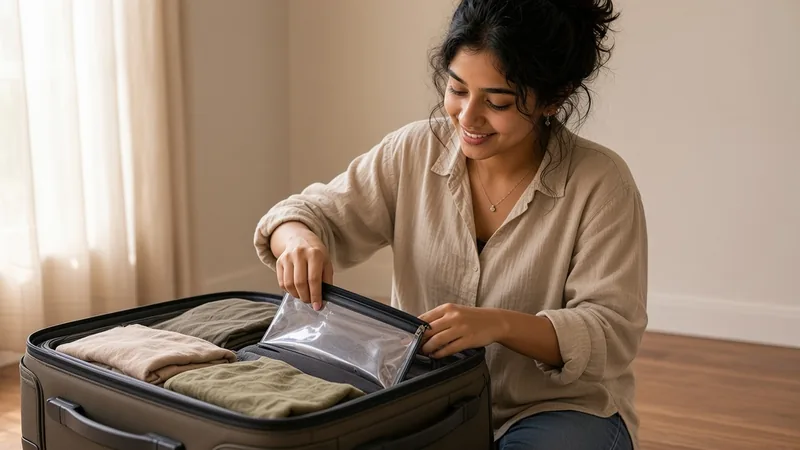
What to pack for an international trip also depends on whether you will wash clothes during the stay. For trips under a week, pack complete daily sets; for longer stays, pack fewer items and plan laundry rather than doubling the suitcase weight. Put liquids and gels in a clear bag for security where your departure airport requires it, and keep lithium batteries in the cabin bag, not in checked luggage.
Things to carry for an international trip (day-of)
On departure day, your hand luggage should answer every counter question without opening the checked bag.
- Passport, visa or eTA, and the phone with offline PDFs
- Printed return or onward reservation (and the airline app if you use one)
- Hotel name, address and first-night confirmation
- Insurance certificate
- Payment cards and the limited cash you decided on
- Medicines for the flight plus 48 hours
- A pen for arrival cards
- The address where you will stay, written plainly for immigration forms
Leave spare keys, unnecessary electronics and anything that creates a security delay at home.
Immigration questions at the airport
Officers ask short questions to test whether your story matches your documents. Common ones include:
- What is the purpose of your trip?
- How long will you stay?
- Where will you stay?
- What do you do at home / who pays for the trip?
- When and how will you leave?
Answer with the same facts that appear on the visa form, hotel proof and return or onward reservation. If the return date on your reservation is 12 days after arrival, do not invent a one-month stay at the desk. If funds proof showed a sponsor, do not claim you are self-funding unless that is also in the file. Keep answers short; offer the document when asked rather than narrating your whole itinerary.
Departure immigration in India and arrival immigration abroad ask different questions, but both reward consistency. Carry the folder that makes the answer visible in under thirty seconds.
If you do not speak the language of the arrival country, keep the hotel address written in the local script when possible, and point to the reservation rather than improvising place names. Officers are used to short answers. Long speeches that invent sightseeing plans not shown in your file help less than a calm pointer to the hotel confirmation and the return date.
Day-before and airport-day timeline
Day before
- Re-check passport, visa or eTA, flights, hotel and insurance dates against each other
- Download offline reservation PDFs and any airline app tickets you will use
- Confirm the airport terminal and bag allowance
- Set aside the documents pouch and day-of carry list
- Charge phones and power banks
- Note the bank’s international helpline
Airport day
- Arrive with the buffer your airline recommends for international departures
- Keep the pouch in one place through check-in, security and immigration
- At check-in, have return or onward proof ready if you are on a one-way or if the route is known for exit checks
- At immigration, answer with the file you are carrying
- After security, refill water and keep medicines in the cabin bag
Need verifiable flight proof for the file? DummyFlights issues a real PNR, typically valid 48–72 hours, for a flat $15 per person, for visa applications and onward proof at immigration only. Free date changes are available on the booking day only.
Get your $15 reservationFrequently Asked Questions
What should I include in my international travel checklist?
Start with passport, visa or entry status, flight proof, hotel proof, funds evidence and insurance. Then add money (card plus limited cash), a documents pouch, medicines and only the clothes and adapters the trip needs. Finish with an airport-day plan so every answer you give matches the file.
What documents are required for international travel from India?
At minimum: a valid passport, the correct visa or eTA if required, flight proof, lodging proof, funds evidence your checklist asks for, and travel insurance where required. Photocopies and offline PDFs of the same set belong in the pouch. Exact lists vary by destination and visa type — read the mission checklist.
What are the must-have items for international travel?
The must-haves are the documents pouch, payment method, prescription medicines, phone with offline copies and one change of clothes in the cabin bag. Everything else is secondary. A missing passport page photocopy is harder to fix at the counter than a missing spare shirt.
What is the 5-4-3-2-1 rule when packing?
It is a popular clothing heuristic (for example five tops, four bottoms, and similar countdowns) used to limit wardrobe bulk. It is optional and unrelated to visa documents. Use it only after the documents, money and medicines are packed.
What questions do immigration officers ask at the airport?
Expect questions on purpose of travel, length of stay, where you will sleep, who pays and how you will leave. Keep answers identical to your form, hotel proof and return or onward reservation. Offer the matching document when asked.
Do I need a return ticket or onward ticket before my visa appointment?
Many short-stay checklists ask for a return or round-trip flight reservation at the application stage; some entry rules and airlines ask for return or onward proof later at check-in or on arrival. There is no single global mandate. Read your embassy checklist and the destination’s entry page. Where a reservation is enough for the file, a temporary verifiable booking can be used so you are not forced to purchase the fare before a decision; where a paid ticket is required, a reservation is the wrong tool.
Can a dummy ticket be used as flight proof in a visa file?
Where a checklist asks for a flight reservation or itinerary rather than a paid ticket, a verifiable temporary reservation with a real booking reference is commonly what applicants submit for that stage. That is not a promise of visa approval, boarding or entry — officers still weigh funds, ties and purpose, and some destinations or airlines require a paid ticket instead. Match the reservation to your form, hotel and insurance, and confirm the booking reference before you submit.
Friendly reminder: DummyFlights provides dummy tickets and dummy hotel bookings to support visa applications and onward-travel proof at immigration. Requirements vary by destination, consulate, visa category and traveller situation. A dummy ticket supports your file; it is not a paid ticket for travel and does not guarantee visa approval or entry.