

Short answer: A cancelled segment does not automatically invalidate a multi-city visa itinerary, but you must check whether the remaining route still matches your purpose, entry point, accommodation, internal travel and return plan. Preserve what you submitted, explain the change honestly, and refresh or replace the document when the route or dates no longer describe one coherent trip. A temporary dummy ticket for visa can support a file, but it cannot guarantee approval, boarding or entry.
Your visa file can look perfectly organized until one leg in a multi-city itinerary gets canceled the week before your appointment. That is where applicants make expensive mistakes. You do not always need a full rebooking, but you do need to know whether that missing segment weakens your route, your return plan, or the story your documents tell together.
We will focus on the decisions that actually matter in 2026: when to leave a cancellation alone, when to make a minimal change, and when the itinerary no longer supports the rest of your application. If your flights, dates, and travel sequence stop matching, the problem is not the canceled ticket. It is the contradiction it creates. We are fixing logic, not chasing fresh PDFs. If one leg changes before your appointment, a flexible dummy ticket can preserve your multi-city route cleanly.
Key facts:
- A cancelled leg can be minor if the entry, stay and return logic remain intact.
- New airports, dates, transit countries or overnight stops may change visa and transit questions.
- Keep the submitted itinerary, the airline notice and one current explanation together.
- Update accommodation, insurance, invitations, leave and internal transport when the route changes.
- A temporary travel-proof document supports planning; it does not replace visa or entry requirements.
Need a temporary multi-city reservation that matches your actual route? Start with the supported dates and cities, then keep the itinerary consistent across your file.
Official-source check: Confirm cancellation, rebooking and ticket-status rules with the airline or issuing system, then check each destination’s current visa, transit and onward-travel requirements. Use the IATA Travel Centre for passport, visa, health and carrier-facing checks; airlines and destination authorities control their respective decisions.
Reviewed for: multi-city route logic, partial cancellations, transit and entry implications, document-version control, internal travel evidence and post-submission explanations.
When One Canceled Flight Does Not Mean Your Entire Visa Itinerary Is Broken
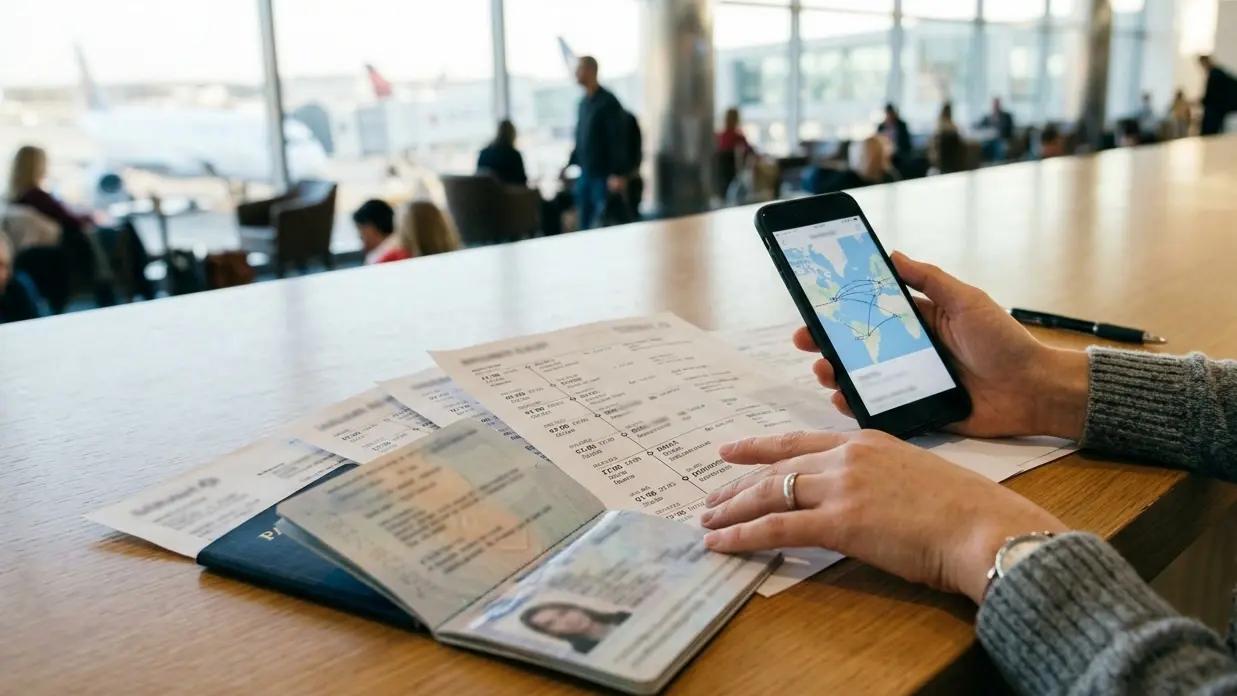
A canceled segment inside a multi-city reservation feels bigger than it often is. For a visa file, the real question is not whether one flight disappeared. It is whether your travel sequence still looks planned, believable, and consistent from first departure to final return.
| Change | Why it matters | Next action |
|---|---|---|
| One flight number or time changes | May leave the route and stay intact | Check arrival, transfer and appointment timing |
| One segment is cancelled | Internal movement or a border crossing may disappear | Rebuild only the affected leg and update connected evidence |
| Entry or exit airport changes | Visa jurisdiction, transit and accommodation logic may change | Recheck destination and transit requirements before submission |
| Dates or total stay change | Leave, insurance, funds and hotel dates may conflict | Align every supporting document and preserve the original version |
The First Thing To Check Is Not The Cancellation Itself — It Is The Role That Segment Played In Your Travel Story
Start with function, not panic.
A canceled flight from Doha to Paris on a Schengen itinerary is not the same as a canceled flight from Paris to Rome halfway through the trip. One may block your main entry into the visa region. The other may affect only how you move inside a route that still basically works.
Ask what the missing leg was doing for your file:
-
Entry leg: proves how you reach the main destination
-
Bridge leg: connects two cities that appear elsewhere in your plans
-
Return leg: shows how and when you leave
-
Optional leg: adds convenience, not credibility
If your canceled segment was the first arrival into the country you are applying for, treat it seriously. If it were a later hop in a longer Europe or Asia route, the damage may be limited.
A Multi-City Visa File Fails Faster When Dates Still Match, But Route Logic No Longer Does
Applicants often look only at dates.
That is not enough.
A route can still show the same travel window and still stop making sense. For example, your documents may show entry into Spain on 12 June, hotel nights in Barcelona and Milan, and a return to Dubai from Milan on 22 June. If the canceled leg was Barcelona to Milan, your dates still look tidy, but the route no longer explains how you got to the city where your return flight leaves.
That kind of break matters because the officer does not need a dramatic contradiction to question the file. A quiet inconsistency is enough.
Watch for route problems like these:
-
You arrive in one city but have no visible path to the next
-
Your return departs from a city you no longer reach
-
A transit point becomes an unexplained overnight stop
-
One country disappears, but the rest of the file still depends on it
A clean-looking PDF can still carry a broken story.
The Safest Question To Ask Yourself Is: “If Someone Reads Only My Flights, Does My Trip Still Make Sense?”
This is the fastest self-check you can do.
Put aside your cover letter, hotel plans, and internal explanations. Read only the flight sequence. Would a visa officer looking at just those pages understand where you start, where you go next, and how you leave?
For a Japanese tourist visa or a UK Standard Visitor visa, this matters more than many applicants realize. Officers often review documents for overall coherence before they look at your personal explanation in detail. If your flight chain already looks incomplete, you lose clarity before the rest of your file gets a chance to help you.
A workable flight sequence should answer three simple questions without effort:
-
Where does the trip begin?
-
How does it move from one destination to the next?
-
Where does it end?
If one canceled segment does not break those answers, you may not be in rebuild territory yet.
Why Some Cancellations Are Better Left Untouched Until The Application Timing Forces A Decision
Not every change deserves an immediate fix.
A rushed replacement often creates a larger mess than the original cancellation. You switch one segment, then your transit city changes. Then your timing shifts. Then the dates in your leave letter, insurance, or event plans no longer line up cleanly.
This happens often with multi-city Schengen and business visitor files because one route edit can affect several supporting documents at once.
Sometimes the stronger move is to pause and assess whether the cancellation actually damages the application today. If your appointment is close and the missing segment is not central to entry or return, a premature rebooking can make the file look recently assembled and internally unstable.
We should care more about document stability than about reacting to every airline movement.
A Triage Framework For Multi-City Applicants
Use a simple priority check before touching your reservation.
High urgency
-
Your entry into the main visa country is gone
-
Your final return is gone
-
Your city order no longer matches your stated itinerary
Medium urgency
-
A middle segment disappeared and now creates a visible route gap
-
A transit city changes and affects your timing
-
One leg still exists, but the onward sequence no longer fits
Lower urgency
-
A non-essential city drop does not affect entry, return, or trip purpose
-
The canceled leg can be removed without changing the main route
-
The rest of the flight chain still reads clearly on its own
How To Handle Partial Cancellations Without Rebuilding The Whole Route From Scratch
For the broader document standard, compare the revised route with the dummy ticket for visa guide and keep only the version your evidence can honestly support.
The hardest cancellations are the partial ones. Your visa route is still standing, but one missing flight starts pulling at the logic of the rest.
If The Middle Segment Disappears, Do Not Automatically Replace It With Another Flight
A vanished middle leg creates pressure because it sits between two documents that still look valid. That is exactly why rushed fixes go wrong.
Say your Schengen file shows Delhi to Paris, then Paris to Rome, then Rome to Doha. If Paris to Rome disappears, your instinct may be to drop in any available replacement. That can backfire fast. A new flight may leave from Orly instead of Charles de Gaulle, move the connection to the next day, or route you through a city never mentioned anywhere else in the application.
Now your trip still exists, but it starts looking improvised.
For embassy review, a middle segment should not be replaced unless the new leg preserves all three of these:
-
The same city order
-
A believable timing sequence
-
No new contradiction with the rest of the file
This matters in multi-country Schengen applications in particular because internal movement helps support your claimed stay pattern. If you suddenly change from a short Paris-Rome hop to a long detour through Madrid, the issue is not price or convenience. The issue is that your route now tells a different story from the one your documents were built around.
The Return Flight Carries More Weight Than Many Applicants Realize
A missing return is rarely a small problem.
For a UK visitor visa, Schengen tourist visa, or Canada visitor visa, the final departure leg does more than complete the booking. It shows that your travel period has a visible end. Once that line disappears, the file can feel open-ended even if your hotels, invitation dates, or leave approval still point to a short stay.
That is why you should rank cancellations by what they do to your exit plan.
A missing internal leg can sometimes be explained by a route adjustment. A missing final return is harder to leave alone because it weakens a core part of the travel picture. If only one part of your multi-city reservation deserves immediate attention, it is usually the last leg that brings you back out of the destination region.
Watch closely for return-flight damage like this:
-
Your final city remains in the file, but no departure exists from it
-
Your return date changes beyond your approved leave period
-
Your return now leaves from a city you no longer reach
-
Your exit from the visa region becomes indirect in a way that your documents never anticipated
Those issues carry more weight than applicants expect because they touch intent, duration, and control of the trip.
When A Consulate Appointment Is Near, A “Cleaner Minimal Edit” Usually Beats A Brand-New Multi-City Reservation
Close to appointment day, the safest edit is often the smallest one.
A full rebuild sounds cleaner in theory. In practice, it often creates fresh inconsistencies right before document review. Your old route may have been Berlin, Prague, Vienna. Your new multi-city reservation may now become Munich, Budapest, and Vienna because that is what was easiest to recreate. On paper, that is still a European trip. For a visa officer, it is not the same trip.
A minimal edit works better when it protects what your file has already established:
-
The same first arrival country
-
The same main destination pattern
-
The same overall travel window
-
The same final departure date, or something very close to it
This is especially useful for Schengen files, where your cover letter, travel insurance, day count, and internal route may already be synced. A brand-new reservation can force changes across every one of those items. A cleaner, minimal edit keeps the story intact and reduces the chance that one late fix creates five new mismatches.
How To Keep The Route Credible When You Remove A Segment Instead Of Replacing It
Sometimes the best fix is subtraction.
If one stop was never central to your visa purpose, removing it can make the trip look stronger. That is often true when a multi-city route includes one extra city that was added for flexibility, not necessity.
For example, a France and Italy tourism itinerary may still hold up if you cut Nice to Milan and keep a shorter Paris-only or Paris-Rome structure, provided the rest of the file is updated cleanly. What matters is that the reduced route still looks intentional.
When you remove a segment, check the knock-on effects carefully:
-
Delete hotel nights tied to the dropped city
-
Remove sightseeing or meeting references connected to that stop
-
Make sure the return still leaves from a city you actually reach
-
Check total trip length against leave letters and forms
-
Tighten your cover letter so the shorter route feels planned, not damaged
A simpler route can help with Japanese short-stay applications and Schengen tourist files because clarity often beats ambition. Four cities in nine days can look busy. Two cities with a clean sequence usually look easier to believe.
If a middle leg drops out and your appointment is close, you do not need a service that pushes constant rebuilding. You need one that lets you adjust dates or route details without turning the rest of the application upside down.
When a cancelled segment makes the old record unusable, DummyFlights can help you prepare a current temporary document around the route and dates you actually support. Confirm current service terms and the destination checklist before relying on any document.
What To Do When Processing Delays, Embassy Timing, And Airline Changes Collide In 2026

In 2026, the timing problem is often bigger than the route problem. A clean multi-city file can start slipping when the airline changes its land in the gap between booking day and embassy review.
A Flight Reservation Can Expire Before Your Appointment And Still Be Less Dangerous Than A Last-Minute Overhaul
For a Schengen visa or UK visitor file, a dummy flight ticket can age out before your visa appointment and still be less risky than rebuilding everything 48 hours before submission. What matters first is whether your travel plans still read clearly across the application.
A fresh dummy ticket booking often looks safer on the surface. It is not safer if the new dates shift your first entry, your return ticket, or the timing you already used in your visa application. That is where a clean-looking update starts creating visible friction.
Treat the reservation like a timing tool, not a panic button. If your temporary flight reservation still reflects the same travel window, same destination country, and same exit dates, you may be better off holding position than forcing a new version into a file that was already stable.
That is especially true when your flight details were already aligned with leave dates, invitation timing, or appointment slots at the visa center.
Multi-City Applicants Need A “Document Sync Window,” Not Just A Valid-Looking Flight PDF
A strong multi-city case depends on a sync window. That means your flight itinerary, cover letter, insurance period, and supporting travel details still agree with each other at the same time.
For a Schengen visa application with Paris, Rome, and Vienna, the sync window closes the moment one update changes the route, but the rest of the visa documentation still points to the old order. A new PDF alone does not fix that.
Check whether these items still match before you touch anything:
-
First arrival city
-
Sequence of internal flights
-
Final departure city
-
Total stay length
-
Onward travel after the main stop
This is where multi-city dummy tickets get judged more strictly than a simple round trip. You are not only showing movement. You are showing control. If your booking reference still maps to the same route logic, the file may remain usable even if the reservation is no longer fresh in a technical sense.
A verifiable flight reservation with a valid PNR or passenger name record helps, but it only helps when the rest of the file still tells the same story.
The Worst Timing Mistake Is Updating Flights After You Have Already Locked The Story Elsewhere
The most common mistake is not an old reservation. It is a late replacement after the rest of the visa application process is already fixed.
Once your forms are submitted, your travel dates are in your cover letter, and your supporting papers are ready for visa submissions, a new flight booking can create contradictions faster than you expect.
Your old route may show entry through Amsterdam and return from Milan. The replacement may now show entry through Brussels and departure from Rome. That is no longer a minor update.
For visa applicants using a dummy ticket for visa review, the danger is not the swap itself. The danger is locking one version of the trip in one place and another version somewhere else. That creates a file that reads as recently patched.
This gets more serious if the route change affects proof of onward or a planned transit visa. A stop that looked harmless on an airline website can become a document issue if your new connection changes country, airport, or transit rules after the rest of your file was already prepared.
When The Embassy Is Likely To Notice The Change, Even If You Hope They Will Not
Some changes stand out immediately under embassy requirements.
A changed first arrival date is visible. A new return city is visible. A route that now begins outside the original destination country is visible. So is the loss of a final exit if the old file clearly showed bounded travel and the new one does not.
For Schengen files, visa authorities often care less about airline mechanics and more about whether the route still coherently satisfies visa requirements. If the mainstay was in France and the revised reservation now makes Italy the longest stop, the timing issue becomes a credibility issue.
Embassies accept itinerary movement when it still looks deliberate. They notice it when the structure changes:
-
The entry city changes without any explanation
-
The last leg disappears
-
The trip loses its original center of gravity
-
A simple connection becomes a new stop with no place elsewhere in the file
That is why a dummy air ticket should never be reviewed in isolation once timing slips. You have to read it as an officer would read the whole travel chain.
Dummy Ticket For Visa: Timing Strategy For 2026 Applicants
If visa processing takes longer in your category or region, your timing strategy has to match your filing style.
If you are filing far ahead, use a temporary reservation that gives you room to adjust later without changing the shape of the trip.
If you are filing late, avoid solving delay anxiety by buying actual tickets too early. A non-refundable ticket can lock you into dates that the embassy never asked you to guarantee. A refundable ticket gives more room, but it still needs to match the rest of the case.
If your appointment gets moved, do not chase a cheap dummy ticket just because the calendar changed. Recheck the route first. The better question is whether your confirmed booking still supports the same actual travel window you stated before.
How To Submit A Multi-City Visa File That Still Looks Deliberate After A Cancellation
Applicants applying from India may receive VFS or destination-portal instructions, while applicants in the United States may follow a consular checklist. In both cases, the destination authority’s current rules control, and a changed multi-city route should be explained accurately rather than presented as the original itinerary.
If the destination asks for a flight reservation rather than a temporary dummy ticket, see BookForVisa’s visa flight itinerary requirements guide so the document type and route explanation remain clear.
By the time you are ready to submit, the route itself is only half the job. The other half is making sure the final file reads like one controlled plan, even if one segment changed late.
Your Cover Letter Should Absorb The Shock, So The Flight PDF Does Not Have To Do All The Work
A flight change should be explained in one calm place, not scattered across the file.
That place is your cover letter.
If one segment dropped out and you adjusted the route, state the revised sequence in plain language. Keep it short. Do not narrate airline drama. Do not sound like a complaint sent to an official airline. Your goal is to show that your travel plan is still deliberate.
A strong note usually covers four points:
-
Your entry city
-
Your remaining city order
-
Your onward ticket or final exit point
-
Your unchanged trip purpose and dates, if they still hold
If the route changed after you generated a dummy flight ticket online, say only what matters to the application. For example, note that one internal leg was revised and that the enclosed flight reservation reflects the updated sequence. That is enough.
Do not turn the cover letter into a technical record of the booking. If your PDF shows an e-ticket number, booking reference, or passenger details, copy them exactly only when you mention them. Small typing errors make a clean file look rushed.
A genuine dummy ticket or verifiable dummy ticket helps most when your cover letter removes the need for the officer to decode the change on their own.
The Real Risk Is Not The Canceled Leg — It Is Contradiction Across Documents
A canceled segment rarely sinks a file by itself. Contradiction does.
This is where applicants get caught. They update the flight booking, but the rest of the pack still points to the old route. The officer now sees two trips inside one visa application.
Read every document against the revised flight itinerary:
-
Cover letter
-
Leave approval
-
Invitation or event letter
-
Insurance dates
-
Hotel reservation
-
Hotel bookings tied to each city
-
Any dummy hotel booking linked to a stop you removed
If the old route had Paris, Milan, and Madrid, and Milan disappeared, then every supporting page that still depends on Milan becomes a problem. The issue is not whether you used a real ticket, a temporary placeholder, or a dummy ticket booking online. The issue is that your travel chain no longer agrees with itself.
This is also the moment to delete noise. Do not attach a sample ticket from an earlier inquiry. Do not include screenshots from an airline's official email if the final PDF already reflects the revised segment. Extra paperwork often creates extra questions.
If your route was first reserved through the official airline website, that does not give the updated file more value unless the dates, cities, and trip purpose still line up. An old printout from the airline website can hurt more than it helps once the route changes.
A clean multi-city file does not need more pages. It needs fewer contradictions.
If You Are Asked About The Itinerary, Confidence Comes From Sequence, Not From Over-Explaining Airline Changes
If an officer or staff member at a visa service asks about the change, answer from the trip plan first.
Start with the route. Then state the adjustment. Then stop.
You do not need to explain the booking channel, payment method, or whether the reservation began as a temporary reservation. You also do not need to volunteer that you avoided buying actual tickets because you did not want to risk losing money before visa approval.
What works better is a direct answer such as this: your trip still starts in the same city, follows the same main purpose, and ends on the same date, but one internal segment was adjusted, and the enclosed reservation shows the final sequence.
That approach works whether the canceled leg was on Air France, Air India, Singapore Airlines, United Airlines, Air Canada, British Airways, or Air Asia. The carrier name is not the point. The point is that the route still makes sense.
If a route changed because of passport renewal, say that clearly and briefly. If a payment issue, such as a delayed bank transfer, caused a fresh reservation to be issued later, mention it only if the officer asks. Keep the answer tied to the travel plan, not the transaction history.
A Stronger File Often Comes From Simplifying The Trip After A Cancellation
Applicants often think a shorter route looks weaker. In practice, the opposite is often true.
A trimmed itinerary can look more credible than a patched one. If you removed one city after a cancellation and the rest of the journey still supports your visa needs, let the simplified version stand. Do not add a new stop just to preserve the original count of cities.
That matters even more when the old file included multiple internal hops and the new one does not. A cleaner path often helps the officer see your actual travel intention faster.
The Five Things To Review Before You Decide You Do Not Need Rebooking
Before you submit a visa application at the visa application centers, run one final check.
-
Does the file still show a clear first entry and final exit?
-
Do all dates in the flight reservation match the written trip timeline?
-
If you used a dummy ticket for visa support, does every city in it still appear elsewhere for a reason?
-
Have you removed dropped stops from hotel reservation pages and supporting notes?
-
If you used a verifiable flight reservation, do the route order and passenger details still read cleanly from page to page?
When Your Multi-City Visa File Still Works After A Cancellation
A canceled leg does not automatically ruin a multi-city visa file. What matters is whether your route still reads clearly for embassy review, from first departure to final return. If the sequence, dates, and supporting documents still line up, you do not need to rebuild the whole itinerary just to make it look newer.
Your next step is simple. Read the file the way a visa officer would read it, then fix only the part that breaks the travel story. If the route still looks deliberate, you can move forward with much more confidence.
Ready to update a changed multi-city plan? Recheck every city, date, transit point and supporting document before submitting one current, truthful version.
FAQ
Does one cancelled flight invalidate a multi-city visa itinerary?
No. It depends on whether the revised route still matches the stated purpose, entry point, accommodation, internal travel and return plan.
Should I replace the entire reservation after a partial cancellation?
Not always. Preserve the original, identify the affected segment and refresh only what no longer describes the route, unless the connected changes make a complete replacement clearer.
What if the cancellation changes my transit country?
Recheck transit permission, airport changes, entry rules and any visa requirement for the new route before relying on the document.
Do I need to update hotels and internal transport too?
Yes when the dates, cities or overnight pattern changes. A flight update that conflicts with hotel, train, event or insurance evidence can weaken the file.
Can I submit the airline cancellation notice with the old itinerary?
You may need both for an accurate explanation, but do not present the old itinerary as current. Follow the destination authority’s update process and keep one clear replacement version.
Can a refreshed multi-city dummy ticket guarantee visa approval or boarding?
No. It can support a consistent file, but approval, boarding and entry depend on the responsible authorities, airline and complete evidence.
Friendly reminder: DummyFlights provides temporary travel-proof documents for planning and application support. Requirements vary by destination, airline, route and applicant situation. A dummy ticket can support a file, but it does not guarantee approval, boarding or entry.