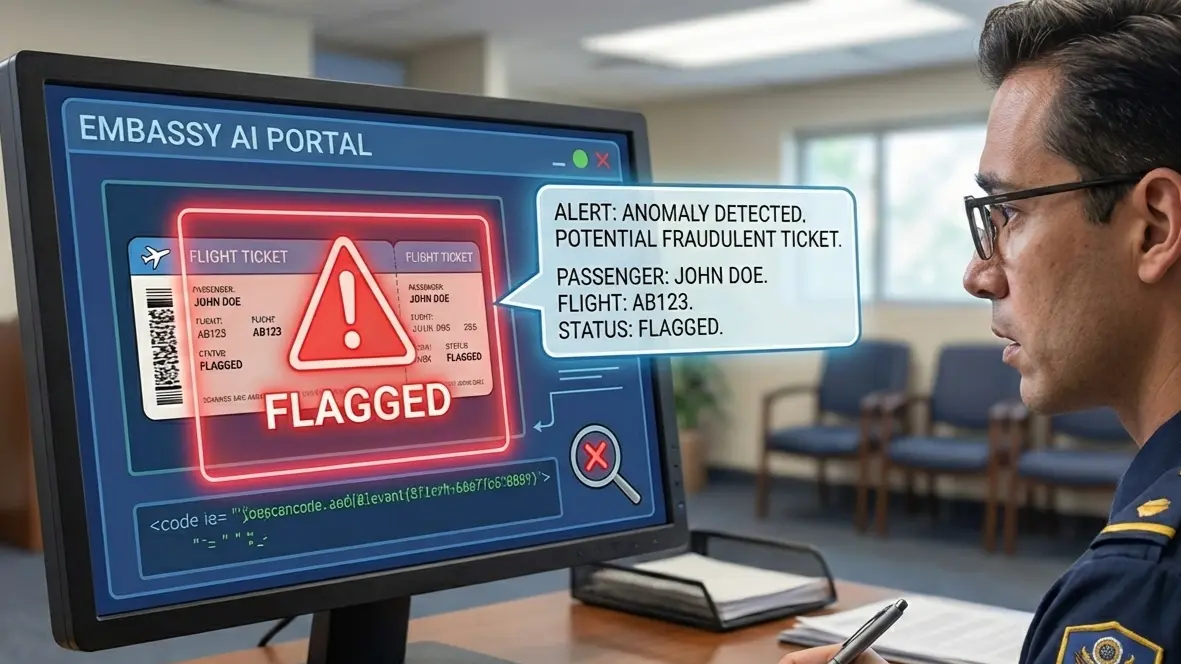
Short answer: Changing one leg of a connecting dummy ticket route can break the married-segment link, leaving one leg confirmed and the other gone. Rebuild the whole route instead: a new dummy flight ticket costs $15 per person, carries a real PNR and stays valid 48-72 hours. Then read every leg again.
Change one leg of a linked route and the whole record can react. The airline's booking system may refuse the edit, withdraw the flight beside it, or reprice what remains, which is why dummy ticket married segment inventory and a partial route change belong together.
The safe answer is to ask the issuer to rebuild the entire route and then read every segment again. The worked example uses a sample Mumbai, Delhi, and Frankfurt record. It covers reservations, not issued tickets or departure evidence.
This guide is about changing a route that already exists. For the first check of a new two-leg reservation, see the guide on verifying both legs of a married-segment dummy ticket.
Key facts
- Married segments sell connecting flights as one unit; carriers check availability and price for the whole journey.
- Cathay Pacific tells agents never to partially withdraw married segments: withdraw the bundle and book again.
- Vietnam Airlines charges agents at least USD 500 per passenger per segment for married-segment abuse in economy.
- Dummy ticket: flat $15 per person, real PNR, valid 48-72 hours.
- Free date changes on the booking day only; later route changes need a new dummy ticket.
- For visa files and onward proof at immigration, not for flying.
Route changed after the booking day? Get a new whole-route dummy ticket with a real PNR for a flat $15 per person.
Rebuild my route for $15In This Guide
- What Happens to a Linked Route When You Change Only One Leg?
- Why Do Airlines Link Connecting Flights in the First Place?
- Which Two Evidence States Should You Compare Before Trusting the Record?
- What Does an Example Partial Route Change Look Like on the Record?
- Why Do Airlines Penalize Partial Changes, and Where Does a Dummy Ticket Fit?
- What Is the Safe Next Step When a Route Needs a Partial Change?
- Which Partial Changes Are Safe on a Dummy Ticket Route?
- Which Airline Rules Is This Guide Based On?
- How Do You Rebuild the Mumbai to Frankfurt Route and Read It Again?
- Frequently Asked Questions
Official-source check: Married-segment rules come from the Cathay Pacific married segment policy and the Vietnam Airlines agent policy; fare recalculation on issued tickets comes from the Lufthansa General Conditions of Carriage, Article 3.3.3.
Reviewed for: married-segment logic, partial route changes, airline agent policies, record checks and dummy ticket facts.
What Happens to a Linked Route When You Change Only One Leg?

Start with the record, not the PDF. A connecting itinerary from Mumbai to Frankfurt through Delhi looks like two lines on a page. Inside the airline's system, it is one linked sale, and the link has a name. Married segments bundle connecting flights into one pricing unit, so the two flight segments travel as a single unit.
That link explains what goes wrong when you touch a leg. Changing or withdrawing one leg of a married-segment itinerary can trigger automatic withdrawals of linked segments. Changing one leg of a married segment may require rebooking, and rebooking is rarely a small edit.
Take the cleanest case: two flights, with one connection at Delhi. The first flight lands, the second flight departs two hours later, and both sit on one route under one set of conditions. Move the opener and the second loses its partner. A system cannot keep a connection that no longer connects.
Here is the problem in plain terms. You hold a reservation with two segments: Mumbai to Delhi, then Delhi to Frankfurt. You want the second leg moved to another departure date, or the first leg swapped for a different city.
A partial route change may break married-segment validity, leading to ticket invalidation on a paid ticket and an unusable record on a reservation.
Be clear about what is being edited. A dummy ticket is a temporary flight reservation with a real PNR, valid 48-72 hours. It is not an issued ticket and it is not for flying. Fare recalculation bites hardest on issued tickets, yet the same linking sits underneath a reservation, so a partial edit can still damage it.
The damage can hide. The status of one leg may be confirmed while the other leg shows as withdrawn if modified improperly. A PNR can exist while segments are withdrawn or unusable, so the record locator still opens a page even though half the route no longer works.
Systems watch for this. GDS systems often automatically flag married segment violations when a partial change is attempted. The flag may show up as a refusal, a silent withdrawal, or a repricing, depending on the carrier.
Placeholder legs add a second layer of risk. A record built from legs that were never sold as one connection has nothing to fall back on once a leg is edited, which is why a whole-route rebuild is safer than any patch.
Why Do Airlines Link Connecting Flights in the First Place?
Money explains most of it, and married segment logic is the tool. Airlines use married segments to manage inventory and revenue, and airlines use married segments to protect revenue and route demand on thinner city pairs. Connecting passengers are the people these rules are written around.
A carrier that lets a connection be split could lose the price difference it earns between a connecting journey and its parts. That commercial reason is why married-segment logic stays switched on, and why carriers write agent rules against splitting it.
Pricing follows the same idea, because airlines sell the pair as one product. Individual legs of married segments cannot be priced separately, and married segments prevent individual pricing of connecting flights. Married segments bundle flights into one pricing unit, so the whole route is priced as one block and a single applicable fare is quoted for it.
The conditions attached to that fare usually govern the bundle. A change to either leg is therefore judged against all of it, which is why fare class and other conditions can follow you through an edit you thought was small.
Availability works the same way across flight inventory. The GDS must check availability for the entire itinerary when handling married segments. If the Delhi to Frankfurt flight has a seat on the new date but no Mumbai to Delhi flight connects to it, the whole request fails even though the flight looks open. Seat availability belongs to the bundle.
Changing one leg of a married segment can require repricing, and that step surprises people. Attempting a partial modification usually results in significant price recalculations for part of the itinerary. Married segments bundle flights into one unit for pricing, so the leg you leave alone is still dragged into the calculation.
Rebooking has its own rule. Airlines require that married-segment routes be handled together in rebooking situations. Married-segment logic can prevent travelers from gaming pricing structures by manipulating itineraries, and handling the pair together is how the carrier keeps that control.
In the distribution layer, the link travels as a connection indicator on each segment. It moves from the shopping response into pricing and into booking, so the flights sell as a connection and not as unrelated flights. A traveller never sees the indicator, but the record depends on it.
Award Space Follows the Same Link
Married segments can complicate award travel bookings. Award seats may require booking married segments together. An airline may release award tickets on a connection while showing no seats on a single leg flown alone, and on partner awards the operating airline sets that restriction, not the program you book through.
Searching long-haul routes a leg at a time can therefore miss space that exists only on the whole itinerary. Even without an award involved, the lesson holds: availability is a property of the bundle.
What Changes When the Flights Are Not Linked?
Separate flights booked individually carry no link. A pair of flights ticketed separately makes two contracts, and self-transfers between them put the connection risk on you. Baggage handling often stops at the first airport, and a missed second flight is usually not the first airline's concern.
On one ticket, the carrier usually owns the missed connection. Linked inventory is the trade: a single bundled unit gives that protection and takes flexibility in return.
Which Two Evidence States Should You Compare Before Trusting the Record?
Read the record twice. The first reading is the linked route as it was created, and the second is the same record after a partial change. These two evidence states differ in ways a cover PDF will not show. The table sets them side by side, field by field, with the publisher behind each rule.
| Field | State A: linked route intact | State B: after a partial change | Rule comes from |
|---|---|---|---|
| Segment list | Both segments present, in travel order | One segment missing, or the order broken | Cathay Pacific married segment policy |
| Leg status | Both legs confirmed | A single leg confirmed, the other withdrawn | Cathay Pacific agent policy (violating bookings are withdrawn) |
| City pair | Same as sold, Mumbai to Frankfurt | Shifted, Delhi to Frankfurt | Cathay Pacific agent policy on OD control |
| Connection indicator | Carried on the linked segments | Missing or broken | GDS segment connection logic (general) |
| Fare | One fare for the bundle | Fare recalculated for the routing actually flown | Lufthansa General Conditions of Carriage, Articles 3.3.3 and 3.3.4 |
| Duplicate records | One active record for the plan | Old and new records both active for one traveller and route | Vietnam Airlines Booking and Ticketing Policy |
| Exposure for the booking party | None | Penalty, chargeback, or loss of inventory access | Vietnam Airlines and Cathay Pacific agent policies |
Read leg status first. Each leg carries its own status code, and codes differ by system and carrier, so use the legend that comes with the record and read the word as well as the letters. A mixed result, one confirmed and one withdrawn, is the signature of State B.
Next, compare flight numbers, the dates, and the local time of each leg. That matters because airports sit in different time zones, so an overnight arrival can quietly move a connection to the next day.
A flight departure moved on a single leg only leaves the other leg out of step. If the numbers and dates match your written plan, the cover page is probably honest.
Count the segments against a fixed number you wrote down at the start. A two-segment route that now shows one segment is State B, whatever the cover page says. Check any deadline printed on the record too, since a reservation can lapse by itself before anyone edits it.
Finish with the city pair. A bundle sold from Mumbai to Frankfurt should still read Mumbai to Frankfurt. If it reads Delhi to Frankfurt, the opening leg is gone, and the record has become a different journey. The same check catches a changed final destination.
Other restrictions on the fare, such as minimum stay or change conditions, travel with the bundle as well. A record that shows the right cities can still carry rules you did not expect, so ask the issuer which restrictions apply before you plan around the dates.
What Does an Example Partial Route Change Look Like on the Record?
The example below is invented. The carrier, locators, flight codes, and passenger are placeholders, and no real booking or lookup result is shown. Its logic follows a pattern an airline publishes in its own agent policy, where removing the opening flight of a bundle shifts the origin and counts as a violation.
FICTIONAL RECORD. NOT A REAL BOOKING. Carrier: Sample Air (ZZ). Locator: XXXXXX (placeholder). Passenger: SAMPLE/ANNA MS STATE A: as created 1 ZZ 201 BOM-DEL 12 MAR 06:10-08:20 Confirmed 2 ZZ 702 DEL-FRA 12 MAR 10:30-14:00 Confirmed Sold city pair: BOM-FRA, one fare STATE B: after an attempt to move segment 1 only 1 ZZ 201 BOM-DEL 12 MAR 06:10-08:20 Withdrawn 2 ZZ 702 DEL-FRA 12 MAR 10:30-14:00 Confirmed City pair now reads: DEL-FRA Fare: part of the route repriced, link flagged STATE C: whole route requested again as a new record Locator: YYYYYY (placeholder) 1 ZZ 205 BOM-DEL 14 MAR 06:10-08:20 Confirmed 2 ZZ 708 DEL-FRA 14 MAR 10:30-14:00 Confirmed City pair: BOM-FRA, one fare Read State A first. A pair of flights, one connection at Delhi, two hours between them, and a single fare from Mumbai to Frankfurt. Everything agrees, which makes it the baseline for every later comparison.
State B is what a partial edit leaves behind. Anna asked to move the Mumbai leg to 14 March and keep the Delhi to Frankfurt flight on 12 March.
That leg now shows Withdrawn, the second still reads Confirmed, and the city pair has shrunk to Delhi to Frankfurt. A PDF reprinted from this record could still show a Frankfurt arrival.
That is the trap. The locator opens, a leg looks alive, and the route is broken. Nobody typed the word invalid. The only evidence is the pair of statuses and the shifted city pair.
State C is the repair that keeps the logic intact. The whole route is requested again, both legs move together, and the system tests availability for the entire itinerary instead of one flight. The result is a new record with a new locator, one fare, and a city pair that matches the original plan.
Now audit State C the way you audited State A: segment list, leg status, city pair, fare, and duplicates. The old locator is the open question. If XXXXXX is still active, the passenger holds two records on similar dates.
Notice what nobody did here. Nobody withdrew a leg to hold a seat on another, nobody added a second booking beside the first, and nobody tried to edit a status by hand. Those moves are what carriers write policies against, and the next part of the guide covers why.
Why Do Airlines Penalize Partial Changes, and Where Does a Dummy Ticket Fit?

Penalties land on whoever made the booking, and married segment control is enforced through them. Agencies risk financial penalties for unauthorized attempts to manipulate married-segment inventory, and travel agents are the party carriers write most of these rules for.
Vietnam Airlines lists unlinking or altering married segments, rebooking, or splitting PNRs to bypass inventory control as system abuse. The penalty is the fare difference or a fixed amount, whichever is higher. The fixed amounts are USD 500 per passenger per segment or fare component in economy, and USD 800 in business or premium economy.
Cathay Pacific treats the same behavior as abusive. Its agents must not partially withdraw married segments, and a bundle no longer needed should be withdrawn whole, with a fresh booking made for the segment still wanted. Non-ticketed bookings with a violation are withdrawn with a remark, and ticketed cases are subject to chargeback.
Serious abuse can lead to blocked access to its inventory without advance notice. Detection does not depend on the visible record, either. A withdrawal made before the booking is ended can still be detected at head office, even though the PNR history does not show it.
Duplicate bookings belong to the same family of problems. Vietnam Airlines defines them as two or more segments for the same passenger on similar routes and dates, created by the same agent, and it may withdraw affected segments without prior notice. An active booking meant to replace an older one therefore needs the older one retired, not left alongside.
Speculative or fictitious bookings are listed separately. Vietnam Airlines defines them as segments created without a genuine and confirmed travel request, or with false passenger details, and charges agents USD 40 per passenger per segment. A reservation for a real traveller, with passport-matching names and a genuine planned trip, is a different thing from a test or fictitious booking.
That is the context a dummy ticket sits in. Whatever monitoring exists happens between the airline and the booking provider, out of your sight. What you control is the request you make: one whole route, real names, real planned dates.
Issued tickets bring a different rule. Where a fare requires a fixed sequence of flights, skipping legs or flying them out of order lets Lufthansa recalculate the fare for the routing actually flown, and carriage may depend on paying any difference. For some passengers, events outside their control are treated differently, and notice should be given when possible.
None of this is a method for working around fare rules. The point runs the other way: the carrier's rules decide what a change costs, and a request that respects them is the only kind that works. When a partial edit seems tempting, treat it as a signal to ask for the whole route instead.
What Is the Safe Next Step When a Route Needs a Partial Change?
Ask for the whole route, not a single leg. That single habit keeps the linked pair intact, because airlines require married-segment routes to be handled together in rebooking, and a whole-route request is the shape the system expects.
- Stop editing the live record. Do not withdraw or rebook a leg by itself, and do not add flights beside it.
- Write your travel plan in one line: origin and destination, travel dates, and return date if there is one. This is the yardstick for the check afterwards.
- Ask the provider that issued the reservation to rebuild the full route with the new dates or cities. A change of one city, such as swapping the connection point, is a new route and not a tweak.
- Open the new record and repeat the State A reading. The PNR deep dive for dummy tickets explains the locator and its fields in general terms.
- Ask what happened to the earlier record, so two records for one passenger do not sit side by side. Never hold the same flight in two records.
- Recheck the record close to the date you rely on it, because a reservation carries a time limit and can lapse.
A dummy ticket from DummyFlights is a flat $15 per person, carries a real PNR and stays valid 48-72 hours. Free date changes are possible on the booking day only; after that, a changed route means a new $15 dummy ticket built as one whole route. It is a reservation for visa files and onward proof at immigration, not an issued ticket.
Keep three kinds of evidence apart. A reservation shows a seat held on a record. A paid ticket, once a fare is paid and the ticket is issued, carries fare conditions that decide what a change costs. What happens at the airport on travel day belongs to the paid ticket alone. A repaired reservation proves neither of the other two.
Verification matters most when the record is shown to anyone. Check the status of both connected legs before you submit the reservation in a visa file, because a reviewer who looks up the PNR sees the record, not your PDF. The full two-leg check is covered in checking both connecting legs on a married-segment dummy ticket.
Complex itineraries increase the risk of verification failure, so a plain two-segment route is easier to keep consistent than a five-leg one. This guide stops there. Whether an application asks for flight proof at all is set by the authority handling it, and some do not ask, so read its own instructions first.
A round trip adds one wrinkle. Outbound and return flights may be priced together, so a change to the return alone can reprice the pair. Ask for the outbound and return as one request, and read both directions afterwards.
A route on one airline is not the only case that links. An interline connection with another carrier can be bundled as well, so changing the partner flight alone is not safe just because it is a different airline.
Finally, keep paid arrangements out of the picture until the record is settled. A reservation has no payment behind it, so travel insurance tied to a trip date, or any other purchase that assumes a paid ticket, should wait for a route you are sure of.
Which Partial Changes Are Safe on a Dummy Ticket Route?
None of the one-leg edits is safe on a linked record. The safe version of each change is a new whole route.
| Change you want | Risky version | Safe version |
|---|---|---|
| Move the second leg to another date | Edit Delhi-Frankfurt alone | New Mumbai-Delhi-Frankfurt route on the new dates |
| Swap the connection city | Replace Delhi with another hub on one leg | New route through the new hub, read again |
| Drop a leg | Withdraw one segment and keep the other | New single-segment or nonstop route |
| Change the return only | Edit the return leg on a priced round trip | New outbound and return as one request |
| Change after the booking day | Ask for an edit | Order a new $15 dummy ticket for the whole route |
This page is about changing a route that already exists. If you are still checking a fresh two-leg reservation before submission, the twin guide on both connecting legs covers that first read.
Which Airline Rules Is This Guide Based On?
- Cathay Pacific, Married Segments / Origin and Destination (OD) Control, agent policy document.
- Vietnam Airlines, Booking and Ticketing Policy for agents, version 4, effective 1 September 2026.
- Lufthansa, General Conditions of Carriage for Passengers and Baggage, Articles 3.3.3 and 3.3.4.
All three were checked on 30 October 2026. Rules and fares change by airline and date, so confirm the current terms with the issuing airline or provider before relying on any rule described here. General statements about how distribution systems link connections are background, not a quote from one carrier.
How Do You Rebuild the Mumbai to Frankfurt Route and Read It Again?
A linked route behaves as one object. Whether the record is a Mumbai to Delhi to Frankfurt reservation or something longer, a partial change risks a half-withdrawn record that still opens on screen. Ask for the whole route, then read every leg, the city pair, and the fare against your written plan.
Keep reservation, issued ticket, and departure evidence apart, and leave the carrier's rules alone, because they decide what any change costs. When the new record reads like State A, the repair is done.
Need the route rebuilt in one piece? Order a whole-route dummy ticket: real PNR, valid 48-72 hours, $15 per person.
Get your $15 dummy ticketFrequently Asked Questions
Can I drop the second leg of a dummy ticket and keep the first?
Not safely on a linked record. Cathay Pacific treats partially withdrawing segments from a bundle as abusive and tells agents to withdraw the whole bundle and book only what is still wanted. For a dummy ticket, ask for a new single-leg or nonstop route as one request, then read it again.
Why does my record show one confirmed leg and one missing leg?
That mixed result usually means one leg was changed or withdrawn on its own. Do not try to revive the missing leg yourself, because a lone rebooking can create duplicate records. Ask for the whole route to be rebuilt, then check every leg, date and city pair against your plan.
Can I change the dates on a connecting dummy ticket?
Yes, on the booking day: free date changes are possible on the booking day only. After that, a new date means a new $15 dummy ticket, built as one whole route so both legs stay linked. Each one carries a real PNR and stays valid 48-72 hours.
Is a nonstop route safer than a connection on a dummy ticket?
A nonstop flight is one segment, so it has no married partner and cannot be half-broken by an edit. It may not match the route you need to show, though. Choose the route your plan needs, then protect it from partial edits by changing it only as a whole.
Will moving both legs together always work?
A whole-route request is the right shape, but availability still decides. The system looks for seats that connect on the new dates, and if none connect, the request fails even when each flight looks open alone. Ask for alternative dates or a different connection in that case.
How is this guide different from the married-segment check guide?
This guide covers changing a route that already exists, one leg at a time, and why to rebuild it whole. The married-segment check guide covers reading both legs of a new reservation before submission. Use that one first, and this one when plans change.
Friendly reminder: DummyFlights provides dummy tickets and dummy hotel bookings to support visa applications and onward-travel proof at immigration. Requirements vary by destination, consulate, visa category and traveller situation. A dummy ticket supports your file; it is not a paid ticket for travel and does not guarantee visa approval or entry.