
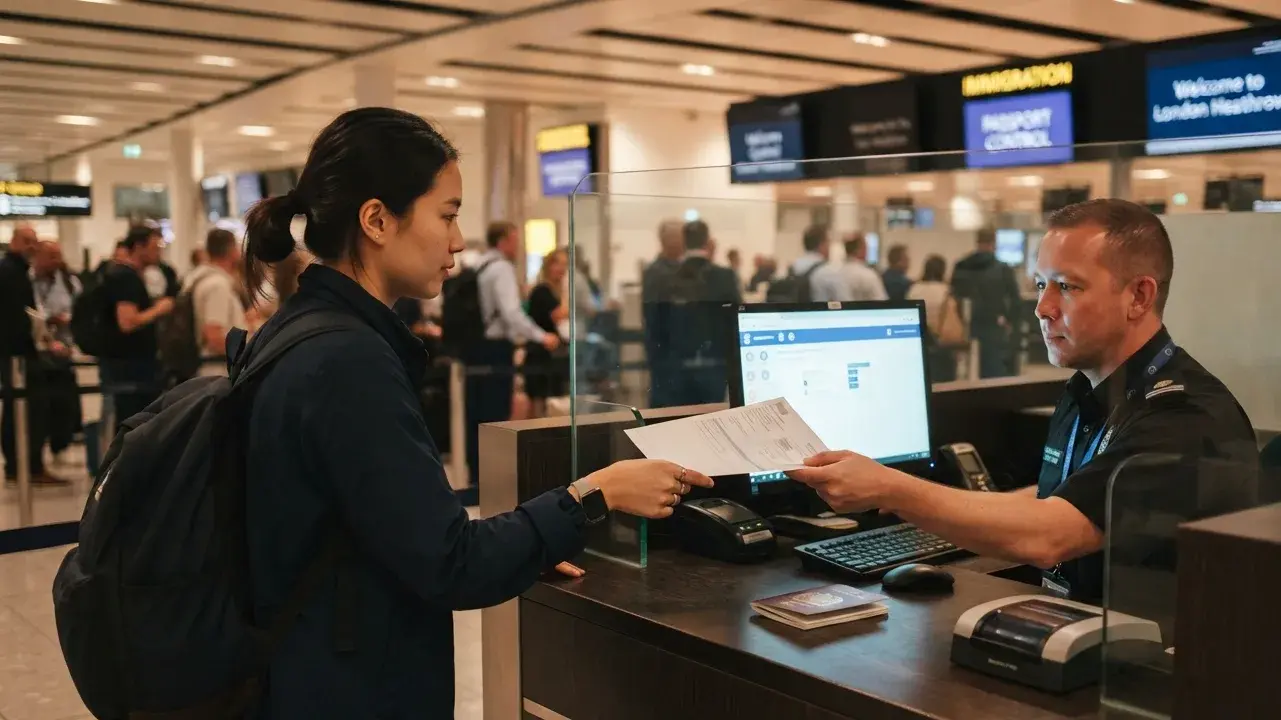
A ticket dummy can help when counter staff ask for a booking code only if the PNR is real, fresh, readable and still inside its valid hold window. The code should match the passenger name, route, date and travel story you are presenting; if staff run a live lookup and the booking has expired, shows cancelled, or never existed, the conversation can quickly shift from routine proof to a document-risk problem.
The tense moment is easy to picture: the agent takes your paper, types six characters, pauses, and looks back at you. That pause feels huge because a booking code is not just decoration on a PDF. At some counters it is a visual detail. At others it is a live query that can show whether the reservation exists, whether the route matches, and whether the booking status still makes sense.
Most travelers prepare for the embassy desk and stop there. The real friction often appears later: a check-in counter, a document desk, a border officer, or a visa-center staff member who decides the code should be checked instead of merely read. This guide explains what each counter is actually doing, why booking codes fail, how hold windows work, what to say without over-explaining, and when a dummy ticket should be refreshed or replaced with a fully ticketed booking.
Key facts for booking-code checks:
- A booking code is useful only when it points to a real reservation record, not an invented document.
- Visa counters usually review consistency; airline counters are more likely to access live systems.
- Temporary holds can expire before the appointment, check-in or arrival desk if timing is wrong.
- A “not found” result does not always mean fraud, but it can create questions you should be ready to answer calmly.
- A dummy ticket supports planning and visa paperwork; it should not replace a real ticket when the destination requires current onward proof at boarding or arrival.
Need a fresh booking code for a visa file or travel-proof check? Create a clean DummyFlights reservation with readable passenger details, route logic and a PNR-style booking reference before the counter conversation starts.
Create Your Dummy TicketIn This Guide
- Who counter staff actually means
- Why booking codes get questioned
- How dummy ticket hold windows work
- What happens when a code shows not found
- Boarding counters vs border counters
- Which destinations run live checks
- Build a code that can survive lookup
- What to say at the counter
- Backup plan if the code fails
- FAQ
Official-source check: IATA says Timatic is used by airlines and travel-industry staff for real-time international travel-document requirements, and GOV.UK carrier guidance explains why carriers check documents carefully before carrying passengers. GOV.UK visitor guidance also says UK visitors may need to show they can pay for return or onward travel, while transit applicants may need confirmed onward travel within the required window. Sources: IATA Timatic, GOV.UK carrier charging procedures, GOV.UK visitor supporting documents and Appendix V: Visitor.
Reviewed for: booking-code wording, airline counter practicality, PNR timing, visa-file versus boarding-proof distinction, route-date consistency, document-risk clarity and official-source alignment.
Who Counter Staff Actually Means
“Counter staff” sounds like one role, but travelers usually use it for four different checkpoints. Each person checks a different thing, through a different process, and with a different consequence if your booking code does not hold up. That is why one traveler can submit a dummy ticket with no issue, while another gets asked to show the booking reference live at the airport.
The embassy or visa-center clerk reviews the file
The visa application counter is usually the least technical checkpoint. A clerk receiving a Schengen, UK, Canada, Thailand or UAE file is normally checking whether the file is complete, whether the dates make sense, and whether the passenger name matches the passport. The review is often about document consistency, not a live airline database lookup.
This role still matters because a weak document can fail before anyone types the booking code. If the date on the reservation contradicts the form, the route does not match the cover letter, or the passenger name is formatted strangely, the file can feel careless even when the booking reference itself is valid.
A clean dummy ticket does most of its work at this stage by making the proposed trip easy to understand. The clerk should not need to decode the route, guess whether the traveler is returning, or wonder why the flight proof looks unrelated to the rest of the application.
The airline check-in agent can work from live systems
The check-in counter is different. Airline agents and document-check desks are closer to operational systems. They are deciding whether you can board a real flight today, not whether your old visa file looked convincing weeks ago. If the route requires onward proof, the agent may ask for a booking code and may check whether that code leads to a current reservation.
This does not mean every agent will verify every onward ticket. Many checks remain visual, especially when the route is low risk or the entry rule is simple. But the power dynamic is different at the airport. The airline can refuse boarding if it believes your documentation is not enough for the destination, because carriers can face penalties or removal costs when passengers arrive without the required documents.
That is why airport timing matters more than embassy timing. A reservation that was fine for an appointment last week may not help if a check-in agent needs proof today and the hold has already expired.
The border officer is asking a live arrival question
An immigration or border officer is not reviewing your past application the same way an embassy did. At arrival, the officer is asking whether you meet entry conditions now. If the country expects a return or onward plan, the officer may ask for proof at the desk, especially when you arrive on a one-way ticket, have a long flexible stay, or cannot explain your next destination clearly.
Some borders treat onward proof lightly. Others treat it as a practical sign that the traveler understands the permitted stay period. Depending on the country and airport, the check can be a quick glance, a question about your exit date, or a deeper review of the booking reference and surrounding documents.
This is where many travelers make a subtle mistake: they assume the document that supported the visa application is still the right document for arrival. Sometimes it is not. If the arrival desk wants current exit proof, the safest answer is current exit proof, not an old temporary reservation that has already done its visa-file job.
The travel agency or outsourced center may sit in the middle
Some applications pass through outsourced visa centers or travel agencies before reaching the consulate. These staff members usually work from checklists, but they can still slow a file down if the booking looks inconsistent. In higher-scrutiny offices, some staff may ask for clearer proof, a refreshed booking, or a corrected document before forwarding the file.
The middleman role explains why experiences vary so much. Two applicants can use similar reservations for the same visa type and face different questions because the office, staff training, route, nationality, timing and document pack are not identical.
The useful mindset is simple: build the booking as if a live check is possible, even if the most likely review is only visual. That does not mean panicking or overbuilding the file. It means using a real, readable record instead of relying on a static-looking document that has nothing behind it.
Why Booking Codes Get Questioned
A booking code gets questioned when the person at the counter needs more than a nice-looking itinerary. They may need to know whether the booking exists, whether it matches the traveler, whether it is still active, and whether it makes sense beside the passport, visa, accommodation and onward plan.
A PNR is not the same as a fake ticket number
A proper dummy ticket is based on a real reservation-style record. It can show a route, travel dates, passenger details and a booking reference or PNR. A fake ticket, by contrast, is usually an edited document with invented details. It may look polished, but when the booking reference is checked there is nothing reliable behind it.
This distinction matters because the risk is not the word “dummy.” The risk is pretending a document is something it is not. A temporary reservation can be used honestly as travel proof for planning or visa documentation. An invented ticket number, altered itinerary, or non-existent booking can create serious trust problems if staff notice it.
If you need the definition-level foundation first, the what is a dummy ticket guide explains the difference between a temporary reservation, an onward proof document and a fake edited PDF.
Visual checks and live lookups are not the same
A visual check is exactly what it sounds like. Staff read the document, compare the name and dates, and decide whether it fits the rest of the file. This is common in document-upload portals, visa-center desks and low-friction embassy appointments.
A live lookup is a different test. The staff member enters the booking code or uses airline tools to see whether the reservation can be found. A document can pass the visual check and still fail the lookup if the booking has expired, the code is mistyped, the airline record is not accessible from that channel, or the document was never tied to a real reservation in the first place.
The problem is that travelers often do not know which type of check they are facing until it begins. A calm glance can remain a calm glance, or it can become a system search. The safest preparation is to assume your booking should look clean on paper and still make sense if the code is checked.
Small inconsistencies trigger bigger questions
Most booking-code questions do not begin with the code itself. They begin with something nearby that feels slightly off. A date mismatch, a strange route, a missing surname, a hotel stay that ends weeks before the return flight, or a ticket number field that looks wrong can push staff to inspect the PNR more closely.
Common triggers include:
- travel dates that do not align with the visa form, invitation letter or accommodation;
- a route that looks random for the stated purpose of travel;
- passenger-name formatting that differs from the passport or application;
- a booking reference that looks unclear, incomplete or difficult to read;
- a document that looks edited, reused or inconsistent with the airline named on it;
- a reservation date that is too old for the counter where it is being shown.
None of these details automatically means refusal, denial of boarding or entry trouble. They do mean the document has stopped being invisible. Once staff start asking about it, the booking needs to explain itself through clean details, not through a long verbal story.
A six-character code alone is not enough
Many travelers treat the booking code as the magic part of the document. It is not. A six-character code only helps if it connects to a booking record that still behaves like a current reservation. Staff may care about the route, the date, the passenger name, the airline, the status and the surrounding file just as much as the code itself.
This is why old, copied or edited documents are weak. They give the traveler something to point at, but not something that can survive the practical question: “What happens when I check this?” A better dummy flight ticket is built around the full record, not just the visible booking reference.
How Dummy Ticket Hold Windows Work
The booking code usually fails for one boring reason: timing. A reservation can be valid when it is created and useless when it is finally checked. That does not always mean the provider made a bad document. It often means the traveler used the document outside the window it was built for.
Temporary reservations sit on a clock
A dummy ticket is normally a temporary reservation, not a fully paid airline ticket. Because the fare has not been permanently purchased, the record can sit on a hold window before it expires or cancels. Some holds are short. Some last longer. The exact behavior can vary by airline, route, booking class, ticketing deadline and reservation channel.
The practical lesson is not to memorize a single universal validity number. The lesson is to time the document around the checkpoint where it may actually be checked. If your visa appointment is tomorrow morning, the reservation needs to be fresh tomorrow morning. If your airline may ask for onward proof at check-in next month, the old visa appointment reservation may no longer help you.
Expired bookings can look worse than they are
When a booking expires, the screen may show no record, a cancelled status, or a booking that exists but is no longer useful as active proof. To the traveler, that may feel like an innocent timing issue. To counter staff, it may look like the document was weak from the start.
Possible outcomes include:
- the booking code returns no matching record;
- the reservation appears cancelled or inactive;
- the route is visible but the status no longer supports the proof being claimed;
- the agent asks whether you have a current return or onward ticket instead.
The fix is not to over-explain expiration at the counter. The fix is to prevent it before you arrive. A fresh, current document makes the interaction feel routine. An expired one forces you to explain why your proof no longer proves what the staff member is asking about.
Work backward from the final checkpoint
Most travelers work forward: they create a ticket dummy when they begin the application, then hope it remains useful. The better method is to work backward from the last point where the code may be checked.
Use this timing sequence:
- List every checkpoint where the booking code may be asked for: appointment, upload portal, check-in desk, transit document desk or arrival counter.
- Identify the latest realistic check, not only the first one.
- Create or refresh the reservation so the hold window covers that latest checkpoint.
- Keep the route and dates aligned with the current plan rather than an earlier draft of the trip.
- If the final checkpoint requires actual current onward proof, arrange a real ticket or flexible booking before travel.
This is especially important when the visa application date and flight date are far apart. A document that helps the application in September may not be the right document to show at an airport in November. The same traveler may need one reservation for the visa file and a newer proof document closer to departure.
Time zones quietly shorten your buffer
A “48-hour” hold is not always experienced as a comfortable two days by the traveler. Airline systems, provider timing, local appointment time and airport time zones can all make the usable window feel shorter. A reservation created late at night may already be counting down from another time zone or from the actual booking creation timestamp, not from the moment you opened the PDF.
Two situations deserve extra caution:
- early-morning appointments where a previous-night booking may already be near the end of its useful window;
- long-haul travel where the check-in desk or arrival desk falls into a different date from the traveler’s local calendar.
For practical planning, treat any stated hold window as shorter than the headline. If you think you have 48 hours, plan like you have 36. That small caution margin is much easier than discovering the code has gone cold while someone is waiting at the counter.

What Happens When a Booking Code Shows Not Found
A “not found” result feels dramatic, but the first reaction is usually procedural. Staff often assume a typo, a wrong airline lookup, a spacing issue, a transposed character or a timing problem before they assume bad intent. Your job is to stay calm enough that the interaction remains procedural.
The first minute is usually troubleshooting
At first, the staff member may retype the code, ask to see the confirmation again, compare the surname, or check whether the booking belongs to a different carrier in the itinerary. This is normal. Booking references are easy to mistype, and some itineraries involve operating carriers, marketing carriers or agency records that do not behave identically in every system.
Possible first responses include:
- “Can you show me the booking confirmation again?”
- “When was this reservation made?”
- “Is this your onward booking or your current flight?”
- “Do you have the airline confirmation or e-ticket number?”
- “Please wait while I check with my supervisor.”
None of those questions mean the situation is lost. They mean the code did not resolve immediately, so the staff member is narrowing down why.
Escalation depends on the counter
At an airline desk, escalation usually means a supervisor, document-check desk or duty manager. That person may have more experience with entry requirements or a better understanding of how to verify the destination’s onward-proof rule.
At a border, escalation may mean secondary inspection or a more detailed conversation. That can feel intimidating, but secondary questioning is used for many routine travel-document checks. It does not automatically mean a traveler has done something wrong.
At a visa application center, escalation may simply mean the file is reviewed more closely, or the applicant is asked to upload a clearer document. The problem may be resolved by replacing the reservation, correcting the route, or aligning the dates with the rest of the file.
Keep notes if the issue causes a delay
If the lookup delays your check-in, boarding, visa submission or arrival process, write down the details while they are fresh. You do not need to make a drama of it. A simple note can help if you later need to explain why a flight was missed, why the file was delayed, or what exact concern the officer raised.
Useful details include:
- the date, time, airport, counter or visa center;
- the exact phrase used by staff if they gave a reason;
- whether the concern was the booking code, name, route, date, ticket number or destination rule;
- whether the matter was resolved on the spot or referred elsewhere;
- any written note, refusal reason or airline instruction you were given.
This is not about building a legal defense from a small travel hiccup. It is about keeping facts straight. Memory gets blurry after stress. A quick note keeps the sequence clean.
Do not over-explain while they are checking
The worst instinct is filling silence. If staff are checking the code, let them check. If they ask a direct question, answer that question directly. Do not volunteer a long story about how the reservation was created, why you chose that route, what you may change later, or whether you plan to cancel something.
Strong counter behavior is plain:
- hand over the document calmly;
- answer the exact question asked;
- keep your explanation consistent with the printed route and dates;
- offer supporting documents only when they are relevant;
- avoid nervous phrases that make the document sound disposable or fake.
A good document should carry most of the weight. Your words should support it, not create a second story beside it.
Boarding Counters vs Border Counters
The most important distinction in this topic is the difference between visa-file proof and live travel proof. A dummy ticket can be useful for a visa application because it shows intended travel without forcing the applicant to buy full airfare before the decision. But a boarding counter or border officer may be asking a more immediate question: do you have a current, usable way to leave?
Visa-file proof answers an application question
A visa file is judged at a particular moment. The decision maker reviews your purpose, dates, accommodation, funds, ties and travel plan as submitted. A temporary booking can support that file when it fits the application and is not presented as a fully paid ticket.
For broad visa-file planning, the dummy ticket for visa pillar is the stronger place to understand how a reservation should support the wider application instead of standing alone.
If the requirement is specifically a flight reservation for visa, that belongs more naturally to BookForVisa’s reservation-focused guidance rather than forcing a DummyFlights article to compete for that keyword.
Airport proof answers a same-day boarding question
At the airport, the question is live. The airline may need to decide whether carrying you creates risk under the destination’s entry-document rules. If onward proof is mandatory or commonly checked on that route, a stale temporary reservation may not be enough.
This is not a weakness in dummy tickets. It is a context problem. A document built for a visa file is not automatically the right document for boarding. If the airline or destination expects current onward proof, the traveler should have proof that is current at that moment.
Border proof answers an entry question
At arrival, the border officer can ask whether you will leave within the permitted stay. A return or onward plan may be one piece of that answer. Funds, accommodation, purpose, previous travel, local address and visa status can also matter.
If your destination has a clear onward-ticket rule or if your travel pattern makes questions likely, do not rely on an old reservation from the visa stage. Have a current proof plan ready before you board. For some travelers, that means refreshing the temporary proof. For others, it means buying a refundable, flexible or fully ticketed onward journey before departure.
When a real ticket becomes the cleaner answer
A real ticket or flexible paid booking becomes the cleaner answer when the counter is no longer asking for “intended travel.” It is asking for current, usable exit proof. That is most likely when:
- the destination explicitly requires onward or return proof at arrival;
- the airline checks onward proof before issuing the boarding pass;
- you are entering visa-free or on arrival with limited pre-screening;
- you are traveling one-way with no obvious exit plan;
- the country, route or traveler profile is known for strict document checks.
The safe rule is simple: use a dummy ticket to support the stage it is designed for, and use current ticketed proof when the travel stage demands it.
Which Destinations Run Live Checks
No one can promise that a specific counter will or will not run a live lookup. Verification habits vary by destination, airline, airport, visa type, route, nationality, staff training and recent enforcement patterns. But you can still read the risk level before you arrive.
Low-verification environments rely on paper consistency
In low-verification settings, staff usually want a complete, professional file. They check whether the travel proof is present, whether the dates fit, and whether the document looks normal. They may not have the time, tools or mandate to call airlines or query every booking code.
These environments often have:
- high application volume and standardized checklist processing;
- short-stay visa categories with familiar document requirements;
- limited evidence of routine airline confirmation calls;
- a stronger focus on consistency across documents than on live booking status.
A clean, readable document usually does well here. That does not mean careless documents are safe. It means the first quality test is paper logic.
Medium-verification environments are inconsistent
Most real-world travel checks sit in the middle. One officer may glance. Another may ask a question. A third may decide the route, name or timing deserves a deeper look. This is where applicants get confused because stories from other travelers seem contradictory.
Medium-verification risk rises when:
- the traveler has limited travel history;
- the stay is long, flexible or one-way;
- the purpose involves study, work, medical travel or repeated visits;
- the route is expensive, indirect or hard to explain;
- another document in the file already looks inconsistent.
In this middle zone, the best defense is boring consistency. The booking code, date, route, hotel, cover letter and visa form should all tell the same story.
High-verification environments expect proof that survives checking
High-verification environments are the ones where the booking code may be actively checked. This can happen at airline document desks, strict arrival counters, transit desks, or visa centers that ask for fresh proof before forwarding a file.
Here, presentation is not enough. The PNR needs to be current, the route needs to be plausible, and the traveler needs to know whether a temporary reservation is appropriate for that stage. If the check is live and the document is stale, the risk moves from cosmetic to practical.
Research the exact route, not only the country
Travelers often research “country requirements” and stop. A better approach is narrower: research the exact airport, airline, transit point, visa type and entry method. The same country can feel different depending on whether you arrive through a major hub, a land border, a low-cost carrier document desk, or a consulate that has recently tightened review habits.
Before relying on any booking code, check:
- whether the airline commonly asks for onward proof on your route;
- whether your destination expects onward or return proof at arrival;
- whether transit countries add their own document rules;
- whether recent traveler reports mention stricter manual checks;
- whether your visa category makes exit intent more important.
This research does not need to be perfect. It just needs to prevent the lazy assumption that every counter behaves like the embassy appointment.
Build a Code That Can Survive Lookup
A booking code is only as strong as the reservation behind it. A polished document with no real record is fragile. A messy document with a real record can still create questions. The strongest version is both: a real reservation-style record and a clean, readable presentation.
The PNR should point to a real record
A useful PNR is not a random string. It should connect to an actual reservation entry with passenger details, route, flight date and carrier information. The reservation may be temporary, and it may not be ticketed, but it should not be invented.
A stronger booking record usually has:
- real flight numbers and route logic;
- passenger name consistent with the passport;
- departure and return or onward dates that match the travel plan;
- a booking reference that is readable and not buried in the document;
- a status and timing window that still make sense when checked.
The goal is not to create a document that looks complicated. The goal is to create one that looks ordinary.
The PDF should reflect the record, not replace it
A PDF is presentation. The reservation record is the substance. If the PDF says one thing and the record says another, the PDF loses. Counter staff trust the system more than the paper once they decide to look behind the document.
That is why manually edited screenshots are risky. They can look neat, but they fail the moment someone asks a live question. A good dummy ticket should not rely on the traveler hoping nobody checks it.
DummyFlights focuses on this practical gap: create a document that is readable enough for visual review and structured enough around a real booking-code workflow to avoid the obvious fake-ticket mistakes.
Formatting still matters before any lookup
Even when the PNR is valid, the layout can invite or reduce scrutiny. Staff notice familiar patterns. They also notice documents that look edited, incomplete or strange.
Check these formatting details before the appointment or airport:
- the passenger name appears exactly as it should for the booking context;
- the booking reference is easy to locate;
- dates are written clearly and do not conflict with local date formats;
- the route uses real airports and believable connection logic;
- the document does not overclaim “confirmed ticket” if it is only a temporary reservation;
- any missing ticket number is understood before you present the document.
Do not confuse PNR with e-ticket number
A PNR or booking reference is not the same as a ticket number. A ticket number usually appears after payment and ticketing. A temporary reservation may have a booking reference without a final e-ticket number. That can be perfectly normal for visa-file proof, but it may not satisfy an airport agent who specifically asks for a ticketed onward booking.
If staff ask, “What is your booking code?” a PNR-style reference may be enough. If staff ask, “Where is the ticket number?” or “Is this ticketed?” they may be asking a different question. Do not answer the second question as if it were the first.
What to Say When Staff Ask for the Booking Code
A solid document still needs calm delivery. You do not need a theatrical script. You need a short, normal answer that matches the document and does not open unnecessary side roads.
Use simple language
When asked for the booking code, hand over the document or show the PDF and say something simple:
- “Here is my flight confirmation.”
- “The booking reference is listed here.”
- “This is my onward travel proof.”
- “The current plan is shown on this itinerary.”
Short language feels routine. Long language can sound defensive, especially at an airport counter where staff are trying to move quickly.
Do not volunteer weak phrases
Some phrases create problems even when the document itself is fine. Avoid saying:
- “It is only for formality.”
- “I will cancel it later.”
- “It is not a real trip.”
- “The visa agent told me to use this.”
- “I just need you to accept it.”
- “It worked for my friend.”
These phrases shift attention away from the document details and toward your intention. If the route, dates and code are clean, let those details speak.
Answer follow-up questions without changing the story
If staff ask when you plan to leave, answer in a way that matches the document. If the itinerary shows a departure on the 18th, do not casually mention that you might stay until the 28th unless you are prepared to explain why the document no longer reflects the plan.
Useful answers are specific but not excessive:
- “My current exit plan is the date shown here.”
- “The return plan matches my accommodation and visa dates.”
- “If plans change later, I will update the booking before travel.”
- “This is the travel proof prepared for this application stage.”
The principle is consistency. Your words, document and wider travel plan should not compete with each other.
Keep your digital copy ready
If the document is on your phone, open it before reaching the counter. Do not make staff wait while you search email, dig through downloads, or refresh a poor connection. A slow handoff does not prove anything bad, but it adds friction at the exact moment you want the interaction to feel normal.
Carry both:
- a printed copy for manual counters;
- a downloaded PDF that opens without internet;
- a screenshot only as backup, not as the main proof;
- any supporting documents that make the route and dates believable.
Backup Plan If the Booking Code Fails
Even good preparation can run into bad timing, system access issues or route-specific rules. A backup plan keeps a failed lookup from becoming a missed flight or a panicked purchase.
If you are at a visa counter
If the issue happens at a visa application counter, the fix is usually administrative. You may be asked for a clearer reservation, corrected document, updated route, or stronger consistency with the rest of the application.
Practical next steps:
- ask what exact detail is unclear;
- replace the reservation if the hold has expired;
- align the new proof with the visa form, accommodation and invitation letter;
- avoid submitting multiple conflicting versions unless the portal requires an updated upload history;
- keep a copy of what was originally submitted.
A visa-counter issue is rarely solved by buying a panic ticket. It is usually solved by making the file cleaner.
If you are at airline check-in
If the issue happens at airline check-in, time matters more. Ask the agent what document would resolve the concern. If the route requires current onward proof, the practical answer may be a refundable or flexible onward booking that can be shown immediately.
Have a fallback route in mind before you travel. It should be plausible, inside your permitted stay, and consistent with your real plan. A random cheap exit route can create a new question instead of solving the old one.
If you are at border control
If the issue happens at arrival, stay calm and focus on the officer’s exact concern. The problem may not be the booking code alone. It may be the stay length, funds, accommodation, visa type, previous travel, or a mismatch between what you say and what the document shows.
Useful supporting proof can include:
- accommodation confirmation;
- travel insurance;
- proof of funds;
- employment, student or business ties outside the destination;
- an actual onward or return ticket if the destination requires one.
Do not argue that a dummy ticket must be accepted. Requirements vary. The better approach is to show the officer a complete, consistent picture of a temporary trip.
Final pre-counter checklist
Before any counter where your booking code may be checked, confirm:
- the booking is fresh enough for the actual check time;
- the passenger name matches the passport;
- the route matches the stated travel purpose;
- the departure and return or onward dates fit the visa, stay and accommodation;
- the booking reference is readable;
- the document does not claim to be a paid ticket if it is only a temporary reservation;
- your backup plan is ready if the counter needs current ticketed proof.
This is the whole game. The booking code should not feel like a fragile trick. It should feel like one clean detail inside a coherent travel plan.
What to Remember Next Time
When counter staff ask for a booking code, they are not all asking the same question. A visa clerk may want consistency. An airline agent may need a live, current record. A border officer may want proof that you can leave within the permitted stay. A travel-center staff member may simply want the file cleaned up before it goes forward.
The safest ticket dummy strategy is to prepare for the specific counter you are facing. Use a real reservation-style record. Time it around the actual check. Keep the route believable. Avoid fake or edited documents. Do not over-explain. And if the travel stage requires current ticketed proof, treat that as a different requirement from visa-file support.
If you keep those distinctions clear, the booking code stops being a scary six-character test. It becomes what it should be: a practical reference that supports a travel plan already built to make sense.
Need a cleaner booking-code document before your appointment or counter check? Build a DummyFlights reservation with readable travel details, a clear route and a practical PNR-style reference before staff ask for it.
Create Your Dummy TicketFAQ
What should I do if counter staff ask for my booking code?
Show the booking confirmation calmly and point to the reference on the document. Answer only the question asked. If they are checking the PNR, wait for the result instead of over-explaining how the reservation was created.
Can a ticket dummy be checked by airline staff?
Yes, airline staff may check a booking reference when onward proof or document compliance matters for the route. Whether they do so depends on the airline, destination, route, staff workflow and specific entry requirement.
Why does a booking code show “not found”?
A booking code may show not found because it was mistyped, searched in the wrong system, expired, cancelled, no longer active, or never connected to a real reservation. Timing is one of the most common causes.
Is a PNR the same as an e-ticket number?
No. A PNR or booking reference identifies a reservation record. An e-ticket number usually appears after ticketing and payment. A temporary reservation may have a PNR without a final ticket number.
Can I use the same dummy ticket for visa and airport check-in?
Sometimes, but only if it is still current and suitable for the checkpoint. A reservation used for a visa file weeks earlier may not be valid or appropriate for airport check-in if the airline needs live onward proof.
Should I say the reservation is temporary?
Do not volunteer extra explanation unless asked. Present the document for the purpose it serves and answer direct questions honestly. Avoid phrases that make the document sound fake, disposable or unrelated to your travel plan.
What if staff ask for a ticket number instead of a booking code?
That may mean they want a ticketed booking, not just a temporary reservation. If the route requires actual onward proof at boarding or arrival, a refundable or flexible real ticket may be safer than relying on an old temporary hold.
How fresh should a dummy ticket be before a counter check?
It should be fresh enough to cover the actual checkpoint where it may be checked, including time-zone differences. Do not create it too early if the booking code needs to remain active at a later appointment, check-in desk or border counter.
Does a valid booking code guarantee boarding or visa approval?
No. A booking code can support a consistent file or travel-proof conversation, but it does not guarantee visa approval, boarding or entry. Requirements vary by destination, airline, route and applicant situation.
Friendly reminder: DummyFlights provides temporary travel-proof documents for planning and application support. Requirements vary by destination, airline, route and applicant situation. A dummy ticket can support a file, but it does not guarantee approval, boarding or entry.