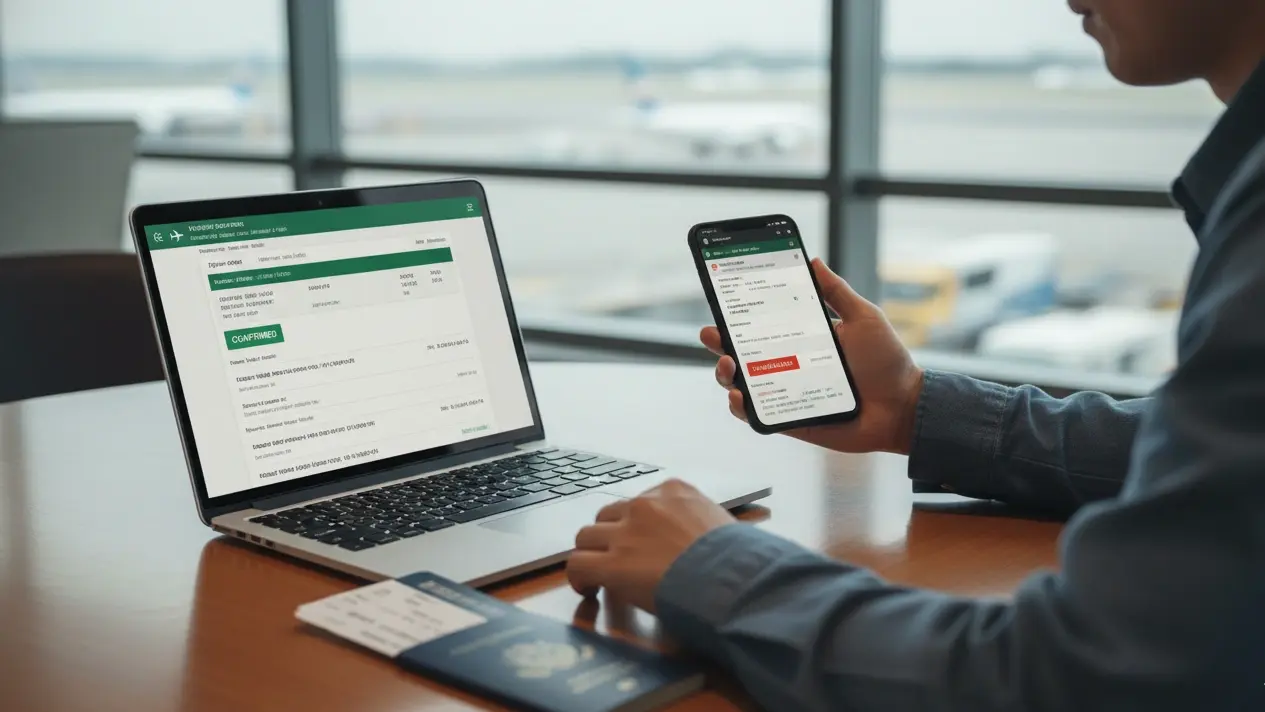
Short answer: A codeshare dummy ticket can show a marketing carrier and an operating carrier that do not appear identically on every airline website. Verify the issuing system, passenger name, route, dates, flight number, operating carrier and PNR before submission. A different lookup view does not automatically mean the reservation is invalid, but it must be explained truthfully and consistently; it cannot guarantee visa approval, boarding or entry.
Key facts
- A codeshare can display one marketing carrier and a different operating carrier without being inherently wrong.
- The issuing reservation system, not every public partner page, is the primary place to check the record.
- Passenger name, route, dates, flight number, PNR and operating-carrier details should agree across the file.
- Airline and destination rules control what can be verified, accepted or boarded.
Need a clear codeshare dummy ticket? DummyFlights can help you prepare temporary travel proof with the passenger, route and dates presented consistently for review.
Create your dummy ticketIn This Guide
- Why A Codeshare Dummy Ticket Can Look “Broken” Even When The Reservation Exists
- How To Tell Which Airline “Owns” The Reservation Before You Panic About The PNR
- What Visa Applicants Should Actually Verify On A Codeshare Dummy Ticket Before Submission
- When A Working PNR Is Still A Bad Visa Document Because The Itinerary Feels Unclear
- The Smart Troubleshooting Workflow When Your Codeshare PNR Fails On The “Wrong” Website
- How To Use Codeshare Dummy Tickets Without Making Your Visa File Look Inconsistent
- The Judgment Call Most Applicants Miss: Whether The Reservation Supports Trust In The Whole Application
- When Your Codeshare Reservation Is Clear Enough To Trust
Official-source check: For passport, visa, health and transit checks that affect a codeshare route, consult the current IATA Travel Centre. Confirm the marketing and operating-carrier display, check-in and reservation rules with the issuing airline and the carrier operating the segment.
Reviewed for: codeshare and operating-carrier terminology, PNR lookup differences, passenger-name and date consistency, visa-file clarity and airline counter verification.
You pull up your dummy ticket, enter the PNR on one airline site, and the booking appears. Then you try the partner airline’s site and get nothing. That single mismatch can make a strong visa file feel shaky, especially when your appointment is close, and you do not want a flight reservation creating avoidable questions.
We need to separate normal codeshare behavior from real document risk. What matters is not whether every airline website recognizes the booking. What matters is whether your itinerary is clear, consistent, and credible enough to submit without second-guessing later. When a codeshare PNR gets messy, a cleaner dummy ticket can keep your visa file easier to trust.
Why A Codeshare Dummy Ticket Can Look “Broken” Even When The Reservation Exists
This is where many visa applicants lose confidence in an otherwise usable flight reservation. A codeshare dummy ticket can look unreliable on the surface, even when the booking itself is sitting exactly where it should.
The Real Reason One Booking Can Belong To Two Airlines At Once
A codeshare itinerary creates one of the easiest visa-document panic moments. You see one airline name on the PDF, another airline name next to “operated by,” and a flight number that seems to belong to the first carrier.
That looks messy if you are reviewing the file quickly before a Schengen appointment, a UK visitor visa submission, or a short-stay application for Japan.
The confusion comes from how the trip is sold versus how it is flown.
One airline may market the flight under its own code. Another airline may operate the aircraft. Your dummy ticket can therefore carry two valid airline identities at the same time without anything being wrong.
That matters because your instinct is usually simple. You see Airline A on the itinerary, so you try Airline A’s website first. When you later try Airline B’s website and the booking does not appear, it feels like the reservation is incomplete. In many codeshare cases, that is normal behavior, not proof of a bad booking.
For visa purposes, the problem is not the existence of two airlines. The problem is that two-airline branding can make a straightforward trip look uncertain if you do not read the itinerary carefully.
Why The Airline Printed On Your PDF May Not Be The Best Place To Check The PNR
The airline shown most prominently on the reservation PDF is often the airline you recognize first. That does not always make it the best place to verify the PNR.
A common example is a route like Delhi to Toronto, where one carrier sells the full itinerary but one long-haul segment is actually operated by a partner. Your PDF may put the selling carrier’s branding at the top, but the operating carrier may control the segment details more directly in its own system.
That is why applicants get mixed results, such as:
-
The PNR opens on the selling carrier’s site
-
The operating carrier’s site shows nothing
-
The flight appears, but only part of the itinerary loads
-
The reservation opens with limited detail on one site and fuller detail on another
None of those outcomes automatically means the ticket is weak for visa use.
The bigger issue is expectation. You expect the biggest logo on the page to be the “home” of the booking. Codeshare tickets do not always work that neatly. If your route includes a partner-operated leg, the most visible airline on the PDF may simply be the commercial face of the booking, not the cleanest verification point.
That difference matters when you are preparing documents under time pressure. If your biometric appointment is close, or you are assembling a tourist visa file with hotel dates and flight dates already aligned, a simple retrieval failure can push you into changing a reservation that did not actually need replacement.
When “Booking Not Found” Means System Behavior, Not A Fake Reservation
“Booking not found” is one of the most misleading messages in this part of the visa process. It sounds final. In reality, it can mean several different things.
Sometimes it means the website you are using is not the correct display point for that booking. Sometimes it means the record has not synced in a way that makes it retrievable on that portal. Sometimes it means the surname needs a very specific format. Sometimes it means the booking exists, but the partner airline does not surface it in the same way.
That is why you should not jump from one failed search result straight to “this dummy ticket is fake.”
A real codeshare reservation may fail on a partner site because of:
-
Different reservation hosts
-
Partial data sharing between carriers
-
Partner access limits on certain fare types
-
Surname spacing or middle-name formatting
-
Timing delays after the reservation is issued
-
Segment-level visibility differences
For a visa applicant, that distinction is important. A technical retrieval issue is frustrating, but it is not the same thing as a nonexistent itinerary. If your PDF is internally consistent and the trip details line up properly, a failed search on the “wrong” airline site may be nothing more than a display limitation.
The mistake is treating every failed search like a document emergency.
Why Some Codeshare Reservations Reveal Different Details Depending On Where You Open Them
Even when a codeshare booking opens successfully, you may not see the same information everywhere. That difference alone causes unnecessary panic.
One airline portal may show:
-
Full route details
-
Passenger name
-
Flight numbers
-
Operating-carrier notes
-
Timing changes
-
Seat or service options
Another portal may show only:
-
Basic segment information
-
Limited passenger detail
-
No seat map
-
No baggage display
-
No extra remarks
That uneven display is not unusual. It often reflects how much of the itinerary the website is designed to expose to passengers. A partner airline may recognize the segment but not present the entire commercial booking in the same polished way.
For visa use, this matters because applicants often compare portals as if they should match line for line. They often do not.
Take a route like Nairobi to Rome via Istanbul. One website may show a clean full itinerary, while the partner site only acknowledges a portion of the trip.
That does not automatically reduce the reservation’s value. What matters is whether one dependable source shows the trip clearly enough for your own review and for your visa file preparation.
You are not trying to win a technical consistency test across airline systems. You are trying to confirm that the itinerary is coherent.
The Visa-Relevant Question Is Not “Does It Open Everywhere?” But “Does It Present Clearly Enough?”
This is the shift that helps applicants stop overcorrecting.
A codeshare dummy ticket does not become strong because four airline portals retrieve it. It becomes useful when the itinerary reads clearly, makes travel sense, and supports your application dates without visible contradictions.
That means your real question should be:
-
Are the passenger details correct?
-
Are the departure and return dates aligned with the application?
-
Are the cities and flight sequence sensible?
-
Is the operating-carrier information visible where needed?
-
Does at least one reliable display point show the reservation properly?
If the answer to those questions is yes, the reservation may be perfectly workable even if another airline's site refuses to load it.
Visa officers and processing staff are not judging your file by whether you personally managed to make every partner carrier’s website cooperate. They are reviewing whether the itinerary presented in your documents looks credible and readable.
That is a very different standard.
Once you judge the ticket on presentation quality instead of portal perfection, you make better decisions. You stop replacing usable bookings for the wrong reason.
The First Mistake Applicants Make: Treating Every Multi-Airline Booking Like A Technical Defect
The first reaction is usually emotional, not practical. You see two airlines, one failed lookup, and you assume the reservation is damaged.
Then the overcorrection starts.
Applicants often do one of these things:
-
Generate a second reservation immediately
-
Switch dates unnecessarily
-
Keep testing random airline websites
-
Save multiple PDFs from different moments
-
Submit an older version by mistake
-
Create a mismatch between flights and the rest of the file
That is where the real risk begins.
A codeshare booking that simply needed a calmer review can turn into a messy document trail. Now your Schengen application cover letter shows one route, your printed itinerary shows another version, and your hotel dates were matched to the first booking, not the second. The issue is no longer the codeshare. The issue is that the paperwork started drifting.
Multi-airline bookings need slower reading, not faster replacement.
Before you treat the reservation like a defect, look at what it is actually telling you. Which airline marketed the route? Which airline operates each leg? Which site gives the clearest view? Does the PDF still tell a clean travel story from departure to return?
How To Tell Which Airline “Owns” The Reservation Before You Panic About The PNR
| Codeshare detail | What it means | What to verify |
|---|---|---|
| Marketing carrier | The airline whose code and flight number appear on the marketed itinerary | Passenger name, route, date and the reservation record shown by the issuing system |
| Operating carrier | The airline actually flying the aircraft and applying its operational process | Check-in location, document rules, baggage process and any carrier-specific cut-off |
| Different lookup result | A public site may show only one carrier’s view or a limited partner record | Use the issuing carrier’s lookup and keep the itinerary explanation accurate |
Once a codeshare itinerary enters your visa file, guessing is what causes most of the stress. You need to identify which airline actually controls the booking display before you decide whether the reservation is stable enough to keep.
Start With The Marketing Carrier, But Do Not Stop There
The first airline you should look at is usually the marketing carrier. That is the airline code attached to the flight number printed on the dummy ticket.
If your reservation shows a flight like AF1234, EK701, or BA257, that code tells you which airline is marketing that segment. It does not always tell you which airline is operating the aircraft or hosting the booking display in the way you expect.
This distinction matters because many applicants review the PDF too quickly. They see the flight number, assume that the airline fully owns the booking, and then panic when the PNR will not open cleanly on a partner carrier’s portal.
For visa preparation, the marketing carrier is your first clue because it tells you how the trip is being presented commercially. That helps you understand why the dummy ticket is branded the way it is. It does not settle the bigger question, which is where the itinerary will display most reliably.
If you are reviewing a Schengen tourist visa itinerary from Mumbai to Barcelona via Paris, or a UK visit visa itinerary from Lagos to Manchester via Amsterdam, the marketing carrier often shapes the PDF layout. It does not always control how every segment appears online.
So yes, start there. Just do not treat it as the full answer.
Read The Small Print That Most Applicants Skip
The line that matters most is often not the airline logo. It is the small text underneath the segment details.
Look for wording like:
-
Operated By
-
Flight Operated By Partner Airline
-
Marketed By
-
Operated On Behalf Of
-
This Flight Is Served By Another Carrier
That small print tells you where the booking complexity begins.
A visa applicant who misses that line often makes the wrong judgment about the reservation. The itinerary may look like a direct booking with one airline, while the actual operating carrier is different on the longest leg. That is where failed PNR checks usually start.
For example, a Japan visa applicant may hold a dummy ticket from Bangkok to Tokyo with one airline name printed at the top, but the actual long-haul segment may be operated by a partner carrier. The PDF may still be correct. The confusion comes from reading the branding and ignoring the operating note.
This small-print check matters for another reason. It helps you decide whether the mismatch is expected. If the dummy ticket clearly says the route is operated by another airline, a failed lookup on the non-controlling site becomes less alarming. You are no longer guessing. You are reading what the itinerary is already telling you.
When applicants skip that line, they often misread a normal codeshare structure as a broken ticket. That leads to unnecessary changes right before submission.
Why The Same Route Can Have A Different Booking Logic Depending On The Segment Mix
Not all codeshare routes behave the same way. A simple one-leg codeshare is easier to track than a multi-segment itinerary with mixed operators.
A single nonstop segment, such as Dubai to Frankfurt, may have one airline marketing the flight and another operating it. That is usually easier to interpret. The booking logic is still split, but only once.
A multi-segment route can be harder:
-
Karachi to Rome via Istanbul
-
Delhi to Toronto via London
-
Nairobi to Madrid via Doha
-
Colombo to Paris via Abu Dhabi
In those cases, one segment may be marketed and operated by the same carrier, while another segment is marketed by one airline and operated by another. That creates uneven display behavior across portals.
For visa use, this affects how confident the itinerary looks when you review it. A two-leg or three-leg route can still be perfectly fine, but you need to understand whether one airline controls the whole booking experience or just part of it.
The segment mix becomes especially important when your visa file depends on a very clear entry point into the destination area. A Schengen application, for example, may rely on a clean arrival into the first member state. If the itinerary splits responsibility across carriers and presents confusing segment labels, you need to know whether that confusion is only visual or whether it affects how the route reads on paper.
This is why two applicants can both hold codeshare dummy tickets and get completely different verification experiences. The route structure itself changes the booking logic.
The Difference Between A Global PNR And An Airline-Specific Locator
One reason applicants feel certain that a reservation is faulty is that they assume one booking must always equal one code everywhere. That is not how many partner systems behave.
Your dummy ticket may show one main PNR on the PDF. That is often the code you try first. But some airlines also generate an internal locator that only appears within their own systems or in deeper booking details.
That means:
-
The main PNR may work on one website
-
A partner site may need a different locator
-
The itinerary may exist in both systems, but not under the same visible code
This is where many applicants waste time before an embassy appointment. They keep entering the same locator on the wrong airline’s site and take each failure as proof that the booking is weak.
For a Canadian visitor visa file or a Schengen business visa application, that kind of false alarm can push you into replacing a usable reservation with a less stable one simply because you did not realize another locator may exist.
You do not need to become an airline-system expert. You just need to understand that one visible code on the PDF is not always the only identifier in play.
If the booking is retrievable in one reliable place and the itinerary details line up cleanly, the presence of airline-specific locators is not a problem. It is simply part of how partner bookings are handled.
What The Flight Number Is Telling You About Branding, Not Necessarily Operation
Flight numbers look authoritative, which is why applicants trust them too much.
The airline code at the start of the flight number tells you how the flight is being sold. It does not guarantee who is flying the aircraft or where your reservation will display most smoothly.
That difference matters on dummy tickets because the flight number is usually the first thing you notice. If your itinerary shows KL, QR, EY, or LH, you naturally think that the airline controls everything attached to the booking. On a codeshare, that is not always true.
This creates a common misunderstanding in visa preparation. You see the flight number, visit that carrier’s site, and feel reassured when the segment exists. Then you visit the partner carrier’s portal, get a mismatch, and start doubting the whole itinerary.
The safer reading is this:
-
The flight number tells you who is presenting the segment commercially
-
The operating-carrier note tells you who is physically flying it
-
The booking display may follow either system more closely, depending on the route
That distinction becomes important when the itinerary is meant to support a very date-sensitive application. If your Spain visa appointment is tied to hotel dates, leave approval, and internal travel planning, you need accuracy more than branding assumptions.
The flight number helps you identify the marketing layer. It does not tell the whole story.
Finding The Right Verification Point For Your Airline Ticket
When a codeshare dummy ticket feels unclear, use a fixed order instead of testing random sites.
Start with the itinerary itself.
-
Check the flight number prefix.
This identifies the marketing carrier. -
Read every “Operated By” note.
This tells you whether a partner airline is involved on one segment or several. -
See whether the itinerary is single-segment or multi-segment.
A multi-leg route often means split booking behavior. -
Use the main PNR where the branding and segment notes point first.
If the marketing carrier and operating carrier are different, test the one that appears most central to the route. -
Look for another locator if the first check is incomplete.
Some partner systems expose a different reference later. -
Judge by display quality.
The best verification point is the one that shows the route clearly, not the one you expected to work.
This approach keeps you from turning a normal partner-airline structure into a self-created paperwork problem.
What To Save Once You Find The Correct Display
Once you identify the right display point, stop chasing symmetry and save what matters.
You want a clean reference set for your visa file review:
-
Passenger name as shown
-
Full routing
-
Departure and return dates
-
Flight numbers
-
Operating-carrier details were visible
-
Current status is shown
-
Any alternate record locator that appears
What Visa Applicants Should Actually Verify On A Codeshare Dummy Ticket Before Submission

Once you know which airline is most likely controlling the booking display, the next step is more important than portal testing. You need to review the reservation the way a visa file reviewer would, not the way an anxious traveler does five minutes before uploading documents.
The Name Match Matters More For A Visa Application Than Airline-Site Convenience
For a visa file, the name on the dummy ticket has to match the passport identity cleanly. This matters more than whether both partner airlines retrieve the PNR without friction.
A codeshare reservation can still be usable for a Schengen tourist visa, UK Standard Visitor visa, or Japan temporary visitor visa if the booking only opens on one carrier’s site. It becomes harder to defend if the passenger's name looks inconsistent.
Check for:
-
Surname order
-
Missing middle names where they matter in your passport usage pattern
-
Doubled given names
-
Initials replacing full names
-
Spacing problems in compound surnames
-
Hyphens dropped or moved
This is especially important for applicants from regions where names are often entered differently across systems. A passport may show a long given-name string, while an airline display shortens it. That is not always fatal, but the reservation should still clearly point to you.
If the PDF shows a compressed version of your name, do not guess that it is fine just because the PNR opens. Look at whether the shortened format still aligns naturally with your passport. For embassy-facing documents, you want recognition, not interpretation.
A reviewer at a French consulate or a VFS desk handling a Netherlands visa application should not have to pause and wonder whether the booking belongs to the passport holder in front of them.
Dates, Cities, And Sequence Must Make Sense As A Travel Story
A codeshare dummy ticket can be technically valid and still weaken your application if the trip sequence looks random.
The route has to support the reason for travel. If you are applying for a Schengen visa for a ten-day visit to Italy, the flight dates should fit that plan cleanly. If your itinerary shows arrival in Milan, a strange detour through another region, and a return date that clashes with your declared hotel stay, the problem is no longer the codeshare. It is the story the reservation tells.
Review the full sequence:
-
Departure city
-
Transit city or cities
-
Destination city
-
Return origin
-
Return timing
Ask whether it fits the visa narrative you are submitting.
For example:
-
A Spanish tourist visa file should not show an entry route and return route that suggest a different main destination without explanation.
-
A Japanese short-stay application should not pair a brief business meeting schedule with an overcomplicated multi-stop routing that looks unrelated to the stated purpose.
-
A Canadian visitor visa file should not show onward ticket timing that cuts the trip shorter than your own cover documents describe.
Codeshare itineraries make this check more important because mixed carrier branding can distract you from plain route logic. You may spend time worrying about which airline owns the PNR and miss the fact that your actual arrival and departure patterns look off.
A good dummy ticket supports your travel story in one quick read.
Why “Operated By” Must Be Legible, Not Buried
On a codeshare reservation, the “operated by” detail does real work. It tells the reviewer why a flight number may not match the airline physically flying the route.
That note should be visible enough to prevent confusion.
You do not need the PDF to look like an airline training document. You do need the segment details to be readable without zooming through layers of tiny print. If the operating-carrier line is hidden in faint text, pushed into a footer, or split awkwardly across the page, the itinerary starts feeling harder to trust.
This matters most on routes where the partner carrier is the long-haul operator.
A visa officer reviewing a UK visitor visa file or a Schengen conference trip should be able to see, in a normal reading flow, that:
-
The route exists
-
The dates line up
-
The named carrier relationship makes sense
If the route says one airline in the header, another airline in the segment note, and a third-looking code in the flight number line, you need those details printed cleanly enough that the document still reads like one coherent itinerary.
When the “operated by” note is too buried, the reservation becomes visually noisy. That may not make it invalid. It does make it easier to question.
The Reservation Timestamp And Validity Window Deserve A Last-Minute Check
Many applicants only check whether the reservation exists. They forget to check whether it still looks current enough at the point of submission.
That can become a bigger issue with codeshare dummy tickets because partner-airline visibility is already less intuitive. If the reservation is nearing the end of its usable window, you do not want to combine that with a booking display that already takes extra explanation.
Before submitting your visa file, check:
-
Issue or generation date
-
Travel dates
-
Whether the reservation still aligns with your appointment date
-
Whether the timing gives the file a fresh, organized feel
This matters in real timelines. A Schengen applicant may prepare documents over several days before the VFS appointment. A UAE resident applying for a European visa may print a reservation early, then submit it later. A UK visitor visa applicant may upload documents after the booking was first reviewed, days before.
If the reservation looks stale, that creates an avoidable weakness.
You are not trying to prove the itinerary will remain live forever. You are trying to submit a document that looks current, deliberate, and aligned with the rest of the application timing.
A codeshare booking with a thin margin between issue date and submission date deserves closer review than a cleaner, simpler display.
Segment Continuity: The Small Detail That Makes An Itinerary Look Real Or Sloppy
This is where strong files separate from rushed ones.
Segment continuity means the trip should flow in a believable way from departure to arrival. The connections should look physically possible and logically arranged.
Check for:
-
Realistic layover timing
-
No impossible airport changes
-
Sensible overnight transitions
-
No unexplained long gaps between linked flights
-
Correct final destination versus stated travel plan
This matters on codeshare tickets because partner-carrier routes often involve transits. A normal transit is fine. A sloppy-looking one is not.
Take a Schengen example. If your itinerary for a France visa shows Cairo to Paris via Rome, that can be acceptable if the segment timing is clear. If the layover looks too short for an international transfer, or the second leg appears disconnected from the first, the ticket starts to look assembled rather than planned.
The same applies to Japan and Canada applications. A route that technically exists but reads awkwardly on paper can invite more doubt than a simpler single-brand itinerary.
Do not focus only on the headline cities. Read the transitions between them. That is often where credibility is gained or lost.
Cabin Class, Fare Labels, And Extra Metadata Should Not Contradict The Main Itinerary
Visa reviewers do not need every travel detail. But if your PDF includes them, those details should not undermine the rest of the reservation.
Look for contradictions such as:
-
One segment shows the economy, while another looks like a different cabin without explanation
-
Fair language that seems disconnected from the route shown
-
Duplicated segment entries
-
Old schedule details mixed with updated ones
-
Partner-airline notes that do not match the displayed flight number
These are not rare on codeshare layouts. Airline systems often format supporting details differently, and some PDFs are cleaner than others.
What matters is whether the extra metadata makes the itinerary feel internally consistent.
For example, if your Germany visa application shows a neat routing to Frankfurt but the lower half of the PDF contains fragment-like entries from a partner system, the reservation may still exist, but the document presentation becomes weaker.
The same applies if a Japanese tourist visa itinerary prints two versions of a segment line that appear to conflict at first glance.
You do not need every extra field to be elegant. You do need them to avoid creating a contradiction that distracts from the main travel plan.
The “Would A Neutral Reviewer Understand This In Thirty Seconds?” Test
This is the best final filter before submission.
Put yourself in the position of a neutral reviewer handling many files in one day. That person is not studying airline partnerships. They are checking whether your trip looks organized and plausible.
Ask:
-
Can someone identify the route quickly?
-
Can they see where you leave from and where you arrive?
-
Can they tell which airline operates the important segment?
-
Does the reservation match the dates you are claiming elsewhere?
-
Does the document feel clean enough to trust at a glance?
If the answer is yes, the codeshare structure is probably not your problem.
When A Working PNR Is Still A Bad Visa Document Because The Itinerary Feels Unclear
A codeshare booking can be real, current, and retrievable, yet still be the wrong document to place inside a visa file. That is the point where technical comfort stops helping, and presentation quality starts deciding whether the itinerary supports your case.
Technical Validity And Documentary Credibility Are Not The Same Thing
A working PNR answers one question only. It tells you the reservation exists in a usable system.
A visa file asks a different question. It asks whether the itinerary helps the reviewer understand your trip without effort.
That difference matters in real applications. A Schengen tourist visa file for Italy, a UK Standard Visitor visa file for London, or a Japan short-stay application for Tokyo can all include a codeshare dummy ticket that works online but still looks confusing on paper. When that happens, the issue is no longer airline retrieval. It is document credibility.
A technically valid reservation can still create doubt if:
-
The route reads awkwardly
-
The airline branding looks mixed and unexplained
-
The segment layout feels fragmented
-
The operating carrier is easy to miss
-
The PDF looks like two systems speaking at once
Visa staff is not reviewing your itinerary like airline staff. They are reviewing it as part of a broader travel claim. If the reservation creates friction, it weakens the way the rest of the file is read.
That is why a working PNR is not the final test. For embassy use, the cleaner question is whether the document communicates your travel plan smoothly.
Why Mixed Airline Branding Can Make A Short Itinerary Look Needlessly Complicated
A simple trip can start looking complicated when the dummy ticket shows too many airline identities at once.
Take a short Schengen holiday route, such as Doha to Rome or Mumbai to Paris, with one transit. If the PDF header shows one carrier, the segment line shows another, and the flight code belongs to the first carrier again, the itinerary starts to feel busier than the trip actually is.
That matters because many visa files depend on a quick impression.
A reviewer handling a French visa application or a Spanish visa application often wants to confirm a few basics fast:
-
Where do you leave from
-
Where you arrive
-
When you travel
-
Whether the route makes sense for the stated purpose
If mixed branding turns a short leisure trip into something that looks operationally dense, the reservation starts doing the opposite of what it should do.
This does not mean codeshare tickets are a problem. It means some codeshare layouts are visually heavier than others. For a Schengen weekend trip, a UK city-break application, or a Japan tourist plan built around a short stay, unnecessary visual complexity can make the itinerary feel less polished than it really is.
The problem is often not the route. It is the way the route is presented.
The Risk Of Submitting A Reservation That Forces Manual Interpretation
The more a reviewer has to interpret, the less the document helps you.
A good visa reservation should not require a mental reconstruction exercise. If the application needs a broader route-and-document reference, compare it with the visa flight itinerary requirements that apply to the file. If a reviewer has to stop and work out whether the flight number belongs to the selling carrier, whether the partner airline actually operates the route, and whether two segment lines refer to one journey or two, the document has already started costing you clarity.
This becomes more sensitive in cases where itinerary logic matters to the file.
For example:
-
A Netherlands visa application with a first entry into Amsterdam should show that clearly.
-
A UK visitor visa for a short family visit should not bury the actual arrival pattern inside partner-airline wording.
-
A Japanese tourist visa for a tightly timed itinerary should not leave doubt about which day you actually land.
Manual interpretation is risky because it shifts the burden from your document to the person reviewing it. That is not where you want the burden to sit.
You cannot control how patient or detail-oriented a reviewer will be. You can control whether the reservation reads cleanly enough to avoid making them work harder than necessary.
If the itinerary needs inside knowledge of airline partnerships to look sensible, it is already a weaker visa document than a cleaner alternative.
When To Replace The Reservation Even If It Is Probably Genuine
There are times when replacing the codeshare dummy ticket is the smarter move, even when you believe the booking itself is genuine.
Replace it when the problem is not the existence, but the readability.
That usually means situations like these:
-
The operator note is too hidden to notice quickly
-
The PDF repeats segment lines in a way that looks contradictory
-
The airline header and segment details feel visually mismatched
-
One leg looks detached from the rest of the journey
-
The document looks more like a backend printout than a travel itinerary
-
The reservation is close to your submission date and already creates confusion
This is especially important in tighter or more presentation-sensitive visa files.
A Schengen file with multiple supporting documents needs internal harmony. If your leave letter, hotel dates, travel insurance, and cover letter all read cleanly, but the flight reservation looks cryptic, the ticket becomes the weak point.
The same applies to Japan and UK applications, where short-trip timing matters. If the route itself is fine but the printout looks messy enough to raise questions, replacing it can be the better choice.
You are not replacing it because codeshares are bad. You are replacing it because this particular display is not helping your case.
When The Reservation Is Probably Fine To Submit As-Is
Not every imperfect-looking codeshare dummy ticket needs to be changed. Some are perfectly suitable once you judge them by the right standard.
The reservation is often fine to keep when:
-
The passenger's name is clear
-
The destination and return dates match the application
-
The main route is easy to follow
-
The operating carrier is visible enough to make sense of the codeshare
-
One reliable source displays the booking coherently
-
The PDF looks current and organized
A common example is a Schengen tourist visa route where the booking opens on the marketing carrier’s website, does not open on the operating carrier’s site, but the PDF itself clearly shows the full itinerary and “operated by” note. That is often not a reason to replace anything.
The same can apply to a Canadian visitor visa itinerary or a UK family-visit route, where the only issue is uneven partner-site retrieval. If the document reads clearly in the application bundle, the cross-site mismatch may not matter at all.
Keep the focus on submission quality. A reservation that looks coherent at a glance can still be a strong visa document even if it is not perfectly symmetrical across airline systems.
How Risk Changes By Applicant Profile, Not Just By Ticket Quality
The same reservation can carry different levels of risk depending on the overall visa file around it.
A well-prepared Schengen application with stable employment documents, consistent hotel dates, clear travel insurance, and a sensible itinerary may absorb a slightly busy-looking codeshare reservation without much trouble. The file already signals order.
A weaker or more closely examined file may not get the same benefit.
For example:
-
A first-time international traveler with limited travel history
-
An applicant whose travel dates have already changed once
-
A file where supporting documents were uploaded in different formats
-
A short-trip application that already looks tightly timed
-
A route that crosses multiple transit points for a simple visit
In those cases, the flight reservation does more than show intended travel. It also contributes to the general impression of how carefully the application was prepared.
That is why you should not judge the dummy ticket in isolation. A technically acceptable codeshare printout may still be the wrong choice if the rest of the file already needs to work harder to establish trust.
A stronger applicant may carry minor document complexity more easily. A borderline file usually benefits from simpler, cleaner presentation.
Why Over-Explaining The Codeshare In A Cover Letter Usually Backfires
When applicants sense a reservation might look confusing, they often try to solve it with an explanation.
That usually makes the problem larger.
A cover letter that starts by defending the flight structure can draw attention to a detail that might otherwise have passed without concern. Instead of letting the itinerary speak for itself, you are inviting the reviewer to study the codeshare mechanics.
That is rarely useful in visa practice.
For a Schengen application, a UK visitor visa, or a Japan short-stay file, the cover letter works best when it supports purpose, timing, and document consistency. It is not the place to educate the reviewer about airline partnerships unless the reservation is so unusual that silence would be worse.
Most of the time, the better fix is simple:
-
Clean up the itinerary if needed
-
Replace the reservation if the layout is too messy
-
Keep the cover letter focused on the trip itself
You want the booking to feel ordinary inside the file. Once you start defending it in writing, it no longer feels ordinary.
A visa reservation should reduce friction, not create a side topic.
The Smart Troubleshooting Workflow When Your Codeshare PNR Fails On The “Wrong” Website
This is the point where panic usually creates more damage than the booking issue itself. When a codeshare PNR fails on one airline website, you need a controlled check sequence that protects your visa timeline instead of scrambling it.
Stop Testing Random Airline Websites
The first bad move is opening every airline portal you can think of and trying the same PNR again and again. That feels productive, but it usually makes the situation harder to read.
A codeshare reservation is not a public key that should open cleanly everywhere. If your Schengen visa itinerary includes a route like Delhi to Rome via Zurich, or your UK visitor visa route runs from Dubai to Manchester via Amsterdam, only certain airline systems may show the booking properly.
Random testing creates three problems:
-
You lose track of which site actually displayed useful information
-
You start treating every failed lookup as a new issue
-
You become more likely to replace a workable reservation too early
The smarter move is to pause and use the ticket itself as the source of truth. Start with what is printed:
-
Flight numbers
-
Airline names
-
“Operated by” notes
-
Route order
-
Passenger name format
If the booking looks coherent on the document, do not let a failed lookup on a guessed airline website override that too quickly.
This matters most when your visa appointment is close. A rushed applicant preparing for a France, Germany, or Spain submission can easily create avoidable inconsistencies by reacting to the wrong signal. You want to troubleshoot with discipline, not with browser tabs.
Confirm The Exact Name Format On The Reservation
A surprising number of PNR failures come from name-entry mismatch, not reservation weakness.
Codeshare systems can be more sensitive to surname structure than applicants expect. That is especially true when passports contain:
-
Multiple given names
-
Compound surnames
-
Hyphenated names
-
Spacing differences
-
Titles or honorific remnants from booking input
Before you conclude that the PNR is unavailable, match the exact name format shown on the reservation PDF. Do not improve it. Do not “correct” it from memory. Use what the itinerary actually reflects.
This becomes important in global visa workflows because many applicants are juggling passport spellings, application-form spellings, and airline-style compressed spellings at the same time. A booking for a Schengen holiday or UK family visit may still be perfectly valid, but a small input difference can block retrieval.
Pay close attention to:
-
Whether the surname is entered first
-
Whether middle names are merged into the given name field
-
Whether spaces are removed
-
Whether the airline display compresses long names
If the reservation reads clearly and the itinerary itself looks right, a name-format issue is one of the easiest problems to misread as a booking failure. That is why this step belongs early in the workflow.
You are not trying to prove the system is elegant. You are trying to avoid throwing out a usable codeshare ticket because one field was entered slightly differently than you expected.
Check Whether The Itinerary Uses A Different Record Locator Elsewhere
A codeshare booking may have more than one usable reference, even when the PDF initially shows only one prominently.
This matters because many applicants test the visible PNR on the partner carrier’s site, get a failure, and assume the reservation is not surfacing anywhere else. In reality, some itineraries contain another record locator deeper in the details, especially where partner-airline systems are involved.
Look for:
-
A second booking reference near the segment details
-
Another locator in a partner airline note
-
A separate reference in email-style confirmation formatting
-
Carrier-specific references attached to individual legs
This is especially relevant on long-haul visa routes with one or more partner-operated segments. A Canada visitor visa itinerary from Mumbai to Vancouver via London or a Schengen route from Cairo to Barcelona via Paris may not behave like a simple one-airline booking. One code may be useful in the selling carrier’s environment, while another is more meaningful on the operating side.
Do not assume the first code you see is the only one in play.
You also do not need to chase every hidden reference endlessly. The goal is narrower than that. You want to know whether another locator explains why the booking failed on one portal while remaining fully valid as a travel document. If you find that second reference and it clarifies the itinerary, you have learned something useful. If you do not, move to the next check rather than getting stuck inside airline-system logic.
Verify The Operating Carrier For Each Segment, Not Just The First One
Many codeshare troubleshooting attempts fail because the applicant checks only the first flight and assumes the rest of the itinerary follows the same control structure.
That is risky on multi-leg visa routes.
A dummy ticket for a Netherlands visa or Italy visa may begin with a short feeder leg on one airline and continue with the main long-haul sector on a partner carrier. If you only verify the first segment, you may end up testing the booking on the wrong airline portal for the part of the trip that actually matters most.
Review each leg individually:
-
Departure city
-
Transit city
-
Destination city
-
Carrier code
-
Operating-carrier note
-
Sequence of segments
This is especially important if the first leg is regional and the second leg is the actual intercontinental flight. The route may appear branded under one airline name, but the long-haul segment may sit more naturally under a different operator.
For visa-file confidence, the long-haul leg often shapes how the whole itinerary is perceived. If that segment is clearly operated by a partner airline, your troubleshooting should reflect that. Otherwise, you may wrongly conclude that the reservation is weak simply because you tested it against the wrong part of the journey.
A codeshare itinerary needs segment-by-segment reading. That is how you stop treating the booking like one flat object and start reading it like the route it actually is.
Judge The Outcome By Visibility Quality, Not Ego
At this stage, you need to let go of the idea that success means making every airline website behave the way you expected.
The real goal is much simpler. Can you see the itinerary clearly enough in one reliable place to trust it for visa use?
That means looking at visibility quality, not emotional satisfaction.
A useful display should show most or all of the following:
-
Your name in a recognizable form
-
The route from origin to destination
-
Travel dates
-
Flight numbers
-
Carrier relationship where relevant
-
Enough structure to understand the trip without guesswork
If one airline site shows that clearly, while another partner site says “booking not found,” your troubleshooting may already be finished.
This mindset matters because applicants often keep pushing after they have the answer they need. They want symmetry. They want both carriers to behave the same way. They want the booking to “prove itself” everywhere.
For a visa file, that is often unnecessary.
A clean display on one correct platform can be more valuable than ten failed experiments on platforms that were never likely to surface the booking properly in the first place. Once you judge the result by clarity, not by portal pride, the next decision becomes much easier.
Decide Quickly Whether To Keep, Reissue, Or Replace
Once you have tested the booking properly, decide without dragging the issue across the rest of your application timeline.
You usually have three practical options.
Keep it if:
-
The itinerary is displayed clearly in one reliable place
-
The passenger details make sense
-
The dates align with the visa file
-
The route reads cleanly on the PDF
-
The codeshare relationship is visible enough to avoid confusion
Reissue it if:
-
The travel dates need adjustment
-
The name formatting is acceptable, but untidy
-
The display is mostly fine, but your submission timing has shifted
-
You need a fresher version before appointment day
Replace it if:
-
The route still looks confusing after proper checks
-
The operating-carrier detail is buried or messy
-
The PDF feels visually inconsistent
-
The validity window is too tight
-
The reservation creates more explanation than reassurance
This is where a calm threshold helps. Do not keep a document simply because you have already spent time troubleshooting it. Do not replace a document simply because one partner site refused to show it.
Make the decision based on how well the reservation now supports the visa file you are actually submitting.
DummyFlights.com offers instantly verifiable reservations with a PNR and PDF, unlimited date changes, transparent pricing and card payment. That matters most when you need a reservation that stays easy to review and update close to submission.
How To Use Codeshare Dummy Tickets Without Making Your Visa File Look Inconsistent
Once you decide to keep a codeshare dummy ticket, the next risk is no longer the PNR itself. The real risk is letting that reservation drift out of sync with the rest of your visa paperwork.
Keep Your Flight Reservation In Sync With The Rest Of The Application
A codeshare dummy ticket should match the story told by every other document in your file.
That matters more than applicants think.
If you are applying for a Schengen tourist visa through the Italian consulate, your flight dates should fit your hotel dates, travel insurance period, leave approval, and any day-by-day plan you include.
If you are applying for a UK Standard Visitor visa for a family visit, the route and timing should line up with the visit window described in your invitation or cover letter. If you are applying for a Japan short-stay visa, your arrival and departure should fit the schedule you present to the embassy.
Codeshare reservations are more vulnerable to mismatches because applicants often edit them late. They reissue the flight after a PNR scare, then forget to update something else.
Check alignment across:
-
Arrival date
-
Departure date
-
First destination city
-
Return city
-
Number of travel days
-
Any stated internal trip timing
A booking can be technically fine and still weaken your application if the rest of the file points to a different trip. That is especially true when the route includes a partner-operated segment and already looks slightly more complex on paper. Once the timing also stops matching, the reservation begins to feel improvised.
Your goal is simple. Every document should appear to describe the same trip without forcing the reviewer to reconcile differences.
Do Not Mix Old And New Itinerary Versions In One Submission
This is one of the easiest ways to make a good visa file look careless.
Applicants often troubleshoot a codeshare dummy ticket, get a cleaner version, and then accidentally leave the earlier itinerary somewhere in the submission pack. That can happen in uploaded PDF folders, printed document sets, or combined files prepared for VFS or embassy review.
A mixed-version problem often looks like this:
-
One flight reservation in the main upload
-
Another reservation is attached to the cover letter
-
Hotel dates matched to the first version
-
Travel insurance matched to the second version
-
A route change that appears in one place but not another
For a Schengen visa, that can make the file look unstable. For a UK visitor visa, it can make the travel plan feel less settled than it really is. For a Japan application, it can make the itinerary appear inconsistent even when the trip itself is straightforward.
Codeshare tickets increase this risk because they are more likely to be reissued for clarity rather than for real trip changes. That means applicants sometimes treat the updated reservation like a minor technical fix and forget that every supporting document now has to reflect the same version.
Before submission, make sure there is only one active flight version in your file.
That means checking:
-
Printed copies
-
Saved downloads
-
Merged PDFs
-
Email attachments
-
File names
-
Cover-letter references
The safest visa file does not just have the correct itinerary. It has only the correct itinerary.
Why The Entry Flight And Exit Flight Should Feel Intentionally Chosen
A visa reservation should not look random at the borders of the trip.
Your entry flight and exit flight do more than show movement. They help prove that the travel plan was thought through from start to finish.
For a Schengen visa, the entry city should make sense for the country you are presenting as the main destination. If you are applying through Spain, the route should not make Spain look like an afterthought unless the rest of the file clearly supports that structure.
For a UK visitor visa, the arrival point should connect logically to where you say you will stay. For a Japan tourist visa, the flight timing should fit the itinerary you submit, especially if your schedule is tight.
This matters more with codeshare reservations because partner-airline routes can make the itinerary look mechanically assembled. If the entry and exit points also feel arbitrary, the whole flight plan starts to look like paperwork rather than travel.
Ask yourself:
-
Does the first landing point fit the purpose of the visit?
-
Does the return point make sense for how the trip ends?
-
Does the route look like something a real traveler would plan for this visa case?
-
Does the entry choice support the embassy or consulate logic behind the application?
A route can be efficient and still look poorly chosen if it sends the wrong signal. That is why the start and end of the itinerary deserve extra attention. They shape first impressions and last impressions at the same time.
Be Careful With Transit Country Exposure In Multi-Partner Itineraries
A multi-partner route can introduce extra transit countries that complicate the visual story of your trip.
This does not automatically create a visa problem. But it can create a presentation problem if the itinerary starts looking wider than the actual visit.
For example, a simple Schengen holiday should not look like a multi-country movement plan unless that is genuinely what your file supports. A UK family-visit route should not appear to involve unnecessary layers of transit that distract from the core purpose. A Canadian visitor visa itinerary should not look like a route assembled from scattered segments when a clearer pattern would support the application better.
Transit-country exposure matters because it changes how the reservation reads at a glance.
A reviewer may not study every operational detail, but they will still notice if the flight path seems more complicated than expected for the trip being described. That can happen when a codeshare itinerary includes:
-
Extra transit stops
-
Partner-operated hops that lengthen the route
-
Different airline identities across short segments
-
Arrival logic that looks less direct than the stated travel purpose suggests
This is not a warning against transit itself. It is a reminder to keep the trip visually proportionate to the application.
If the visa case is straightforward, the route should usually look straightforward too. A transit structure that makes sense commercially may still be the wrong choice for documentary clarity.
What To Do If The Embassy Reviews After The Reservation Expires
This is a practical concern, especially for applicants dealing with variable processing timelines.
A dummy ticket may be valid and well-presented when you submit it, but embassies and visa centers do not always review the file immediately. That can make applicants worry about whether the reservation will still look current at the time of review.
The first point is important. Your job is to submit a consistent, sensible itinerary at the time of application. You are not expected to guarantee that a reservation remains active forever through every stage of processing.
That said, timing still matters.
If you submit a codeshare dummy ticket very close to the edge of its usefulness, and the layout already looks a bit complex, you increase the chance that the reservation feels less clean if reviewed later. This is especially relevant in Schengen cases where appointment dates, document upload timing, and embassy review timing may not line up neatly.
Plan with a margin where possible.
That means:
-
Avoid generating the reservation too early
-
Avoid leaving it to the final hour if the file still needs checking
-
Make sure the dates remain consistent with the rest of the application
-
Keep a clean copy saved in case you need to refer back to the submitted version
For a UK or Japan application, the same principle applies. Submit a reservation that looks deliberate and current at the filing stage. Do not keep changing it after submission unless there is a real need and the process allows for an update.
The strongest approach is controlled timing, not constant refreshing.
When A Cleaner Single-Carrier Display Is Better Than A Cheaper Or Flashier Codeshare
Not every codeshare is the best documentary choice, even when the route is perfectly acceptable.
Sometimes a cleaner single-carrier display is the better visa document because it removes visual noise. That matters when your application already depends on clarity and consistency more than route sophistication.
A simpler display is often stronger when:
-
The trip itself is short
-
The main destination is obvious
-
The file is being reviewed quickly
-
The rest of the paperwork is straightforward
-
The applicant would gain nothing from a more layered route
Think about a Schengen city-break file, a short UK leisure visit, or a Japan tourism plan with fixed dates. In those cases, a flashy-looking or heavily partnered route may add no real value. If a single-carrier presentation would show the same travel plan more cleanly, that can be the better choice for the application.
This is not about price or airline prestige. It is about documentary readability.
A codeshare route can still be the right option when it looks organized and fits the bill. But if you are choosing between a visually busy itinerary and a simpler one that communicates the same plan more clearly, clarity usually wins.
Visa paperwork rewards coherence more often than complexity.
The Final Pre-Submission Review For Codeshare Reservations
Before you upload or print the file, give the reservation one last review as part of the whole application.
Focus on the details that affect consistency:
-
The passenger's name matches the passport closely
-
Dates match the stated travel period
-
Entry and exit points fit the visa narrative
-
The main destination is supported by the route
-
Operating-carrier information is readable
-
No duplicate itinerary versions remain in the file
-
No extra transit logic makes the trip look wider than intended
-
The reservation still looks current and deliberate
Then do one more check that applicants often skip.
Read the itinerary in the same order an embassy reviewer likely will. Start from the first page of the file. Move through the flight reservation, cover letter, accommodation, insurance, and schedule as one sequence. If the codeshare ticket blends into that sequence naturally, it is doing its job.
If it interrupts the sequence and forces you to explain the trip to yourself again, the file may still have a clarity problem.
The Judgment Call Most Applicants Miss: Whether The Reservation Supports Trust In The Whole Application
When you review the last section of your file, the real question is no longer whether the pnr code worked once on an official airline website. The bigger question is whether the reservation helps your whole visa application process feel organized, credible, and easy to trust.
Visa Officers Rarely Analyze Flights In Isolation
A flight itinerary is rarely judged alone. It sits next to your cover letter, passport copy, bank statements, hotel bookings, insurance, and any other visa proof you submit.
That matters because a dummy flight ticket is not being read as an airline-only document. It is being read as part of a larger claim about where you are going, why you are going, and when you plan to return. For a Schengen case, a UK visit, or student visa applications with fixed academic dates, your entry and exit dates need to match the rest of the file cleanly.
That is why the passenger name record matters only in context. A booking reference number can be valid, the flight details can look correct, and the flight booking can still weaken the file if the surrounding documents point to a different trip.
Visa officers and immigration officers do not need you to prove every airline relationship. They need to see valid travel documentation that supports the trip you say you are taking to the destination country. A reservation that reads clearly helps. A reservation that interrupts the reading flow hurts.
Why A Minor Airline-System Quirk Can Become A Major Presentation Problem
A small technical issue becomes a document problem when it changes how the file looks on paper.
A booking may open on an airline's official site, fail on a partner page, and still be perfectly real. But if that same document also shows mixed branding, crowded segment lines, and unclear name and travel details, the quirk starts affecting trust.
This is where applicants often get distracted by the wrong test. They ask whether the booking is a genuine dummy ticket or whether a dummy air ticket is enough on its own. The better question is whether the reservation still looks dependable when placed inside the full set of visa requirements.
There are a few more reasons this matters. A route that looks slightly overbuilt can make a short holiday seem less settled. A document that needs airline knowledge to decode can make a simple visit look harder to follow. A file that already has timing pressure can look weaker if the reservation seems unstable while you are awaiting visa approval.
The problem is not that the booking is false. The problem is that the presentation may create avoidable doubt.
Strong Applications Use Reservations To Confirm Plausibility, Not To Win Technical Arguments
A strong application uses the reservation to confirm the trip, not to prove that the applicant understands airline systems.
That distinction matters in practice. A dummy ticket for visa should support the core facts of the trip:
-
Where do you leave from
-
Where you land
-
How long do you stay
-
Whether onward travel or a return ticket fits the stated purpose
-
Whether the flight ticket lines up with the rest of the file
Some applicants also think ahead to proof of onward travel after arrival. That can matter later with immigration officers, but inside the visa file, the first job of the booking is to make the trip look plausible.
This is why a verifiable flight reservation is usually more useful than a document that triggers extra explanation. The clearer the reservation looks, the less it competes with the rest of your paperwork.
It also helps to stay realistic. No booking can guarantee visa approval. Any promise that sounds like a dummy ticket guarantee or a guarantee of visa approval language should not shape your judgment. What supports visa approval is a coherent file, not a magical booking label.
When The Best Move Is To Simplify, Not Defend
Sometimes the smartest move is to stop defending the booking and choose a cleaner document.
That is especially true when you are using a dummy ticket, given that the file already contains enough moving parts. If the route is simple but the PDF looks cluttered, simplification usually helps more than explanation.
A paid ticket is not automatically better. A full-price ticket is not automatically clearer. A non-refundable ticket can increase financial risk if you are still awaiting visa approval, and non-refundable flights can expose you to losing money without improving the quality of the submission. A real ticket may be useful for actual travel later, but a temporary flight reservation can be the smarter tool during document review.
The same logic applies to a temporary airline reservation. If it supports the dates, destination, and purpose neatly, it may serve the file better than a complex confirmed ticket or full ticket that adds visual noise. What matters is whether the airline ticket helps the application read well.
This is where cost savings and clarity often work together—reducing financial risk before the visa decision can be practical, especially if a cleaner reservation already covers the documentary needs.
How To Think About “Good Enough” In A Codeshare Dummy Ticket
Good enough does not mean perfect across every portal. Good enough means the reservation supports trust without becoming the center of the file.
For most applicants, a good-enough booking has these qualities:
-
The flight details match the stated trip
-
The entry and exit dates align with the rest of the file
-
The booking shows a usable PNR code or booking reference number
-
The route reads clearly from departure to return
-
The document feels like a verifiable dummy ticket, not a confusing printout
-
The key data is easy to check against the passport and schedule
A reservation can also function as proof of onward travel when the trip structure requires it. If the booking makes onward travel or the return segment easy to understand, it is doing useful work for the application.
A Calm Standard For Last-Minute Panic
Last-minute panic usually starts when several small worries pile up at once.
Maybe the passenger name record opens on one portal but not another. Maybe the flight booking is a few days old. Maybe the route includes a partner carrier and looks busier than you hoped. None of those facts alone should push you into a rushed change.
Use a calmer standard instead.
Keep the reservation if:
-
The flight itinerary still matches your other documents
-
The name and travel details are clean
-
The route to the destination country remains easy to follow
-
The booking can still be checked through an official airline source or another reliable point
-
The document looks like a verifiable flight reservation rather than a rough placeholder
Be more careful if the booking creates multiple forms of friction at once. That includes a route that looks overly complex, a document that no longer matches your dates, or a reservation that feels harder to trust the closer you get to submission.
This is also the point where applicants confuse a ticket before filing with a ticket that still works at filing. If you uploaded a ticket before updating the route, remove the older version. Once you receive dummy ticket documents, review them against every other file in the bundle before you print or upload anything.
The final call should be based on how the reservation supports the whole file, not on whether it looks impressive.
Ask three questions.
Does the booking support the trip you are actually presenting? A dummy ticket for visa use should match the trip purpose, dates, and route without forcing the reviewer to guess.
Does it reduce financial risk while you are awaiting a decision? Buying a full ticket too early, especially a non-refundable ticket, may increase pressure without making the application stronger.
Does it look credible on the documents you are actually submitting? That includes whether the booking appears on an airline's official confirmation page, whether the flight ticket reflects the right dates, and whether the reservation can function as valid travel documentation.
For example, a codeshare route involving Air India or United Airlines may still be perfectly suitable if the booking presents the route clearly, the flight details are consistent, and the document behaves like a verified flight reservation.
No document can guarantee visa approval, and no reservation alone causes visa rejection or ensures success. What matters is whether the booking supports the file in a calm, readable way.
When Your Codeshare Reservation Is Clear Enough To Trust
A codeshare dummy ticket does not need to work on every airline website to support your visa file. What matters is whether your flight itinerary is clear, your flight details match the rest of your documents, and the reservation reads like a real travel plan from entry to exit. Once you check the right airline, the right PNR code, and the right booking display, you can judge the document with much more confidence.
If the reservation is readable, consistent, and easy to understand, you can move forward without second-guessing it. If it still creates confusion, we should treat clarity as the better next step before submission.
Want a codeshare record that is easier to verify? Keep the issuing carrier, operating carrier, flight details and passenger information aligned before you submit the file.
Prepare your dummy ticketFrequently Asked Questions
What is a codeshare flight?
A codeshare flight is marketed by one airline but operated by another. The itinerary may show both carriers, and each carrier may display the booking differently in its own systems.
Why does a codeshare PNR work on one airline website but not another?
Partner systems do not always expose the same fields or reservation view. Check the issuing carrier’s lookup first, then compare the passenger name, route, dates and flight number with the partner information.
Which airline owns a codeshare reservation?
The issuing or ticketing system controls the reservation record you need to verify, while the operating carrier controls the aircraft and much of the day-of-travel process. Keep both roles clear in your explanation.
Can a codeshare dummy ticket be used for a visa application?
It may support an application when the reservation is truthful, permitted by the destination’s checklist and consistent with the rest of the file. It does not guarantee approval, boarding or entry, and it should not hide the operating carrier.
What should I check before submitting a codeshare itinerary?
Check the passport name, route, dates, flight number, PNR, marketing carrier, operating carrier, airport sequence, accommodation dates and any transit or entry permission required for the route.
What should I do if the PNR cannot be found on the partner airline site?
Do not immediately assume the record is fake or invalid. Check the issuing airline’s system, confirm the booking code format, contact the relevant carrier when appropriate and explain the codeshare accurately rather than altering the document.
Friendly reminder: DummyFlights provides temporary travel-proof documents for planning and application support. Requirements vary by destination, airline, route and applicant situation. A dummy ticket can support a file, but it does not guarantee approval, boarding or entry.