Short answer: A paid hotel room has two clocks, a penalty-free deadline and a no-show trigger, and missing either can cost the first night or the whole stay. For the accommodation proof in a visa file, a dummy booking avoids that exposure: a flat $15 per person, valid 48-72 hours, with no room charge riding on a deadline.
Many visa applicants book a real, flexible hotel room for their file and then discover the room comes with deadlines of its own. A paid room carries two dates that travellers mix up: the penalty-free deadline and the no-show trigger. Miss the first and a late-release fee may apply. Miss both and the property may charge a no-show fee, typically the first night or the full amount. Terms differ by property and rate, so no single window fits every hotel booking.
This guide shows how to read both dates on a paid room, compares a flexible rate with a prepaid fixed one, works through a Mumbai-to-Lisbon example by the clock, and explains when a dummy hotel booking is the simpler choice for a visa file while the decision is pending.
Key facts
- Dummy ticket: a flat $15 per person, with a real PNR (booking reference) you can check.
- Dummy hotel booking: also a flat $15 per person, valid 48-72 hours, to support the accommodation proof in a visa file.
- Valid for 48-72 hours, so order it close to your appointment or travel date.
- Dummy ticket dates can be changed free of charge on the booking day only.
- Can be issued even while you are at the embassy or visa centre.
- For visa files and onward-travel proof at immigration; it is not a paid ticket for flying.
- Accepted by embassies worldwide as travel-plan evidence.
Visa still pending? Support your accommodation proof without a room charge: a dummy hotel booking is a flat $15 per person and stays valid 48-72 hours.
Get your $15 dummy hotel bookingIn This Guide
- What Is the Difference Between a No-Show Fee and a Penalty-Free Deadline?
- How Do Flexible and Prepaid Fixed Room Terms Compare Across Properties?
- What Does a Mumbai to Lisbon Room Comparison Look Like?
- How Do You Verify Your Own Room Terms Before Relying on Them?
- What Can an Embassy Actually Verify About a Hotel Record?
- When Does a Dummy Hotel Booking Make More Sense Than a Flexible Room?
- Which Questions Should You Ask the Property About a Paid Room?
- Which Date Should You Write Down First?
- Frequently Asked Questions
Official-source check: For Schengen short stays, the European Commission's Schengen visa guidance lists evidence of accommodation among the supporting documents. Hotel penalty patterns in this guide come from Booking.com's published policy codes and terms of service and Expedia's customer guidance, which are commercial terms, not visa rules. Your consulate's own checklist decides what accommodation evidence it wants.
Reviewed for: paid-room penalty deadlines versus no-show charges, hotel time-zone conversion, Schengen accommodation-evidence wording and dummy hotel booking validity.
What Is the Difference Between a No-Show Fee and a Penalty-Free Deadline?

The penalty-free deadline defines the last moment to release without penalty. A no-show fee is a different charge. A no-show fee is charged when no check-in or release occurs by the deadline. Keeping the two apart is the whole task, because a property treats them as separate events with separate costs.
Run one stay through three outcomes. Release the room before the deadline, and you pay nothing. If you release after the deadline, a late-release fee may apply. Never release and never arrive, and the property can record a no-show. The standard no-show penalty is typically the first night's stay or the full booking amount.
Who Sets the Fee?
The property does, not the platform you booked through. Any late-release or no-show fee, and any money paid back, depends on the property's own policy.
Some bookings cannot be released for free at all, while others can be released for free only before a deadline. Penalty-free policies vary by hotel and booking platform, so the only text that counts is the one attached to your record.
The two charges can match in amount, so the practical difference is the record each one leaves. Releasing a room produces a dated email that proves when you acted, while a no-show leaves only a gap, and a gap is hard to argue with later.
The charge lands on the card used to make the booking. Penalties for a no-show or a late release go to that card, and a card is normally billed only when the property's terms were not followed, or a prepayment was due.
Prepaid fixed rates sit outside this pair. Prepaid fixed rates have no penalty-free window; the dates cannot be moved, and releasing the room may cost the full booking value. With no deadline to beat, the only question is whether you can truly use the stay.
Why the Clock Matters
The local time zone is crucial for determining release deadlines. A deadline of midnight on 12 March means midnight at the hotel, not at your desk. For a traveller booking from Mumbai or Delhi into Western Europe, the gap is several hours, which is enough to turn a free release into a charged one.
Plans change for ordinary reasons: a moved appointment, a retimed flight, a better hotel. Making plans around a booking that still has an open free window costs little. Planning around one that has already closed is where fees appear.
A late arrival needs its own handling. Informing the hotel of a late arrival can prevent being marked a no-show, and a delayed flight can leave a guest who fully intends to come looking absent. Send the message before the arrival date ends, using the contact details on the record.
Key takeaway: the deadline is a time on a clock, the no-show is an event on a date, and the fee behind each one comes from the property.
How Do Flexible and Prepaid Fixed Room Terms Compare Across Properties?
Properties pick their own shapes across accommodation bookings, so comparing two records teaches more than memorising one rule. Many flexible rates let you release the room without charge until a day or two before check-in, while stricter properties set the deadline 72 hours or more before arrival. Treat both figures as patterns, not promises, because no universal window exists.
What the Published Policy Shapes Look Like
On Booking.com, a property chooses its policy from a published list of codes, and the list shows how wide the spread is. One option lets a guest release the room free at any time with no prepayment. Others set a deadline and then charge the first night, half the price, or the full price.
Deadlines in that list run from the afternoon of the arrival day, with cut-offs between noon and 7:00 PM, out to 90 days before arrival. Another code starts the penalty at 4:00 PM on the day before arrival.
A prepaid fixed code charges the total price if the guest releases at any point. Flexible hotel bookings allow a free release within a set timeframe, and the codes are simply the many ways a property can set that timeframe.
When two offers for the same room look alike, ask three things of each. When does the free window close, and on whose clock? What is charged after it closes? Is anything charged now? The answers usually sort the offers faster than the headline rate does, and they take less than a minute to find on the booking page.
How a Booking Through Expedia Follows the Same Logic
Hotel releases booked through Expedia are controlled by the property's policy. Your options depend on whether the booking is flexible and whether you release within the allowed timeframe. Money comes back only if you release the room before the property's stated deadline.
On a prepaid fixed booking, money usually does not come back. A property may still choose to waive fees or offer a credit after an unexpected event, but that decision belongs to the property and is not guaranteed. Do not build a plan on a waiver you have not been offered in writing.
Where an Upfront Payment Changes the Picture
Some properties take an upfront payment, and it may not be returned. On a flexible rate with a deposit, the amount is returned when you release the room in time. A card hold is separate: it only checks that the card is valid, and it is released after a period that depends on the property and the card provider.
Put numbers on it with a fictional three-night stay at 120 euros a night, 360 euros in all. Miss the deadline on a first-night shape, and you owe 120 euros. Miss it on a half-price shape, and you owe 180 euros. Miss it on a full-price shape, or book a prepaid fixed rate, and you owe 360 euros.
Read each shape as a financial risk with a date attached. A fully flexible rate carries almost none, a deadline-then-first-night rate carries one night, and a prepaid fixed rate carries the whole booking from the moment you pay.
The general rule worth keeping is to read the policy on the record in front of you. Any average hides properties at both extremes, and the difference between 24 hours and 72 hours is exactly the difference between a message sent on time and a fee.
What Does a Mumbai to Lisbon Room Comparison Look Like?
Daniel Whitmore is a fictional traveller. He plans three nights in Lisbon from 14 to 17 March 2027, flying from Mumbai, and he holds two records for the same nights. Both records are invented for this guide. Neither is a real confirmation, and no real property is described.
| Field | Record A: flexible rate | Record B: prepaid fixed rate | Publisher behind the field |
|---|---|---|---|
| Who writes the policy text | The property | The property | Booking.com, Customer terms of service; Expedia customer guidance |
| Rule on the record | Free until 12 March 2027, 00:00, Lisbon time | No penalty-free window | Booking.com, published policy codes; Booking.com, Frequently Asked Questions |
| Charge after the deadline | First night | Total price whenever the room is released | Booking.com, published policy codes |
| Date changes | Allowed if the property policy permits | Not possible | Booking.com, Frequently Asked Questions |
| No-show consequence | Policy penalty charged to the card on the booking | Policy penalty, which may be the full booking value | Booking.com, Customer terms of service; Booking.com, Frequently Asked Questions |
| Late arrival | Message the property before arrival | Message the property before arrival | Booking.com, Customer terms of service |
| Where to read the policy | Booking confirmation | Booking confirmation | Booking.com, Frequently Asked Questions |
| Proof the release went through | Confirmation email, or contact the property if none arrives within 24 hours | Same | Booking.com, Frequently Asked Questions |
Record A follows a published shape: free release until two days before arrival, then the first night. Record B follows the prepaid fixed shape. His travel dates are the same on both, with check-in on 14 March and check-out on 17 March, so the only difference is what each record costs him when plans move.
Reading the Clock Before Anything Else
Record A's free window closes at 00:00 on 12 March in Lisbon, where clocks sit on Western European Time in mid-March. India Standard Time runs 5 hours 30 minutes ahead, so that moment is 05:30 in Mumbai on the same morning.
On 12 March, Daniel's plans shift. At 07:00 in Mumbai, he decides to release Record A. In Lisbon it is 01:30, the window has closed, and the property may charge the first night. Had he acted at 22:00 in Mumbai on 11 March, Lisbon time would have been 16:30 and the release would have been free.
Daylight saving adds one more trap. Clocks in Lisbon move to summer time on 28 March 2027, after Daniel's stay, so no shift applies here. On a stay that straddles a clock change, the same printed deadline can sit an hour from where you expect it, so convert each deadline fresh.
What Record B and a Late Arrival Add
Record B offers no window to beat. Releasing it at any hour may cost the total price, and the dates cannot move, so Daniel would keep it only if he is sure of the stay.
Now suppose his connection through Doha slips, and he expects to reach the hotel at 23:50 on 14 March. Before leaving Mumbai, he messages the property with the new arrival time. That message is the step that can keep the night from being recorded as a no-show, and it costs nothing.
The pair teaches one habit. Each record states its terms during booking and again in the confirmation email, so Daniel should save both policy texts on booking day. Record A rewards attention to a clock. Record B rewards certainty about the trip. Neither rewards guessing.
What a Dummy Hotel Booking Would Have Changed
Suppose Daniel had not needed a paid room for the visa file at all. A dummy hotel booking for the same three Lisbon nights would have supported his accommodation proof for a flat $15 per person, valid 48-72 hours, with no room charge riding on 12 March. He would then book the real room after the visa decision, choosing a flexible or prepaid rate with his dates settled.
How Do You Verify Your Own Room Terms Before Relying on Them?
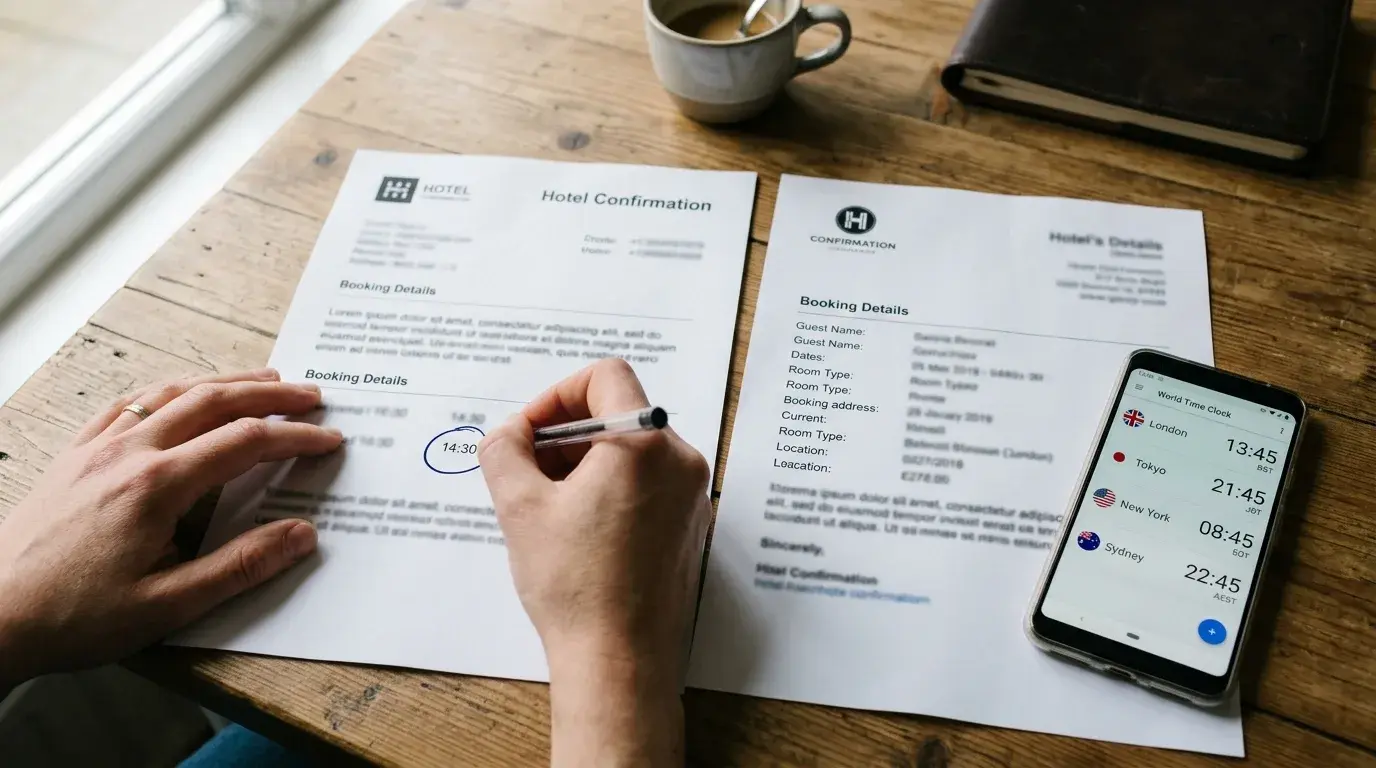
The safe next step is a ten-minute read of the record in front of you, done on the day you book and again before any deadline. Start with the hotel booking confirmation, because it is the document that states your terms.
Work through it in this order:
- Find the penalty-free line. It is usually a date and time with a phrase such as "free until" in front of it.
- Note which clock the time uses. If the record does not say, ask the property rather than guessing.
- Convert that time to your own, and write both beside the hotel name.
- Read what follows the deadline: the first night, a percentage, or the full price.
- Find the no-show wording and compare it with the late-release charge.
- Save the confirmation code, the booking reference and the hotel details on the day you book.
Keep the result as a four-line sheet for each booking: the deadline as printed, the clock it names, the deadline in your own time, and the charge if you miss it.
For Record A in the fictional example, that sheet reads "12 March, 00:00", "Lisbon", "05:30 in Mumbai", and "first night". Four short lines are easier to act on at 06:00 than a full confirmation email.
Check the document type as well. A reservation document, a payment receipt, and a price quote are different records, and each carries different terms. A confirmed booking should name the guest as the passport details do, with no nickname or shortened surname.
Then match the record to the rest of your plan. Booking dates, hotel dates, and check-out dates should sit inside your travel schedule, your flight plan, and your day-by-day plan for the destination city. The DummyFlights guide on matching hotel dates to flight dates walks through that check night by night.
Exit dates should fall after the last hotel night, and travel insurance dates deserve the same glance. If any of them disagree, fix the source record instead of explaining the gap later.
Add a buffer. In our view, set a reminder at least twelve hours before the deadline, counted in the hotel's own time, because a deadline measured in another time zone is easy to misjudge by a few hours.
When you message the property, name the booking, the original arrival date, and the new arrival time, and ask for a written reply. A vague note such as "running late" leaves the property to guess how late, and a written reply gives you something to show if a charge appears anyway.
After you release a room, look for the confirmation email, and check spam and junk folders as well. If nothing arrives within 24 hours, contact the property to confirm it received your request. Until then, treat the booking as active.
When travel plans change, repeat the read from the first step on the new record. A changed booking is a new record with its own deadline. If an official checklist asks for specific accommodation evidence, follow it first; that part of the file sits outside this guide.
What Can an Embassy Actually Verify About a Hotel Record?
A hotel record shows less than people hope and more than they expect. Many consulates read accommodation beside the flight and the dates, and visa officers can notice when the pieces disagree.
Some consulates may check accommodation details with the property. A check usually shows only what the reservation system holds on that day: the guest name, the dates, and whether the reservation is active. A released booking looks released, and a lapsed one looks lapsed.
That is why the useful test is honesty and currency, not price. A reservation a hotel can find, that still stands on the day it is checked and that you describe truthfully, is what a reader expects. Edited or invented documents and false information are a different order of problem from any hotel fee, and they can lead to a refusal.
Consistency is the practical test. The hotel dates should match the flight dates, the cover letter and the form. A mismatch in travel documents can draw extra scrutiny, so compare the dates on the booking with the flight reservation and the cover letter before the file moves on.
Timing matters too. A DummyFlights dummy hotel booking stays valid for 48-72 hours, so order it close to your appointment or the date the file is checked, not weeks ahead. If your checklist asks for a specific form of accommodation evidence, follow it first.
A fee does not make a record stronger or weaker. A paid no-show fee proves only that a charge was made, and a flexible booking proves only that a reservation stood at a point in time. Neither says anything about the purpose of the trip, which belongs to the rest of the file.
No record can promise visa approval, and visa requirements differ by destination. What you control is whether the accommodation proof you submit is accurate, current, and part of the visa documentation you can explain. For a wider view of what consulates expect from accommodation evidence, BookForVisa has a hotel reservation for visa guide.
When Does a Dummy Hotel Booking Make More Sense Than a Flexible Room?
A dummy hotel booking is a temporary reservation made to support the accommodation proof in a visa file, and its appeal is money and timing. It is not a room for an actual stay, and hotels do not treat it as one.
The main benefit is that no room money is committed before the decision. The UK's guide to supporting documents for visitors lists hotel bookings among the documents that are less useful as evidence for a visit visa, so a UK applicant should not pay for a room just for the file. Other offices ask for accommodation evidence, so follow your own checklist.
A flexible paid room still carries a deadline and a fee schedule that you must watch while the visa is pending. A dummy hotel booking costs a flat $15 per person and stays valid 48-72 hours; it has no penalty clock tied to the room, because no room has been paid for.
Once dates settle after the visa decision, you can compare real accommodation options and book a paid room with the right rate for your plans. Applicants who book a flexible room instead need to watch the clock described earlier in this guide.
These benefits hold only for a record you can read. Recheck the property name, the guest name and the dates on any dummy hotel booking before relying on it, and make sure it matches the rest of the file.
| Question | Flexible paid room | Prepaid fixed room | Dummy hotel booking |
|---|---|---|---|
| Money committed before the visa decision | Often none until the deadline, then a penalty | The full stay | A flat $15 per person |
| Main risk | Missing the penalty-free deadline | Losing the full amount if plans change | Lapsing before the file is checked |
| How long it lasts | Until the stay or the release | Until the stay | 48-72 hours |
| Good for an actual stay | Yes | Yes | No; it supports visa paperwork only |
| Best when | Dates are firm and the window outlasts the decision | The trip is certain | The decision is pending and the checklist accepts a reservation |
Put the risks side by side. A flexible room risks the penalty after its deadline, while a dummy booking risks lapsing or drifting out of line with the flight. Each risk is controllable only when you know its date.
Our view: if your dates are firm and the property's penalty-free window outlasts your decision timeline, a flexible booking is simple and keeps a real stay. If either is uncertain, a dummy hotel booking removes the deadline problem rather than managing it. For the basics of the product, read what a dummy hotel booking contains.
The same caution applies to flight tickets: commit money only when the dates are settled.
Which Questions Should You Ask the Property About a Paid Room?
What time zone does the deadline use? The hotel's. Ask for the deadline in writing with the zone named, then convert it yourself and keep both times beside the confirmation.
Is the no-show charge the same as the late-release charge? Not always. The first night and the full booking amount are both common, so ask for the exact wording instead of assuming.
Can you move your dates on a paid room instead of releasing it? That depends on the rate. Dates on a prepaid fixed booking usually cannot be moved, while a flexible rate may allow it under the property's policy.
Will the room be held if you arrive late? Message the property with your new arrival time before the arrival date ends, and ask for a reply you can save.
Can a consulate contact the hotel? Some may check details with the property, so make sure any record you submit is genuine, current and described truthfully.
Where can you find the policy again later? Each property's terms appear on its information page, during booking, in the fine print, and in the confirmation email, so save the text on booking day.
Who do you contact if the property does not reply? Use the booking page, the app, or the platform's Help Center, and include your booking details, a short summary, and any supporting documents.
How do you know a release worked? Look for the confirmation email. If none arrives within 24 hours, contact the property.
Which Date Should You Write Down First?
For a Mumbai to Lisbon trip like Daniel's, write down the penalty-free deadline first, in the hotel's own time, then the no-show trigger, then the penalty each one carries. Those three lines separate a message sent on time from a bill that arrives later.
The terms belong to the property, so read the record you hold, double-check the clock, and keep a dated copy of everything you save. If the visa is still pending and you would rather not watch a room clock at all, a dummy hotel booking supports the accommodation proof without one.
Rather not watch a room deadline while the visa is pending? Get a dummy hotel booking for $15 per person, and add a matching dummy ticket with a real PNR for your flights.
Get your $15 dummy hotel bookingFrequently Asked Questions
What is the difference between a no-show fee and a penalty-free deadline?
The penalty-free deadline is the last moment you can release a paid room without a charge. A no-show fee applies when you neither arrive nor release the room in time. Both are set by the property, and the no-show charge is typically the first night or the full booking amount.
Which time zone does a hotel deadline use?
The hotel's own local time. A deadline of 00:00 on 12 March in Lisbon is 05:30 the same morning in Mumbai, so an applicant acting at 07:00 in Mumbai has already missed it. Convert every deadline yourself and write both times beside the confirmation.
Does a hotel no-show fee affect a visa application?
A fee says nothing about the purpose of your trip. What matters for the file is whether the accommodation evidence is genuine, current and consistent with your flights, cover letter and form. Follow your consulate's checklist for the kind of accommodation evidence it wants.
How long is a DummyFlights dummy hotel booking valid?
A DummyFlights dummy hotel booking stays valid for 48-72 hours and costs a flat $15 per person, the same as a dummy ticket. Order it close to your appointment or the date the file is checked, so it is still active when the consulate reads it.
When is a dummy hotel booking better than a flexible paid room?
When the visa decision is still pending and your dates may move. A flexible room carries a penalty deadline you must watch; a dummy hotel booking supports the accommodation proof for $15 per person without a room charge. Book the real room once the visa is granted.
Can a dummy hotel booking be used for an actual stay?
No. A dummy hotel booking supports the accommodation proof in a visa file. It is not a paid room, and hotels do not treat it as a booking for a real stay. Once your visa is decided, book and pay for the room you will actually use.
Friendly reminder: DummyFlights provides dummy tickets and dummy hotel bookings to support visa applications and onward-travel proof at immigration. Requirements vary by destination, consulate, visa category and traveller situation. A dummy ticket supports your file; it is not a paid ticket for travel and does not guarantee visa approval or entry.