
Short answer: A Honduras onward ticket should show a real departure that fits both your passport's visa conditions and the stay actually granted. A dummy ticket is a temporary flight reservation, not a paid fare; ask the operating airline whether it accepts a live hold. A named bus booking can document a real road exit, but an internal CA-4 crossing does not reset shared regional days. Do not use a blanket 90-day rule: current UK guidance says British visitors need a visa and receive a 30-day stamp, while US guidance describes different terms for US tourists.
Honduras is the passport-specific exception that a generic CA-4 checklist can miss. This guide keeps the original airport, land-border, airline, document, refund and multi-country workflows, but separates the visa a traveler needs from the regional clock and the departure proof a reviewer may request.
Key facts
- Current US guidance says US tourists can visit for 90 days or less without a visa and need a return or onward ticket.
- Current UK guidance says British visitors need a visa for Honduras and describes a 30-day entry stamp; verify individual visa and extension conditions.
- CA-4 time starts at first regional entry and does not automatically restart at an internal border.
- A PNR is a booking locator, not proof of payment, ticket issuance or universal acceptance.
- Airline boarding, Honduras admission and the next country's entry are separate checks.
In This Guide
- What Honduras Immigration Expects From Your Exit Plan
- Why the CA-4 Agreement Changes How You Plan Your Exit
- Choosing Between a Flight, a Bus, and a Refundable Fare
- What Airline Staff Check Before You Ever Reach Honduras
- Your Arrival Day at Tegucigalpa, San Pedro Sula, or Roatán
- Crossing Into Honduras by Land From Guatemala, El Salvador, or Nicaragua
- Refundable Fares, Price Locks, and Short-Term Reservations Compared
- Matching Names, Dates, and Codes So Your Booking Holds Up
- Planning the Legs After Honduras
- Your Honduras Exit Plan, Ready Before Takeoff
- Frequently asked questions
Official-source check: UK Honduras entry guidance states the British visa and 30-day stamp position, explains CA-4 days, customs QR and border fees. US Honduras travel guidance gives the US tourist visa and onward-or-return position. Honduras's National Institute of Migration is the local authority for current categories and extensions. These sources are passport-specific; confirm your own route before departure.
Reviewed for: passport-specific visa and stay, CA-4 first-entry clock, real air versus road exit, carrier acceptance, issued ticket versus hold, official taxes and customs declaration, and next-country admission. Examples are illustrative.
What Honduras Immigration Expects From Your Exit Plan
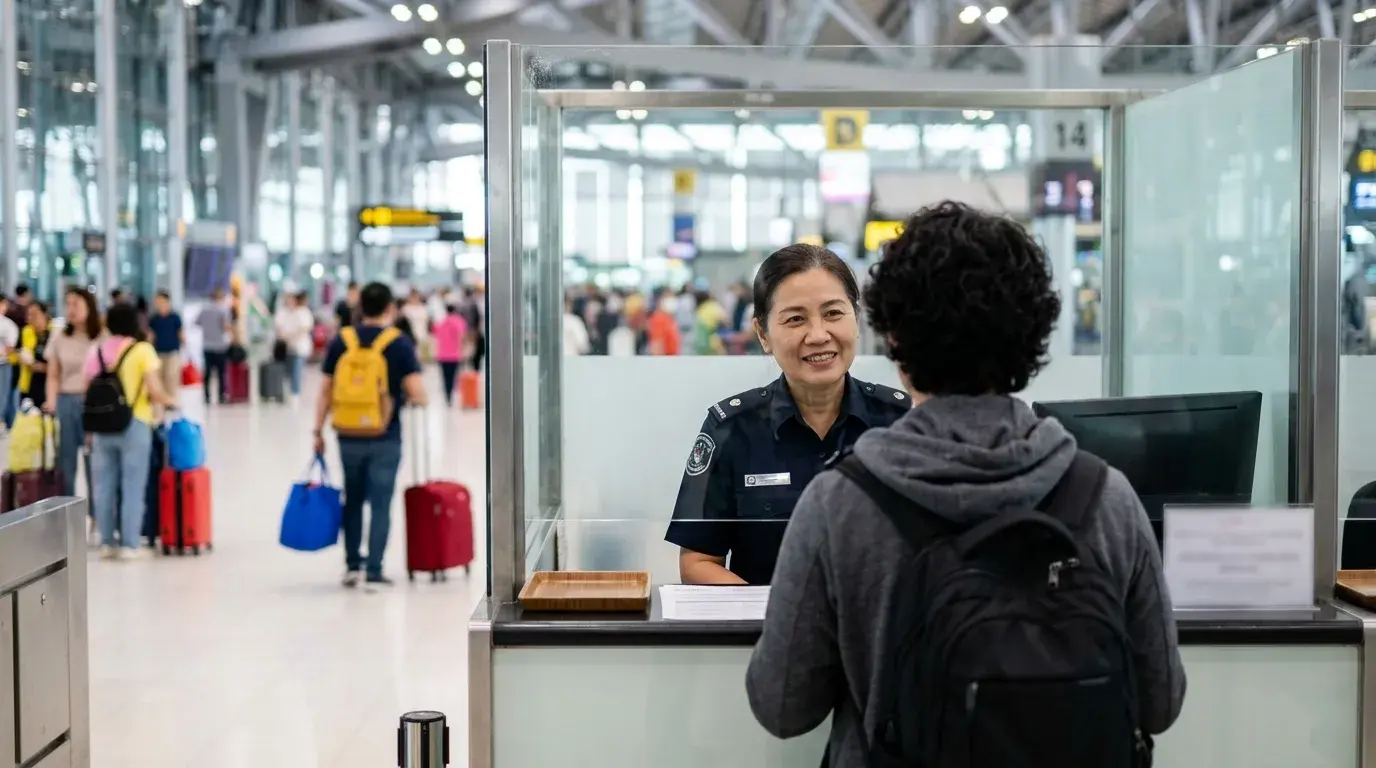
A Honduras exit plan is not merely decorative. The operating airline may review it before boarding, and a Honduran officer may assess admission later. Neither check guarantees the other's outcome.
Why Honduras Asks for Proof of Onward Travel
Current US travel guidance says US visitors need a return or onward ticket. The precise rule for another passport or visa category must be checked with Honduras's immigration authority, the relevant mission and the operating airline.
An onward document supports a proposed departure; it does not prove a traveler will leave or guarantee admission. The form should fit the real route, passenger and permitted period.
Travelers may be asked for onward evidence at check-in, transit or admission. The frequency of checks varies, so prepare the authentic document even if another traveler says nobody asked them.
A clear plan makes a review easier, but officers assess the full entry conditions, not one ticket alone. Visa status, purpose, funds and the admissibility of the next destination can matter too.
The 90-Day Clock and Your Departure Date
Do not assume every tourist receives 90 days. US guidance describes 90 days or less without a visa for US tourists; current UK guidance says British visitors need a visa and receive a 30-day visit stamp. Check the permission actually issued to you.
Place the actual departure within the visa and admission period you personally hold. A flight dated beyond that period may require a lawful extension first, even if another nationality receives more time.
Illustrative example: Emily arrives on 3 March and receives permission through 1 April. A 20 March departure fits that record; a 15 June flight does not, unless she obtains a valid extension or different permission. Do not infer a 90-day grant from the map.
Leave practical time for weather or schedule changes where feasible, but no universal two-week buffer is required. The hard constraint is the lawful end date and the traveler's real route.
Check your own passport and visa category before using a CA-4 day calculator. A British visitor, for example, currently needs a Honduras visa even if other CA-4 destinations permit a visa-free visit.
What Counts as Acceptable Evidence at the Desk
A return flight or genuine onward transport can document different departures. Confirm what your airline and Honduras authority accept for your route; one format is not universally sufficient.
The formats travelers use most often look like this:
- Issued return or onward flight that matches the genuine plan
- Accepted active flight reservation with its provisional status disclosed
- Named international bus ticket for a real road exit, if accepted
- Other genuine international transport specifically accepted for the itinerary
Each option has different evidentiary value. A bus into another CA-4 country shows a Honduras exit but not a regional exit; a provisional flight may fail a ticketed-carriage requirement.
A transport reference can help verify a record, but no universal rule says every valid exit document must have an airline PNR. A bus operator may issue a different reference; a PNR alone does not prove ticket issuance.
What Officers Check First on Your Itinerary
For a flight, a current booking reference can help an issuer or carrier locate the record. A bus ticket uses its own operator's confirmation. Officers do not necessarily access the same airline system or check every code.
A fabricated document is unacceptable. An authentic hold, paid fare or bus booking should accurately describe its status and route; appearance or code format cannot guarantee a successful review.
A quick check usually covers these points:
- Passenger name matching the passport and provider format
- Real international route and dated exit
- Booking, hold or issued-ticket status clearly identified
- Date within actual permission and CA-4 period, when relevant
- Next-country entry authorization
A mismatch can trigger a question or delay. Resolve it through the issuer; a matching set of fields is helpful but does not end every immigration inquiry.
How Visa Applications and Travel Plans Connect
A visa-file itinerary and a border-crossing document answer different questions. If the real trip changed after an application, carry the current booking and explain the change truthfully; do not preserve a false route merely to match an old form.
A sudden change between what you declared and what you present can raise eyebrows. If your plans shift, update your travel documentation so every page tells the same story. Consistency is the cheapest form of credibility you can carry.
Carry both printed and digital copies. Phones die, and airport Wi-Fi fails. A paper copy of your onward travel proof costs almost nothing and saves a lot of stress.
Keep one more habit in mind. Save your travel evidence in an offline folder on your phone, and email a copy to yourself. If your bag goes missing, your proof does not.
What to Do When Your Exit Date Is Still Open
An open-ended traveler still needs a lawful period and a credible departure plan. Honduras admission terms differ by nationality; a flexible itinerary cannot substitute for an extension or visa.
Choose the real exit date you can support within your actual permission, not the latest date in a generic 90-day window. Update the booking if plans move and obtain any needed extension before expiry.
Compare the real change and cancellation terms. A flexible fare, bus booking or provisional flight hold solves different problems, and some holds cannot be amended or kept active for a long trip.
Write your plan down in one line before you travel. For example: "Arrive 3 March, leave Honduras by bus on 25 May, fly onward on 28 May." That single line keeps your travel documentation, your answers, and your booking in step.
Describe uncertainty honestly if asked. Show the current intended date and explain how the transport can be changed under its actual terms; do not present a provisional document as an inflexible commitment or an issued ticket.
Honduras also sits inside a regional border pact, and that pact changes how you should read your dates.
Why the CA-4 Agreement Changes How You Plan Your Exit
A Honduras itinerary can be misdated if previous CA-4 days are ignored. Count the regional history and then apply the Honduras visa and admission period actually granted to this passport.
How the CA-4 Border Control Agreement Shapes Your Clock
Honduras, El Salvador, Guatemala and Nicaragua form CA-4. Internal movements remain subject to border checks and nationality-specific visa conditions; the arrangement does not create a universal permission to enter Honduras.
A common CA-4 period generally runs from first regional entry rather than restarting in each member state. That does not override a shorter Honduras stamp, a visa condition or an extension decision.
Illustrative example: Daniel used 35 days of an authorized CA-4 period in Guatemala. His regional balance may be shorter on reaching Honduras, but he must also meet Honduras's own visa and stamp conditions; subtracting 35 from 90 is not the whole decision.
Verify the current rule for the passport. UK guidance now says British visitors need a Honduras visa and receive a 30-day entry stamp; US tourist guidance describes different terms. Use the shortest applicable lawful deadline.
Why Your First Entry Stamp Matters Most
Record the first CA-4 entry and the Honduras admission separately. An officer may review both. A stamp or electronic record, not an assumed national standard, is the date anchor.
Photograph your passport pages as you go. If an officer questions your count, a clear record of your first arrival helps you explain it. Keep the photo with your onward travel proof.
Build the departure from the earlier of your actual Honduras permission or the relevant CA-4 end. If an extension is needed, seek it from the National Institute of Migration before permission expires.
A mismatch here is easy to make and easy to avoid. Count the days on a calendar app before you book, and count them again after you cross each border.
Choosing an Exit Point Inside or Outside the CA-4 Zone
A bus from Honduras to Nicaragua, Guatemala or El Salvador leaves Honduras but stays inside CA-4. It cannot by itself show departure from the whole regional allowance.
For a longer trip, map the final exit from the CA-4 area as well as the Honduras leg. A later flight to Panama or a real road crossing to a non-CA-4 country answers a different timing question.
Consider these two cases:
- Bus to Nicaragua: Honduras departure, but CA-4 time continues
- Flight to Panama: both Honduras and CA-4 departure, subject to Panama admission
- Return flight home: clear regional exit when genuinely planned and within the lawful period
The stronger record is the one that matches the actual journey and relevant deadline. A CA-4 internal ticket is not wrong, but it does not extend regional days.
What Costa Rica Panama Routes Add to the Picture
A later Costa Rica or Panama leg introduces separate passport, entry and onward-document rules. Do not import their requirements into Honduras or assume one national exit booking satisfies the next border.
Plan the chain: Honduras departure, any intermediate CA-4 movement, regional exit and the next country's admission. Dates must fit each applicable permission.
Keep a current record for each meaningful international leg. Avoid buying conflicting 'backup' tickets solely for appearance; every document should reflect travel you could actually take.
How Other Countries Compare on Onward Rules
Avoid global counts of countries that supposedly require onward travel; rules are passport-, route- and time-specific. Compare each destination's current official guidance instead.
Do not rank destinations as universally 'strictest.' A traveler heading beyond Central America should check the next country's published entry conditions and the operating airline's document standard.
Costa Rica has its own onward-travel rule, but a document accepted there does not automatically satisfy Honduras. Keep the two reviews and their dates separate.
Use authentic evidence for each actual border. A generic backup cannot fix a visa deficit, a date beyond permission or a destination that will not admit the traveler.
Planning a Multi-Country Loop Without Breaking the Rules
A loop through Guatemala, Honduras, and Nicaragua looks easy on a map. In practice, each leg adds a border crossing, a stamp, and a question.
Use this simple approach:
- Record the first CA-4 entry and actual authorized period
- Check Honduras's own visa and stamp conditions
- Identify a genuine exit from Honduras and, when needed, CA-4
- Verify the next country's entry rules
- Review the transport record before each check
A simple timeline reduces avoidable errors, but it cannot guarantee admission or substitute for official permission.
What Your Passport Country Changes in This Equation
CA-4 membership does not erase nationality-based visa rules. Current UK guidance requires British citizens to have a Honduras visa; US tourist guidance describes visa-free stays of 90 days or less for US citizens.
Read the actual visa, entry stamp and any extension decision. The stay may be shorter than a regional maximum. Never set an exit date solely by a friend's passport or a generic chart.
Travelers with different passports may face different entry categories, document requirements and admission periods. Verify the rule that applies to each member of the party.
If the rule is unclear, contact the Honduran mission or National Institute of Migration before buying travel. An unanswered email is not permission to enter or stay.
Recheck the official destination and transit conditions close to departure, especially when the itinerary adds a border or changes transport mode.
Now that your dates make sense, you can decide which kind of document to carry.
Choosing Between a Flight, a Bus, and a Refundable Fare

Flight, bus and refundable fare can support different real routes. Their acceptability and cost depend on passport, mode, operating carrier and actual booking status; no format is automatically approved by every Honduran officer.
When a One Way Flight Out of the Region Makes Sense
An issued onward flight outside CA-4 clearly documents a dated regional departure when that is the real plan. Its next destination must admit the traveler, and its date must fit the shorter applicable permission.
Illustrative example: Olivia plans to leave Honduras for Panama by air. She checks her Honduras admission, accumulated CA-4 days and Panama entry conditions before choosing the flight; no acceptance outcome is presumed.
Compare live fares and change terms. One-way pricing varies by carrier and route, and no reliable rule says it is always more than half a return fare.
Ask the operating airline which onward document it accepts for this passenger and itinerary. Its pre-boarding check can differ from the later Honduran admission review.
When a Bus Ticket Beats a Flight on Paper
A named international bus ticket fits a genuine road departure from Honduras. But a bus to another CA-4 member does not end shared regional time.
Confirm the current operator, border crossing, passenger name and departure date. A ticket terminating inside Honduras is not evidence of international exit.
Do not assume an airline categorically rejects bus evidence or prefers only flights. Ask the carrier operating the inbound flight what document it will accept for an actual road exit.
Avoid presenting a contradictory flight solely to pass check-in while intending a different bus exit. If a carrier requires issued air carriage, resolve that requirement honestly before travel.
What a Return Flight Does and Does Not Prove
An issued return flight can show a genuine departure back to the origin. It does not guarantee admission, and a provisional return hold is not the same as a purchased fare.
Round-trip fares may be cheaper or dearer than two singles; compare the actual fare terms and total cost rather than assuming a pricing rule.
The weakness is flexibility. A return ticket fixes your departure date, and changing it can trigger fees. If your trip may stretch or shrink, a rigid return can become a problem on day 80.
If the real journey continues to a third country, show that onward route instead of an unrelated return ticket. Consistency matters more than the familiar shape of the fare.
How Flight Prices Swing Between Booking Windows
Flight prices around Central America move quickly. Fares to and from Honduras rise during holiday weeks, school breaks, and dive season on the Bay Islands.
Booking early lowers your risk of a spike, but it also commits you before your plans settle. Booking late keeps you flexible, but it exposes you to higher costs and fewer seats.
Watch for hidden fees when you compare. Baggage charges, seat selection, payment surcharges, and change penalties can double a cheap fare. The advertised price and the final price rarely match.
Payment protections vary by card, issuer, country and dispute basis. Do not assume a particular card will refund a voluntary cancellation or an entry-document problem.
Comparing Cost, Risk, and Flexibility Side by Side
Issued refundable fares and temporary reservations are different. A fare provides carriage under its terms; a hold can expire without ticketing and may not meet a paid-ticket requirement.
Use this comparison to decide:
| Option | What it proves | Check before relying on it |
|---|---|---|
| Issued onward flight | Ticketed international departure | Fare, date, next-country admission |
| Return flight | Ticketed trip back | Refund and change conditions |
| International bus | Actual road exit from Honduras | Carrier acceptance and CA-4 clock |
| Temporary flight hold | Provisional intended air route | Expiry and whether unticketed proof is accepted |
Choose according to the genuine route and stated document rule. A low-cost hold is not stronger merely because it displays a PNR; a paid fare is not useful if its destination or date contradicts the trip.
Ask how certain the exit date is, which evidence the operating airline accepts and what funds can be tied to a refundable fare under its actual refund timetable.
Combining Formats for a Longer Route
Some journeys have distinct real transport legs, each with its own document. That differs from holding mutually contradictory exits for the same date to influence a reviewer.
A traveler may have a bus from Honduras to Nicaragua and a later flight from the CA-4 area to Panama. Show both when relevant; the first exits Honduras, the second exits the region.
Use documents that describe the actual sequence. A fabricated flight is not a suitable backup for an overland plan, and a regional bus cannot solve an expired CA-4 period.
Dates and locations across the real legs should connect. If a plan changes, update or cancel the superseded record through the issuer instead of showing two incompatible final exits.
Keep a current set of documents. Archive superseded copies so you do not accidentally present an old date or status as current.
The answers to your three questions narrow your choice quickly, and the next step is to see what happens at your departure airport.
What Airline Staff Check Before You Ever Reach Honduras
Your first real test happens far from Honduras. The agent at your departure airport decides whether you board, and that agent works under rules of their own.
Why the Check Happens at Your Departure Airport
An airline may check destination documents at online check-in, bag drop, transfer or gate. The timing varies, so keep current evidence accessible through the last boarding point.
Carrier-liability and return-transport obligations can motivate pre-boarding checks, but exact obligations depend on route and law. Do not assume the airline always pays every cost or uses one global document standard.
Have the record ready when asked, but check the airline's own process. The review may happen at more than one airport, and an online boarding pass is not a promise that later checks are waived.
Online check-in does not always remove the step. Some carriers flag Honduras routes and ask you to visit a desk to confirm your documents. Arrive early enough to handle that without panic.
Why Airlines Must Check Onward Tickets
Airlines check travel documents under carrier policy and destination rules. No universal law says every carrier must demand an onward airline ticket from every Honduras passenger.
Do not rely on an unsupported fixed carrier-fine figure. Penalties and obligations vary by jurisdiction and case; the practical task is to meet the actual entry and carrier requirements.
Treat a document request as a route-specific check, not a personal accusation. Ask exactly which visa, exit mode, date or booking status the agent needs to verify.
That view helps you stay calm. You are not being accused of anything. You are helping the agent finish a required step.
What Happens When a Boarding Pass Depends on Your Document
An unresolved document question can delay a boarding pass. The issue may be a visa, passport, exit route or ticketing status, not merely the absence of a PNR.
A carrier may refuse boarding if applicable entry-document conditions are unmet. The frequency and financial outcome are not predictable from a generic article; identify the exact issue early.
A replacement may be possible before check-in closes, but do not rely on a last-minute purchase. Confirm whether the carrier needs an issued fare or would accept genuine road transport.
Prepare in advance. Keep your document ready, and keep a backup in case the first one will not load. A second copy in your email saves you from a dead battery or a weak signal.
What Agents See in the Airline's System
An agent may inspect a booking code or another transport confirmation. Not every agent has access to every airline or agency system, and a bus ticket uses its operator's record rather than a flight PNR.
An issuer record can identify a passenger, route, date and status. An issued e-ticket number, where present, is distinct from the PNR. Ask what the agent can verify through the supported channel.
A polished PDF cannot make a nonexistent booking real. Equally, a consumer website failing to display an agency record is not conclusive; resolve status with the issuer.
Check the issuer's supported verification method. If the public manage-booking page displays the record, compare it with the PDF; if not, contact the issuer rather than assuming the agent sees the same screen.
How to Handle a Questioning Agent Politely
Stay calm, speak plainly, and answer exactly what the agent asks. Agents deal with hundreds of travelers each day, and a short, clear answer helps them move on.
Here is a simple pattern:
-
State your exit plan in one sentence
-
Offer the document without being asked twice
-
Point to the date and the code
-
Wait while the agent checks
Do not argue about the rule. If the agent says no, ask politely what format they would accept. Many agents will explain what works, and some will even point you to a sales desk.
For a family, verify that each passenger is correctly named on the actual shared or separate booking. One PNR can include several travelers; it is the passenger list, not one-reference-per-person, that matters.
What to Do If the Agent Rejects Your Document
A rejection at the counter feels like a crisis, but you usually have options. Ask the agent which detail failed. The answer tells you what to fix, and it is often small.
Name, date, expiry, visa and carrier-required ticketing status are possible issues. Diagnose the exact one before paying for a replacement; not all can be fixed at the counter.
Try these steps in order:
- Ask which document condition is unmet
- Check the issuer's current status and passenger details
- Ask for a supervisor or document-desk review when a rule is unclear
- Obtain a truthful replacement only if time and terms permit
- Keep the airline's stated reason for follow-up
Keep track of the time. Check-in counters close well before departure, and a rushed purchase can cost you the flight even if the document works.
If the agent still refuses, ask for the reason in writing or ask to speak with a supervisor. Stay polite throughout. A calm traveler gets help faster than an angry one, and agents remember how you spoke to them.
How Early to Arrive When Honduras Is Your Destination
Allow extra time for an international document review based on your carrier's check-in opening and closure times. No universal three-to-four-hour arrival rule applies at every airport.
The extra time pays for itself. If the agent finds a problem, you have room to solve it. If they find none, you wait in the lounge with a coffee and no regret.
Verify your actual counter opening and online-check-in process. Arriving before a counter opens may not help; the useful buffer is before its closing deadline.
Travel with all your documents in one pocket. Your passport, your exit proof, and your first night's booking should come out in one motion. Fumbling through bags slows you down and signals nerves.
Once you pass this step and land, a different set of questions begins.
Your Arrival Day at Tegucigalpa, San Pedro Sula, or Roatán
The plane has landed, your bag is still on the belt, and the last gatekeeper stands between you and your trip. Arrival day goes smoothly when you know the order of events and keep your paperwork within reach.
The Walk From the Jet Bridge to the Immigration Booth
Most international arrivals follow the same path. You leave the aircraft, follow the signs, and join a queue for the immigration booth. The queue can be short in Roatán and long in San Pedro Sula when several flights land together.
Use the walk to get organized. Pull out your passport, your entry form if you have one, and your exit document. Put them in one hand so you do not dig through a backpack at the booth.
Tegucigalpa has two airports in play for many travelers. Toncontín handles a lot of regional traffic, and Palmerola, near Comayagua, serves international routes too. Check which one your flight uses, because your ground transfer plan depends on it.
Keep your phone charged and your screen brightness up. If the officer asks to see your onward travel proof, a dim screen or a dead battery turns a simple request into a delay.
Questions a Border Officer May Ask
A border officer may ask about purpose, length of stay, accommodation, funds and exit route. Interview length and outcome vary; do not promise a one-minute admission.
Travelers may face questioning at immigration without an onward ticket. Even with one, expect a short exchange. The officer wants your answers to match your documents.
Here are typical questions and how to answer them:
-
How long will you stay? Give the number of days, and make it match your exit date.
-
Where do you go next? Name the city or country on your document.
-
Where will you stay? Give the name of your first hotel or hostel.
-
Do you have a ticket out? Show it, and point to the date.
Answer in short sentences. Avoid long stories about your plans. If the officer wants more detail, they will ask.
Answer truthfully and courteously. Clothing, eye contact or rehearsed confidence does not prove eligibility; complete, consistent documents matter more than performance.
What Happens If the Document Does Not Pass
Missing or unsuitable evidence can lead to follow-up questions or refusal in some cases. Only the authority can decide based on the full facts; do not describe a single missing ticket as an automatic deportation trigger.
An officer may request another document or direct a traveler to secondary review. Whether a new purchase can be made at the port is discretionary and should never be the travel plan.
A refusal can create carrier and traveler obligations under applicable law and fare conditions. Do not claim every cost inevitably falls on one party or promise a specific return process.
Stay polite if something goes wrong. Ask what the officer needs, and ask if you may use a phone or Wi-Fi to retrieve a document. Arguing rarely helps, and calm answers often do.
The Airport Counter Fix and Why It Is a Stressful Option
Some travelers decide to solve the problem at the last minute. They land, find a counter, and buy a ticket. It can work, but it is a stressful option.
Last-minute fares vary widely by route, season and availability. Avoid a fixed airport price range; compare actual live options before leaving home.
You also depend on the counter being open, the system being online, and your card being accepted. Any one of those can fail, and you do not want to learn that at 2 a.m. after a long flight.
A better plan is to arrive with the document ready. If you need a backup, get it before you leave home, where you can compare prices, read the terms, and keep your nerves steady.
Small Airports, Small Queues, Same Rules
Airport size or atmosphere does not change the traveler's visa and admission conditions. Check the current rule for the actual port rather than assuming a quiet counter is lenient.
An officer at any Honduran port may assess the applicable documents. The precise questions and processes vary; prepare the real itinerary for each entry point.
Island travelers should prepare for one extra step. Many visitors reach Roatán by connecting through the mainland or through another Central American hub. Your onward document has to cover the full journey, not just the last leg.
Keep your proof available while you travel between islands and the mainland. Domestic flights and ferries do not usually trigger an onward check, but a random question can happen anywhere.
Small Habits That Smooth Your Arrival
A few habits help every traveler:
-
Keep a printed copy of your exit document in your passport holder
-
Save a PDF to your phone and to a cloud folder
-
Know your first night's address by heart
-
Carry a small amount of cash for fees or transport
These steps take five minutes at home. They save you much longer at the airport.
Practice your answers aloud once. It sounds silly, but a rehearsed sentence about your plan comes out clearer than an improvised one. Say where you stay, how long you stay, and how you leave.
Keep papers organized for fast access, but do not suggest that appearance or body language determines honesty. An officer assesses the actual conditions and may ask further questions.
Arriving by air is only one way into Honduras, and the land route has its own habits.
Crossing Into Honduras by Land From Guatemala, El Salvador, or Nicaragua
Land entry still involves immigration control and passport-specific Honduras conditions. A CA-4 neighbor crossing is not automatic admission, especially where a visa is required.
Which Land Borders Travelers Use Most
Honduras shares frontiers with three countries, and each has well-known crossings. From Guatemala, many travelers use El Florido, near Copán Ruinas, or Agua Caliente in the west. From El Salvador, travelers often cross at El Amatillo or El Poy. From Nicaragua, Guasaule and Las Manos see steady traffic.
Each land border has its own rhythm. Some crossings are quiet and quick. Others fill with trucks and buses, and the process slows. Plan your timing around the busiest hours.
Even an internal CA-4 crossing can involve a passport, visa, stamp and remaining-days check. Do not infer admission from how quick a prior border felt.
Check official crossing procedures and hours in advance. Local anecdotes may be useful logistics tips but cannot replace the immigration rule.
What Border Officials Ask For on Foot or by Bus
A land officer may ask for passport, visa or exemption, actual authorized period and onward plan. Do not assume the same evidence standard as the inbound airline.
On a bus, the process can feel different. Drivers often collect passports, and passengers file through a counter in groups. Officers may check your document at the window or in the bus aisle.
Keep your exit document where you can reach it fast. A buried paper slows the whole group, and you will feel the pressure of a driver waiting.
A land officer may ask about accommodation, funds, remaining regional days or the next leg. The questions vary by port and traveler; give short, accurate answers rather than relying on a past airport experience.
If you travel with a group, each person answers for themselves. Do not let one traveler speak for the others, and do not coach each other through the questions.
Showing a Bus Reservation Versus a Flight at the Frontier
A named bus reservation can support a genuine Honduras road exit. If it leads to another CA-4 member, also keep track of the later regional exit before shared time ends.
A flight outside CA-4 documents a different type of exit. Do not claim officers generally prefer it; choose the route that is real and verify what the reviewer accepts.
The document should explain an actual departure on a lawful date. It does not by itself prove that a visitor will leave or satisfy every visa condition.
Mixed plans are common. You might enter by bus from Guatemala and leave by air from San Pedro Sula. Carry the flight document for entry and keep your bus details handy in case plans change.
Some bus companies issue a plain receipt and nothing more. A receipt without a date or a code is weak proof. Ask for a ticket that shows the route, the date, and your name.
Time of Day, Fees, and Cash on Hand
Arrive early in the day when you can. Crossings are busiest in the late morning, and some offices close earlier than you expect. A mid-afternoon arrival can leave you stuck on the wrong side of the line.
UK guidance says a land-border immigration fee may be charged and recommends keeping the receipt. Check the current official amount and pay only an authorized charge; ask for a receipt when possible.
Cash may be useful at some land posts, but payment methods vary. Carry an appropriate, safe amount and confirm the current rule rather than assuming cards never work.
Cell service can be weak near the border. Download your documents before you reach the crossing, and do not count on mobile data to open a file when the officer asks.
How Overland Travelers Avoid Gaps in Proof
Overland travelers face a special risk. Their trips run for weeks, plans change often, and documents expire in the middle of the road.
Review your exit document each time you cross. Does it still match your plan? Does the date still fit inside your permitted stay? If the answer is no, update it before the next frontier.
A short checklist helps:
- Does the exit date fit both Honduras permission and CA-4 time?
- Does the passenger match the passport?
- Is the booking or bus ticket currently valid?
- Can the next country admit the traveler?
- Does the operating carrier accept this mode of evidence?
Update the answers at every major stop. It takes a minute, and it prevents the kind of surprise that ruins a good trip.
If your trip includes both land and air legs, align them. A flight out of the region should match the days you have left once you account for every border you crossed.
What Changes When You Cross With Others
Group crossings move at the pace of the slowest member. If you travel with friends, organize your documents before the border, not at the window.
Organize a group before the crossing. Each person needs a valid passport and to be correctly named on any shared or individual transport booking; one PNR may contain several passengers.
Families with children should carry extra paperwork where required, such as birth certificates or consent letters. These rules vary by nationality and by crossing, so check them early.
If you travel in a rented or shared vehicle, ask the owner about vehicle permits well before you reach the frontier. A missing vehicle document can hold up your whole group, even when your personal papers are perfect.
Whatever route you take in, the next decision is which kind of reservation to hold.
Refundable Fares, Price Locks, and Short-Term Reservations Compared
Three formats dominate the choice for Honduras: a fare you can cancel, a hold that expires, and a reservation built for a short check. Each one answers the entry question in a different way, and each carries its own clock.
Refundable Flights: Book, Show, Cancel
A genuinely refundable issued fare can document a real intended departure. Do not buy solely to display and then cancel while continuing to claim that cancelled route as the exit plan.
A paid refundable ticket has an e-ticket under its fare terms. That is different from a provisional hold, even if both have a booking reference. Check the issuing carrier's status and conditions.
A refund can take time and may be partial. Check the contract, deadline and payment method; no uniform processing period applies.
Read the fare rules before you pay. Some "refundable" fares return only a portion, and others charge a service fee. A fare that looks cheap can lose its advantage once the deductions appear.
Cancel when the genuine plan changes and the contract allows it. Update the onward evidence if the original exit is no longer valid.
The 24-Hour Price Lock and Who Offers It
Some airlines offer temporary fare-hold or price-lock products, but availability, duration and payment terms change. Do not state that Copa has a universal 24-hour offer; verify its current route-specific option directly.
A price lock or hold is not always an issued ticket. Inspect its expiry and whether the reviewer accepts an unticketed reservation before using it for entry proof.
Use it carefully for entry purposes. If you need to show a reservation at check-in, make sure the hold stays valid until after you present it. An expired hold shows up as cancelled in the system.
Panama City is a possible connection hub, but the actual route and product availability vary. Check the carrier's current schedule, fee, hold length and ticketing status rather than relying on a dated example.
Temporary Reservations and the 48-Hour Window
Temporary reservation validity varies by provider and booking. Do not assume a standard 48-hour window or that one hold automatically covers both check-in and Honduras arrival.
Time the record to span the actual review points and leave room for correction. Its displayed expiry and issuer terms—not a blanket one-to-two-day rule—control.
Account for time zones and long layovers. Confirm the current reservation will still be active when the last operating carrier and arrival officer may review it.
A short-lived booking has value only while its true status is valid and the reviewing authority accepts that type of evidence. A PNR is not a guarantee of ticketing or admission.
If your entry check might happen later, a longer-lasting document is safer. A temporary reservation that expires before the officer looks at it protects nobody.
Where Hidden Fees Hide
Every format has costs that do not show up in the headline price. Learn where to look.
-
Change fees: carriers charge to move a date, and the fee can exceed the fare.
-
Cancellation fees: a refundable fare may still deduct a service charge.
-
Payment surcharges: some sellers add a fee for certain cards.
-
Currency conversion: your bank may add a margin on foreign charges.
-
Expiry penalties: a missed deadline can turn a hold into a lost deposit.
Read the full price on the last screen before you pay. If the total changes between the first page and the last, that difference is the fee you did not expect.
Compare totals, not base fares. A cheap booking with high add-ons costs more than a simple one with a clear price.
Choosing by Timeline: How Long Must Your Proof Last?
Match your format to the length of time you need it to work.
Choose by the actual time needed. A provisional hold may be unsuitable for a later check; a purchased fare or real bus booking has different validity and cancellation terms.
DummyFlights supplies temporary itineraries. Check current price, validity, verification method and change policy; do not promise officers will verify every record or that a specific PNR presentation guarantees acceptance.
The record should be authentic and accurately described. A checked code can confirm a booking exists, but it does not decide whether a paid ticket is required.
Ask three questions before you buy:
-
When will the first check happen?
-
When might the last check happen?
-
What will it cost me if my plans change?
Flexibility has value only under the actual provider terms. Do not assume free date changes; compare the cost of amendment, replacement and a real issued fare.
Keep a note of every deadline attached to your booking. A refund window, a hold expiry, or a change cutoff can pass silently. Set a phone reminder for each one on the day you book.
Once you choose, the details inside the document decide whether it holds up.
Matching Names, Dates, and Codes So Your Booking Holds Up
A document may raise questions if identity, route, dates or status are inconsistent. Check the fields against the passport and actual plan; a small typo should be corrected through the issuer rather than hidden.
Why Your Name Must Match Your Passport Exactly
The passenger name should match the passport under the carrier's accepted format. Surname, given names and any required middle-name fields deserve careful review, especially where systems normalize spaces or special characters.
Consider Jonathan Michael Reed. His passport reads "Reed, Jonathan Michael." A booking under "Jon Reed" may look close, but an automated check can flag it. An agent has to decide whether to trust it, and many will not.
Use the machine-readable line at the bottom of your passport page as your guide. Copy the names exactly as they appear. Do not shorten, anglicize, or reorder them.
If your passport has a long or unusual name, check how the airline's form handles it. Some systems cut off long names or drop special characters. Contact the carrier or the seller before you travel if the record looks wrong.
Check titles and dates of birth as well. An error in either field can cause the same trouble as a wrong surname. Catch it now, not at the counter.
Dates That Fit Your Permitted Stay
The exit date should fit both the visitor's Honduras permission and, where applicable, remaining CA-4 time. A generic 90-day count is unsafe for a shorter stamp or visa condition.
Record the first CA-4 entry, then compare the remaining regional period with Honduras's actual visa or stamp. Use the earlier lawful deadline and verify counting conventions with the authority when close.
Check the arrival and departure times as well. An overnight flight that departs just after midnight can shift the date by a day. Read the local date on the document, not the date you remember.
If your plan involves a long layover, make sure the document shows the final exit from Honduras, not just a stop along the way. The officer cares about when you leave the country.
How Booking Codes and the PNR Code Work
A flight PNR is a booking locator, often short and alphanumeric. It may identify a hold or an issued ticket. An international bus uses a different operator reference; neither code format is universal.
The reference connects a document to an issuer record when one exists. It does not prove payment, issuance or universal acceptance, and a genuine bus ticket need not have an airline PNR.
Keep the booking reference easy to read. Print it in a large, clean font, and place it near the top of your document. A faint code on a crowded page can slow an agent down.
A booking reference identifies an itinerary record; an e-ticket number identifies issued air carriage when one exists. Payment, points and agency settlement can differ, so ask the issuer for the actual ticketing status instead of inferring it from appearance.
Use the issuer's supported lookup channel. An agency booking may not appear in a public airline portal, and a successful lookup does not mean an unticketed hold meets a paid-fare requirement.
Which Documents to Carry and in What Form
Carry your exit document in several forms so a single failure cannot stop you.
-
A printed copy in your passport holder
-
A PDF saved to your phone for offline use
-
A copy in your email for retrieval anywhere
-
A screenshot of the booking page as a last resort
Your boarding pass for the flight into Honduras also matters. Officers sometimes glance at it to confirm your arrival details, and a mismatch between your boarding pass and your itinerary raises questions.
Keep your travel documentation together in one folder. A clear sleeve with your passport, your entry form, your exit document, and your first night's booking makes every check faster.
Your exit document is also your travel evidence if anything goes wrong later. If an officer questions your stay at departure, a clean record of your plan supports you.
Fixing a Mistake Before You Fly
If you spot an error, act at once. The time to fix a name or date is days before departure, not at the airport.
Contact the seller or the carrier and explain the issue in one clear message. Include your booking code, the wrong detail, and the correct detail. Keep a copy of every reply.
Correction and reissue terms depend on carrier and fare. Ask the issuer which fields can be fixed and what the time and cost will be; do not hand-edit a PDF.
Replace an unusable document before travel if the genuine plan requires it. The relative cost cannot be predicted, and a new record still needs to match visa, route and permission.
A genuine, accurate record is essential, but no document 'passes without drama' by itself. Officers may verify other entry conditions or ask further questions.
Final Read-Through Before You Leave Home
Give your document one slow read the evening before you travel. Fresh eyes catch what rushed ones miss.
Check each field against your passport in this order: surname, given names, date of birth, then passport number if shown. Next, read the dates aloud. Then read the booking code character by character.
Look at the route as well. Does the departure city match your plan? Does the destination make sense for the trip you describe? A mismatch between your story and your route is easy to spot and easy to fix at home.
Ask a friend to read it too. Another person notices typos you have stopped seeing. Five minutes of review costs nothing and can protect hundreds of dollars.
Save the final version in three places and delete older drafts. Old files cause confusion when you reach for the wrong one at the counter.
With your document in order, you can look past Honduras to the rest of your route.
Planning the Legs After Honduras
Honduras is rarely the end of the trip. Where you go next shapes the document you carry now, and a smart exit connects smoothly to the border that follows.
Chaining Honduras to Costa Rica Panama Routes
Many travelers move south from Honduras through Nicaragua, Costa Rica, and Panama. Each border brings its own check, and each check can ask for a new exit document.
Costa Rica has its own onward requirement. If the route continues there, check its current official rule and next-country entry before assuming a Honduras document covers that later border.
A good habit is to book your last exit from the chain early, then add short links as you go. A flight out of Panama, for example, can cover the end of your journey while you handle each border one at a time.
Keep the dates consistent. Your document for Honduras should show a departure date that still leaves you time to reach each later border within the days you have left.
Panama City as a Hub and Buenos Aires Beyond
Panama City works as a hub for travelers who plan to fly out of the region. Many Central American routes connect through it, and Copa Airlines runs a large share of those connections.
From there, a long route to Buenos Aires or other South American capitals opens up. An onward flight from Panama City to Buenos Aires shows a clear exit from Central America and gives your Honduras document a destination that officers recognize.
Remember that each country on your route has its own rules. Argentina and its neighbors can ask different questions than Honduras. Check each country's entry guidance before you commit to a route.
A longer stay needs the appropriate permission. A far-future exit document should be supported by the visa or extension actually held, not by an assumed tourist allowance.
Long Hauls to Southeast Asia and Kuala Lumpur
Some travelers continue far beyond Latin America. A route from Central America to Southeast Asia is common among long-term wanderers, and Kuala Lumpur is a popular gateway because of its large hub airport.
Long-haul itineraries bring additional transit and destination conditions. Avoid claiming an entire region is uniformly strict; check each passport and operating carrier.
A long-haul document should cover the full route, not just the first stop. If you fly from Panama to Kuala Lumpur, your exit from Malaysia may matter before you ever board.
Keep your chain of documents tidy. A single folder with one proof per border keeps you ready for any question, in any language.
Digital Nomads and Open-Ended Stays
Digital nomads face a special challenge. They often have no fixed end date, and they move when the Wi-Fi, the weather, or the budget changes.
Tourist permission may be unsuitable for a longer stay or work activity. Check the lawful category and extension options with Honduras's immigration authority rather than assuming a remote-work visa exists.
For short hops, a flexible document helps. A reservation that allows date changes lets you adjust as your plans evolve, and it avoids the cost of repeated new bookings.
Describe your purpose truthfully and obtain the proper status when required. Honesty does not itself authorize work or extend the visit.
Comparing Rules Across Regions
The Schengen area's day-count system differs from CA-4 in law, visa categories and counting. Use it only as a reminder to check a shared-zone clock, not as a substitute rule for Honduras.
Other regions differ in the details. Some ask for proof of funds, some ask for a return ticket to your home country, and some check only at the airline desk. Learn the rule for each stop before you arrive.
A simple routine helps:
-
Write down every border on your route
-
Note the days allowed in each zone
-
Pair each border with one exit document
-
Review the list before every flight
This routine takes minutes and gives you a clear picture of your whole trip. It also makes each onward journey easier to explain.
Your return flight home can serve as the final piece. If you plan to go back to your home country at the end, a return flight with a date inside your limits closes the loop.
Timing Each Leg Against Your Remaining Days
Long routes eat days faster than they appear to. A week in Guatemala, ten days in Honduras, and two weeks in Nicaragua already use a month.
Draw a simple timeline with every country and every date. Mark the day your CA-4 allowance ends, and mark the day each later border expects you. Gaps and overlaps show up at once.
Leave a practical buffer where possible, but no fixed spare week cures an expired visa or regional period. Recalculate after cancellations or border changes.
Update your timeline whenever plans change. A fresh timeline tells you whether your onward document still fits, and it tells you early enough to replace it.
Share your plan with someone at home. If you lose your phone or your papers, that person holds a copy of your route and your booking codes.
When to Replace a Document Mid-Trip
A document that worked in week one may fail in week eight. Dates move, holds expire, and plans shift.
Replace your exit proof when any of these happen:
- The actual exit date no longer fits permission
- The genuine route or next-country entry changed
- The booking expired or was cancelled
- A carrier schedule change made the plan unworkable
Update the record before the next review point. Processing time varies; do not promise that a new document can be arranged in minutes at a remote frontier.
Keep the old one until the new one is confirmed. Delete it afterward so you do not show the wrong file by mistake.
Put together, these steps give you a plan you can defend at any desk.
Your Honduras Exit Plan, Ready Before Takeoff
Honduras entry depends on passport-specific visa and admission conditions as well as a credible departure plan. A real flight, accepted hold or genuine road ticket should name the traveler and leave within the period actually granted, including any CA-4 limit.
Check the current issuer status, carrier rule and next-country entry before takeoff. Keep the document accessible at each check; none of these steps guarantees boarding or admission.
Need a provisional Honduras flight reservation? First verify your visa and actual stay, then ask your operating carrier whether a temporary hold is acceptable for the real departure you intend.
Review onward reservation optionsFrequently Asked Questions
Is a Honduras onward ticket required?
US government guidance says US tourists need a return or onward ticket. Other passports and airlines may have different document checks; confirm your visa, route and carrier rule before travel.
Can a British traveler assume 90 visa-free days in Honduras?
No. Current UK guidance says British visitors need a visa and describes a 30-day entry stamp. The visa, admission stamp and extension decision—not a generic CA-4 figure—control the permitted stay.
Does entering Honduras from Guatemala restart CA-4 days?
No automatic reset follows an internal CA-4 crossing. Count from first entry, check the authorized period and apply Honduras's passport-specific visa conditions separately.
Will a bus ticket to Nicaragua prove I leave the CA-4 region?
No. It can show departure from Honduras, but Nicaragua is also in CA-4. If the regional period is ending, plan a genuine exit from the region or obtain lawful permission.
Is a live PNR equivalent to a paid ticket?
No. A PNR locates a booking. An unticketed hold may expire and may not satisfy a reviewer that requires issued carriage; inspect the actual ticketing status and issuer terms.
Can I use a refundable fare for proof and cancel it?
Use a fare only for a genuine travel plan and follow its contract. Refunds, deadlines and fees vary, and cancelling a route that is still your stated exit can undermine the truth of your plan.
Friendly reminder: DummyFlights provides temporary travel-proof documents for planning and application support. Requirements vary by destination, airline, route and applicant situation. A dummy ticket can support a file, but it does not guarantee approval, boarding or entry.